Proceedings of the Fourth Conference on Machine Translation (WMT), Volume 3: Shared Task Papers (Day 2) pages 289–293 289
Parallel Corpus Filtering based on Fuzzy String Matching
Sukanta Sen, Asif Ekbal, Pushpak Bhattacharyya Department of Computer Science and Engineering
Indian Institute of Technology Patna
{sukanta.pcs15,asif,pb}@iitp.ac.in
Abstract
In this paper, we describe the IIT Patna’s sub-mission to WMT 2019 shared task on paral-lel corpus filtering. This shared task asks the participants to develop methods for scoring each parallel sentence from a given noisy par-allel corpus. Quality of the scoring method is judged based on the quality of SMT and NMT systems trained on smaller set of high-quality parallel sentences sub-sampled from the orig-inal noisy corpus. This task has two language pairs. We submit for both the Nepali-English and Sinhala-English language pairs. We de-fine fuzzy string matching score between En-glish and the translated (into EnEn-glish) source based on Levenshtein distance. Based on the scores, we sub-sample two sets (having 1 mil-lion and 5 milmil-lions English tokens) of paral-lel sentences from each paralparal-lel corpus, and train SMT systems for development purpose only. The organizers publish the official eval-uation using both SMT and NMT on the final official test set. Total 10 teams participated in the shared task and according the official eval-uation, our scoring method obtains 2nd posi-tion in the team ranking for 1-million Nepali-English NMT and 5-million Sinhala-Nepali-English NMT categories.
1 Introduction
In this paper, we describe our submission to the WMT 20191 parallel corpus filtering task (Koehn et al.,2019). The aim of this shared task is to ex-tract two smaller sets of high-quality parallel sen-tences from a very noisy parallel corpus. This par-allel corpus is crawled from the web as part of the Paracrawl project and contains all kinds of noise (wrong language in source and target, sentence pairs that are not translations of each other, bad language, incomplete or bad translations, etc.).
1http://www.statmt.org/wmt19/
parallel-corpus-filtering.html
This task provides the participants two sets of such noisy parallel corpora: one is for Nepali-English with English token count of 40.6 million and an-other is for Sinhala-English with English token count of 59.6 million. The participants are asked to submit score for each sentence in each of these two parallel corpora (Nepali-English and Sinhala-English). Based on the scores, two smaller sets of parallel sentences that amount to 1 million and 5 millions are extracted from each of those two par-allel corpora. The quality of the scoring method is judged based on the quality of the neural machine translation (NMT) and statistical machine trans-lation (SMT) systems trained on these smaller corpora. We participated in both language pair: Nepali-English and Sinhala-English.
Building machine translation (MT) systems, specifically NMT (Kalchbrenner and Blunsom,
2013; Cho et al., 2014; Sutskever et al., 2014;
Bahdanau et al., 2015) systems, require supervi-sion of huge amount of high-quality parallel train-ing data. Though recently emerged unsupervised NMT (Artetxe et al., 2018;Lample et al., 2018) has shown promising results on related language pairs, it does not work for distant language pairs like Nepali-English and Sinhala-English (Guzm´an et al., 2019). Also, a vast majority of languages in the world fall in the category of low-resource languages as they have too little, if any, parallel data. However, getting parallel training data is not easy as it takes time, money and expert transla-tors. Though we can have parallel data compiled from online sources, it is not reliable as it is often very noisy and poor in quality. It has been found that MT systems are sensitive to noise ( Khayral-lah and Koehn, 2018). This necessitates to filter out noisy sentences from a large pool of parallel parallel sentences.
Nepali-English and Sinhala-English for which we have very little amount of publicly avail-able parallel corpora. We use these parallel corpora for building our scoring scheme based on fuzzy string matching. Total 10 teams par-ticipated in the shared task. According the official evaluation, our scoring method obtains 2nd position in the team ranking in two cate-gories: 1-million Nepali-English NMT and 5-million Sinhala-English NMT.
2 Our Approach
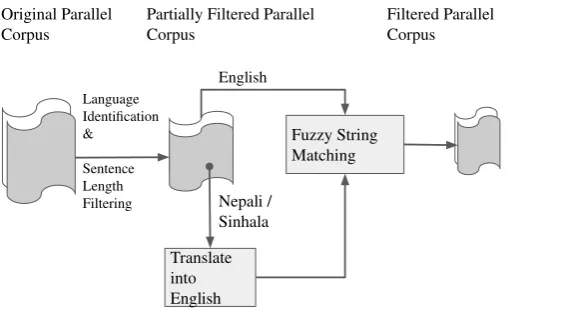
The raw parallel corpus is very noisy and main contributing to that is the wrong language. We study both the parallel corpora (Nepali-English and Sinhala-English) and find that there are many parallel sentences which have wrong language at source, target, or both sides. We use language identifier to remove these sentences. The block diagrammatic representation of our approach has been shown in figure1.
In our scoring scheme, 0 is the lowest score of a parallel sentence. We set score 0 in the following scenarios:
• Wrong source or target: we detect the lan-guage of a sentence pair using langid2 and if any of the source or target has wrong lan-guage id, we set 0 score to that sentence pair. This helps in filtering out many wrong paral-lel sentences.
• As official evaluation is done using MT sys-tems trained on sub-sampled sentences hav-ing maximum 80 tokens, we set score 0 to all the sentence pairs that have a source or target length more than 80 tokens.
For further scoring, we translate the Nepali (or Sinhala) sentences from remaining parallel sen-tences into English and find the lexical matching between a English sentenceE and translated En-glishE0. To score each pair XX-English (XX is Nepali or Sinhala), we consider four fuzzy string matching scores based on Levenshtein distance (Levenshtein,1966) between target (English) and source (translated into English). These score are implemented in fuzzywuzzy3, a python-based string matching package, as:
2
https://github.com/saffsd/langid.py
3https://github.com/seatgeek/
fuzzywuzzy
• Ratio (R1): ratio betweenE andE
0
defined as:
|E|+|E0| −L
|E|+|E0| (1)
where|E|and|E0|are the lengths ofE and E0, and L is the Levenshtein distance be-tweenEandE0.
• Partial ratio (R2): same asR1 but based on sub-string matching. It first finds the best matching sub-string between the two input stringsE andE0. Then it findsR1 between the sub-string and shorter string among the two input strings.
• Token sort ratio (R3): E and E0 are sorted and thenR1 is calculated between the sorted EandE0.
• Token set ratio (R4): It first removes the du-plicate tokens inEandE0and then calculates R1.
We combine these four scores (R1,R2,R3,R4) in two different ways (taking arithmetic mean or geometric mean):
ScoreAM =
1 4
4 X
i=1
Ri (2)
ScoreGM =
4 Y
i=1 Ri
!14
(3)
3 Datasets
Source #Sents #Tokens
Nepali-English
Bible 61,645 1,507,905
Global Voices 2,892 75,197 Penn Tree Bank 4,199 88,758 GNOME/KDE/Ubuntu 494,994 2,018,631
Total 563,640
Sinhala-English
Open Subtitles 601,164 3,594,769 GNOME/KDE/Ubuntu 45,617 150,513
[image:2.595.306.527.420.692.2]Total 646,781
Translate into English
Fuzzy String Matching Original Parallel
Corpus
Partially Filtered Parallel Corpus
Filtered Parallel Corpus
English
Nepali / Sinhala
Language Identification &
[image:3.595.160.443.67.223.2]Sentence Length Filtering
Figure 1: Block diagrammatic representation of our approach. We first apply language identification and set maximum sentence length of up to 80 to get partially filtered corpus from original corpus. Then translate non-English (Nepali / Hindi) sentence into non-English. Finally, we apply fuzzy string matching between original non-English and translated English to get filtered corpus.
Set Nepali-English Sinhala-English
dev 2,559 2,898
devtest 2,835 2,766
Table 2: Number of sentences in dev and devtest.
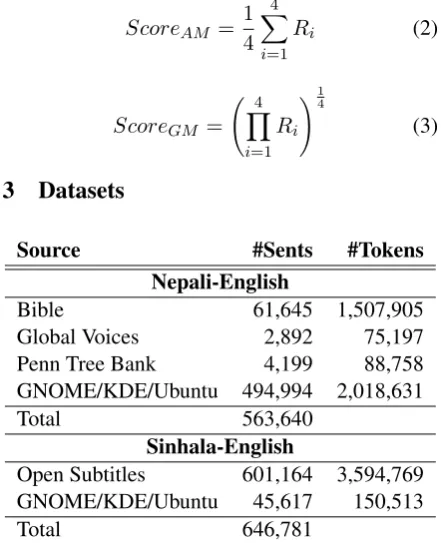
This filtering task is focused on two language pairs: Nepali-English with a 40.6 million-word (English token count) and Sinhala-English with a 59.6 million-word for which we develop our method to score each pair of sentences. These par-allel corpora are compiled from the web. Apart these two parallel corpora, some other publicly available data are provided for development pur-pose. Nepali and Sinhala have very little pub-licly available parallel data. Most of the parallel data for Nepali-English originate from GNOME and Ubuntu handbooks, and rest of the par-allel sentences are compiled from Bible cor-pus (Christodouloupoulos and Steedman, 2015), Global Voices, Penn Tree Bank. For Sinhala-English, we have only two sources of parallel data: OpenSubtitles (Lison et al., 2018), and GNOME and Ubuntu handbooks.
We use only above mentioned, shown in Ta-ble1, parallel data for training phrase-based SMT (Koehn et al., 2003) systems to translate non-English (Nepali and Sinhala) into non-English for cal-culating fuzzy string matching scores. Apart from those parallel data, participants are provided with development (dev) and development test (devtest) sets having parallel sentence counts 2559 and 2835 for Nepali-English, and 2898 and 2766 for
Sinhala-English, respectively. The details of the data are shown in the Table1and2. We tokenize the training, development and test sets in prepro-cessing stage. For tokenizing Nepali and Sinhala, we use Indic NLP library4, and for tokenizing En-glish sentences, we use the Moses tokenizer5.
4 Experiments
For our fuzzy string matching as well as evaluating the quality of the sub-sampled sets, we build XX-English (XX is Nepali or Sinhala) phrase-based SMT (Koehn et al.,2003) system using the Moses tool (Koehn et al., 2007). For training the SMT system we keep the following settings: grow-diag-final-and heuristics for word alignment, msd-bidirectional-fe for reordering model, and 5-gram language model with modified Kneser-Ney smoothing (Kneser and Ney,1995) using KenLM (Heafield, 2011). The BLEU6 (Papineni et al.,
2002) scores for these SMT systems are 3.7 and 4.6 for Nepali-English and Sinhala-English, re-spectively.
5 Results
Crude filtering based on language identification and sentence length filtered out almost 77% and 70% parallel sentences from Nepali-English and Sinhala-English corpora, respectively. However,
4
https://bitbucket.org/anoopk/indic_ nlp_library
5
https://github.com/moses-smt/ mosesdecoder/blob/RELEASE-3.0/scripts/ tokenizer/tokenizer.perl
1 million 5 million
Scoring Scheme SMT NMT SMT NMT
test devtest test devtest test devtest test devtest Nepali-English
Arithmetic Mean 3.84 3.64 5.48 5.94 4.34 4.03 1.29 1.25 Geometric Mean 3.89 3.57 5.28 5.57 4.27 4.01 1.32 1.25
Sinhala-English
Arithmetic Mean 3.07 3.63 3.16 3.70 4.44 5.12 3.87 4.54 Geometric Mean 3.03 3.52 3.01 3.36 4.42 5.17 4.28 5.08
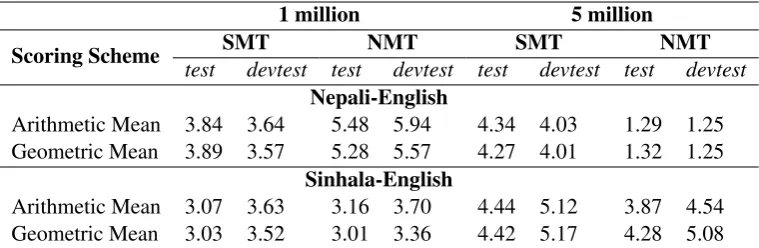
Table 3: Official BLEU scores for 1-million and 5-million sub-sampled sets.
we observe that the language identifier is not ef-ficient in identifying Nepali or Sinhala sentences and misclassifies many sentences. For example, many Nepali sentences are classified as Hindi or Marathi.
Corpus Before After
Nepali-English 2,235,512 509,750 Sinhala-English 3,357,018 1,015,504
Table 4: Number of parallel sentences in the raw paral-lel corpora before and after applying language identifi-cation and sentence length based filtering.
Then using the SMT systems as described in Section 4, we translate the Nepali (or Sinhala) sentences from partially filtered parallel corpora into English, and apply fuzzy string matching to score each pair of sentences. We sub-sample sets with 1 million and 5 million English tokens. The size of the sub-sampled sets are shown in the Table5. To judge the quality of the sub-sampled sets, we train SMT systems following the settings described in4. We measure the quality of theses sub-samples using BLEU scores shown in Table6.
Official Evaluation Total 10 teams participated in the shared task. The organizers (Koehn et al.,
2019) publish the BLEU scores of the 1-million and 5-million sub-sampled sets on the final official test sets. Official BLEU scores for our systems are shown in the Table3.
6 Conclusion
In this paper, we report our submission to WMT 2019 shared task on parallel corpus filtering. The aim of this task is to score each parallel sentence from two very noisy parallel corpora: Nepali-English and Sinhala-Nepali-English. We develop a fuzzy string matching scoring scheme based on
Leven-Scoring Scheme 1 million 5 million Nepali-English
Arithmetic Mean 56,868 200,725 Geometric Mean 53,821 185,978
Sinhala-English
[image:4.595.109.489.62.186.2]Arithmetic Mean 70,114 264,271 Geometric Mean 67,888 249,275
Table 5: Number of sentences for 1-million and 5-million sub-sampled sets for two scoring schemes.
Scoring Scheme 1 million 5 million Nepali-English
Baseline 3.40 4.22
Arithmetic Mean 4.20 3.50 Geometric Mean 4.30 3.80
Sinhala-English
Baseline 4.16 4.77
Arithmetic Mean 4.20 5.10 Geometric Mean 4.00 5.30
Table 6: BLEU scores on devtest for SMT systems trained on two sub-sampled sets. Baseline is the of-ficial baseline as reported in shared task page. We use sacreBLEU (Post,2018).
[image:4.595.86.282.304.348.2] [image:4.595.318.514.383.506.2]References
Mikel Artetxe, Gorka Labaka, Eneko Agirre, and Kyunghyun Cho. 2018. Unsupervised Neural Ma-chine Translation. InProceedings of the Sixth Inter-national Conference on Learning Representations (ICLR).
Dzmitry Bahdanau, Kyunghyun Cho, and Yoshua Ben-gio. 2015. Neural Machine Translation by Jointly Learning to Align and Translate. InProceedings of the 3rd International Conference on Learning Rep-resentation (ICLR 2015).
Kyunghyun Cho, Bart Van Merri¨enboer, Dzmitry Bah-danau, and Yoshua Bengio. 2014. On the Properties of Neural Machine Translation: Encoder-decoder Approaches. In Proceedings of SSST-8, Eighth Workshop on Syntax, Semantics and Structure in Statistical Translation, pages 103–111.
Christos Christodouloupoulos and Mark Steedman. 2015. A massively parallel corpus: the Bible in 100 languages. Language resources and evaluation, 49(2):375–395.
Francisco Guzm´an, Peng-Jen Chen, Myle Ott, Juan Pino, Guillaume Lample, Philipp Koehn, Vishrav Chaudhary, and Marc’Aurelio Ranzato. 2019. Two New Evaluation Datasets for Low-Resource Ma-chine Translation: Nepali-English and Sinhala-English. arXiv preprint arXiv:1902.01382.
Kenneth Heafield. 2011. KenLM: Faster and Smaller Language Model Queries. In Proceedings of the Sixth Workshop on Statistical Machine Translation, pages 187–197. Association for Computational Lin-guistics.
Nal Kalchbrenner and Phil Blunsom. 2013. Recurrent Continuous Translation Models. InProceedings of the 2013 Conference on Empirical Methods in Nat-ural Language Processing (EMNLP 2013), pages 1700–1709.
Huda Khayrallah and Philipp Koehn. 2018. On the Impact of Various Types of Noise on Neural Ma-chine Translation. InProceedings of the 2nd Work-shop on Neural Machine Translation and Genera-tion, Melbourne, Australia. Association for Compu-tational Linguistics.
Reinhard Kneser and Hermann Ney. 1995. Improved backing-off for m-gram language modeling. In Acoustics, Speech, and Signal Processing, 1995. ICASSP-95., 1995 International Conference on, vol-ume 1, pages 181–184. IEEE.
Philipp Koehn, Francisco Guzm´an, Vishrav Chaud-hary, and Juan M. Pino. 2019. Findings of the WMT 2019 Shared Task on Parallel Corpus Filtering for Low-Resource Conditions. In Proceedings of the Fourth Conference on Machine Translation, Volume 2: Shared Task Papers, Florence, Italy. Association for Computational Linguistics.
Philipp Koehn, Hieu Hoang, Alexandra Birch, Chris Callison-Burch, Marcello Federico, Nicola Bertoldi, Brooke Cowan, Wade Shen, Christine Moran, Richard Zens, et al. 2007. Moses: Open Source Toolkit for Statistical Machine Translation. In Pro-ceedings of the 45th annual meeting of the ACL on interactive poster and demonstration sessions, pages 177–180. Association for Computational Linguis-tics.
Philipp Koehn, Franz Josef Och, and Daniel Marcu. 2003. Statistical Phrase-Based Translation. In Proceedings of the 2003 Conference of the North American Chapter of the Association for Computa-tional Linguistics on Human Language Technology-Volume 1, pages 48–54. Association for Computa-tional Linguistics.
Guillaume Lample, Alexis Conneau, Ludovic Denoyer, and Marc’Aurelio Ranzato. 2018. Unsupervised Machine Translation using Monolingual Corpora Only. In Proceedings of the Sixth International Conference on Learning Representations (ICLR).
Vladimir I Levenshtein. 1966. Binary codes capable of correcting deletions, insertions, and reversals. In Soviet physics doklady, volume 10, pages 707–710.
Pierre Lison, J¨org Tiedemann, and Milen Kouylekov. 2018. Opensubtitles2018: Statistical Rescoring of Sentence Alignments in Large, Noisy Parallel Cor-pora. InProceedings of the Eleventh International Conference on Language Resources and Evaluation (LREC-2018).
Kishore Papineni, Salim Roukos, Todd Ward, and Wei-Jing Zhu. 2002. BLEU: a Method for Automatic Evaluation of Machine Translation. InProceedings of the 40th annual meeting on association for com-putational linguistics, pages 311–318, Philadelphia, Pennsylvania.
Matt Post. 2018. A Call for Clarity in Reporting BLEU Scores. InProceedings of the Third Conference on Machine Translation: Research Papers, pages 186– 191, Belgium, Brussels. Association for Computa-tional Linguistics.