348
Exploring Diachronic Changes of Biomedical Knowledge using
Distributed Concept Representations
Gaurav Vashisth1,2, Jan-Niklas Voigt-Antons1,2, Michael Mikhailov1 and Roland Roller1
1German Research Center for Artificial Intelligence (DFKI), Berlin, Germany 2Technische Universit¨at Berlin
Abstract
In research best practices can change over time as new discoveries are made and novel meth-ods are implemented. Scientific publications reporting about the latest facts and current state-of-the-art can be possibly outdated after some years or even proved to be false. A pub-lication usually sheds light only on the knowl-edge of the period it has been published. Thus, the aspect of time can play an essential role in the reliability of the presented information. In Natural Language Processing many meth-ods focus on information extraction from text, such as detecting entities and their relationship to each other. Those methods mostly focus on the facts presented in the text itself and not on the aspects of knowledge which changes over time.
This work instead examines the evolution in biomedical knowledge over time using scien-tific literature in terms of diachronic change. Mainly the usage of temporal and distribu-tional concept representations are explored and evaluated by a proof-of-concept.
1 Introduction
Scientific literature presents knowledge for a par-ticular time period it has been published. Vari-ous studies have been performed to explore such knowledge from scientific literature, where work bySwanson(1986) led to the discovery of a new drug to treat Raynaud’s disease. Similarly, a study byZhu et al. (2013) has concluded that drug dis-covery using scientific literature plays a pivotal role in the treatment of cancer, which can im-prove the quality of life of patients (Cummings et al., 2011). Although scientific literature is an excellent source of information, there has been an explosion in the number of publications each year. This poses a challenge for biomedical re-searchers and practitioners to keep themselves in-formed of recent developments. The increasing
number at the same time provides an opportunity to automatically explore the data on how a change in knowledge has evolved. Some studies have tried to explore such changed knowledge by inves-tigating temporal information (Zhou and Hripc-sak, 2007; He and Chen, 2018), studying the di-achronic change in the meaning of the word. A diachronic semantic change in language is associ-ated with progression in the meaning of the word which is estimated by exploring its usage over time.
This work aims to automatically explore the advances in medical knowledge extracted from the abstracts of scientific research by using word/concept embeddings. Especially, we ex-amine how treatments of pathological conditions have changed over time. For this reason we fo-cus on concepts rather than words, as biomedi-cal concepts can be mentioned in text in different ways (e.g. ‘headache’, ‘cephalgia’ or ‘pain in the head’). Moreover, biomedical concepts help to en-capsulate noun phrases represented by more than one word, for example, ‘eye lens’ or ‘lung cancer’. An analysis on word level instead would take all situations the single words occur into account, and therefore would be more general. To quantify such changes we measure how the usage of a biomedi-cal concept has (semantibiomedi-cally) changed over time by comparing different embedding periods.
2 Related Work
Human language is a complex system which has been evolving from the point of its origin whether it is because of social or cultural (Hamilton et al.,
2016a,b) or technological (Phillips et al., 2017) reasons. Some words acquire new meaning much faster than other words (Blank,1999) for example words like broadcast, gay, and awful have been used in a different context in the present time as compared to an earlier time.
To study the semantic change for words, ini-tially, co-occurrence matrices (Sagi et al., 2009;
Wijaya and Yeniterzi, 2011; Jatowt and Duh,
2014), K-means clustering (Wijaya and Yeniterzi,
2011), Frequency-based methods (Kulkarni et al.,
2014) were used. Representations using co-occurrence matrices are based on the notion of word occurring in the same context. The co-occurrence matrix assumes that words occurring in same context tend to have the same meaning (Firth,1957) and are represented by methods such pointwise mutual information (Turney and Pan-tel, 2010), Singular Value Decomposition matri-ces, and Latent Semantic Analysis.
Another popular method to represent words are distributed representations. Words are repre-sented in a dense and continuous form, that en-ables us to capture the meaning in a condensed form. There are various methods such Word2Vec (Mikolov et al.,2013b,a) and Global Vectors for Word Representation (Glove) (Pennington et al.,
2014) which create a distributed representation of words. Distributed methods consume less mem-ory compared to co-occurrence matrices because of their compact size and ranges between 100 di-mensions to 1000. Moreover, the distributed meth-ods are robust baseline methmeth-ods with their proven success in capturing linguistic meaning (Mikolov et al.,2013b).
Kim et al.(2014) explored the temporal changes in the meaning of word using Skip-gram nega-tive sampling (SGNS) method. To generate word embedding for each time frame the embeddings from previous time frame was used to initialize the embedding for the next successive time frame.
Hamilton et al. (2016b) try to answer two ques-tions, first whether the frequency of a word affects the change in meaning, which has been long stud-ied (Bybee et al.,2007;Pagel et al.,2007; Lieber-man et al., 2007). Second, whether there is a relationship between a polysemous and semantic
change of a word.
Also in the biomedical domain semantic changes in scientific abstracts have been explored (Yan and Zhu, 2018). In the study, the authors explored semantic changes for a set of words us-ing their occurrence frequency and their distribu-tion across different topics. Scientific literature has also motivated studies using biomedical con-cepts instead of free text; however, they only mea-sure the similarity and relatedness between differ-ent concepts using differdiffer-ent embedding methods (De Vine et al.,2014;Choi et al.,2016;Liu et al.,
2018;Beam et al.,2018).
Our study draws motivation from previous stud-ies. However, different to other work we try to explore diachronic change using biomedical con-cepts. Particularly we would like to use diachronic change to assist the exploration of knowledge changes in the biomedical domain.
3 Temporal Concept Embeddings
In the following the generation of the biomedical temporal concept embeddings used to identify se-mantic changes is introduced.
3.1 Data Resources
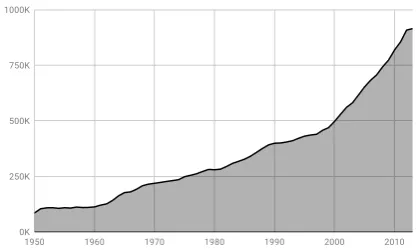
[image:2.595.312.521.543.668.2]The MEDLINE repository1 is a bibliographic database from life sciences containing around 26 millions articles dating back to 1809. MEDLINE is quickly growing as the number of publications added to the repository each year are increasing (see Figure 1). Title and abstracts within the MEDLINE repository define the source to gener-ate the embeddings in this work.
Figure 1: Number of MEDLINE abstracts published each year on PUBMED between 1950 and 2014.
Another relevant resource is the Unified Med-ical Language System (UMLS) (Bodenreider,
2004), a biomedical knowledge base which de-fines a large number of biomedical concepts and their relations to each other. Each concept is rep-resented by a unique concept identifier known as CUI and includes word variations and synonyms. As we focus on the generation of concept em-beddings, we normalize text mentions from MED-LINE abstracts to UMLS.
The concept normalization is carried out using MetaMap (Aronson, 2001), a popular named en-tity recognition system for biomedical text. How-ever, to avoid processing millions of sentences with MetaMap, we use the MetaMapped 2015 MEDLINE Baseline Results, a MEDLINE sub-set already enriched by MetaMap Machine Out-put (MMO). In addition to that, we also use an-nual baseline files from the MEDLINE/PUBMED Baseline Repository (MBR) which contain meta-information about each publication such as publi-cation ID, publipubli-cation year and author name(s).
3.2 Data Preprocessing
First, publications from MMO are enriched with publication year (PubYear) by using the publica-tion ID and the informapublica-tion from the MBR files. Then, the text occurrence of each medical abstract and its title are mapped and replaced with their concept ID, using the offset information provided in MMO (Figure 2). In this way, we create a text to train our embeddings. Since we do not consider character embeddings, we can treat concept IDs as words without any disadvantage.
Figure 2: Shows mapping of medical text to their cor-responding concept ID for Publication ID:20895112.
To create temporal embeddings, the prepro-cessed MEDLINE abstracts are split into differ-ent time depended subsets using PubYear. Em-beddings are then trained on those splits. Ide-ally, we would like to train models using equally sized time ranges, such as embeddings per year or decade. However, this is not easily possible for various reasons: Firstly, as seen in Figure 1 the number of publications is constantly increasing. A consistent split into equal time frames would result in highly unbalanced splits regarding the
number of included abstracts. In addition to that PUBMED includes mainly titles and no abstracts before 1975, which further reduces the number of text for the lower represented period.
Period # Publications
1809-1970 3,374,099 1971-1975 1,162,030 1976-1980 1,346,833 1981-1985 1,528,475 1986-1990 1,863,659 1991-1995 2,065,386 1996-2000 2,297,006 2001-2005 2,938,855 2006-2010 3,721,166 2011-2012 1,762,603 2013-2015 1,283,218
Table 1: Distribution of publications in each period
Conversely, the generation of equally sized splits (according to the number of ab-stracts/sentences) has the disadvantage that it will be more challenging to differentiate between particular years. Rounding up or down the number of included publications might also be not a satisfying solution, as the time ranges might differ too much. For this reason, we mainly focus on time range splits including 5 years of MEDLINE abstracts. As the number of publications is lower at the beginning of the 20th century and publications often do not contain any abstract, we combine the ‘early’ MEDLINE data into one big split (1809-1970). Moreover, as the number of publications steadily increase we create smaller splits from 2011. The final split into periods is presented in Table 1, including their corresponding number of abstracts.
3.3 Temporal Embeddings
To generate temporal embeddings, we use Fast-Text (Bojanowski et al.,2016) in Skip-gram nega-tive sampling (SGNS) mode, which predicts con-text words corresponding to a given target word occurring in its neighborhood. The values of the hyperparameters base on the recommendation of
occur-rence of concepts is 5, learning rate as .05, sam-pling threshold as .0001, dimension to 300 and context window to 10.
The different temporal embeddings were trained sequentially, starting from the first period (1809-1970) and ending with (2013-2015). We started the training of the first period with ran-dom initialization of the embeddings. All other embeddings were then initialized by the values of the former time embedding. This incremental training process has been applied as the training of a particular time period can build on the knowledge seen in earlier periods. Incremental training can be seen as an analogy of how human knowledge evolves over time. The temporal concept embeddings used in this work can be downloaded here2.
3.4 Measuring Semantic Changes
To measure the semantic change between a con-cept pair we use cosine distance (similarity) at dif-ferent periods as also described inHamilton et al.
(2016b). A cosine distance closer to 1 shows a stronger similarity/relation between the two con-cepts than a distance closer to 0. In this work, however, we are particularly interested in exam-ining whether the semantic shift can be used to explore how treatments (of particular diseases) evolved. Therefore, we selected particular con-cept pairs and explore how their similarity score evolves.
In addition to cosine similarity we use Posi-tive Pointwise Mutual Information (PPMI) ma-trix (Levy and Goldberg,2014), as reference mea-sure. A PPMI matrix is a variant of Pointwise Mutual Information (PMI) and provides an asso-ciation between two words occurring together in a corpus and how strongly they are related to each other (Church and Hanks,1990). When a specific word pair co-occurs more frequently they have a higher PPMI score and vice-versa. PPMI is still widely used co-occurrence matrix method and in this work we have used a normalized PPMI score which ranges between 0 to 1, whereas 1 indicates more frequent pairs.
4 Exploring Biomedical Knowledge Changes
In this section, we examine the usage of temporal concept embeddings to detect diachronic changes
2http://biomedical.dfki.de/
in the context of altering knowledge in biomedi-cal literature. Particularly, we explore whether the embeddings reveal known changes in treatments in biomedical history, as a proof-of-concept. For instance, we would like to know whether it is pos-sible to see a relative change in terms of cosine similarity, i.e., if a preferred treatment for some
Disease Xchanges at timetfrom one medication to a new one (see example in Figure 3). Our as-sumption is that the usage of temporal concept em-beddings reveal a similar pattern. Before time t
[image:4.595.309.521.311.485.2]we assume, that the old treatment has got a higher cosine similarity compared to the new treatment. And then after some decrease the new medication outperforms the other one. In the following, we will explore this phenomenon based on various ex-amples.
Figure 3: Shows a treatment change of some Disease X fromMedication-oldtoMedication-newat timet.
4.1 Proof-of-Concept
In this section, different examples are presented to explore the usage of temporal concept embed-dings to detect knowledge changes. We use those examples as a proof-of-concept. Each example in-cludes a high-level introduction, followed by an investigation of the similarity scores over time and an explanation of the presented results.
4.1.1 Minoxidil
Minoxidil (CUI=C0026196) is a medication, ini-tially used for treating high blood pressure (Hy-pertension) (Stoehr et al.,2019) . Nowadays Mi-noxidil is still used as a drug of last resort for treatment of resistant hypertension (remains above a target level, in spite of being prescribed three or more anti-hypertensive drugs simultaneously with different mechanisms of action). However, in 1988 FDA approved the medication also for treat-ing hair loss problems. Presently, Minoxidil is used mainly to treat early baldness pattern such as
[image:5.595.311.523.280.384.2]Androgenic Alopecia(C0162311) andScalp Hair Loss(C0574769).
Figure 4: The similarity score of minoxidil with med-ical conditions from 1809 to 2015. Change in usage ocurs in 1986. WhereOld UsagewasHigh Blood
Pres-sureandNew Usageis hair fall
The exploration of the cosine similarity for mi-noxidil and its change in treatment is presented in Figure 4. The figure depicts a high similarity to hypertension in the ’70s, which is significantly higher than the high blood pressure. However, af-ter 1980 the similarity slowly decreases in the next following years. Around 1985 we can see a big drop. At the same time the similarity of alope-cia and scalp hair loss strongly increase around 1985. From the following period, the similarity score of both concepts outperforms hypertension and are significantly higher than hypertension.
4.1.2 Microprolactinoma
Microprolactinoma (Prolactinoma)3 is a type of benign tumor that occurs in the pituitary gland of the brain (Casanueva et al., 2006;Glezer and Bronstein, 2015). Its treatment has changed no-tably over time. Until the 1970’s this tumor was removed by a surgical method known as Transeth-moidal Hypophysectomy (C0405509) (Richards et al., 1974). Beginning from the late 1970’s
3Microadenoma of a pituitary gland
a new class of medical therapy with Dopamine Agonists was introduced to treat Microprolacti-noma (C0344452) without having to undergo a surgery. Dopamine Agonists is a class of drugs that activate dopamine receptors. The treatment usingDopamine Agonistshas a cure rate of more than 80%. The most effective Dopamine Ago-nistsused as a main treatment drugs are Cabergo-line (C0107994) and bromocriptine (C0006230) (Tirosh and Shimon,2016;Glezer and Bronstein,
[image:5.595.76.288.283.375.2]2015) which are D2 dopamine agonists that in-hibit prolactin secretion. Only if patients do not respond to medications, a surgical method called Transsphenoidal surgery4 (C2985562) is used (Tirosh and Shimon,2016).
Figure 5: Similarity Score of Microprolactinoma with different treatment methods from 1809 until 2015. Change in the medication occurs after 1976. WhereOld MethodwasTransethmoidal
hypophysec-tomyandNew MethodsareTranssphenoidal surgery,
Bromocriptine,dopamine agonists cabergoline.
Figure 5 presents the semantic shift in the use of different treatment methods for Microprolacti-noma. The first embedding point is seen from the period 1976-1980. Before that period none of the concepts occurred frequently enough to be con-sidered in the embedding. Within the first period of occurrence (1976-1980) we have a significantly higher similarity score of Microprolactinoma with
Transethmoidal Hypophysectomy in comparison to Bromocriptine concepts and Transsphenoidal surgerywhich starts decreasing in the next follow-ing years. After 1980, we see an increase in the similarity for all thebromocriptineconcepts along with Transsphenoidal surgery, which shows a change in the treatment method for Microprolacti-noma. The similarity score of both the Bromocrip-tine and Transsphenoidal surgery concepts have significantly higher similarity score than Transeth-moidal Hypophysectomy from 1981. Whereas
from 1986, after the induction of cabergoline, both of the dopamine agonists and Transsphe-noidal surgeryhave a higher similarity score than
Transethmoidal Hypophysectomy. Also Cabergo-lineis getting more popular after 2006 and is then significantly higher than other treatments.
4.1.3 White Blood Cell Cancer
A subtype of cancer of white blood cells known as chronic myeloid leukemia (CML) or Chronic Myelosis (C0023473) is a medical condition. In this condition there is an abnormal increase in the number of white blood cells (WBC) compared to red blood cells (RBC). WBC are responsible for protecting the body against infections, but when produced in large numbers, they start accumulat-ing in blood and bone marrow. This prohibits the growth of RBC and causes weight loss, spleen en-largement and bone pain (Radich et al.,2018).
Before 2001, Chronic Myelosis was treated predominantly by chemotherapy using alkylat-ing antineoplastic agents, such as Mitobronitol
(C0026236) and Myelobromol (C0700014). The introduction of targeted therapy led to the im-proved survival rate of patients compared to the earlier generation of medication. The new targeted therapy method includes a class of drugs called
[image:6.595.76.288.542.635.2]Tyrosine Kinase Inhibitors (TKI) (C1268567), whereasImatinib (C0935989) is one of the most important representatives of this class. Tyrosine Kinase Inhibitors were first synthesized in 1998 (Yaish et al., 1988), and Imatinib was first ap-proved in 2001 to treat this type of blood cancer.
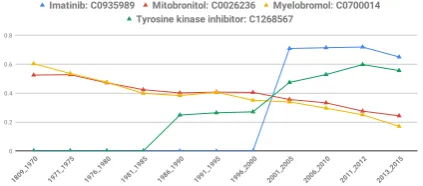
[image:6.595.311.522.569.671.2]Figure 6: Similarity Score of White blood cell cancer with different treatment methods from 1809 until 2015. Change in the medication occurs in 2001. Old Meth-odswere Mitobronitol,Myelobromoland New Meth-odsareTyrosine Kinase InhibitorandImatinib.
Figure 6 depicts different treatments used for white blood cell cancer. The similarity score for both Mitobronitol and Myelobromol is high in
’70s. However, after ’70s their score starts de-creasing but are still significantly higher than Tyro-sine Kinase Inhibitorfrom 1990’s to 2000. From 2001 there is a significantly higher similarity for both Tyrosine Kinase Inhibitor and Imatinib as compared to bothMitobronitolandMyelobromol.
4.1.4 Hepatitis-C
Hepatitis-C (C0220847) is an infectious blood-borne disease which is caused by the hepatitis C virus (HCV). Hepatitis-C mainly affects the liver which can cause liver diseases and eventually lead to liver failure. HCV spreads mostly through fected blood transfusions or poorly sterilized in-jection needles, also during intravenous inin-jection of drugs. (Maheshwari and Thuluvath,2010).
Presently there is no vaccine to prevent HCV virus, however chronic infections are treated by antiviral medications (Webster and Klenerman,
2015). Until 2011,Polyethylene Interferon Alpha-2a (C0391001), Polyethylene Interferon Alpha-2b (C0796545) in combination with Ribavirin5
(C0035525) were used to treat hepatitis-C and had a cure rate of less than 50%. From 2011, the sec-ond generation of antiviral medication known as Direct Antiviral Agents (DAA) was approved by the FDA. DAA directly interfere with the machin-ery of Hepatitis-C virus, thus inhibiting its growth and transmission. There are several classes of DAA that are used at different stages in the treat-ment of Hepatitis-C such as Telaprevir, Bocepre-vir, Daclatasvir. However, for current work we just show Telaprevir (C1876229). This DAA is used in combination withRibavirinwhich have a cure rate of more than 90% (Rivett and Alexander,
2019).
Figure 7: Similarity Score of Hepatitis-C with dif-ferent treatment methods from 1809 to 2015, change in the medication occurs in 2011.Old Methodswere Polyethylene interferon alpha-(2a and 2b) and New
MethodsisTelaprevir.
Figure 7 shows a rise in the similarity of second generation of antivirals (Telaprevir ) from 2011 as compared with first generations (Polyethylene Interferon Alpha-(2a,2b)) where there is a de-crease in the similarity. From 2011 the similar-ity score ofTelapreviris significantly higher than the bothPolyethylene interferon alpha-(2a,2b), re-spectively. We can also notice, that the similarity score Ribavirin is high this is because it is still used in combination with the new generation of antiviral medications as well. Before 1976 the oc-currence of any antivirals medication concepts that appears close to Hepatitis-C is not high enough as such concepts are not present.
4.2 Concept Embeddings vs. Co-occurrence
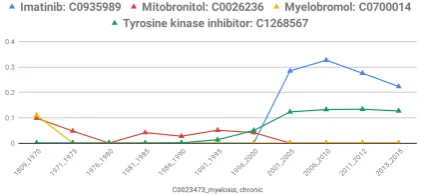
[image:7.595.76.287.439.536.2]As seen in the examples above, temporal concept embeddings can be used to identify diachronic changes. In comparison to that, those changes can be also identified using a simple co-occurence metrics, such as PPMI. Figure 8 shows an example for White Blood Cell Cancer. However, in com-parison to the example in Section 4.1.3, changes can be much stronger and values can quickly de-crease to zero, if the co-occurrence of two con-cepts suddenly decreases.
Figure 8: Similarity Score using PPMI matrix for WBC with different treatment methods from 1809 to 2015.
The score ofMitobronitolfor instance suddenly drops to 0 in 1976-1980 and then increases in 1981. Conversely, the concept embeddings show a slow decrease in similarity for same pair at 1976-1980. This is can have several reasons: Firstly, even if concepts do not occur together within the same context window, they might occur within the same context which is considered by concept em-bedding. Moreover, the initialization of embed-dings for 1976-1980 build on top of the previ-ous period (1970-1975). The incremental learn-ing mechanism helps concept embeddlearn-ings to over-come the drawback of sudden drop in the
similar-ity of a concept-pair if they do not co-occur in a specific period.
4.3 Discussion
The previous examples showed that we can use diachronic semantic changes to identify medical knowledge change. To measure the change in treatment of some disease from an old medica-tion to a new medicamedica-tion was not as simple as our initial assumption was. Originally, examples were provided by a medical student on a rather high level. Given these examples the correspond-ing concepts and concept IDs had to be identi-fied within UMLS. In various cases those concepts were ambiguous and the most appropriate concept had to be selected, e.g. Hepatitis-C in UMLS is represented as Hepatitis C virus (C0220847) as well as Hepatitis C (C0019196).
It also happened that a concept mention did not show the effect we were interested in (no occurrence, low similarity scores, no in-crease/decrease). This caused a more detailed manual analysis to find out why. In some cases, if a concept did not show the effect we were searching for, it turned out that a more spe-cific concept instead showed the expected ef-fect. For instance we found that particular deriva-tives ofdopamine agonistssuchCabergolineand
Bromocriptinewere more talked about in the con-text of Microprolactinoma than dopamine ago-nists. This is an interesting aspect of how infor-mation are connected and which are actually men-tioned in the scientific text. Unfortunately this is difficult to solve given our high level examples and a method solely based on general literature.
However, even though the examples above were manually selected with a lot of domain knowledge, we can clearly show that knowledge changes are present in our temporal concept embeddings. In order to address possible concerns, the next sec-tion explores knowledge changes of known UMLS pairs.
5 Exploring Existing Medical Knowledge
Concept Embeddings Co-occurrence
Period # POS (MAX) # NEG (MAX) # POS (MAX) # NEG (MAX)
[image:8.595.98.502.62.209.2]1809-1970 7 0.330 (0.754) 56 0.208 (0.588) 225 0.026 (0.286) 573 0.003 (0.171) 1971-1975 2 0.318 (0.721) 52 0.197 (0.596) 644 0.022 (0.354) 984 0.003 (0.086) 1976-1980 11 0.307 (0.742) 106 0.168 (0.564) 360 0.026 (0.325) 680 0.003 (0.134) 1981-1985 10 0.310 (0.711) 137 0.157 (0.530) 355 0.029 (0.330) 663 0.003 (0.150) 1986-1990 12 0.304 (0.681) 135 0.155 (0.553) 388 0.028 (0.310) 729 0.002 (0.139) 1991-1995 16 0.301 (0.672) 150 0.149 (0.505) 527 0.026 (0.266) 761 0.002 (0.073) 1996-2000 12 0.297 (0.680) 157 0.149 (0.510) 566 0.025 (0.337) 780 0.002 (0.149) 2001-2005 7 0.287 (0.689) 147 0.146 (0.499) 536 0.024 (0.309) 767 0.002 (0.121) 2006-2010 10 0.271 (0.695) 177 0.144 (0.476) 655 0.021 (0.300) 832 0.002 (0.077) 2011-2012 13 0.272 (0.730) 146 0.153 (0.467) 957 0.017 (0.355) 1178 0.002 (0.088) 2013-2015 15 0.265 (0.696) 136 0.152 (0.425) 1158 0.015 (0.246) 1264 0.002 (0.077)
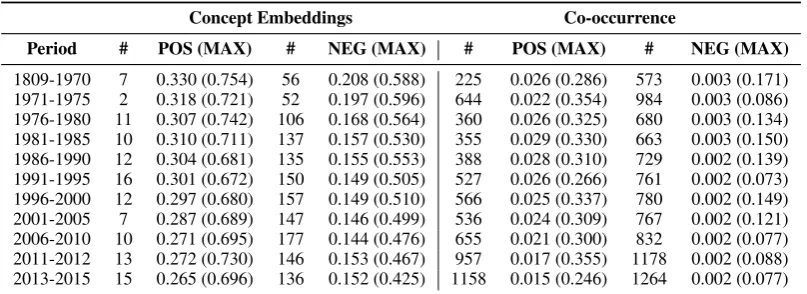
Table 2: Exploration of known (positive) and unknown (negative) drug-disease concept pairs of UMLS across different time periods. The table shows the mean and its maximum scores below POS and NEG in terms of cosine similarity and PPMI. In addition to that, that table shows the number of concept pairs (#) which do not occur together within the set of 3,000 drug-disease pairs.
Metathesaurus. First we explore known concept pairs with cosine similarity for concept embed-dings in comparison to PPMI. After that we ex-amine selected relations of UMLS and track their similarity across different periods.
5.1 Exploring known Drug-Disease Pairs:
Concept Embeddings vs. Co-occurrence
In the following we examine concept embeddings using cosine similarity in comparison to the co-occurrence metric PPMI on known drug-disease relations of UMLS. To do so, we use may-treat
andmay-preventrelations of UMLS and selected randomly for each time period a set of 3,000 con-cept pairs. We made sure, that both concon-cepts oc-curred within that time slice. Then we randomly generated a set of negative concept pairs (un-known according to UMLS) with the same size. Next we use both sets (positive and negative) to calculate cosine similarity using concept embed-ding and PPMI matrix .
The results are presented in Table 2 and show, that the average score is higher for the known re-lations pairs (positive) in comparison to the ran-domly generated negative pairs. This is valid for cosine similarity and PPMI. Moreover we can see, that the average cosine score for concept embed-ding is above the PPMI, as well as for the corre-sponding MAX scores. However, both scores can not be directly compared.
Interestingly, the table shows a varying number of concept pairs which are not covered by a metric (lower than .05 for concept embedding and zero for PPMI). Particularly the co-occurrence metric PPMI has fewer information about various
con-cept pairs in comparison to concon-cept embedding. For instance, in period 2013-2015 while the cosine similarity for concept embedding score for only 15 positive concept pairs is below .05, 1158 con-cept pairs are not considered by co-occurrence, as concepts do not occur together frequent enough. Note, the low PPMI scores might be related to the sparseness of the PPMI matrix.
Overall, the results show, that the incremental temporal concept embeddings have got an advan-tage over the co-occurrence metric PPMI. As the concept embedding uses knowledge from previous time slices and considers contextual information it is able to better cope with the situation if concept pairs do not frequently together.
5.2 Exploring Drug-Disease Pairs across
different Time Periods
In the following we use temporal concept embed-dings to explore changes in biomedical knowl-edge. We apply the technique to explore known drug-disease pair relations may treat and
may preventof the UMLS Metathesaurus. An in-crease over time might indicate6 a higher use of drug against the corresponding disease in present time as compared to previous periods; whereas a decrease can indicate new treatment therapy for the disease from disease-drug pair. This might be interesting as often various treatments exist for a disease. In this way, it might be possible to iden-tify a more popular treatment (according to sim-ilarity score) which is at the same time also en-coded within the embeddings.
Drug Disease 1809-1970
1971-1975
1991-1995
1996-2000
2011-2012
2013-2015
Oxymetholone
Anemias 0.36 0.43 0.23 0.18 0.23 0.23 Epoetin Alfa Recombinant 0.00 0.00 0.43 0.37 0.35 0.42 Sodium Cromoglycate
Bronchitic Asthma 0.58 0.60 0.51 0.45 0.45 0.29 Aalmeterol 0.00 0.00 0.56 0.55 0.50 0.56 Tolazamide
Type 2 Diabetes Mellitus 0.63 0.46 0.48 0.45 0.28 0.27 Sitagliptin 0.00 0.00 0.00 0.00 0.54 0.62 Pramipexole
Syndrome Parkinson’s 0.00 0.00 0.39 0.48 0.46 0.46 Amantadine Hydrochloride 0.41 0.51 0.41 0.36 0.17 0.20 Risperidone
Type Schizophrenia 0.00 0.00 0.53 0.60 0.58 0.59 Acetophenazine Maleate 0.46 0.41 0.35 0.32 0.20 0.20 Tamoxifen
Tumor of Breast 0.00 0.28 0.51 0.48 0.49 0.49 Testolactone 0.43 0.38 0.25 0.22 0.12 0.10
Table 3: Decrease (upper part) and increase (lower part) in similarity formay-treatandmay-preventdrug-disease pairs across different time periods
Table 3 presents results for particular diseases in terms of increasing and decreasing similarity scores for knownmay-treatandmay-prevent drug-disease pairs. The similarity scores shown here are for the first two periods (1809-1970, 1971-1975), two periods from the middle (1991-1995, 1996-2000) and the last two ones (2011-2012, 2013-2015). Each row contains a two different known drugs related to a disease. The upper part presents a scenario with a decreasing similarity score (rel-ative to the disease) and the lower part an increas-ing score. For example, the table shows that the similarity between Tolazamide and Type 2 Dia-betes Mellitusis .63 in 1809-1970. With each suc-ceeding period the value decreases and eventually reaches .27 in 2013-2015. On the other hand, the similarity between theSitagliptinwithType 2 Di-abetes Mellitusis 0 until 1996-2000 due to its ab-sence in this period. However, from 2011 we see a sudden and strong increase.
The table shows that we can detect changes of known relational facts. The results are also in line with our original hypothesis that scientific jour-nals reflect the change in medical knowledge since each journal provide current medical facts. As scientific research around these fact evolves, we witness a change in medical knowledge which is present in the scientific journals.
6 Conclusion
In the present work, we have successfully shown that it is possible to explore the diachronic seman-tic change on a biomedical concept level. The au-tomatic exploration of knowledge changes might be particularly useful to extend structured knowl-edge, such as UMLS potentially. For instance, UMLS often includes an extensive range of
differ-ent treatmdiffer-ents or prevdiffer-entions for a disease. How-ever, all relations have the same importance and the same weighting. Thus it is not necessar-ily obvious which one is the treatment of choice (also depending on time, but also co-morbidities or other symptoms). Our proposed method could be a first (and simplistic) step to highlight partic-ular concept pairs. For instance, temporal concept embeddings could be used to support (distantly su-pervised) relation extraction (Roller and Steven-son, 2014) or to spot particular trends automati-cally (Chen et al.,2007).
However, our current approach has got some limitations as it is unable to detect the negative polarity between the pairs. In terms of this we as-sume that a higher similarity is correlated with a stronger use, which is not necessarily correct. Fu-ture work could take this into account.
Finally, as mentioned in Section 4.3, it would be interesting to address the problem that sometimes only particular child concepts show an effect we are interested in. It might be possible to overcome this by including graph embeddings in addition to the text based temporal ones.
Acknowledgments
This project has received funding from the Eu-ropean Unions Horizon 2020 research and in-novation programme under grant agreement No 780495 (BigMedilytics). In addition to that we would like to thank our colleagues for their feed-back and suggestions.
References
page 17. American Medical Informatics Associa-tion.
Andrew L. Beam, Benjamin Kompa, Inbar Fried, Nathan P. Palmer, Xu Shi, Tianxi Cai, and Isaac S. Kohane. 2018. Clinical Concept Embeddings Learned from Massive Sources of Medical Data. CoRR, abs/1804.01486.
Andreas Blank. 1999. Why do new meanings occur? A cognitive typology of the motivations for lexical se-mantic change. Historical semantics and cognition, 13:6.
Olivier Bodenreider. 2004. The Unified Medical Lan-guage System (UMLS): Integrating Biomedical Ter-minology. Nucleic acids research, 32(Database issue):D267–70.
Piotr Bojanowski, Edouard Grave, Armand Joulin, and Tomas Mikolov. 2016. Enriching Word Vec-tors with Subword Information. arXiv preprint arXiv:1607.04606.
Joan Bybee et al. 2007. Frequency of Use and the Or-ganization of Language. Oxford University Press on Demand.
Felipe F Casanueva, Mark E Molitch, Janet A Schlechte, Roger Abs, Vivien Bonert, Marcello D Bronstein, Thierry Brue, Paolo Cappabianca, Anna-maria Colao, Rudolf Fahlbusch, et al. 2006. Guide-lines of the Pituitary Society for the diagnosis and management of prolactinomas. Clinical endocrinol-ogy, 65(2):265–273.
Elizabeth S Chen, Peter D Stetson, Yves A Lussier, Marianthi Markatou, George Hripcsak, and Carol Friedman. 2007. Detection of practice pattern trends through natural language processing of clinical nar-ratives and biomedical literature. InAMIA Annual Symposium Proceedings, volume 2007, page 120. American Medical Informatics Association.
Youngduck Choi, Chill Yi-I Chiu, and David Sontag. 2016. Learning Low-Dimensional Representations of Medical Concepts. AMIA Summits on Transla-tional Science Proceedings, 2016:41.
Kenneth Ward Church and Patrick Hanks. 1990. Word Association Norms, Mutual Information, and Lexi-cography. Computational linguistics, 16(1):22–29.
Greta G. Cummings, Susan Armijo Olivo, Patricia D. Biondo, Carla R. Stiles, Ozden Yurtseven, Robin L. Fainsinger, and Neil A. Hagen. 2011. Effectiveness of Knowledge Translation Interventions to Improve Cancer Pain Management. J. Pain Symptom Man-age., 41(5):915–939.
Lance De Vine, Guido Zuccon, Bevan Koopman, Lau-rianne Sitbon, and Peter Bruza. 2014. Medical Se-mantic Similarity with a Neural Language Model. In Proceedings of the 23rd ACM International Confer-ence on ConferConfer-ence on Information and Knowledge Management, pages 1819–1822. ACM.
John R Firth. 1957. A Synopsis of Linguistic Theory, 1930-1955. Studies in linguistic analysis.
Andrea Glezer and Marcello D. Bronstein. 2015. Pro-lactinomas. Endocrinol. Metab. Clin. North Am., 44(1):71–78.
William L. Hamilton, Jure Leskovec, and Dan Juraf-sky. 2016a. Cultural Shift or Linguistic Drift? Com-paring Two Computational Measures of Semantic Change. Proceedings of the 2016 Conference on Empirical Methods in Natural Language Process-ing.
William L. Hamilton, Jure Leskovec, and Dan Juraf-sky. 2016b. Diachronic Word Embeddings Reveal Statistical Laws of Semantic Change. InProc. As-soc. Comput. Ling. (ACL).
Jiangen He and Chaomei Chen. 2018. Predictive Ef-fects of Novelty Measured by Temporal Embed-dings on the Growth of Scientific Literature. Fron-tiers in Research Metrics and Analytics, 3:9.
Adam Jatowt and Kevin Duh. 2014. A Framework for Analyzing Semantic Change of Words across Time. In Proceedings of the 14th ACM/IEEE-CS Joint Conference on Digital Libraries, pages 229– 238. IEEE Press.
Yoon Kim, Yi-I Chiu, Kentaro Hanaki, Darshan Hegde, and Slav Petrov. 2014. Temporal Analysis of Lan-guage through Neural LanLan-guage Models. In Pro-ceedings of the Workshop on Language Technolo-gies and Computational Social Science@ACL 2014, Baltimore, MD, USA, June 26, 2014, pages 61–65. Association for Computational Linguistics.
Vivek Kulkarni, Rami Al-Rfou, Bryan Perozzi, and Steven Skiena. 2014. Statistically Significant Detec-tion of Linguistic Change. CoRR, abs/1411.3315.
Omer Levy and Yoav Goldberg. 2014. Neural Word Embedding as Implicit Matrix Factorization. In Ad-vances in Neural Information Processing Systems, pages 2177–2185.
Omer Levy, Yoav Goldberg, and Ido Dagan. 2015. Improving Distributional Similarity with Lessons Learned from Word Embeddings. Transactions of the Association for Computational Linguistics, 3:211–225.
Erez Lieberman, Jean-Baptiste Michel, Joe Jackson, Tina Tang, and Martin A Nowak. 2007. Quantifying the Evolutionary Dynamics of Language. Nature, 449(7163):713.
Yue Liu, Tao Ge, Kusum S Mathews, Heng Ji, and Deborah L McGuinness. 2018. Exploiting Task-Oriented Resources to Learn Word Embeddings for Clinical Abbreviation Expansion. arXiv preprint arXiv:1804.04225.
Tomas Mikolov, Kai Chen, Greg Corrado, and Jef-frey Dean. 2013a. Efficient Estimation of Word Representations in Vector Space. arXiv preprint arXiv:1301.3781.
Tomas Mikolov, Quoc V Le, and Ilya Sutskever. 2013b. Exploiting similarities among languages for ma-chine translation. arXiv preprint arXiv:1309.4168.
Mark Pagel, Quentin D Atkinson, and Andrew Meade. 2007. Frequency of Word-Use Predicts Rates of Lexical Evolution throughout Indo-European His-tory. Nature, 449(7163):717.
Jeffrey Pennington, Richard Socher, and Christo-pher D. Manning. 2014. Glove: Global Vectors for Word Representation. In Proceedings of the 2014 Conference on Empirical Methods in Natural Lan-guage Processing, EMNLP 2014, October 25-29, 2014, Doha, Qatar, A Meeting of SIGDAT, a Spe-cial Interest Group of the ACL, pages 1532–1543. ACL.
Lawrence Phillips, Kyle Shaffer, Dustin Arendt, Nathan Hodas, and Svitlana Volkova. 2017. Intrin-sic and extrinIntrin-sic evaluation of spatiotemporal text representations in Twitter streams. InProceedings of the 2nd Workshop on Representation Learning for NLP, pages 201–210.
Jerald P Radich, Michael Deininger, Camille N Ab-boud, Jessica K Altman, Ellin Berman, Ravi Bhatia, Bhavana Bhatnagar, Peter Curtin, Daniel J DeAn-gelo, Jason Gotlib, et al. 2018. Chronic myeloid leukemia, version 1.2019, nccn clinical practice guidelines in oncology. Journal of the National Comprehensive Cancer Network, 16(9):1108–1135.
S H Richards, J P Thomas, and D Kilby. 1974. Transethmoidal hypophysectomy for pituitary tu-mours. Proceedings of the Royal Society of Medicine, 67(9):889–892.
Lucy Rivett and Graeme Alexander. 2019. Is the con-quest of hepatitis c imminent? Expert reviews in molecular medicine, 21.
Roland Roller and Mark Stevenson. 2014. Self-supervised Relation Extraction Using UMLS. In In-formation Access Evaluation. Multilinguality, Mul-timodality, and Interaction, pages 116–127, Cham. Springer International Publishing.
Eyal Sagi, Stefan Kaufmann, and Brady Clark. 2009. Semantic density analysis: Comparing word mean-ing across time and phonetic space. InProceedings of the Workshop on Geometrical Models of Natu-ral Language Semantics, pages 104–111. Associa-tion for ComputaAssocia-tional Linguistics.
Jenna R Stoehr, Jennifer N Choi, Maria Colavincenzo, and Stefan Vanderweil. 2019. Off-label use of topi-cal minoxidil in alopecia: A review. American jour-nal of clinical dermatology, pages 1–14.
Don R Swanson. 1986. Fish oil, raynaud’s syndrome, and undiscovered public knowledge.Perspectives in biology and medicine, 30(1):7–18.
Amit Tirosh and Ilan Shimon. 2016. Current ap-proach to treatments for prolactinomas. Minerva Endocrinol., 41(3):316–323.
Peter D Turney and Patrick Pantel. 2010. From Fre-quency to Meaning: Vector Space Models of Se-mantics. Journal of artificial intelligence research, 37:141–188.
Daniel P Webster and Paul Klenerman. 2015. Hepatitis c. Hepatitis C. Lancet, 385(9973):1124–1135.
Derry Tanti Wijaya and Reyyan Yeniterzi. 2011. Un-derstanding Semantic Change of Words over Cen-turies. In Proceedings of the 2011 International Workshop on DETecting and Exploiting Cultural di-versiTy on the Social Web, pages 35–40. ACM.
P. Yaish, A. Gazit, C. Gilon, and A. Levitzki. 1988. Blocking of EGF-dependent cell prolifera-tion by EGF receptor kinase inhibitors. Science, 242(4880):933–935.
Erjia Yan and Yongjun Zhu. 2018. Tracking Word Se-mantic Change in Biomedical Literature. Interna-tional journal of medical informatics, 109:76–86.
Li Zhou and George Hripcsak. 2007. Temporal Rea-soning with Medical Data—a Review with Empha-sis on Medical Natural Language Processing. Jour-nal of biomedical informatics, 40(2):183–202.