Using Distributed Representations to Disambiguate Biomedical and
Clinical Concepts
St´ephan TulkensF and Simon ˇSusterF♠ and Walter DaelemansF
FCLiPS ♠CLCG
University of Antwerp University of Groningen Prinsstraat 13 Oude Kijk in ’t Jatstr. 26 2000 Antwerpen 9700AS Groningen
Belgium The Netherlands
{firstname.lastname}@uantwerpen.be
Abstract
In this paper, we report a knowledge-based method for Word Sense Disambiguation in the domains of biomedical and clini-cal text. We combine word representa-tions created on large corpora with a small number of definitions from the UMLS to create concept representations, which we then compare to representations of the con-text of ambiguous terms. Using no re-lational information, we obtain compara-ble performance to previous approaches on the MSH-WSD dataset, which is a well-known dataset in the biomedical do-main. Additionally, our method is fast and easy to set up and extend to other do-mains. Supplementary materials, includ-ing source code, can be found athttps: //github.com/clips/yarn
1 Introduction
Word Sense Disambiguation (WSD) is a procedure in which an ambiguous term or concept is assigned a single sense appropriate for that context, and is an important step in the creation of a semantic rep-resentation of a document (Ide and V´eronis, 1998). While performing WSD will benefit most natural language processing applications, disambiguation of concepts is a critical component of applications operating on clinical and biomedical text, in which the same word can denote differing concepts, and may thus elicit radically different responses.
Compounding this problem of ambiguity is the fact that clinical text, in general, is noisier than other domains, and contains a large variety of ab-breviations, some of which may be specific to a single hospital or physician. Additionally, there is a marked absence of large volumes of annotated clini-cal text, even for English, which presents a problem
for supervised approaches to Word Sense Disam-biguation. For other languages, such as Dutch, there exist no freely available annotated corpora of clinical text.
A first step towards solving this problem could be the use of distributed representations. Where a more traditional word representation, such as a TF-IDF bag-of-words (BoW) representation, carries frequency information, distributed representations encode semantic information. A big advantage to using these representations is that they can be gen-erated from large corpora of unlabeled text, and can be trained on very large corpora in a reason-able amount of time. These representations, es-pecially when trained using neural architectures such asword2vec(Mikolov et al., 2013), have been shown to improve performance on a variety of tasks when compared to more traditional BoW representations.
We hypothesize that these kinds of distributional representations are well-suited for WSD in the clin-ical and biomedclin-ical domain because of the lack of training data, and the large terminological va-riety. We present a knowledge-based approach to Word Sense Disambiguation which creates concept representations by combining definitions from the Unified Medical Language System (UMLS) with distributed representations. We test our hypothesis on the MSH-WSD, which is a well-known dataset for WSD in the biomedical domain.
2 Related Research
All knowledge-based methods we review use the Unified Medical Language System®(UMLS) Metathesaurus® (Bodenreider, 2004) as a knowl-edge base, possibly augmented with external sources, such as MeSH®-indexed abstracts. Gen-erally speaking, the UMLS contains two separate information sources that are suitable for use in
ambiguation: the concept unique identifier (CUI), which is a unique label for each concept, and the semantic type (ST), which is a set of 135 broad labels such as “Animal” or “Chemical”. In gen-eral, a word is only considered disambiguated if the correct CUI can be selected; hence, as McInnes and Pedersen (2013) note, approaches based on se-mantic types are not able to disambiguate between approximately 12% of concepts, as some concepts with the same surface form have an identical ST, but a different CUI.
In terms of approaches using ST, Humphrey et al. (2006) create one vector for each semantic type by creating a BoW representation of all words that denote that semantic type. For each ambiguous term, a target word vector is created by taking a window of words from the right and left of the term. The concept which is associated with the ST with the lowest cosine distance is then taken to be the correct sense of the term. Similarly, Alexopoulou et al. (2009) create a method which finds the closest concept based on a combination of co-occurrence with other semantic types and ontological similarity throughis-arelationships.
Closest to our approach is the machine read-able dictionary (MRD) approach (McInnes, 2008; Jimeno-Yepes et al., 2011), which uses definitions from the UMLS to create concept vectors by creat-ing BoW representations of concepts uscreat-ing all defi-nitions of the concept and those of related concepts. This BoW representation contains TF-IDF values where D is the number of concepts in which a word appears, thereby reducing the influence of general words which occur in many concepts. These rep-resentations are then compared to the vectorized contexts of the ambiguous terms using cosine dis-tance. A refinement of MRD, called second-order co-occurrence MRD (2-MRD) (McInnes, 2008), re-places each word in a definition by a vector which contains TF-IDF values of co-occurrence counts, thereby associating each word with a context.
McInnes and Pedersen (2013) introduce UMLS::SenseRelate, an approach which is based on Pedersen et al. (2004)’s WordNet::SenseRelate. In this system, each possible sense for an ambigu-ous term is assigned a distance-weighted score based on theconceptsof the terms surrounding it, where the concepts of the surrounding terms are determined using UMLS::Similarity (McInnes et al., 2009).
Jimeno-Yepes and Berlanga (2015) present
so-Medline Mimic-III Bioasq Corpus size 920,081 13,097,844
-Vocabulary 196,960 71,663 1,701,632
[image:2.595.308.526.63.120.2]Dimension 320 320 200
Table 1: The number of words in the corpus, the resulting vocabulary size, and the dimension of the resulting vectors.
called step models, which calculate the probabil-ity of a word occurring with a certain concept by considering the number of times a word occurs in the definitions of that concept and its related concepts. It then steps through the UMLS-defined ontology of concepts, and refines the probabilities for each word and each concept based on the rela-tions within the ontology.
Finally, Chen et al. (2014) present an approach for general WSD which uses word embeddings coupled with WordNet (Fellbaum, 1998) as a re-source to perform sense disambiguation, and which creates sense-specific word embeddings from these sense-disambiguated word representations.
3 Materials 3.1 Test Corpus
We use the MSH-WSD corpus (Jimeno-Yepes et al., 2011), which consists of a set of 203 ambigu-ous terms, each associated with multiple concepts, to evaluate our approach. Of the 203 terms in the corpus, 106 are regular terms, 88 are acronyms, and 9 can be acronyms and regular terms. For each of these concepts, up to 100 MeSH abstracts were re-trieved, resulting in a set of 37,888 abstracts. In our approach, all abstracts were pre-processed using the tokenizer from the Pattern package (De Smedt and Daelemans, 2012), and all stop words were removed using the English stop word list from
scikit-learn(Pedregosa et al., 2011). 3.2 Word vectors
We evaluate our approach using three sets of vec-tors: The first set was trained on a small set of Medline abstracts1, and a second set of vectors created on the entirety of the MIMIC-III corpus of clinical notes (Johnson et al., 2016). For both sets, we used theword2vecimplementation from
gensim( ˇReh˚uˇrek and Sojka, 2010), using skip-gram with negative sampling, a frequency cutoff
1The specific IDs of these abstracts are available in the
of 5 and a negative sampling of 15. Additionally, we used a third set of vectors, available from the BioASQ organisers2, which was trained on a much larger set of Medline abstracts.3The model statis-tics are visualized in Table 1.
4 Approach
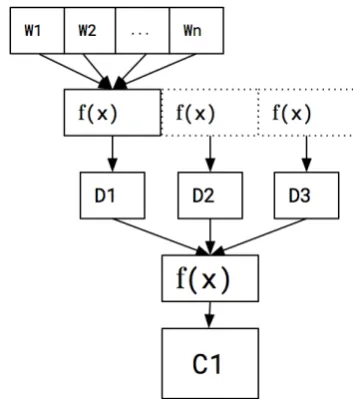
Similar to the 2-MRD approach detailed above, our approach createsconcept vectorsby replacing each word in every definition by the vector representa-tion of that word. This creates anM×nmatrix for each definition, whereM is the dimensionality of the word vectors, andnthe number of words con-tained in that definition. Following this, for each definition, we then obtain a single vector of dimen-sionalityMby applying a compositional function to the matrix, thereby obtaining so-calleddefinition vectors, which represent the entire meaning of the definition in one vector. Each concept can then be represented by aM×dmatrix, wheredis the num-ber of definitions that a concept has in the UMLS. Finally, we apply a second composition function to this matrix, thereby obtaining a single vector of dimensionalityM which represents the combined meaning of all definitions for that concept, i.e. a concept vector.
[image:3.595.324.501.64.264.2]For each abstract in the test corpus, we first lo-cate each ambiguous term through a simple lookup. For each located term in the abstract we create a vector representation by retrieving all words in a window of sizewsurrounding the ambiguous term, and replacing the words by their vectors. Note that this window does not include the ambiguous term itself. These collections of vectors are then combined intoM-dimensional vectors using the same composition function as above. This is done separately for each term occurrence within a single document, creating a M ×x matrix, where xis the number of times the ambiguous term occurs in a single document. These are then combined in anM-dimensionalterm vectorusing the same composition we used for the concepts, above. A schematic representation of our model is given in Figure 1.
Because all concept and term vectors are created using the same distributed vectors and composi-tional functions, the vector space in which they are
2Available on the BioASQ website.
3While we concede that the BioASQ corpora might contain
abstracts from the MSH dataset, it does not contain any explicit labeled information that might be used in disambiguation.
Figure 1: Our model represents a concept by re-placing all words W in a definition D by their vectors, and then composing these into a definition vector with a functionf(x). For each concept, all definition vectorsDare then composed into a con-cept vectorCusing a second composition function
f(x).
placed is also comparable. Hence, for each am-biguous word we encounter, we can use the cosine distance between the abstract vector of the am-biguous utterance and each possible sense of that word to determine the correct sense. This makes our approach very similar to theLesk family of approaches (Lesk, 1986).
In terms of composition function we experi-mented with elementwise multiplication, averaging and summation, all of which are unordered com-positional functions (Mitchell and Lapata, 2008). In addition, it is worth noting that there’s still a lively debate whether ordered composition actually leads to better results for estimating document-, or sentence-level meaning, when compared to un-ordered composition (Iyyer et al., 2015; Socher et al., 2013).
5 Results
med mim bio MRD 2-MRD 0-step 2-step r-step UMLS::SenseRelate Accuracy C 0.80 0.69 0.84 0.81 0.78 0.82 0.86 0.89 0.75
Accuracy U 0.72 0.63 0.75 - - -
-Table 2: Results using constrained (C) and unconstrained (U) terms.
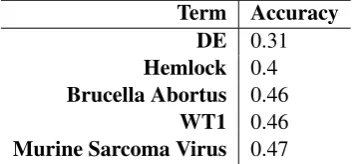
Term Accuracy DE 0.31 Hemlock 0.4 Brucella Abortus 0.46
WT1 0.46 Murine Sarcoma Virus 0.47 Table 3: The 5 lowest-performing terms.
in the MSH-WSD dataset as possible targets. The unconstrained version considers all concepts which are denoted by the ambiguous term in the 2015AB version of the UMLS as possible targets. The term
cortex, for example, only has 2 concepts asso-ciated with it in the MSH-WSD dataset, while in the 2015AB UMLS release it can denote 5 separate concepts. Because the unconstrained version of the task considers all words, it therefore gives a better indication of real-life performance.
Accuracy C and U denote that the scores were ob-tained in the constrained settings and unconstrained setting, respectively. All reported scores use a win-dow size of 6, which was optimized on a randomly selected set of 20 terms from the MSH-WSD set. Varying the window size had negligible results: all window sizes over 6 had comparable results, and increasing the window size over 30 causes a (small) decline in results. This is in line with McInnes and Pedersen (2013), who report a positive effect of window size that quickly tapers off for window sizes>10. Concerning the composition functions, summation and averaging as first and second or-der composition function worked best, while using element-wise multiplication did not work well in any case. Where possible, we display the self-reported scores from the relevant papers on the same dataset.
A first thing to note is the large difference in accuracy when changing the set of word repre-sentations, especially the difference between the Medline vectors and the vectors derived from the Mimic-III corpus. It is currently unclear what causes these performance differences, although it is likely that the small vocabulary, caused by the noisiness of the clinical data in the MIMIC-III
cor-pus, reduces performance. Compared to previous approaches, our approach outperforms the MRD, 2-MRD, and UMLS::SenseRelate approaches, but does not manage to improve on the scores of the step models. Recall, however, that the step models largely rely on relationships in the UMLS ontology to estimate concept relatedness.
To compare how our models improved when in-cluding relation information, we also experimented with adding definitions of related concepts, i.e. con-cepts which had a sibling, parent or child rela-tionship to each concept. In contrast to patterns observed in earlier work, this did not have a sig-nificant, and often a detrimental, effect on perfor-mance. Note that this makes our model entirely independent of the actual UMLS hierarchy, and more flexible as a result, as we only use the map-pings from definition to CUI for disambiguation, and no other information, such as relations or se-mantic type. In addition, our system is also fast: on a consumer-grade laptop, our approach takes 10 seconds to vectorize and disambiguate all abstracts in the MSH dataset, not taking into account the time it takes to load the embeddings into memory. Our approach obtains an accuracy of>90%on 103 terms, showing that it is able to disambiguate a large variety of terms. For some terms, how-ever, the performance was below random guessing. These are shown in Table 3. The pattern of er-rors is quite clear: Our approach has trouble with disambiguation if the definitions of the concepts themselves are lexically very similar. As an exam-ple, on the termHemlockour approach performs below chance level because one of the concepts denotes a family of poisonous plants, while the other reports a tree, also called hemlock, the de-scription of which mentions that it is explicitlynot poisonous. We expect these kinds of problems to be alleviated with the addition of more data.
6 Conclusion and future work
[image:4.595.93.272.145.227.2]ontology. This makes the approach easily transfer-able to other languages, for which such ontologies might not exist, and to other domains. The large variation in accuracy when changing sets of word embeddings also raises interesting prospects for improvement; better word representations will lead to an improvement in our approach without modify-ing the approach itself. Additionally, we would like to experiment with different composition functions for composing the definition and concept vectors.
Acknowledgments
Part of this research was carried out in the frame-work of the Accumulate IWT SBO project, funded by the government agency for Innovation by Sci-ence and Technology (IWT). We would also like to thank Elyne Scheurwegs for making the small set of Medline abstract available to us.
References
Dimitra Alexopoulou, Bill Andreopoulos, Heiko Di-etze, Andreas Doms, Fabien Gandon, J¨org Hak-enberg, Khaled Khelif, Michael Schroeder, and Thomas W¨achter. 2009. Biomedical word sense dis-ambiguation with ontologies and metadata: automa-tion meets accuracy. BMC bioinformatics, 10(1):1.
Olivier Bodenreider. 2004. The unified medical language system (UMLS): integrating biomedical terminology. Nucleic acids research, 32(suppl 1):D267–D270.
Xinxiong Chen, Zhiyuan Liu, and Maosong Sun. 2014. A unified model for word sense representation and disambiguation. InEMNLP, pages 1025–1035. Cite-seer.
Tom De Smedt and Walter Daelemans. 2012. Pattern for Python. The Journal of Machine Learning Re-search, 13(1):2063–2067.
Christiane Fellbaum. 1998. WordNet. Wiley Online Library.
Susanne M Humphrey, Willie J Rogers, Halil Kilicoglu, Dina Demner-Fushman, and Thomas C Rindflesch. 2006. Word sense disambiguation by selecting the best semantic type based on Journal Descriptor In-dexing: Preliminary experiment. Journal of the American Society for Information Science and Tech-nology, 57(1):96–113.
Nancy Ide and Jean V´eronis. 1998. Introduction to the special issue on word sense disambiguation: the state of the art. Computational linguistics, 24(1):2– 40.
Mohit Iyyer, Varun Manjunatha, Jordan Boyd-Graber, and Hal Daum´e III. 2015. Deep unordered compo-sition rivals syntactic methods for text classification. InAssociation for Computational Linguistics.
Antonio Jimeno-Yepes and Rafael Berlanga. 2015. Knowledge based word-concept model estimation and refinement for biomedical text mining. Journal of biomedical informatics, 53:300–307.
Antonio J Jimeno-Yepes, Bridget T McInnes, and Alan R Aronson. 2011. Exploiting MeSH indexing in MEDLINE to generate a data set for word sense disambiguation. BMC bioinformatics, 12(1):1.
AEW Johnson, TJ Pollard, L Shen, L Lehman, M Feng, M Ghassemi, B Moody, P Szolovits, LA Celi, and RG Mark. 2016. MIMIC-III, a freely accessible critical care database. Scientific Data.
Michael Lesk. 1986. Automatic sense disambiguation using machine readable dictionaries: how to tell a pine cone from an ice cream cone. InProceedings of the 5th annual international conference on Sys-tems documentation, pages 24–26. Association for Computing Machinery.
Bridget T McInnes and Ted Pedersen. 2013. Evaluat-ing measures of semantic similarity and relatedness to disambiguate terms in biomedical text.Journal of biomedical informatics, 46(6):1116–1124.
Bridget T McInnes, Ted Pedersen, and Serguei VS Pakhomov. 2009. Interface and UMLS-Similarity: open source software for measuring paths and semantic similarity. InAMIA Annual Sym-posium Proceedings, volume 2009, page 431. Amer-ican Medical Informatics Association.
Bridget T McInnes. 2008. An unsupervised vector approach to biomedical term disambiguation: inte-grating UMLS and Medline. InProceedings of the 46th Annual Meeting of the Association for Compu-tational Linguistics on Human Language Technolo-gies: Student Research Workshop, pages 49–54. As-sociation for Computational Linguistics.
Tomas Mikolov, Ilya Sutskever, Kai Chen, Greg S Cor-rado, and Jeff Dean. 2013. Distributed representa-tions of words and phrases and their compositional-ity. InAdvances in neural information processing systems, pages 3111–3119.
Jeff Mitchell and Mirella Lapata. 2008. Vector-based models of semantic composition. In Proceedings of the Association for Computational Linguistics, pages 236–244.
Fabian Pedregosa, Ga¨el Varoquaux, Alexandre Gram-fort, Vincent Michel, Bertrand Thirion, Olivier Grisel, Mathieu Blondel, Peter Prettenhofer, Ron Weiss, Vincent Dubourg, et al. 2011. Scikit-learn: Machine learning in Python. The Journal of Ma-chine Learning Research, 12:2825–2830.
Radim ˇReh˚uˇrek and Petr Sojka. 2010. Software Frame-work for Topic Modelling with Large Corpora. In
Proceedings of the LREC 2010 Workshop on New Challenges for NLP Frameworks, pages 45–50, Val-letta, Malta, May. ELRA. http://is.muni.
cz/publication/884893/en.