135
A Comparison of Word-based and Context-based Representations for
Classification Problems in Health Informatics
Aditya Joshi♠, Sarvnaz Karimi♠, Ross Sparks♠, C´ecile Paris♠, C Raina MacIntyre♣ ♠CSIRO Data61, Sydney, Australia
♣Kirby Institute, University of New South Wales, Sydney, Australia
{firstname.lastname}@csiro.au , [email protected]
Abstract
Distributed representations of text can be used as features when training a statistical classi-fier. These representations may be created as a composition of word vectors or as context-based sentence vectors. We compare the two kinds of representations (word versus context) for three classification problems: influenza infection classification, drug usage cation and personal health mention classifi-cation. For statistical classifiers trained for each of these problems, context-based rep-resentations based on ELMo, Universal Sen-tence Encoder, Neural-Net Language Model and FLAIR are better than Word2Vec, GloVe and the two adapted using the MESH ontol-ogy. There is an improvement of 2-4% in the accuracy when these context-based represen-tations are used instead of word-based repre-sentations.
1 Introduction
Distributed representations (also known as ‘em-beddings’) are dense, real-valued vectors that cap-ture semantics of concepts (Mikolov et al.,2013). When learned from a large corpus, embeddings of related words are expected to be closer than those of unrelated words. When a statistical clas-sifier is trained, distributed representations of tex-tual units (such as sentences or documents) in the training set can be used as feature represen-tations of the textual unit. This technique of sta-tistical classification that uses embeddings as fea-tures has been shown to be useful for many Natu-ral Language Processing (NLP) problems (Zhang et al.,2015;Joshi et al.,2016;Chou et al.,2016; Simova and Uszkoreit,2017;Fu et al.,2016; Bus-caldi and Priego,2017) and biomedical NLP prob-lems (Yadav et al., 2017; Kholghi et al., 2016). In this paper, we experiment with three classifica-tion problems in health informatics: influenza in-fection classification, drug usage classification and
personal health mention classification. We use sta-tistical classifiers trained on tweet vectors as fea-tures. To compute a tweet vector,i.e., a distributed representation for tweets, typical alternatives are: (a) tweet vector as a function of word embeddings of the content words1 in the tweet; or, (b) a con-textualised representation that computes sentence vectors using language models. The former con-siders meanings of words in isolation, while the latter takes into account the order of these words in addition to their meaning. We compare word-based and context-word-based representations for the three classification problems. This paper investi-gates the question:
‘When statistical classifiers are trained on vectors of tweets for health informat-ics, how should the vector be computed: using word-based representations that consider words in isolation or context-based representations that account for word order using language models?’
For these classification problems, we compare five approaches that use word-based representa-tions with four approaches that use context-based representations.
2 Related Work
Distributed representations as features for statistical classification have been used for many NLP problems: semantic relation ex-traction (Hashimoto et al., 2015), sarcasm detection (Joshi et al., 2016), sentiment analy-sis (Zhang et al., 2015;Tkachenko et al., 2018), co-reference resolution (Simova and Uszkoreit, 2017), grammatical error correction (Chou et al., 2016), emotion intensity determination (Buscaldi
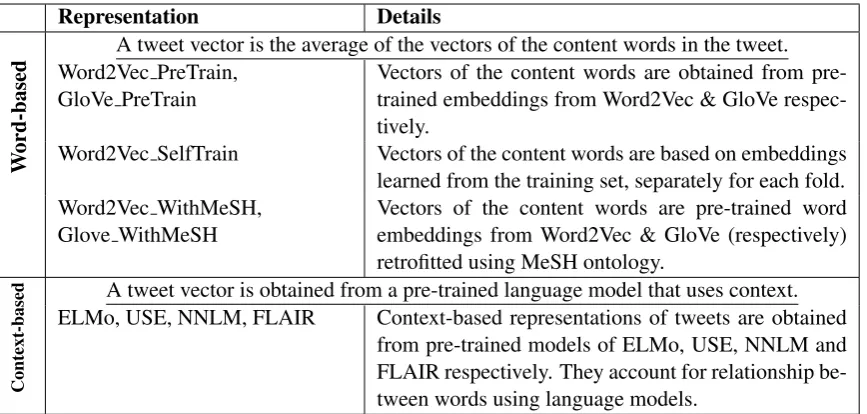
Representation Details
A tweet vector is the average of the vectors of the content words in the tweet.
W
ord-based
Word2Vec PreTrain, GloVe PreTrain
Vectors of the content words are obtained from pre-trained embeddings from Word2Vec & GloVe respec-tively.
Word2Vec SelfTrain Vectors of the content words are based on embeddings learned from the training set, separately for each fold. Word2Vec WithMeSH,
Glove WithMeSH
Vectors of the content words are pre-trained word embeddings from Word2Vec & GloVe (respectively) retrofitted using MeSH ontology.
Context-based
A tweet vector is obtained from a pre-trained language model that uses context. ELMo, USE, NNLM, FLAIR Context-based representations of tweets are obtained
[image:2.595.84.518.61.268.2]from pre-trained models of ELMo, USE, NNLM and FLAIR respectively. They account for relationship be-tween words using language models.
Table 1: Summary of the representations used in our experiments.
and Priego, 2017) and sentence similarity detec-tion (Fu et al.,2016). In terms of the biomedical domain, word embedding-based features have been used for entity extraction in biomedical corpora (Yadav et al., 2017) or clinical informa-tion extracinforma-tion (Kholghi et al., 2016). Several approaches for personal health mention classifi-cation have been reported (Aramaki et al., 2011; Lamb et al., 2013a; Yin et al., 2015). Aramaki et al. (2011) use bag-of-words as features for personal health mention classification. Lamb et al. (2013a) use linguistic features including coarse topic-based features, while Yin et al. (2015) use features based on parts-of-speech and dependencies for a statistical classifier. Feng et al. (2018) compare statistical classifiers with deep learning-based classifiers for personal health mention detection. In terms of detecting drug-related content in text, there has been work on detecting adverse drug reactions (Karimi et al., 2015). Nikfarjam et al. (2015) use word embedding clusters as features for adverse drug reaction detection.
3 Representations
A tweet vector is a distributed representation of a tweet, and is computed for every tweet in the train-ing set. The tweet vector along with the output la-bel is then used to train the statistical classification model. The intuition is that the tweet vector cap-tures the semantics of the tweet and, as a result, can be effectively used for classification. To ob-tain tweet vectors, we experiment with two
alter-natives that have been used for several text classi-fication problems in NLP: word-based representa-tions and context-based representarepresenta-tions. They are summarised in Table1, and described in the fol-lowing subsections.
3.1 Word-based Representations
A word-based representation of a tweet combines word embeddings of the content words in the tweet. We use the average of the word embed-dings of content words in the tweet. Average of word embeddings have been used for differ-ent NLP tasks (De Boom et al.,2016;Yoon et al., 2018;Orasan,2018;Komatsu et al.,2015;Ettinger et al.,2018). As in past work, words that were not learned in the embeddings are dropped during the computation of the tweet vector. We experiment with three kinds of word embeddings:
1. Pre-trained Embeddings: Denoted as
Word2Vec PreTrainedandGloVe PreTrained
in Table1, we use pre-trained embeddings of words learned from large text corpora: (A) Word2Vec byMikolov et al.(2013): This has been pre-trained on a corpus of news articles with 300 million tokens, resulting in 300-dimensional vectors; (B) GloVe by Penning-ton et al. (2014): This has been pre-trained on a corpus of tweets with 27 billion tokens, resulting in 200-dimensional vectors.
2. Embeddings Trained on The Training
cor-Classification # tweets (# true tweets)
IIC 9,006 (2,306) DUC 13,409 (3,167) PHMC 2,661 (1,304)
Table 2: Dataset statistics.
pus from an unrelated domain (news and gen-eral, in the case of Word2Vec and GloVe respectively), they may not capture the se-mantics of the domain of the specific clas-sification problem. Therefore, we also use the Word2Vec Model available in the gensim library (Reh˚uˇrek and Sojka,ˇ 2010) to learn word embeddings from the documents. For each split, the corresponding training set is used to learn the embeddings. The embed-dings are then used to compute the tweet vec-tors and train the classifier. We refer to these asWord2Vec SelfTrain.
3. Pre-trained embeddings retrofitted with
medical ontologies: Another alternative to adapt word embeddings for a classification problem is to use structured resources (such as ontologies) from a domain same as that of the classification problem. Faruqui et al. (2015) show that word embeddings can be retrofitted to capture relationships in an on-tology. We use the Medical Subject Head-ings (MeSH) ontology (Nelson et al.,2001), maintained by the U.S. National Library of Medicine, which provides a hierarchically-organised terminology of medical concepts. Using the algorithm by Faruqui et al. (2015), we retrofit pre-trained embeddings from Word2Vec and GloVe, with the MeSH ontology. The retrofitted embeddings for Word2Vec and GloVe are referred to as
Word2Vec WithMeSH, andGloVe WithMeSH
respectively.
The three kinds of word-based representations re-sult in five configurations: Word2Vec PreTrained,
GloVe PreTrained, Word2Vec SelfTrain,
Word2Vec WithMeSH, andGloVe WithMeSH.
3.2 Context-based Representations
Context-based representations may use language models to generate vectors of sentences. There-fore, instead of learning vectors for individual
words in the sentence, they compute a vector for sentences on the whole, by taking into account the order of words and the set of co-occurring words.
We experiment with four deep contextualised vectors: (A)Embeddings from Language
Mod-els (ELMo) by Peters et al. (2018): ELMo uses
character-based word representations and bidi-rectional LSTMs. The pre-trained model com-putes a contextualised vector of 1024 dimensions. ELMo is available in the Tensorflow Hub2, a repository of machine learning modules; (B)
Uni-versal Sentence Encoder (USE) by Cer et al.
(2018): The encoder uses a Transformer archi-tecture that uses attention mechanism to incorpo-rate information about the order and the collection of words (Vaswani et al.,2017). The pre-trained model of USE that returns a vector of 512 di-mensions is also available on Tensorflow Hub; (C)
Neural-Net Language Model (NNLM)by
Ben-gio et al.(2003): The model simultaneously learns representations of words and probability functions for word sequences, allowing it to capture seman-tics of a sentence. We use a pre-trained model available on Tensorflow Hub, that is trained on the English Google News 200B corpus, and com-putes a vector of 128 dimensions; (D)FLAIRby Akbik et al. (2018): This library by Zalando re-search3 uses character-level language models to learn contextualised representations. We use the pooling option to create sentence vectors. This is a concatenation of GloVe embeddings and the for-ward/backward language model. The resultant is a vector of 4196 dimensions.
Table 1 refers to the four configurations as
ELMo,USE,NNLMandFLAIRrespectively.
4 Experiment Setup
We conduct our experiments on three boolean classification problems in health informatics: (A) Influenza Infection Classification (IIC): The goal is to predict if a tweet reports an influenza infection (‘I have been coughing all day’, for ex-ample) or describes information about influenza (‘flu outbreaks are common in this month of the year’, for example). We use the dataset pre-sented in Lamb et al. (2013b); (B) Drug Usage Classification (DUC): The objective here is to
2
https://www.tensorflow.org/hub/;
Ac-cessed on 3rd June, 2019.
3https://github.com/zalandoresearch/
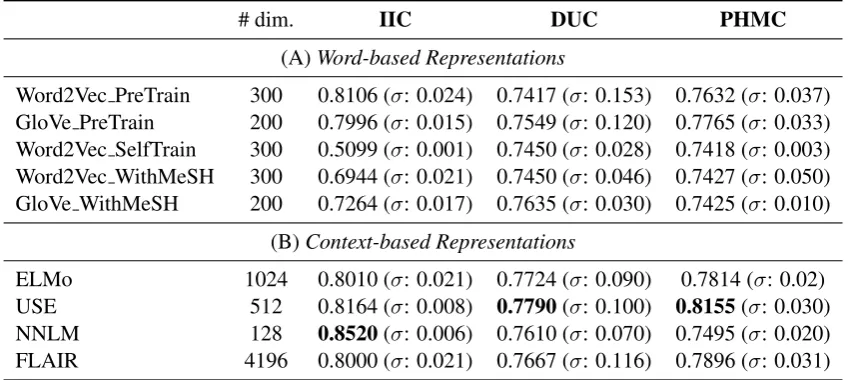
# dim. IIC DUC PHMC
(A)Word-based Representations
Word2Vec PreTrain 300 0.8106 (σ: 0.024) 0.7417 (σ: 0.153) 0.7632 (σ: 0.037) GloVe PreTrain 200 0.7996 (σ: 0.015) 0.7549 (σ: 0.120) 0.7765 (σ: 0.033) Word2Vec SelfTrain 300 0.5099 (σ: 0.001) 0.7450 (σ: 0.028) 0.7418 (σ: 0.003) Word2Vec WithMeSH 300 0.6944 (σ: 0.021) 0.7450 (σ: 0.046) 0.7427 (σ: 0.050) GloVe WithMeSH 200 0.7264 (σ: 0.017) 0.7635 (σ: 0.030) 0.7425 (σ: 0.010)
(B)Context-based Representations
ELMo 1024 0.8010 (σ: 0.021) 0.7724 (σ: 0.090) 0.7814 (σ: 0.02) USE 512 0.8164 (σ: 0.008) 0.7790(σ: 0.100) 0.8155(σ: 0.030)
NNLM 128 0.8520(σ: 0.006) 0.7610 (σ: 0.070) 0.7495 (σ: 0.020)
[image:4.595.87.517.63.253.2]FLAIR 4196 0.8000 (σ: 0.021) 0.7667 (σ: 0.116) 0.7896 (σ: 0.031)
Table 3: Comparison of five word-based representations with four context-based representations; Average accuracy with standard deviation (σ) indicated in brackets.
detect whether or not a tweet describes the us-age of a medicinal drug (‘I took some painkillers this morning’, for example). We use the dataset provided by Jiang et al. (2016); (C) Per-sonal Health Mention classification (PHMC): A personal health mention is a person’s report about their illness. We use the dataset provided by Robinson et al. (2015). For example ‘I have been sick for a week now’ is a personal health men-tion while ‘Rollercoasters can make you sick’ is not. It must be noted that IIC involves influenza while the PHMC dataset covers a set of illnesses as described later.
The datasets for each of the classification prob-lems consist of tweets that have been manually an-notated as reported in the corresponding papers. The statistics of these datasets are shown in Ta-ble2. The values in brackets indicate the number of true tweets (i.e., tweets that have been labeled as true), since these are boolean classification prob-lems. For details on inter-annotator agreement and the annotation techniques, we refer the reader to the original papers. Based on sentence vectors ob-tained using either word-based or context-based representations, we train logistic regression with default parameters available as a part of the Lib-linear package (Fan et al.,2008). We report five-fold cross-validation results for our experiments. Each fold is created using stratified k-fold sam-pling available in scikit-learn4.
4https://scikit-learn.org/stable/;
Ac-cessed on 3rd June, 2019.
5 Results
We first present a quantitative evaluation to com-pare the two types of representations. Following that, we analyse sources of errors.
5.1 Quantitative Evaluation
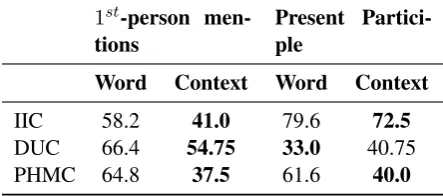
degrada-1st-person men-tions
Present Partici-ple
Word Context Word Context
IIC 58.2 41.0 79.6 72.5
DUC 66.4 54.75 33.0 40.75
[image:5.595.71.293.64.162.2]PHMC 64.8 37.5 61.6 40.0
Table 4: Average number of instances (out of 100 randomly sampled mis-classified instances) containing first-person mentions and present participle form for the three classification problems and two types of rep-resentations.
tion in the accuracy for IIC and PHMC, as com-pared to without retrofitting. There is an improve-ment of 1% point in the case of DUC. Similarly, learning the embeddings on the specific training corpus does not work well. It leads to a degrada-tion as compared to pre-trained embeddings. This could happen because pre-trained embeddings are trained on much larger corpora than our training datasets, thereby capturing semantics more effec-tively than theWord2Vec SelfTrainvariant.
5.2 Qualitative Evaluation
For a qualitative comparison of the two representa-tions, we analyse 100 randomly sampled instances that are mis-classified by each classifier. While these instances need not be the same for each clas-sifier, the trends in the errors show where one kind of representation scores over the other. We com-pared linguistic properties of these mis-classified instances, such as the person, tense and number. Table4shows two linguistic properties where we observed the most variation: first-person mentions and the use of present participles. The two proper-ties are important in terms of the semantics of the three classification problems. First-person men-tions are useful indicators to identify if the speaker has influenza, took a drug or reported a personal health mention. Similarly, present participle forms of verbs appear in situations where a person has had an infection or taken a drug. For ‘Word’, the average is over the five representations, while for ‘Context’, the average is over the four context-based representations. In the case of IIC, an av-erage of 58.2 mis-classified instances from word-based representations contained first person men-tions. The corresponding number for context-based representations was 41. For PHMC, the av-erages are 64.8 (word-based) and 37.5
(context-based). The difference is not as high in the case of DUC (66.4 and 54.75 respectively). Differences are observed in the case of present participle in mis-classified instances. However, in the case of DUC, errors from context-based representations contain more average number of present partici-ples (40.75) than word-based representations (33).
6 Conclusions
In this paper, we show that context-based rep-resentations are a better choice than word-based representations to create tweet vectors for clas-sification problems in health informatics. We experiment with three such problems: influenza infection classification, drug usage classification and personal health mention classification, and compare word-based representations with context-based representations as features for a statisti-cal classifier. For word-based representations, we consider pre-trained embeddings of Word2Vec and GloVe, embeddings trained on the train-ing split, and the pre-trained embeddtrain-ings of Word2Vec and GloVe retrofitted to a medical on-tology. For context-based representations, we con-sider ELMo, USE, NNLM and FLAIR. For the three problems, the highest accuracy is obtained using context-based representations. In compar-ison with pre-trained embeddings, the improve-ment in classification is approximately 4% for in-fluenza infection classification, 2% for drug usage classification and 4% for personal health mention classification. Embeddings trained on the train-ing corpus or retrofitted on the ontology perform worse than those pre-trained on a large corpus.
While these observations are based on statistical classifiers, the corresponding benefit of context-based representations on neural architectures can be validated as a future work. In addition, while we average the word vectors to obtain tweet vec-tors, other options for tweet vector computation can be considered for word-based representations. In terms of the dataset, the comparison should be validated for text forms other than tweets, such as medical records. Medical records are expected to have typical challenges such as the use of abbre-viations and domain-specific phrases that may not have been learned in pre-trained embeddings.
Acknowledgment
References
Alan Akbik, Duncan Blythe, and Roland Vollgraf. 2018. Contextual string embeddings for sequence labeling. In Proceedings of the 27th International Conference on Computational Linguistics, pages 1638–1649.
Eiji Aramaki, Sachiko Maskawa, and Mizuki Morita. 2011. Twitter catches the flu: Detecting influenza epidemics using Twitter. In Empirical Methods in Natural Language Processing, pages 1568–1576, Edinburgh, UK. Association for Computational Lin-guistics.
Yoshua Bengio, R´ejean Ducharme, Pascal Vincent, and Christian Jauvin. 2003. A neural probabilistic lan-guage model. Journal of machine learning research, 3(Feb):1137–1155.
Davide Buscaldi and Belem Priego. 2017. Lipn-uam at emoint-2017:combination of lexicon-based fea-tures and sentence-level vector representations for emotion intensity determination. In 8th Workshop on Computational Approaches to Subjectivity, Sen-timent and Social Media Analysis, pages 255–258, Copenhagen, Denmark.
Daniel Cer, Yinfei Yang, Sheng-yi Kong, Nan Hua, Nicole Limtiaco, Rhomni St John, Noah Constant, Mario Guajardo-Cespedes, Steve Yuan, Chris Tar, et al. 2018. Universal sentence encoder. arXiv preprint arXiv:1803.11175.
Wei-Chieh Chou, Chin-Kui Lin, Yuan-Fu Liao, and Yih-Ru Wang. 2016. Word order sensitive embed-ding features/conditional random field-based chi-nese grammatical error detection. In3rd Workshop on Natural Language Processing Techniques for Ed-ucational Applications, pages 73–81, Osaka, Japan. The COLING 2016 Organizing Committee.
Cedric De Boom, Steven Van Canneyt, Thomas De-meester, and Bart Dhoedt. 2016. Representation learning for very short texts using weighted word embedding aggregation. Pattern Recognition Let-ters, 80:150–156.
Allyson Ettinger, Ahmed Elgohary, Colin Phillips, and Philip Resnik. 2018. Assessing composition in sen-tence vector representations. In 27th International Conference on Computational Linguistics, pages 1790–1801, Santa Fe, New Mexico.
Rong-En Fan, Kai-Wei Chang, Cho-Jui Hsieh, Xiang-Rui Wang, and Chih-Jen Lin. 2008. Liblinear: A library for large linear classification. Journal of ma-chine learning research, 9:1871–1874.
Manaal Faruqui, Jesse Dodge, Sujay Kumar Jauhar, Chris Dyer, Eduard Hovy, and Noah Smith. 2015. Retrofitting word vectors to semantic lexicons. In
Conference of the North American Chapter of the Association for Computational Linguistics: Human Language Technologies, pages 1606–1615.
Shichao Feng, Keyuan Jiang, Jiyun Li, Ricardo A Calix, and Matrika Gupta. 2018. Detecting personal experience tweets for health surveillance using un-supervised feature learning and recurrent neural net-works. InWorkshops at the 32nd AAAI Conference on Artificial Intelligence, pages 425–430, New Or-leans, Louisiana.
Cheng Fu, Bo An, Xianpei Han, and Le Sun. 2016. Is-cas nlp at semeval-2016 task 1: Sentence similar-ity based on support vector regression using multiple features. In10th International Workshop on Seman-tic Evaluation, pages 645–649, San Diego, Califor-nia.
Kazuma Hashimoto, Pontus Stenetorp, Makoto Miwa, and Yoshimasa Tsuruoka. 2015. Task-oriented learning of word embeddings for semantic relation classification.arXiv preprint arXiv:1503.00095.
Keyuan Jiang, Ricardo Calix, and Matrika Gupta. 2016. Construction of a personal experience tweet corpus for health surveillance. In ACL Workshop on biomedical natural language processing, pages 128–135, Berlin, Germany.
Aditya Joshi, Vaibhav Tripathi, Kevin Patel, Pushpak Bhattacharyya, and Mark Carman. 2016. Are word embedding-based features useful for sarcasm detec-tion? In Empirical Methods in Natural Language Processing, pages 1006–1011, Austin, Texas.
Sarvnaz Karimi, Chen Wang, Alejandro Metke-Jimenez, Raj Gaire, and Cecile Paris. 2015. Text and data mining techniques in adverse drug reaction detection.ACM Computing Surveys, 47(4):56.
Mahnoosh Kholghi, Lance De Vine, Laurianne Sit-bon, Guido Zuccon, and Anthony Nguyen. 2016. The benefits of word embeddings features for active learning in clinical information extraction. In Aus-tralasian Language Technology Association Work-shop, pages 25–34, Melbourne, Australia.
Hiroya Komatsu, Ran Tian, Naoaki Okazaki, and Ken-taro Inui. 2015. Reducing lexical features in parsing by word embeddings. In Pacific Asia Conference on Language, Information and Computation, pages 106–113, Shanghai, China.
Alex Lamb, Michael J Paul, and Mark Dredze. 2013a. Separating fact from fear: Tracking flu infections on twitter. In North American Chapter of the Associ-ation for ComputAssoci-ational Linguistics: Human Lan-guage Technologies, pages 789–795, Atlanta, Geor-gia.
Tomas Mikolov, Ilya Sutskever, Kai Chen, Greg S Cor-rado, and Jeff Dean. 2013. Distributed representa-tions of words and phrases and their compositional-ity. InAdvances in neural information processing systems, pages 3111–3119.
Stuart J Nelson, W Douglas Johnston, and Betsy L Humphreys. 2001. Relationships in medical subject headings (mesh). InRelationships in the Organiza-tion of Knowledge, pages 171–184.
Azadeh Nikfarjam, Abeed Sarker, Karen Oconnor, Rachel Ginn, and Graciela Gonzalez. 2015. Phar-macovigilance from social media: mining adverse drug reaction mentions using sequence labeling with word embedding cluster features. Journal of the American Medical Informatics Association, 22(3):671–681.
Constantin Orasan. 2018. Aggressive language identi-fication using word embeddings and sentiment fea-tures. In1st Workshop on Trolling, Aggression and Cyberbullying, pages 113–119, Santa Fe, New Mex-ico.
Jeffrey Pennington, Richard Socher, and Christo-pher D. Manning. 2014. Glove: Global vectors for word representation. InEmpirical Methods in Natu-ral Language Processing, pages 1532–1543.
Matthew Peters, Mark Neumann, Mohit Iyyer, Matt Gardner, Christopher Clark, Kenton Lee, and Luke Zettlemoyer. 2018. Deep contextualized word rep-resentations. In North American Chapter of the Association for Computational Linguistics: Human Language Technologies, pages 2227–2237, New Or-leans, Louisiana.
Radim ˇReh˚uˇrek and Petr Sojka. 2010. Software Frame-work for Topic Modelling with Large Corpora. In LREC Workshop on New Challenges for NLP Frameworks, pages 45–50, Valletta, Malta. http:
//is.muni.cz/publication/884893/en.
Bella Robinson, Ross Sparks, Robert Power, and Mark Cameron. 2015. Social media monitoring for health indicators. InInternational Congress on Modelling and Simulation, Gold Coast, Australia.
Iliana Simova and Hans Uszkoreit. 2017. Word em-beddings as features for supervised coreference res-olution. In Recent Advances in Natural Language Processing, pages 686–693, Varna, Bulgaria.
Maksim Tkachenko, Chong Cher Chia, and Hady Lauw. 2018. Searching for the x-factor: Exploring corpus subjectivity for word embeddings. InAnnual Meeting of the Association for Computational Lin-guistics, pages 1212–1221, Melbourne, Australia.
Ashish Vaswani, Noam Shazeer, Niki Parmar, Jakob Uszkoreit, Llion Jones, Aidan N Gomez, Łukasz Kaiser, and Illia Polosukhin. 2017. Attention is all you need. InAdvances in Neural Information Pro-cessing Systems, pages 5998–6008.
Shweta Yadav, Asif Ekbal, Sriparna Saha, and Pushpak Bhattacharyya. 2017. Entity extraction in biomedi-cal corpora: An approach to evaluate word embed-ding features with pso based feature selection. In
European Chapter of the Association for Computa-tional Linguistics, pages 1159–1170.
Zhijun Yin, Daniel Fabbri, S Trent Rosenbloom, and Bradley Malin. 2015. A scalable framework to de-tect personal health mentions on twitter. Journal of medical Internet research, 17(6).
Su-Youn Yoon, Anastassia Loukina, Chong Min Lee, Matthew Mulholland, Xinhao Wang, and Ikkyu Choi. 2018. Word-embedding based content fea-tures for automated oral proficiency scoring. In3rd Workshop on Semantic Deep Learning, pages 12– 22, Santa Fe, New Mexico.