Proceedings of the 6th Workshop on Balto-Slavic Natural Language Processing, pages 69–75, Valencia, Spain, 4 April 2017. c2017 Association for Computational Linguistics
Comparison of Short-Text Sentiment Analysis Methods for Croatian
Leon Rotim and Jan Šnajder
Text Analysis and Knowledge Engineering Lab
Faculty of Electrical Engineering and Computing, University of Zagreb Unska 3, 10000 Zagreb, Croatia
{leon.rotim,jan.snajder}@fer.hr
Abstract
We focus on the task of supervised senti-ment classification of short and informal texts in Croatian, using two simple yet ef-fective methods: word embeddings and string kernels. We investigate whether word embeddings offer any advantage over corpus- and preprocessing-free string ker-nels, and how these compare to bag-of-words baselines. We conduct a compari-son on three different datasets, using dif-ferent preprocessing methods and kernel functions. Results show that, on two out of three datasets, word embeddings form string kernels, which in turn outper-form word and n-gram bag-of-words base-lines.
1 Introduction
Sentiment analysis (Pang and Lee, 2008) – a task of predicting whether the text expresses a posi-tive, negaposi-tive, or neutral opinion in general or with respect to an entity – has attracted considerable attention over the last two decades. Some of the more popular applications include political popular-ity (O’Connor et al., 2010) and stock price predic-tion (Devitt and Ahmad, 2007). Social media texts, including user reviews (Tang et al., 2009; Pontiki et al., 2014) and microblogs (Nakov et al., 2016; Kouloumpis et al., 2011), are particularly amenable to sentiment analysis, with applications in social studies (O’Connor et al., 2010; Wang et al., 2012) and marketing analyses (He et al., 2013; Yu et al., 2013). At the same time, social media poses a great challenge for sentiment analysis, as such texts are often short, informal, and noisy (Baldwin et al., 2013), and make heavy use of figurative language (Ghosh et al., 2015; Buschmeier et al., 2014).
Sentiment analysis is most often framed as a
supervised classification task. Many approaches resort to rich, domain-specific features (Wilson et al., 2009; Abbasi et al., 2008), including surface-form, lexicon-based, and syntactic features. On the other hand, there has been a growing trend in using feature-light methods, including neural word embeddings (Maas et al., 2011; Socher et al., 2013) and kernel-based methods (Culotta and Sorensen, 2004; Lodhi et al., 2002a; Srivastava et al., 2013). In particular, two methods that stand out in terms of both their simplicity and effectiveness are word embeddings (Mikolov et al., 2013a) and string kernels (Lodhi et al., 2002b).
In this paper we focus on sentiment classification of short text in Croatian, a morphologically com-plex South Slavic language. We compare two sim-ple yet effective methods – word embeddings and string kernels – which are often used in text classi-fication tasks. While both methods are easy to set up, they differ in terms of preprocessing required: word embeddings require a sizable, possibly lem-matized corpus, whereas string kernels require no preprocessing at all. This motivates the main ques-tion of our research: do word embeddings offer any advantage over corpus- and preprocessing-free string kernels, and how do these methods com-pare to simpler bag-of-words methods? To the best of our knowledge, this question has not explicitly been addressed before, especially for a morpholog-ically complex language like Croatian. We present findings from the comparison on three different short-text datasets in Croatian, manually labeled for sentiment polarity, using different levels of mor-phological preprocessing. To spur further research, we make one dataset publicly available.
2 Related Work
e.g., (Thelwall et al., 2010; Kiritchenko et al., 2014), especially within the recent SemEval evalu-ation campaigns (Nakov et al., 2016; Rosenthal et al., 2015; Rosenthal et al., 2014). Recent research has focused on sentence-level sentiment classifica-tion using neural networks: Socher et al. (2012) and Socher et al. (2013) report impressive results us-ing a matrix-vector recursive neural network (MV-RNN) and recursive neural tensor networks models over parse trees. Tree kernels present an alterna-tive to neural-based approaches: Kim et al. (2015) and Srivastava et al. (2013) use tree kernels on sen-tence dependency trees and achieve competitive re-sults. However, as noted by Le and Mikolov (2014), while syntax-based methods work well at the sen-tence level, it is not straightforward to extend them to fragments spanning multiple sentences. Another downside of these methods is that they rely on pars-ing, which often fails on informal texts.
Word embeddings (Mikolov et al., 2013a) and string kernels (Lodhi et al., 2002b) present an alter-native to syntax-based methods. Tang et al. (2014) and Maas et al. (2011) learn sentiment-specific word embeddings, while Le and Mikolov (2014) reach state-of-the-art performance for both short and long sentiment classification of English texts. Zhang et al. (2008) report impressive performance on Chinese reviews using string kernels.
There has been limited research on sentiment analysis for Croatian. Bi ¯din et al. (2014) applied MV-RNN to prediction of phrase sentiment, while Glavaš et al. (2013) addressed aspect-based sen-timent analysis using a feature-rich model. More recently, Mozetiˇc et al. (2016) presented a multilin-gual study of sentiment-labeled tweets and senti-ment classification in different languages, includ-ing Croatian. However, they experiment only with classifiers using standard bag-of-words features.
3 Datasets
We conducted our comparison on three short-text datasets in Croatian.1The datasets differ in domain,
genre, size, and the number of classes. Table 1 summarizes the datasets’ statistics.
Game reviews (GR). This dataset originally con-sisted of longer reviews of computer games, in which annotators have labeled 1858 text spans that express positive or negative sentiment. We used the
1The Game reviews dataset is available at http://
takelab.fer.hr/croSentCmp. Due to Twitter terms of use, we do not make other two datasets publicly available.
GR TD TG
# Positive 826 2091 2258 # Negative 1032 607 3883
# Neutral – 269 1858
[image:2.612.341.509.39.128.2]Total 1858 2967 7999 Avg. # words 7.97 11.12 22.04 Type-token ratio 0.35 0.18 0.21
Table 1: Datasets’ statistics
text spans for our analysis. The spans were labeled by three annotators, and the final annotation was determined by the majority vote on a per-token ba-sis. The spans need not contain full sentences nor need to be limited to a single sentence.
Domain-specific tweets (TD). This dataset con-tains tweets related to the television singing compe-tition “The Voice of Croatia”. The dataset contains 2967 tweets labeled as positive, neutral, or negative by three annotators. The inter-annotator agreement in terms of Fleiss’ kappa is 0.721. The final label for each tweet was determined by the majority vote.
General-topic tweets (TG). This is a collection of 7999 general-topic tweets, labeled as positive, neutral, or negative by a single annotator.
The two Twitter datasets, TD and TG, mostly contain informal and often ungrammatical text, whereas the GR dataset is mostly edited, gram-matical text. Furthermore, as can be seen from Ta-ble 1, Twitter datasets are fairly unbalanced across the three classes, whereas GR is more balanced across the two classes. The GR dataset exhibits the greatest lexical variance, as evidenced by the high type-token ratio. On the other hand, as in-dicated by the average number of words per text segment/tweet, the texts in TG are longer than the text in the other two datasets.
4 Models
We based all our experiments on the Support Vector Machine (SVM) classification algorithm. Besides being a high-performing algorithm, SVM offers the advantage of using various kernel functions, including string kernels. We used the LIBSVM implementation (Chang and Lin, 2011) for non-linear models and the LIBLINEAR implementation (Fan et al., 2008) for linear models.
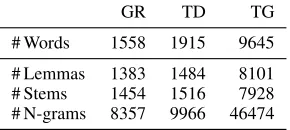
GR TD TG # Words 1558 1915 9645 # Lemmas 1383 1484 8101 # Stems 1454 1516 7928 # N-grams 8357 9966 46474
Table 2: BoW baseline feature vector dimensions
dor et al., 2016).2 Croatian is a highly inflectional
language, which has been shown to negatively af-fect classification accuracy (Malenica et al., 2008). We therefore experimented with two morphologi-cal normalization techniques: lemmatization and stemming. For lemmatization, we used the CST lemmatizer for Croatian by Agi´c et al. (2013). The reported lemmatization accuracy is 97%. For stem-ming, which is a simple and less accurate alter-native to lemmatization, we employed a simple rule-based stemmer by Ljubeši´c et al. (2007). The stemmer works by stripping the inflectional suf-fixes of nouns and adjectives. We performed no stopwords removal.
BoW baselines. We evaluated four bag-of-word (BoW) baselines. The baselines use words, stems, and lemmas as features. Additionally, we consid-ered character n-grams, which have been proven useful for text classification of noisy texts (Cavnar et al., 1994). Character n-grams can be viewed as an alternative to morphological normalization, as well as a feature-based counterpart to string ker-nels. We experimented with 2-, 3-, 4-, and 5-grams, which we combined into a single feature set. From each dataset, we filtered out all words, lemmas, and stems occurring less than two times, and all n-grams occurring less than six times. Table 2 lists the vector feature dimensions after filtering. We used a linear kernel for all baseline models.
Word embeddings. Word embeddings (Mikolov et al., 2013a) belong to a class of predictive dis-tributional semantics models (Turney and Pantel, 2010), which derive dense vector representations of word meanings from corpus co-occurrences. While it has been shown that word embeddings produce high-quality word representations, it has also been shown that they exhibit additive compositionality, i.e., they can be used to represent the composi-tional meaning of phrases and text fragments by means of simple vector averaging (Mikolov et al.,
2https://github.com/tensorflow/models/
blob/master/syntaxnet/universal.md
2013b; Wieting et al., 2015). We trained 300-dimensional skip-gram word embeddings using the word2vec tool3on fhrWaC (Šnajder et al., 2013),
a filtered version of the Croatian web corpus com-piled by Ljubeši´c and Klubiˇcka (2014). We set the window size to 5, negative sampling parameter to 5, and used no hierarchical softmax. When aver-aging the vectors, we ignored the words, stems, or lemmas that are not covered in the corpus.
SVM’s performance very much depends on the choice of the kernel function. For the word embed-dings model, we experimented with three different kernels: the linear kernel, the radial basis func-tion (RBF) kernel, and the cosine kernel (Kim et al., 2015). A linear kernel is tantamount to not using any kernel at all and effectively results in a linear model. In contrast, the RBF kernel yields a high-dimensional non-linear model. The cosine kernel is similar to a linear kernel, but additionally includes vector normalization (hence accounting for different-length vectors) and raising to a power:
CK(x,y) =h121 +khxxkk,yyikiα
String kernels. A string kernel measures the sim-ilarity of two texts in terms of their string similar-ity, effectively mapping the instances to a high-dimensional feature space. This eliminates the need for features and morphological processing. We experimented with two widely used kernels: a subsequence kernel (SSK) (Lodhi et al., 2002a) and a spectrum kernel (SK) (Leslie et al., 2002). SSK maps each input stringsto
ϕu(s) =
X
i:u=s[i] λl(i)
whereu is a subsequence searched for ins, iis a vector of indices at whichuappears ins,lis a function measuring the length of a matched subse-quence andλ≤1is a weighting parameter giving lower weights to longer subsequences. The corre-sponding kernel is defined as:
Kn(s, t) =
X
u∈Σn
hϕu(s), ϕu(t)i
wherenis maximum subsequence length for which we are calculating the kernel andΣnis a set of all finite strings of lengthn. The spectrum kernel can be viewed as a special case of SSK where vector of
3https://code.google.com/p/word2vec/
Model/Features Kernel GR TD TG BoW baseline
Words Linear 0.712 0.673 0.485 N-grams Linear 0.714 0.690 0.509 Stems Linear 0.765 0.716 0.517 Lemmas Linear 0.741 0.711 0.505
Word embeddings
Words Linear 0.801 0.653 0.550 Words RBF 0.807 0.693 0.565∗ Words Cosine 0.812 0.715 0.560 Lemmas Linear 0.798 0.655 0.536 Lemmas RBF 0.806 0.715 0.543 Lemmas Cosine 0.822∗ 0.711 0.546
String kernels
– SK 0.781 0.722 0.496
[image:4.612.85.295.40.221.2]– SSK 0.778 0.718 0.506
Table 3: F1-scores for the BoW, word embeddings, and string kernel models on the game reviews (GR), domain-specific (TD), and general-topic (TG) twit-ter datasets. The best-performing configuration for each model is indicated in bold. Statistically significant differences are marked with∗.
indicesimust yield contiguous subsequences and λis set to 1. We compute the string kernels using the Harry string similarity tool.4
5 Experiments
Evaluation setup. We evaluated all models us-ing nestedk-folded evaluation with hyperparameter grid search (Candγfor RBF,λandnfor SSK,n for SK,αfor the cosine kernel). We used 10 folds in the outer and 5 folds in inner (model selection) loop. Following the established practice in evaluat-ing sentiment classifiers (Nakov et al., 2013), we evaluated using the average of the F1-scores for the positive and the negative classes. We used a t-test (p<0.05, with Bonferroni correction for mul-tiple comparisons where applicable) for testing the significance of differences between the F1-scores.
Results. Table 3 shows the F1-scores on the three datasets for the baseline, word embeddings, and string kernel models, using different feature sets and kernel configurations. For BoW baselines, the best results are obtained using stemming on all three datasets, i.e., lemmatization does not outper-form stemming on neither of the three datasets. For word embeddings, non-linear kernels, cosine kernel in particular, outperform the linear kernel. Lemma-tization improves the performance only slightly on the GR dataset, and does not improve or even hurts
4http://www.mlsec.org/harry/index.html
the performance on the other two datasets. Finally, for string kernels, we obtain the best results with the spectrum kernel on GR and TD datasets, and subsequence kernel on the TG dataset.
Comparing the best results for the three mod-els, we observe that both word embeddings and string kernels outperform the BoW baseline on the GR and TG datasets (statistically significant dif-ference). Overall, word embeddings yield the best performance on these two datasets, while string ker-nels give the best performance on the TD dataset, though the difference is not statistically significant. Comparing across the datasets, we notice that the performance on TD and TG datasets is worse than on the GR dataset. This can be traced back to the informality of TD and TG texts, and also the fact that these datasets have three sentiment classes, whereas the GR dataset has only two. The perfor-mance on the TG set is probably further impeded by the fact that it covers a variety of topics, and has been annotated by a single annotator.
Discussion. We can make three main observa-tions based on the results obtained. The first is that a word embedding model with a cosine kernel and with either words or lemmas as features signifi-cantly outperforms both the baseline and the string kernel model on two out of three datasets. This suggest that a word embedding model should be the model of choice for short-text sentiment anal-ysis in Croatian. The second observation is that lemmatization was mostly not useful in our case: for BoW baseline, stems and n-grams offer better or comparable performance, while for word em-beddings lemmatization improved performance on only one out of three datasets. While this could probably be traced back to the noisiness of the in-formal text (at least for TD and TG datasets), it suggests that lemmatization does not really pay off for this task, especially considering its complex-ity relative to stemming. Finally, we observe that, although string kernels did not significantly outper-form the best baseline models, they do significantly outperform the BoW with words as features on two out of three datasets. Thus, in cases when both a stemmer and word embeddings are not available, string kernels may be the model of choice.
6 Conclusion
We trained a number of SVM models, using dif-ferent preprocessing techniques and kernels, and compared them on three datasets exhibiting differ-ent characteristics. We find that word embeddings outperform the baseline bag-of-word-models and string kernels on two out of three datasets. Thus, word embeddings are a method of choice for short-text sentiment classification of Croatian. In cases when word embeddings are not an option, bag-of-words with simple stemming is the preferred method. Finally, if stemming is not available, string kernels should be used. We found lemmatization to be of limited use for this task.
References
Ahmed Abbasi, Hsinchun Chen, and Arab Salem. 2008. Sentiment analysis in multiple languages: Feature selection for opinion classification in web forums. ACM Transactions on Information Systems (TOIS), 26(3):12.
Željko Agi´c, Nikola Ljubeši´c, and Danijela Merkler. 2013. Lemmatization and morphosyntactic tagging of Croatian and Serbian. In Proceedings of the 4th Biennial International Workshop on Balto-Slavic Natural Language Processing (BSNLP 2013), Sofia, Bulgaria.
Daniel Andor, Chris Alberti, David Weiss, Aliaksei Severyn, Alessandro Presta, Kuzman Ganchev, Slav Petrov, and Michael Collins. 2016. Globally nor-malized transition-based neural networks. arXiv preprint arXiv:1603.06042.
Timothy Baldwin, Paul Cook, Marco Lui, Andrew MacKinlay, and Li Wang. 2013. How noisy so-cial media text, how different soso-cial media sources? In Proceedings of the 6th International Joint Con-ference on Natural Language Processing (IJCNLP), pages 356–364, Nagoya, Japan.
Siniša Bi ¯din, Jan Šnajder, and Goran Glavaš. 2014. Predicting Croatian phrase sentiment using a deep matrix-vector model. InProceedings of the Ninth Language Technologies Conference, Information So-ciety (IS-JT 2014), Ljubljana, Slovenija.
Konstantin Buschmeier, Philipp Cimiano, and Roman Klinger. 2014. An impact analysis of features in a classification approach to irony detection in prod-uct reviews. In Proceedings of the 5th Workshop on Computational Approaches to Subjectivity, Sen-timent and Social Media Analysis, pages 42–49. William B. Cavnar, John M. Trenkle, et al. 1994.
N-gram-based text categorization. Ann Arbor MI, 48113(2):161–175.
Chih-Chung Chang and Chih-Jen Lin. 2011. LIB-SVM: A library for support vector machines. ACM
Transactions on Intelligent Systems and Technology, 2:27:1–27:27.
Aron Culotta and Jeffrey Sorensen. 2004. Depen-dency tree kernels for relation extraction. In Pro-ceedings of the 42nd Annual Meeting on Association for Computational Linguistics, page 423. Associa-tion for ComputaAssocia-tional Linguistics.
Ann Devitt and Khurshid Ahmad. 2007. Sentiment polarity identification in financial news: A cohesion-based approach. InProceedings of the 45th Annual Meeting of the Association of Computational Lin-guistics, pages 984–991, Prague, Czech Republic. Association for Computational Linguistics.
Rong-En Fan, Kai-Wei Chang, Cho-Jui Hsieh, Xiang-Rui Wang, and Chih-Jen Lin. 2008. LIBLINEAR: A library for large linear classification. Journal of machine learning research, 9:1871–1874.
Aniruddha Ghosh, Guofu Li, Tony Veale, Paolo Rosso, Ekaterina Shutova, John Barnden, and Antonio Reyes. 2015. Semeval-2015 Task 11: Sentiment analysis of figurative language in Twitter. In Pro-ceedings of the 9th International Workshop on Se-mantic Evaluation (SemEval 2015), pages 470–478.
Goran Glavaš, Damir Korencic, and Jan Šnajder. 2013. Aspect-oriented opinion mining from user reviews in Croatian. InProceedings of the 4th Biennial In-ternational Workshop on Balto-Slavic Natural Lan-guage Processing (BSNLP), pages 18–23, Sofia, Bul-garia.
Wu He, Shenghua Zha, and Ling Li. 2013. Social media competitive analysis and text mining: A case study in the pizza industry. International Journal of Information Management, 33(3):464–472.
Jonghoon Kim, Francois Rousseau, and Michalis Vazir-giannis. 2015. Convolutional sentence kernel from word embeddings for short text categorization. In
Proceedings of the 2015 Conference on Empirical Methods in Natural Language Processing (EMNLP), pages 775–780, Lisbon, Portugal. Association for Computational Linguistics.
Svetlana Kiritchenko, Xiaodan Zhu, and Saif M. Mo-hammad. 2014. Sentiment analysis of short in-formal texts. Journal of Artificial Intelligence Re-search, 50:723–762.
Efthymios Kouloumpis, Theresa Wilson, and Jo-hanna D. Moore. 2011. Twitter sentiment analysis: The good the bad and the omg! InProceedings of the Fifth International Conference on Weblogs and Social Media (ICWSM), pages 538–541, Barcelona, Spain.
Quoc V. Le and Tomas Mikolov. 2014. Distributed representations of sentences and documents. In Pro-ceedings of The 31st International Conference on Machine Learning (ICML), volume 14, pages 1188– 1196.
Christina S. Leslie, Eleazar Eskin, and William Stafford Noble. 2002. The spectrum kernel: A string kernel for svm protein classifica-tion. InProceedings of the Pacific Symposium on Biocomputing, volume 7, pages 566–575.
Nikola Ljubeši´c and Filip Klubiˇcka. 2014. {bs,hr,sr}WaC – web corpora of Bosnian, Croatian
and Serbian. InProceedings of the 9th Web as Cor-pus Workshop (WaC-9), pages 29–35, Gothenburg, Sweden. Association for Computational Linguistics. Nikola Ljubeši´c, Damir Boras, and Ozren Kubelka. 2007. Retrieving information in Croatian: Building a simple and efficient rule-based stemmer. Digital information and heritage/Seljan, Sanja, pages 313– 320.
Huma Lodhi, Craig Saunders, John Shawe-Taylor, Nello Cristianini, and Chris Watkins. 2002a. Text classification using string kernels. Journal of Ma-chine Learning Research, 2(Feb):419–444.
Huma Lodhi, Craig Saunders, John Shawe-Taylor, Nello Cristianini, and Chris Watkins. 2002b. Text classification using string kernels. Journal of Ma-chine Learning Research, 2(Feb):419–444.
Andrew L. Maas, Raymond E. Daly, Peter T. Pham, Dan Huang, Andrew Y. Ng, and Christopher Potts. 2011. Learning word vectors for sentiment analy-sis. InProceedings of the 49th Annual Meeting of the Association for Computational Linguistics: Hu-man Language Technologies-Volume 1, pages 142– 150, Stroudsburg, PA, USA. Association for Compu-tational Linguistics.
Mislav Malenica, Tomislav Šmuc, Jan Šnajder, and B. Dalbelo Baši´c. 2008. Language morphology off-set: Text classification on a Croatian–English paral-lel corpus. Information processing & management, 44(1):325–339.
Tomas Mikolov, Kai Chen, Greg Corrado, and Jef-frey Dean. 2013a. Efficient estimation of word representations in vector space. arXiv preprint arXiv:1301.3781.
Tomas Mikolov, Ilya Sutskever, Kai Chen, Greg S. Cor-rado, and Jeff Dean. 2013b. Distributed repre-sentations of words and phrases and their composi-tionality. InProceedings of the Neural Information Processing Systems Conference (NIPS 2013), pages 3111–3119, Lake Tahoe, USA.
Igor Mozetiˇc, Miha Grˇcar, and Jasmina Smailovi´c. 2016. Multilingual Twitter sentiment classification: The role of human annotators.PLOS ONE, 11:1–26. Preslav Nakov, Sara Rosenthal, Zornitsa Kozareva, Veselin Stoyanov, Alan Ritter, and Theresa Wilson. 2013. Semeval-2013 Task 2: Sentiment analysis in Twitter. InSecond Joint Conference on Lexical and Computational Semantics (*SEM), Volume 2: Sev-enth International Workshop on Semantic Evalua-tion (SemEval 2013), pages 312–320, Atlanta, Geor-gia.
Preslav Nakov, Alan Ritter, Sara Rosenthal, Fabrizio Sebastiani, and Veselin Stoyanov. 2016. Semeval-2016 Task 4: Sentiment analysis in Twitter. Pro-ceedings of SemEval, pages 1–18.
Brendan O’Connor, Ramnath Balasubramanyan, Bryan R. Routledge, and Noah A. Smith. 2010. From tweets to polls: Linking text sentiment to pub-lic opinion time series. InInternational Conference on Web and Social Media (ICWSM), pages 122–129, Washington, DC.
Bo Pang and Lillian Lee. 2008. Opinion mining and sentiment analysis.Foundations and trends in infor-mation retrieval, 2(1-2):1–135.
Maria Pontiki, Dimitris Galanis, John Pavlopoulos, Harris Papageorgiou, Ion Androutsopoulos, and Suresh Manandhar. 2014. Semeval-2014 task 4: As-pect based sentiment analysis. Proceedings of Se-mEval, pages 27–35.
Sara Rosenthal, Alan Ritter, Preslav Nakov, and Veselin Stoyanov. 2014. SemEval-2014 Task 9: Sentiment analysis in Twitter. InProceedings of the 8th international workshop on semantic evaluation (SemEval 2014), pages 73–80, Dublin, Ireland.
Sara Rosenthal, Preslav Nakov, Svetlana Kiritchenko, Saif M. Mohammad, Alan Ritter, and Veselin Stoy-anov. 2015. SemEval-2015 Task 10: Sentiment analysis in Twitter. InProceedings of the 9th inter-national workshop on semantic evaluation (SemEval 2015), pages 451–463.
Jan Šnajder, Sebastian Padó, and Željko Agi´c. 2013. Building and evaluating a distributional memory for Croatian. InProceedings of the 51st Annual Meet-ing of the Association for Computational LMeet-inguistics, pages 784–789, Sofia, Bulgaria.
Richard Socher, Brody Huval, Christopher D. Man-ning, and Andrew Y. Ng. 2012. Semantic com-positionality through recursive matrix-vector spaces. InProceedings of the conference on empirical meth-ods in natural language processing (EMNLP), pages 1201–1211. Association for Computational Linguis-tics.
Richard Socher, Alex Perelygin, Jean Y. Wu, Jason Chuang, Christopher D. Manning, Andrew Y. Ng, and Christopher Potts. 2013. Recursive deep mod-els for semantic compositionality over a sentiment treebank. In Proceedings of the conference on empirical methods in natural language processing (EMNLP), volume 1631, page 1642.
Shashank Srivastava, Dirk Hovy, and Eduard H. Hovy. 2013. A walk-based semantically enriched tree ker-nel over distributed word representations. In Pro-ceedings of the Conference on Empirical Methods in Natural Language Processing (EMNLP), pages 1411–1416, Seattle, USA. Association for Compu-tational Linguistics.
Huifeng Tang, Songbo Tan, and Xueqi Cheng. 2009. A survey on sentiment detection of reviews. Expert Systems with Applications, 36(7):10760–10773. Duyu Tang, Furu Wei, Nan Yang, Ming Zhou, Ting Liu,
and Bing Qin. 2014. Learning sentiment-specific word embedding for twitter sentiment classification. InThe 52nd Annual Meeting of the Association for Computational Linguistics (ACL), pages 1555–1565, Baltimore, MD, USA.
Mike Thelwall, Kevan Buckley, Georgios Paltoglou, Di Cai, and Arvid Kappas. 2010. Sentiment strength detection in short informal text. Journal of the American Society for Information Science and Technology, 61(12):2544–2558.
Peter D. Turney and Patrick Pantel. 2010. From frequency to meaning: Vector space models of se-mantics. Journal of artificial intelligence research, 37:141–188.
Hao Wang, Dogan Can, Abe Kazemzadeh, François Bar, and Shrikanth Narayanan. 2012. A system for real-time twitter sentiment analysis of 2012 us pres-idential election cycle. InProceedings of the ACL 2012 System Demonstrations, pages 115–120. Asso-ciation for Computational Linguistics.
John Wieting, Mohit Bansal, Kevin Gimpel, and Karen Livescu. 2015. Towards universal para-phrastic sentence embeddings. arXiv preprint arXiv:1511.08198.
Theresa Wilson, Janyce Wiebe, and Paul Hoffmann. 2009. Recognizing contextual polarity: An explo-ration of features for phrase-level sentiment analysis.
Computational linguistics, 35(3):399–433.
Yang Yu, Wenjing Duan, and Qing Cao. 2013. The impact of social and conventional media on firm eq-uity value: A sentiment analysis approach. Decision Support Systems, 55(4):919–926.
Changli Zhang, Wanli Zuo, Tao Peng, and Fengling He. 2008. Sentiment classification for Chinese reviews using machine learning methods based on string ker-nel. In Proceedings of the 3rd International Con-ference on Convergence Information (ICCIT), vol-ume 2, pages 909–914, Busan, Korea. IEEE.