JU NLP at SemEval-2016 Task 6: Detecting Stance in Tweets
using Support Vector Machines
Braja Gopal Patra, Dipankar Das, and Sivaji Bandyopadhyay Department of Computer Science and Engineering, Jadavpur University
Kolkata, India
{brajagopal.cse,dipankar.dipnil2005}@gmail.com sivaji cse [email protected]
Abstract
We describe the system submitted to the SemEval-2016 for detecting stance in tweets (Task 6, Subtask A). One of the main goals of stance detection is to automatically determine the stance of a tweet towards a specific tar-get as ‘FAVOR’, ‘AGAINST’, or ‘NONE’. We developed a supervised system using Support Vector Machines to identify the stance by an-alyzing various lexical and semantic features. The average F1 score achieved by our system is 60.60.
1 Introduction
Recent research in the areas of opinion mining and/or sentiment analysis on natural language texts is gaining importance due to various academic and commercial perspectives. One of the main reasons is that a vital amount of information can be obtained from text data that are available in the internet in forms of news, reviews, blogs, chats, and tweets.
Several experiments have been attempted in the field of sentiment analysis or opinion mining on user generated content or social media data till date (Pa-tra et al., 2015). One of the main goals in such tasks is to assign polarities (positive or negative) to a piece of text. Identification of the writer’s attitude towards a specific target, known as stance detection, is a relevant and challenging topic which has unduly been averted by most researchers (Mohammad et al., 2016). Lately it has become conventional that peo-ple express stance explicitly or implicitly in various microblogging sites.
Stance detection is the task of automatically de-termining from text whether the author is in favor of
the given target, against the given target, or whether neither inference is likely.1 The stance detection
can often bring complementary information to sen-timent analysis, because we often care about the au-thor’s evaluative outlook towards specific targets and propositions rather than simply considering whether the speaker is angry or happy (Mohammad et al., 2016). Stance detection even becomes more difficult when it is performed on the short texts like tweets. The latter being an important sub-field of sentiment analysis/opinion mining. Automatic stance detec-tion can be used in several applicadetec-tions such as in-formation retrieval, text summarization, and textual entailment.
More recent approaches to stance detection have been performed using linguistic rules on online debate dataset (Somasundaran and Wiebe, 2009; Hasan and Ng, 2013; Sridhar et al., 2014) andNPOV Corpusfrom Wikipedia (Recasens et al., 2013). To the best of our knowledge, not much computational attempts have been performed on tweets for stance detection. It is also observed that both the super-vised and unsupersuper-vised machine learning algorithms have been implemented for identifying the stance and several features like n-gram, frame semantic features, and dependency were used in stance detec-tion tasks (Somasundaran and Wiebe, 2009; Anand et al., 2011; Sridhar et al., 2014).
We participated in the SemEval 2016-Task 6: De-tecting Stance in Tweets.1 The main goal of this
task is to identify stance present in a tweet towards a specific target. For example, Target = ‘Hillary Clinton, Tweet = ‘A Black President,Healthcare 4
1http://alt.qcri.org/semeval2016/task6/
all, Marriage Equality...what´s next?..a Woman Pres-ident?!Damn RIGHT! #SCOTUS #MarriageEqual-ity, Stance = ‘FAVOR. In the above example, the tweet is in favor of the target “Hillary Clinton”. In the test dataset, the targets of the corresponding tweets are given and we have to find out whether the stance towards the target is in ‘FAVOR’ or ‘AGAINST’ or ‘NONE’.
There are two subtasks, in subtask A, we have to identify the stance towards a specific target whereas in subtask B, we have to identify the stance towards only one target “Donald Trump” using a large set of unlabeled tweets associated with the target. We have only participated in subtask A. Several lexical and semantic features are used to identify the stance towards a target. Support Vector Machines (SVM) is used for the classification purpose.
2 Dataset and Evaluation
The organizers provided the trial, training, and test dataset of 100, 2814, and 1249 tweets, respectively for detecting stance towards five targets namely “Atheism”, “Climate Change is a Real Concern”, “Feminist Movement”, “Hillary Clinton”, and “ Le-galization of Abortion”. All tweets in the dataset are annotated with stance (‘FAVOR’ or ‘AGAINST’ or ‘NONE’) towards the above mentioned targets. The stance ‘NONE’ means the tweet is not in ‘FAVOR’ or ‘AGAINST’ of the target.
Systems were evaluated using the official metric calculated macro-average of two labels only, i.e.F1 score= (F-ScoreFAVOR+ F-ScoreAGAINST)/2.
3 System Framework
3.1 Features
In order to achieve good accuracy using machine learning algorithms, we need to have a good set of features. Based on the genre of tweet, we identified the following features as listed below.
3.1.1 Target Specific Words
Initially, an n-gram model was created to iden-tify the target’s presence in the tweet. But, we observed that the dimension as well as the spar-sity of feature vectors were increased enormously. Thus, we created individual topic bags related to
Topic
Bags Favor AgainstWord Bags
A 311 69 210
C 129 63 42
F 95 72 49
H 73 40 31
[image:2.612.353.498.60.156.2]L 101 44 59
Table 1:Statistics of the topic, favor, and against bags for five targets (A: Atheism, C: Climate Change is a Real Concern, F: Feminist Movement, H: Hillary Clinton, L: Legalization of Abortion)
each of the targets. Seed words related to the tar-gets were populated using RitaWordNet.2 Some
handcrafted rules were implemented to find names in words and hashtags. For example, “Hillary” is present in “#HillaryClinton”, then we considered “#HillaryClinton” in the topic bag “Hillary”. Fur-ther, we checked the topic bags manually and re-moved some unrelated words collected using the WordNet. The detailed word level statistics of the topic bags are given in Table 1.
At first, we checked that whether a tweet contains any word from the corresponding target related topic bag or not. If no word is present, then we tagged that tweet as ‘NONE’ and no further processing is performed on that tweet. Further, this topic bags are used along with the dependency information.
3.1.2 Sentiment Words
We have used three lexicons namely SentiWord-Net (Baccianella et al., 2010), NRC Emotion Lex-icon (Mohammad and Turney, 2013), and NRC Hashtag Emotion Lexicon (Mohammad, 2012) for our experiments along with manually created lexi-cons for each of the targets. Moreover, two bags were created for each of the targets namely ‘favor’ and ‘against’ bags. Hashtags are also included in the above lexicons. The word level statistics of the ‘fa-vor’ and ‘against’ bags are given in Table 1. We used the frequency of the sentiment words matched with the above sentiment or emotion lexicons as features. Again, we used these lexicons in the later experi-ments also.
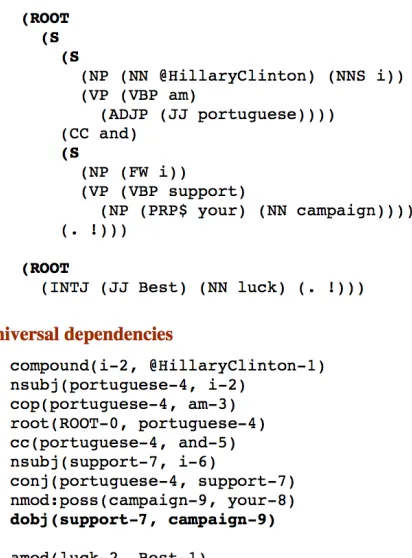
Figure 1:Dependency relations from Stanford Parser
3.1.3 Dependency Information
It is found in the literature that the dependency relations act as useful feature in sentiment analy-sis (Patra et al., 2014a; Patra et al., 2014b). Thus, we used the Stanford Parser3to get the dependency
rela-tions. We searched for the word pairs in dependency relations that consist of two component words, one of which is present in either ‘favor’ or ‘against’ bag, whereas the other one is present in SentiWordNet.
In the above Figure 1, we found a relation “dobj(support-7, campaign-9)”. The word ‘cam-paign’ is present in the ‘favor’ bag for the target “Hillary Clinton” and the word ‘support’ is present in SentiWordNet as positive. This relation is consid-ered as favor positive type. Similarly, three other types namely favor negative, against positive, and against negative were considered. The counts of each type are used as features.
Again, we identified the simple sentences based on the symbol “(S” or “(ROOT” in Figure 1. For
3http://stanfordnlp.github.io/CoreNLP/
each of the simple sentences, we removed the stop-words (except the negation stop-words) and identified the sentiment words using SentiWordNet. We applied some handcrafted rules given below. 1. Not + NEG = POS, 2. Not + POS = NEG, 3. POS + POS = POS, 4. NEG + NEG = NEG. If there are multiple posi-tive words present in a simple sentence, we tagged it as positive. If there are only two sentiment words, one with positive and other as negative, we tagged the sentence as negative. It is observed that the fre-quency of the negative instances is much higher than the positive instances in the training data. Finally, we counted the number of positive and negative in-stances in a tweet and used as features.
3.2 Classification Framework
We used LibSVM, an variant of SVMs implemented in the Weka.4 We performed the 10-fold cross
val-idation on the training and trial dataset for all the targets using the above features. But, the system performance was observed as poor and the system achieves the average F1 score of 0.43. Again, we performed the 10-fold cross validation on the train-ing and trial dataset for all the targets, separately. We calculated the average F1 score for each of the five targets and these are 0.46, 0.40, 0.48, 0.52, and 0.49 for “Atheism”, “Climate Change is a Real Concern”, “Feminist Movement”, “Hillary Clinton”, and “Le-galization of Abortion”, respectively. This yields an average F1 score of 0.47 for all the targets, which is higher than the F1 score achieved by the previ-ous system. This motivates us to develop our final systems separately for each of the targets.
3.2.1 Results
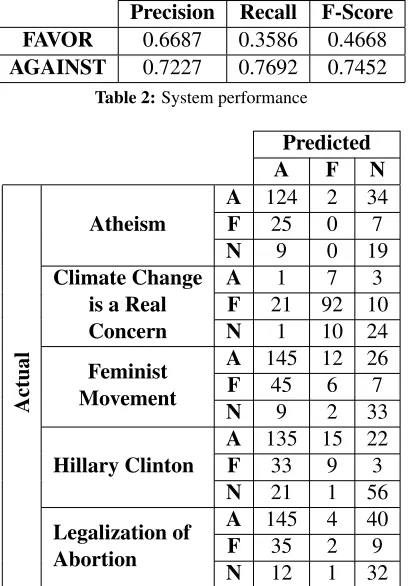
The LibSVM based system achieved the maxi-mum F-Score of 0.4668 and 0.7452 for the ‘FAVOR’ and ‘AGAINST’ classes, respectively as shown in Table 2. The system achieved the maximum aver-age F1 score of 0.6060. Whereas, the teamMITRE
has achieved the first position with the maximum av-erage F1 score of 0.6782.
The confusion matrix for our system is shown in Table 3. From the matrix, we observed that the system is biased towards the ‘AGAINST’ stance (except “Climate Change is a Real Concern” tar-get). The main reason may be the biasness in the
Precision Recall F-Score FAVOR 0.6687 0.3586 0.4668
[image:4.612.86.290.61.354.2]AGAINST 0.7227 0.7692 0.7452 Table 2:System performance
Predicted
A F N
Actual
Atheism AF 12425 20 347
N 9 0 19
Climate Change is a Real Concern
A 1 7 3
F 21 92 10
N 1 10 24
Feminist Movement
A 145 12 26
F 45 6 7
N 9 2 33
Hillary Clinton AF 135 15 2233 9 3
N 21 1 56
Legalization of Abortion
A 145 4 40
F 35 2 9
N 12 1 32
Table 3:Confusion Matrix of our System (A: Against, F: Favor, N: None)
training dataset as the number of instances for the ‘AGAINST’ stance is maximum for all the targets (except “Climate Change is a Real Concern” target). Another reason may be the less number of training instances as we developed our system for each of the targets, separately.
4 Conclusion and Future Work
We presented a system for identifying the stance in tweets using dependency and semantic features. The maximum average F1 score of 0.6060 is achieved by the system using SVM classifier. The task stance detection on social media data is helpful for real life applications like political campaign and opinion poll.
In near future, we plan to use the TweeboParser,5
as it works well for tweets as compared to the Stan-ford Parser. Another immediate goal is to increase the size of topic bags and sentiment lexicons related to each of the targets. We are also planing to use un-supervised approach and several machine learning
5http://www.cs.cmu.edu/ ark/TweetNLP/
algorithms for classifying the stance in near future.
Acknowledgments
The present work is supported by a grant from the project “CLIA System Phase II” funded by Depart-ment of Electronics and Information Technology (DeitY), Ministry of Communications and Informa-tion Technology (MCIT), Government of India. The first author is supported by “Visvesvaraya Ph.D. Fel-lowship” funded by DeitY, Government of India.
References
Pranav Anand, Marilyn Walker, Rob Abbott, Jean E. F. Tree, Robeson Bowmani, and Michael Minor. 2011. Cats rule and dogs drool!: Classifying stance in on-line debate. InProceedings of the 2nd workshop on computational approaches to subjectivity and senti-ment analysis, pages 1–9.
Stefano Baccianella, Andrea Esuli, and Fabrizio Sebas-tiani. 2010. Sentiwordnet 3.0: An enhanced lexical resource for sentiment analysis and opinion mining. In
Proceedings of 7th Language Resources and Evalua-tion Conference, volume 10, pages 2200–2204. Kazi S. Hasan and Vincent Ng. 2013. Stance
classifi-cation of ideological debates: Data, models, features, and constraints. In Proceedings of the 6th Interna-tional Joint Conference on Natural Language Process-ing, pages 1348–1356.
Saif M. Mohammad and Peter D. Turney. 2013. Crowd-sourcing a word-emotion association lexicon. Compu-tational Intelligence, 29(3):436–465.
Saif M. Mohammad, Svetlana Kiritchenko, Parinaz Sobhani, Xiaodan Zhu, and Colin Cherry. 2016. SemEval-2016 Task 6: Detecting stance in tweets. In
Proceedings of the International Workshop on Seman-tic Evaluation, SemEval’16, San Diego, California. Saif M. Mohammad. 2012. #emotional tweets. In*SEM
2012: The First Joint Conference on Lexical and Computational Semantics, pages 246–255, Montr´eal, Canada, 7-8 June. Association for Computational Lin-guistics.
Braja G. Patra, Soumik Mandal, Dipankar Das, and Sivaji Bandyopadhyay. 2014a. Ju cse: A conditional ran-dom field (crf) based approach to aspect based senti-ment analysis. InProceedings of the 8th International Workshop on Semantic Evaluation (SemEval 2014), pages 370–374.
2014b. Identifying aspects and analyzing their sen-timents from reviews. InProceedings of 13th Mexi-can International Conference on Artificial Intelligence (MICAI), pages 9–15. IEEE.
Braja G. Patra, Dipankar Das, Amitava Das, and Rajen-dra Prasath. 2015. Shared task on sentiment analysis in indian languages (sail) tweets-an overview. In Pro-ceedings of Mining Intelligence and Knowledge Ex-ploration, pages 650–655. Springer.
Marta Recasens, Cristian Danescu-Niculescu-Mizil, and Dan Jurafsky. 2013. Linguistic models for analyzing and detecting biased language. InProceedings of the 51th Annual Meeting of the ACL, pages 1650–1659. Swapna Somasundaran and Janyce Wiebe. 2009.
Rec-ognizing stances in online debates. InProceedings of the Joint Conference of the 47th Annual Meeting of the ACL and the 4th International Joint Conference on Natural Language Processing, pages 226–234. Asso-ciation for Computational Linguistics.