582
DeepAnalyzer at SemEval-2019 Task 6:
A deep learning-based ensemble method for identifying offensive tweets
Gretel Liz De la Pe ˜na Sarrac´en and Paolo Rosso
PRHLT Research Center, Universitat Polit`ecnica de Val`encia, Spain
Abstract
This paper describes the system we developed for SemEval 2019 on Identifying and Cate-gorizing Offensive Language in Social Media (OffensEval - Task 6). The task focuses on of-fensive language in tweets. It is organized into three sub-tasks for offensive language identi-fication; automatic categorization of offense types and offense target identification. The ap-proach for the first subtask is a deep learning-based ensemble method which uses a Bidirec-tional LSTM Recurrent Neural Network and a Convolutional Neural Network. Additionally we use the information from part-of-speech tagging of tweets for target identification and combine previous results for categorization of offense types.
1 Introduction
The use of Internet has become an important me-dia of personal and commercial communication. In this scenario, some users take advantage of the anonymity of this kind of communication, using this to engage in behaviour that many of them would not consider in real life. Therefore, much of the offensive language is widespread in social networks. Then, studying offensive language in texts from the social media is an essential task for security, the prevention of cyber-bullying, among other abusive behavior.
To increase the research in this areas, several workshops have been organized, such as ALW1 and TRAC2. Recently, OffensEval3 (Zampieri et al., 2019b), which is a shared task at the SemEval-20194 workshop has been launched on the research community. The aim of OffensE-val is to deal with offensive language detection in
1https://sites.google.com/site/abusivelanguageworkshop2017/ 2
https://sites.google.com/view/trac1/home
3
https://competitions.codalab.org/competitions/20011
4http://alt.qcri.org/semeval2019/index.php?id=tasks
the English language focusing on messages from Twitter.
In OffensEval, the treatment of offensive con-tent is divided into three subtasks taking the type and target of offenses into account:
• A: Offensive language identification.
• B: Automatic categorization of offense types.
• C: Offense target identification.
In this work, we present the methodology pro-posed to each of these sub-tasks, which includes an ensemble of a LSTM Recurrent Neural Net-work and a Convolutional Neural NetNet-work, and additionally linguistic features for the last two sub-tasks. The architecture of the system will be more detailed in the following sections.
The paper is organized as follows. Next section briefly describes other works in this area. Then, Section 3 describes the proposed metodology and the dataset. Results are discussed in Section 4. Finally, we draw our conclusions together with a summary of our findings in Section 5.
2 Related Work
Some approaches have been proposed to tackle the problem of offensive language detection. It is the case of recent works (Waseem et al.,2017;
ElSherief et al.,2018;Gamb¨ack and Sikdar,2017;
Zhang et al.,2018) and surveys (Schmidt and Wie-gand,2017) and (Fortuna and Nunes,2018). There are even studies on languages other than English such as (Su et al., 2017) on Chinese and (Fiˇser et al.,2017) on Slovene.
Many of the last approaches rely on neural net-work models. For instance, the net-work of (Ganesan et al., 2018) presents a Multi-Layer Feedforward Neural Networks. Moreover, (Park and Fung,
on Convolutional Neural Networks (CNN) to clas-sify sexist and racist abusive language: Char-CNN, WordChar-CNN, and HybridCNN. It work re-ports that can boost the performance of simpler models. Also, (Pitsilis et al.,2018) proposes a de-tection scheme that is an ensemble of Recurrent Neural Network classifiers. It incorporates various features associated with user-related information. They report that the scheme can successfully dis-tinguish racism and sexism messages from normal text.
3 Methodology and Data
The corpus provided by the organizers consists of 14,100 tweets in English. The data collection methods used to compile the dataset used in Of-fensEval is described inZampieri et al.(2019a).
The first step is the preprocessing of the tweets, where texts are cleaned. All emoticons, hash-tag and urls are removed. Then, the texts are represented as vectors with word embedding vec-tors. We used the pre-trained word vectors of Glove (Pennington et al.,2014), trained on 2 bil-lion words from Twitter.
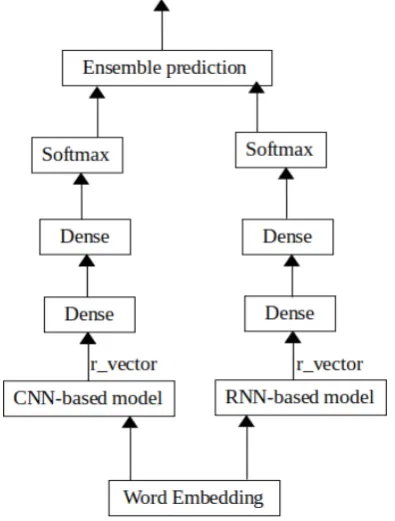
The method proposed in this work is based on an architecture that sequentially obtains the output for each of the subtasks. In the first level we use a model whose input is the word embeddings of a tweet and the output is a vector (r vector) that is taken as a compact representation of the input and is used in the following steps. For the model, two types of networks have been used. In a first approach a Recurrent Neural Network (RNN) is used, and as a second approximation a Convolu-tional Neuronal Network (CNN). These two mod-els are described below.
3.1 Convolutional Neural Network
The model is a version of the convolutional neural networks presented in (Kim, 2014) for sentence-level classification tasks. Here, the input of the model is a matrix where each row corresponds to the embedding vector of each word in the tweet. Three different filters of sizes 3, 4 and 5 are ap-plied in a 1D convolution step to capture informa-tion from 3-grams, 4-grams and 5-grams. The fea-ture maps produced by the convolution layer are forwarded to a Maxpooling layer. We used 2x2 filters for this pooling function on a feature map to reduce it to the single most dominant features.
Finally, the r vector is generated by the
concate-nation of the results for each of the filters.
3.2 Recurent Neural Network
In NLP problems, standard LSTM Recurrent Neu-ral Networks receive sequentially (left to right or-der) at each time step a word embeddingwt and produces a hidden stateht.
On the other hand, the bidirectional LSTM makes the same operations as standard LSTM but, processes the incoming text in a left-to-right and a right-to-left order in parallel. Thus, the output is a two hidden state at each time step−→htand
←− ht. The proposed method uses a Bidirectional LSTM network which considers each new hidden state as the concatenation of these twohˆt = [
− → ht,
←− ht]. The idea of this Bi-LSTM is to capture long-range and backwards dependencies.
3.3 Sub-task A
[image:2.595.323.521.437.698.2]For the first sub-task, which consists in the iden-tification of offensive language in tweets,r vector is used as input of a Fully Connected Neural Net-works (FCNN) of two layers with activation func-tion relu. The class (offensive or not) is obtained in a third layer of two units, that refer to the num-ber of classes, with a softmax activation function.
Figure 1: Architecture. Sub-task A
of both CNN and RNN models were made. In the first weighting all the weight is for RNN (RNN run). In contrast, in the second one, all the weight is for CNN (CNN run). Finally, the third one is the actual ensemble model where both mod-els are assigned equal weight (Ensemble run). For combining the results of both models, the system gets the mean of the predictions of each one.
3.4 Sub-tasks B and C
In the sub-task of detecting the target of offensive language, the information of the part-of-speech tagging process of the tweets is used. This allows us to make more fine-grained distinctions on the words in texts which can identify to the target of aggressiveness. For instance, this information al-lows to discriminate between a proper noun and other kind of noun, and if a noun is plural or sin-gular. In this way the model can learn sequences of tags which represent each type of target. The POS labels are obtained with Standford CoreNLP and they are represented as a one hot vectors. The sequence of labels is analyzed with a LSTM RNN, and a representation p vector is obtained. Then, the concatenation of vectorsr vectorandp vector is used as input to another FCNN of one hidden layer with the activation function relu, and an out-put layer with two neurons with a softmax acti-vation function. In this way, the prediction cor-responding to the offensive target in the tweets is obtained. The Figure2shows this processing.
Finally, for the sub-task of classifying the types of offensive tweet, the prediction is obtained in a similar way to the previous sub-task. Here, a one hot vector corresponding to the POS tags present in the tweet is added tor vector. Then, the predic-tion is calculated using another FCNN.
Finally, cross entropy is used as the loss func-tion, which is defined as:
L=−X
i
yi∗log(ˆy) (1)
Whereyiis the ground true classification of the tweet andyˆthe predicted one.
4 Results
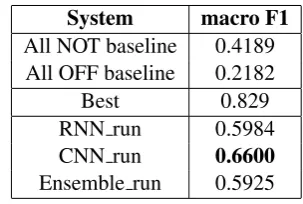
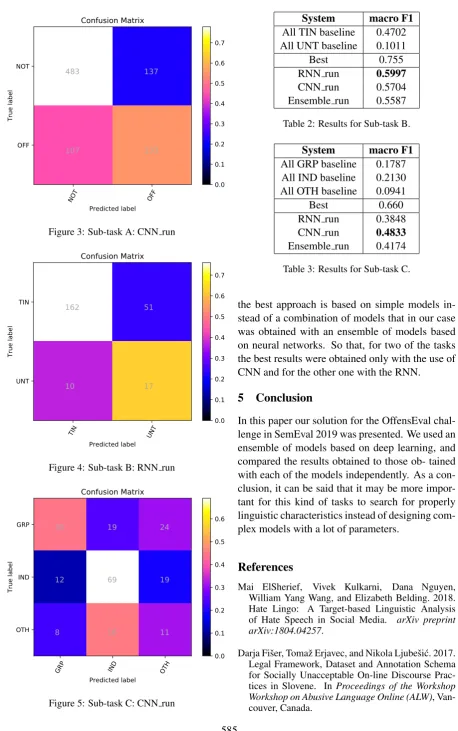
[image:3.595.320.523.68.335.2]In the evaluation, the official ranking metric is macro-averaged F1. The results obtained in each subtask are shown in the next tables and confu-sion matrices. For each case, each of the three approaches discussed above (CNN run, RNN run
Figure 2: Architecture. Sub-task B
and Ensemble run) was evaluated and the results are shown in the tables with the name that was in-dicated. Also, random baseline generated by as-signing the same labels for all instances are in-cluded. For example, ”All OFF” in sub-task A represents the performance of a system that labels everything as offensive. It was used for compari-son.
System macro F1
All NOT baseline 0.4189 All OFF baseline 0.2182
Best 0.829
RNN run 0.5984 CNN run 0.6600
Ensemble run 0.5925
Table 1: Results for Sub-task A
These results reveal a behavior not as good as expected, since although the baselines were ex-ceeded in each case, the results were relatively far from the best results of the competition. Perhaps this is due to the fact that the different linguistic characteristics that could be extracted from tweets, such as information related to emoticons, hashtags and urls, were not analyzed in detail.
[image:3.595.338.490.506.608.2]NOT OFF Predicted label NOT
OFF
True label
483
137
107
133
Confusion Matrix
[image:4.595.69.528.51.783.2]0.0 0.1 0.2 0.3 0.4 0.5 0.6 0.7
Figure 3: Sub-task A: CNN run
TIN UNT
Predicted label TIN
UNT
True label
162
51
10
17
Confusion Matrix
0.0 0.1 0.2 0.3 0.4 0.5 0.6 0.7
Figure 4: Sub-task B: RNN run
GRP IND OTH
Predicted label GRP
IND
OTH
True label
35
19
24
12
69
19
8
16
11
Confusion Matrix
0.0 0.1 0.2 0.3 0.4 0.5 0.6
Figure 5: Sub-task C: CNN run
System macro F1
All TIN baseline 0.4702 All UNT baseline 0.1011
Best 0.755
RNN run 0.5997
[image:4.595.342.491.62.160.2]CNN run 0.5704 Ensemble run 0.5587
Table 2: Results for Sub-task B.
System macro F1
All GRP baseline 0.1787 All IND baseline 0.2130 All OTH baseline 0.0941
Best 0.660
RNN run 0.3848 CNN run 0.4833
Ensemble run 0.4174
Table 3: Results for Sub-task C.
the best approach is based on simple models in-stead of a combination of models that in our case was obtained with an ensemble of models based on neural networks. So that, for two of the tasks the best results were obtained only with the use of CNN and for the other one with the RNN.
5 Conclusion
In this paper our solution for the OffensEval chal-lenge in SemEval 2019 was presented. We used an ensemble of models based on deep learning, and compared the results obtained to those ob- tained with each of the models independently. As a con-clusion, it can be said that it may be more impor-tant for this kind of tasks to search for properly linguistic characteristics instead of designing com-plex models with a lot of parameters.
References
Mai ElSherief, Vivek Kulkarni, Dana Nguyen, William Yang Wang, and Elizabeth Belding. 2018. Hate Lingo: A Target-based Linguistic Analysis of Hate Speech in Social Media. arXiv preprint arXiv:1804.04257.
[image:4.595.77.300.66.266.2]Paula Fortuna and S´ergio Nunes. 2018. A Survey on Automatic Detection of Hate Speech in Text. ACM Computing Surveys (CSUR), 51(4):85.
Bj¨orn Gamb¨ack and Utpal Kumar Sikdar. 2017. Using Convolutional Neural Networks to Classify Hate-speech. In Proceedings of the First Workshop on Abusive Language Online, pages 85–90.
Aishwarya Ganesan, Sneha Birajdar, Shivani Dalvi, and Jagruti Dandekar. 2018. Offensive language de-tection using ai technique.
Yoon Kim. 2014. Convolutional neural
net-works for sentence classification. arXiv preprint arXiv:1408.5882.
Ji Ho Park and Pascale Fung. 2017. One-step and two-step classification for abusive language detection on twitter. arXiv preprint arXiv:1706.01206.
Jeffrey Pennington, Richard Socher, and Christo-pher D. Manning. 2014. Glove: Global vectors for word representation. InEmpirical Methods in Nat-ural Language Processing (EMNLP), pages 1532– 1543.
Georgios K Pitsilis, Heri Ramampiaro, and Helge Langseth. 2018. Detecting offensive language in tweets using deep learning. arXiv preprint arXiv:1801.04433.
Anna Schmidt and Michael Wiegand. 2017. A Sur-vey on Hate Speech Detection Using Natural Lan-guage Processing. InProceedings of the Fifth Inter-national Workshop on Natural Language Process-ing for Social Media. Association for Computational Linguistics, pages 1–10, Valencia, Spain.
Huei-Po Su, Chen-Jie Huang, Hao-Tsung Chang, and Chuan-Jie Lin. 2017. Rephrasing Profanity in Chi-nese Text. In Proceedings of the Workshop Work-shop on Abusive Language Online (ALW), Vancou-ver, Canada.
Zeerak Waseem, Thomas Davidson, Dana Warmsley, and Ingmar Weber. 2017. Understanding Abuse: A Typology of Abusive Language Detection Subtasks. In Proceedings of the First Workshop on Abusive Langauge Online.
Marcos Zampieri, Shervin Malmasi, Preslav Nakov, Sara Rosenthal, Noura Farra, and Ritesh Kumar. 2019a. Predicting the Type and Target of Offensive Posts in Social Media. InProceedings of NAACL.
Marcos Zampieri, Shervin Malmasi, Preslav Nakov, Sara Rosenthal, Noura Farra, and Ritesh Kumar. 2019b. SemEval-2019 Task 6: Identifying and Cat-egorizing Offensive Language in Social Media (Of-fensEval). InProceedings of The 13th International Workshop on Semantic Evaluation (SemEval).
Ziqi Zhang, David Robinson, and Jonathan Tepper. 2018. Detecting Hate Speech on Twitter Using a Convolution-GRU Based Deep Neural Network. In