Continuous fluency tracking and the challenges of varying text complexity
Beata Beigman Klebanov, Anastassia Loukina, John Sabatini, Tenaha O’Reilly Educational Testing Service
660, Rosedale Rd, Princeton NJ, USA 08541, NJ, USA
{bbeigmanklebanov, aloukina, jsabatini, toreilly}@ets.org
Abstract
This paper is a preliminary report on us-ing text complexity measurement in the service of a new educational application. We describe a reading intervention where a child takes turns reading a book aloud with a virtual reading partner. Our ulti-mate goal is to provide meaningful feed-back to the parent or the teacher by contin-uously tracking the child’s improvement in reading fluency. We show that this would not be a simple endeavor, due to an intri-cate relationship between text complexity from the point of view of comprehension and reading rate.
1 Introduction
According to the 2015 report from the National Assessment of Educational Progress on reading achievement, 31% of U.S. 4th graders read be-low the Basic level.1 Our goal is to help
low-proficiency readers such as these improve their reading skill.
The critical transition from word-by-word reading to fluency, or from learning how to read to reading for learning or enjoyment, requires ex-tended and sustained reading practice. To en-courage such practice we propose an educational application which combines (1) an excellent story to achieve engagement (such as “Harry Potter and the Sorcerer’s Stone” by J. K. Rowling), and (2) a virtual reading companion, implemented through an audiobook, who would take turns reading aloud with the child – “you read a page, I read the next one”. The turn-taking allows the child to alter-nate between the more effortful reading and the less effortful listening, as well as supplies a model
1https://www.nationsreportcard.gov/reading math 2015/ #reading/acl?grade=4
reading of many of the words and phrases the child will encounter during his turn.
In addition to supporting sustained reading by children, the system will also provide the teacher or parent with a detailed picture of the child’s de-velopmental trajectory, by continuously tracking the child’s reading fluency throughout his reading turns. Oral reading fluency is not only an impor-tant indicator of reading skill in itself (Hudson et al., 2008; Fuchs et al., 2001), for students in early elementary grades it is also strongly corre-lated (r around 0.7) with reading comprehension (Roberts et al.,2005;Good et al.,2001).
The standard measure of oral reading fluency is words correct per minute (henceforth, WCPM) (Wayman et al.,2007), combining aspects of speed and accuracy of oral reading.2 Several studies
(Balogh et al.,2007;Zechner et al.,2009) showed thatWCPM can be accurately computed automati-cally using an automated speech recognizer (ASR) and a string matching algorithm; this approach has already been incorporated into many commercial and research systems for automated oral fluency assessment such as VersaReader (Balogh et al., 2012) or ProjectLISTEN(Mostow,2012) (see also
Eskenazi(2009) for a review).
Previous studies on reading fluency indicate that WCPM may vary across different texts (Ardoin
et al.,2005;Compton et al.,2004). It seems rea-sonable to assume that variation in text complex-ity/readability might be one of the sources of vari-ation in oral reading fluency across different pas-sages: Texts that cause comprehension difficul-ties may also elicit less fluent reading. In fact, this assumption underlies text selection for tests of oral reading fluency such as DIBELS (Good and Kaminski,2002) that rely on readability to select
2In some studies, reading rate (words per minute) is used as a separate measure while fluency is defined in terms of expressiveness and adherence to syntax (Danne et al.,2005).
comparable passages (Francis et al.,2008). Since in our application the child will be reading dif-ferent passages in the book on difdif-ferent days, it is possible that the differences between passages would confound the measurement of the child’s progress. In this case, WCPM would need to be adjusted to account for such differences in order to produce interpretable feedback.
Previous work generally focused on text proper-ties and WCPM in short texts that have already been controlled for grade-level appropriate read-ability. Little is known about the variability of text complexity across a whole book and how this may affectWCPM of a child reading the book. There-fore, the focus of this paper is to see whether an adjustment of WCPM to text is in fact necessary in our context, and, if so, whether it can be done using a state-of-the-art text complexity measure.
We address the following research questions: (1) What is the extent of variation in passage com-plexity in J. K. Rowling’s “Harry Potter and the Sorcerer’s Stone” (henceforth,HP1)? (2) Does the complexity of the text actually impact reading flu-ency as measured byWCPM? (3) Do automatically generated estimates of text complexity correspond to the observed fluency patterns?
The rest of the paper is organized as fol-lows. We first introduce previous work related to text complexity measurement and the relationship between text complexity and oral reading fluency. We then present the results of two studies: In the first study we looked at variation in text complex-ity across passages selected from HP1. In the second study we investigate how text complexity estimates relate to WCPM of children reading se-lected passages from the book. Our findings are then discussed and implications for research on continuous tracking of fluency are drawn.
2 Related Work
Text Complexity Estimation: While for Dale
and Chall(1949) the notion of text readability in-volved “the extent to which they [readers] under-stand it [the text], read it at an optimal speed, and find it interesting”,3most classical (Flesch,1948;
Gunning,1952;Kincaid et al.,1975;McLaughlin, 1969) and modern (Sheehan et al.,2014;Flor and Beigman Klebanov, 2014; Vajjala and Meurers, 2012; Schwarm and Ostendorf, 2005) measures of text readability/complexity focus on reading
3Quoted fromDuBay(2004).
comprehension, including special formulas and models designed for special populations, such as young children (Spache, 1953), learners of En-glish as a second language (Beinborn et al.,2014; Heilman et al.,2007), adults with mental disabili-ties (Feng et al.,2009), among others.
While comprehension-based complexity esti-mation of relatively short reading passages has been the subject of extensive research for many decades, there is little research on estimating the complexity of long, book-level texts. In early work on readability,Fowler(1978) estimated read-ability of a novel using the mean of readread-ability estimates of fifteen randomly selected 100-word passages from the novel. Milone (2012) gene-rates book-level complexity estimates by com-bining complexity estimates for the text in the book with a measure based on the length of the book, following the observation that longer books tend to be more difficult, all else being equal. He decided to base the estimate of text complexity in the book on the analysis of the whole book, as opposed to samples from the book, based on the observation of extensive within-text variability in estimates of text complexity and the concomitant hazard of a large sampling error if only parts of the book are taken into account during complexity es-timation (see Appendix E inMilone(2012)). For example, the book Black Beauty yields a grade-level estimate of 5.4 based on the text of the whole book; looking at 500-word slices yields estimates anywhere from 2.2 to 9.5 per slice – a range of 7 grade levels. This finding raises the ques-tion of a young reader’s experience in the face of such variability. To our knowledge, our project is the first study to address variation in within-book reading experiences in general, and variation in oral reading performance specifically.
Relationship between oral reading fluency
and text complexity: InCompton et al. (2004),
correlated with both performance measures. Ar-doin et al.(2005) examined a number of readabil-ity formulas for their abilreadabil-ity to predict WCPM and found generally fairly low correlations (r<0.5).
In Petscher and Kim (2011), about 35,000 students in grades 1-3 read three grade-level-appropriate passages (as measured by Spache for-mula) during each of 4 administrations of an oral reading fluency test throughout the year. The authors estimated the amount of variability in WCPM that was attributable to variation among students vs variability across the text passages. Their results showed that 2%-4% was attributable to variability in passages and/or order of passages for grade 1, with higher proportions for grades 2 (5%-6%) and 3 (3%-9%). Petscher and Kim (2011) also observed an increase in the reading rate from the first to the third administered pas-sage within an assessment, consistently with other studies (Francis et al.,2008;Jenkins et al.,2009), pointing to the existence of practice effects in oral reading performance of consecutively read texts.
To summarize, the related work suggests that (1) some amount of variation in reading fluency is attributable to variation in text passages being read, for early elementary grade children; (2) clas-sical readability formulas are not very effective predictors of oral reading fluency.
We note however that passage readabil-ity/complexity variation across texts used in pre-vious studies tends to be limited, since texts se-lected for assessments are typically controlled for grade-level-appropriate readability. In contrast, we consider a case where children are reading a long novel that is not specifically designed to be grade-level controlled; we therefore expect more variation in complexity across different passages in a book. Larger variation may show better align-ment between reading rates and text complexity estimates.
3 Study I: Text complexity in Harry Potter and the Sorcerer’s Stone 3.1 Data and methodology
For this first study we considered the variation in text complexity in J. K. Rowling’s “Harry Potter and the Sorcerer’s Stone”. We first split the book into a series of consecutive, non-overlapping 250 word chunks. These should take 2-3 minutes to read for our target population and constitute the approximate amount of text to be read by the child
at each turn. For each chunk, after 250 words, we either extended or reduced the chunk to the end of a paragraph, thus ensuring that each passage had a natural break point.
The whole book consists of 79,508 words spread across 17 chapters. We created 318 con-secutive passages, with a mean length of 250.0 words (SD=16.9). The shortest passage contained 177 words and the longest passage contained 309 words. Half of the passages (II and III quartiles) fell within 242-259 words range.
We used TextEvaluator,4a state-of-the-art
mea-sure of comprehension complexity of a text (Napolitano et al., 2015; Sheehan et al., 2014, 2013;Nelson et al.,2012),5 to conduct text
com-plexity analyses. TextEvaluator extracts a range of linguistic features and uses them to compute a complexity index on the scale of 100-2000, as well as an overall grade equivalent score. TextEvalu-ator computes three complexity scores based on the models optimized for literary, informational and mixed texts. We used the literary metric as the final complexity score for our passages since all texts were excerpts from a novel.6
In addition to the overall score, several di-mension scores are provided, including: Syn-tactic Complexity (using features related to sen-tence complexity); Academic Vocabulary (the ex-tent to which words in the text are characteristic of academic texts); Word Unfamiliarity (a com-posite measure of word frequency); Lexical Co-hesion (measures the degree of overlap between concepts across adjacent sentences within para-graphs); Level of Argumentation (indexes the ease or difficulty of inferring connections across sen-tences when the underlying format of a text is ar-gumentative); additional dimensions include Inter-active/Conversational Style, Concreteness, Degree of Narrativity.
We note that passage lengths between 177 and
4https://textevaluator.ets.org/
5TextEvaluator appears in theNelson et al.(2012) bench-mark as SourceRater.
309 words are within scope for TextEvaluator, al-beit on the shorter side of the range:Sheehan et al. (2013) report an evaluation with texts ranging in length from 112 to more than 2,000 words.
For this analysis, we treated each chunk from the book as an independent passage. Thus, TextEvaluator had no access to information about other passages. One might contend that there are limitations to such an approach, as some aspects of difficulty of the text may change as the reader ac-cumulates knowledge about the world of the book. For example, words that are initially unfamiliar, such as names of characters, magic creatures and artifacts, spells and curses, would become increas-ingly familiar as the story progresses. In contrast, other aspects of complexity, such as the syntactic complexity of sentences, are less likely to become more or less challenging as one reads further into the book. In the current study, we have not at-tempted to capture any such text continuity effects. 3.2 Results
The overall TextEvaluator complexity of passages across the book varied from 160 to 1150 with average complexity 613.4 (SD=163.1). In terms of grade levels this corresponds to variation from second to eleventh grade, with the average around grade six.
The dimension scores also varied across the book although the patterns were different for dif-ferent dimensions. Figure 1 shows the distribu-tions for different dimension scores. The scale for all scores is 0-100. The score for Academic vo-cabulary was consistently low across all passages (Mean=27, SD=7.3), while the score for narra-tivity was consistently high (Mean=83, SD=5.8). The score for the Level of Argumentation showed the largest spread (Mean=53 and SD=19.8). We also note the substantial spread in Syntactic com-plexity (Mean=46.1 and SD=11.3).
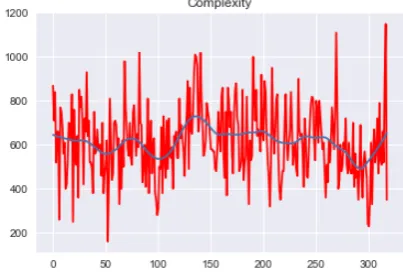
We also considered how the complexity varies as one proceeds through the book (Figure2). The red line shows values for each passage, the blue line shows a smoothed estimate calculated using lowess (Cleveland,1979).7 The plot shows there
is a substantial fluctuation from passage to pas-sage as well as potentially longer-range trends that may correspond to the book’s narrative struc-ture. Specifically, the peak around 130-140 cor-responds to the description-heavy introduction to
[image:4.595.314.525.67.206.2]7as implemented in (Seabold and Perktold,2010)
Figure 1: Distributions of scores for various di-mensions of text complexity in HP1. The dimen-sions are ordered on the x-axis by spread (SD).
Hogwarts and Harry’s first classes; the valley around 300 corresponds to the fast-moving final stand-off between Harry and Voldemort/Quirrell.
Figure 2: Distribution of holistic text complexity scores as one proceeds through HP1.
The answer to research question 1 is thus: The extent of variation in text complexity across pas-sages in the book is very substantial. If text complexity has any systematic effect on the oral reading performance, the extent of variation in complexity suggests that it is likely to become a major confounding factor in tracking the child’s progress in fluency while reading the book. 4 Study II: Text complexity and oral
reading fluency
[image:4.595.319.521.352.490.2]complex-ity as estimated by TextEvaluator, and collected oral reading fluency estimates for these passages from a sample of 2-4 graders. The details of the procedure and the results are described in this sec-tion.
4.1 Passage selection
We ordered all 318 passages by estimated text complexity, and selected passages from the middle of the distribution and from the lowest and high-est deciles. In addition to TextEvaluator score, when selecting passages we also took into account whether a passage could be reasonably read as stand-alone text. Table 1 shows the characteris-tics of these three passages. All passages are from the first chapter of the book.
Passage # words TE score Complexity Percentile
Easy 226 260 1.9%
Medium 282 580 51.5%
[image:5.595.330.502.62.117.2]Hard 246 800 90.3%
Table 1: The characteristics of the passages used for the data collection: length in words, complex-ity, complexity relative to the whole book.
4.2 Data collection procedure
The recordings took place in an office with several children recorded simultaneously. The texts were presented on screen and the audio was captured using the head-set with a microphone.
Before reading the experimental passages, the child first listened to the passage that begins the first chapter of HP1 (starting with “Mr. and Mrs. Dursley of number four, ...”) as narrated by the professional actor Jim Dale (Rowling and Dale, 2016). Then the child read aloud the passage im-mediately following the passage read by the nar-rator. Since all children read this passage first, this passage is used as a reference text to measure baselineWCPMfor each child.
The experimental passages were then presented to children in a randomized order, to allow sepa-ration between text and order effects in subsequent analyses (Petscher and Kim,2011;Francis et al., 2008; Jenkins et al., 2009). The children were asked to read at their natural pace.
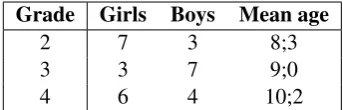
A total of 30 children took part in this data col-lection selected via a convenience sample. Table 2shows the distribution by grade and gender and
Grade Girls Boys Mean age
2 7 3 8;3
3 3 7 9;0
[image:5.595.72.290.292.362.2]4 6 4 10;2
Table 2: The demographic characteristics of par-ticipants.
the average age in each group. All recordings were done in April of 2017.
4.3 Computation of oral reading measures
To compute WCPM we used a professional scription agency to obtain word-by-word tran-scriptions of each child’s reading and aligned them to the passage text using an algorithm based on dynamic programming. We next computed how many words in the original passage matched those in the transcription. This algorithm is similar to that used to computeASRword error rate, but fol-lowing the standard practice in reading research we only penalized substitutions and deletions and did not take into account any insertions. Most chil-dren’s reading closely followed the texts, with the average of 93.8% of all words in each text read correctly (SD=3.7, min=82.7%, max=99.6%).
We manually identified in each recording the time stamps where the child started and finished reading the text. WCPM was computed by divid-ing the total time it took the child to read the text by the total number of matched words in each text. The averageWCPMin the experimental texts in our corpus was 117.1 (SD=27.3, min=57.2, max=196.0). To get an idea where these read-ers stand with respect to general population of U.S. children of comparable age, we consulted the WCPM norms in Table 1 of Hasbrouck and
4.4 Results
To evaluate the effect of text on WCPM, we used a mixed effects linear model. These models offer a more powerful way to con-duct repeated-measures analyses than a simple repeated-measures ANOVA, because they make it possible to combine both continuous and cate-gorical predictors. We used WCPM as the depen-dent variable and speaker idepen-dentity as a random fac-tor. We included the following fixed factors: text identity (categorical), the baseline WCPM on the reference text (continuous), and order in which each text was read (continuous). In addition to the main effects, we also included the interaction between text identity and the baselineWCPM. Ta-ble3shows the standardized coefficients and sig-nificance values for the model. We tookWCPMfor the Medium text as the reference category.
Variable Coeff. P>|z|
1 Intercept 0.522 <0.001 2 text-easy -0.814 <0.001 3 text-hard -1.165 <0.001 4 base wcpm 0.893 <0.001 5 text-easy:base wcpm -0.258 0.001 6 text-hard:base wcpm -0.132 0.089
[image:6.595.320.522.65.234.2]7 order 0.046 0.236
Table 3: The standardized coefficients and their significance values for fixed effects used to pre-dictWCPMon each text (N=90). In addition to the fixed effects, the model also included the random effect for speakers (not shown in the table).
First, we observe that the child’s baseline reading fluency estimated from the reference text is a significant factor, as expected. Second, we note that the order in which the experimental texts were presented does not yield a significant effect.
The identity of the passage (Easy, Medium, Hard) has a significant effect on reading fluency. Thus, the Hard text is read 1.2 standard deviations less fluently than the Medium text (row 3); this re-sult accords with expectations. The rere-sult in row 2 is surprising: There is a highly significant and large difference in WCPM between the Easy text and the Medium text, but it is in theopposite direc-tion – the Medium text is read 0.8 standard devia-tionsmore fluentlythan the Easy text. Thus, while the results clearly attest to a substantial effect of the text on WCPM, the estimates of text complex-ity are in a rather dramatic mis-alignment with the
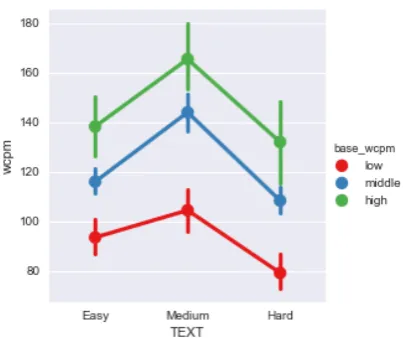
Figure 3: AverageWCPMfor the three texts in our study. To illustrate the interaction between fluency and text we divided all speakers into three equal bins based on ‘base wcpm’.
pattern of the oral reading.
Row 5 in Table3shows a significant interaction effect between text and base WCPM, for Medium vs Easy texts: The higher the base reading fluency of the child (base wcpm), the bigger the difference inWCPMbetween Easy and Medium text. This ef-fect is consistent with the tendency shown in row 6, though it does not reach significance: the more fluent readers also tended to differentiate more between the Medium and Hard texts. This find-ing suggests that more fluent readers seem to have a tendency to differentiate their oral reading pat-tern depending on the text they read to a larger ex-tent than the less fluent readers. Indeed, there is a significant, medium-strength correlation between a child’saverageWCPMfor the three texts and his or her variancein WCPM across these texts: r = 0.47,p <0.01.
Figure3shows the average ofWCPMacross the three texts in our study. To illustrate the interac-tion between text and fluency we divided all chil-dren into three equal groups based on their base WCPMon the reference text.
[image:6.595.76.288.320.432.2]iden-tity has a significant effect, with one of the com-parisons going in the opposite direction from that predicted; the interaction effect for base reading rate and text for Easy vs Medium is significant; order and the second interaction effects are not significant. This finding suggests that, at least for these readers, the basic speed of reading is system-atically affected by the identity of the text. 5 Discussion
The main finding in our study is that while differ-ent passages consistdiffer-ently elicit differdiffer-ent reading rates, text complexity as estimated by a state-of-the-art measure does not predict the differences correctly – a passage that is rated as 3.2 grade lev-els more difficult than another is in fact read sig-nificantlyfaster, consistently across readers. We consider several possible reasons for this effect:
• TextEvaluator’s complexity estimates may not be accurate when applied to passages from a novel.
• Oralreading is not only a kind of reading, but also a kind ofspeaking. Reading rate might thus be affected by properties of speech, in a direction that differs, or even contradicts, the impact of text complexity.
• Reading a story aloud, or narration, is not only a kind of oral reading, but also a kind ofperformancefor an audience. While chil-dren are not explicitly asked to narrate, the nature of the text might drive them to do so, as well as the model reading provided by the narrator of the audiobook (recall that the chil-dren listened to a passage narrated by the ac-tor Jim Dale before reading aloud their own passages). Variation in WCPM across texts could be effected by demands of expressive narration that are unrelated, or at least not di-rectly related, to comprehension complexity of the text.
5.1 Estimation of text complexity in book excerpts
One possible hypothesis for explaining the find-ing is that TextEvaluator scores may not provide an adequate estimate of complexity for book ex-cerpts, since the engine, like many other complex-ity/readability measures, has been developed and validated for estimating reading comprehension difficulty of standalone passages meant for use in
assessments. In particular, the guidelines for using TextEvaluator specifically exclude drama, yet the Easy text includes an informal conversation with punctuation used to indicate emotions of the in-terlocutors. The Easy text contains the following excerpts:
(1) “Well, I just thought ... maybe ... it was something to do with ... you know ... her crowd.”
(2) “Funny stuff on the news,” Mr. Durs-ley mumbled. “Owls ... shooting stars ... and there were a lot of funny-looking people in town today ... ”
TextEvaluator treats “...” as if they were sentence-final periods, as in:
(3) “Well, I just thought. Maybe. It was something to do with. You know. Her crowd.”
(4) “Funny stuff on the news,” Mr. Durs-ley mumbled. “Owls. Shooting stars. And there were a lot of funny-looking people in town today.”
This creates multiple very short sentences which in turns lowers the complexity score since average sentence length is one of the indicators of text complexity. However, an alternative interpre-tation where utterance-internal “...” are more akin to commas is also possible, as in:
(5) “Well, I just thought, maybe, it was something to do with, you know, her crowd.”
(6) “Funny stuff on the news,” Mr. Durs-ley mumbled. “Owls, shooting stars, and there were a lot of funny-looking people in town today.”
analyzing passages for assessments would not ac-count correctly for stylistic devices used in nov-els. Indeed, Nelson et al. (2012) observed that various measures of text complexity, including TextEvaluator, generally had better correlations with grade level for informational texts than for narrative texts.
5.2 Text complexity vs general properties of speech prosody
Average sentence length is a text complexity in-dicator used in both classical (such as Flesh-Kincaid) and modern text complexity measures – longer sentences tend to be more difficult from the point of view of comprehension. From the point of view of speech prosody, however, it is not clear that a long sentence would be uttered slower than a few shorter sentences covering, in total, the same number of words (or syllables). Studies of speech prosody have consistently demonstrated that the duration of segments increases at certain impor-tant locations within utterances, sentence bound-aries being one such location (see White (2014) for a detailed review of this topic). As a result, the overall time it would take to read a text with many short sentences might in fact be longer than a text with the same number of words split into longer sentences.
We observe that the actor who is narrating the audiobook is unlikely to be influenced by text complexity to the same extent as young readers who are still learning to read. It is hard to imagine that any of the passages in HP1 are genuinely dif-ficult for the narrator, as a reader who is not only proficient but highly skilled,8and also very
famil-iar with the text he is narrating. Thus, if we ob-serve substantial variation in reading rates across the three texts for the narrator, it is likely that the reason for the changes is something other than text complexity, as quantified by comprehension-related measures.
To test this hypothesis we compute the reading rate for the narrator following the same approach as described above. We found that the patterns of the reading rate of the narrator closely followed those we observed for children in our study: The Easy text was read slower than the Medium text which in turn was read faster than the Hard text. Figure4shows theWCPMfor the narrator relative to the children in our study.
[image:8.595.321.523.65.235.2]8The narrator, Jim Dale, has won Grammy awards for his recordings of two of the seven Harry Potter books.
Figure 4: AverageWCPM for children in our cor-pus and the audiobook narrator (purple).
It appears that readers with different levels of reading fluency (young learners and a perform-ing professional), are affected by some aspect of the text in a similar way, which makes it less likely that this aspect is directly related to compre-hension complexity, since complexity should pose much less of a challenge for a performing profes-sional than for a second grader. General patterns of speech are one potential reason (as also men-tioned in section 5.2); another possibility is that in the context of narrating a story, reading rate is affected by “directives” in the text that govern ex-pressive oral reading performance of each passage (cf. Theune et al.(2006)). Such directives could include markers of hesitation, emphasis, surprise, stuttering, etc.; some of these might have a sys-tematic effect on reading rate.
5.3 Interaction between base fluency and impact of text identity
profi-ciency readers are likely to be focused more on reading words, while better readers also attend to other structures in the text. Indeed, Schwanen-flugel et al.(2015) found that more fluent readers communicate linguistic focus while reading aloud by prosodically marking direct quotes, exclama-tions, and contrastive words. This direction re-quires further exploration; if the finding is repli-cated with a larger sample of readers with more variation in reading proficiencies, it would suggest that the extent of adjustment for text effects needs to be moderated by the reader’s baseline reading rate.
6 Conclusion
In this paper we discussed the challenges of continuous fluency tracking within an assisted-reading intervention where a child reads a long novel rather than a set of grade-controlled pas-sages. We showed that there is substantial vari-ation in passage difficulty across a single book as estimated by a state-of-the-art measure of text complexity for comprehension and a consistent variation in reading rates between passages. Con-tinuous fluency tracking needs to account for this variability. The results of our small preliminary study suggest not only that a state-of-the-art mea-sure of comprehension complexity does not pre-dict reading rates well, but in fact substantial vari-ation in reading rates may be unrelated to com-prehension complexity of the text. Additional re-search needs to be done to further explore these relationships.
7 Acknowledgements
We would like to thank Ren´e Lawless, Kelsey Dreier, and Thomas Florek for their help with data collection; Diane Napolitano for her help with running TextEvaluator; Patrick Lange and Binod Gyawali for their help with preparing the narra-tor’s data. We would also like to thank our many colleagues at ETS who discussed this work with us and provided useful comments.
References
Scott P. Ardoin, Shannon M. Suldo, Joseph Witt, Seth Aldrich, and Erin McDonald. 2005. Accuracy of readability estimates’ predictions of CBM perfor-mance.School Psychology Quarterly20(1):1–22.
Jennifer Balogh, Jared Bernstein, Jian Cheng, and Bren Townshend. 2007. Automatic evaluation of reading
accuracy: Assessing machine scores. Proceedings of SLaTE ITWR Workshop.
Jennifer Balogh, Jared Bernstein, Jian Cheng, Alis-tair Van Moere, Brent Townshend, and Masanori Suzuki. 2012. Validation of automated scoring of oral reading. Educational and Psychological Mea-surement72(3):435–452.
Lisa Beinborn, Torsten Zesch, and Iryna Gurevych. 2014. Readability for foreign language learn-ing: The importance of cognates. International Journal of Applied Linguistics 165(2):136–162.
https://doi.org/doi:10.1075/itl.165.2.02bei.
William S. Cleveland. 1979. Robust locally weighted regression and smoothing scatterplots. Journal of the American Statistical Association 74(368):829– 836.
Donald Compton, Amanda Appleton, and Michelle Hosp. 2004. Exploring the relationship between text-leveling systems and reading accuracy and flu-ency in second-grade students who are average and poor decoders. Learning Disabilities Research 19(3):176–184.
Edgar Dale and Jeanne Chall. 1949. The concept of readability.Elementary English26(23).
Mary C. Danne, Jay R. Campbell, Wendy S. Grigg, Madeline J. Goodman, and Andreas Oranje. 2005. Fourth-Grade Students Reading Aloud: NAEP 2002 Special Study of Oral Reading. The Nation’s Report Card. NCES 2006-469. National Center for Educa-tion Statistics.
William DuBay. 2004. The principles of readability. http://files.eric.ed.gov/fulltext/ED490073.pdf. Maxine Eskenazi. 2009. An overview of spoken
lan-guage technology for education. Speech Communi-cation51(10):832–844.
Lijun Feng, No´emie Elhadad, and Matt Huenerfauth. 2009. Cognitively motivated features for readability assessment. InProceedings of the 12th Conference of the European Chapter of the ACL (EACL 2009). Association for Computational Linguistics, Athens, Greece, pages 229–237.
Rudolph Flesch. 1948. A new readability yardstick. Journal of Applied Psychology32(3):221–233. Michael Flor and Beata Beigman Klebanov. 2014.
As-sociative lexical cohesion as a factor in text com-plexity. International Journal of Applied Linguistics 165(2):223–258.
Gilbert Fowler. 1978. The comparative readability of newspapers and novels. Journalism Quarterly 55(3):589–591.
Lynn S. Fuchs, Douglas Fuchs, Michelle K. Hosp, and Joseph R. Jenkins. 2001. Oral reading fluency as an indicator of reading competence: A theoretical, empirical, and historical analysis. Scientific Studies of Reading5(3):239–256.
Roland H. Good, Deborah C. Simmons, and Edward J. Kame’enui. 2001. The importance and decision-making utility of a continuum of fluency-based indi-cators of foundational reading skills for third-grade high-stakes outcomes. Scientific Studies of Reading 5(3):257–288.
Ronald. H. Good and Ruth. A. Kaminski. 2002. DI-BELS oral reading fluency passages for first through third grades. Technical Report 10. Eugene, OR: University of Oregon.
Robert Gunning. 1952. The Technique of Clear Writ-ing. McGraw-Hill.
Jan Hasbrouck and Gerald Tindal. 2006. Oral reading fluency norms: A valuable assessment tool for reading teachers. The Reading Teacher59(7):636– 644.
Michael Heilman, Kevyn Collins-Thompson, Jamie Callan, and Maxine Eskenazi. 2007. Combining lexical and grammatical features to improve read-ability measures for first and second language texts. In Human Language Technologies 2007: The Con-ference of the North American Chapter of the Asso-ciation for Computational Linguistics; Proceedings of the Main Conference. Association for Computa-tional Linguistics, Rochester, New York, pages 460– 467.
Roxanne F. Hudson, Paige C. Pullen, Holly B. Lane, and Joseph K. Torgesen. 2008. The complex na-ture of reading fluency: A multidimensional view. Reading & Writing Quarterly25(1):4–32.
Joseph R. Jenkins, J. Jason Graff, and Diana L. Miglioretti. 2009. Estimating reading growth using intermittent CBM progress monitoring. Exceptional Children46:315–342.
J. Peter Kincaid, Robert P. Fishburne, Richard Rogers, and Brad Chissom. 1975. Derivation of new read-ability formulas (Automated Readread-ability Index, Fog Count and Flesch Reading Ease Formula) for navy enlisted personnel. Institute for Simulation and Training56.
G. Harry McLaughlin. 1969. SMOG grading - a new readability formula. Journal of Reading12(8):639– 646.
Michael Milone. 2012. The Development of ATOS: The Renaissance Readability Formula.
http://mpemc.weebly.com/uploads/5/4/0/7/5407355/ development of atos.pdf.
Jack Mostow. 2012. Why and how our auto-mated reading tutor listens. Proceedings of the International Symposium on Automatic Detection
of Errors in Pronunciation Training pages 43– 52. https://www.cs.cmu.edu/˜listen/pdfs/2012-05-05 ISADEPT2012 keynote final.pdf.
Diane Napolitano, Kathleen M. Sheehan, and Robert Mundkowsky. 2015. Online readability and text complexity analysis with TextEvaluator. In Pro-ceedings of HLT-NAACL. pages 96–100.
Jessica Nelson, Charles Perfetti, David Liben, and Meredith Liben. 2012. Measures of text difficulty: Testing their predictive value for grade levels and student performance. In Technical Report to the Gates Foundation.
http://achievethecore.org/content/upload/ nelson perfetti liben measures of text difficulty research ela.pdf.
Yaacov Petscher and Young-Suk Kim. 2011. The util-ity and accuracy of oral reading fluency score types in predicting reading comprehension. Journal of School Psychology49(1):107–129.
Greg Roberts, Roland Good, and Stephanie Corcoran. 2005. Story retell: A fluency-based indicator of reading comprehension. School Psychology Quar-terly20(3):304–317.
Joanne K. Rowling and Jim Dale. 2016. Harry Potter and the sorcerer’s stone. Listening Library/Penguin Random House, New York.
https://usd.shop.pottermore.com/collections/audio-books/products/harry potter and the sorcerers stone audio book1 english.
Paula J. Schwanenflugel, Matthew R. Westmoreland, and Rebekah George Benjamin. 2015. Reading flu-ency skill and the prosodic marking of linguistic fo-cus.Reading and Writing28(1):9–30.
Sarah E. Schwarm and Mari Ostendorf. 2005. Reading level assessment using support vector machines and statistical language models. In Proceedings of the 43rd Annual Meeting on Association for Compu-tational Linguistics. Association for Computational Linguistics, Stroudsburg, PA, USA, ACL ’05, pages 523–530.
Skipper Seabold and Josef Perktold. 2010. Statsmod-els: Econometric and Statistical Modeling with Python. In Proceedings of the Python in Science Conference. pages 57–61.
Kathleen M. Sheehan, Michael Flor, and Diane Napoli-tano. 2013. A two-stage approach for generating un-biased estimates of text complexity. InProceedings of the Workshop on Natural Language Processing for Improving Textual Accessibility. Association for Computational Linguistics, Atlanta, Georgia, pages 49–58.
George Spache. 1953. A new readability formula for primary-grade reading materials. The Elementary School Journal53(7):410–413.
Mari¨et Theune, Koen Meijs, Dirk Heylen, and Roeland Ordelman. 2006. Generating expressive speech for storytelling applications. IEEE Transactions on Au-dio, Speech and Language Processing 14(4):1137– 1144.
Sowmya Vajjala and Detmar Meurers. 2012. On im-proving the accuracy of readability classification us-ing insights from second language acquisition. In Proceedings of the Seventh Workshop on Build-ing Educational Applications UsBuild-ing NLP. Associ-ation for ComputAssoci-ational Linguistics, Stroudsburg, PA, USA, pages 163–173.
Miya Miura Wayman, Teri Wallace, Hilda Ives Wi-ley, Renta Tich, and Christine A. Espin. 2007. Literature synthesis on curriculum-based measure-ment in reading. The Journal of Special Education 41(2):85–120.
Laurence White. 2014. Communicative function and prosodic form in speech timing. Speech Communi-cation63-64:38–54.