Grammatical error correction using neural machine translation
Zheng Yuan and Ted Briscoe The ALTA Institute Computer Laboratory University of Cambridge
{zy249,ejb}@cam.ac.uk
Abstract
This paper presents the first study using neu-ral machine translation (NMT) for grammati-cal error correction (GEC). We propose a two-step approach to handle the rare word problem in NMT, which has been proved to be useful and effective for the GEC task. Our best NMT-based system trained on the CLC outperforms our SMT-based system when testing on the publicly available FCE test set. The same sys-tem achieves an F0.5 score of 39.90% on the
CoNLL-2014 shared task test set, outperform-ing the state-of-the-art and demonstratoutperform-ing that the NMT-based GEC system generalises ef-fectively.
1 Introduction
Grammatical error correction (GEC) is the task of detecting and correcting grammatical errors in text written by non-native English writers. Un-like building machine learning classifiers for spe-cific error types (e.g. determiner or preposition er-rors) (Tetreault and Chodorow, 2008; Rozovskaya and Roth, 2011; Dahlmeier and Ng, 2011), the idea of ‘translating’ a grammatically incorrect sen-tence into a correct one has been proposed to handle all error types simultaneously (Felice et al., 2014; Junczys-Dowmunt and Grundkiewicz, 2014). Sta-tistical machine translation (SMT) has been suc-cessfully used for GEC, as demonstrated by the top-performing systems in the CoNLL-2014 shared task (Ng et al., 2014).
Recently, several neural machine translation (NMT) models have been developed with promis-ing results (Kalchbrenner and Blunsom, 2013; Cho
et al., 2014; Sutskever et al., 2014; Bahdanau et al., 2014). Unlike SMT, which consists of com-ponents that are trained separately and combined during decoding (i.e. the translation model and lan-guage model) (Koehn, 2010), NMT learns a single large neural network which inputs a sentence and outputs a translation. NMT is appealing for GEC as it may be possible to correct erroneous word phrases and sentences that have not been seen in the train-ing set more effectively (Luong et al., 2015). NMT-based systems thus may help ameliorate the lack of large error-annotated learner corpora for GEC.
However, NMT models typically limit vocabu-lary size on both source and target sides due to the complexity of training (Sutskever et al., 2014; Bah-danau et al., 2014; Luong et al., 2015; Jean et al., 2015). Therefore, they are unable to translate rare words, and out-of-vocabulary (OOV) words are re-placed withUNKsymbol. This problem is more se-rious for GEC as non-native text contains not only rare words (e.g. proper nouns), but also misspelled words (i.e. spelling errors). By replacing all the OOV words with the sameUNKsymbol, useful in-formation is discarded, resulting in systems that are not able to correct misspelled words or even keep some of the error-free original words, as in the fol-lowing examples (OOV words are underlined):
Original sentence
... I amgoignto make a plan ... System hypothesis
... I am UNK to make a plan ... Gold standard
... I amgoingto make a plan ...
Original sentence
I suggest you visit first the cathedral of “ Le Seu d’Mrgell ” because it is the most emblematic building in the area .
System hypothesis
I suggest you visit first the cathedral of “ Le UNK UNK ” because it is the most UNK build-ing in the area .
Gold standard
I suggest you visit first the cathedral of “ Le Seu d’Mrgell ” because it is the most emblematic building in the area .(unchanged)
Inspired by the work of Luong et al. (2015), we propose a similar but much simpler two-step ap-proach to address the rare word problem: rather than annotating the training data with alignment infor-mation, we apply unsupervised alignment models to find the sources of the words in the target sentence. Once we know the source words that are responsible for the unknown target words, a word level transla-tion model learnt from parallel sentences is used to translate these source words.
This paper makes the following contributions. First, we present the first study using NMT for GEC, outperforming the state-of-the-art. Second, we pro-pose a two-step approach to address the rare word problem in NMT for GEC, which we show yields a substantial improvement. Finally, we report results on two well-known publicly available test sets that can be used for cross-system comparisons.
2 Neural machine translation
NMT systems apply the so-called encoder-decoder mechanism proposed by Cho et al. (2014) and Sutskever et al. (2014). An encoder reads and en-codes an entire source sentencex= (x1, x2, ..., xT) into a vectorc:
c=q(h1, h2, ..., hT) (1) where a hidden statehtat timetis defined as:
ht=f(xt, ht−1) (2)
A decoder then outputs a translation y = (y1, y2, ..., yT0)by predicting the next wordytbased
on the encoded vectorcand all the previously pre-dicted words{y1, y2, ..., yt−1}:
p(y) =
T0 Y
t=1
p(yt|{y1, y2, ..., yt−1}, c) =
T0 Y
t=1
g(yt−1, st, c) (3) wherestis the hidden state of the decoder. Different neural network models have been proposed, for example, Kalchbrenner and Blun-som (2013) proposed a hybrid of a recurrent neural network (RNN) and a convolutional neural network, Sutskever et al. (2014) used a Long Short-Term Memory (LSTM) model, Cho et al. (2014) proposed a similar but simpler gated RNN model, and Bah-danau et al. (2014) introduced an attentional-based architecture.
In this work, we use the RNNsearch model of Bahdanau et al. (Bahdanau et al., 2014), which con-tains a bidirectional RNN as an encoder and an attention-based decoder. The bidirectional RNN en-coder has a forward and a backward RNN. The for-ward RNN reads the source sentence from the first word to the last, and the backward RNN reads the source sentence in reverse order. By doing this, it captures both historical and future information. The attention-based model allows the decoder to fo-cus on the most relevant information in the source sentence, rather than remembering the entire source sentence.
3 Handling rare words
traced back to their origins. The training data was first re-annotated using the output of a word align-ment algorithm. NMT systems were then built using this new data. Finally, information about the OOV words in the target sentence and their corresponding words in the source sentence was extracted from the NMT systems and used in a post-processing step to translate these OOV words using a dictionary.
We propose a similar two-step approach: 1) align-ing the unknown words (i.e.UNKtokens) in the tar-get sentence to their origins in the source sentence with an unsupervised aligner; 2) building a word level translation model to translate those words in a post-processing step. In order to locate the source words that are responsible for the unknown target words, we apply unsupervised aligners directly and use only the NMT model output instead of first re-annotating training data, and then building new NMT models using this newly annotated data as pro-posed by Luong et al. (2015). Our approach is much simpler as we avoid re-annotating any data and train only one NMT model. Due to the nature of error cor-rection (i.e. both source and target sentences are in the same language), most words translate as them-selves, and errors are often similar to their correct forms. Thus, unsupervised aligners can be success-fully used to align the unknown target words. Two automatic alignment tools are used: GIZA++ (Och and Ney, 2003) and METEOR (Banerjee and Lavie, 2005). GIZA++ is an implementation of IBM Mod-els 1-5 (Brown et al., 1993) and a Hidden-Markov alignment model (HMM) (Vogel et al., 1996), which can align two sentences from any languages. Un-like GIZA++, METEOR aligns two sentences from the same language. The latest METEOR 1.5 only supports a few languages, and English is one of them. METEOR identifies not only words with ex-act matches, but also words with identical stems, synonyms, and unigram paraphrases. This is use-ful for GEC as it can deal with word form, noun number, and verb form corrections that share iden-tical stems, as well as word choice corrections with synonyms or unigram paraphrases. To build a word level translation model for translating the source words that are responsible for the target unknown words, we need word-aligned data. The IBM Mod-els are used to learn word alignment from parallel sentences.
4 Experiments
4.1 Dataset
We use the publicly available FCE dataset (Yan-nakoudakis et al., 2011), which is a part of the Cambridge Learner Corpus (CLC) (Nicholls, 2003). The FCE dataset contains 1,244 scripts produced by learners taking the First Certificate in English (FCE) examination between 2000 and 2001. The texts have been manually annotated by linguists using a taxon-omy of approximately 80 error types. The publicly available FCE dataset contains about 30,995 pairs of parallel sentences for training (approx. 496,567 tokens on the target side) and about 2,691 pairs of parallel sentences for testing (approx. 41,986 tokens on the target side). Since the FCE training set is too small to build good MT systems, we add train-ing examples extracted from the CLC. Overall, there are 1,965,727 pairs of parallel sentences in our train-ing set. The source side contains 28,823,615 words with 248,028 unique words, and the target side con-tains 29,219,128 words with 143,852 unique words. As we can see, the source side vocabulary size is much larger than that of the target side. Training and test data is pre-processed using RASP (Briscoe et al., 2006).
4.2 Evaluation
System performance is evaluated using three au-tomatic evaluation metrics: I-measure (Felice and Briscoe, 2015), M2 Scorer (Dahlmeier and Ng,
2012) and GLEU (Napoles et al., 2015). In the I-measure, an Improvement (I) score is computed by comparing system performance with that of a baseline which leaves the original text uncorrected (i.e. the source). The M2 Scorer was the official
scorer in the CoNLL shared tasks (Ng et al., 2013; Ng et al., 2014), with F0.5 being the reported
met-ric in the 2014 edition. GLEU is a simple variant of BLEU (Papineni et al., 2002), which shows better correlation with human judgments on the CoNLL-2014 shared task test set.
4.3 SMT baseline
translation table. In addition to default features, we add character-level Levenshtein distance to each mapping in the phrase table as proposed by Fe-lice et al. (2014). Decoding is performed using Moses (Koehn et al., 2007). The language model used during decoding is built from the corrected sentences in the learner corpus, to make sure that the final system outputs fluent English sentences. The IRSTLM Toolkit (Federico et al., 2008) is used to buid a 5-gram language model with modified Kneser-Ney smoothing (Kneser and Ney, 1995). 4.4 NMT training details
Our training procedure and hyper-parameters for the NMT system are similar to those used by Bahdanau et al. (2014). We train models with sentences of length up to 100 words, which covers about 99.96% of all the training examples. In terms of vocabulary size, we limit the target vocabulary size to 30K, and experiment with three different source vocabulary sizes: 30K, 50K and 80K.1 Each model is trained
for approximately 5 days using a Tesla K20 GPU. The output sentences from the NMT systems are aligned with their source sentences using GIZA++. In addition, alignment information learnt by ME-TEOR is used by GIZA++ during aligning. All the UNK tokens in the output sentences are replaced with the translation of the source words that are re-sponsible for those UNK tokens. The translation is performed using a word level model learnt from IBM Model 4.
4.5 Results
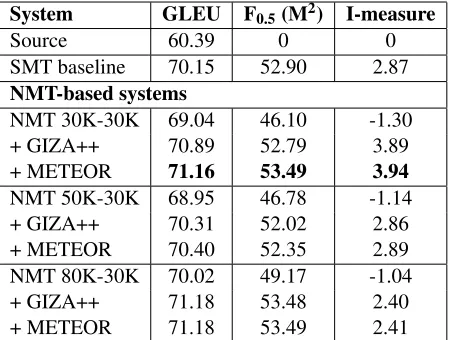
From the results in Table 1, we can see that NMT-based systems alone are not able to achieve compa-rable results to an SMT-based system. It is proba-bly because of the rare word problem, as increasing the source side vocabulary size helps. The perfor-mance of the best NMT system alone (NMT 80K-30K), without replacingUNK tokens, is still worse than the SMT baseline. When we replace theUNK tokens in the NMT output, using GIZA++ for un-known word alignment improves the system per-formance for all three NMT systems in all three evaluation metrics. We can see that our proposed approach is more useful for NMT systems trained 1Preliminary experiments show that increasing the source side vocabulary size is more useful than target side.
System GLEU F0.5(M2) I-measure
Source 60.39 0 0 SMT baseline 70.15 52.90 2.87
NMT-based systems
NMT 30K-30K 69.04 46.10 -1.30 + GIZA++ 70.89 52.79 3.89 + METEOR 71.16 53.49 3.94
[image:4.612.314.539.58.228.2]NMT 50K-30K 68.95 46.78 -1.14 + GIZA++ 70.31 52.02 2.86 + METEOR 70.40 52.35 2.89 NMT 80K-30K 70.02 49.17 -1.04 + GIZA++ 71.18 53.48 2.40 + METEOR 71.18 53.49 2.41
Table 1:System performance on the FCE test set (in percent-ages). The results of our best system are marked inbold.
on a small source side vocabulary (e.g. 30K) than a large vocabulary (e.g. 50K, 80K). The larger the vocabulary size, the smaller the gain after replac-ingUNKtokens. The introduction of the METEOR alignment information to GIZA++ yields further im-provements. Our best system (NMT 30K-30K + GIZA++ + METEOR) achieves an F0.5 score of
53.49%, an I score of 3.94%, and a GLEU score of 71.16%, outperforming the SMT baseline in all three evaluation metrics.
Comparing the output of the SMT baseline with that of the NMT system reveals that there are some learner errors which are missed by the SMT system but are captured by the NMT system. One possi-ble reason is that the phrase-based SMT system is trained on surface forms and therefore unaware of syntactic structure. In order to make a correction, it has to have seen the exact correction rule in the training data. Since the NMT system does not rely on any correction rules, in theory, it should be able to make any changes as long as it has seen the words in the training data. For example:
Original sentence
There arekidnapseverywhere and not all of the
familycan afford the ransom ... SMT hypothesis
There arekidnapseverywhere and not all of the
There arekidnappingseverywhere and not all of thefamiliescan afford the ransom ...
Gold standard
There arekidnappingseverywhere and not all of thefamiliescan afford the ransom ...
The SMT system fails to correct the word form er-ror as the correction rule (kidnaps→kidnappings) is not in the SMT phrase table learnt from the training data. Since these two words (kidnaps and kidnap-pings) have been seen in the training data, the NMT system corrects this error successfully.
5 CoNLL-2014 shared task
The CoNLL-2014 shared task on grammatical er-ror correction required participating systems to cor-rect all errors present in learner English text. The official training and test data comes from the Na-tional University of Singapore Corpus of Learner English (NUCLE) (Dahlmeier et al., 2013). F0.5
was adopted as the evaluation metric, as reported by the M2 Scorer. In order to test how well our
sys-tem generalises, we apply our best syssys-tem trained on the CLC to the CoNLL-2014 shared task test data directly without adding the NUCLE training data or tuning for the NUCLE. The state-of-the-art F0.5
score was reported by Susanto et al. (2014) after the shared task. By combining the outputs from two classification-based systems and two SMT-based systems, they achieved an F0.5score of 39.39%.
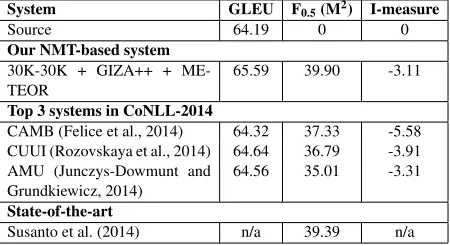
Re-sults of the uncorrected baseline, our best NMT-based system, Susanto et al. (2014)’s system and the top three systems in the shared task are presented in Table 2. We can see that our NMT-based sys-tem outperforms the top three teams, achieving the highest F0.5, I and GLEU scores. It also outperforms
the state-of-the-art combined system from Susanto et al. (2014). Our system achieves the best F0.5score
of 39.90% even though it is not trained on the NU-CLE data. This result shows that our system gen-eralises well to other datasets. We expect these re-sults might be further improved by retokenising the test data to be consistent with the tokenisation of the CLC.2
2The NUCLE data was preprocessed using the NLTK toolkit, whereas the CLC was tokenised with RASP.
System GLEU F0.5(M2) I-measure
Source 64.19 0 0
Our NMT-based system 30K-30K + GIZA++ +
ME-TEOR 65.59 39.90 -3.11
Top 3 systems in CoNLL-2014
CAMB (Felice et al., 2014) 64.32 37.33 -5.58
CUUI (Rozovskaya et al., 2014) 64.64 36.79 -3.91
AMU (Junczys-Dowmunt and
Grundkiewicz, 2014) 64.56 35.01 -3.31
State-of-the-art
[image:5.612.314.539.59.182.2]Susanto et al. (2014) n/a 39.39 n/a
Table 2:System performance on the CoNLL-2014 test set with-out alternative answers (in percentages).
6 Conclusions
We have shown that NMT can be successfully ap-plied to GEC once we address the rare word prob-lem. Our proposed two-step approach forUNK re-placement has been proved to be effective, and to provide a substantial improvement. We have de-veloped an NMT-based system that generalises well to another dataset. Our NMT system achieves an F0.5 score of 53.49%, an I score of 3.94%, and a
GLEU score of 71.16% on the publicly available FCE test set, outperforming an SMT-based system in all three metrics. When testing on the official CoNLL-2014 test set without alternative answers, our system achieves an F0.5 score of 39.90%,
out-performing the current state-of-the-art. In future work, we would like to explore other ways to ad-dress the rare word problem in NMT-based GEC, such as incorporating the soft-alignment information generated by the attention-based decoder, or using character-based models instead of word-based ones.
Acknowledgements
References
Dzmitry Bahdanau, Kyunghyun Cho, and Yoshua Ben-gio. 2014. Neural Machine Translation by Jointly Learning to Align and Translate. CoRR, abs/1409.0473.
Satanjeev Banerjee and Alon Lavie. 2005. METEOR: an automatic metric for MT evaluation with improved correlation with human judgments. InProceedings of the ACL Workshop on Intrinsic and Extrinsic Evalu-ation Measures for Machine TranslEvalu-ation and/or Sum-marization, pages 65–72.
Ted Briscoe, John Carroll, and Rebecca Watson. 2006. The second release of the RASP system. In Proceed-ings of the COLING/ACL 2006 Interactive Presenta-tion Sessions, pages 77–80.
Chris Brockett, William B. Dolan, and Michael Gamon. 2006. Correcting ESL errors using phrasal SMT tech-niques. In Proceedings of the COLING/ACL 2006, pages 249–256.
Peter F. Brown, Vincent J. Della Pietra, Stephen A. Della Pietra, and Robert L. Mercer. 1993. The mathemat-ics of statistical machine translation: parameter esti-mation. Computational Linguistics, 19(2):263–311. Kyunghyun Cho, Bart van Merrienboer, Caglar Gulcehre,
Dzmitry Bahdanau, Fethi Bougares, Holger Schwenk, and Yoshua Bengio. 2014. Learning Phrase Repre-sentations using RNN Encoder-Decoder for Statistical Machine Translation. InProceedings of the 2014 Con-ference on Empirical Methods in Natural Language Processing, pages 1724–1734.
Daniel Dahlmeier and Hwee Tou Ng. 2011. Gram-matical error correction with alternating structure op-timization. InProceedings of the 49th Annual Meet-ing of the Association for Computational LMeet-inguistics, pages 915–923.
Daniel Dahlmeier and Hwee Tou Ng. 2012. Better evalu-ation for grammatical error correction. InProceedings of the 2012 Conference of the North American Chap-ter of the Association for Computational Linguistics: Human Language Technologies, pages 568–572. Daniel Dahlmeier, Hwee Tou Ng, and Siew Mei Wu.
2013. Building a large annotated corpus of learner en-glish: the NUS Corpus of Learner English. In Pro-ceedings of the 8th Workshop on Innovative Use of NLP for Building Educational Applications, pages 22– 31.
Marcello Federico, Nicola Bertoldi, and Mauro Cettolo. 2008. IRSTLM: an open source toolkit for handling large scale language models. InProceedings of the 9th Annual Conference of the International Speech Com-munication Association, pages 1618–1621.
Mariano Felice and Ted Briscoe. 2015. Towards a stan-dard evaluation method for grammatical error
detec-tion and correcdetec-tion. InProceedings of the 2015 Con-ference of the North American Chapter of the Associa-tion for ComputaAssocia-tional Linguistics: Human Language Technologies, pages 578–587.
Mariano Felice, Zheng Yuan, Øistein E. Andersen, He-len Yannakoudakis, and Ekaterina Kochmar. 2014. Grammatical error correction using hybrid systems and type filtering. InProceedings of the 18th Confer-ence on Computational Natural Language Learning: Shared Task, pages 15–24.
S´ebastien Jean, Kyunghyun Cho, Roland Memisevic, and Yoshua Bengio. 2015. On Using Very Large Target Vocabulary for Neural Machine Translation. In Pro-ceedings of the 53rd Annual Meeting of the Associa-tion for ComputaAssocia-tional Linguistics and the 7th Inter-national Joint Conference on Natural Language Pro-cessing, pages 1–10.
Marcin Junczys-Dowmunt and Roman Grundkiewicz. 2014. The AMU system in the CoNLL-2014 shared task: grammatical error correction by data-intensive and feature-rich statistical machine translation. In
Proceedings of the 18th Conference on Computational Natural Language Learning: Shared Task, pages 25– 33.
Nal Kalchbrenner and Phil Blunsom. 2013. Recurrent Continuous Translation Models. In Proceedings of the 2013 Conference on Empirical Methods in Natu-ral Language Processing, pages 1700–1709.
Reinhard Kneser and Hermann Ney. 1995. Improved backing-off for M-gram language modeling. In Pro-ceedings of the IEEE International Conference on Acoustics, Speech, and Signal Processing, pages 181– 184.
Philipp Koehn, Hieu Hoang, Alexandra Birch, Chris Callison-Burch, Marcello Federico, Nicola Bertoldi, Brooke Cowan, Wade Shen, Christine Moran, Richard Zens, Chris Dyer, Ondˇrej Bojar, Alexandra Con-stantin, and Evan Herbst. 2007. Moses: open source toolkit for statistical machine translation. In Proceed-ings of the 45th Annual Meeting of the ACL on Inter-active Poster and Demonstration Sessions, pages 177– 180.
Philipp Koehn. 2010. Statistical Machine Translation. Cambridge University Press.
Thang Luong, Ilya Sutskever, Quoc Le, Oriol Vinyals, and Wojciech Zaremba. 2015. Addressing the Rare Word Problem in Neural Machine Translation. In Pro-ceedings of the ACL-IJCNLP, pages 11–19.
Graham Neubig, Taro Watanabe, Eiichiro Sumita, Shin-suke Mori, and Tatsuya Kawahara. 2011. An unsuper-vised model for joint phrase alignment and extraction. InProceedings of the 49th Annual Meeting of the As-sociation for Computational Linguistics: Human Lan-guage Technologies, pages 632–641.
Hwee Tou Ng, Siew Mei Wu, Yuanbin Wu, Christian Hadiwinoto, and Joel Tetreault. 2013. The CoNLL-2013 shared task on grammatical error correction. In
Proceedings of the Seventeenth Conference on Com-putational Natural Language Learning: Shared Task, pages 1–12.
Hwee Tou Ng, Siew Mei Wu, Ted Briscoe, Christian Hadiwinoto, Raymond Hendy Susanto, and Christo-pher Bryant. 2014. The CoNLL-2014 shared task on grammatical error correction. In Proceedings of the 18th Conference on Computational Natural Language Learning: Shared Task, pages 1–14.
Diane Nicholls. 2003. The Cambridge Learner Corpus - error coding and analysis for lexicography and ELT. InProceedings of the Corpus Linguistics 2003 Confer-ence, pages 572–581.
Franz Josef Och and Hermann Ney. 2003. A system-atic comparison of various statistical alignment mod-els. Computational Linguistics, 29(1):19–51.
Kishore Papineni, Salim Roukos, Todd Ward, and Wei-Jing Zhu. 2002. BLEU: a method for automatic eval-uation of machine translation. InProceedings of the 40th Annual Meeting of the Association for Computa-tional Linguistics, pages 311–318.
Alla Rozovskaya and Dan Roth. 2011. Algorithm selec-tion and model adaptaselec-tion for ESL correcselec-tion tasks. In
Proceedings of the 49th Annual Meeting of the Associ-ation for ComputAssoci-ational Linguistics, pages 924–933. Alla Rozovskaya, Kai-Wei Chang, Mark Sammons, Dan
Roth, and Nizar Habash. 2014. The Illinois-Columbia System in the CoNLL-2014 Shared Task. In Proceed-ings of the 18th Conference on Computational Natural Language Learning: Shared Task, pages 34–42. Hendy Raymond Susanto, Peter Phandi, and Tou Hwee
Ng. 2014. System combination for grammatical error correction. InProceedings of the 2014 Conference on Empirical Methods in Natural Language Processing (EMNLP), pages 951–962.
Ilya Sutskever, Oriol Vinyals, and Quoc V. Le. 2014. Se-quence to SeSe-quence Learning with Neural Networks. In Advances in Neural Information Processing Sys-tems, pages 3104–3112.
Joel R. Tetreault and Martin Chodorow. 2008. The ups and downs of preposition error detection in ESL writ-ing. InProceedings of the 22nd International Confer-ence on Computational Linguistics, volume 1, pages 865–872.
Stephan Vogel, Hermann Ney, and Christoph Tillmann. 1996. HMM-based word alignment in statistical trans-lation. InProceedings of the 16th International Con-ference on Computational linguistics, volume 2, pages 836–841.
Helen Yannakoudakis, Ted Briscoe, and Ben Medlock. 2011. A new dataset and method for automatically grading ESOL texts. InProceedings of the 49th An-nual Meeting of the Association for Computational Linguistics: Human Language Technologies, pages 180–189.