Proceedings of the First International Workshop on Spatial Language Understanding (SpLU-2018), pages 1–11
Exploring the Functional and Geometric Bias of Spatial Relations Using
Neural Language Models
Simon Dobnik∗ Mehdi Ghanimifard∗ John D. Kelleher† ∗CLASP and FLOV, University of Gothenburg, Sweden
†Dublin Institute of Technology, Ireland
∗{simon.dobnik,mehdi.ghanimifard}@gu.se†[email protected]
Abstract
The challenge for computational models of spatial descriptions for situated dialogue sys-tems is the integration of information from different modalities. The semantics of spa-tial descriptions are grounded in at least two sources of information: (i) a geometric repre-sentation of space and (ii) the functional inter-action of related objects that. We train sev-eral neural language models on descriptions of scenes from a dataset of image captions and examine whether the functional or geometric bias of spatial descriptions reported in the liter-ature is reflected in the estimated perplexity of these models. The results of these experiments have implications for the creation of models of spatial lexical semantics for human-robot di-alogue systems. Furthermore, they also pro-vide an insight into the kinds of the semantic knowledge captured by neural language mod-els trained on spatial descriptions, which has implications for image captioning systems.
1 Introduction
Spatial language understanding is fundamental re-quirement for human-robot interaction through di-alogue. A natural task for a human to request a robot to fulfil is to retrieve or replace an object for them. Consequently, a particularly frequent form of spatial description within human-robot interac-tion is alocative expression. A locative expression is a noun phrase that describes the location of one object (thetarget object) relative to another object (thelandmark). The relative location of the target object is specified through a prepositional phrase:
Bring methe big red book
| {z }
Target
on the table| {z } Landmark
| {z }
Prepositional Phrase
| {z }
Locative Expression
.
In order to understand these forms of spatial de-scriptions a robot must be equipped with compu-tational models of the spatial semantics of prepo-sitions that enable them to ground the semantics of the locative expression relative to the context of the situated dialogue.
A natural approach to developing these compu-tational models is to define them in terms of scene
geometry. And, indeed, there is a tradition of re-search that follows this path, see for example ( Lo-gan and Sadler,1996;Kelleher and Costello,2005,
2009). However, there is also a body of experi-mental and computational research that has high-lighted that the semantics of spatial descriptions are dependent on several sources of information beyond scene geometry, including functional se-mantics (which encompasses a range of factors such as world knowledge about the typical inter-actions between objects, and object affordances) (Coventry and Garrod, 2004). We can illustrate this distinction between geometric and function-ally defined semantics using a number of exam-ples. To illustrate a geometric semantics: assum-ing a spatial meanassum-ing, anythassum-ing can be described asto left of anything else so long the spatial con-figuration of the two objects is geometrically cor-rect. However, as (Coventry et al., 2001) has shown the spatial descriptionthe umbrella is over the manis sensitive to the protective affordances of the umbrella to stop rain, and is appropriate in contexts where, the umbrella is not in a geometri-cally prototypical position above the man, so long as the umbrella is protecting the man from the rain. A further complication with regard to modelling the semantics of spatial descriptions is that experi-mental results indicate that the contribution of ge-ometrical and functional factors is not the same for every spatial relation (Garrod et al.,1999; Coven-try et al., 2001). This experimental work shows that there is an interplay between function and
ometry in the definition of spatial semantics and therefore the spatial meaning of given spatial rela-tion is neither fully funcrela-tional nor fully geometric. Rather, spatial terms can be ordered on a spectrum based on the sensitivity of their semantics to geo-metric or functional factors.
Given the distinction between geometric and functional factors in shaping spatial semantics, a useful analysis that would inform the design and creation of computational models of spa-tial semantics isto identify the particular seman-tic bias (geometric/functional) that each spatial term evinces. However, such an analysis is dif-ficult. Native speakers do not have strong in-tuitions about the bias of prepositions and such bias had to be established experimentally ( Coven-try et al., 2001; Garrod et al., 1999) or through linguistic analysis (Herskovits,1986, p.55).1
Re-viewing the literature on this experimental and an-alytic work reveals that prepositions such as in,
on, at, over, under have been identified as being functionally biased, whereasabove,below,left of
andright of are geometrically biased. Other spa-tial relations may be somewhere in between. In this paper we will use these relations as ground-truth pointers against which our methods will be evaluated. If the method is successful, then we are able to make predictions about those relations that have not been verified for their bias experi-mentally. Knowing the bias of a spatial relation is useful both theoretically and practically. The-oretically, it informs us about the complexity of grounded semantics of spatial relations. In par-ticular, it engages with the “what” and “where” debate where it has been argued that spatial rela-tions are not only spatial (i.e. geometric) (Landau and Jackendoff,1993;Coventry and Garrod,2004;
Landau,2016). Practically, the procedure to esti-mate the bias is useful for natural language genera-tion systems, for example in situated robotic appli-cations that cannot be trained end-to-end. Given that a particular pair of objects can be described geometrically with several spatial relations, the knowledge of functional bias may be used as a fil-ter, prioritising those relations that are more likely for a particular pair of objects, thereby
incorporat-1The discussion of Herskovits focuses on interaction of objects conceptualised as geometric shapes, for exampleon: contiguity with line or surface. The fact that the inter-acting objects can be conceptualised as different geometric shapes points and therefore related by a particular preposi-tions points to their functional nature as discussed here.
ing functional knowledge. This approach to gen-eration of spatial descriptions is therefore similar to the approach that introduces a cognitive load based hierarchy of spatial relations (Kelleher and Kruijff, 2006) or a classification-based approach that combines geometric (related to the bounding box), textual (word2vec embeddings) and visual features (final layer of a convolutional network) (Ramisa et al., 2015). The functional geometric bias of spatial relations could also be used to in-form semantic parsing, for example in preposi-tional phrase attachment resolution (Christie et al.,
2016;Delecraz et al.,2017).
Previous work has investigated metrics of the semantic bias of spatial prepositions, see (Dobnik and Kelleher, 2013, 2014). (Dobnik and Kelle-her, 2013) uses (i) normalised entropy of target-landmark pairs to estimate variation of targets and landmarks per relation and (ii) log likelihood ra-tio to predict the strength of associara-tion of target-landmark pairs with a spatial relation and presents ranked lists of relations by the degree of argu-ment variation or strength of the association re-spectively. The approach hypothesises that func-tionally biased relations are more selective in the kind of targets and landmarks they co-occur with. The reasoning behind this is that geometrically it is possible to relate a wider range of objects than in the case where additional functional constrains be-tween objects are also applied. (Dobnik and Kelle-her,2014) generalises over landmarks and targets in WordNet hierarchy and estimates the generality of the types of landmark. Again, the work hypoth-esises that functional relations are more restricted in their choice of target and landmark objects and therefore are generally more specific in terms of the WordNet hierarchy. Both papers present re-sults compatible with the hypotheses where the functional or geometric nature of prepositions is predicted in line with the experimental studies (Garrod et al.,1999;Coventry et al.,2001).
Sensitive to the fact that relations such asinand
This paper adopts a similar research hypothe-sis to (Dobnik and Kelleher,2014,2013), namely that: it is possible to distinguish between function-ally biased and geometricfunction-ally biased spatial rela-tions by examining the diversity of the contexts in which they occur. Defining the concept of context in terms of the target and landmark object pairs that a relation occurs within, the rationale of this hypothesis is that: geometrically biased relations are more likely to be observed in a more diverse set of contexts, compared to functionally biased rela-tions, because the use of a geometrically biased relation only presupposes the appropriate geomet-ric configuration whereas the use of a functionally biased relation is also constrained by object affor-dances or typical interactions.
However, the work presented in this paper pro-vides a more general analytical technique based on a neural language model (Bengio et al.,2003;
Mikolov et al.,2010) which is applied to a larger dataset of spatial descriptions. We use neural lan-guage models as the basic tool for our analysis because they are already commonly used to learn the syntax and semantics of words in an unsu-pervised way. The contribution of this paper in relation to (i) the previous analyses of geomet-ric and functional aspects of spatial relations is that it examines whether similar predictions can be made using these more general tools of repre-senting meaning of words and phrases; the contri-bution to (ii) deep learning of language and vision is that it examines to what extent highly specific world-knowledge can be extracted from a neural language model. The paper proceeds as follows: in Section2we describe the datasets and their pro-cessing, in Section3we describe the basics behind language models and the notion of perplexity, in Section4and5we present and discuss our results. We conclude in Section6.
The code that was used to produce the datasets and results discussed in this paper can be found at: https://github.com/GU-CLASP/ functional-geometric-lm.
2 Datasets
The Amsterdam Metaphor Corpus (Steen et al.,
2010) which is based on a subsection of a BNC reveals that the spatial sense of prepositions are very rare in genres such as news, fiction and aca-demic texts. For example, below only has two instances that are not labelled as a metaphor and
more than 60% of fragments with in, on, and
over are not used in their spatial sense. For this reason Dobnik and Kelleher (2013) use two image description corpora (IAPR TC-12 ( Grub-inger et al.,2006) and Flickr8k (Rashtchian et al.,
2010)) where spatial uses of prepositions are com-mon. They apply a dependency parser and a set of post-processing rules to extract spatial relations, target and landmark object triplets. The size of this extracted dataset is 96,749 instances and is rela-tively small for training a neural language model. (Kordjamshidi et al., 2017) released CLEF 2017 multimodal spatial role labelling dataset (mSpRL) which is a human annotated subset of the IAPR TC-12 Benchmark corpus for spatial relations, tar-gets and landmarks (Kordjamshidi et al., 2011) containing 613 text files and 1,213 sentences. While this dataset could not be used to train a lan-guage model directly, a spatial role labelling clas-sifier could be trained on it to identify spatial rela-tions and arguments which would then be used to produce a bootstrapped dataset for training a neu-ral language model.
Recently, Visual Genome (Krishna et al.,2017) has been released which is a crowd-source an-notated corpus of 108K images which also in-cludes annotations ofrelationshipsbetween (pre-viously annotated) bounding boxes. Relation-ships are predicates that relate objects which in-clude spatial relations (2404639, “cup on table”), verbs (2367163, “girl holding on to bear”) as well as combinations of verbs and spatial relations (2317920, “woman standing on snow”) and oth-ers. We use this dataset in the work reported here. Its advantage is that it contains a large number of annotated relationships but the disadvantage is that these are collected in a crowd-sourced setting and are therefore sometimes noisy but we assume these are still of better quality than those from a bootstrapped machine annotated dataset.
consid-eration. While compound variants of spatial re-lations have slightly different meanings, we only collapsed those relations for which we assumed this would not affect their geometric or functional bias. Furthermore, Dobnik and Kelleher (2013) show that compound relations cluster with their non-compound variants using normalised entropy of target-landmark pairs as a metric. Finally, some variation was due to the shorthand notation used by the annotators, e.g. “to left of”. The reason be-hind keeping all relation(ships) in the training set is to train the language model on as many targets and landmarks as possible and to learn paradig-matic relations between them. We normalise all words to lowercase and remove the duplicate de-scriptions per image (created by different anno-tators). We also check for and remove instances where a spatial relation is used as an object, e.g. “chair on left”. We remove instances where one of the words has fewer than 100 occurrences in the whole dataset which reduces the dataset size by 10%. We add start and end tokens to the triplets (hsitarget relation landmarkh/si) as required for training and testing a language model. The dataset is shuffled and split into 10 folds that are later used in cross-validation. In the evaluation, we take 20 samples per spatial relation from the held out data of those relations that are members of the dictio-nary created previously. This way the average per-plexity is always calculated on the same number of samples per each relation.2
3 Language model and perplexity
3.1 Language model
Probabilistic language models capture the sequen-tial properties of language or paradigmatic rela-tions between sequences of words. Using the chain rules of probabilities they estimate the like-lihood of a sequence of words:
P(w1:T) = T
∑
t=1P
(wt+1|w1:t) (1)
Neural language models estimate probabilities by optimising parameters of a function represented in a neural architecture (Bengio et al.,2003):
ˆ
P(wt+1|w1:t =vk1:t) = f(vt−1;Θ) =ytˆ (2)
2The reason we use 20 sample is that this is also the size of the 10% test folds in the down-sampled dataset described later. In selecting 20 items for the test-set we also ensure that it contains the vocabulary in the down-sampled training folds.
whereΘrepresents parameters of the model, f be-ing the composition of functions within the neu-ral network architecture, andvk1:t the words up to timetin the sequence. The output of the function is ˆyt ∈Rn, a vector of probabilities, with each
di-mension representing the probability of a word in the vocabulary. The loss of a recurrent language model is the average surprisal for each batch of data (Graves et al.,2013;Mikolov et al.,2010):
loss(S) =−
∑
s∈S |s|
∑
t=0
log(ytˆ(vkt+1))
|S| × |s| (3)
Note that our architecture is deliberately simple as we apply it in an experimental setting with con-strained descriptions3. We use a Keras
implemen-tation (Chollet et al.,2015), and fit the model pa-rameters with Adam (Kingma and Ba,2014) with a batch size of 32 and iterations of 20 epochs. On each iteration the language model is optimised on the loss which is related to perplexity as described in the following section.
3.2 Perplexity
Instead of calculating the averages of likelihoods from Equation 1, which might get very low on long sequences of text, we use perplexity which is an exponential measure for average negative log likelihoods of the model. This solves the repre-sentation problem with floating points and large samples of data.
Perplexity(S,P) =2ES[−log2(P(w1:T))] (4)
where w1:T is an instance in a sample collection S. Perplexity is often used for evaluating language models on test sets. Since language models are optimised for low perplexities4, the perplexity of
a trained model can be used as a measure of fit of the model with the samples.
4 Varying targets and landmarks
4.1 Hypotheses
As a language model encodes semantic relations between words in a sequence we therefore expect that the distinction between functional and geo-metric spatial relations will also be captured by
3For more details on the architecture see SectionA.1in the supplementary material, in particular Figure6and Equa-tion5.
it. As functionally biased spatial relations are used in different situational contexts than geometrically biased spatial relations, we expect that a language model will capture this bias in different distribu-tions of target and landmark objects in the forms of the perplexity of phrases. Our weak hypothesis is that the perplexity of phrases on the test set flects the functional-geometric bias of a spatial re-lation (Hypothesis 1). We take the assumption that functionally-biased relations are more selective in terms of their target and landmark choice (Sec-tion1) and consequently sequences such as<s> target relation landmark </s>with
func-tional relations have a higher predictability in the dataset resulting in a lower perplexity in the lan-guage model (Hypothesis 2). Related to this hy-pothesis, there is a stronger hypothesis that target and landmark are predictable with a given func-tional spatial relation (Hypothesis 3).
4.2 Method
We train two language models as described in Section 3.1. For training and evaluation 10-fold cross-validation is used and average results are re-ported. We ensure that the evaluation sets con-tain no vocabulary not seen during the training. The language model 1 (LM1) is trained on unre-stricted frequencies of instances. In training the language model 2 (LM2) we down-sample rela-tions so that they are represented with equal fre-quencies. The dataset to train LM2 contains 200 instances of each possible relations while the eval-uation set contains 20 instances for each spatial relation. Note that using this method some tar-geted spatial relations might disappear from the evaluation set as their frequency in the held-out data is too low. In addition to the requirement that the evaluation set contains no out-of-vocabulary items, the target and landmarks are included with-out restriction on their frequency, as they occur with these spatial relations.
4.3 Results
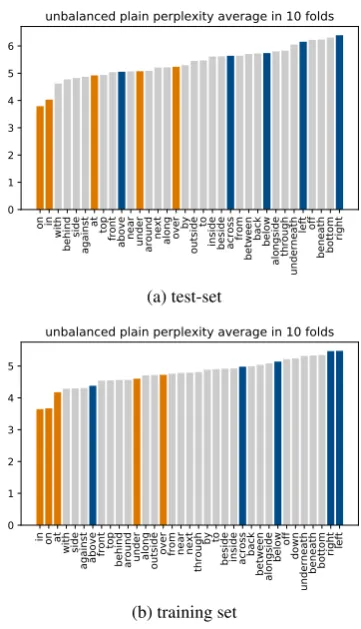
Figure 1 shows the estimated average perplexi-ties of a subset of spatial relations, those that sat-isfy the sampling frequency requirement described in Section 4.2. Functionally and geometrically biased spatial relations as identified experimen-tally in the literature (Section 1) are represented with orange and blue bars respectively. There is a tendency that functionally biased relations lead to lower mean perplexity of phrases (Hypothesis
(a) test-set
[image:5.595.324.505.67.382.2](b) training set
Figure 1: Mean perplexities of spatial descriptions of LM1 (orange: functionally biased, blue: geometrically biased relations).
2 is confirmed) and also that there is a tendency that spatial relations of a particular bias cluster to-gether (Hypothesis 1 is also confirmed). We re-port results both on the training set and the test set which show the same tendencies. This means that our model generalises well on the test set and that the latter is representative.
However, in the language model the perplexities are biased by the frequency of individual words: more frequent words are more likely and therefore they are associated with lower LM perplexity. The results show high Spearman’s rank correlation co-efficient ρ=0.90 between frequencies of spatial
relation in the dataset and the perplexity of the model on the test set: on (329,529)>in (108,880) >under (11,631)>above (8,952)>over (5,714) >at (4,890)>below (2,290)>across (1,230)>
left (996)>right (891). For the purposes of our
[image:5.595.324.506.70.227.2]frequen-(a) test-set
[image:6.595.90.270.63.382.2](b) training set
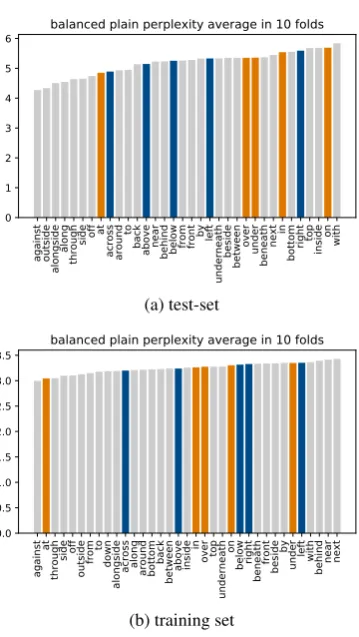
Figure 2: Mean perplexities of LM2 by spatial rela-tion (orange: funcrela-tionally biased, blue: geometrically biased).
cies in training. Figure2shows the ranking of spa-tial relations by the perplexities when the language model was trained with balanced frequencies. The two kinds of spatial relations are less clearly sep-arable as the colours overlap (Hypothesis 3 is not confirmed). In comparison to Figure1there is an observable trend that all instances lead to lower perplexities in the training set which is the effect of down-sampling on vocabulary size. Figure2also shows that phrases with geometrically biased spa-tial relations have a higher change towards lower perplexities.
Noting that the frequency of using functionally-biased spatial relations are higher in English, this bias and our strong hypothesis for predictability of target-landmark pairs can be expressed with simple joint probabilities which we are estimating with the language model:
P(target,relation,landmark) =
P(relation)P(target,landmark|relation)
It is possible that targets and landmarks that occur with these relations are very specific to these
rela-tions but infrequent with other relarela-tions. When we remove their frequency support provided by the frequency of relations these targets and landmarks become infrequent in the dataset and therefore less probable which on overall results in higher per-plexities of phrases with functionally-biased rela-tions. Specificity of targets and landmarks can be a source of these results.
To provide (some) evidence for this assump-tion, Figure3shows the average ratios of unique types over total types of targets and landmarks in the balanced dataset over 10-folds on which LM2 was trained. There is a very clear division be-tween functionally and geometrically biased spa-tial relations in terms of the uniqueness of tar-gets, functionally-biased relations are occurring with more unique ones which contributes to higher perplexity of LM2. There is less clear distinction between the two kinds of spatial relations in terms of uniqueness of landmarks. Some functional re-lations such ason occur with fewer unique land-marks than targets (from .11 to .06), some ge-ometric relations such as right occur with more unique landmarks than targets (from .07 to .11). The asymmetry between targets and landmarks is expected since the choice of landmarks in the im-age description task is restricted by the choice of the targets (as well as other contextual factors such as visual salience). They have to be “good landmarks” to relate the targets to. A functional relation-landmark pair is more related to the target through the landmark’s affordances whereas a ge-ometric relation-landmark pair is more related to the target through geometry. This might explain for example, whyonhas fewer, butrighthas more unique landmarks than targets. On the other hand there are also relations where the ratio of unique targets and landmarks is very similar, for example
at(.14 and .14). Overall, it appears that if unique-ness of objects is contributing to the perplexity of the language model of phrases which functionally-biased relations (which in this balanced dataset is the case) then this is more contributed by targets rather than the landmarks.
To further explore the idea of asymmetry be-tween targets and landmarks we re-arranged the targets and landmarks in the descriptions from the balanced dataset that LM2 was trained to
<s> landmark relation target </s>and
trained LM20. The average perplexities over
(a) targets (b) landmarks
Figure 3: Ratio between unique types and all types per spatial relation in the balanced dataset for LM2.
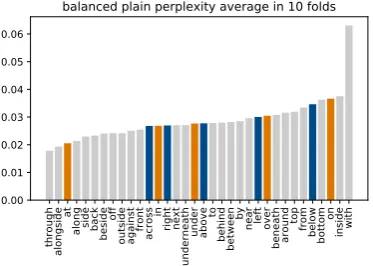
Comparing Figure4with Figure2we first observe that the perplexity of LM20 on the descriptions is
overall several magnitudes lower than the perplex-ity of LM2 (max 0.06, max 140). Secondly, we observe that the perplexities of phrases containing different relations are very similar and that there is no separation of phrases by perplexity depending on the relation bias. The results are in line with our argument above. Knowing the landmark, it is much easier for the language model to predict the relation (of either kinds) and the target.
Figure 4: Mean perplexities of LM20 by spatial
rela-tion (orange: funcrela-tionally biased, blue: geometrically biased)
In conclusion, the explanation why descriptions with functionally-biased relations have a higher perplexity than descriptions with geometrically-biased descriptions appears to be twofold: (i) functionally-biased relations are more selective of their targets as expressed by the uniqueness counts, and (ii) functional relations are also more selective of their landmarks but this fact works against the performance of the language model.
As it is trained on the sequence left to right, it has to learn to predict relations only on the basis of targets which in the case of functionally-biased relations are represented by more unique tokens than geometrically-biased relations. The more in-formative words, the landmarks, that would enable the language model to predict a functional rela-tion, comes last, after the relation has already been seen. The possible reason why geometrically-biased relations lead to lower perplexities of a lan-guage model on descriptions is because they have fewer unique targets. Hence, our Hypothesis 1 which linked selectivity of functionally-biased re-lations to low perplexity of phrases can be refuted. In spatial relations the order of the semantic in-terpretation of tokens (that we want to capture in these experiments) is different from the linear syn-tactic order of order which can be captured by the language model. When this order is changed as in LM20our predictions come closer to the
hypothe-sis (Figure4).5
By removing the frequency bias on spatial re-lations in LM2 we fix the distribution of spatial relations and examine the effect of distribution of targets and landmarks on perplexities of phrases (spatial relation as fixed context). In the follow-ing section, we fix the distributions of targets and landmarks of each spatial relation and examine the perplexity of phrases when another spatial relation is projected in this context (targets-landmarks as fixed context).
[image:7.595.84.271.441.574.2]5 Varying spatial relations
5.1 Hypotheses
Given a particular spatial relation, the distribu-tion of targets and landmarks that occur with it creates a particular signature of targets and land-marks, the target-landmark context of a spatial re-lation. In this experiment, we investigate the effect on perplexity of phrases when another spatial rela-tion is projected in such a target-landmark context. Given different selectivity of functionally- and geometrically-biased spatial relations, namely the functionally-based spatial relations are more se-lective of their targets and landmarks and therefore create more specific contexts, we should observe differences in perplexities of phrases when other spatial relations are projected in these contexts. In particular, we hypothesise that geometrically-biased spatial relations are more easily swap-pable than functionally-biased spatial relations as measured by the perplexity of a language model trained on the original, non-swapped phrases (Hy-pothesis 4).
5.2 Method
We use LM2 from Section4 (trained on the bal-anced frequencies of spatial relations) with no ad-ditional training from the previous experiment. We group descriptions in the evaluation set by spa-tial relation. For each phrase containing a par-ticular spatial relation, we replace it with every other spatial relation and estimate the perplexity of the resulting phrase using a language model. Fi-nally, we calculate the mean of perplexities over all phrases. We use 10-fold cross-validation and report the final means across the 10 folds.
5.3 Results
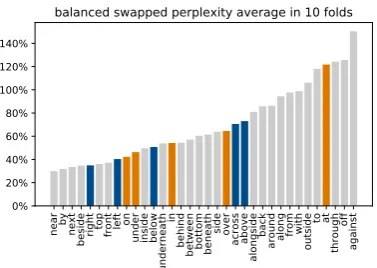
Figure 5 shows a %-increase in mean complex-ities from those in Figure 2 when LM2 is ap-plied on phrases with swapped relations in the contexts of the original relations. Hence, the column “at” shows the %-increase in perplexi-ties of phrases that originally contained atin the validation dataset but this was replaced by all other spatial relations. Comparing with Figure2
[image:8.595.317.506.69.203.2]the estimated perplexities are higher across all cases which is predictable. There is a weak ten-dency that replacing functionally-biased relations with other relations leads to higher perplexities of spatial descriptions than replacing geometrically-biased relations, but the distinction is not clear cut
Figure 5: %-increase in perplexities of LM2 shown per context of the original preposition when swapped with another one.
(Hypothesis 4 partially confirmed). The lack of a clear distinction between two classes of descrip-tions confirms our previous observadescrip-tions about landmarks and targets: the LM has learned par-ticular contexts for both kinds of descriptions.
6 Discussion and conclusion
for its arguments is correct but it is exemplified in a greater perplexity of a language model in the con-text of balanced spatial relations. We argued that this has to do with the fact that the targets are more unique to these relations (which is consequence of a greater specificity for arguments of functionally biased relations) and is also related to the way a se-quential language model works. In the unbalanced dataset, the perplexity of the language model is re-versed (it is lower with functionally biased rela-tions) because the specificity of targets to relations is boosted with greater frequency of functionally-biased relations. The fact that functionally-functionally-biased relations are more frequent is probably related to the fact that such descriptions are more informa-tive than purely geometric ones if available for a particular pair of objects.
We can only report tendencies based on the per-plexities of our language models as our conclu-sions. This is because the functional-geometric bias is graded, because the predictions are highly dependent on the quality and the size of the dataset, and because other semantic relations might also be expressed by this measure. We chose a large contemporary dataset of image de-scriptions because we hope that it contains a high proportion of prepositions used as spatial rela-tions. However, there is no guarantee that all prepositions in this dataset are used this way. We observe that there is considerable variation of obtained values across the 10-folds of cross-validation and we report the mean values over all folds. As an illustration, in the supplementary ma-terial (SectionA.2) we give an example of graphs from two intermediary folds.
Using a language model in this task we have also learned new insights about the way language models encode spatial relations in image descrip-tions. It has been pointed out (cf. (Kelleher and Dobnik, 2017) among others) that convolutional neural networks with an attention model are de-signed to detect objects whereas spatial relations between objects are likely to be predicted by the language model. In this work we show that lan-guage models are not only predicting the rela-tion (which is expected) but are able to distin-guish between different classes of relations thus encoding finer semantic distinctions. This tells us that language models are able to encode a surpris-ing amount of information about world knowledge with a usual caveat that it is difficult to separate
several strands of this knowledge.
The work can be extended in several ways. One way is to study dataset effects on the predicted re-sults. Datasets with descriptions of robotic actions and instructions may be particularly promising as they focus on spatial uses. Different normalisa-tions of spatial relanormalisa-tions have a significant effect on the results. In this work composite spatial rela-tions suchon the left side of are normalised to sim-ple spatial relations such as left. However, these could be treated as separate relations as difference between may exist. A more systematic examina-tion of clusters of spatial relaexamina-tions would eventu-ally tell us what other spatial relations not yet iden-tified as functionally or geometrically biased have similar properties to those that have identified as such experimentally.
Acknowledgements
The research of Dobnik and Ghanimifard was supported by a grant from the Swedish Research Council (VR project 2014-39) for the establish-ment of the Centre for Linguistic Theory and Studies in Probability (CLASP) at Department of Philosophy, Linguistics and Theory of Science (FLoV), University of Gothenburg.
The research of Kelleher was supported by the ADAPT Research Centre. The ADAPT Cen-tre for Digital Content Technology is funded un-der the SFI Research Centres Programme (Grant 13/RC/2106) and is co-funded under the European Regional Development Funds.
References
Yoshua Bengio, R´ejean Ducharme, Pascal Vincent, and Christian Jauvin. 2003. A neural probabilistic lan-guage model. Journal of machine learning research, 3(Feb):1137–1155.
Franc¸ois Chollet et al. 2015. Keras. https:// github.com/keras-team/keras.
Gordon Christie, Ankit Laddha, Aishwarya Agrawal, Stanislaw Antol, Yash Goyal, Kevin Kochersberger, and Dhruv Batra. 2016. Resolving language and vision ambiguities together: Joint segmentation & prepositional attachment resolution in captioned scenes.arXiv, 1604.02125 [cs.CV].
Kenny R. Coventry, Merc`e Prat-Sala, and Lynn Richards. 2001. The interplay between geometry and function in the apprehension of Over, Under, Above and Below. Journal of Memory and Lan-guage, 44(3):376–398.
Sebastien Delecraz, Alexis Nasr, Frederic Bechet, and Benoit Favre. 2017. Correcting prepositional phrase attachments using multimodal corpora. In Proceed-ings of the 15th International Conference on Parsing Technologies, pages 72–77, Pisa, Italy. Association for Computational Linguistics.
Simon Dobnik and John D. Kelleher. 2013. Towards an automatic identification of functional and geo-metric spatial prepositions. InProceedings of PRE-CogSsci 2013: Production of referring expressions – bridging the gap between cognitive and computa-tional approaches to reference, pages 1–6, Berlin, Germany.
Simon Dobnik and John D. Kelleher. 2014. Explo-ration of functional semantics of prepositions from corpora of descriptions of visual scenes. In Proceed-ings of the Third V&L Net Workshop on Vision and Language, pages 33–37, Dublin, Ireland. Dublin City University and the Association for Computa-tional Linguistics.
Yarin Gal and Zoubin Ghahramani. 2016. A theoret-ically grounded application of dropout in recurrent neural networks. InAdvances in neural information processing systems, pages 1019–1027.
Simon Garrod, Gillian Ferrier, and Siobhan Campbell. 1999. In and on: investigating the functional geom-etry of spatial prepositions. Cognition, 72(2):167– 189.
Alex Graves, Abdel-rahman Mohamed, and Geoffrey Hinton. 2013. Speech recognition with deep recur-rent neural networks. InAcoustics, speech and sig-nal processing (icassp), 2013 ieee internatiosig-nal con-ference on, pages 6645–6649. IEEE.
Michael Grubinger, Paul D. Clough, Henning M¨uller, and Thomas Deselaers. 2006. The IAPR bench-mark: A new evaluation resource for visual informa-tion systems. In Proceedings of OntoImage 2006: Workshop on language resources for content-based mage retrieval during LREC 2006, Genoa, Italy. Eu-ropean Language Resources Association.
Annette Herskovits. 1986. Language and spatial cog-nition: an interdisciplinary study of the preposi-tions in English. Cambridge University Press, Cam-bridge.
John D. Kelleher and Fintan J. Costello. 2005. Cog-nitive representations of project prepositions. In
In Proceedings of the Second ACL-Sigsem Work-shop on The Linguistic Dimensions of Prepositions and their Used In Computational Linguistic For-malisems and Applications.
John D. Kelleher and Fintan J. Costello. 2009. Apply-ing computational models of spatial prepositions to visually situated dialog.Computational Linguistics, 35(2):271–306.
John D. Kelleher and Simon Dobnik. 2017. What is not where: the challenge of integrating spatial represen-tations into deep learning architectures. In Proceed-ings of the Conference on Logic and Machine Learn-ing in Natural Language (LaML 2017), Gothenburg, 12 –13 June, volume 1 ofCLASP Papers in Compu-tational Linguistics, pages 41–52, Gothenburg, Swe-den.
John D. Kelleher and Geert-Jan M. Kruijff. 2006. In-cremental generation of spatial referring expressions in situated dialog. InProceedings of the 44th An-nual Meeting of the Association for Computational Linguistics, ACL-44, pages 1041–1048. Association for Computational Linguistics.
Diederik Kingma and Jimmy Ba. 2014. Adam: A method for stochastic optimization. InInternational Conference on Learning Representations.
Parisa Kordjamshidi, Taher Rahgooy, Marie-Francine Moens, James Pustejovsky, Umar Manzoor, and Kirk Roberts. 2017. CLEF 2017: Multimodal spa-tial role labeling (mSpRL) task overview. In Experi-mental IR Meets Multilinguality, Multimodality, and Interaction, pages 367–376, Cham. Springer Inter-national Publishing.
Parisa Kordjamshidi, Martijn Van Otterlo, and Marie-Francine Moens. 2011. Spatial role labeling: To-wards extraction of spatial relations from natural language. ACM Transactions on Speech and Lan-guage Processing, 8(3):4:1–4:36.
Ranjay Krishna, Yuke Zhu, Oliver Groth, Justin John-son, Kenji Hata, Joshua Kravitz, Stephanie Chen, Yannis Kalantidis, Li-Jia Li, David A Shamma, Michael Bernstein, and Li Fei-Fei. 2017. Visual genome: Connecting language and vision using crowdsourced dense image annotations. Interna-tional Journal of Computer Vision, 123(1):32–73.
Barbara Landau. 1996. Multiple geometric representa-tions of objects in languages and language learners.
Language and space, pages 317–363.
Barbara Landau. 2016. Update on “What” and “where” in spatial language: A new division of labor for spa-tial terms.Cognitive Science, 41(S2):321–350.
Barbara Landau and Ray Jackendoff. 1993. “what” and “where” in spatial language and spatial cogni-tion. Behavioral and Brain Sciences, 16(2):217– 238, 255–265.
Tom´aˇs Mikolov, Martin Karafi´at, Luk´aˇs Burget, Jan ˇCernock`y, and Sanjeev Khudanpur. 2010. Recur-rent neural network based language model. In
Eleventh Annual Conference of the International Speech Communication Association.
Arnau Ramisa, Josiah Wang, Ying Lu, Emmanuel Dellandrea, Francesc Moreno-Noguer, and Robert Gaizauskas. 2015. Combining geometric, textual and visual features for predicting prepositions in im-age descriptions. InProceedings of the 2015 Con-ference on Empirical Methods in Natural Language Processing, pages 214–220, Lisbon, Portugal. Asso-ciation for Computational Linguistics.
Cyrus Rashtchian, Peter Young, Micah Hodosh, and Julia Hockenmaier. 2010. Collecting image annota-tions using Amazon’s Mechanical Turk. In Proceed-ings of the NAACL HLT 2010 Workshop on creating speech and language data with Amazon’s Mechani-cal Turk, Los Angeles, CA. North American Chap-ter of the Association for Computational Linguistics (NAACL).
Gerard J Steen, Aletta G Dorst, J Berenike Herrmann, Anna Kaal, Tina Krennmayr, and Trijntje Pasma. 2010. A method for linguistic metaphor identifica-tion: From MIP to MIPVU, volume 14. John Ben-jamins Publishing.
A Supplementary material
[image:11.595.336.526.204.324.2]A.1 Language Model Architecture
Figure 6: The recurrent language model diagram with LSTM recurrent unit.
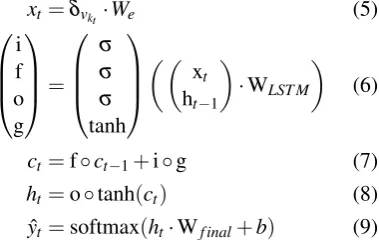
The neural language model architecture with the Long-Short Terms Memory (LSTM) function and its parameters, similar to tied weights in (Gal and Ghahramani,2016):
• We∈Rn×d for word embeddings,
• WLST M∈R2d×4d for parameters of the
Long-Short Term Memory function,
• WFinal ∈Rd×n of the final dense layer with softmax.
where n is the vocabulary size for V =
{v1,v2, ...,vn} andd is both the embeddings size
and the memory size in LSTM. For mini-batches from training data, these parameters are being up-dated using a stochastic gradient descent to min-imise the loss.
xt=δvkt·We (5)
i f o g
=
σ σ σ
tanh
xt
ht−1
·WLST M
(6)
ct=f◦ct−1+i◦g (7)
ht=o◦tanh(ct) (8)
ˆ
yt=softmax(ht·Wf inal+b) (9)
whereδvkt represents the one-hot encoding of the
t-th word in the sequence. Thext is the word em-bedding for this word, and two vectors ct and ht
represent the states of the recurrent unit. Figure6
illustrates the same equation.
A.2 Evaluation
(a)
(b)
[image:11.595.336.496.439.708.2]