Proceedings of NAACL-HLT 2018, pages 575–581
Robust Machine Comprehension Models via Adversarial Training
Yicheng Wang and Mohit Bansal University of North Carolina at Chapel Hill
{yicheng, mbansal}@cs.unc.edu
Abstract
It is shown that many published models for the Stanford Question Answering Dataset ( Ra-jpurkar et al., 2016) lack robustness, suf-fering an over 50% decrease in F1 score during adversarial evaluation based on the AddSent (Jia and Liang,2017) algorithm. It has also been shown that retraining models on data generated by AddSent has limited ef-fect on their robustness. We propose a novel alternative adversary-generation algorithm, AddSentDiverse, that significantly increases the variance within the adversarial training data by providing effective examples that pun-ish the model for making certain superficial assumptions. Further, in order to improve robustness to AddSent’s semantic perturba-tions (e.g., antonyms), we jointly improve the model’s semantic-relationship learning capa-bilities in addition to our AddSentDiverse-based adversarial training data augmentation. With these additions, we show that we can make a state-of-the-art model significantly more robust, achieving a 36.5% increase in F1 score under many different types of adversar-ial evaluation while maintaining performance on the regular SQuAD task.
1 Introduction
We explore the task of reading comprehension based question answering (Q&A), where we fo-cus on the Stanford Question Answering Dataset (SQuAD) (Rajpurkar et al.,2016), in which mod-els answer questions about paragraphs taken from Wikipedia. Significant progress has been made with deep end to end neural-attention models, with some achieving above human level performance on the test set (Wang and Jiang,2017;Seo et al.,
2017;Wang et al., 2017;Huang et al., 2018; Pe-ters et al., 2018). However, as shown recently by Jia and Liang (2017), these models are very fragile when presented with adversarially
gener-ated data. They proposed AddSent, which cre-ates a semantically-irrelevant sentence containing a fake answer that resembles the question syntacti-cally, and appends it to the context. Many state-of-the-art models exhibit a nearly 50% reduction in F1 score on AddSent, showing their over-reliance on syntactic similarity and limited semantic under-standing.
Importantly, this is in part due to the nature of the SQuAD dataset. Most questions in the dataset have answer spans embedded in sentences that are syntactically similar to the question. Thus during training, the model is rarely punished for answer-ing questions based on syntactic similarity, and learns it as a reliable approach to Q&A. This cor-relation between syntactic similarity and correct-ness is of course not true in general: the adver-saries generated by AddSent (Jia and Liang,2017) are syntactically similar to the question but do not answer them. The models’ failures on AddSent demonstrates their ignorance of this aspect of the task. Jia and Liang (2017) presented some ini-tial attempts to fix this problem by retraining the BiDAF model (Seo et al.,2017) with adversaries generated with AddSent. But they showed that the method is not very effective, as slight modifica-tions (e.g., different positioning of the distractor sentence in the paragraph and different fake an-swer set) to the adversary generation algorithm at test time have drastic impact on the retrained model’s performance.
In this paper, we show that their method of adversarial training failed because the specificity of the AddSent algorithm along with the lack of naturally-occurring counterexamples allow mod-els to learn superficial clues regarding what is a ‘distractor’ and subsequently ignore it; thus sig-nificantly limiting their robustness. Instead, we first introduce a novel algorithm, AddSentDiverse, for generating adversarial examples with
cantly higher variance (by varying the locations where the distractors are placed and expanding the set of fake answers), so that the model is pun-ished during training time for making these su-perficial assumptions about the distractor. We show that an AddSentDiverse-based adversarially-trained model beats an AddSent-adversarially-trained model across 3 different adversarial test sets, showing an average improvement of 24.22% in F1 score, demonstrating a general increase in robustness.
However, even with our diversified adversarial training data, the model is still not fully resilient to AddSent-style attacks, e.g., its antonymy-style semantic perturbations. Hence, we next add se-mantic relationship features to the model to let it directly identify such relationships between the context and question. Interestingly, we see that these additions only increase model robustness when trained adversarially, because intuitively in the non-adversarially-trained setup, there are not enough negative (adversarial) examples for the model to learn how to use its semantic features.
Overall, we demonstrate that with our adver-sarial training method and model improvement, we can increase the performance of a state-of-the-art model by 36.46% on the AddSent evaluation set. Although we focused on the AddSent adver-sary (Jia and Liang, 2017), our method of effec-tive adversarial training by eliminating superficial statistical correlations (with joint model capability improvements) are generalizable to other similar insertion-based adversaries for Q&A tasks.1
2 Related Work
Adversarial Evaluation In computer vision, adversarial examples are frequently used to punish model oversensitivity, where semantic-preserving perturbations (usually in the form of small noise vectors) are added to an image to fool the classi-fier into giving it a different label (Szegedy et al.,
2014;Goodfellow et al.,2015).
In the field of Q&A, Jia and Liang (2017) in-troduced the AddSent algorithm, which generates adversaries that punish model failure in the other direction: overstability, or the inability to detect semantic-altering noise. It does so by generating distractor sentences that only resemble the ques-tions syntactically and appending them to the con-text paragraphs (detailed description included in
1We release our AddSentDiverse-based adversarial
train-ing dataset for SQuAD athttps://goo.gl/qdSNDr.
Sec. 3). When tested on these adversarial ex-amples, Jia and Liang (2017) showed that even the most ‘robust’ amongst published models (the Mnemonic Reader (Hu et al.,2017)) only achieved 46.6% F1 (compared to 79.6% F1 on the regular task). Since then, the FusionNet model (Huang et al.,2018) used history-of-word representations and multi-level attention mechanism to obtain an improved 51.4% F1 score under adversarial eval-uation, but that is still a 30% decrease from the model’s performance on the regular task. We show, however, that one can make a pre-existing model significantly more robust by simply reing it with better, higher variance adversarial train-ing data, and improve it further with minor seman-tic feature additions to its inputs.
Adversarial Training It has been shown in the field of image classification that training with adversarial examples produces more robust and error-resistant models (Goodfellow et al., 2015;
Kurakin et al., 2017). In the field of Q&A, Jia and Liang(2017) attempted to retrain the BiDAF (Seo et al., 2017) model with data generated with AddSent algorithm. Despite performing well when evaluated on AddSent, the retrained model suffers a more than 30% decrease in F1 perfor-mance when tested on a slightly different adver-sarial dataset generated by AddSentMod (which differs from AddSent in two superficial ways: us-ing a different set of fake answers and prependus-ing instead of appending the distractor sentence to the context). We show that using AddSent to generate adversarial training data introduces new superfi-cial trends for a model to exploit; and instead we propose the AddSentDiverse algorithm that gen-erates highly varied data for adversarial training, resulting in more robust models.
3 Methods
defined rules; (4) Errors in grammar are fixed by crowd-workers; (5) The finalized distractor is ap-pended to the end of the context. The specificity of the algorithm creates new superficial cues that a model can learn and use during training and never get punished for: (1) a model can learn that it is unlikely for the last sentence to contain the real answer; (2) a model can learn that the fixed set of fake answers should not be picked. These nullify the effectiveness of the distractors as the model will learn to simply ignore them. We thus introduce the AddSentDiverse algorithm, which adds two modifications to AddSent that allows for generating higher-variance adversarial examples. Namely, we randomize the distractor placement (Sec.3.1) and we diversity the set of fake answers used (Sec. 3.2). Lastly, to address the antonym-style semantic perturbations used in AddSent, we show that we need to improve model capabilities by adding indicator features for semantic relation-ships (but only when) in tandem with the addition of diverse adversarial data (Sec.3.3).
3.1 Random Distractor Placement
Given a paragraph P containing nsentences, let
X, Y be random variables representing the
loca-tion of the sentence containing the correct answer counting from the front and back.2 Let P0
rep-resent the paragraph with the inserted distractor, andX0 andY0 represent the updated location of
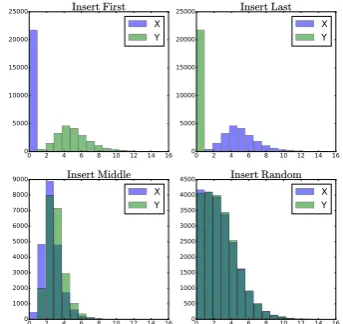
the sentence with the correct answer. As shown in Fig.1, their distribution is highly dependent on the strategy used to insert the distractor. During training done byJia and Liang(2017), the distrac-tor is always added as the last sentence, creating a very skewed distribution forY0. This resulted in
the model learning to ignore the last sentence, as it was never punished for doing so. This, in turn, caused the retrained model to fail on AddSent-Mod, where the distractor is inserted to the front instead of the back of the context paragraph (this is shown by our experiments as well). However, Fig. 1 shows that when the distractor is inserted randomly, the distributions of X0 and Y0 are
al-most identical to that ofXandY, indicating that
no new correlation between the location of a sen-tence and its likelihood to contain the correct an-swer is introduced by the distractors, hence forc-ing the model to learn to discern them from the 2Note that for any fixedn,Y =n−X, but for our
[image:3.595.310.526.63.124.2]pur-poses it is easier to keep them separate since the length of the paragraph is also a random variable.
Figure 1: Left: Distribution ofX andY for the orig-inal SQuAD training set. Middle: Distribution ofX0
andY0 when the distractor is inserted at the end of the
context. Right: Distribution of X0 andY0 when the
distractor is inserted randomly into the context.
real answers by other, deeper means.
3.2 Dynamic Fake Answer Generation
To prevent the model from superficially decid-ing what is a distractor based on certain specific words, we dynamically generate the fake answers instead of using AddSent’s pre-defined set. Let
S be the set that contains all the answers in the
SQuAD training data, tagged by their type (e.g., person, location, etc.). For each answera, we
gen-erate the fake answer dynamically by randomly se-lecting another answer a0 6= a from S that has
the same type as a, as opposed to AddSent (Jia
and Liang, 2017), which uses a pre-defined fake answer for each type (e.g., “Chicago” for any lo-cation). This creates a much larger set of fake an-swers, thus decreasing the correlation between any text and its likelihood of being a part of a distrac-tor, forcing the model to become more robust.
3.3 Semantic Feature Enhanced Model
AddSent-Training Original-SQuAD-Dev AddSent AddSentPrepend AddSentRandom AddSentMod Average
Original-SQuAD 84.65 42.45 41.46 40.48 41.96 50.20
AddSent 83.76 79.55 51.96 59.03 46.85 64.23
AddSentDiverse 83.49 76.95 77.45 76.02 77.06 78.19
Table 1: F1 performance of the BSAE model trained and tested on different regular/adversarial datasets.
Training AddSent AddSentPrepend Average
InsFirst 60.22 79.81 70.02
InsLast 79.54 51.96 65.75
InsMid 74.74 74.33 74.54
[image:4.595.72.531.62.104.2]InsRandom 76.33 77.38 76.85
Table 2: F1 performance of the BSAE model trained on datasets with different distractor placement strategies.
style adversaries by diversifying the training data alone. For the model to be robust to semantics-based (e.g., antonym-style) attacks, it needs extra knowledge of lexical semantic relations. Hence, we augment the input of each word in the ques-tion/context with two indicator features indicat-ing the existence of its synonym and antonym (using WordNet (Fellbaum, 1998)) in the con-text/question, allowing the model to use lexical se-mantics directly instead of learned statistical cor-relations of the word embeddings.
4 Experiments And Results 4.1 Model and Training Details
We use the architecture and hyperparameters of the strong BiDAF + Self-Attn + ELMo (BSAE) model (Peters et al., 2018), currently (as of Jan-uary 10, 2018) the third highest performing single-model on the SQuAD leaderboard.3
4.2 Evaluation Details
Models are evaluated on the original SQuAD dev set and 4 adversarial datasets: AddSent, the adver-sarial evaluation set byJia and Liang(2017), and 3 variations of AddSent: AddSentPrepend, where the distractor is prepended to the context, AddSen-tRandom, where the distractor is randomly in-serted into the context,4and AddSentMod (Jia and
Liang, 2017), where a different set of fake an-swers is used and the distractor is prepended to the context. Experiments measure the soft F1 score and all of the adversarial evaluations are model-dependent, following the style of AddSent, where multiple adversaries are generated for each
exam-3https://rajpurkar.github.io/SQuAD-explorer/
4Note that since the distractor was randomly inserted, the
model cannot identify/ignore the distractor reliably based on location. Thus, high performance on AddSentRandom serves as a better indicator for robustness to semantic-based attacks.
ple in the evaluation set and the model’s worst per-formance among the variants is recorded.
4.3 Primary Experiment Results
In our main experiment, we compare the BSAE model’s performance on different test sets when trained with three different training sets: the origi-nal SQuAD data (Origiorigi-nal-SQuAD), SQuAD data augmented with AddSent generated adversaries (similar to adversarial training conducted by Jia and Liang (2017)), and SQuAD data augmented with our AddSentDiverse generated adversaries. For the latter two, we run the respective adversar-ial generation algorithms on the training set, and add randomly selected adversarial examples such that they make up 20% of the total training data. The results are shown in Table1. First, as shown, the AddSent-trained model is not able to perform well on test sets where the distractors are not in-serted at the end, e.g., the AddSentRandom ad-versarial test set.5 On the other hand, it can be
seen that retraining with AddSentDiverse boosts performance of the model significantly across all adversarial datasets, indicating a general increase in robustness.
4.4 Distractor Placement Results
We also conducted experiments studying the ef-fect of different distractor placement strategies on the trained models’ robustness. The BSAE model was trained on 4 variations of AddSentDiverse-augmented training set, with the only difference between them being the location of the distractor within the context: InsFirst, where the distractor is prepended, InsLast, where the distractor is ap-pended, InsMid, where the distractor is inserted in the middle and InsRandom, where the distrac-tor is randomly placed. The retrained models are tested on AddSent and AddSentPrepend, whose only difference is where the distractor is located. The result is shown in Table2. It is clear that when trained under InsFirst and InsLast, the model only 5For this 59.03% accuracy, i.e., in the remaining 40.96%
Training AddSentPrepend AddSentMod
Fixed-FakeAns 77.37 73.65
Dynamic-FakeAns 77.45 77.06
Table 3: F1 performance of the BSAE model trained on datasets with different answer generation strategies.
Model/Training Original-SQuAD-Dev AddSent
BSAE/Reg. 84.65 42.45
BSAE/Adv. 83.49 76.95
BSAE+SA/Reg. 84.62 44.60
[image:5.595.73.289.61.94.2]BSAE+SA/Adv. 84.49 78.91
Table 4: Regular and adversarial training with BSAE and BSAE+SA (with synonym/antonym features).
performs well on test sets created by a similar dis-tractor placement strategy, indicating that they are exploiting superficial trends instead of learning to process the semantics. It is also shown that In-sRandom gives optimal performance on both eval-uation datasets. Further investigations regarding distractor placement can be found in the appendix.
4.5 Fake Answer Generation Results
We also conducted experiments studying the ef-fect of training on data containing distractors with dynamically generated fake answers (Dynamic-FakeAns) instead of chosen from a predefined set (Fixed-FakeAns). The trained models are tested on AddSentPrepend and AddSentMod, whose only difference is that AddSentMod uses a differ-ent set of fake answers. The results are displayed in Table 3. It shows that the model trained on Fixed-FakeAns suffers an approximate 3% drop in performance when tested on a dataset with a dif-ferent set of fake answers, but this gap does not ex-ist for the model retrained on Dynamic-FakeAns.
4.6 Semantic Feature Enhancement Results
In Table1, we see that despite improving perfor-mance on adversarial test sets, adversarial train-ing on the BSAE model leads to a 1% decrease in its performance on the original SQuAD task (from 84.65% to 83.49%). Furthermore, there is still a 6.5% gap between its performance on adversarial datasets and the original SQuAD dev set (76.95% vs 83.49%). These point to the limitations of adversarial training without any model enhancements, especially for AddSent’s antonymy style semantic perturbations (see de-tails in Sec. 3.3). We thus conducted experi-ments to test the effectiveness of adding WordNet based synonymy/antonymy semantic-relation in-dicators in helping the model to better deal with semantics-based adversaries. We added the
lexi-cal semantic indicators to the BSAE model to cre-ate the BSAE+SA model. We trained and tested it in both the regular and adversarial setup. Its results, compared to the original BSAE model are shown in Table 4, where we see that un-like the BSAE model, adversarial training of the BSAE+SA model does not cause a decrease in its performance on the original SQuAD dataset, as the model can now learn lexical semantic relation-ships instead of statistical correlations. We also see that the BSAE+SA model, when trained in the normal setup, shows very similar performance as the BSAE model across all metrics. This is most likely because despite having the ability to recog-nize semantic relations, there are not enough neg-ative examples in the regular SQuAD training set to teach the model how to use these features cor-rectly, but this issue is solved via the addition of adversarial examples in adversarial training.
4.7 Error Analysis
Finally, we examined the errors of our final adversarially-trained BSAE+SA model on the AddSent dataset and found that out of the 21.09% remaining errors (Table 4), 33.3% (46 cases) of these erroneous predictions occurred within the in-serted distractor, and 63.7% (88 cases) occurred on questions that the model got wrong in the orig-inal SQuAD dev set (without the inserted distrac-tors). The former errors are mainly occurring within distractors created with named-entity re-placements (which we haven’t addressed directly in the current paper) or malformed distractors (that in fact do answer the question).
5 Conclusion
We demonstrate that we can overcome model overstability and increase their robustness by training on diverse adversarial data that elimi-nates latent data correlations. We further show that adversarial training is more effective when we jointly add useful semantic-relations knowl-edge to improve model capabilities. We hope that these robustness methods are generalizable to other insertion-based adversaries for Q&A tasks.
Acknowledgments
References
C. Fellbaum. 1998. Wordnet: An electronic lexical database. InMIT Press.
Maayan Geffet and Ido Dagan. 2005. The distribu-tional inclusion hypotheses and lexical entailment. InACL.
I. Goodfellow, J. Shlens, and C. Szegedy. 2015. Ex-plaining and harnessing adversarial examples. In International Conference on Learning Representa-tions (ICLR).
Zellig S Harris. 1954. Distributional structure. Word 10(2-3):146–162.
Minghao Hu, Yuxing Peng, and Xipeng Qiu. 2017. Re-inforced mnemonic reader for machine comprehen-sion.CoRR, abs/1705.02798.
Hsin-Yuan Huang, Chenguang Zhu, Yelong Shen, and Weizhu Chen. 2018. Fusionnet: Fusing via fully-aware attention with application to machine compre-hension. In International Conference on Learning Representations (ICLR).
R. Jia and P. Liang. 2017. Adversarial examples for evaluating reading comprehension systems. In Em-pirical Methods in Natural Language Processing (EMNLP).
A. Kurakin, I. Goodfellow, and S. Bengio. 2017. Ad-versarial machine learning at scale. InInternational Conference on Learning Representations (ICLR).
Jeffrey Pennington, Richard Socher, and Christo-pher D. Manning. 2014. Glove: Global vectors for word representation. InEmpirical Methods in Nat-ural Language Processing (EMNLP). pages 1532– 1543.
Matthew E Peters, Mark Neumann, Mohit Iyyer, Matt Gardner, Christopher Clark, Kenton Lee, and Luke Zettlemoyer. 2018. Deep contextualized word rep-resentations. NAACL.
P. Rajpurkar, J. Zhang, K. Lopyrev, and P. Liang. 2016. Squad: 100,000+ questions for machine comprehen-sion of text. InEmpirical Methods in Natural Lan-guage Processing (EMNLP) 2016.
Minjoon Seo, Aniruddha Kembhavi, Ali Farhadi, and Hannaneh Hajishirzi. 2017. Bi-directional attention flow for machine comprehension. In International Conference on Learning Representations (ICLR).
C. Szegedy, W. Zaremba, I. Sutskever, J. Bruna, D. Er-han, I. Goodfellow, and R. Fergus. 2014. Intriguing properties of neural networks. InInternational Con-ference on Learning Representations (ICLR).
S. Wang and J. Jiang. 2017. Machine comprehen-sion using match-lstm and answer pointer. In Inter-national Conference on Learning Representations (ICLR).
Wenhui Wang, Nan Yang, Furu Wei, Baobao Chang, and Ming Zhou. 2017. Gated self-matching net-works for reading comprehension and question an-swering. InACL.
A Appendix: Distractor Placement Strategies
This section provides a theoretical framework to predict a model’s performance on adversarial test sets when trained on adversarial data generated by a specific distractor-insertion strategy.
Given a paragraph composed of n
sen-tences (with the distractor inserted) P =
{s1, s2, . . . , sn}, where si is the ith sentence
counting from the front. Define random variables
X andY to represent the location of the distrac-tor counting from the front and back, respectively. The distributions ofXandY are dependent upon
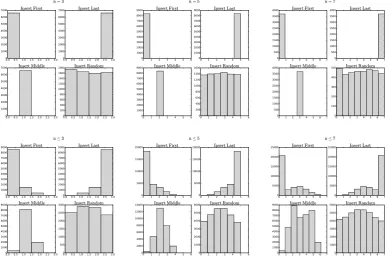
the insertion strategy used to add the distractors, several examples of this are displayed in Fig.2.
Figure 2: Distributions of X and Y in
adversari-ally augmented SQuAD training data under different distractor-insertion strategies.
A bidirectional deep learning model, trained in a supervised setting, should be able to jointly learn
X andY. Thus, at test time, when given a
para-graph of n sentences, the model can obtain the
probability that the sentence sa is the distractor,
Psa, by computingP(X =a) +P(Y = n−a).
Ideally, we want the distribution ofPsa to be
uni-form, as that means the model is not biased to-wards discarding any sentence as the distractor based on location. The actual distributions ofPsa
under different distractor-insertion strategies are displayed in Fig. 3 for n = 3, 5 and 7. We
pick thesenas they are typical lengths of contexts
[image:6.595.326.498.342.504.2]Figure 3: Learned distribution ofPsafor differentn.
Figure 4: Distribution of length of paragraphs in the SQuAD training set.
insertion, the distribution is very close to uniform. Note that if we were to aggregatenand plotPsa
forn≤ 3,5and7, as shown in Fig.3, the
distri-butions ofPsa created by inserting in the middle
and inserting randomly are very similar, but the distribution of inserting in the middle is skewed against the beginnings and ends of the paragraphs. This explains why in our experiment studying the effect of distractor placement strategies (see Ta-ble2), InsMid’s performance was not skewed to-wards either AddSent or AddSentPrepend, but was worse on both when compared to InsRandom.
This method of calculating the distribution of
Psa allows us to predict the model’s performance
when trained on datasets where the distractors are inserted at specific locations. To test this hy-pothesis, we created two datasets: InsFront-3 and InsFront-6 where the distractors were inserted as the 3rd and 6th sentence from the beginning and
Figure 5: Distributions of Psa under InsFront-3 and
InsFront-6 forn≤5.
Training AddSent AddSentPrepend Average
InsFront-3 75.47 72.79 74.13
InsFront-6 77.73 64.42 71.10
Table 5: F1 Performance of the BSAE model trained on datasets with different distractor placement strategies.
measure the model’s performance when trained on these two datasets. The distributions of Psa for
[image:7.595.330.497.361.448.2]