Proceedings of NAACL-HLT 2018, pages 1737–1746
Provable Fast Greedy Compressive Summarization
with Any Monotone Submodular Function
Shinsaku Sakaue Tsutomu Hirao Masaaki Nishino Masaaki Nagata
NTT Communication Science Laboratories
{sakaue.shinsaku, hirao.tsutomu}@lab.ntt.co.jp {nishino.masaaki, nagata.masaaki}@lab.ntt.co.jp
Abstract
Submodular maximizationwith the greedy algorithm has been studied as an effective approach toextractive summarization. This approach is known to have three advan-tages: its applicability to many useful sub-modular objective functions, the efficiency of the greedy algorithm, and the provable performance guarantee. However, when it comes tocompressive summarization, we are currently missing a counterpart of the extractive method based on submodular-ity. In this paper, we propose a fast greedy method for compressive summarization. Our method is applicable to any mono-tone submodular objective function, includ-ing many functions well-suited for docu-ment summarization. We provide an ap-proximation guarantee of our greedy algo-rithm. Experiments show that our method is about 100 to 400 times faster than an existing method based on integer-linear-programming (ILP) formulations and that our method empirically achieves more than 95%-approximation.
1 Introduction
Automatic document summarization continues to be a seminal subject of study in natural lan-guage processing and information retrieval (Luhn, 1958;Edmundson,1969;Cheng and Lapata,2016; Peyrard and Eckle-Kohler, 2017). Owing to the recent advances in data collection, the size of doc-ument data to be summarized has been exploding, which has been bringing a drastic increase in the demand for fast summarization systems.
Extractive summarizationis a widely used ap-proach to designing fast summarization systems. With this approach, we construct a summary by
extracting some sentences from the original docu-ment(s). The extractive approach is not only fast but also has the potential to achieve state-of-the-art ROUGEscores (Lin,2004), which was revealed byHirao et al. (2017b). In many existing meth-ods, sentences are extracted by solving various subset selection problems: for example, the knap-sack problem(McDonald,2007),maximum cover-age problem(Filatova and Hatzivassiloglou,2004; Takamura and Okumura,2009a),budgeted median problem(Takamura and Okumura,2009b), and sub-modular maximization problem(Lin and Bilmes, 2010). Of particular interest, the method based on submodular maximization has three advantages: (1) Many objective functions used for document summarization are known to be monotone and submodular(Lin and Bilmes,2011;J Kurisinkel et al.,2016); examples of such functions include the coverage function, diversity reward function, and ROUGE. Therefore, the method can deliver high performance by using monotone submodular objective functions that are suitable for the given tasks. (2) The efficient greedy algorithm is effective for the submodular maximization problem, which provides fast summarization systems. (3) Theo-retical performance guarantees of the greedy algo-rithm can be proved; for example, a 12(1−e−1 )-approximation guarantee can be obtained.
Although the above extractive methods success-fully obtain summaries with high ROUGEscores, they have the following shortcoming: A long sen-tence typically has redundant parts, which means a summary constructed simply by extracting some sentences often includes many redundant parts. As a result, if the limitation placed on summary length is tight, the extractive approach cannot yield an informative summary.
compressed sentences, and thus we can obtain a concise and informative summary. To make com-pressed sentences, the dependency-tree-based ap-proach (Filippova and Strube,2008) is often used, which is advantageous in that each compressed sen-tence preserves its original dependency relations. Specifically, given a set of dependency trees con-structed for sentences in the original documents, a summary is obtained by extracting some rooted subtrees; each subtree corresponds to a compressed sentence. Different from the extractive summa-rization, the dependency relations in each sentence must be taken into account, and hence the afore-mentioned extractive methods cannot be applied to compressive summarization. A number of methods have been proposed for compressive summariza-tion (Berg-Kirkpatrick et al.,2011;Almeida and Martins,2013;Morita et al.,2013;Kikuchi et al., 2014;Hirao et al.,2017a). These methods formu-late summarization as a type of combinatorial opti-mization problem with a tree constraint, and they obtain summaries by solving the problem. Unfor-tunately, the existing methods have two drawbacks: (1) The class of objective functions to which they are applicable is limited; for example, they work only with the linear function or coverage function. As a result, the performance of these methods can-not be improved by elaborating the objective func-tions. (2) They contain costly procedures as their building blocks: integer-linear-programming (ILP) solvers, dynamic programming (DP) algorithms, and so on. Therefore, they are not fast enough to be applied to large-scale document data. In a nutshell, compressive summarization is currently missing a fast method that is applicable to a wide variety of objective functions.
1.1 Our Contribution
In this paper, we propose a submodularity-based greedy method for compressive summarization. Our method is, so to speak, a compressive coun-terpart of the greedy method for extractive sum-marization (Lin and Bilmes,2010). Similar to the extractive method, our method has the three key advantages:
1. Our method works with any monotone sub-modular objective function, a wide class of useful objective functions, examples of which include the coverage function, ROUGE, and many others (Lin and Bilmes, 2011; J Kurisinkel et al.,2016).
2. Our method is faster than existing compres-sive summarization methods since it employs the efficient greedy algorithm. Specifically, given a set,V, of all textual units contained in the document data and a summary length lim-itation value,L, our method requires at most O(L|V|)objective function evaluations. Ex-periments show that our method is about 100 to 400 times faster than the ILP-based method implemented withCPLEX.
3. A theoretical guarantee of our method can be proved; specifically, a 12(1 − e−1/λ )-approximation guarantee can be obtained, where λis a parameter defined from given document data (a definition is shown later). This result generalizes the 12(1 − e−1 )-approximation of the greedy algorithm for submodular maximization with a knapsack constraint (Leskovec et al.,2007). In experi-ments, our method achieved more that 95%-approximation. Furthermore, our method at-tained ROUGE1 scores comparable to those of the ILP-based method.
1.2 Related Work
There are many existing methods for compres-sive summarization (Berg-Kirkpatrick et al.,2011; Almeida and Martins,2013;Morita et al., 2013; Kikuchi et al.,2014;Hirao et al.,2017a), and they attempt to create summaries by solving optimiza-tion problems with a tree and length constraints. Unfortunately, these methods accept only a few objective functions.
A common approach is to use ILP formulations. Berg-Kirkpatrick et al.(2011) formulate the prob-lem as an ILP with the coverage objective function, which is solved by using an ILP solver. Almeida and Martins(2013) also employs an ILP formula-tion and solves the problem via an algorithm based ondual decomposition, which runs faster than an ILP solver.1These ILP-based methods are optimal
in terms of objective function values. However, it is hard to apply them to large-scale document data since to solve ILPs often takes long computation time.
1Their method was observed to be about 25 times faster
In an attempt to uncover the potential power of dependency-tree-based compressive summariza-tion, Hirao et al. (2017a) solved ILPs with the ROUGE objective function with an ILP solver. Their method obtains summaries by directly maxi-mizing the ROUGEscore for given reference sum-maries (i.e., any other methods cannot achieve higher ROUGEscores than their method). The re-sulting summaries, calledoracle summaries, were revealed to attain substantially high rouge scores, which implies that there remains much room for further research into compressive summarization.
A greedy method with a DP algorithm (Morita et al.,2013) is probably the closest one to our idea. Their method iteratively chooses compressed sen-tences in a greedy manner, for which a DP algo-rithm is employed. Thanks to the submodularity of their objective function, their method enjoys a
1
2(1−e−1)-approximation guarantee. However, be-cause of the costly DP procedure, their method is less scalable than the standard greedy methods such as the extractive method (Lin and Bilmes, 2010) and ours. Moreover, it is applicable only to objec-tive functions that are designed for their problem settings; for example, it cannot use ROUGEas an objective function.
1.3 Overview of Our Approach
A high-level sketch of our approach is as follows: As in many existing works, we formulate the com-pressive summarization task as a combinatorial op-timization problem with a tree constraint, which we call thesubmodular tree knapsack problem(STKP). STKP is generally NP-hard; in fact, it includes the knapsack problem and maximum coverage prob-lem as special cases. Unfortunately, as we will see later, a naive greedy algorithm for STKP does not offer any approximation guarantee in general. The main difficulty with STKP is that its tree con-straint is too complex. To avoid dealing with the complex constraint directly, we transform STKP into a special case of thesubmodular cost submod-ular knapsack problem(SCSKP) (Iyer and Bilmes, 2013). For general SCSKP, no approximation guar-antee has been proved. Fortunately, in our case, a
1
2(1−e−1/λ)-approximation can be proved by ex-ploiting the structure of the resulting SCSKP. Thus we obtain a fast greedy method for compressive summarization, which works with various mono-tone submodular objective functions and enjoys an approximation guarantee.
2 Submodularity
Given finite setV (e.g., a set of chunks), set func-tion g : 2V → R is said to be submodular if g(A ∪B) + g(A ∩ B) ≤ g(A) +g(B) holds for any A, B ⊆ V. We define g(A | B) := g(A ∪B) −g(B). The submodularity is also characterized by the followingdiminishing return property: g({v} | A) ≥ g({v} | B) for any A ⊆ B andv ∈ V\B. Set functiong is mono-tone if g(A) ≤ g(B) for any A ⊆ B. In this paper, we focus on monotone submodular func-tions such thatg(∅) = 0. The submodularity and monotonicity are a natural fit for document summa-rization; intuitively, the marginal gain,g({v} |S), of adding new chunkv ∈ V to summaryS ⊆V is small ifSalready has many chunks (submodu-larity), and a summary becomes more informative as it gets more chunks (monotonicity). In fact, as in (Lin and Bilmes,2011), many objective func-tions well-suited for document summarization have submodularity and monotonicity; examples of such functions include the coverage function, diversity reward function, and ROUGE, to name a few. 3 Problem Statements
We formulate the summarization task as the follow-ing subtree extraction problem called STKP here-after. In what follows, we let[M] :={1, . . . , M} for any positive integerM.
We attempt to summarize document data con-sisting ofN sentences. Each sentence forms a de-pendency tree, which can be constructed by using existing methods (e.g., (Filippova and Strube,2008; Filippova and Altun,2013)). For convenience, we call the dependency tree of a sentence thesentence tree. Thei-th sentence (i ∈[N]) yields sentence tree Ti = (Vi, Ei) rooted at ri ∈ Vi, where Vi is a set of textual units (e.g., words or chunks) contained in the i-th sentence, and edges in Ei represent their dependency relations. We define a document tree with a dummy root vertex ras
T:= ({r} ∪V, E), whereV andE are vertex and edge sets, respectively, defined as follows:
V := [ i∈[N]
Vi, E :=
[
i∈[N]
{Ei∪ {(r, ri)}}.
𝐫
𝑟
1
𝑟
2
𝑣
1
𝑣
2
𝑣
5
𝑣
6
𝑣
3
𝑣
4
𝑇
1
𝑇
2
(a) Document treeT= ({r} ∪V, E)
𝐫
𝑟
1𝑣
2𝑣
4𝐫
𝑟
2𝐫
𝑟
2𝑣
5𝐫
𝑟
2𝑣
6𝐫
𝑟
1𝑟
1𝐫
𝑣
1𝐫
𝑟
1𝑣
2𝐫
𝑟
1𝑣
2𝑣
3 [image:4.595.96.523.69.238.2](b) Set of all paths rooted atr
Figure 1: Illustration of the problem reformulation. The left figure is a document tree rooted atr; it consists of two sentence trees,T1andT2, rooted atr1andr2, respectively. We haveV ={r1, r2, v1, . . . , v6}. The right figure showsP, the set of all paths rooted atr. Note that|V|=|P|holds. With our method, the greedy algorithm is performed overP, which requires at mostO(|V|)objective function evaluations in each iteration.
trees form a single document tree. Figure 1 (a) illustrates an example of a document tree.
Given document treeT, a summary preserves the original dependency relations if it forms a sub-tree rooted at r in T. Therefore, our aim is to find a rooted subtree ofTthat includes informative textual units. For eachv ∈ V, the length ofvis denoted by`v≥0; for example,`vis the number of words or characters in chunkv. IfS ⊆ V is a subset of the textual units included in an obtained summary, its total length must be less than or equal to the given length limitation valueL≥0; namely, the following knapsack constraint must be satis-fied: Pv∈S`v ≤ L. The quality of summaryS is evaluated by a monotone submodular function g. Consequently, compressive summarization is formulated as STKP:
maximize
S⊆V g(S) (1)
subject to X v∈S
`v ≤L,
S∪ {r}forms a subtree inT. At first glance, it may seem that the following naive greedy approach works well for this problem: Start-ing from rootr, we sequentially add the most bene-ficial child to the current solution until the knapsack constraint is violated. Unfortunately, the approxi-mation ratio of this method can become arbitrarily bad since it may miss beneficial vertices that are far
fromr; if such missed vertices are more beneficial than those added to the solution by a considerable margin, the resulting approximation ratio is almost equal to zero. To avoid this difficulty, we reformu-late STKP in the next section.
4 Proposed Method
We observed that the naive greedy algorithm does not work well for STKP (1) due to the complex tree constraint. We circumvent this difficulty by trans-forming STKP into a special case of the submod-ular cost submodsubmod-ular knapsack problem (SCSKP). We then provide a greedy algorithm for SCSKP. An approximation guarantee of the greedy algo-rithm is also presented.
4.1 Problem Reformulation
We show that STKP can be transformed into SCSKP. LetP be a set of all paths that connect
Algorithm 1Greedy 1: U ← P,X ← ∅
2: whileU 6=∅do
3: p= argmaxp0∈U f(p
0|X)
c(p0|X) 4: ifc(X+p)≤Lthen
5: X←X+p
6: end if 7: U ←U−p
8: end while
9: pˆ= argmaxp0∈Pf(p0)
10: returnY = argmaxX0∈{X,pˆ}f(X0)
problem onP: maximize
X⊆P f(X) :=g(VX) (2)
subject to c(X) := X v∈VX
`v ≤L.
We here suppose thatc(p)≤Lholds for allp∈ P; anyp∈ Pviolating this condition can be removed in advance since no feasible solution includes such p. The set functionsf andcare monotone submod-ular functions defined on P (see the Appendix), and thus the above problem is SCSKP. Figure1 illustrates how to transform STKP into SCSKP.
4.2 Greedy Algorithm
We provide a greedy algorithm for SCSKP (2). In what follows, given anyX, Y ⊆ P, we define the binary operators+and−onP as
X+Y :={p∈ P :p∈Xand/orp∈Y}, X−Y :={p∈ P :p∈Xandp /∈Y}. Namely, they are the union and subtraction of two subsets defined onP. We sometimes abuse the
notation and regardp ∈ P as a subset ofP; for example, we letX+p=X+{p}for anyX⊆ P andp ∈ P. Furthermore, we definef(X |Y) := f(X+Y)−f(Y)andc(X |Y) :=c(X+Y)−
c(Y)for anyX, Y ⊆ P.
Algorithm1 presents a concise description of the greedy algorithm for SCSKP (2). In practice, function evaluations in the above greedy algorithm can be reduced by using the technique provided in (Leskovec et al.,2007) with some modifications. The resulting greedy algorithm requires at most O(L|V|)function evaluations.
Different from the naive greedy algorithm ex-plained in Section3, the above greedy algorithm is performed on the set of all rooted paths,P. Thus,
even if beneficial vertices are far fromr, rooted paths that include such beneficial vertices are con-sidered as candidates to be chosen in each itera-tion. As a result, we get the following performance guarantee for Algorithm 1; we define λi as the number of leaves inTi for i ∈ [N], and we let λ:= maxi∈[N]λi.
Theorem 1. IfY ⊆ Pis the output of Algorithm1 andX∗⊆ P is an optimal solution for SCSKP(2), then we havef(Y)≥ 12(1−e−1/λ)f(X∗). Proof. See the Appendix.
In other words, Algorithm 1 enjoys a 12(1−
e−1/λ)-approximation guarantee. Notably, if the values of λi (i ∈ [N]) are bounded by a small constant for allN sentences, the performance guar-antee does not deteriorate no matter how many sentences are in the document data. This implies that our method works effectively for summariz-ing large-scale document data that comprises many sentences.
4.3 Relation with Existing Work
We first see some existing results. For submodu-lar maximization with a size constraint (i.e., |S|
must be at most a certain value), the greedy al-gorithm has been proved to achieve (1− e−1 )-approximation (Nemhauser et al.,1978). Khuller et al. (1999) studied the maximum coverage problem with a knapsack constraint, and proved that the greedy algorithm achieves (1−e−1/2 )-approximation. They also showed that(1−e−1 )-approximation can be obtained by executing the greedy algorithm O(|V|3) times, and this result was generalized to the case with a submodu-lar objective function (Sviridenko, 2004). The greedy algorithm for submodular maximization with a knapsack constraint is known to achieve
1
2(1−e−1)-approximation (Leskovec et al.,2007). Lin and Bilmes (2010) stated that (1−e−1/2 )-approximation can be obtained with the greedy algorithm, but a mistake in their proof was pointed out byMorita et al.(2013).2
Unlike the above problem settings, submodular maximization with a tree constraint has only a few literatures.Krause et al.(2006) studied submodu-lar maximization over a graph with a knapsack and tree constraints, but their algorithm, calledpSPIEL, 2Probably, this mistake can be fixed with the techniques
requires a complicated preprocessing step and im-poses some assumptions on the problem, which do not hold in most summarization tasks. Iyer and Bilmes(2013) addressed SCSKP, a more general problem setting. Their algorithm is, however, more expensive than the greedy algorithm, and it only achieves a bi-criterion approximation guarantee (i.e., not only the objective value but also the mag-nitude of constraint violation is approximated); if we use this algorithm for document summariza-tion, a resulting summary may violate the length limitation.
We turn to the relation between our result and the existing ones. We consider submodular maxi-mization with a knapsack constraint. This problem can be formulated as an STKP on a star graph, whose vertex and edge sets are{r, r1, . . . , rN}and
{(r, r1), . . . ,(r, rN)}, respectively (i.e., every leaf corresponds to an element inV ={r1, . . . , rN}). In this case, we haveλ = 1, and thus we obtain a 12(1−e−1)-approximation guarantee, matching the result of (Leskovec et al.,2007).3
5 Objective Functions
As presented in (Lin and Bilmes,2011), many ob-jective functions used for document summarization are known to be monotone and submodular. Below we list examples of the functions that will be used in the experiments.
Coverage Function
To use the coverage function is a simple but power-ful approach to document summarization, and so it appears in many existing works (e.g., (Filatova and Hatzivassiloglou,2004;Takamura and Okumura, 2009a;Berg-Kirkpatrick et al.,2011)). LetM be the number of distinct words in the document data, and suppose that they are indexed withj ∈ [M]. We let wj (j ∈ [M]) be the weight value of the j-th word. Given summaryS ⊆V, the coverage function COV(S)is defined as follows:
COV(S) := M
X
j=1 wjzj,
wherezj ∈ {0,1}is a binary decision variable that indicates whether thej-th word is included inSor not; more precisely,zj = 1if and only if at least one textual unit inS contains thej-th word.
3We also tried to obtain an approximation guarantee that
corresponds to the(1−e−1/2)-approximation (Khuller et al.,
1999;Lin and Bilmes,2010), but it was not straightforward to apply their techniques to our case.
Coverage Function with Rewords
A summary obtained with the above coverage func-tion often consists of many overly-compressed sen-tences, which typically leads to low readability. Morita et al. (2013) addressed this problem by adding a positive reward term to the coverage func-tion. Given summaryS, letbri ∈ {0,1}(i∈[N])
be a binary decision variable that indicates whether ri, the root node of sentence treeTi, is included inSor not. Note that, ifS∪ {r}forms a rooted subtree in T, we have bri = 1if and only if at
least one textual unit in thei-th sentence appears inS. With these additional variables, the modified coverage function can be written as
COVR(S) :=COV(S) +γ X v∈S
`v− N
X
i=1 bri
!
,
whereγ ≥ 0is a parameter that controls the rate of sentence compression. The value ofPN
i=1bri
is equal to the number of sentences whose textual unit(s) is used in S. Therefore, a summary that consists of fewer sentences tends to get a higher objective value, thus enhancing readability.
ROUGE
ROUGE(Lin,2004) is widely used for summariza-tion evaluasummariza-tion, and it is known to be highly corre-lated with human evaluation. Furthermore, ROUGE is known to be monotone and submodular (Lin and Bilmes, 2011). Specifically, given K reference summariesR1, . . . , RK⊆V and function Ce(S), which counts the number of times thatn-grame occurs in summary S ⊆ V, the ROUGEn score function is defined as
ROUGEn(S)
:= PKk=1Pe∈Rkmin{Ce(S),Ce(Rk)} PK
k=1Pe∈RkCe(Rk)
.
6 Experiments
Objective function Method Approximation ratio ROUGE1 Time (ms)
Coverage Greedy 0.964 0.347 1.34
ILP 1.00 0.346 231
Coverage with rewards GreedyILP 0.9671.00 0.3340.332 1.44552
ROUGE1 Greedy 0.985 0.468 0.759
[image:7.595.111.494.62.157.2]ILP (oracle) 1.00 0.494 92.1
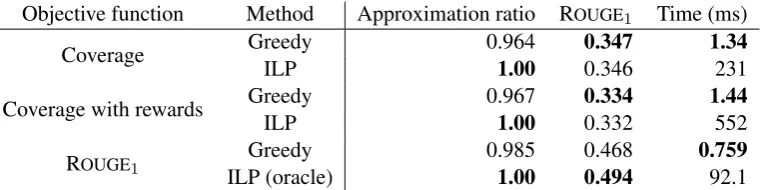
Table 1: Approximation ratios, ROUGE1 scores, and running times for our method (Greedy) and the ILP-based method (ILP); the average values over the 50 topics are presented. The two methods are applied to compressive summarization tasks with three types of objective functions: Coverage, Coverage with rewards, and ROUGE1. Summaries obtained with the ILP-based method and ROUGE1 objective function are oracle summaries.
6.1 Settings
In the following experiments, we regardV as the set of all chunks in the document data. For each chunkv ∈ V, we let`v be the number of words contained inv, and we set the length limitation, L, to 100. For the coverage function and the one with rewards, the weight valueswj(j∈[M]) were estimated by logistic regression (Yih et al.,2007) trained on the DUC-2003 dataset. For the coverage function with rewards, we set the parameter,γ, to 0.9.
The experiments were conducted on the DUC-2004 dataset for multiple document summarization evaluation, which is a commonly used benchmark dataset. The dataset consists of 50 topics, each of which has 10 newspaper articles. The depen-dency trees for this dataset were obtained as fol-lows: We first applied the Stanford parser (de Marn-effe et al.,2006) to all sentences in the dataset in or-der to obtain dependency relations between words. We then applied Filippova’s rules (Filippova and Strube,2008;Filippova and Altun, 2013) to the obtained relations so as to construct trees that rep-resent dependency relations between chunks. To obtain summaries with high readability, we treated a set of chunks connected with certain relations (e.g., subject–object) as a single chunk.
Our algorithm was implemented in C++ and compiled withGCC version 4.8.5. The ILP-based method solved ILPs with CPLEX ver. 12.5.1.0, a widely used commercial ILP solver. The details of ILP formulations for the three objec-tive functions are presented in the Appendix. All experiments were conducted on a Linux machine (CPU: Intel Xeon E5-2620 v4 2.10GHz and 32GB RAM).
6.2 Results
Table 1 summarizes the comparisons of the achieved approximation ratios, ROUGE1scores and running times. The ILP-based method are al-ways optimal in terms of objective values (i.e., 100%-approximation is attained), and our method achieved more than 95%-approximation. We ob-served that the maximum number,λ, of leaves in a sentence tree was about 22 on average, which leads to a 2.2%-approximation guarantee of our algorithm. Therefore, our method empirically per-forms much better than the theoretical guarantee; this is often the case with the greedy algorithm for submodular maximization problems, in particular when the problems have complex constraints. The ROUGE1 scores of our method are comparable to those of the ILP-based method. With the cover-age function and the one with rewards, it happened that our method attained slightly higher ROUGE1 scores than those of ILP-based methods;4note that
this result is possible since the objective values and ROUGE1scores are not completely correlated. The results on approximation ratios and ROUGE1 scores imply that our method compares favorably with the ILP-based method in terms of empirical performance. With regard to the running times, our method substantially outperformed the ILP-based method. Specifically, our method was about 170, 380, and 120 times faster than the ILP-based one for the coverage function, the one with rewards, and the ROUGE1objective function, respectively.
Table2 shows examples of the summaries ob-tained by our method and the ILP-based method; both methods used the coverage function with rewards as an objective function. We see that 4 Similar results were observed in (Takamura and
Greedy:
Yeltsin suffered from disease and had a heart attack followed by multiple bypass surgery in the months. Russian President Boris Yeltsin cut short a trip to Central Asia on Monday due to a respiratory infection that revived questions about his health and ability to lead Russia through a sustained economic crisis. Doctors insisted that Yeltsin fly home ahead of schedule. The prime minister reiterated Wednesday that Yeltsin has plans to resign early elections. Russia’s Constitutional Court opened hearings Thursday on whether Boris Yeltsin can seek a term. Sources in Primakov’s office said the cancellation was due to concerns.
ILP:
Russian President Boris Yeltsin cut short a trip to a respiratory infection that revived questions about his health and ability to lead Russia through a economic crisis. Yeltsin was spending outside Moscow his spokesman Dmitry Yakushkin told reporters. Doctors insisted Monday that Yeltsin fly home from Central Asia ahead of schedule because he was suffering. Yeltsin falls ill speculation arises. The prime minister reiterated Wednesday that Yeltsin has plans to resign early elections. Russia’s Constitutional Court opened hearings Thursday on whether Boris Yeltsin can seek a term. Sources in Primakov’s office said the cancellation was due to concerns.
Table 2: Summaries obtained with our greedy method (upper) and the ILP-based method (lower) for topic:D31032. To obtain these summaries, both methods used the coverage function with rewards as an objective function.
both methods successfully created informative sum-maries that preserve original dependency relations. The readability of obtained summaries is unfortu-nately not high enough. Note that not only our method but also most compressive summarization methods suffer this problem; in fact, there is lit-tle difference between the two summaries obtained with our method and the optimal ILP-based method with regard to readability. To conclude, the empiri-cal performance of our method matches that of the ILP-based method, while running about 100 to 400 times faster.
7 Conclusion and Discussion
We proposed a fast greedy method for compres-sive summarization. Our method works with any monotone submodular objective function; ex-amples of such functions include the coverage function, ROUGE, and many others. The 12(1−
e−1/λ)-approximation guarantee of our method was proved, which generalizes the 12(1− e−1 )-approximation for submodular maximization with a knapsack constraint. Experiments showed that our greedy method empirically achieves more than 95%-approximation and that it runs about 100 to 400 times faster than the ILP-based method im-plemented withCPLEX. With the coverage func-tion and its variant, our method attained as high ROUGE1scores as the ILP-based method.
As mentioned above, current compressive
sum-marization systems often fail to achieve high read-ability, and one possible approach to this problem is to develop better objective functions. Since our method is applicable to various monotone submod-ular objective functions and can find almost optimal solutions efficiently, our method would be helpful in testing the performance of newly proposed ob-jective functions. Thus we believe that our method is useful for advancing the study into compressive summarization.
Interestingly, STKP can be seen as a variant of DR-submodularmaximization (Soma and Yoshida, 2017), which is a submodular maximization prob-lem defined over integer lattice. The constraint that appears in DR-submodular maximization is some-what easier to deal with than that of our problem; exploiting this, Soma and Yoshida(2017) devel-oped a polynomial-time algorithm that achieves roughly 12-approximation. The techniques studied in this field may be useful to develop better algo-rithms for STKP, which we leave for future work.
References
Taylor Berg-Kirkpatrick, Dan Gillick, and Dan Klein. 2011. Jointly learning to extract and com-press. In Proceedings of the 49th Annual Meet-ing of the Association for Computational Lin-guistics: Human Language Technologies. Associa-tion for ComputaAssocia-tional Linguistics, pages 481–490.
http://www.aclweb.org/anthology/P11-1049. Jianpeng Cheng and Mirella Lapata. 2016.
Neu-ral summarization by extracting sentences and words. In Proceedings of the 54th Annual Meet-ing of the Association for Computational Lin-guistics (Volume 1: Long Papers). Association for Computational Linguistics, pages 484–494.
https://doi.org/10.18653/v1/P16-1046.
Marie-Catherine de Marneffe, Bill MacCartney, and Christopher D. Manning. 2006. Generating typed dependency parses from phrase structure parses. In
Proceedings of the 5th International Conference on Language Resources and Evaluation. European Language Resources Association, pages 449–454.
http://www.aclweb.org/anthology/L06-1260. Harold P. Edmundson. 1969. New methods in
auto-matic extracting. Journal of the ACM 16(2):264– 285. https://doi.org/10.1145/321510.321519. Elena Filatova and Vasileios Hatzivassiloglou. 2004.
A formal model for information selection in multi-sentence text extraction. InProceedings of the 20th International Conference on Computational Linguis-tics.http://www.aclweb.org/anthology/C04-1057. Katja Filippova and Yasemin Altun. 2013.
Overcom-ing the lack of parallel data in sentence compression. In Proceedings of the 2013 Conference on Empiri-cal Methods in Natural Language Processing. Asso-ciation for Computational Linguistics, pages 1481– 1491.http://www.aclweb.org/anthology/D13-1155. Katja Filippova and Michael Strube. 2008.
De-pendency tree based sentence compression. In
Proceedings of the 5th International Natural Language Generation Conference. Association for Computational Linguistics, pages 25–32.
http://www.aclweb.org/anthology/W08-1105. Tsutomu Hirao, Masaaki Nishino, and Masaaki
Na-gata. 2017a. Oracle summaries of compressive summarization. In Proceedings of the 55th An-nual Meeting of the Association for Computational Linguistics (Volume 2: Short Papers). Associa-tion for ComputaAssocia-tional Linguistics, pages 275–280.
https://doi.org/10.18653/v1/P17-2043.
Tsutomu Hirao, Masaaki Nishino, Jun Suzuki, and Masaaki Nagata. 2017b. Enumeration of ex-tractive oracle summaries. In Proceedings of the 15th Conference of the European Chap-ter of the Association for Computational Lin-guistics: Volume 1, Long Papers. Association for Computational Linguistics, pages 386–396.
http://www.aclweb.org/anthology/E17-1037.
Rishabh Iyer and Jeff Bilmes. 2013. Submod-ular optimization with submodSubmod-ular cover and submodular knapsack constraints. In Proceed-ings of the 26th International Conference on Neural Information Processing Systems - Vol-ume 2. Curran Associates Inc., pages 2436–2444.
http://dl.acm.org/citation.cfm?id=2999792.2999884. Litton J Kurisinkel, Pruthwik Mishra, Vignesh-waran Muralidaran, Vasudeva Varma, and Dipti Misra Sharma. 2016. Non-decreasing sub-modular function for comprehensible summarization. In Pro-ceedings of the NAACL Student Research Workshop. Association for Computational Linguistics, pages 94–101.https://doi.org/10.18653/v1/N16-2014. Samir Khuller, Anna Moss, and Joseph S. Naor.
1999. The budgeted maximum coverage prob-lem. Information Processing Letters 70(1):39–45.
https://doi.org/10.1016/S0020-0190(99)00031-9. Yuta Kikuchi, Tsutomu Hirao, Hiroya Takamura,
Manabu Okumura, and Masaaki Nagata. 2014.
Single document summarization based on nested tree structure. In Proceedings of the 52nd An-nual Meeting of the Association for Computational Linguistics (Volume 2: Short Papers). Associa-tion for ComputaAssocia-tional Linguistics, pages 315–320.
https://doi.org/10.3115/v1/P14-2052.
Andreas Krause, Carlos Guestrin, Anupam Gupta, and Jon Kleinberg. 2006. Near-optimal sensor place-ments: Maximizing information while minimiz-ing communication cost. In Proceedings of the 5th International Conference on Information Pro-cessing in Sensor Networks. ACM, pages 2–10.
https://doi.org/10.1145/1127777.1127782.
Jure Leskovec, Andreas Krause, Carlos Guestrin, Christos Faloutsos, Jeanne VanBriesen, and Natalie Glance. 2007. Cost-effective outbreak detection in networks. In Proceedings of the 13th ACM SIGKDD International Conference on Knowledge Discovery and Data Mining. ACM, pages 420–429.
https://doi.org/10.1145/1281192.1281239.
Chin-Yew Lin. 2004. ROUGE: A package for automatic evaluation of summaries. In
Proceedings of Workshop on Text
Sum-marization Branches Out. pages 74–81.
http://www.aclweb.org/anthology/W04-1013. Hui Lin and Jeff Bilmes. 2010. Multi-document
summarization via budgeted maximization of submodular functions. In Human Language Technologies: The 2010 Annual Conference of the North American Chapter of the Associa-tion for ComputaAssocia-tional Linguistics. Association for Computational Linguistics, pages 912–920.
http://www.aclweb.org/anthology/N10-1134. Hui Lin and Jeff Bilmes. 2011. A class of
Lin-guistics: Human Language Technologies. Associa-tion for ComputaAssocia-tional Linguistics, pages 510–520.
http://www.aclweb.org/anthology/P11-1052. Hans P. Luhn. 1958. The automatic
cre-ation of literature abstracts. IBM Journal of Research and Development 2(2):159–165.
https://doi.org/10.1147/rd.22.0159.
Ryan McDonald. 2007. A study of global inference algorithms in multi-document summarization. In
Proceedings of the 29th European Conference on IR Research. Springer-Verlag, pages 557–564.
http://dl.acm.org/citation.cfm?id=1763653.1763720. Hajime Morita, Ryohei Sasano, Hiroya Takamura, and Manabu Okumura. 2013. Subtree extrac-tive summarization via submodular maximiza-tion. In Proceedings of the 51st Annual Meet-ing of the Association for Computational Lin-guistics (Volume 1: Long Papers). Association for Computational Linguistics, pages 1023–1032.
http://www.aclweb.org/anthology/P13-1101. George L. Nemhauser, Laurence A. Wolsey, and
Mar-shall L. Fisher. 1978. An analysis of approxima-tions for maximizing submodular set funcapproxima-tions— I. Mathematical Programming 14(1):265–294.
https://doi.org/10.1007/BF01588971.
Maxime Peyrard and Judith Eckle-Kohler. 2017.
Supervised learning of automatic pyramid for optimization-based multi-document summarization. In Proceedings of the 55th Annual Meeting of the Association for Computational Linguis-tics (Volume 1: Long Papers). Association for Computational Linguistics, pages 1084–1094.
https://doi.org/10.18653/v1/P17-1100.
Tasuku Soma and Yuichi Yoshida. 2017. Non-monotone DR-submodular function maxi-mization. In Proceedings of the 31st AAAI Conference on Artificial Intelligence. pages 898–904. https://aaai.org/ocs/index.php/AAAI/ AAAI17/paper/view/14483.
Maxim Sviridenko. 2004. A note on maximizing a submodular set function subject to a knapsack con-straint. Operations Research Letters32(1):41–43.
https://doi.org/10.1016/S0167-6377(03)00062-2. Hiroya Takamura and Manabu Okumura. 2009a. Text
summarization model based on maximum coverage problem and its variant. InProceedings of the 12th Conference of the European Chapter of the ACL. As-sociation for Computational Linguistics, pages 781– 789. http://www.aclweb.org/anthology/E09-1089. Hiroya Takamura and Manabu Okumura. 2009b.
Text summarization model based on the bud-geted median problem. In Proceedings of the 18th ACM Conference on Information and Knowledge Management. ACM, pages 1589–1592.
https://doi.org/10.1145/1645953.1646179.
Wen-tau Yih, Joshua Goodman, Lucy Vanderwende, and Hisami Suzuki. 2007. Multi-document summarization by maximizing informative content-words. In Proceedings of the 20th International Joint Conference on Artificial Intelligence. Mor-gan Kaufmann Publishers Inc., pages 1776–1782.