Automatic Extraction of Parallel Speech Corpora
from Dubbed Movies
Alp ¨Oktem1 and Mireia Farr´us1 and Leo Wanner2,1 1Universitat Pompeu Fabra, Spain
2Catalan Institute for Research and Advanced Studies (ICREA), Spain
Abstract
This paper presents a methodology to ex-tract parallel speech corpora based on any language pair from dubbed movies, to-gether with an application framework in which some corresponding prosodic pa-rameters are extracted. The obtained par-allel corpora are especially suitable for speech-to-speech translation applications when a prosody transfer between source and target languages is desired.
1 Introduction
The availability of large parallel corpora is one of the major challenges in developing translation sys-tems. Bilingual corpora, which are needed to train statistical translation models, are harder to acquire than monolingual corpora since they presuppose the implication of labour in translation or interpre-tation. Working in the speech domain introduces even more difficulties since interpretations are not sufficient to capture the paralinguistic aspects of speech. Several attempts have been recently made to acquire spoken parallel corpora of considerable size. However, these corpora either do not reflect the prosodic aspects in the interpreted speech or do not carry the traits of natural speech. Or they simply do not align well the source and the target language sides.
To account for this deficit, we propose to ex-ploit dubbed movies where expressive speech is readily available in multiple languages and their corresponding aligned scripts are easily accessi-ble through subtitles. Movies and TV shows have been a good resource for collecting parallel bilin-gual data because of the availability and open ac-cess of subtitles in different languages. With 1850 bitexts of 65 languages, the OpenSubtitles project (Lison and Tiedemann, 2016) is the largest
re-source of translated movie subtitles compiled so far. The time information in subtitles makes it easy to align sentences of different languages since tim-ing is correlated to the same audio (Itamar and Itai,2008). In the presence of multiple aligned au-dio for the same movie, the alignment can be ex-tended to obtain parallel speech corpora. Popular movies, TV shows and documentaries are released with dubbed audio in many countries. Dubbing requires the voice acting of the original speech in another language. Because of this, the dubbed speech carries more or less the same paralinguistic aspects of the original speech.
In what follows, we describe our methodology for the extraction of a speech parallel corpus based on any language pair from dubbed movies. Unlike Tsiartas et al.(2011), who propose a method based on machine learning for automatically extracting bilingual audio-subtitle pairs from movies, we only need raw movie data, and do not require any training. Moreover, our methodology en-sures the fulfilment of the following requirements: (a) it is easily expandable, (b) it supports multi-ple pairs of languages, (c) it can handle any do-main and speech style, and (d) it delivers a par-allel spoken language corpus with annotated ex-pressive speech. “Exex-pressive speech” annotation means that the corpus is prosodically rich, which is essential to be able to deal with non-neutral speech emotions, as done in increasingly popu-lar speech-to-speech translation applications that try to cope with prosody transfer between source and target utterances (Ag¨uero et al.,2006;Sridhar et al.,2008;Anumanchipalli et al.,2012).
The remainder of the paper is structured as fol-lows. Section2reviews the main multilingual par-allel speech corpora available to the research com-munity. Section3presents the methodology used in the current paper, and Section 4 discusses the current state of the obtained parallel corpora so far.
In Section5, finally, some conclusions are drawn and some aspects of our future work in the context of parallel speech corpora are mentioned.
2 Available Parallel Speech Corpora As already mentioned above, several attempts have been made to compile large spoken parallel corpora. Such corpora of considerable size are, e.g., the EPIC corpus (Bendazzoli and Sandrelli, 2005), the EMIME Bilingual Database (Wester, 2010), and the Microsoft Speech Language Trans-lation (MSLT) corpus (Federmann and Lewis, 2016). All of them have been manually compiled, and all of them show one or several shortcom-ings. The EPIC corpus, which has been compiled from speeches from the European Parliament and their interpretations, falls short in reflecting the prosodic aspects in the interpreted speech. The EMIME database is a compilation of prompted speeches and does not capture the natural spoken language traits. The MSLT corpus has been col-lected in bilingual conversation settings, but there is no one-to-one alignment between sentences in different languages. A summary of the available bilingual speech corpora is listed in Table1.
3 Methodology
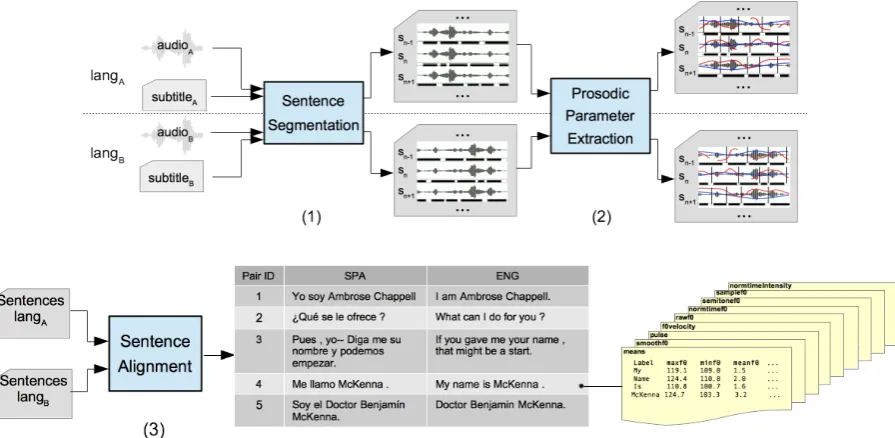
Our multimodal parallel corpus creation consists of three main stages: (1) movie sentence segmen-tation, (2) prosodic parameter extraction, and (3) parallel sentence alignment. The first and second stages can be seen as a monolingual data creation, as they take the audio and subtitle pairs as input in one language, and output speech/text/prosodic parameters at the sentence level. The resulting monolingual data from stages 1 and 2 are fed into stage 3, where corresponding sentences are aligned and reordered to create the corresponding parallel data. A general overview of the system is presented in Figure1.
Let us discuss each of these stages in turn.
3.1 Segmentation of movie audio into sentences
This stage involves the extraction of audio and complete sentences from the original audio and the corresponding subtitles of the movie. For sub-titles, the SubRip text file format1 (SRT) is
ac-cepted. Each subtitle entry contains the following
1https://www.matroska.org/technical/
specs/subtitles/srt.html
information: (i) start time, (ii) end time, and (iii) text of the speech spoken at that time in the movie. The subtitle entries do not necessarily correspond to sentences: a subtitle entry may include more than one sentence, and a sentence can spread over many subtitle entries; consider an example portion of a subtitle:
80
00:06:46,114 --> 00:06:48,741 Well, I was stationed
up in Casablanca
81
00:06:48,825 --> 00:06:51,535 at an army field hospital during the war.
82
00:06:51,995 --> 00:06:53,871 - Do you live in Morocco? - Yes.
The sentence segmentation stage starts with a preprocessing step in which elements that do not correspond to speech are removed. These include: Speaker name markers (e.g., JAMES: . . . ), text formatting tags, non-verbal information (laughter, horn, etc.) and speech dashes. Audio is initially segmented according to the timestamps in subti-tle entries, with extra 0.5 seconds at each end. Then, each audio segment and its respective sub-title text are sent to the speech aligner software (Vocapia Scribe2) to detect word boundaries. This
pre-segmentation helps to detect the times of the words that end with a sentence-ending punctuation mark (‘.’, ‘?’, ‘!’, ‘:’, ‘...’). Average word boundary confidence score of the word alignment is used to determine whether the sentence will be extracted successfully or not. If the confidence score is above a threshold of 0.5, the initial segment is cut from occurrences of sentence-endings. In a second pass, cut segments that do not end with a sentence-ending punctuation mark are merged with the sub-sequent segments to form full sentences. We used
Libav3library to perform the audio cuts.
3.2 Prosodic parameter extraction
This stage involves prosodic parameter extraction for each sentence segment detected in stage 1. The
ProsodyProlibrary (Xu,2013) (a script developed for the Praat software (Boersma and Weenink, 2001)) is used to extract prosodic features from speech. As input, ProsodyPro takes the audio of
2https://scribe.vocapia.com/
Corpus Languages Speech style
EPIC English, Italian, Spanish spontaneous/interpreted MSLT English, French, German constrained conversations EMIME Finnish/English, German/English prompted
EMIME Mandarin Mandarin/English prompted
MDA (Almeman et al.,2013) Four Arabic dialects prompted
[image:3.595.78.525.62.159.2]Farsi-English (Melvin et al.,2004) Farsi/English read/semi-spontaneous Table 1: Some available parallel speech corpora.
Figure 1: Above: Monolingual corpus creation from different audio-subtitle pairs in parallel. Below: Bilingual parallel corpus creation of the example dataset.
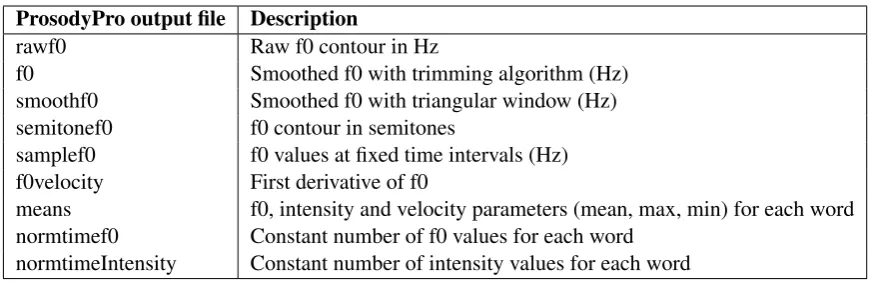
an utterance and a TextGrid file containing word boundaries and outputs a set of objective mea-surements suitable for statistical analysis. We run ProsodyPro for each audio and TextGrid pair of sentences to generate the prosodic analysis files. See Table2for the list of analyses performed by ProsodyPro (Information taken from ProsodyPro webpage4).
The TextGrid file with word boundaries is pro-duced by sending the sentence audio and transcript to the word-aligner software and then converting the alignment information in XML into TextGrid format. Having word boundaries makes it possi-ble to align continuous prosodic parameters (such as pitch contour) with the words in the sentence.
3.3 Parallel sentence alignment
This stage involves the creation of the parallel data from two monolingual data obtained from differ-ent audio and subtitle pairs of the same movie. The
4http://www.homepages.ucl.ac.uk/
˜uclyyix/ProsodyPro/
goal is to find the corresponding sentence s2in
lan-guage 2, given a sentence s1 in language 1. For
each s1 with timestamps (ss1, es1), s2 is searched
within a sliding window among sentences that start in the time interval [ss1 - 5, ss1 + 5]. Among
candidate sentences within the range, the most similar to s1 is found by first translating s1 to
lan-guage 2 and then choosing the {s1, s2} pair that
gives the best translation similarity measure above a certain threshold. For translation, the Yandex TranslateAPI5and for similarity measure the Me-teorlibrary (Denkowski and Lavie,2014) is used.
4 Obtained Corpus and Discussion We have tested our methodology on three movies, which we retrieved from the University Library:
The Man Who Knew Too Much(1956),Slow West
(2015) andThe Perfect Guy(2015). The movies are originally in English, but also have dubbed Spanish audio. English and Spanish subtitles were
[image:3.595.76.524.195.414.2]ProsodyPro output file Description
rawf0 Raw f0 contour in Hz
f0 Smoothed f0 with trimming algorithm (Hz) smoothf0 Smoothed f0 with triangular window (Hz) semitonef0 f0 contour in semitones
samplef0 f0 values at fixed time intervals (Hz) f0velocity First derivative of f0
means f0, intensity and velocity parameters (mean, max, min) for each word normtimef0 Constant number of f0 values for each word
[image:4.595.81.518.60.202.2]normtimeIntensity Constant number of intensity values for each word Table 2: Some of the files generated by ProsodyPro.
acquired from theopensubtitleswebpage6.
At the time of the submission, we have auto-matically extracted 2603 sentences in English and 1963 sentences in Spanish summing up to 80 and 49 minutes of audio respectively and annotated with prosodic parameters. 1328 of these sentences were aligned to create our current parallel bilin-gual corpora. We are in the process of expanding our dataset.
Due to the copyright on the movies, we are unable to distribute the corpus that we extracted. However, using our software, it is easy for any re-searcher to compile a corpus on their own. For testing purposes, English and Spanish subtitles and audio of a small portion of the movieThe Man Who Knew Too Much, as well as the parallel data extracted with this methodology are made avail-able on the github page of the project.
Movie ID # sentencesextracted # sentencesaligned
(eng / spa) (parallel)
slow.west 414 / 315 237
tmwktm 1429 / 813 599
perfect.guy 760 / 835 492
TOTAL 2603 / 1963 1328 Table 3: Process results for three movies.
Lang. # subtitleentries end marks# sentence # sentencesextracted
eng 1743 1681 1429
spa 1266 1613 813
Table 4: Sentence extraction statistics in English (original audio) and Spanish (dubbed audio) of the movieThe Man Who Knew Too Much.
Table 3 lists the number of monolingual and
6https://www.opensubtitles.org/
parallel sentences obtained from the three movies so far. We observe that the number of Spanish sen-tences extracted in stage 2 is sometimes lower than the number of English sentences. This is mainly because of the translation difference between the Spanish subtitles and the dubbed Spanish audio. Subtitles in languages other than the original lan-guage of the movie do not always correspond with the transcript used in dubbing. If the audio and the text obtained from the subtitle do not match, the word aligner software performs poorly and that sentence is skipped. This results in fewer number of extracted sentences in dubbed languages of the movie. Table4shows more in detail the effect of this. Poor audio-text alignment results in loss of 15.0% of the sentences in original audio, whereas in dubbed audio this loss increases to 49.6%.
Another major effect on detection of sentences is the background noise. This again interferes with the performance of the word aligner software. But since samples with less background noise is de-sired for a speech database, elimination of these samples is not considered as a problem.
5 Conclusions and Future Work
We have presented a methodology for the extrac-tion of multimodal speech, text and prosody par-allel corpora from dubbed movies. Movies con-tain large samples of conversational speech, which makes the obtained corpus especially useful for speech-to-speech translation applications. It is also useful for other research fields such as large comparative linguistic and prosodic studies.
adapted to any other prosodic feature extraction module in order to obtain a customized prosody parallel corpus for any specific application. The code to extract multilingual parallel corpora to-gether with a processed sample movie excerpt is open source and available to use7under the GNU
General Public License8.
As future work, we plan to extend our corpus in size and make the parallel prosodic parameters available online. We also plan to replace the pro-prietary word aligner tool we are using with an open source alternative with better precision and speed.
Acknowledgments
We would like to thank Alicia Burga for giv-ing the initial idea of this work. This work is part of the KRISTINA project, which has received funding from theEuropean Union’s Horizon 2020 Research and Innovation Programme under the Grant Agreement number 645012. The second au-thor is partially funded by the Spanish Ministry of Economy, Industry and Competitiveness through theRam´on y Cajalprogram.
References
Pablo D. Ag¨uero, Jordi Adell, and Antonio Bona-fonte. 2006. Prosody generation for
speech-to-speech translation. InInternational Conference on
Acoustics, Speech, and Signal Processing (ICASSP). IEEE, volume 1, pages 557–560.
Khalid Almeman, Mark Lee, and Ali Abdulrahman Almiman. 2013. Multi dialect Arabic speech
par-allel corpora. In 1st International Conference on
Communications, Signal Processing, and their Ap-plications (ICCSPA). IEEE, pages 1–6.
Gopala Krishna Anumanchipalli, Lu´ıs C. Oliveira, and Alan W. Black. 2012. Intent transfer in
speech-to-speech machine translation. In Spoken Language
Technology (SLT) Workshop. IEEE, pages 153–158.
Claudio Bendazzoli and Annalisa Sandrelli. 2005. An approach to corpus-based interpreting studies: de-veloping EPIC (European Parliament Interpreting
Corpus). In MuTra 2005–Challenges of
Multidi-mensional Translation. pages 1–12.
Paul Boersma and David Weenink. 2001. Praat, a
sys-tem for doing phonetics by computer. Glot
Interna-tional5(9/10):341–345.
7https://github.com/TalnUPF/
movie2parallelDB
8http://www.gnu.org/licenses
Michael Denkowski and Alon Lavie. 2014. Meteor universal: Language specific translation evaluation for any target language. InProceedings of the EACL Workshop on Statistical Machine Translation. Christian Federmann and William D. Lewis. 2016.
Mi-crosoft Speech Language Translation (MSLT) cor-pus: The IWSLT 2016 release for English, French
and German. InInternational Workshop on Spoken
Language Translation.
Einav Itamar and Alon Itai. 2008. Using movie sub-titles for creating a large-scale bilingual corpora. In 6th International Conference on Language Re-sources and Evaluation (LREC).
Pierre Lison and J¨org Tiedemann. 2016. OpenSub-titles2016: Extracting large parallel corpora from
movie and TV subtitles. In 10th International
Conference on Language Resources and Evaluation (LREC 2016). pages 923–929.
Robert S. Melvin, Win May, Shrikanth S. Narayanan, Panayiotis G. Georgiou, and Shadi Ganjavi. 2004. Creation of a doctor-patient dialogue corpus
us-ing standardized patients. In 4th International
Conference on Language Resources and Evaluation (LREC).
Vivek Kumar Rangarajan Sridhar, Srinivas Bangalore, and Shrikanth S. Narayanan. 2008. Factored trans-lation models for enriching spoken language transla-tion with prosody. InInterspeech. pages 2723–2726. Andreas Tsiartas, Prasanta Ghosh, Panayiotis G Geor-giou, and Shrikanth Narayanan. 2011. Bilingual audio-subtitle extraction using automatic segmenta-tion of movie audio. InInternational Conference on Acoustics, Speech and Signal Processing (ICASSP). IEEE, pages 5624–5627.
Mirjam Wester. 2010. The EMIME Bilingual
Database. Technical report, The University of Ed-inburgh.
Yi Xu. 2013. ProsodyPro — A Tool for Large-scale
Systematic Prosody Analysis. In Tools and