Supporting beginner teacher identity development: external
mentors and the third space
Joanna McIntyrea*and Andrew J. Hobsonb
aSchool of Education, University of Nottingham, Dearing Building, Jubilee Campus, Wollaton Road, Nottingham NG8 1BB, UK;bSchool of Education, University of Brighton, Checkland Building Falmer, Brighton BN1 9PH, UK
(Received 26 February 2014;final version received 2 February 2015)
This paper reportsfindings from a study of support provided by non-school-based mentors of secondary science teachers in England. It focuses on the identity development of beginning teachers of physics, some of the recipients of the men-toring. Drawing on the analysis of interview and case study data, and utilising third space theory, the authors show how external mentors (experienced, subject specialist teachers who were not based in the same schools as the teachers they were supporting) facilitated opportunities for mentees to negotiate and shape their professional identities, and made valuable contributions to three distinct and important aspects of beginning teachers’identity development. The paper argues that non-judgemental support from external mentors enhances beginner teachers’ professional learning and identity development through the creation of a discursive‘third’space in which mentees are able to openly discuss professional learning and development needs, discuss alternatives to performative norms and take risks in classrooms. Opportunities for beginner teachers to engage in such activities are often restricted in and by the current climate of schooling and teacher education within England.
Keywords: beginning teachers; external mentoring; teacher identity; teaching physics; third space
Introduction
This paper is based upon an analysis and theorisation of a subset of data generated for an original study of external mentor support for teachers in England (Hobson et al. 2012). We use the term ‘external mentor’ to refer to an experienced teacher who has the same subject specialism but is not employed in the same school as the teacher they are supporting. The interaction between external mentor and mentee may take place within and/or outside of the mentee’s school, and may be face-to-face and/or remote. The data analysed relate to mentoring support on two programmes. First, a pilot programme of regional mentoring for participants under-taking the Physics Enhancement Programme, a subject knowledge enhancement (SKE) programme for non-specialist beginning teachers of secondary physics (Shepherd 2008). Second, the work of ‘Teaching and Learning Coaches’ associated with the Stimulating Physics Network, a support programme for (pupils and) teachers of physics in schools with a low take up of A-level Physics and/or a lack of
AQ1
*Corresponding author. Email:[email protected]
© 2015 Taylor & Francis
physics subject expertise, established by a partnership of the Institute of Physics and the Science Learning Centres (Jenkinson et al.2011).
The paper casts new light on some of the processes involved in beginner teach-ers’1professional identity development, where professional identity is taken to mean 5 ‘how teachers define themselves to themselves and to others’(Lasky2005, 901). In particular, we show how working with a subject specialist educator operating in a purely supportive role can enable beginning teachers of physics to overcome chal-lenges associated with three important features of identity development. In so doing, we suggest that‘third space’ (Bhabha1990) provides a valuable theoretical lens to 10 understand how external mentors facilitated the emergence of new dialogic spaces, within which the beginner teachers were enabled to better understand and negotiate their professional identities. Understanding how pre-service and early career teachers shape and can be helped to develop their professional identities is an important con-sideration to all who work with them, not least because of the interplay between tea-15 cher identity and teacher resilience, teacher well-being and teacher effectiveness (Day et al. 2007; Pearce and Morrison 2011; Bullough 2012). The study is also timely given international concerns about the recruitment and retention of teachers of shortage subjects such as physics (Smithers and Robinson 2008; Osborne and Dillon2008; DfE2011).
20 We begin by introducing the context for the study and outlining the theoretical framework, drawing on the concepts of identity and third space. We next provide an account of the methods of data generation and analysis employed, before going on to present and discuss our researchfindings. In conclusion, we explore some impli-cations of ourfindings, notably for policy-makers and those working with beginning 25 teachers.
Context
Difficulties in recruiting high-quality specialist teachers to some subject areas are compounded by the problem of subsequently retaining them (Ingersoll 2003). Within England, this has been particularly marked in physics, within a context in 30 which science teachers in secondary education may be required to teach three sub-jects–chemistry, biology and physics–regardless of their knowledge of and educa-tional background in these areas. Various naeduca-tional government initiatives have been introduced with the intention of overcoming teacher shortages in specific subjects. These include SKE courses in subjects which prospective teachers have not studied 35 as a major component of their degree programmes. Such SKE courses are designed to develop participants’ knowledge of the subject to a standard deemed appropriate for the teaching of advanced level, prior to them completing an ITP programme, the Postgraduate Certificate in Education (PGCE) (DfE and TA 2012). The six-month Physics Enhancement Programme (PEP), first introduced in its pilot phase in 2004, 40 was one example of a SKE course and the forerunner of the wider range of SKEs
which exist today.
would provide insufficient opportunity to ‘achieve and sustain gains in subject knowledge’ (Shepherd 2008, 4). The role of the mentors was to support the early
5 professional learning and development (PLD) of beginning teachers (mentees), with particular emphasis on supporting mentees’ subject knowledge and subject peda-gogy, for the period from the commencement of their PEP course, through their PGCE and to the end of their second year in post. Despite lobbying from the IOP, Gatsby and others, the additional mentoring component was not included as part of
10 the post-pilot, national roll-out of PEP, funded by the (then) Training and
Develop-ment Agency for Schools. Nor was the work and potential added value of regional mentors given much attention in a commissioned evaluation of the PEP programme (Scott and Ryder2007).
The Stimulating Physics Network (SPN) also involved the deployment of expert
15 subject specialist teachers of physics to work as Teaching and Learning Coaches
(TLCs) throughout England. Each TLC was employed on a part-time basis to pro-vide bespoke programmes of support for the teaching and learning of physics in schools within regional clusters. One indicator of the need for a TLC was the absence of specialist physics teachers in a school’s science department. Whilst TLCs
20 provided support to whole departments, including teachers at different career stages,
for the purposes of this paper, we were interested in the support provided to teachers in theirfirst and second years in post. For both PEP and SPN, this provision of sub-ject specialist mentoring or ‘coaching’ was independent of the support provided to the beginning teacher by their schools, notably the provision of school-based
men-25 tors during ITP and the subsequent induction period (normally one year post-ITP).
For this reason, and because we see coaching as one element of the broader concept of mentoring (Hobson and Malderez 2013), we refer collectively to PEP Regional Mentors and SPN TLCs asexternal mentors(EMs).
The provision ofschool-based mentoring is a common characteristic of ITP and
30 new teacher induction programmes in England (DfE 2010,2012a), as it is in many
other education systems (Long 1997; Lindgren 2005; Lopez-Real and Kwan 2005; Crasborn et al. 2008; Rajuan, Beijaard, and Verloop 2010; Asada 2012; Bullough 2012). And such mentoring has been found to bring about a number of benefits for beginning teachers, including improvements in classroom, behaviour, time and
35 workload management, increased job satisfaction, and enhanced problem-solving
capacities, self-reflection and self-esteem (Johnson, Berg, and Donaldson 2005; Lindgren 2005; Bullough 2012). However, where the optimum conditions for school-based mentoring are not met, not only are such positive outcomes less likely to occur, but in some cases, mentoring may even do more harm than good (Hobson
40 et al. 2009) and contribute (for example) to mentees’ anxiety and stress (Beck and
Kosnik 2000). One of the reasons for this relates to tensions brought about by the conflicting roles that the mentors in some systems have to perform in working with beginning teachers, especially when the mentor’s role is commonly associated with that of assessor and gatekeeper to the profession (Hobson and Malderez 2013).
45 Another difficulty is that while research (e.g. Smith and Ingersoll 2004; Bradbury
2010) suggests that beginning teachers gain most from being mentored by subject specialists, this is not always possible, especially in shortage subjects, such as phys-ics, where some secondary schools find it difficult to recruit such specialists (Moor et al.2006; Hillier, de Winter, and Twidle2013).
50 Despite the plethora of research studies dealing with school-based mentoring
(Wang and Odell 2002; Hobson et al. 2009; Rajuan, Beijaard, and Verloop 2010;
Postlethwaite and Haggarty 2012), little has been written about the less common support for teachers provided byexternalmentors. In this paper, we explore specific outcomes associated with beginning teachers’ experience of being mentored by 5 expert subject-specialist educators who are external to and independent of their school and who (unlike school-based mentors) play no role in assessing them against a set of prescribed professional ‘Standards’ as they work to become mem-bers of the teaching profession and of a community of specialist science educators.
Theoretical framework
10 While the concept of identity is understood and employed in different ways by dif-ferent writers (Beijaard, Meijer, and Verloop2004) and is problematic (Roth2008), our own conceptualisation is informed by poststructuralist accounts of identities as multilayered, multifaceted, dynamic and constantly evolving or in continual flow (Gee 2000; Hall 2000; Hamilton 2010). We also recognise that identity transmuta-15 tions are linked to socio-contextual factors and to power (Beauchamp and Thomas 2009; Lumby 2009), a point which is especially apposite for understanding teacher identities, with some writers seeing these as particularly vulnerable, unstable and susceptible to school and national policy pressures and contexts (Lasky 2005; Leaton Gray2006).
20 Some writers suggest that teacher identities are‘neither intrinsically positively or negatively stable nor intrinsically fragmented’ but dependent upon the ways in which individual teachers can at different times‘manage’different‘personal, profes-sional and situational factors’ (Day et al.2007, 122). In a similar vein, and perhaps emphasising individual teacher agency to a greater degree, Sachs (2005) contends 25 that‘teacher identity …is negotiated through experience and the sense that is made of that experience’(p. 15), and provides‘a framework for teachers to construct their own ideas of‘how to be’,‘how to act’ and‘how to understand’their work’ (ibid.). That said, it may be argued that in educational systems which have embraced what Sahlberg (2010) refers to as the‘global educational reform movement’(GERM) and 30 which are thus characterised by discourses and practices of accountability, perform-ativity and surveillance (Ball2003), teachers are nonetheless susceptible to develop-ing those‘vulnerable’teacher identities referred to above. Moreover, for a variety of reasons, beginning teachers are especially vulnerable and, as Lumby (2009) puts it, ‘less able to resist their identity being defined by others’ (p. 355). Two related 35 part-explanations for this are the relatively intense scrutiny under which beginner teachers find themselves, and the need to demonstrate their ‘competence’ against prescribed ‘standards’ in order to gain entry to the profession, which for many constitutes a primary survival concern (Edwards 1998). In such a context, where beginner teachers’ representations of their professional selves are at variance with 40 the views of significant others (Sullivan 1953), such as school-based mentors, they may feel that they have to construct an identity which conforms to others’ expecta-tions (Lasky2005). The complex process of teacher identity formation is more chal-lenging still for those beginner teachers following SKE programmes and learning to teach subjects in which they are not (yet) specialists, especially since a key aspect 45 of teacher identity development relates to the extent to which beginner teachers feel confident and passionate about the subject they are learning to teach (Helms 1998; Hobbs2012).
In her discussion of the identity development of ‘reform-minded science teachers’ in the USA, Luehmann (2007) argues that when teachers are required to
5 ‘assume a new identity that goes against the norm’, there is a need for them to be offered ‘motivating and‘safe’ places where one can try out the new identity’(2007, 835). We would go further and argue, given various considerations such as those relating to beginner teacher vulnerability, that all beginning teachers should have opportunities to develop their teacher identities (and more generally to learn and
10 develop as teachers) within such‘motivating and safe’spaces. In relation to this, we
suggest that the concept of ‘third space’ (Bhabha 1990) provides a helpful lens through which the identity development of beginning teachers– and the potentially valuable role of external mentors in supporting this – may be viewed and under-stood. A third space is a metaphorical or material space, within which individuals
15 can make sense of the (sometimes competing) discourses and systems which are
pre-valent in the other spaces they inhabit. Bhabha originally used this conceptualisation to illustrate how contrasting cultural experiences can combine to create a hybrid transformative space, from which new understandings emerge which are not bound by any one cultural discourse. He also usefully refers to third spaces as‘in-between’
20 spaces which ‘provide the terrain for elaborating strategies of selfhood that initiate
new signs of identity, and innovative sites of collaboration and contestation…’ (Bhabha1994, 1–2).
It is important to acknowledge that Bhabha’s construct of third space has been critiqued by a number of writers (for example, see Parry1994; Su2011; Law1997),
25 and that the concept of third space has been used in a variety of ways by different
scholars (e.g. Lefebvre1991; Gutierrez1995; Soja1996; Moje et al.2004; Gutiérrez 2008). In thefield of teacher preparation, spatialised theorisation has been mobilised to understand the intersections and interstices of the work of the university and the school: hybrid or third spaces are said to exist, for example, when practices cross
30 the so-called academic and practitioner boundaries (Zeichner 2010; Martin, Snow,
and Franklin Torrez2011; Taylor, Klein, and Abrams 2014; Williams2014). In this paper, we draw on Bhabha’s (1994) notion of ‘in-between’ spaces, and on Guetierrez’s (2008) notion of authentic interactions in a discursive space, and con-ceptualise third space as that which is created through an integration‘of knowledges
35 and Discourses drawn from different spaces’ (Moje et al. 2004, 41). Here, third
spaces are created when knowledges, practices and discourses within an individual’s
first (usually informal) space, such as the home or community, are merged with (usually dominant) knowledges, practices and discourses of more formal second spaces, for example, the school or church (Moje et al.2004).
40
Methods
Thefindings reported in this paper are based on analyses of a subset of data generated for the mixed-method‘Modes of Mentoring and Coaching’(MoMaC) study (Hobson et al.2012). This broader study set out to examine the nature and impact of mentoring and coaching associated with three different support programmes for teachers of
sci-45 ence in England, employing part-structured interviews (Hobson and Townsend2010)
and case studies. It also sought to explore the potential demand for external mentors amongst primary and secondary teachers of all subjects through a national teacher survey. (Further details of the methodology andfindings of the broader study can be found in Hobson et al. [2012] and Hobson and McIntyre [2013]).
5 The subset of data analysed for the present paper relates to external mentors associated with two of these programmes, the PEP and SPN, and comprises data generated via:
(1) part-structured interviews conducted in different regions of England with 28 10 beginner teachers (19 PEP, 9 SPN) who had accessed the support of an external mentor, and with 13 external mentors themselves (5 PEP, 8 SPN), to elicit participants’ experiences of the mentoring and their perceptions of its impact;
(2) case studies of the work of four external mentors (two PEP, two SPN), 15 which in total included direct observation of five face-to-face meetings between mentors and mentees; documentary analysis of email exchanges between mentors and five mentees; and follow-up interviews with the four mentors and six beginner teacher mentees whose interactions with the EMs were observed and/or analysed to elicit their retrospective reflections on the 20 mentoring interactions;
(3) part-structured interviews with six (‘post-pilot’) PEP participants, across two providers, to explore their views about the potential value of external mentor support, which had not been available to them personally.
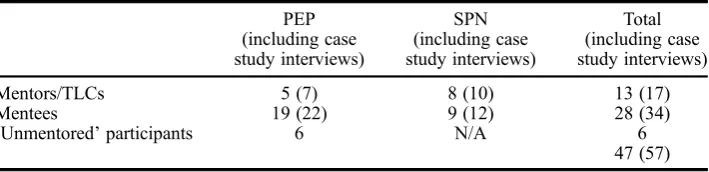
The number of interviews conducted with different categories of participant is 25 summarised in Table1.
[image:6.493.71.426.560.646.2]We refer to our main method of data generation for this study as ‘part-structured’ interviews (Hobson and Townsend 2010) to describe a relatively flexible form of ‘semi-structured’ interviews which draw upon Tomlinson’s (1989) notion of hierar-chical focusing. The aim of the hierarhierar-chically focused interview is to ensure cover-30 age of the researcher’s agenda whilst minimising the interviewer’s influence on interviewees’ responses, by seeking to‘elicit as spontaneous a coverage of as much of the interview agenda as possible’ (Tomlinson 1989, 169). This is achieved by constructing an interview agenda that starts with a single general question, which theoretically allows the interviewee to speak about all of the things in which the 35 researcher is potentially interested, but that also includes more specific questions and prompts to be used as required. During the interview, interviewees are encour-aged in a non-directive manner to elaborate and expand upon the views they are expressing, using both verbal and non-verbal strategies (e.g. deliberate silences, explicit request such as ‘do go on’), and are prompted to discuss those aspects of 40 the researcher’s agenda which they do not spontaneously address by (as far as possible) using terminology which has already been introduced by the interviewee. Whilst adhering to these principles, we chose not to begin our various interviews for
Table 1. Interviews conducted.
PEP (including case study interviews)
SPN (including case study interviews)
Total (including case study interviews)
Mentors/TLCs 5 (7) 8 (10) 13 (17)
Mentees 19 (22) 9 (12) 28 (34)
‘Unmentored’participants 6 N/A 6
this study with a single broad question because of the relatively wide range of expe-riences and perceptions we wished to explore with different categories of
intervie-5 wees (e.g. relating to participants’ experiences of school-based mentoring, to actual or potential benefits and costs of working with an external mentor, to other forms of support for participants’PLD and to participants’perceptions of their PLD needs).
The sampling strategy adopted varied according to the method of data generation employed and across the participant groups. First, given the relatively small total
10 number of PEP mentors nationally (at the time of recruitment to our study, there
were seven, each working in one of the three regions of England in which the PEP programme was being piloted), all of these were invited to participate in the initial (pre-case study) interviews. Six agreed to do so, although in the event, it proved impossible to conduct an interview with one of these. The five PEP mentors
inter-15 viewed were all white males who were experienced teachers of physics and who
had held or were holding head of department or other leadership roles in schools. Secondly, given that as many as 155 PEP pilot participants had given permission to share their email addresses for research purposes, we approached a stratified sample (by region and gender) of just over a quarter (40) of these to request whether they
20 were willing to be interviewed. From this, 19 interviews were eventually conducted
–with ten female and nine male participants from a range of ethnic backgrounds. Thirdly, we also invited a stratified sample (again by region and gender) of 12 TLCs (out of 23 who held the role across England), of whom eight agreed and were subsequently interviewed – six white males and two white females. Like the PEP
25 mentors, the TLCs were experienced teachers and leaders of physics, some of whom
were still teaching, while some were semi-retired and/or undertaking mentoring and coaching alongside other consultancy roles. Fourthly, since we had no direct means of identifying teachers who had accessed TLC support, those TLCs who agreed to participate in our research were also asked to invite teachers they were supporting to
30 participate in the study, which led to interviews with nine beginning teachers.3Like
PEP participants, most of the SPN mentees that we interviewed had entered teaching as their first career, though in both cases, there were a small number of career-changers. While all PEP and most SPN mentees entered teaching through one-year university-administered PGCE programmes, a minority of SPN mentees had entered
35 teaching through other routes, notably the undergraduate Bachelor of Arts with
Qualified Teacher Status course and the postgraduate employment-based Graduate Teacher Programme (GTP).
Case study participants were selected from existing participants who indicated a willingness to be included using purposive sampling to facilitate the examination of
40 a variety of approaches to mentoring we had identified as being in use. These
selec-tion decisions were informed by an initial analysis of data generated from the earlier interviews with mentors and mentees. Finally, four providers of ‘post-pilot’ PEP were approached– based for reasons of convenience and cost on their geographical proximity to existing fieldwork sites – and asked to facilitate the research team’s
45 access to‘unmentored’participants on their programmes. Two of these agreed, from
which a total of six participants (four females and two males from a range of ethnic backgrounds) volunteered and were subsequently interviewed.
At the time of data generation, mentees were in their first or second year of teaching following completion of their ITP, while the ‘unmentored’PEP participants
50 were following their PEP courses prior to embarking upon PGCE programmes.
conducted on a face-to-face basis. Where this did not prove possible, participants were interviewed via telephone (in six cases) or else the discussion took place via email (two participants). The face-to-face and telephone interviews varied in dura-5 tion between 25 min and one hour 15 min, with an average duration of 52 min. With the consent of participants, all interviews were recorded and subsequently tran-scribed, whilefield notes taken during observations were typed up as soon as possi-ble after the event. Following the initial analyses of all data generated for the wider study, for the purposes of producing a full report on the research (Hobson et al. 10 2012), each of the present authors subsequently undertook an independent reanalysis of separate ‘qualitative’4 data-sets (together amounting to around a half of all rele-vant transcripts and field notes), employing constant comparative methods (Miles and Huberman 1994). The role of external mentors in helping to enhance beginner teachers’identity development (the focus of this paper) was independently identified 15 by each of us as a prominent theme in the data. The outcomes of these analyses informed the subsequent development of a coding frame to undertake a data-driven thematic analysis (Braun and Clarke 2006), using MAXQDA qualitative data analysis software.
We should state that the study as a whole was conducted in accordance with the 20 ethical guidelines of the British Educational Research Association (BERA 2011). For example, all prospective participants were granted the opportunity to give or decline their informed consent to take part in the research, as well as the right to subsequently withdraw consent, while in presenting findings of the research here and elsewhere, we have sought to protect the anonymity and non-traceability of par-25 ticipants. While the perspectives of teachers in general are marginalised in much education discourse (Lingard 1995), and this is especially the case for beginning teachers (Hobson 2010), in the presentation of findings which follows, we draw on feminist traditions to accord a prominent place to our beginner teacher participants’ ‘voices’ (Bell and Klein 1996; Mahony, Menter, and Hextall 2004). Due to limita-30 tions of space, specific findings are normally illustrated by one or two illustrative quotations, and, unless otherwise stated, the quotations provided are fairly typical of the (reported and sometimes observed) experiences and perceptions of a larger num-ber–and usually at least a significant minority–of participants.
Findings
35 In this section, we draw attention to three important features of identity development that the beginning teachers in this study sought to negotiate, each of which posed challenges to them, challenges which they were helped to overcome with the support of their external mentor. We then go on to offer an interpretation of these findings which draws on‘third space’theory. First, however, we provide a context for this in 40 the form of a summary overview of the support provided by EMs.5
External mentor support: an overview
(such as classroom management), for their emotional well-being, for building their confidence as teachers of physics, for developing their resilience and for their career progression. Support was provided predominantly via face-to-face contact and email,
5 with the former including both one-to-one meetings (normally in mentees’schools) and group meetings (for PEP participants, these were often informal social events such as group meals or get-togethers at science events or regional or national confer-ences; for SPN participants, they more often took the form of school-based work-shops for science departments). For both PEP and SPN, some support was also
10 facilitated through telephone conversations, whilst a minority of participants utilised
text messaging or social networking sites (most commonly Facebook).
It is important to note that not all PEP and SPN participants who were offered the provision of an external mentor took advantage of the support to any meaningful degree: on the basis of our research evidence, we estimate that approximately half
15 of eligible participants did so.6 Of those beginner teachers who did meaningfully
engage with a PEP or SPN external mentor, the frequency of contact normally ran-ged from once a week to once a term, and all such participants reported that the mentoring had a positive impact. The perceived benefits were categorised as: impact on professional subject knowledge and skills base; impact on teaching and learning
20 (e.g. increased use of practical work); impact on emotional well-being (e.g. relating
to mentees’ increased confidence in their physics knowledge and corresponding reduced anxiety relating to teaching physics); enhanced recognition and career advancement for mentees; and associated benefits for mentees’departments, schools and the wider professional community (e.g. enhanced teacher retention). Some of
25 these benefits came about, at least in part, through the processes involved in
men-tees’ development of their identities as teachers and as subject specialists, the main focus of this paper to which we now turn.
Three features of identity development and external mentor support
Thefindings of our analyses suggest that working with external mentors in the ways
30 described above helped three distinct aspects of identity development for our
begin-ner teachers, namely those relating to performative school cultures, to becoming subject specialists and to engaging with relevant communities of practice. We dis-cuss each of these, in turn, before examining such identity development through the lens of third space.
35 Identity formation and presentation in normative and performative contexts
In general, our analyses support the conclusions of Lasky (2005) that teachers’ pro-fessional identities evolve over time and are part-shaped and constrained by‘school, reform and political contexts’(p.901). Our data suggest that two particular contex-tual factors were rarely far from beginner teachers’ thoughts about their teaching
40 and their identities as teachers. The first was that, particularly as student teachers
and NQTs, they felt that they were under almost constant scrutiny and vulnerable to others’ judgements and criticism. As one participant put it ‘whatever you ask your [school-based] mentor they would judge you on and [think] ‘why doesn’t she know that?’’(PEP mentee 3, female). A second, related consideration concerns the specific
‘performance managed’, namely the prescribed Teacher Standards which have come to dominate both policy discourse and local practice. Some participants suggested that their experiences of school-based mentoring were focused almost entirely upon the Standards – based around the criteria for teaching … to get you past all the 5 objectives’(PEP mentee 17, male). One of the ways in which some if not all partici-pants negotiated their identity development (consciously or otherwise) in the face of these considerations was by developing or presenting‘strategic and positional’ iden-tities (Hall2000) as coping mechanisms, effectively defining themselves in different ways to different people. Most notably, and probably motivated by an understand-10 able desire in the circumstances to present an appearance of competence to others (Edwards 1998), our data suggest that it was commonplace for beginner teachers to mask from school-based mentors, line managers, university tutors and others those elements of their self-identities that portrayed (or betrayed) them as new entrants in need of support and guidance. For example, one mentee statedI wouldn’t be speak-15 ing to my [school based] mentor about flaws that I have (PEP mentee 3, female),
while another admitted that:
there is a part of you that feels if I go to this person to say I don’t know this, what would it look like in terms of them thinking why does this person not know this basic thing? (SPN mentee 1, female)
20 While masking aspects of their teacher identities may seem preferable to having their identities ‘defined by others’ (Lumby 2009), one of the consequences for beginner teachers of being unwilling or unable to openly acknowledge their profes-sional development needs to school-based colleagues or university tutors is that those professionals are thereby less able to help them address such needs, which 25 may restrict their development as teachers (Hobson and McIntyre2013). One
partic-ipant got to the very heart of the issue in exclaiming:
You don’t want to look like you don’t know what you’re talking about but you also want help. (PEP mentee 15, female)
Fortunately for most of the beginner teacher participants in this study, they were able 30 to enlist the support of an external mentor to help them to negotiate their own learn-ing and growth as teachers and their developlearn-ing professional identities in the face of the challenges outlined above, and to provide support for professional development needs that they were not able to address via standard support mechanisms. The unique role of EMs, positioned outside of the school context, enabled them to pres-35 ent an alternative perspective to those typically encountered in normative and
perfor-mative spaces. One participant, for example, described EM support as:
less focused on jumping through hoops and more about being a better teacher. (PEP mentee 18, male)
Interactions with external mentors provided dialogic spaces, within which mentees 40 felt able to present aspects of their self-identities which revealed their insecurities
and professional development needs:
I’ve used [EM] loads and can ask stuff that I would feel a bit too stupid to ask col-leagues. [EMs] don’t seem to judge. (SPN mentee 8, female)
Some such mentees made explicit reference in this context to the independent and non-judgemental nature of EM support:
I was keen to have [EM] come into my lesson and share his expertise. He wasn’t com-ing in to pick holes in what I was docom-ing but to support. (SPN mentee 7, male)
5 What is clear from the findings is that the EM is positioned as a much needed ally for some (perhaps many) beginning teachers, and such an ally was a desirable prospect for some of the‘post-pilot’PEP participants we spoke to (who did not have access to an EM):
It’s the university that’s assessing us [so] it might be difficult to say ‘I’m having a
10 really bad nightmare I need to talk to somebody’ …So I think…someone externally
could be useful, if you want to ask a question about your subject knowledge and you don’t want to look stupid… I can see the value of it. (‘Unmentored’PEP participant 4, female)
Developing an identity as a subject specialist
15 We suggested earlier that an important aspect of a teacher’s identity formation
involves their identification with the subject they teach (e.g. Helms 1998). For the beginning teachers in this study, this meant they must also negotiate an additional dimension of identity development, that of becoming a subject specialist teacher where the subject matter is a relatively newfield to them. Both interview and
obser-20 vation data evidence ways in which interactions with their external mentor helped
beginning teachers to deal with specific challenges of teaching physics. Some begin-ning teachers directly compared the EM’s subject-specific support with more gener-alised support they had received in their schools. For example:
[EM] is much more physics support as well because the mentors in school support you
25 on how to teach rather than content. So the physics knowledge and how you go about
teaching physics. (PEP mentee 12, male)
There were three specific approaches to teaching physics that the EMs helped with. The first of these was their understanding of, and the avoidance of reinforcing, common misconceptions within physics. When considering
miscon-30 ceptions, the EMs helped their mentees with their own as well as their pupils’
misunderstandings:
[the EM found] out what misconceptions pupils have about forces, and [sought to] to check on any of mine as well. (SPN mentee 5, female)
Second, the beginning teachers perceived a particular challenge of teaching physics
35 to be that of understanding how to set up and demonstrate concepts through
practi-cal work (‘practicals’) and experiments:
he literally spent the day giving me ideas of how to put things together. (PEP mentee 13, female)
Until they received this kind of support from their EM, some mentees had
some-40 times avoided practical work in their teaching. Third, the beginning teachers
reactivity and resistance. For some, there was a perception before they had engaged 5 with the support of their EM that their teaching of these areas had been unsuccessful
and‘dry’(SPN mentee 1, female):
So [EM] comes in with ideas of ways to make it more engaging, things that the kids are actively involved in. (SPN mentee 1, female)
Because external mentors helped beginning teachers both with their own understand-10 ing of the subject matter and with innovative ways of engaging the pupils with spe-cific topics, the danger of promoting fun activities based on an insecure knowledge base was avoided. The beginning teachers were thus supported to plan and teach in ways that led to what Wilson and Kittleson refer to as‘meaningful science learning’ (2012, p. 710).
15 Our analyses suggest that developing an identity as a subject specialist teacher who is able to plan for meaningful learning is a long-term endeavour, and that this is a continual or iterative process which reflects teachers’ grasp of, and confidence relating to, both subject content knowledge and subject pedagogical knowledge. Beginning teachers usually rely on their more experienced colleagues to help with 20 this process as the secondary school subject department can provide ‘the locus around which secondary teachers gather, collaborate, develop identities and support each other’(Hobbs2013, 275). Accordingly, the development of a subject specialist identity was a particular issue for those participants in the present study who were or had been based in schools in which there was a scarcity of physicists and/or 25 whose mentors had not been physics specialists, since this restricted opportunities to develop their knowledge and understanding through dialogue and collaborative working with such subject-specialist colleagues:
It’s a small science department…I’m the only one who has done anything in physics so they look to me as being the expert. And because of my route into science I’ve got 30 gaps and I don’t always know the answers. (SPN mentee 4, female)
That said, beginner teacher participants in schools whichdidemploy specialist phys-ics teachers did not always benefit from their presence to the extent that they might have, for three main reasons. First, some such specialist teachers were unable to make sufficient time for them. Second, some beginner teachers were reluctant to 35 engage in open dialogue with experienced specialists in their schools due to issues relating to the performativity context discussed in the previous section. Thirdly, some beginner teachers considered that the physicists in their workplaces were too ‘old school’ (PEP mentee 15, female; SPN mentee 2, female) and (especially in comparison to EMs) were perceived to be:
40 people who are less equipped to help you and [who] go with established ways of doing things and [do] not make physics lessons as exciting as they can be. (SPN mentee 7, male)
5 content and pedagogical content knowledge, and (partly through doing so) by boosting their confidence in and enthusiasm for the teaching of physics. So mentees explained that the support from their EM had helped by:
encouraging us to teach physics help[ing] those students who learn best by seeing things, through experiments and practicals, rather than by hearing it. As a result pupils
10 are engaging more with what’s going on in the lessons. (SPN mentee 7, male)
These findings support and complement those of Hobbs (2012), who stated that teacher identity development as a teacher of a particular subject is contingent upon the individual’s:
commitment to the subject, being able to identify with it personally and professionally,
15 and knowing how to bring the subject matter alive for students. (9)
She goes onto argue that this does not happen simply at a cognitive level, but also at an aesthetic level. Ourfindings suggest that external mentors can inspire and fos-ter a passion for the subject within beginning teachers who initially lack confidence in that subject, and that this helps them to identify both with the subject and with
20 themselves as teachers of that subject.
Forming identities as part of a community of practice
Teacher identity formation is also connected in various respects to teachers’ relation-ships with and to relevant professional communities (Talbert and Mclaughlin2002). One important ingredient of identity development involves being accepted into
vari-25 ous communities of practice (Lave and Wenger 1990). As suggested above,
how-ever, some beginner teachers of physics lead something of a ‘balkanized’ existence (Hargreaves 2001) and have limited opportunities to develop their teacher identities alongside subject-specialist colleagues in their schools. As one participant in the present study put it, ‘you can be working in a bit of a vacuum’ (PEP mentee 2,
30 male). Our analyses suggest that the majority of the newly and recently qualified
teachers we spoke to felt isolated in their schools, either because there were no spe-cialist teachers with whom they could ‘talk physics’ or because they were trying to teach physics in a manner that was not consistent with how the department approached the subject. In such a context, involvement with a broader professional
35 community assumes even greater importance to a beginner teacher’s identity
development.
Our data reveal that PEP external mentors in particular played a valuable role in connecting beginner teachers of physics to their broader communities. They did so,
firstly, by working to establish a peer network amongst PEP participants through
40 both face to face and social networking. This often began during the early stages of
the PEP programme, with the mentor encouraging mentees to attend social functions such as group meals, and continued through participants’ PEP, PGCE and NQT Induction programmes to the end of their second year in teaching (though those beginner teachers who took up posts in different regions to those where they had
45 followed their PEP and PGCE programmes – and which their external mentors
5 [E]ven the PEP course itself wasn’t as valuable as what [the EM] was doing… He organised us and we kept together and we built up camaraderie in our team and we felt we could bounce ideas off each other because he brought us all together. (PEP mentee 15, female)
[O]ne of the best things is knowing other people are going through the same things as 10 you are. Knowing that there is a learning curve and …you are all going through it. You share ideas, de-stress with each other and it helps you stick with it…it certainly has helped keep me going. (PEP mentee 18, male)
Secondly, external mentors were catalysts not only in developing peer support networks, but also in encouraging (both PEP and SPN) mentees to become involved 15 with their local science teaching communities and providing a conduit to national professional organisations of subject specialists, specifically the Institute of Physics and the Association for Science Education. Indeed, for some participants, apart from networking with PEP and PGCE coursemates and/or colleagues in their departments, interaction with other members of the physics teaching community occurred only 20 through opportunities created by their EM. Through promoting mentees’ involve-ment with the broader community of physics and science teachers, as well as through their direct contact with mentees, EMs helped compensate for the feelings of isolation felt by some beginning teachers and provided further opportunities for them to develop their identities as physics teachers. One such teacher commented
25 that:
…it makes you feel part of the whole thing, feel part of the wider…world of physics. (PEP mentee 16, male)
In contrast, some ‘post-pilot’ PEP participants, who did not have access to an EM, articulated concerns about their potential isolation following the completion of 30 their course and dispersal of their PEP and PGCE peer groups:
I think from our discussions at the moment we have all this support, [but] what hap-pens when we’re on our own? … we would definitely appreciate a regional mentor, someone [we] can always have…(‘Unmentored’PEP participant 2, female)
Mentoring dialogues as third spaces
5 Our data (drawn from direct observation of interaction and discourse between beginner teachers and their EM and peers, as well as participants’ perceptions of these interactions as recollected and rehearsed in the research interviews) suggest that the work of EMs acted as a catalyst for third, in-between, discursive spaces to be created out of the intersections of the first and second spaces that mentees
inhab-10 ited. That is, beginner teachers’ interactions both with their EM and with peers in
networks facilitated by their EM, created a form of refuge and reflexive space, within which participants could critically reflect on their practice and that of their school. An illustrative example of this is from field notes taken for one of the case studies of PEP mentoring, specifically at one of a series of regular group meals
15 organised by the mentor.
There were eight mentees at this session, all were NQTs and had been on the same PEP course together. [EM] sat in the middle of the group and joined in but did not nec-essarily lead discussions as the meal progressed. There was a relaxed informal atmo-sphere and the conversation drifted between talk about physics and science teaching
20 more generally as well as more personal topics ranging from life outside school to‘the
strain of doing cover, of Ofsted7, of in-school mentors’.
When interviewed, this case study mentor explained that the meals and other activi-ties he initiated were designed to cultivate an informal support network amongst mentees. He suggested that getting to know others in the same situation –‘knowing
25 they’re not alone, is the most important thing of all – teaching is very tough…’
(PEP mentor 1, male).
These kinds of activities created opportunities for beginning teachers to negotiate new understandings and professional identities. In these third spaces, mentees were more able to recognise and critically interrogate the dominant discourses of schools
30 and schooling, and to explore and interrogate pedagogies that they felt were more in
line with the kind of teacher self the mentee wanted to become:
[Y]ou can get a bit consumed with your own school and think that is the only way. (PEP mentee 8, female)
[I]t gave me an opportunity to see or question how I was doing it. (PEP mentee 9,
35 male)
Our data also suggest that in this safe, discursive space, beginner teachers felt able to talk informally with their EM and with each other about a range of matters, including issues relating to what one mentee referred to as their‘flaws’(PEP mentee 3, female), or to their development as teachers and subject specialists, which they
40 were not always willing or able to openly discuss in their schools:
Just having a relaxed conversation and not feeling you are under any pressure. There is no judgement, you know it is completely non-judgemental and private which I think really helps. Because there are often more of us in the same boat we can really relate, and then [EM] is there to…reassure…us. (PEP mentee 8, female)
45 Our analyses suggest that key to this was external mentors’ independence from
schools and their performance management structures, and the particular approaches to mentoring that they adopted, described by one PEP mentor as:
free access to me, to seek support and bounce ideas around with, without the possible other agendas that might exist with coaches and mentors in school. (PEP mentor 1,
Conclusions and implications
The findings reported in this paper support those of some previous studies’, which have found that teacher identity is multifaceted, and that identity formation is infl u-enced by a number of sociopolitical considerations including power relationships. 5 Our study enriches the evidence base in this field, most notably by demonstrating benefits that working with an external mentor can bring for beginner teacher identity development, and by mobilising third space theory to help illuminate and understand some of these benefits. Before elaborating upon this, we first wish to acknowledge that, like all research, the present study is not without its limitations. For example, 10 and firstly, in terms of the validity or credibility (Guba and Lincoln 1994) of our data, we should beware taking participants’ accounts, which our analysis mostly draws upon, at face value (Dingwall 1997), especially perhaps in a context in which some of these have stated that they have not been honest about some matters with colleagues in their schools. That said, the accounts of our mentee participants are 15 generally consistent with those provided by those external mentors we interviewed, with the email exchanges between mentors and mentees that we analysed, and with our direct observation of mentor–mentee interaction, while the very fact that some teacher participants were willing to admit that they were not always honest with their colleagues suggests a certain degree of openness with ourselves as researchers. 20 Secondly, for various reasons, including those relating to the sampling strategies
they teach. Secondary teachers of physics were not more likely than other teachers 5 to indicate that they might benefit from external mentor support, and nor were non-specialist teachers of physics or other subjects.
We should also acknowledge that our study – and readers of this paper–might have benefited from greater contextual detail relating, for example, to the amount of interaction between participating teachers and external mentors, and to other science
10 teachers in the participants’ schools. Finally, it should also be noted that while in
discussing their experiences of external mentor support, many participants high-lighted differences between this and the support provided by school-based mentors, our study does not allow for a direct comparison of the quality or pros and cons of the support provided by school-based and external mentors. That said, our evidence
15 suggests that, in addition to the benefits associated with the confidentiality permitted
by beginner teachers’relationships with external mentors, more generally the quality of the mentoring provided by school-based mentors was highly variable (as previous research has shown), while that provided by PEP and SPN mentors was of a more consistently high standard. This may be explained by a number of considerations,
20 including the relatively rigorous selection process employed and the greater degree
of choice available to the Institute of Physics in appointing the PEP and SPN men-tors, the fact that they were paid and trained to undertake the role, and tended to have more time in which to provide the mentoring.
Despite its remaining limitations, this study casts new light on the processes of
25 beginning teacher identity formation as they apply to at least some categories of
beginning teacher, and develops the evidence base in a number of important respects, as we now go on to explain.
External mentor support for identity formation in a third space
In this paper, we have highlighted three distinct and important features of beginner
30 teacher identity development, and ways in which external mentors can facilitate and
help beginner teachers overcome obstacles associated with each of them. More spe-cifically, and drawing on third space theory (Bhabha 1994), our analyses have shown that the work of external mentors, who are purely supportive and have no assessment function, can provide ‘motivating’ and ‘safe’spaces (Luehmann 2007),
35 within which non-specialist, beginning teachers of physics are able to negotiate the
practices, expectations and performance measures that define their work contexts and, in doing so, to overcome impediments to their professional learning and posi-tively develop their professional identities. First, for some beginning teachers,‘safe’ and ‘motivating’ third spaces (in which opportunities exist to overcome contextual
40 barriers to PLD) were created through informal face to face contact, or through
digi-tally mediated dialogue, in the form of email or mobile phone text, (typically) initi-ated by the beginning teacher. Within these third spaces, some usual practices were suspended and hierarchical relationships flattened as beginning teachers voluntarily turned to their more experienced mentor or their peers to explore and better
under-45 stand the professional contexts in which they were learning and working, without
(or with a much reduced) fear of judgement. The creation of a third space in this way allows for identification with alternative ways of being a teacher which go beyond the expectations embodied in dominant discourses. These findings extend existing literature which explores the ways in which teacher identity development is
and Piot2009) and demonstrate some of the ways in which, through their discourse with their EM (and their peers in networks facilitated by their EM), beginning teach-ers make sense of their emerging ‘identity struggle’ (Trent 2013) as they examine the norms, policies and practices of their institutions.
5 Secondly, moving beyond these expectations of teacher identity within dominant discourses involves a certain element of courage on the behalf of most beginning teachers as ‘trying on a new identity within a community of practice (especially when it is counter to the norm) involves assuming risks’ (Luehmann 2007, 828). Our findings suggest that mentees’ dialogues with the EM and within the peer net-10 work cultivated by the EM provided a space in which the EM legitimised any risks taken by the mentee and, in so doing, strengthened the processes of identity forma-tion. Within this space, the potential existed for beginner teachers to explore thoughts, feelings and practices, which may run counter to the prevailing views and practices within the institution. We suggest that this helped the new entrants navigate 15 differing views, school-based expectations and their own desires and understandings of what their experiences as emerging teachers of physics should or could be. This is especially important for beginning teachers joining departments with no physi-cists. Access to a specialist EM, who can work with the novice in a safe space in which they can both assume a discourse of detached criticality, can enable better 20 understanding of the ways in which subject pedagogy can develop. We do not wish to suggest that beginning teachers without access to the support of an EM are never able to create alternative third spaces (perhaps with like-minded colleagues in school) through which they will be able to develop aspects of their professional identity. However, this study shows how the construction of a third space with an 25 independent experienced subject specialist can help beginner teachers develop pro-fessional identities through processes by which they become more informed, criti-cally aware and astute, and more able to manage different ‘personal, professional and situational factors’(Day et al.2007, 122).
Thirdly, the development of a subject specialist teacher identity is dependent 30 upon a range of factors, including confidence in the subject and the associated peda-gogy (Beijaard, Verloop, and Vermunt 2000; Fox 2010) and a growing sense of becoming a part of, and belonging to, a professional body of subject experts (Saka et al.2013) at a time when beginning teachers, especially non-specialists, are experi-encing the‘vulnerable’early years in the profession, where constructing an identity 35 as a teacher of science is particularly characterised by ‘struggles’and reliant upon a ‘range of professional influences’ (Danielsson and Warwick2014). This study dem-onstrates that the work of EMs in facilitating entry into different professional com-munities of practice, including the wider science education community in addition to school-based communities, made another important contribution to their mentees’ 40 identity formation, notably by helping mentees interpret and reflect upon the dis-courses associated with and utilised by these communities of practice. As the begin-ning teachers became more confident and skilled in engaging with these discourses and participating within these communities, their identities as teachers of physics were developed and strengthened (cf. Luehmann2007; Hobbs 2013). Our focus on 45 the work of the EM has thus drawn attention to their role in the development of a subject specialist identity as the mentees come to self-identify as beginning teachers of physics who are developing confidence in their subject knowledge and their subject pedagogy. The study adds further weight to literature which suggests that positive identification with the subject is an important aspect of teacher identity
AQ6
5 formation (Hobbs 2012). The people who were appointed as EMs were not only experienced practitioners, they were subject knowledge experts who had a passion for their subject and were able to enthuse mentees to be so too, as is evidenced in the extreme by one mentee when she saidI never imagined that I would be able to teach physics. It [EM support] has changed me, even over [my specialist subject]
10 biology, I prefer to teach physics, it has changed me that much (PEP mentee 15,
female).
Finally, our analysis lends support to poststructuralist understandings of identity construction by suggesting that as the beginning teachers traversed the boundaries between the different spaces discussed in this paper, they were (consciously or
other-15 wise) making decisions about which aspects or facets of their identities to display to
others. So, for example, some beginning teachers spoke of the need to conceal their lack of subject knowledge from their school colleagues in what we have character-ised as their second space whilst choosing to seek advice about this from their EM within what we have suggested to be a third space. The choices they made were
20 context-dependent. Consequently, some beginning teachers felt they needed to
pres-ent what they felt significant others8 within their school communities would recog-nise as socially desirable or competent ‘performances’, whilst their interactions with the EM within a third space enabled them to be more ‘themselves’. The EMs con-tributed to their mentees’ professional learning and identity development partly
25 through the provision of psychological support within this space, which helped
beginner teachers navigate the emotionally charged processes of becoming a teacher (Hobson et al.2008). Within a third space, beginner teachers became more confident about their own positions and viewpoints (whether they chose to voice these within their institutions or not). Their interactions with their EMs and peers within this
30 space helped them to make sense of the performative contexts which characterised
their second space, and for some, this led to ‘new understandings and enhanced practices’(Martin, Snow, and Franklin Torrez2011, 300)9.
Some implications for policy, practice and further research
We suggest that the findings reported in this paper have a number of implications
35 for policy, practice and further research relating to identity development and to
sup-port for beginning teachers more generally – in the UK and further afield. Firstly, policy-makers have an important role to play in bringing their influence to bear on dominant discourses about the nature and importance of PLD for beginning teachers. Our findings suggest a need, in England at least, for a shift in these dominant
dis-40 courses towards positive acknowledgement and recognition of the ways in which
teachers’ PLD come about, including through making mistakes and critically reflecting on these (Lovett and Davey 2009, 563), alongside a recognition that opportunities for risk-taking and innovation are desirable for professional learning and identity formation.
45 Secondly, as new entrants to the profession within England are judged against a
common set of Teachers’Standards (DfE2012b), which apply to all teachers regard-less of their background or experience, there is a need for beginner teachers to have an ‘ally’ who can help negotiate these Standards and create spaces where they feel able to acknowledge their ‘flaws’and needs in order to learn and develop. Settlage
50 et al. (2009) suggest that ‘self-doubt’ and ‘uncertainty’ are crucial components of
whom mentees’ ‘self-doubt’ can be expressed without fear of judgement) can be potentially vital in this learning process and that the selection of individuals for this role should be based on their subject knowledge, their expert practice as teachers 5 and mentors, and their ability to provide an independent perspective. In our view, there may be a strong case for providingall beginner teachers with opportunities to access external mentors, at least those in education systems, like our own, in which their identity development and PLD more widely are impeded by performativity cul-tures in general and by the requirement for school-based mentors to formally assess 10 their development in particular. To facilitate this, regional or national networks and registers of trained external mentors might be established for different subject areas.
The policy recommendations suggested above could positively impact the prac-tices of those working with beginning teachers in schools. If dominant discourses at a policy level acknowledge that beginning teachers are on a developmental journey, 15 this could potentially have a powerful impact, enabling teacher educators and men-tors to adopt a more pragmatic and developmental approach to supporting beginner teachers than that allowed by performativity contexts, and one which better acknowledges the realities of teaching and professional learning. This is especially important in an evolving landscape of ITP which prioritises school-based and 20 school-led training, as is the case in England (DfE2010). Crucially for some begin-ning teachers, the approach taken by the EMs in our research ran counter to the nar-row, technicist model of teaching (McNally and Blake 2012) enacted in some induction programmes and so provided an alternative view of what teaching could be.
25 We also extend Ruohotie-Lyhty’s call for identity development to be‘taken into consideration’ in teacher education programmes (2013, 127) by suggesting that those involved in supporting teachers’ initial preparation and early PLD consider their role in helping beginner teachers shape and develop their identities. We suggest that ITP programmes should offer opportunities for overt discussion of professional 30 identity development and of the idea that identity can be understood as multifaceted, multilayered and constantly evolving. Beginning teachers may then be in a stronger position to understand that the choice to present a specific aspect of their identity at a given time might have consequences which they need to address–if, for example, they are concealing any perceived limitations in their knowledge or practice. Explic-35 itly sharing this understanding with beginning teachers during the early stages of their professional learning (for example, during ITP) could potentially be empower-ing for them.
Further research which examines the ways in which beginning teachers view the processes by which they assume different identities might enable us to better under-40 stand whether or not these are conscious choices (and whether or not this matters). More generally, we would encourage additional studies which explore the viability and potential of similar or different models of external mentor support for beginning teachers of different subject areas and phases of education, wherever these may exist or be introduced or piloted. To the extent that such studies might mobilise third 45 space theory in a planned as opposed to retrospective fashion, researchers should seek to generate data which capture a more substantial amount of direct evidence and examples of the discursive practices which mentees engage in with both external mentors and their peers.
influential (Sahlberg 2010) and/or where school-based mentors are not required to formally assess them as well as support their PLD (Ulvik and Sunde 2013) – can engage in discursive practices where they are able to critically negotiate professional influences which we argue is a key function of third space. It may be that in such
5 contexts, entrants to the profession may not have to negotiate the kinds of impedi-ments to identity development that we have identified in the English context, thus perhaps obviating the need for external mentors.
Acknowledgements
We are grateful to the Gatsby Charitable Foundation and Institute of Physics for supporting
10 the research reported in this paper. We are also indebted to Pat Ashby, Susan Jones, Angi
Malderez, David Stephens and the anonymous reviewers and editors ofResearch Papers in Educationfor their helpful comments and suggestions in relation to the development of the paper.
Notes
15 1. We use‘beginner-’or‘beginning teachers’in this paper to refer to those undertaking
ini-tial teacher preparation (ITP) or in theirfirst or second year in teaching post ITP. We use the term ITP, in preference to alternatives such as initial teacher training (ITT), initial tea-cher education (ITE), pre-service training, and initial teatea-cher education and training (ITET), to signal our belief that effective teacher preparation requires both‘training’and
20 ‘education’as these are often understood, and/but that the distinction between the two
terms is somewhat blurred and artificial (Tomlinson1995; Hobson et al.2008).
2. The Institute of Physics (IOP) is a scientific charity, based in London but with an interna-tional membership, devoted to improving the practice, understanding and application of physics. The Gatsby Charitable Foundation, also based in London, is an endowed
grant-25 making trust which has a particular interest in science education amongst other concerns.
3. As part of the wider study, 19 interviews were conducted with teachers supported by TLCs. We have drawn upon the data from 9 of these. The remaining 10 were more expe-rienced teachers so the data were less relevant to the focus of this paper.
4. We use inverted commas here to acknowledge that the distinctions between qualitative
30 and quantitative research, methods and data are somewhat simplistic and exaggerated, as
Hammersley (1996) and others have shown.
5. A more comprehensive account of the nature and impact of this support, and detailed evidence relating to the summary account which follows, can be found in Hobson et al. (2012).
35 6. The reasons that some participants did not take up the offer of EM support included time
constraints on the part of the beginner teachers, and satisfaction on some mentees’parts with existing (notably school-based) support for their PLD. For some PEP participants, geographical distance between themselves and their mentors was also an issue, reducing opportunities for face-to-face meetings; while for SPN, school gatekeepers, such as heads
40 of department, sometimes failed to facilitate external mentors’access to potential benefi
-ciaries of their support.
7. Ofsted (the Office for Standards in Education, Children’s Services and Skills) is the non-ministerial government department of Her Majesty’s Chief Inspector of Schools in Eng-land (HMCI), which inspects and regulates services providing care for children and
45 young people, and education and skills for learners of all ages.
8. We use the term‘significant other’(Sullivan1953) to refer to those colleagues and lead-ers who participants perceive have importance and influence in their contexts.
9. We should acknowledge that it may well be the case that beginner teacher participants only became consciously aware of the presentation of a different aspect of their identity
50 – if at all – as they interacted with us within the research interview, which arguably
became an additional third space for some.
Notes on Contributors
Joanna McIntyre is Director of Initial Teacher Education at the University of Nottingham, UK.
5 Andrew J. Hobson is Professor of Education and Head of the Education Research Centre at the University of Brighton, UK. He is Editor of theInternational Journal of Mentoring and Coaching in Education.
References
Asada, T. 2012.“Mentoring Novice Teachers in Japanese Schools.”International Journal of 10 Mentoring and Coaching in Education1 (1): 54–65.
Ball, S. J. 2003.“The Teacher’s Soul and the Terrors of Performativity.” Journal of Educa-tion Policy18 (2): 215–228.
Beauchamp, C., and L. Thomas. 2009. “Understanding Teacher Identity: An Overview of Issues in the Literature and Implications for Teacher Education.”Cambridge Journal of 15 Education39: 175–189.
Beck, C., and C. Kosnik. 2000.“Associate Teachers in Pre-Service Education: Clarifying and Enhancing Their Role.”Journal of Education for Teaching26 (3): 207–224.
Beijaard, D., P. Meijer, and N. Verloop. 2004. “Reconsidering Research on Teachers’ Professional Identity.”Teaching and Teacher Education20: 107–128.
20 Beijaard, D., N. Verloop, and J. D. Vermunt. 2000. “Teachers’Perceptions of Professional Identity: An Exploratory Study from a Personal Knowledge Perspective.” Teaching and Teacher Education16 (7): 749–764.
Bell, D., and R. Klein, eds. 1996. Radically Speaking: Feminism Reclaimed. Melbourne: Spinifex Press.
25 Bhabha, H. 1990.“The Third Space: Interview with Homi Bhabha.”InIdentity: Community, Culture, Difference, edited by J. Rutherford, 207–221. London: Lawrence and Wishart. Bhabha, H. K. 1994.The Location of Culture. New York: Routledge.
Bradbury, L. 2010. “Educative Mentoring: Promoting Reform-based Science Teaching Through Mentoring Relationships.”Science Teacher Education94 (6): 1049–1071. 30 Braun, V., and V. Clarke. 2006. “Using Thematic Analysis in Psychology.” Qualitative
Research in Psychology3: 77–101.
BERA (British Educational Research Association ). 2011. Guidelines for Ethical Research. London: British Educational Research Association.
Bullough, R. V. 2012. “Mentoring and New Teacher Induction in the United States: A 35 Review and Analysis of Current Practices.” Mentoring and Tutoring: Partnership in
Learning20 (1): 57–74.
Crasborn, F., P. Hennissen, N. Brouwer, F. Korthagen, and T. Bergen. 2008.“Promoting Ver-satility in Mentor Teachers’Use of Supervisory Skills.”Teaching and Teacher Education 24: 499–514.
40 Danielsson, A. T., and P. Warwick. 2014.“‘You Have to Give Them Some Science Facts’: Primary Student Teachers’Early Negotiations of Teacher Identities in the Intersections of Discourses about Science Teaching and about Primary Teaching.” Research in Science Education44: 289–305.
Day, C., P. Sammons, G. Stobart, A. Kington, and Q. Gu. 2007.Teachers Matter: Connect-45 ing Lives, Work and Effectiveness. Maidenhead: Open University Press.
DfE (Department for Education). 2010.The Schools White Paper: The Importance of Teach-ing. London: HMSO.
DfE (Department for Education). 2011.HC 1515 Attracting, Training and Retaining the Best Teachers, Written Evidence. Accessed August 3, 2012. http://www.publications.parlia 50 ment.uk/pa/cm201012/cmselect/cmeduc/writev/1515/att22.htm
DfE (Department for Education). 2012a.Induction for Newly Qualified Teachers (England): Guidance for Appropriate Bodies, Local Authorities, Head Teachers, School Staff and Governing Bodies. London: HMSO.
DfE (Department for Education). 2012b. Teachers’ Standards. Accessed October 2, 2012. 55 https://www.education.gov.uk/publications/eOrderingDownload/teachers%20standards.pdf
AQ9
AQ10
AQ11
AQ12
AQ13
AQ15