A POST 9/11 ANALYSIS
Neil Gordon Bowie
A Thesis Submitted for the Degree of PhD
at the
University of St Andrews
2012
Full metadata for this item is available in
St Andrews Research Repository
at:
http://research-repository.st-andrews.ac.uk/
Please use this identifier to cite or link to this item:
http://hdl.handle.net/10023/3641
UNIVERSITY OF ST. ANDREWS
THE APPLICATION OF DATABASE TECHNOLOGIES
TO THE STUDY OF TERRORISM AND COUNTER-
TERRORISM: A POST 9/11 ANALYSIS
A thesis submitted in part–candidature for the degree of
Doctor of Philosophy (Ph.D.)
Neil Gordon Bowie
DECLARATIONS
(i) I, Neil Gordon Bowie, hereby certify that this thesis, which is approximately
80,000 words in length, has been written by me, that it is the record of work carried out by me and that it has not been submitted in any previous application for a higher degree.
Date: ... Signature of Candidate: ...
(ii) I was admitted as a research student in October 2007, and as a candidate for the degree of Doctor of Philosophy (Ph.D.) in October 2007; the higher study for which this is a record was carried out in the University of St. Andrews between 2007 and 2011.
Date: ... Signature of Candidate: ...
(iii) I hereby certify that the candidate has fulfilled the conditions of the Resolution and Regulations appropriate for the degree of Doctor of Philosophy (Ph.D.) in the University of St. Andrews and that the candidate is qualified to submit this thesis in application for that degree.
Date: ... Signature of Supervisor: ...
(iv) In submitting this thesis to the University of St. Andrews we understand that
The following is an agreed request by candidate and supervisor regarding the electronic publication of this thesis:
Embargo on both [all] of printed copy and electronic copy for the same fixed period of five years on the following ground(s):
Publication would preclude future publication.
Date: ... Signature of Candidate: ...
ABSTRACT
THE APPLICATION OF DATABASE TECHNOLOGIES TO THE
STUDY OF TERRORISM AND COUNTER-TERRORISM:
A POST 9/11 ANALYSIS
Data and information of the highest quality are critical to understanding and countering acts of terrorism. As a tool, database technologies are becoming integral to the field of terrorism studies. The intelligence failings of September 11th 2001 illustrate the need for timely, relevant and accurate data, derived from a plethora of complex intelligence sources.
This thesis will argue that, at least until 9/11, the academic study of terrorism and counter-terrorism databases has been limited and that the subject lacks an overall coherency and direction. The thesis asks: what is the quality and practical value of database technologies in the field of terrorism and counter-terrorism post 9/11? The study will provide a cross-disciplinary approach, specifically from the disciplines of political science and computer science. It will present an understanding of the conceptual, design, operation, strengths and weaknesses of terrorism and counter-terrorism databases. The ramifications of post 9/11 and its impact upon the intelligence community, and the areas of security, privacy and emerging technologies in data mining and terrorism informatics are assessed.
This study will examine mainly open source information on terrorism and counter-terrorism databases. The research methodology will be carried out using a series of case studies, from the ITERATE, RAND/MIPT, WITS, and GTDB data sets. Primary sources, for example, codebooks, and secondary source materials such as Library of Congress and GAO reports are used. A comparative sampling of relational databases and terrorism data sets is undertaken.
The thesis will illustrate that with increased federal funding, new terrorism database technologies, post 9/11, operate under sophisticated schemata, requiring complex and systematic synthesis. In addition, issues of data sharing, fusion, interoperability and ethical concerns will be addressed.
DEDICATION
ACKNOWLEDGEMENTS
The journey is complete. I struggle to find the words of gratitude to express to my loving family, my supervisors, close friends and the many individuals and organisations that have helped me throughout the years.
To my late dad, Thomas Smith Bowie and my mum, Elizabeth Bowie, thank you from the very bottom of my heart. Through the most challenging of times they have always been there with their unconditional love, understanding and support; it will never be forgotten. Also, thanks indeed to my family, Graeme and Julie, David and Carol and Brian and Elaine for many years of continued support.
To Isa and Dave McLaren, and David - your unwavering love and support has been truly special. Thank you so much.
Although not with us today, I would like to say a special thanks to Aunty Bunty and Jimmy Bain, always supportive of my studies; I just know they would be delighted I made it!
One of the great privileges of my time at St. Andrews University was to have the highest standards of doctoral supervision. To Professor Ali Watson in the School of International Relations, my deepest thanks. Your on-going support, understanding and belief in me have touched me deeply. You helped me close the circle. To Dr. Alex P. Schmid, former Director of the Centre for the Study of Terrorism and Political Violence (CSTPV) at St. Andrews, I would like to convey my sincere and heartfelt felt thanks for the excellent supervision you gave to me both at St. Andrews and on your return to Vienna. Your patience, commitment, enthusiasm and willingness to give freely of your time has been remarkable. You entrusted me with opportunities in terrorism research that have been invaluable. I feel so truly privileged to have worked with you.
From the age of eighteen, as an undergraduate at the University of Aberdeen through to postgraduate studies at St. Andrews, to the late Professor Paul Wilkinson, I extend my most sincere gratitude. Professor Wilkinson inspired my interest in terrorism studies and for three decades gave generously of his time and support for my research. I will always treasure the phone call I made to let him know I had passed my Viva.
To my dear friends Susan, Jennifer, Alan, Gillian, Graham, Mooneen and Jan - always there for me, a massive thank you. To Frances McKee, what can I say? I’m lost for words. Your loving support from start to finish and beyond has been priceless. Thank you so much. Many other people have shown much kindness over my years at St. Andrews University. I would particularly like to thank Professor Bruce Hoffmann and Donna Hoffmann, and also Gina Wilson. To Gillian Duncan and Julie Middleton of the CSTPV, you have been so very kind. Thank you for sharing so many special times. Finally, my thanks must also go to the many other people whose paths I’ve crossed in St. Andrews and beyond.
Neil G. Bowie
TABLE OF CONTENTS
DECLARATIONS . . . ii
ABSTRACT . . . iv
DEDICATION . . . . . . v
ACKNOWLEDGEMENTS . . . vi
TABLE OF CONTENTS . . . vii
LIST OF ILLUSTRATIONS . . . .. . . x
LIST OF TABLES . . . xii
LIST OF ABBREVIATIONS . . . xiii
CHAPTER I. THE NEED FOR KNOWLEDGE . . . 1.1 Introduction . . . 1.2 Defining the problem . . . 1.3 Scope and research design methodology . . . 1.4 Data sets in historical context . . . 1.5 Defining: data sets, chronologies and databases . . . 1.6 Development of computerised terrorism data sets: The early years. . . 1.7 Information technology and Terrorism Studies . . . 1.8 Quantitative theory development . . . 1.9 Conclusions . . . 1 2 4 6 12 13 18 23 26
CHAPTER II. THE PRE-9/11 CONTEXT
2.1 Introduction . . . 2.2 Early Research – monographs . . . 2.3 Early Research – journal articles and data sets . . . 2.4 Early Research – technical literature . . . . . . 2.5 Conclusions . . .
28 30 40 51 54
CHAPTER III. DESIGN AND DEVELOPENT ISSUES IN TERRORISM AND COUNTER-TERRORISM DATABASES POST 9/11
3.1 Introduction . . . 3.2 Data definition: Defining Terrorism . . . . . . 3.3 Methodology . . . . . . 3.4 Sourcing data . . .
3.5 Data Validity . . . . . . . . . 3.6 The Codebook . . . . . . 3.7 Error Rates . . . 3.8 Other Data Collection Methods . . . 3.9 User Manuals . . . 3.10Database Management Systems (D.B.M.S) . . . 3.11Alternative approaches to terrorism data set design . . . 3.12Database Organisation and Structure . . .
3.13Advantages and Disadvantages of Database Management
Systems . . . 3.14 Conclusions . . .
72 86 87 88 91 98 100 101 105 117
CHAPTER IV. POST 9/11: AN ANALYSIS OF TERRORISM AND
COUNTER-TERRORISM DATABASES: THE PUBLIC, THE PRIVATE AND THE IN-BETWEEN
4.1 Introduction . . . 4.2 Examining Terrorism Data Sets . . . 4.3 The Public Profile . . . 4.4 The Private: Government and Commercial . . .
4.5 Government (Restricted and Unclassified) Terrorism Data
Sets . . . 4.6 Academic Terrorism Data Sets . . . Case Study: South Africa . . . 4.7 Conclusions . . .
CHAPTER V. TERRORISM AND COUNTER-TERRORISM DATABASES POST-9/11: A COMPLEX MATRIX WITH FUTURE CHALLENGES
5.1 Introduction . . . 5.2 The 9/11 Commission . . . 5.3 U.S. Border Screening . . . 5.4 Information Sharing . . . 5.5 The Markle Foundation . . . 5.6 Legislation Post 9/11 . . . 5.7 Conclusions . . .
119 120 123 215 220 254 269 274 276 280 290 300 304 309 311
CHAPTER VI. SUMMARY AND CONCLUSIONS
6.1 Introduction . . . 6.2 Summary . . . 6.3 Conclusions . . .
2
APPENDICES:
Appendix A - List of Publicly Accessible Terrorism Databases for Chapter 4 . . . .
Appendix B - Field Visits undertaken pre and during Thesis research . . .
Appendix C - Poster Presentation – IEEE 2010, Vancouver, Canada . . .
1 7 1
BIBLIOGRAPHY . . . . .
328
329
330
LIST OF ILLUSTRATIONS
Figures Page No.
Figure 1: Number of Incidents of Terrorism Worldwide, 1970-2007 (GTD)
130
Figure 2: Number of Terrorist Incidents Worldwide, 1992-2008, attributed toAl-Qaeda, according to GTD
131
Figure 3: Number of Incidents of Terrorism in Western Europe, Eastern Europe, former USSR & the Newly Independent States (NIS) 1997-2007 (GTD)
131
Figure 4: Trends in Person-borne Improvised Explosive Device (PBIED) vs.Suicide Vehicle-borne Improvised Explosive Device (SVBIED) attacks for Pakistan (NCTC 2008 Report on Terrorism)
139
Figure 5: Trends in Person-borne Improvised Explosive Device (PBIED) vs. Suicide Vehicle-borne Improvised Explosive Device (SVBIED) attacks for Rest of World. (NCTC 2008 Report on Terrorism)
140
Figure 6: Comparison of Terrorism Fatalities and Incidents by Region (NCTC
2008 Report on Terrorism)
141
Figure 7: Comparison of High-Fatality Sunni Attacks in Iraq (IZ) and Afghanistan (AF) versus Rest of World (RoW), 2004-2008 (NCTC 2008 Report on Terrorism)
142
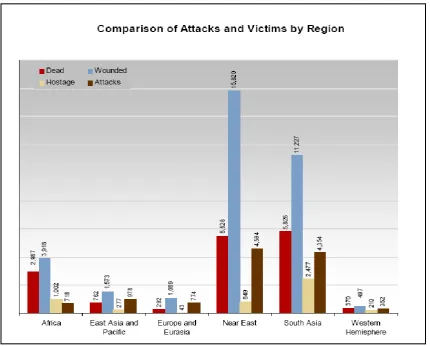
Figure 8: Comparison of Terrorist Attacks and Victims by Region (NCTC 2008Report on Terrorism)
143
Figure 9: International Terrorism Casualties, 1968-2007 (ITERATE)
149
Figure 10: International Terrorist Activity of Three Major Terrorist Groups,1968-2007 (ITERATE)
150
Figure 11: Worldwide Terrorist Incidents by Year, 1999 - 2005 (MIPT)
156
Table 12: Top Twenty Countries in terms of Terrorist Fatalities per MillionPeople 1968-2006 (MIPT)
156
Figure 13: Terrorist Incidents by Weapon, RAND-MIPT Terrorism Incident
Database, 1 Jan. 2005 - 31 Dec. 2005 (MIPT Terrorism Annual 2006)
161
Figure 14: Terrorist Incidents by Target, RAND-MIPT Terrorism IncidentDatabase, 1 Jan. 2005 - 31 Dec. 2005 (MIPT Terrorism Annual 2006)
162
Figure 15: Domestic Incidents of Terrorism by Region, RAND-MIPT TerrorismIncident Database, 1 Jan. 2005 - 31 Dec. 2005 (MIPT Terrorism Annual 2006)
163
Figure 16: Total International Terrorist Attacks, 1982-2003 (Patterns of GlobalTerrorism 2003)
168
Figure 17: Incidents of Terrorism Worldwide (Country Reports on Terrorism
2008: National Counterterrorism Center: Annex of Statistical Information)
169
Figure 18: Internal Terrorism in Western Europe, 1950-2004 (TWEED athttp://folk.uib.no/sspje/tweed.htm )
172
Figure 19: Weekly Fatalities: Major Conflicts in South Asia, 9 -15 March, 2009
(SATP, Weekly Assessments & Briefings, Vol. 7, No. 36, 16 March 2009)
176
Figure 20: All Israeli Fatalities, Monthly, Palestinian – Israeli Conflict,2000-2003 (www.ict.org.il)
180
Figure 21: All Palestinian Fatalities, Monthly, Palestinian – Israeli Conflict,
2000-2003 (www.ict.org.il)
181
Figure 22: Increasing Human Insecurity, 1976-2008 (Median Scores)
(www.politicalterrorscale.orghttp://www.ict.org.il).
182
Figure 23: Decreasing Human Insecurity 1976-2008 (Median Scores)
(www.politicalterrorscale.orghttp://www.ict.org.il).
185
Figure 25: Number of failed, foiled or successful attacks and number of arrested suspects for separatist terrorism in member states 2006-2008 (TE-SAT
Report 2009).
FIGURES
Page No.
Figure 26: Left-wing and Anarchist Terrorist Attacks by Target, 2006-2008
(TE-SAT Report 2009)
192
Figure 27: Sample ISVG Omniscope Dataplayer – Incidents by Tactics,
Philippines 30/12/00 – 13/6/09 (www.isvg.org)
196
Figure 28: Sample ISVG Omniscope Dataplayer – Incidents by Targets,
Jemaah Islamiya 01/08/00 – 22/07/08 (www.isvg.org)
196
Figure 29: Sample Algeria from Armed Conflict Database – The International
Institute for Strategic Studies (www.iiss.org)
201
Figure 30: Sample Myanmar from Armed Conflict Database – The International
Institute for Strategic Studies (www.iiss.org).
202
Figure 31: Deaths from non-state forces’ bombings and those killed fifty or
more (Iraq Body Count)
205
Figure 32: Confirmed incidents involving unauthorized possession and related criminal activities, 1993-2008 (www.ns-iaea.org)
207
Figure 33: Incidents reported to the ITDB involving theft or loss, 1993-2008(www.ns-iaea.org)
208
Figure 34: Conflicts by Region 1946-2007 (UCDP website)
213
Figure 35: Peace Agreements in Armed Conflicts 1989-2007 (UCDP website)
213
Figure 36: Post-Conflict Countries that revert to Conflict 1960-2007LIST OF TABLES
Tables Page No.
3.1 Working Definition of Terrorism in Five Terrorism Databases 60
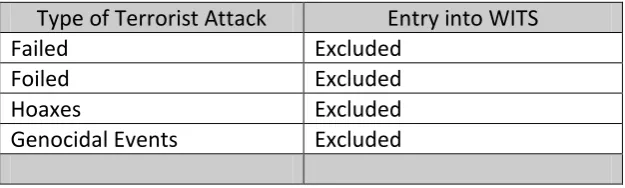
3.2 Events excluded from the WITS database 63
3.3 Terrorism Definitional Criteria – Global Terrorism Database (GTD)
67
3.4 Codesheet Model for IDC International Standard 113
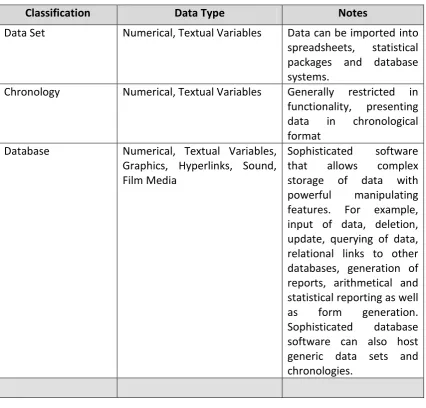
4.1 Simple Functional Description of Data Sets, Chronologies and Databases
122
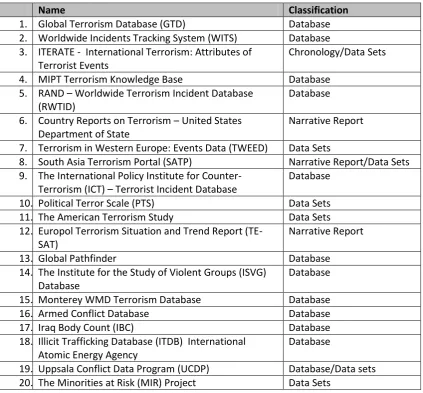
4.2 Classification of Public Profile Data Sets, Chronologies and Databases
123
4.3 Classification of Private, Government and Commercial data
sets, chronologies and databases.
LIST OF ABBREVIATIONS
ATS The American Terrorism Study
CRS Congressional Research Service
CSTPV The Centre for the Study of Terrorism and Political Violence
GAO General Accounting Office
GTD Global Terrorism Database
IBC Iraq Body Count
ISVG The Institute for the Study of Violent Groups
ITDB Illicit Trafficking Database
ITERATE International Terrorism: Attributes of Terrorist Events
MIR Minorities at Risk Project
MIPT Memorial Institute for the Prevention of Terrorism
NCTC National Counterterrorism Center
PTS Political Terror Scale
RAND The RAND Corporation
SATP South Asia Terrorism Portal
TE-SAT Europol Terrorism Situation and Trend Report
TWEED Terrorism in Western Europe: Events Data
UCPD Uppsala Conflict Data Program
WITS Worldwide Incidents Tracking System
CHAPTER I
THE NEED FOR KNOWLEDGE
1.1. Introduction
At the dawn of the 21st century, the issue of terrorism and political violence remains high on the agenda of governments, security agencies and those individuals
concerned with maintaining democracy and the rule of law. The analysis of terrorism
events data by policy makers, analysts and academics requires information of the
highest quality if sound judgements are to be made. Their diverse need for
information has produced a plethora of databases on terrorism. Sophisticated
computerised database systems to record and interrogate the accumulated body of
knowledge on terrorist data have been available for several years. Unfortunately the
technical potential of these has not always been translated into practical reality.
Whilst traditional terrorist tactics e.g. bombings, kidnappings and hijackings, have
largely remained unchanged, the methods by which information on acts of terrorism
can be stored on computer have been revolutionised in the past twenty years. As a
result, the advent of widely available, relatively cheap, but highly advanced
computer technology, permits storage and a much more sophisticated level of
interrogation and retrieval of information.
The subject of information technology within the terrorism field has been
poorly defined. Classification of the topic under the headings of ‘Information
Terrorism’, ‘Technology and Terrorism’, ‘Computers and Terrorism’, and latterly
terrorism events data sets1 for the analysis of terrorism incidents has been used
widely in the research field in recent years.2 Unfortunately, however, our
understanding of the application of computerised data sets to the study of terrorism
has remained somewhat limited. To date there exists an array of computerised data
sets on terrorism, all of which vary in size and quality. The development of the data
sets has been somewhat haphazard. Moreover, no overall body provides guidelines
for the establishment of computerised databases on terrorism. As a result there is
little consistency or continuity in their development. This has major repercussions
for quantitative and empirical research in the terrorism field. Apart from seminal
research undertaken by Fowler in 1981, 3 and Schmid and Jungman’s compilation of
databases on terrorism in 1988,4 no comprehensive inventory of terrorism databases
post 9/11 exists. It is the aim of this thesis to undertake such an analysis with
particular reference to databases post 9/11.
1.2. Defining the Problem
This thesis sets out to answer the following questions: first, what is the quality,
practical value and impact of database technologies in the field of terrorism and
counter-terrorism post 9/11?; and second, how can the application of database
1
Data sets on terrorism events data are usually held within databases systems. They can, however, also be used within spreadsheets and word-processors, with more limited functionality.
2
The literature using terrorism events data sets for quantitative analysis is wide and varied. A key U.S. Government publication is the National Counterterrorism Center’s (NCTC) annual Report on Terrorism. See: http://www.nctc.gov/witsbanner/docs/2009_report_on_terrorism.pdf Earlier pre 9/11 data sets included the United States Department of State’s Patterns of Global Terrorism and Edward Mickolus’s ITERATE (New York: Greenwood Press, 1988).
3
Fowler, William Warner. Terrorism Data Bases: A Comparison of Missions, Methods, and Systems. RAND Corporation. Santa Monica 1981. N-1503-RC. See: http://www.rand.org/pubs/notes/N1503.html [Accessed 13/06/10]
4
systems improve the quality of terrorism and counter-terrorism research? The
principal advantage of new technology is in its ability to absorb massive quantities of
raw data, complete an almost infinite array of manipulations, finally synthesising and
producing data that is meaningful in terms of the questions being asked. Impressive
as this may sound, further questions relating specifically to the application of
database systems to terrorism research need to be asked. For example, what is the
present state of the art with regard to the development of computerised data sets ?;
what are the major conceptual, definitional, theoretical and practical problems faced
in the design of computerised data sets on terrorism?; do these have any major
repercussions for terrorism data sets?; can the subject of computerised terrorism
data sets be clearly defined within the information technology area of terrorism
studies?; what are the strengths and weaknesses of existing open source terrorism
data sets, and can the quality of these data sets be improved?; can some form of
minimum standards be agreed upon in the practical design of terrorism data sets?;
and, indeed, why is this study crucial to the study of terrorism?
With these questions in mind, the main hypotheses of this thesis are:
1. That the study of computerised terrorism databases has had very little direction.
The subject area needs to be drawn together under the classification of
‘Terrorism Informatics’ if its full potential is to be realised.
2. That despite the fact that computerising terrorism data sets has allowed for more
sophisticated levels of interrogation, this still does not deal with the issues
3. The application of computerised databases to terrorism research requires a high
level of inter-disciplinarity. This includes the disciplines of international relations,
computer science and other techniques (empirical, quantitative, content analysis,
link analysis etc.) derived from a variety of social science disciplines, e.g.
economics and psychology. The task of integrating such an eclectic array of
subjects requires a systems approach to the fusion of computers and the study of
terrorism.
4. The inevitable shift towards a more technologically based response to countering
acts of terrorism requires the field of Terrorism Informatics to be more formally
recognised for the full potential of technology to be realised.
1.3. Scope and Research Design Methodology
The thesis is particularly concerned with the information aspects of terrorism and
counter-terrorism in general, and database management systems specifically. The
scope of databases used in this thesis is mainly limited to publicly available data sets,
databases and chronologies on terrorism. The thesis will draw upon a wide range of
publicly accessible sources of information. These include opens source material, as
well as a number of case studies. In addition, through a variety of field visits, the
opinions of those people currently working in the field of terrorism research, as to
the efficacy of particular data sets has been considered. These will be highlighted
Open Source Material
The thesis will use various research methods to build a comprehensive
evidence base to answer the above research questions. This study will examine
mainly open source material and both primary and secondary source material is
used. Primary source material will include terrorism database codebooks, whilst
secondary source material will include academic literature, commercial literature,
Library of Congress material, U.S. Government Accounting Office (GAO) publications
and various relevant websites. The open source material will cover two distinct time
periods: early terrorism database literature pre-9/11 and post 9/11 literature on
terrorism and counter-terrorism databases. The early pre-9/11 literature will be used
in Chapter 1 and part of Chapter 2 to provide the historical context and foundation
from which one can analyse the seismic changes that have occurred in the field of
terrorism and counter-terrorism database technologies, as a consequence of the
events of September 11th 2001. This contextual foundation will provide a point of reference from which an analysis of database technologies and their application to
terrorism and counter-terrorism post-9/11 can be undertaken.
Case Studies
In addition to primary and secondary source material, the thesis will use a selection
of case studies to illustrate key arguments and to advance understanding. The case
studies will focus on three terrorism databases in particular: The Worldwide
Incidents Tracking System (WITS), The Global Terrorism Database (GTD) and the
RAND Worldwide Terrorism Incident Database (RWTID). These three databases have
established open source terrorism databases that all have legacy, and reflect the use
of state of the art database technologies. In addition to these principle databases,
the thesis will refer to many other terrorism and counter-terrorism databases where
relevant, sometimes in some detail, to allow for a cross-comparison of terrorism
events data to be undertaken. There is a plethora of terrorism and counter-terrorism
databases within Government, academia and the private sector. The temptation to
spread the analysis over dozens of databases would be at the cost of the quality of
analysis. Thus the three principle databases chosen provide the opportunity for both
in-depth analysis whilst at the same time reflecting the many generic issues involved
in the development and operation of mainstream terrorism and counter-terrorism
databases. Importantly, a key element of Chapter Four of the thesis will be the
development of an Inventory of Terrorism Databases. The inventory will be used to
provide a comprehensive set of data and narrative commentary on some of the
world’s principle open-source terrorism databases. The following section provides a
brief historical context to the early development of data sets in international
relations and their subsequent use in terrorism studies.
1.4. Data sets in historical context
The use of social science data sets as a measurement tool for understanding violent
social phenomena dates back to the early 1930’s. Pioneers in this field include the
significant body of work carried out by researchers such as Lewis F. Richardson,
Quincy Wright5 and Pitirim A. Sorkin.6 Their analysis of conflict by means of
5
quantitative and empirical techniques for the numeric recording of events was a
move away from traditional historical, normative and purely theoretical methods of
international relations analysis. The main pioneers of events data7 research carried
out their work in Universities in the United States and Europe. Among some of the
earliest empirical data sets developed were Stanford’s Crisis project (1914), the
Correlates of War Project (COW) at the University of Michigan and the International
Crisis Behaviour project conducted by the University of Maryland. Pioneering
empirical work carried out by Lewis Fry Richardson8 on the mathematical
measurement and analysis of international conflict and the arms race broke the
mould of traditional theoretical analysis of international relations and set the scene
for contemporary quantitative techniques. Thus, although in its infancy, this
diversification from the descriptive, historical analysis of international relations to
more quantitative techniques, provided an early basis for future empirical research.
Data sets on political conflict, wars, political violence, terrorism and other
social phenomena have by their very nature involved the use of multiple variables9.
At the most basic level this will involve the use of numbers and text.10 The use of such data sets in quantitative and empirical research on terrorism often requires the
application of techniques from the simple aggregation of terrorism incidents to more
Dougherty, James E. and Robert L. Pfaltzgraff, Jr. Contending Theories of International Relations. (New York: Harper & Row, 1990.) p.36-41.
6
Sorikin, Pitrim A. Social and Cultural Dynamics (New York: American Book, 1937), vol. 3, Fluctuation of Social Relationships, War and Revolution.
7
Events data is defined by Dougherty and Platzgraff as a “single action events of nonroutine, extraordinary, or newsworthy character that in some clear sense are directed across national boundaries and have in most instances a specific foreign target.” Dougherty, James E. and Robert L. Pfaltzgraff, Jr. Contending Theories of International Relations. (New York: Harper & Row, 1990.) p.152
8
Ibid.
9
Some of the most common variables used in terrorism events data sets include: incident number, incident description, date, location, type of incident (e.g. bombing, IED, hi-jacking) fatalities, injured, and perpetrator.
10
sophisticated methods of analysis such as Markovian and Poisson probability
models.11 Whilst the increasing use of computers to carry out such quantitative measurement has now become a standard tool amongst social science researchers,
this has not always been the case. The rapid development of computers from basic
calculating and scientific machines to highly sophisticated research tools has
changed the face of social science research to almost unrecognisable proportions.
However, without accurate and reliable techniques to carry out such statistical
analysis of terrorism events, all data would be rendered invalid. Moreover, issues of
accuracy and reliability are not confined solely to the statistical analysis of terrorism
data sets held on computer. Of increasing importance is an understanding of how
the terrorism data set sits within the overall database schema.12 In other words, the validity of codification and mapping of terrorist variables into a computerised data
set requires considerable thought and bears on-going responsibilities for terrorism
researchers. Formal design procedures and documentation in the codification of
terrorism data sets vary enormously. 13 This is due partly to the sensitive subject of terrorism itself, the respective organisations developing the data set, (for example
The National Counterterrorism Center, the RAND Corporation and The Federal
Bureau of Intelligence (FBI) )14 and the security implications that follow. While such documentation in the terrorism field remains limited,15 it is not without precedent 16
11
For further discussion on these models of analysis see Gurr, Ted Robert. "Empirical Research on Political Terrorism: The State of the Art and How it Might be Improved.", in Robert O. Slater and Michael Stohl (eds.),
Current Perspectives on International Terrorism (London: Macmillan, 1988), pp.115-154.
12
The description of the database is called the Database Schema; this is distinguished from the actual database.
13
These issues are further expanded upon in Chapter 3 of the thesis.
14
The National Counterterrorism Center (http://www.nctc.gov), RAND (http://www.rand.org) and F.B.I http://www.fbi.gov/news/testimony/the-terrorist-screening-database-and-watchlisting-process [accessed 29/03/11] all produce a series of data sets on terrorism related issues. For further details see Chapter 3.
15
as there is a recognised methodology in cognate areas of study, e.g. low-intensity
conflict and irregular warfare. 17
Many such data sets are now held on computer and are increasingly available
on the internet accompanied by relevant codebooks and documentation. Among the
more well known data sets are The Violent Intranational Conflict Data Project
(VICDP)18, Dimentionality of Nations (DON),19 the Conflict and Peace Databank (COPDAB),20 the World Events Interaction Survey (WEIS)21 and the PROTOCOL for Assessing Non-violent Direct Action (PANDA).22
In terms of terrorism databases, limited forms of the ITERATE (International
Terrorism: Attributes of Terrorist Events) data set produced by Edward Mickolus are
available on the Internet23, although full access is restricted to Yale University students. Indeed, complex factors lie behind the lack of publicly available
computerised terrorism data sets. As Chapter 4 will explain the vast majority of
publicly available terrorism data sets are now held on some form of computerised
database system, where early annual reports for example such as the State
wide publication of information regarding an organisations data sets and its codification procedures may be open to threats of national security.
16
For a more detailed discussion of coding methodology within conflict studies see: Cioffi-Revilla, Claudio., The Scientific Measurement of International Conflict: Handbook of Datasets on Crises and Wars, 1495-1988 A.D.
(Boulder, Colorado: Lynne Rienner Publishers, Inc. 1990.)
17
For an extensive range of information on conflict data sets see: A Beginner’s Guide to Conflict Data – Finding and Using the Right Dataset. Eck, Kristine Uppsala Conflict Data Program, Department of Peace and Conflict Research, Uppsala University, Uppsala, Sweden (2005).
http://www.pcr.uu.se/digitalAssets/18/18128_UCDP_paper1.pdf [Accessed 02/04/11]
18
See: http://mailer.fsu.edu/~whmoore/garnet-whmoore/vicdp/Codebook.pdf [Accessed 02/04/11]
19
Dimensionality of Nations Project: Dyadic Foreign Conflict Variables, 1950-1965. See: http://www.icpsr.umich.edu/icpsrweb/ICPSR/studies/05408 [Accessed 02/04/11]
20
Conflict and Peace Data Bank (COPDAB), 1948-1978. See:
http://www.icpsr.umich.edu/icpsrweb/ICPSR/studies/07767 [Accessed 02/04/11]
21
World Event/Interaction Survey (WEIS) Project, 1966-1978. See:
http://www.icpsr.umich.edu/icpsrweb/ICPSR/studies/05211 [Accessed 02/04/11]
22
For a brief discussion on the background to PANDA see: http://www.vranet.com/FAQ.html [Accessed 02/04/11].
23
Departments Patterns of Global Terrorism24 or the RAND/ST-Andrews 25 data sets on terrorism incidents were only published in hard copy format.26 The format and availability of terrorist data sets is dependent upon the type of organisation
publishing the data. Issues of security, the type of data set, its public, commercial or
academic status, all affect the type of data set that is made available. In the early
years of computer availability, the medium on which the data was held, i.e. floppy
disks such as the ITERATE data set, CD-ROM or internet access varied among
organisations. This format is all but redundant, with the advent of the Internet,
secure networks and sophisticated digital archiving technology. Unlike established
data sets on conflict, for a variety of reasons that will be discussed later in the thesis,
the development of academic data sets on terrorism has never had an overall
co-ordinating body to set standards in the development of computerised data sets on
terrorism. No professional standards apply in the field and the development of data
sets appears to be on an ad-hoc basis, an issue that will be addressed later in the
thesis.
For reasons such as these, the study of computerised terrorism data sets
within the terrorism studies field has historically been weak.27 This has not been helped by the wide use of headings such as Information Warfare, Computing and
24
In recent years, with the advent of the Internet the U.S. State Department has made available .PDF versions of Patterns of Global Terrorism. These can be found at: http://www.state.gov/s/ct/rls/crt/index.htm [Accessed 19/02/11].
25
The RAND/St. Andrews data sets were never publicly available via the Internet. For further details see: Hoffman, Bruce, and Donna Kim Hoffman. “The RAND-St. Andrews Chronology of International Terrorism, 1994.” Terrorism and Political Violence. Vol.7. No.4, Winter 1995. pp.178-229. Also: Hoffman, Bruce, and Donna Hoffman. “Chronology of International Terrorism, 1995.” Terrorism and Political Violence. Vol.8. No.3, Autumn 1996. pp.87-127.
26
Access to data published by these organisation can be obtained by computer however that would be dependent upon some third party making available the information in a computerised format.
27
With the exception of work carried out by William Fowler at the RAND Corporation [William Warner Fowler,
Terrorism, or Cyber-Warfare that are both misleading and inaccurate, whilst other
topic headings under Databases and Terrorism, or the general term of Information
Terrorism has left classification of the subject area confused and ill-defined.28 This lack of definitional clarity on terrorism data sets has long been reflected in its
omission from recognized typologies of terrorism studies, as can be seen even in
Jungman’s long-established Typology of Terrorism Research.29 Without a clear framework, our understanding of the conceptual, theoretical and practical issues
that effect the operation of computerised terrorism data sets is likely to be
somewhat hindered. In addition, problems relating to the design of terrorism data
sets, the awareness of their current uses and potential future applicability in
research and counter-terrorism work require further investigation if the full
capability of modern technology is to be realised. Before doing this, however, it will
be useful to examine the definitional nature of data sets, chronologies and
databases. This will allow a clarification of terms that will provide a sound
foundation upon which the thesis argument can be built.
28
Loose classification of terrorism data sets in some literature as chronologies, databases and data banks without thought given to their true classification has caused confusion in the literature. Chronologies on terrorism events data are an arrangement of terrorism events in order of occurrence by chronological date. Databases on terrorism can hold a much more sophisticated schema of data, contained within tables. The data can be relationally linked to allow researchers to perform queries, enter data, and generate reports and graphical data, in addition to further sophisticated functions. Not all database on terrorism are events databases, they could, for example, be based upon terrorist groups or intelligence driven databases containing information on individual terrorists and accompanying profiles, such as the NCTC’s TIDE database. Data banks is a rather dated term in computing science from the 1970’s.
29
1.5. Defining: data sets, chronologies and databases
Elmasri and Navathe emphasise the significance of an appropriate definition of the
term ‘database’, arguing that they should have the following implicit properties:
‘A database is a logically coherent collection of data with some inherent meaning. A random assortment of data cannot be referred to as a database. A database is designed, built, and populated with data for a specific purpose. It has an intended group of users and some preconceived applications in which these users are interested. A database represents some aspect of the
real world, sometimes called the mini-world. Changes to the mini-world are
reflected in the database.’
It is important to differentiate between a database and a database management system (DBMS).
‘The DBMS is *hence+ a general-purpose software system that facilitates the process of defining, constructing, and manipulating databases for various applications. Defining a database involves specifying the types of data to be stored in the database, along with a detailed description of each type of data. Constructing the database is the process of storing the data itself on some storage medium that is controlled by the DBMS. Manipulating a database includes such functions as querying the database to retrieve specific data, updating the database to reflect changes to the mini-world, and generating reports from the data. …..The database and software are together called a database system.’30
This issue of clarity over the terminology used to describe a terrorism data set is
important. Many terrorism data sets are held on a wide variety of computerised
systems and this has led to inter-changeability of the term chronology and database.
For example, the ITERATE31 chronologies on terrorism, the Pinkerton Risk
Assessment Services (PRAS) database (now incorporated into the Global Terrorism
Database),the RAND-St.Andrews Chronologies on International Terrorism, and the
State Department’s Threat Analysis Division Information Management System
(TADIMS) database are among numerous titles given to terrorism data sets. The
30
Elmasri, Ramez, and Shamkant B. Navathe. Fundamentals of Database Systems. (Redwood City, California: The Benjamin/Cummings Publishing Company, Inc. 1989.) pp.3-4.
31
problem of classification arises in relation to the functionality32 of the chronology or database systems. Simple text based chronologies on terrorism have differing design
features from that of a fully-fledged database management system (DBMS).
Consequently design issues can vary between data sets. The capabilities, for
example, of a text based data set such as ITERATE tend to be much more limiting
than that of a true database system such as TADIMS. 33 The beauty of the database
management system is its ability to retain text and coded variables (fields) and
present terrorism data sets, chronologies and databases as part of its basic
functionality. 34 Regardless of the type of data set in use, the design, collection, and entry of terrorism data into a computerised format requires thoughtful
consideration. With this in mind, this thesis now turns to an examination of the early
years of terrorism database creation.
1.6. Development of Computerised Terrorism Data Sets: The Early Years
The structure of some of the earliest data sets on political violence bears a strikingly
similar format to that of contemporary data sets on terrorism. Developed largely in
the 1960’s, terrorism events variables were coded used as the main unit of analysis.
The most popular technique for analysis was aggregate events data, such as Gurr’s
Strife Events Data Sets, Causal Model on Civil Strife, 1961-1965 and Arthur S. Bank’s
32
Functionality relates to the actual functional operations of the data set. For example this could include such operations as report generation, querying of the database, input forms, validity checks and mathematical and statistical operators.
33
A terrorism data set or chronology can be held on a text based computer system and as such this does not constitute a true database management system (DBMS). Generally containing large amounts of un-coded text, they may or may not contain some variables.
34
Domestic Conflict Behaviour, 1919-1966.35 Although many of these studies are available on computer via the Inter-University Consortium for Political and Social
Research (ICPSR), their original format was either manually held or supported on
text-based software.36 The general use of computers and particularly database systems by non-science based researchers was rare. Both computer science and
terrorism as established fields were in their relative infancies in the 1960’s and thus
the perceived benefits from computerisation of terrorism data had not as yet been
realised.
1961 saw the first generation of generalised database management system.
It was nearly another decade (1970), until the concept of the relational database
model, developed by Ted Codd, an IBM research fellow, was conceived. Many of the
early database systems were designed for larger commercial users such as American
Airlines or for U.S Department of Defense programs.37 Despite the apparent void between availability of systems and application in terrorism research, interest in
their use as an intelligence-based tool began to emerge in the late 1960’s and early
1970’s.
The development by the CIA of their FITE (File on International Terrorist
Events) database, operating under the Ramis III system, the Defense Intelligence
Agency’s STIF (Significant Terrorist Incident Files) database, operating on the DIAL
database system and BDM’s coded chronology of terrorism, were among the earliest
35
Ibid. pp.139-140. For a comprehensive list of conflict and political violence data sets see: Schmid and Jongman pp.139-175.
36
Access to specific ICPSR data sets can be accessed at the ICPSR’s web site at: http://www.icpsr.umich.edu
37
known computer applications in the field of counter- terrorism.38 All of these data sets were initially designed in the form of coded chronologies on international
terrorism, using a mixture of public domain sources and intelligence sources, except
for BDM’s database, which did not have access to classified information. The CIA
chronology had an extensive array of up to 150 variables detailing incidents from
1968 onwards, held in the main chronology, and a series of ancillary files relating to
different terrorism information. Both the CIA and DIA chronologies were used
primarily for intelligence estimates and forecasting. BDM’s terrorism chronology, on
the other hand, was used for basic research.
Although the earliest terrorism data sets took the form of chronologies on
terrorism incidents, moves towards using computerised databases in a more
sophisticated format had developed by the early 1970’s. The FBI’s Bureau of Alcohol,
Tobacco and Firearms (ATF), began operating in 1975, their Explosives Incidents
System (EXIS). The database was operated on a mainframe system from the ATF’s
offices in Washington D.C. The EXIS database’s main remit was to hold information
on explosives incidents occurring in the United States that were either being
investigated by the ATF or had been reported to the ATF.39 Although organisation of
the database was maintained in Washington D.C., data input on bombing incidents
came from bomb squads at federal, state and local level.40
While much of the emphasis on terrorism database development appeared
to be based in the United States, efforts in Europe to use computers in counter
-terrorism work were being developed in West Germany by the late 1970’s. The
38
For other basic details on these data sets see: Fowler (note 3). pp.31-40. The BDM Corporation and their data sets no longer appear to exist. Extensive enquiries within the United States drew little success as to their eventual fate.
39
Revell, Oliver B. ‘Counter Terrorism, Planning and Operations.’ The Police Chief, October 1991.
40
German Police Information System (INPOL) was developed in the mid 1970’s and
was operational by 1977.41 The INPOL system was used by police throughout the former West Germany (FDR), both in counter-terrorism work, and in criminal and
drug related crimes. The INPOL system was, for its time, a fairly advanced system
offering multiple facilities. A centralised database, with regional network access,
INPOL maintained a database of wanted terrorists and criminals, including
fingerprint files. In addition, INPOL held files on known terrorist groups and
individuals, generated from the result of terrorist activity. What made the INPOL
system sophisticated for its time was the capability of the system to provide
documents on legal advice, technical data and dispatch systems for command and
control. With variable coded terrorist details, relevant ancillary database files,
narrative documentation and accessibility over national and local police networks
throughout West Germany, the INPOL systems provided a model for future
development.
Whilst the development of terrorism data sets, like INPOL, in the police and
intelligence fields served specific intelligence needs, such classified information
remained unavailable to the small, but emerging community of researchers hungry
for data. This community comprised of academics, policy analysts and commercial
organisations requiring terrorist data to pursue their requisite needs. Unable to
obtain classified data, researchers and analysts developed their own computerised
data sets. Thomas Snitch, at The American University, developed a coded database
using the statistical software SPSS, basing the unit of analysis on assassination
41
attempts world-wide between 1968 and 1978.42 In 1972, the RAND Corporation, an independent think-tank based in Santa Monica, California, began research work on
the study of international terrorism, eventually developing an extensive collection of
computerised chronologies and databases on terrorism (see Chapter 4). Work at
RAND, for example, by Waterman and Jenkins, applying computerised heuristic
modelling techniques to the study of international terrorism, was well advanced for
its time.43 Driven by growing commercial and multinational interest in business risk, the value of terrorism data grew in the early 1970’s with companies such as Risks
International, Inc. of Virginia, establishing their database of terrorism and political
violence, which dates back to 1970.44 As a result, terrorism data became ‘valuable’ in three main respects: first, as a tool in the intelligence and police communities, to
help counter acts of terrorism; second, in academic disciplines, to move the
boundaries of research from traditional historical, descriptive and theoretical studies
to quantitative and empirical based research and, third: terrorism data had
commercial value in that it could be sold as part of a consultancy service, to willing
corporate directors requiring risk analysis for overseas business.
The late 1960’s and 1970’s were therefore a time for experimentation and
prototype in the field of computerised terrorism data sets. There appears to have
been little co-ordination between organisations, and most appeared pre-occupied
42
Fowler (note 3) p.39.
43
Waterman, D.A. and Brian M. Jenkins. HeuristicModelling Using Rule-Based Computer Systems (Santa Monica CA: RAND Corp., P-5811, 1977). See: http://www.rand.org/content/dam/rand/pubs/papers/2006/P5811.pdf [Accessed 13/06/10].
44
Risks International Inc. of Virginia became known as Pinkerton Risk Assessment Services (PRAS). It published its Annual Risk Assessment [1970-1997] on world-wide political violence in both hard-copy format and via the Internet until the late 1990’s . The entire database was given over to the START project at the University of Maryland, to form the core data for the Global Terrorism Database (GTD) See:
with developing and maintaining their respective data sets. Comparative analysis of
data sets was also difficult to assess, and with such a small amount of data to
compare, quantitative comparisons of data sets were not meaningful or easy to
measure. This point did not go unnoticed by several researchers at the time. As
Fowler noted:
‘the size of chronology-based data sets did not permit adequately reliable quantitative analysis, particularly in the case of interesting categories of terrorist incidents.’45
The quantitative analysis of barricade-and-hostage incidents was a particular
example of data shortcomings. As Jenkins, Johnson and Ronfeldt note:
‘It is hazardous to draw statistical inferences from so small a universe. The conclusions that may be suggested, or the predictions that seem inherent, are quite tentative. In our analysis of the [77 barricade-and-hostage] cases we have given the actual numbers and the percentages these represent … to give greater meaning to the imprecise words that are commonly used in place of numbers ….. [Yet] the data do not permit a high level of confidence based upon rigorous quantitative analysis of a sufficiently large population of events.’ 46
The tragic and ironic solution to such a paucity of data was that through time, as
incidents of terrorism were likely to occur, data could be coded to permit credible
quantitative and empirical analysis of terrorism events.
1.7. Information Technology and Terrorism Studies
Technology and terrorism as a recognisable field in the terrorism literature has been
growing over the past few years. It is a crucial as a tool in the assessment and
analysis required to counter acts of terrorism. Where the area of computerised data
sets on terrorism fits into this field is not clear. Early discussion of the technology
45
Fowler (note 3) p.6.
46
area of terrorism research tended to include such areas as explosive detection
systems, aviation security, terrorist weaponry and nuclear issues relating to
terrorism. Grant Wardlaw, discussing terrorism and technological change, expresses
concern over such issues as armaments, biological agents and major advances
conventional weaponry, that if obtained by terrorists could cause immense harm.47
These are valid and legitimate areas of concern under the technology heading.48 What appears to be lacking is a clear Information Technology field and in particular a
focus on computerised data sets on terrorism. Schmid and Jongman do mention the
term ‘data base’ in their book Political Terrorism; contextually within the book the
database area is not specifically classified under an information technology
heading49. As Chapter Two will illustrate, there have been real concerns regarding where best to situate the research on terrorism informatics and, indeed, it is only
post-9/11 that a much broader literature base has evolved. Very little reference can
be found within the technology and terrorism literature to information technology
and terrorism as a classified subject area.50 Even scarcer is published literature on the application of database technologies to terrorism data sets and more specifically
as a tool in terrorism research. As Chapter 4 will demonstrate, it is important to
differentiate between the study of computerised data sets on terrorism and the use
of computers in the intelligence field. Although both topics have certain common
47
Wardlaw, Grant. Political Terrorism, (Cambridge: Cambridge University Press, 1984.) pp.25-27.
48
For further early discussion of terrorism and technology see: Hoffman, Bruce ‘Responding to Terrorism Across the Technological Spectrum’ Terrorism and Political Violence, Vol6, No. 3 (Autmn 1994), pp.366-390.
49
‘Data and Data Bases on State and Non-State Terrorism’ (In collaboration with R. Thysse) Schmid, Alex P. and Albert J. Jongman, Political Terrorism: A New Guide to Actors, Authors, Concepts, Data Bases, Theories and Literature. (New Brunswick, USA: Transaction Books, 2nd. Ed, 1988.) Chp. 3. pp.137-174.
50
denominators a fusion of the two topics would not be helpful,51 in particular because not all databases systems are intelligence systems.
There are several reasons how this paucity of published research work in
computerised terrorism data sets could be explained. First, as an established
academic field the study of political violence and terrorism has only been developed
to any extent in the past forty years. Classification of the subject as entry only
appeared in The New York Times in 1968. Prior to that the subject was classified
under the general heading of violence or low intensity conflict. Second, in the same
forty year period, while the development and use of the computers as a viable
research tool in the social sciences has advanced considerably, the application of the
database technology as a research tool in terrorism studies has at times had a rather
chequered history until recently. While mainframe computers have been available
for scientific use since the post-war period, their use as a tool specifically in the
terrorism field did not occur until the 1970’s. Work by Brian Jenkins at the RAND
Corporation on Heuristics modelling of terrorism incidents in 1977 was one of the
earliest examples of the application of computing to terrorism research.52
Consequent development of the RAND chronologies and databases on International
Terrorism were to follow in 1980. Development of police surveillance systems by the
German Federal Intelligence Service (Bundesnachrichtendienst) - BND, in 1977 after
the Scheyler kidnap53 was one of the earliest attempt to use mainframe computers
51
Put simply, terrorism databases in general deal with events data. They can be held by either academic, private or Government agencies. They are not all intelligence based systems for use in counter-terrorism efforts.
52
Waterman, D.A. and Brian M. Jenkins. HeuristicModelling Using Rule-Based Computer Systems (Santa Monica CA: RAND Corp., P-5811, 1977). See: http://www.rand.org/content/dam/rand/pubs/papers/2006/P5811.pdf [Accessed 13/06/10]
53
to gather and establish links between data.54 British efforts at similar data gathering
techniques was co-ordinated by the Home Office under a project called Holmes.55
As Ted Gurr notes, for many academics, increasing interest in the study of
political violence as a legitimate topic of research was initially based upon historical,
atheoretical and case study approaches to the subject.56 Research carried out by Fowler at the RAND Corporation on numerical indexes on terrorism variables in the
early 1980’s was an early attempt to develop the power of the database using
mainframe technology.57 Information technology as a recognisable field had not developed in the general science literature let alone the specialised area of terrorism
studies. The capability of these systems was generally limited to the retention of
variable and text coded data allowing for the creation of chronologies and data sets
on terrorism. Few academics had the expertise or financial resources and could not
foresee the potential in developing computerised terrorism database systems.
Computers were seen among academics as being very much part of the
mathematical and computing disciplines, and given that the functional capability of
the available systems were anyway somewhat limited, their potential application
could not be fully appreciated.
As Fowler notes:
‘The development of large scale data sets on terrorism were left to the larger Think Tank organisations such as the Rand Corporation, The Defence Intelligence Agency (D.I.A.) established 1970 and private corporations such
54
Ibid.
55
Ibid.
56
Gurr, Ted Robert. "Empirical Research on Political Terrorism: The State of the Art and How it Might be Improved.", in Robert O. Slater and Michael Stohl (eds.), Current Perspectives on International Terrorism
(London: Macmillan, 1988), pp.115-154.
57
as the BDM Corporation’s chronology established in 1965 concentrating on terrorist incidents concerning ‘...private business and governmental concerns...’.58
Others included had a relevant interest in maintaining data on terrorism and
governments agencies and intelligence agencies. This also included military agencies
both in Europe and North America, their remit being mainly tied to military, scientific
and commercial use. Many arts and social science researchers were not particularly
comfortable with the use of computers as a research tool. Indeed they did not even
envisage it as a tool with which they could use in their work for several years. The
invention of the personal computers and more sophisticated mainframe computers
were the move forward that would allow terrorism researchers and analyst to use
the computer as a tool in terrorism research. However as Chapter Two indicates the
wide spread use of personal computers among the academic community has not
seen a parallel increase in published literature on computerised terrorism data sets.
Certain terrorism analysts developed their own data sets on terrorism including
former U.S. State Department employee Dennis Pluchinsky, who developed a
database in a private capacity for academic work.59 However, for several reasons, terrorism researchers were slow to adopt the database technologies. Principal
amongst these was the huge investment of both time and resources required to
develop and maintain terrorism data sets to a high academic standard and integrity.
Information technology and terrorism research as an established field was in many
ways still in its infancy. The arrival of the Internet and the increasing use of
computer networks, as well as increased attention being paid to such topics as
58
Ibid. (note 3).
59
Cyber-Terrorism, Information Warfare and Information Terrorism60 has tended to overshadow the specialist area of computerised terrorism data sets. Instant
gratification and retrieval of information (of varying quality) has tended to be at the
expense of a serious analysis of the use of computers in terrorism database research.
Furthermore the increasing interest being paid to such topics as computer security,
intelligence systems, computer viruses and the sabotage of computers by terrorists
under the technology banner has again sidelined the issue of terrorism databases.
Increasing computer literacy among social scientists and terrorism researchers has
tended to take the focus of attention away from the core issues of terrorism
databases. The visual attraction of the internet, coupled with an increasing
awareness of the volatility of data and information has also tended to obscure the
importance of studying the topic of terrorism database technologies as a subject per
se.
1.8. Quantitative Theory Development
The use of quantitative techniques in terrorism research has grown substantially in
the past thirty years. Studies by many academics and analysts have increasingly
relied upon the use of terrorism data sets to further theoretical debate in the field.
Most terrorism chronologies and databases are coded with a mixture of text
variables (for example, incident details, name of terrorist group, and type of incident
60
– bombing, hijack, chemical attack) in addition to some numeric indices (number of
fatalities, number of injured, estimated cost of damage).61 As James Coleman asks, ‘What is it about quantitative measurement that is so crucial for theory-development? … *Its power+ … lies in its ability to carry out transformations … upon input data.’62
Furthermore,
‘If these data are in the form of numbers, and maintain their properties as numbers after transformation, then powerful transformations of algebra, calculus and matrix algebra can be carried out upon them.’ 63
The computer as a tool in the manipulation of such raw terrorist data sets has, as
Fowler argues, an increasingly vital role in quantitative theory development.64 Awareness at the Rand Corporation, and among other terrorism researchers, that
computers could not only store raw data on terrorist incidents but be used for
quantitative empirical research was becoming apparent by the early 1980’s. Fowler’s
paper: ‘An Agenda for Quantitative Research on Terrorism'65 recognised the
potential for developing sets of ‘profiles’ defining the behaviour of terrorist groups.
These profiles would be numerically indexed in a computerised database. Variables
or ‘profiles’ included ‘frequency, severity, quality and effect of terrorist acts’.
Building upon these the creation of aggregate profiles that would reflect national,
regional and international behaviour began to be added to database research.
Establishing such a database would allow the use of time-series, process analysis and
multivariate calculations. The great beauty of such an exercise is that a computerised
database would allow researchers to model or manipulate the data to form an
61
The most common numeric variables are: number of injured, number of hostages, number of fatalities, incident totals, database incident number, incident date, financial cost etc.
62
Cioffi-Revilla, op cit.
63
Ibid. 64
Fowler, William Warner. An agenda for Quantitative Research on Terrorism. (Santa Monica: Rand P-6591, 1980.) See: http://www.rand.org/content/dam/rand/pubs/papers/2009/P6591.pdf [Accessed 07/01/11].
65