Synergy between face alignment and tracking via Discriminative Global
Consensus Optimization
Muhammad Haris Khan
?†John McDonagh
?Georgios Tzimiropoulos
? ?Computer Vision Laboratory, University of Nottingham, Nottingham, UK
†
Electrical Engineering Department, COMSATS Lahore Campus, Pakistan
{Muhammad.Khan3,yorgos.tzimiropoulos}@nottingham.ac.ukAbstract
An open question in facial landmark localization in video is whether one should perform tracking or tracking-by-detection (i.e. face alignment). Tracking produces fit-tings of high accuracy but is prone to drifting. Tracking-by-detection is drift-free but results in low accuracy fittings.
To provide a solution to this problem, we describe the very first, to the best of our knowledge, synergistic ap-proach between detection (face alignment) and tracking which completely eliminates drifting from face tracking, and does not merely perform tracking-by-detection. Our first main contribution is to show that one can achieve this syn-ergy between detection and tracking using a principled opti-mization framework based on the theory of Global Variable Consensus Optimization using ADMM; Our second contri-bution is to show how the proposed analytic framework can be integrated within state-of-the-art discriminative meth-ods for face alignment and tracking based on cascaded re-gression and deeply learned features. Overall, we call our method Discriminative Global Consensus Model (DGCM). Our third contribution is to show that DGCM achieves large performance improvement over the currently best perform-ing face trackperform-ing methods on the most challengperform-ing category of the 300-VW dataset.
1. Introduction
Face alignment is the problem of localizing a set of land-marks on human faces in still images. Face tracking is the problem of localizing the facial landmarks for all frames of a given video. Most face tracking methods are exten-sions of face alignment methods; the main difference is that, in face alignment, initialization is performed from the bounding box of a face detector, whereas in face tracking, from the shape of the previously tracked frame. Because changes in facial pose and expression from one frame to the next one are typically small, in tracking, initialization is
DGCM
Detection Initializations
Subproblem i
Subproblem i+1 Subproblem 1
Subproblem 2
[image:1.612.314.549.249.404.2]Tracking Initializations
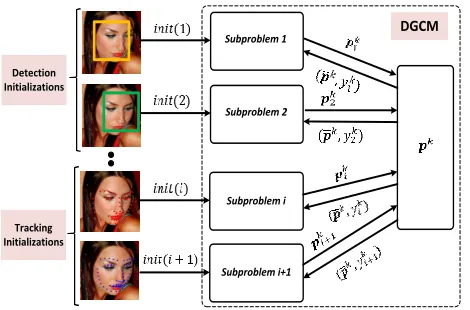
Figure 1. Overview of DGCM: our method performs landmark lo-calization in video via a synergy between face alignment (i.e. de-tection) and tracking. This synergy is achieved by solving a Global Consensus Optimization problem using ADMM. We assume that different detection and tracking initializations define different op-timization sub-problems. At each iteration of DGCM, the inde-pendent shape updates for each sub-problem are coupled through the ADMM updates. Notably, both the detector and tracker used in DGCM are trained in a discriminative manner.
first synergistic approach between tracking and detection that completely eliminates drifting from tracking, and does not merely perform tracking by detection.
To improve landmark localization in video, prior work has considered a few fairly orthogonal directions like im-proving the fitting method used [5,29,17,9,25,33,24], multi-view models [30,32], exploiting temporal coherency between frames [15], incremental learning [21, 16, 1], tracking-by-detection [28,6], re-fitting [18] and using mul-tiple initializations [31,16]. Notably, in most (if not all) of these methods, drifting is handled by just re-initializing the tracker. To the best of our knowledge, there is no prior method proposing a synergistic way to combine tracking and detection in a principled manner. We show that by do-ing so, significant performance improvement in terms of fit-ting accuracy can be obtained.
The main idea behind our work is simple: perform face alignment when tracking drifts or, from the opposite per-spective, correct detection using the solution from the pre-viously tracked frame. To achieve this synergy, we describe a principled optimization framework for deformable model fitting based on the theory of Global Variable Consensus Optimization using the Alternating Direction Method of Multipliers (ADMM) [3]. Fig. 1shows an overview of our method. In summary, our contributions are:
1. We propose the very first synergistic approach between tracking and detection that completely eliminates drift-ing from trackdrift-ing, and does not merely perform trackdrift-ing- tracking-by-detection.
2. To this end, we propose the very first method integrat-ing the theory of Consensus Optimization usintegrat-ing ADMM with the problem of deformable model fitting.
3. Although we derive our framework using analytic gra-dient descent, we also show how to further integrate the derived formulation into a fully discriminative one based on cascaded regression and deeply learned features. Be-cause of that, we call our method Discriminative Global Consensus Model (DGCM).
4. We show that DGCM achieves significant performance improvement over the currently best performing face tracking methods on the most challenging category of the 300-VW dataset [22].
2. Related work
To improve facial landmark localization in video, a num-ber of orthogonal directions have been proposed in litera-ture. We group them in 5 categories as follows.
The first one is to simply improve the accuracy and the robustness of the face alignment method that is adopted for tracking. To this end, methods based on cascaded regres-sion have recently emerged as the state-of-the-art, see for example [5,29,17,9,25,33,24,8,27]. The second line of
work is to make use of temporal coherency to create more adaptive and sophisticated fitting algorithms like, for ex-ample, the multi-view cascaded regression approaches of [30,32], the spatio-temporal recurrent encoder-decoder net-work of [15] as well as the incremental learning approaches of [21,16,1]. Note that all methods from the first two cat-egories are purely tracking methods and deal with drifting by typically relying on a SVM to detect when tracking goes off and then re-initialize the tracking procedure.
The third category is to perform joint re-fitting of all shapes for the whole video (i.e. offline) as in [18]. Such methods are post-processing methods, can be applied only when the whole video has been tracked, are typically very slow, and have been shown to mainly correct very crude er-rors. A fourth approach is to perform tracking-by-detection, see for example [28, 6]. Notably, we also make use of tracking-by-detection to eliminate drifting but synergisti-cally with a tracker to exploit shape information from the previously tracked frames.
A fifth approach for improving landmark localization is to obtain multiple fittings using different initializations, and then combine the fitted results, as in [31,16]. Note that both [31, 16] have only been shown how to combine the fitted shapes obtained by applying thesame face alignment method (i.e. the same detection method), and not how to achieve synergy between detection and tracking as proposed in our work. Also, these methods have not been shown to correct drifting in face tracking. More importantly, both [31,16] are actually post-processing methods, in which the multiple fittings are obtained independently and then are somehow combined. Hence, both [31,16] are sub-optimal. In this work, we propose a sixth orthogonal improvement for facial landmark localization in video: synergy between face alignment and tracking. To this end, we introduce a novel optimization framework that integrates the theory of Consensus Optimization using ADMM with the problem of discriminative fitting of facial deformable models.
3. Discriminative Global Consensus Model
In this section, we describe the proposed synergistic ap-proach for face alignment and tracking. To do so, in section
descent formulation into a fully discriminative one based on cascaded regression and deeply learned features. Over-all, we call our method Discriminative Global Consensus Model (DGCM).
3.1. Generative facial deformable model
In our formulation, we used a generative facial de-formable model that is based on parametric shape and ap-pearance models. Perhaps, the most notable example of such models is the Active Appearance Model [7,11]. We chose to use the most recent parts-based formulation of [26] which has been shown to largely outperform the holistic-based approach. Our deformable model is built in a fully supervised manner, from a set of training facial imagesIi each of which is annotated withufiducial points defining the facial shape, a vector∈ R2u×1.
Shape model. All training facial shapes are firstly
nor-malized using Procrustes Analysis. Then, the shape model is obtained by applying PCA on all training normalized shapes. The model is defined in terms of a mean shapes0 andnshape eigenvectorssiwhich form the columns of ma-trixS∈ R2u×n. Finally, to model similarity transforms,S is appended with 4 additional bases [11]. Using this model, a shape can be generated from:
s(p) =s0+Sp, (1)
wherep∈ Rn×1is the vector of the shape parameters.
Appearance model. All training facial images are firstly
warped to a reference frame so that similarity transforma-tions are removed. Then, around each landmark a descrip-tor is extracted and all descripdescrip-tors are stacked in a vecdescrip-tor ∈ RN×1 which defines the part-based facial appearance. Finally, the appearance model is obtained by applying PCA on all training part-based facial appearances. The appear-ance model is defined in terms of the mean appearappear-anceA0 andmappearance eigenvectorsAiwhich form the columns of matrixA ∈ RN×m. Using this model, a part-based fa-cial appearance can be generated from:
A(c) =A0+Ac, (2)
wherec ∈ Rm×1 is the vector of the appearance param-eters. As for the case of the descriptor used, most com-monly, SIFT descriptors [10] are used; notably we show in this work that if one uses deeply learned features, large im-provements in fitting accuracy can be obtained.
3.2. Optimization problems for face alignment and
tracking
To localize the landmarks in a given facial image, one can fit the generative deformable model of the previous sec-tion by solving the following optimizasec-tion problem:
arg min
p,c f(p,c) = arg minp,c ||I(s(p))−A(c)|| 2, (3)
whereI(s(p)) ∈ RN×1 is obtained by concatenating the descriptors extracted from the landmarks ofs(p).
As mentioned earlier, the difference between face align-ment and tracking is in the initialization. In face detection,
pinit = pdet = (p1,0, p3, p4,0, . . . ,0)T, where p1, and
p2, p3, are the scale and the translation parameters obtained from the bounding box of the face detector. In face tracking, we are looking to estimate the shape parameters for frame
t, sopinit =pt−1wherept−1is shape parameter vector as estimated at framet−1. Note thatcinit=0for both cases.
3.3. Global Consensus optimization for deformable
model fitting
Because the problem of Eq. (3) is non-convex, a locally optimal solution can be readily found using analytic gra-dient descent. Because the obtained solution depends on the initialization, we propose to view the different initial-izations in the optimization problem of Eq. (3) as separate optimization problems. In our case, we treat the problem of face alignment and the problem of face tracking as sep-arate optimization problems because the initialization for these problems is different (although the error to be opti-mized has the same functional form). Notice that an arbi-trary number of initializations can be used, with the hope that some of them will be sufficiently close to the “correct” solution. For example, one can apply some noise to the face detection bounding box, or to the fitted shape of the pre-viously tracked frame to generate an arbitrary number of initializations; the trade-off in this case is a linear increase in computational complexity.
To make our point clearer, we follow the same notation as in [12], to emphasize the point that gradient descent opti-mization is used to solve the non-convex problem of Eq. (3) and hence using initializationpinit(i)can be interpreted as solving a different optimization problemfi(pi):
arg min pi,ci
fi(pi,ci) =gdarg min pi=pinit(i)
ci=0
||I(s(pi))−A(ci)||2,
(4) where gdarg minpi=pinit(i) means “perform gradient
de-scent starting frompinit(i)” (ciis always initialized to0). Notice that a different parameter vectorpi is used for the
i−th problemfi(the same holds also forci).
Assume M different initializations pinit(i), i = 1, . . . , M, each of which defining sub-problemfias in Eq. (4). Then, we propose to perform joint optimization so that all sub-problems converge to the same solution. To this end, we can formulate the following Global Variable Consensus Optimization problem [3]:
arg min p1,...,pM
c1,...,cM
M
X
i=1
fi(pi,ci), s.t.pi=p,,i= 1, . . . , M.
Note that there is no need to impose constraints onci. The reason for this is that if the global constraints forpi of Eq. (5) are satisfied, then necessarilyci = c,,i = 1, . . . , M. Actually, as we show below, ci = ,i = 1, . . . , M can be completely eliminated from the optimization problem of Eq. (5). The Consensus Optimization problem of Eq. (5) can be solved using the Alternating Direction Method of Multipliers (ADMM). Following [3], the ADMM solution for thei−th sub-problem at iterationk+ 1is:
pki+1,cki+1 := arg min pi,ci
{fi(pi,ci)
+ (yki)T(pi−p¯k) +
ρ
2||pi−¯p k||2}
yik+1 := yki +ρ(pik+1−¯pki+1), (6)
whereρis the penalty parameter,p¯k =PM
i=1piis the av-erage of the shape parameters at iterationk, andyik+1are the auxiliary (dual) variables driving the shape parameters of each sub-problem into consensus. In the next paragraphs, we describe our modifications to Eq. (6) and how to solve the optimization problem of Eq. (6).
Shape-based penalty. ADMM theory [3] allows one to
replace the quadratic term (ρ/2)||r||2 with (1/2)rTQr, where Qis a symmetric positive definite matrix. In our case, we choseQ = Λ−1, whereΛis the diagonal matrix containing the eigenvalues of the shape model computed us-ing PCA. This is equivalent of usus-ing the Mahalanobis dis-tance in the shape parameter space. It is more intuitive than using the standard form of the penalty and we found it nec-essary for the algorithm to behave well.
Inexact minimization. The formulation of Eq. (6)
re-quires finding the optimal value forpi,ci at each iteration
k, which is costly because at each iteration, for each sub-problem, an iterative Gauss-Newton minimization would be required. However, ADMM converges even when the min-imization is not carried out exactly [4], allowing us to per-form a single Gauss-Newton update per iteration.
Gauss-Newton update. To perform inexact minimization
for each sub-problem (given in the first row of Eq. (6)), we follow prior work on deformable model fitting using an-alytic gradient descent, in particular, Gauss-Newton opti-mization [11,2,26]. Given the current estimatepk
i andcki for iteration k, we firstly perform a first-order Taylor ap-proximation. Then, the ADMM updates are given by:
∆pi,∆ci := arg min ∆pi,∆ci
{||I(s(pki)) +Jki∆pi
− A0−Acki −A∆ci|| 2
+ (yik)T(pki + ∆pi−p¯k)
+ Λ
−1
2 ||p k
i + ∆pi−p¯k||2}
pki+1,cki+1 := pki + ∆pi,cki + ∆ci
yki+1 := yik+ Λ−1(pki+1−¯pki+1), (7)
whereJki ∈ RN×nis the image Jacobian with respect to the shape parameterspki. Notice that in the above minimization problem,∆cidoes not appear in the second and third terms. Hence, we can apply the same Gauss-Newton approach of [26] which by-passes the calculation of∆c, and at each it-eration solves only for∆p(for more details on why this is possible see [26]). By doing so, the ADMM updates are:
∆pi := arg min ∆pi
{||I(s(pki)) +Jki∆pi−A0||2P
+ (yki)T(pki + ∆pi−¯pk)
+ Λ
−1
2 ||p k
i + ∆pi−p¯k||2}
pki+1 := pki + ∆pi
yik+1 := yki + Λ−1(pki+1−p¯ki+1), (8)
where||x||2
P=xTPxis the weighted`2-norm of a vector
x,P=E−AAT is a projection operator that projects-out the appearance variation, andEis the identity matrix. No-tice that because we work in a subspace orthogonal to the appearance variation, ∆chas been completely eliminated from the optimization problem. Finally, by solving the op-timization problem of Eq. (8), we obtain the final ADMM updates rules for our Consensus Optimization problem:
∆pi := −(Hki,P)− 1
{(Jki,P)T(I(s(pki))−A0) +yki + Λ−1(pki −¯pk)}
pki+1 := pki + ∆pi
yki+1 := yki + Λ−1(pki+1−¯pki+1), (9)
whereJk
i,P = PJ k
i andHki,P = J T
i,PJi,P + Λ−1 are the projected-out image-based Jacobian and Hessian for the
i-thsub-problem at iterationk.
Overall algorithm. At each iterationk, and for thei−th
sub-problem/initialization, the proposed algorithm firstly computes the image-basedJk
i,P,Hki,P (and its inverse), and then uses the first and second rows of Eq. (9) to update the shape parameters for this sub-problem. This process is re-peated for all sub-problems, and then the new average of the shape parameter vectorpki+1is obtained. Then, this is used to update the auxiliary variables for each sub-problem from the last row of Eq. (9).
3.4. Discriminative Global Consensus optimization
are relatively slow because the image-based Jacobian, Hes-sian and its inverse need to be re-computed per iteration. To circumvent this problem, recent state-of-the-art face align-ment methods have suggested learning “averaged” descent directions in a discriminative manner using the framework of cascaded regression [5, 29,17,9,25,33, 24]. In this section, we show how to incorporate this type of discrim-inative training into the proposed analytic formulation for Consensus Optimization introduced in the previous section.
While most works in Cascaded Regression estimate a di-rect mapping between image features and shape updates, the ADMM update for∆pi in Eq. (9) does not allow this requiring the calculation ofHki,P at each iteration. There-fore, we will proceed based on PO-CR [25] which is the only method that explicitly calculates averaged Jacobians (and then Hessians) at each iteration from data.
We will firstly review PO-CR [25]: AssumingHtraining imagesIi,i = 1, . . . , H with ground truth shape parame-tersp∗i, andK perturbed shapes for each imagepk
i,j,j = 1, . . . , Kat level (iteration)kof the cascade, and denoting ∆pi,j = p∗i −p
k
i,j, PO-CR learns an averaged projected-out JacobianbJkP =PbJkat level (iteration)kof the cascade
by solving the following optimization problem
arg min b Jk P H X i=1 K X j=1
||I(s(pki,j)) +Jk∆pi,j−A0||2P. (10)
After computing bJkP, PO-CR further computes the
aver-aged Hessian HbkP = (bJkP)TbJkP and its inverse. The
aver-aged descent directions areRk = (HbkP)−1(bJkP)T and for
each training sample the shape update is given by∆pi,j =
Rk(I(s(pk
i,j)−A0)).We note that the problem of Eq. (10) is derived from the problem of deformable model fitting of Eq. (3) that has no constraints. We also note that training a model for face alignment or tracking depends on how the perturbed shapes are produced. For face alignment, the per-turbed shapes at the first iteration are produced in order to capture the statistics of the face detector used whereas for tracking the shape changes between consecutive frames.
We now describe the training of the detection and track-ing models within our Consensus Optimization framework. For each training imageIi, we assumeKdperturbed shapes for training the detection model andKtr perturbed shapes for training the tracking model. In our case, and in analogy to the unconstrained optimization problem of Eq. (10), to estimate the averaged Jacobian for detection (or tracking) at iterationk, the optimization problem of Eq. (8) will be used. In particular,Jb
d,k
P for the detection model is estimated
(us-ing theKdperturbed shapes for each training image) from
b
Jd,kP = arg min
b Jk P H X i=1 Kd X j=1
{||I(s(pki,j)) +Jk∆pi,j−A0||2P
+ (yki)T(pi,jk + ∆pi,j−¯pki)
+ Λ
−1
2 ||p k
i,j+ ∆pi,j−p¯ki||
2}, (11)
and similarly using the tracking initializationsKtrone can compute Jb
tr,k
P for the tracking model. It is evident from Eq. (11) thatbJkP does not depend on the second and third
terms and hence the optimization problem reduces to the one of Eq. (10). Hence, at each iteration, we estimate
b
Jd,kP andbJ
tr,k
P separately. Following this, we then estimate the averaged ADMM HessianHb
d,k P = (bJ
d,k P )
T
b
Jd,kP + Λ−1 and its inverse, and similarly we do the same for Hb
tr,k P . Hence, at each iteration, the averaged descent directions for the detection and tracking models are estimated inde-pendently, and the shape updates are also calculated in a similar fashion. This results in a very intuitive algorithm: during training, the averaged descent directions for detec-tion and tracking are estimated dis-jointly giving rise to independent models which during testing are then forced to agree through the coupling of the ADMM updates of Eq. (9)1. More specifically, testing is performed as
fol-lows: For each sub-problem/initialization, at iteration k, we use the detection model{bJ
d,k P ,(Hb
d,k P )−
1}or the
track-ing model{Jb
tr,k P ,(Hb
tr,k P )
−1}to update∆p
ifrom the first row of Eq. (9), depending on whether that particular sub-problem/initialization corresponds to face alignment or tracking. Then, the average shape parameter vectorspki+1
over all initializations are computed and the auxiliary vari-ables for each sub-problemyki+1are also updated through the last row of Eq. (9).
The complexity of the proposed method at test time de-pends linearly on the number of initializations used. For
M initializations, the complexity per iteration isO(M nN), whereO(nN)is the complexity of the original PO-CR.
4. Experiments
We primarily evaluate the performance of the proposed DGCM on the 300-VW test set [22]. This is by far the most challenging and large-scale face tracking dataset to date containing 121,278 frames. Note that this is the only publicly available large scale face tracking dataset. Addi-tionally, in section4.4, we also report the results of another
1Note that one could also apply the ADMM updates of Eq. (9) during
experiment on the 300-W test set [19] and our cats dataset, illustrating how DGCM can enhance the performance of hu-man and animal face alignment for the case of poor face detection initializations (note that this is not a tracking ex-periment).
4.1. Performance evaluation
300-VW consists of 3 categories of increasing diffi-culty: A (62,135 frames), B (32,805 frames) and C (26,338 frames). C is by far the most challenging. We report results on category C, and for the results of categories B and A, see supplementary material. Following prior work, results are reported for the 49 inner points.
DGCM consists of two models for landmark localiza-tion, one for face alignment (i.e. detection) and one for face tracking, both trained using the discriminative ADMM framework described in section3.4. Although our frame-work allows for an arbitrary number of initializations for detection and tracking, we merely used one for detection and one for tracking2. This means that, compared to [25],
the complexity of the DGCM model used in our evaluations is just doubled.
We trained our face alignment model on all training data from the 300-W competition [20] using also the statistics of the face detector of [13] that was used to initialize our face alignment model for all frames of the video sequences. We trained our tracking model on the same data using also the statistics capturing the shape changes between consecutive frames from the 300-VW training set. Similarly to [1] and [21], a simple SVM was used to detect the cases that the tracker gets lost. We used two types of features for training DGCM: (1) SIFT features [10] as in [25], and (2)conv-3
features using VGG-16 [23]3. We report interesting
self-evaluation results in section 4.2 and comparison with the state-of-the-art in section4.3.
4.2. Self-evaluation
In this section, we compare the performance of DGCM with two related methods of interest. The first method performs tracking-by-detection alone (i.e. face alignment for each frame) using the same face detector for initial-ization (as the one used in DGCM). The second method performs face tracking alone using the shape initialization from the previously tracked frame. Both the face alignment and tracking methods are trained using PO-CR on the same training data as the one that DGCM was trained on.
2We also tried more initializations but we observed little difference in
performance. The reason for this is that most of the cases that the fittings were no good were cases in which both the detector and the tracker were unable to fit the particular image even when initialisation is perfect, for example some very low quality videos.
3Theconv-3feature maps of the VGG network were up-sampled to
have the same resolution as the input and then features were extracted at the landmarks locations. Note that we used the provided pre-trained network.
Table 1. Comparison between Tracking-convand Detector-conv
on category C. The table shows the percentage of frames for which one method provides more accurate fitting results over the other.
Method # frames % frames [email protected] Tracking 9682 36.76 55.94 Detection 16656 63.24 58.58
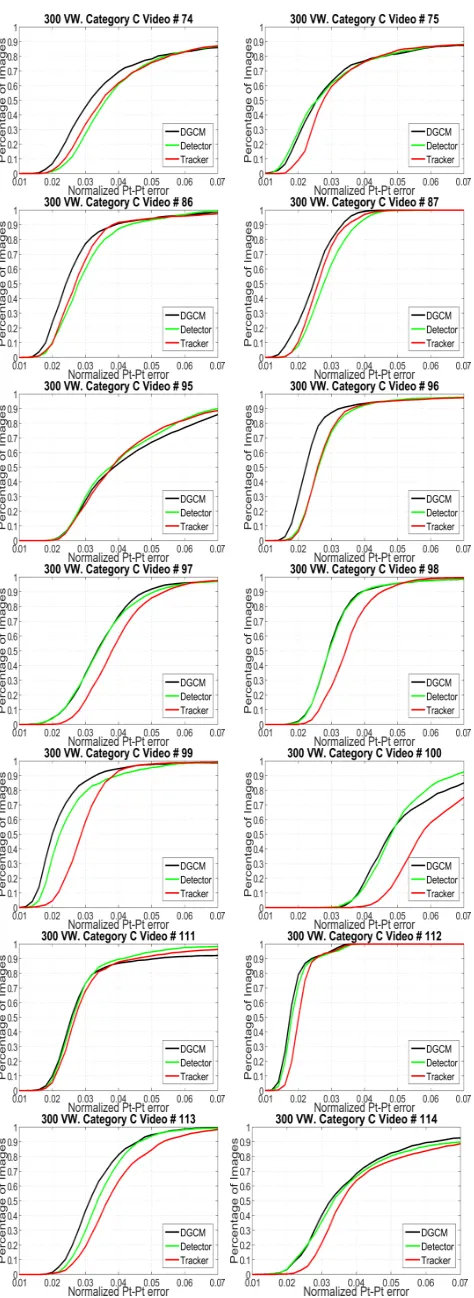
Fig.3shows the obtained results from all videos of cat-egory C. The results for each video separately, for conv
features only, are also shown in Fig. 4and in terms of the Area Under the Curve @ 0.08 error in Table2. Our main conclusions from these experiments are:
• Using conv features results in large performance im-provement over SIFT.
• Fig. 3shows that DGCM consistently results in perfor-mance improvement for both SIFT andconv features. The biggest improvement is observed for the case of Cat-egory C andconvfeatures, where the improvement over the detector is about6−7%almost across the whole spec-trum of the pt-pt-error. This performance improvement becomes more notable for specific videos (74, 86, 87, 96, 99, 113) as Fig.4and Table2show.
• This performance improvement is obtained even though the tracker seems to perform much worse compared to the detector. As shown in Table1, for Category C andconv
features, we found that the tracker (alone) outperforms the detector (alone) only for the 36%of the total number of frames. By improving our tracker, further boosting in DGCM performance is expected.
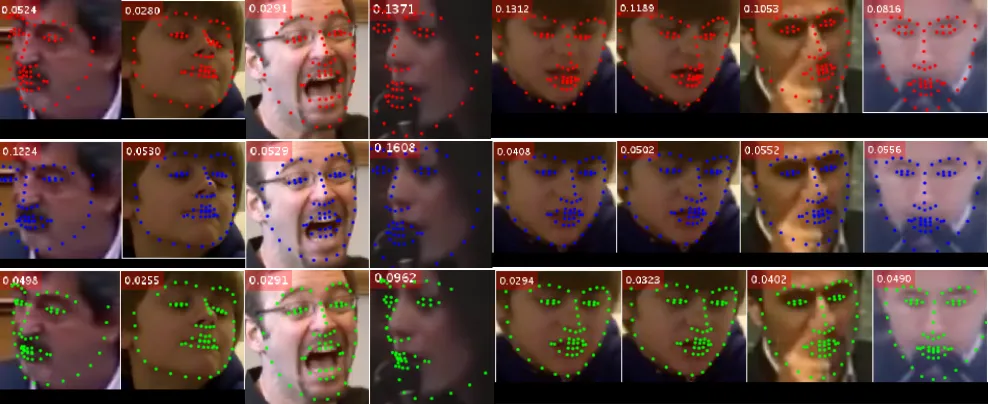
• As expected, the tracker typically produces more accu-rate fittings compared to the detector when there are grad-ual large variations in pose and expression. Such exam-ples are included in the first 4 images (from left to right) of Fig. 2. Also, when the tracker’s initialization is poor, the detector produces better fitting results. Examples of such cases are displayed in the last 4 images of Fig.2. • Finally, with very few exceptions, DGCM works better
or at least comparably with the second best performing method. Such examples are displayed in the last row of Fig. 2. One exception to this is video #95, where we observe that DGCM is worse than both the detector and tracker. We attribute this to the following reason: for this video, the detector and tracker seem to work equally poorly. The reason is that the tracker is re-initialized for about 40% of the frames literally “converting” the tracker to detector. However, in our ADMM, the tracker is always initialised from the result of the previous frame which because of the difficulty of the video is poor.
4.3. Comparison with state-of-the-art
Figure 2. First row (red): Tracking fittings. Second row (blue): Detection fittings. Third row (green): DGCM fittings. The normalized error for each fitting is displayed on the top-left corner. First 4 images (from left to right): Tracker works better than the detector. Last 4 images: Detector works better than the tracker. In all 8 cases, DGCM works better or comparably with the second best performing method.
Table 2. Area under curve @ 0.08 error for Tracking-conv, Detection-conv, and DGCM-convfor each individual video of category C. The numbers are percentages.
Meth./Vi. #74 #75 #86 #87 #95 #96 #97 #98 #99 #100 #111 #112 #113 #114 Tracking 48.43 55.90 63.37 66.66 46.31 64.45 50.25 55.97 62.75 24.55 61.66 73.99 51.32 47.47 Detection 47.43 58.35 62.10 64.46 46.96 64.42 55.10 61.03 67.88 36.98 63.80 75.96 56.00 51.29 DGCM 51.77 58.02 66.13 69.08 44.48 68.85 55.75 61.20 71.44 35.01 61.38 76.86 58.43 52.87
Figure 3. Comparison between DGCM with Detection (alone) and Tracking (alone) on category C of 300-VW.
the state-of-the-art face alignment method of [24], and the state-of-the-art tracker of [21]. Fig. 5shows the obtained results on category C. We note that (a) DGCM based on
conv features is by far the best performing method, and (b) DGCM based on SIFT features is consistently the sec-ond best method. Finally, the very competitive method of [21] proposes incremental learning to enhance tracking ac-curacy. Such an improvement is orthogonal to our
frame-work, and is the focus of future work.
4.4. Detection experiment
In this section, we performed another experiment illus-trating how DGCM can be used for enhancing detection (i.e. face alignment) performance for the case of poor ini-tialization. The experiment was performed on two differ-ent datasets, namely (a) the publicly available 300-W test set [19], containing 600 images captured in indoor and out-door environments, and (b) our cats dataset4consisting of 2000 images, out of which 200 are kept for testing and the rest for training. In particular, we used two noise levels for initializing a PO-CR detector based onconvfeatures, and DGCM (using also PO-CR and conv features). In both cases, initializations were produced by scaling and translat-ing the ground truth boundtranslat-ing boxes ustranslat-ing a noise distribu-tion, defined byσnoise.
When the noise level is low, PO-CR for both human and cat faces produces good results even when only 1 initializa-tion is used (green line in Fig.6). However, when the noise level is high, the performance of PO-CR drops significantly even when multiple, 5 in these experiments, initializations are used and the median of the 5 fittings for each image is taken as the final fitting (dashed green line in Fig.6). On the
Figure 4. Comparison between DGCM-conv with
[image:8.612.309.546.71.214.2]Detection-conv(alone) and Tracking-conv(alone) on all 14 videos of cat-egory C.
Figure 5. Comparison between DGCM and state-of-the art on cat-egory C of 300-VW.
Figure 6. PO-CR detector vs DGCM for different noise levels of initialization on 300-W testset (left) and cats dataset (right). For large noise levels, DGCM shows little loss in performance.
contrary, when 5 initializations are used for DGCM, there is very little loss in performance, as the black line in Fig.6
illustrates.
5. Conclusions
We proposed a method for achieving synergy between face alignment and tracking based on the principled frame-work of Global Variable Consensus Optimization using ADMM. We also showed how the proposed formulation can be integrated with state-of-the-art discriminative methods for face alignment and tracking based on cascaded regres-sion and deeply learned features. Contrary to prior work in face tracking, our method is both drifting-free and, at the same time, able to exploit shape information from the pre-viously tracked frame. Finally, we demonstrated that our method results in large performance improvement over the state-of-the-art on the 300-VW dataset.
6. Acknowledgements
[image:8.612.309.546.249.345.2]References
[1] A. Asthana, S. Zafeiriou, S. Cheng, and M. Pantic. Incre-mental face alignment in the wild. InCVPR, 2014.
[2] S. Baker and I. Matthews. Lucas-kanade 20 years on: A unifying framework.IJCV, 56(3):221–255, 2004.
[3] S. Boyd, N. Parikh, E. Chu, B. Peleato, and J. Eckstein. Distributed optimization and statistical learning via the al-ternating direction method of multipliers. Foundations and TrendsR in Machine Learning, 3(1):1–122, 2011.
[4] S. Boyd and L. Vandenberghe. Convex optimization. Cam-bridge university press, 2004.
[5] X. Cao, Y. Wei, F. Wen, and J. Sun. Face alignment by ex-plicit shape regression. InCVPR, 2012.
[6] G. G. Chrysos, E. Antonakos, P. Snape, A. Asthana, and S. Zafeiriou. A comprehensive performance evaluation of deformable face tracking” in-the-wild”. arXiv preprint arXiv:1603.06015, 2016.
[7] T. Cootes, G. Edwards, and C. Taylor. Active appearance models.TPAMI, 23(6):681–685, 2001.
[8] H. Fan and E. Zhou. Approaching human level facial land-mark localization by deep learning. Image and Vision Com-puting, 47:27–35, 2016.
[9] V. Kazemi and S. Josephine. One millisecond face alignment with an ensemble of regression trees. InCVPR, 2014. [10] D. G. Lowe. Distinctive image features from scale-invariant
keypoints.IJCV, 60(2):91–110, 2004.
[11] I. Matthews and S. Baker. Active appearance models revis-ited.IJCV, 60(2):135–164, 2004.
[12] I. Matthews, T. Ishikawa, and S. Baker. The template update problem.IEEE Transactions on Pattern Analysis & Machine Intelligence, (6):810–815, 2004.
[13] J. McDonagh and G. Tzimiropoulos. Joint face detection and alignment using a deformable hough transform model. InECCV-W, 2016.
[14] O. M. Parkhi, A. Vedaldi, A. Zisserman, and C. Jawahar. Cats and dogs. InCVPR, 2012.
[15] X. Peng, R. S. Feris, X. Wang, and D. N. Metaxas. A recur-rent encoder-decoder network for sequential face alignment. InECCV, 2016.
[16] X. Peng, S. Zhang, Y. Yang, and D. N. Metaxas. Piefa: Personalized incremental and ensemble face alignment. In
ICCV, 2015.
[17] S. Ren, X. Cao, Y. Wei, and J. Sun. Face alignment at 3000 fps via regressing local binary features. InCVPR, 2014. [18] C. Sagonas, Y. Panagakis, S. Zafeiriou, and M. Pantic.
Raps: Robust and efficient automatic construction of person-specific deformable models. InCVPR, 2014.
[19] C. Sagonas, G. Tzimiropoulos, S. Zafeiriou, and M. Pantic. 300 faces in-the-wild challenge: The first facial landmark localization challenge. InICCV-W, 2013.
[20] C. Sagonas, G. Tzimiropoulos, S. Zafeiriou, and M. Pantic. A semi-automatic methodology for facial landmark annota-tion. InCVPR-W, 2013.
[21] E. S´anchez-Lozano, B. Martinez, G. Tzimiropoulos, and M. Valstar. Cascaded continuous regression for real-time in-cremental face tracking. InECCV, 2016.
[22] J. Shen, S. Zafeiriou, G. Chrysos, J. Kossaifi, G. Tzimiropou-los, and M. Pantic. The first facial landmark tracking in-the-wild challenge: Benchmark and results. InICCV-W, 2015. [23] K. Simonyan and A. Zisserman. Very deep convolutional
networks for large-scale image recognition. arXiv preprint arXiv:1409.1556, 2014.
[24] G. Trigeorgis, P. Snape, M. A. Nicolaou, E. Antonakos, and S. Zafeiriou. Mnemonic descent method: A recurrent pro-cess applied for end-to-end face alignment. InCVPR, 2016. [25] G. Tzimiropoulos. Project-out cascaded regression with an
application to face alignment. InCVPR, 2015.
[26] G. Tzimiropoulos and M. Pantic. Gauss-newton deformable part models for face alignment in-the-wild. InCVPR, 2014. [27] S. Xiao, J. Feng, J. Xing, H. Lai, S. Yan, and A. Kas-sim. Robust facial landmark detection via recurrent attentive-refinement networks. InECCV, 2016.
[28] S. Xiao, S. Yan, and A. A. Kassim. Facial landmark detection via progressive initialization. InICCV-W, 2015.
[29] X. Xiong and F. De la Torre. Supervised descent method and its applications to face alignment. InCVPR, 2013.
[30] X. Xiong and F. De la Torre. Global supervised descent method. InCVPR, 2015.
[31] J. Yan, Z. Lei, D. Yi, and S. Z. Li. Learn to combine multiple hypotheses for accurate face alignment. InICCV-W, 2013. [32] S. Yang, P. Luo, C. C. Loy, and X. Tang. From facial parts
responses to face detection: A deep learning approach. In
ICCV, 2015.