Forecast Evaluation Tests and Negative Long-run
Variance Estimates in Small Samples
David I. Harvey, Stephen J. Leybourne and Emily J. Whitehouse
School of Economics, University of Nottingham
May 3, 2017
Abstract
In this paper, we show that when computing standard Diebold-Mariano-type tests for equal forecast accuracy and forecast encompassing, the long-run variance can frequently be neg-ative when dealing with multi-step-ahead predictions in small, but empirically relevant, sample sizes. We subsequently consider a number of alternative approaches to dealing with this problem, including direct inference in the problem cases and use of long-run variance estimators that guarantee positivity. The …nite sample size and power of the di¤erent approaches are evaluated using extensive Monte Carlo simulation exercises. Overall, for multi-step-ahead forecasts, we …nd that the recently proposed Coroneo and Iacone (2016) test, which is based on a weighted periodogram long-run variance estimator, o¤ers the best …nite sample size and power performance.
Keywords: Forecast evaluation; Long-run variance estimation; Simulation; Diebold-Mariano test; Forecasting.
JEL Classi…cation: C12, C22, C53.
1
Introduction
Given the critical role that forecasting plays in economic and …nancial research and
policy-making, the evaluation of competing forecasts of the same outcomes has become an extensive
and prominent …eld in the econometric and empirical economic literatures. Within this …eld,
the most common forecast evaluation exercise typically undertaken is to compare the accuracy
of two or more sets of forecasts on the basis of some measure of loss associated with the forecast
errors, such as mean squared forecast error. In a key contribution to the literature, Diebold
and Mariano (1995) [DM] proposed an approach for testing equal forecast accuracy valid for
potentially contemporaneously correlated, serially correlated and non-normal forecast errors,
based on testing for a zero mean in a series de…ned as the di¤erence between the two forecasts’
error loss functions (the “loss di¤erential”). Harvey et al. (1997) [HLNa] suggested two …nite
sample modi…cations to the DM statistic to improve size control in small samples, based on a
…nite sample bias correction to the test statistic, and using Student’s t critical values rather
than those from a standard normal. Application of the DM test or its HLNa variant have now
become prevalent in empirical forecasting research, to the extent that it is now routine for the
results of such forecast accuracy tests to be reported alongside any forecast comparisons.
Testing for equal forecast accuracy is just one approach to evaluating the predictive ability
of rival forecasts. A second popular evaluation method is to test for whether one set of forecasts
encompasses another, in the sense that the encompassed forecasts do not result in a reduction in
forecast accuracy when used in combination with the encompassing set of forecasts. Harveyet
al. (1998) [HLNb] proposed a forecast encompassing test based on a DM-type approach, where
the loss di¤erential is rede…ned to permit testing an encompassing null hypothesis, and the
approach has become standard in cases where one abstracts from model parameter estimation
uncertainty.
In this paper we focus on the behaviour of the DM/HLNa tests based on squared error loss,
and the HLNb test for encompassing, in small samples. Our work is therefore in a similar vein
to that of Ashley (2003) and Ashley and Tsang (2014) who investigate out-of-sample inference
with limited data availability. The DM test statistic is fundamentally comprised of the loss
di¤erential series sample mean standardised by an estimate of the long-run variance. DM make
use of the fact that optimal h-steps-ahead forecasts are at most (h 1)-order dependent to
advocate use of a rectangular kernel in the long-run variance estimator which truncates at lag
h 1. While this approach results in decent …nite sample size and power properties for many
sample size and h settings, the long-run variance estimator is not guaranteed to be positive whenever h > 1. DM note this possibility, but suggest that such an outcome would be rare; similarly, Clark (1999) …nds a low occurrence of negative long-run variance estimates in his equal
accuracy test simulations (always less than 3% of replications). However, these observations
were made on the basis of results that considered predictions only up to two steps ahead. Our
be much greater in small samples when longer horizon forecasts are considered. For example,
when testing equal mean squared forecast error with h = 6, we …nd that negative variance
estimates arise approximately 20% of the time for a sample size of 16, rising to over 40% of the
time for a sample size of 8.
In practical applications, often due to the limitations of economic or forecast data, it is
not uncommon for forecast evaluation to be conducted using sample size and forecast horizon
settings that lie in the region where negative variance estimates occur frequently. For example,
in the context of testing for equal forecast accuracy, the recent papers Caporale and Gil-Alana
(2014), Dreger and Wolters (2014), Dib et al. (2008) and Qin et al. (2008) all implement
the DM/HLNa tests in forecast samples smaller than 25 observations with horizons of h = 6 or greater. Further, Mehl (2009) and Chow and Choy (2006) have reported …nding negative
DM/HLNa long-run variance estimates when using samples of 18 and 24 forecasts at horizons
of 6 and 5-6, respectively.
Given that negative variance estimates can arise frequently in situations of practical
rele-vance, it is important to determine the best approach to deliver a reliable testing procedure
in terms of small sample size and power properties. DM suggest treating a negative variance
estimate as a zero, thereby automatically rejecting the null against a two-sided alternative in
such cases. However, given the low occurrence of negative variance estimates in their
simula-tions, the size implications of such an approach are not fully explored. In the simulation work
of Clark (1999), the relatively few replications where negative variance estimates were obtained
were excluded from the simulations, thereby abstracting from the e¤ects of dealing with certain
problematic cases. HLNa and HLNb simulated combinations of sample size and forecast
hori-zon where negative variances can occur frequently, but their simulations failed to correctly deal
with negative variance estimates, thus again the impact of negativity in the variance estimate
is not clear. Of course, other long-run variance estimators exist which ensure non-negativity;
for example, DM, Clark (1999) and others discuss the possible use of the Bartlett kernel, and
in a recent paper on testing equal forecast accuracy, Coroneo and Iacone (2016) recommend
use of the nonparametric periodogram estimator of Hualde and Iacone (2017), combined with
use of bandwidth-dependent critical values. The second contribution of this paper is therefore
to formally assess the behaviour of di¤erent strategies for dealing with the potential problem of
negative long-run variance estimation in tests of equal accuracy and encompassing. We conduct
an extensive set of Monte Carlo simulations to establish the small sample size and power
prop-erties of di¤erent approaches. Broadly, we …nd that for multi-step-ahead forecasts, the Coroneo
and Iacone (2016) approach outperforms other methods, and the attractive …nite sample
prop-erties reported in their paper for moderate sample sizes and forecast horizons extends to the
small sample and longer horizon region under focus in this paper for both equal accuracy and
encompassing tests, where the DM/HLNa and HLNb tests can su¤er from negative variance
estimates.
and HLNb tests for equal mean squared forecast error and forecast encompassing. Section 3
highlights by simulation the frequency with which negative long-run variance estimates can
arise for di¤erent sample sizes and forecast horizons. In section 4, a number of ways of dealing
with these cases are considered, including alternative long-run variance estimators that are
guaranteed to be positive, and section 5 investigates the performance of these procedures using
…nite sample size and power simulations. In section 6 we conduct a related set of simulation
experiments using a DGP calibrated to the empirical work of Dreger and Wolters (2014), while
section 7 considers simulations for the case where forecasts are obtained from estimated models.
Section 8 concludes.
2
Standard tests for equal accuracy and encompassing
Consider …rst the issue of evaluating whether two competing sets of forecasts are equally
accu-rate according to some loss function-based accuracy measure, or whether one forecast
outper-forms the other in terms of that metric. Denote the actuals byyt and the competing forecasts
byf1tand f2t,t= 1; :::; T, and consider a given loss functionL(:) that depends on the forecast
errors, so that the cost of error associated with the forecast fit is L(eit),i= 1;2. Now de…ne
the loss di¤erential series
dt=L(e1t) L(e2t); t= 1; :::; T:
The null hypothesis of equal forecast accuracy, according to the speci…ed loss functionL(:), can
then be expressed as
H0 :E(dt) = 0:
For example, under squared error loss,dt=e21t e22tand the null hypothesis entails the equality
of population mean squared forecast errors.
Under the assumptions that dt is covariance stationary and short memory, DM propose a
test of H0 based on the asymptotic distribution of the sample mean loss di¤erential
p
T(d E(dt)) d
!N 0; !2
where d=T 1PTt=1dt and !2 denotes the long-run variance of dt, i.e. !2 =P1j= 1 j with j = Cov(dt; dt j). Denoting a consistent long-run variance estimator by !^2, the DM test
statistic is then given by
DM =pT d
^
!
which has an asymptotic standard normal distribution under the null. DM suggest use of
a long-run variance estimator comprised of a weighted sum of sample autocovariances, and,
they advocate using a rectangular kernel truncated at lagh 1, i.e.
^
!2= ^0+ 2
h 1
X
j=1
^j (1)
where^j =T 1PTt=j+1 dt d dt j d .1 HLNa propose a modi…cation of the DM statistic
designed to improve the small sample size behaviour of the test. Their statistic is based on an
approximate bias correction to the long-run variance estimator, and can be written as
M DM =pT+ 1 2h+T 1h(h 1) d
^
! : (2)
These authors also suggest use oftT 1critical values in place of those from the standard normal,
again to better control small sample size.
Next consider investigating whether one set of forecasts encompasses another, in that the
accuracy of one set of (encompassing) forecasts f1t cannot be improved through linear
com-bination with a second set of (encompassed) forecasts f2t. HLNb develop a test for forecast
encompassing based on the Bates and Granger (1969) forecast combination scheme, where the
combination weights sum to one.2 Denoting the combined forecast by fct, the combination is
fct = (1 )f1t+ f2t
where (0 1) determines the weights associated with the constituent forecasts. In this
context, forecast f1t encompasses forecast f2t if the optimal mean squared error-minimising
combination weight
opt =
E(e21t) E(e1te2t)
E(e2
1t) +E(e22t) 2E(e1te2t)
is equal to zero. The null of forecast encompassing can then be expressed in a DM-type form:
H0 :E(dt) = 0
withdt in this case de…ned as
dt=e1t(e1t e2t): (3)
HLNb therefore propose applying the DM approach to this testing problem, along with the
HLNa bias correction and use of tT 1 critical values. The test statistic is then (2) but with dt
given by (3). The test is conducted against the one-sided alternative E(dt) > 0 (i.e. > 0),
given the assumption of a non-negative combination weight.
1
Note that ARCH-type behaviour in the forecast errors induces additional autocorrelation intodt, requiring use of higher order lags; see Harvey, Leybourne and Newbold (1999).
2
3
Frequency of negative long-run variance estimates
The long-run variance estimator (1), based on the rectangular kernel, is not guaranteed to be
positive wheneverh >1. In practice, of course, a negative outcome is highly problematic since the M DM statistic for testing equal accuracy or encompassing cannot be computed. In such
circumstances, a practitioner must then decide how to deal with such a result; suggestions in
the literature include treating the estimate as zero or using an alternative long-run variance
estimator that guarantees positivity. Whatever strategy is followed will have implications for
the size and power of the resulting testing procedure, so it is therefore valuable to quantify
how frequently negative long-run variance estimates are likely to be encountered in practice.
While DM, Clark (1999) and Coroneo and Iacone (2016),inter alios, note that (1) can produce a
negative result, little evidence has so far been provided as to the extent of this potential problem.
To shed more light on the issue, in this section we report results from Monte Carlo simulation
experiments to determine the frequency with which negative long-run variance estimates arise
for di¤erent sample sizes and forecast horizons, both for equal accuracy and encompassing tests.
To begin, we consider the case of testing for equal forecast accuracy, adopting a standard
simulation data generating process [DGP] consistent with the work of DM, HLNa and Clark
(1999). We assume mean squared error loss, so that dt = e21t e22t, t = 1; :::; T, generating
the forecast errors according to the following DGP, which allows forh-steps-ahead forecasts to
follow moving average [MA] processes of orderh 1:
e1t = v1t+ h 1
X
j=1
jv1;t j
e2t =
p
R
0 @v2t+
h 1
X
j=1
jv2;t j
1 A
where[v1t; v2t]0 N(0; I2),t= 1 (h 1); :::; T. The ratio of the variances of the two forecast
errors is given by R > 0, with R = 1 giving the null and R 6= 1 the alternative. Focusing
on the small samples that are often employed in forecast evaluation exercises, we simulate this
DGP forT =f8;16;32;64g,h=f2;3;4;5;6g, and calculate the frequency with which negative
values of the long-run variance estimator (1) arise. We consider three settings for the MA
parameters: (i) the case of no serial correlation with j = 0 8j, (ii) a case of moderate serial
correlation with j = 0:9=(h 1) 8j, and (iii) a case of high degree serial correlation with j
set to the jth element of = (0:95;0:9;0:8;0:65;0:6), these values being drawn from the US in‡ation forecast error-based DGP 1 of Clark and McCracken (2013). Here and throughout the
paper, simulations are conducted using 10,000 Monte Carlo replications. Table 1 reports the
results under the null (R = 1), and under the alternative (R >1), with the settings R = 12,
R= 7,R= 3 and R= 2forT = 8,T = 16,T = 32andT = 64, respectively (chosen to ensure that the test powers considered in section 5 are roughly comparable across sample sizes).
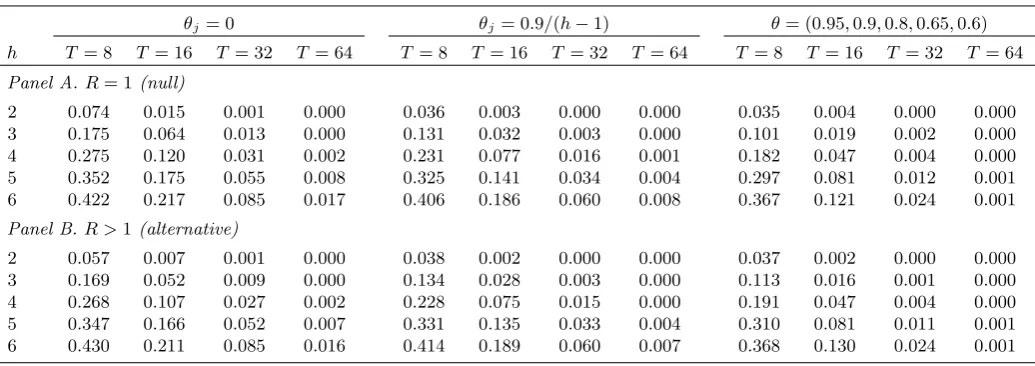
that increases with the forecast horizon, and decreases with the sample size. While the
occur-rence of negative estimates is rare whenT = 64, the problem can be substantial for the smaller
sample sizes considered, particularly for longer forecast horizons where the frequency can rise
above 40%. In such circumstances, a practitioner would be unable to compute the standardDM
orM DM test statistics almost half the time. The pattern of frequencies for negative long-run variance estimates has very little dependence on whether the simulations are conducted under
the null or alternative hypotheses, and while there is a reduction in the frequency of negative
estimates as the degree of serial correlation increases, the overall features of the results are
sim-ilar across the di¤erent dependence settings, particularly for the longer forecast horizons. We
also considered simulations where the forecast errors were contemporaneously correlated, but
this had little e¤ect on the proportion of negative long-run variances obtained. These results
highlight a potentially serious issue with the implementation of standard tests for equal forecast
accuracy in small samples.
Turning now to testing for forecast encompassing, we let dt = e1t(e1t e2t), t = 1; :::; T,
where the forecast errors are generated according to the following DGP, again allowing for
MA(h 1)-dependence in the errors ofh-steps-ahead forecasts:
eit=vit+ h 1
X
j=1
jvi;t j; i= 1;2
where "
v1t
v2t
#
N 0;
"
1
2
#!
; t= 1 (h 1); :::; T
with 2 > 2. The null hypothesis that forecast f1t encompasses f2t is obtained by setting
= 1, while a setting of < 1 gives the alternative. Under the alternative, it can be shown
that power depends only on the single parameterk=p 2 2=(1 ). Table 2 reports results
for the frequency of negative long-run variance estimates using the same settings for T, h and
j as in Table 1. Results are reported under both the null and alternative, with the settings
fork under the alternative beingk= 1:25,k= 2:00,k= 3:00 and k= 4:50 forT = 8,T = 16,
T = 32andT = 64, respectively (again chosen to broadly align the test power levels considered
in section 5 across sample sizes).
The pattern of negative estimates for the long-run variance is very similar in the case of
testing for forecast encompassing to that for testing for equal forecast accuracy. Indeed, on
comparing Tables 1 and 2 for a given combination ofT,h and j, it is clear that the numerical
frequencies are very close to each other, suggesting that the prevalence of negative long-run
variance estimates is driven more by the interplay of sample size, serial correlation and the
number of estimated autocovariances (h 1), rather than by the precise form of dt. We again
see a rising incidence of negative estimates asT decreases and ashincreases. As with the equal accuracy results, it makes little di¤erence whether the long-run variance is being calculated
serial correlation. The overall …nding is that negative long-run variance estimates can occur
with very high probability for equal accuracy and encompassing tests when using
multi-step-ahead forecasts with small, yet practically relevant, sample sizes.
4
Adjusted Diebold-Mariano-type tests
Given the prevalence of negative long-run variance estimates that arise for multi-step-ahead
forecasts in small samples when using the standard long-run variance estimator in the DM-type
tests, it is important to establish methods for dealing with this potential problem. In this
section we consider a number of possible approaches, all based on the DM-type tests for equal
accuracy and encompassing. The following section then evaluates their relative performance in
terms of …nite sample size and power.
The …rst approach we consider is the suggested method of DM in the equal accuracy testing
context, which is to treat any occurrence of a negative long-run variance as a zero, viewing the
negative estimate as indicative of a very small long-run variance. This of course implies a test
statistic of 1, depending on the sign of the numeratord. In a two-sided testing context, as in DM, such a treatment induces an immediate rejection of the null hypothesis, so a negative
long-run variance estimate always indicates evidence in favour of the alternative hypothesis under
this approach. When testing against a one-sided alternative, as is common in applications of
equal accuracy tests and always the case when testing for encompassing, treating a negative
long-run variance as zero will either induce automatic rejection or non-rejection, depending on
whether the implied test statistic value of +1 or 1 lies in the relevant one-tailed critical
region. Applying this approach to the M DM tests of HLNa and HLNb, we can express the method as
M DMrej =
(
M DM if!^2>0
sign(d) 1 otherwise
with the test statistic to be compared withtT 1 critical values.
Given the frequency with which negative long-run variance estimates can occur, theM DMrej
approach will induce substantial over-size in two-sided equal accuracy testing procedures for
h >1 and smallT, as all occurrences of a negative!^2 trigger a rejection of the null. A similar,
albeit reduced, feature of over-size would also be expected for one-sided equal accuracy tests
and tests for forecast encompassing, with rejections of the null occurring whenever a negative
^
!2 coincides with the appropriate sign ofd. A simple conservative approach which would avoid such properties is to treat the occurrence of a negative long-run variance estimate as a failure
to correctly estimate the true long-run variance, and default tonon-rejection of the null in such
instances. One way of writing such a method would be to de…ne the adjusted test statistic as
M DMnon=
(
M DM if!^2 >0
with the test statistic again being compared with tT 1 critical values. A potential down-side
of this approach is that the greater size control a¤orded by treating negative estimate cases as
non-rejections is also likely to be associated with low power under the respective test alternative.
Another simple approach is to deal with a negative long-run variance estimate by replacing
it with the corresponding short-run variance estimate ^0, thereby reducing the bandwidth in
(1) from h 1 to zero. While this approach neglects the impact of autocorrelation terms, it can be argued that the very presence of a negative estimate indicates that estimation of such
components is highly unreliable in these situations. When the short-run variance estimator is
used, the appropriate bias correction in the M DM statistic is that forh= 1, i.e.
M DM0 =
p
T 1 pd
^0
!
and the overall test statistic that adopts this statistic when a negative long-run variance is
encountered can be written as
M DMSR=
(
M DM if!^2 >0
M DM0 otherwise
:
Critical values from the tT 1 distribution are again to be used.
While the above methods replace negative long-run variances with simple decision rules or
a short-run variance estimate, the next two approaches we consider retain a proper estimate of
the long-run variance, but make use of estimators that impose positivity. An obvious possibility
in this class is to replace the rectangular kernel in (1) with the Bartlett kernel, i.e.
^
!2Bart= ^0+ 2
m
X
j=1
1 j
m+ 1 ^j
wherem denotes the bandwidth. Clark (1999) considered such an approach with Newey-West
and pre-whitened Newey-West bandwidth selection. While Clark’s simulations abstracted from
issues of negative variance estimation, it was found that a Bartlett-based approach could result
in greater …nite sample over-size than when using the rectangular kernel, hence it would not be
recommended to use the Bartlett kernel in all circumstances, particularly when the rectangular
kernel does not have negative variance estimate problems. Here, we consider a hybrid approach,
whereby the standard M DM test is used provided the long-run variance estimate is positive, but in the case of a negative estimate, the statistic switches to one based on the Bartlett kernel.
For consistency with the optimal forecast-motivated choice of truncation h 1 in (1), along with the fact that use of the Bartlett kernel is most likely to arise in small samples, we set the
Bartlett bandwidth to m =h 1. As the HLNa bias correction does not apply to !^2Bart (and an equivalent bias correction is not possible to obtain without e¤ectively reducing!^2Bartto!^2), we de…ne the DM statistic that uses the Bartlett long-run variance estimator as
DMBart=
p
T d
^
!Bart
We can then write the third testing approach as
M DMB=
(
M DM if!^2 >0
DMBart otherwise
withtT 1 critical values employed as before.
The original DM test, and the variants outlined above, all make use of weighted sample
au-tocovariances in the long-run variance estimator. An alternative approach proposed by Coroneo
and Iacone (2016) is to use a weighted periodogram estimator, and these authors recommend
construction of a DM-type test using the estimator of Hualde and Iacone (2017). Denoting the
periodogram ofdtfor Fourier frequency j = 2 j=T by
I( j) =
1 p
2 T
T
X
t=1
dte i jt
2
withithe imaginary unit, they suggest use of the Daniell kernel with bandwidthmto construct the weighted periodogram estimator of the long-run variance
^
!2Dan = 2 1
m
m
X
j=1
I( j)
which is then used to construct the DM-type test statistic
DMCI =
p
T d
^
!Dan
:
If the bandwidth is treated as …xed, !^2Dan is not a consistent estimator of !2, but is asymp-totically unbiased, and under the null hypothesis of E(dt) = 0, DMCI follows an asymptotic
t2m distribution. This …xed-m treatment results in a test with appealing …nite sample
prop-erties, o¤ering better size control relative to the m ! 1 treatment that results in standard normal limit theory. Coroneo and Iacone observe that thet2m distribution can act as a better
approximation of the true null distribution for a smaller bandwidth, whereas larger bandwidths
can be associated with higher power, hence a size-power trade-o¤ emerges. Following these
authors, we consider two versions of the test, setting the bandwidths according to m= T1=3
and m = T1=4 (where b:c denotes the integer part of the argument), denoting the resulting test statistics by DMCI;1 and DMCI;2, respectively. Note that for any given sample size, m
is then treated as a …xed number so that the …xed-m asymptotic theory can be applied, with critical values drawn from the t2m distribution.
In addition to the above methods, we also experimented with other possible solutions to the
negative variance estimate problem. We considered replacing a negative long-run variance
esti-mate with a modi…ed estiesti-mate based on reducing the rectangular kernel bandwidth sequentially
until a positive estimate was obtained, and we investigated the exponential covariogram-based
long-run variance estimator proposed in the spatial prediction context by Hering and
bandwidth h 1, examining results for the Bartlett kernel using a larger bandwidth setting of 2(h 1), and also the standard and pre-whitened quadratic spectral long-run variance
estima-tors of Andrews (1991) and Andrews and Monahan (1992) with automatic bandwidth selection.
However, these alternatives did not deliver superior …nite sample size and power performance
relative to the better of the approaches considered above, hence we do not detail these tests
and their results in this paper; full results are available from the authors on request.
5
Finite sample size and power
In this section we consider the …nite sample performance of the di¤erent methods outlined in the
previous section. We …rst consider testing for equal forecast accuracy, again focusing on mean
squared error loss (dt=e21t e22t), and simulate the empirical sizes of the M DMrej,M DMnon,
M DMSR,M DMB,DMCI;1 andDMCI;2 testing approaches, with the tests conducted against
a two-sided alternative at the nominal 0.10-level. In addition to these six approaches, for
comparison we also report results for theDMBart statistic compared withtT 1 critical values,
which always employs the Bartlett kernel-based estimator !^2Bart regardless of the sign of the rectangular kernel-based estimator !^2. As with the earlier simulations in section 3, we use
a standard simulation setup in line with DM, HLNa and Clark (1999). Table 3 reports the
sizes for the same simulation DGPs that were considered in the negative long-run variance
simulations of section 3 when the null hypothesis was imposed (R= 1). Note thatDMCI;1 and
DMCI;2 are identical when T = 16since T1=3 = T1=4 in this case.
Whenh= 1, the originalM DM statistic cannot su¤er from negative long-run variance
esti-mation problems, soM DMrej,M DMnon,M DMSR,M DMB all amount to simply conducting
M DM. (Note also that when h= 1, no serial correlation is present in the DGP, hence the j
settings play no role.) Here, the test is well behaved, with sizes very close to the nominal level,
with only modest under-size displayed for T = 8 and T = 16. A very similar pattern of size behaviour is also seen for DMCI;1 and DMCI;2, while DMBart exhibits some minor over-size
but is also generally well behaved. All tests are therefore reliable for one-step-ahead forecasts
and there is little to choose between them in terms of …nite sample size.
For multi-step-ahead forecasts (h > 1), the possibility of negative long-run variance esti-mates arises and so the method of dealing with these problem cases results in di¤erent size
properties for the overall procedures that we consider. The M DMrej approach translates any
negative long-run variance estimate into a rejection of the null, thus the high frequency of
neg-ative estimates for larger h and smallerT induces a high degree of over-size for this approach.
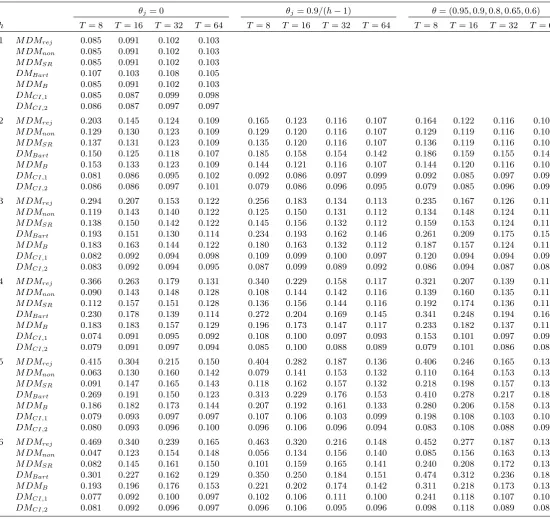
In line with the results of Table 1, the size of M DMrej reaches almost 0.50, and such large
upward size distortions render this procedure invalid. TheDMBarttest can also exhibit severe
over-size, consistent with the simulations of Clark (1999), with size rising to almost 0.50 in the
worst cases. TheM DMB method achieves better size control through use of the Bartlett kernel
of h and T, with empirical size rising above 0.30 in the case of high degree serial correlation. The M DMSR approach (which replaces negative long-run variance estimates with a short-run
variance estimate) o¤ers better size control for the cases of no serial correlation and modest
serial correlation, but, as might be expected, when the degree of serial correlation is high, the
simpli…cation of using only a short-run variance results in substantial size distortions. Of the
M DM-based approaches, the best performing method is M DMnon (which translates negative
variance estimates into non-rejections of the null). However, the size can still be in‡ated above
the nominal level, with sizes of around 0.16 occurring. In contrast, the DMCI;1 and DMCI;2
weighted periodogram approaches o¤er a much greater degree of size control across h and T.
Apart from the case ofT = 8with high degree serial correlation, the two versions generally have size close to 0.10, with the worst upward size distortion being a size below 0.12, o¤ering a clear
improvement over the other methods considered. WhenT = 8,h >3and the errors are highly serially correlated, DMCI;1 can su¤er from more substantial over-size, while DMCI;2 retains
excellent size control. The attractive …nite sample size results reported in Coroneo and Iacone
(2016) for moderate sample sizes and forecast horizons therefore extend to the small sample
and longer horizon region under focus here, particularly forDMCI;2, suggesting a valuable role
for theDMCI approach in delivering forecast accuracy tests with reliable size in small samples.
When comparing results for the over-sizedDMBart test and the well-behavedDMCI;2 test,
both of which always use a long-run variance estimator that is guaranteed to be positive yet have
very di¤erent …nite sample size properties, it is interesting to examine the di¤erences between
the tests, so as to ascertain the components ofDMCI;2 that are instrumental in achieving size
control. The DMCI;2 statistic makes use of a di¤erent form of long-run variance estimator
(a weighted periodogram estimator with Daniell kernel) compared to the DMBart statistic
(which uses a weighted autocovariance estimator with Bartlett kernel), and the DMCI;2 test
adopts critical values from the t2m distribution (based on …xed-m asymptotic theory) while
the DMBart test uses tT 1 critical values (based on a limiting standard normal distribution
obtained fromm! 1asymptotic theory). To gain some insight into the relative contributions of the change in long-run variance estimator and the change in critical values, we computed the
size of a hybrid test that compares theDMCI;2 statistic with tT 1 critical values. Results from
these unreported simulations (which are available from the authors on request) show that in
the cases where DMBart is most over-sized (h > 3 with small T and moderate or high degree
serial correlation), use of DMCI;2 with tT 1 critical values roughly halves the extent of the
size distortion, suggesting that the long-run variance estimator and critical values both play an
important role in controlling small sample size. In situations where DMBart has size closer to
the nominal level, comparing DMCI;2 with tT 1 critical values results in relatively little size
improvement (indeed in some cases the over-size is greater than that for DMBart), suggesting
that it is the use of t2m critical values that plays the dominant part in improving size in such
cases.
their relative powers. Table 4 reports the size-adjusted powers of the equal accuracy test
procedures (with the exception of M DMrej), where the critical values for each test are …rst
obtained by simulation from the corresponding size experiment. The M DMrej approach is
not amenable to size-adjustment due to the high proportion of automatic rejections induced
by negative long-run variance estimates being treated as zero, which cannot be corrected by
adjusting critical values; regardless of this, the severe over-size properties ofM DMrej exclude
it as a reliable procedure anyway. The DGPs are again those used in section 3, with R varied
across T to keep the power levels broadly similar across di¤erent sample sizes. When h = 1, where the M DMnon, M DMSR and M DMB procedures simply reduce to M DM, and where
DMBartonly di¤ers fromM DM by
p
T =(T 1)with the same size-adjusted power, it is clear that the originalM DMtest can o¤er decent power gains overDMCI;1andDMCI;2, particularly
for smaller samples where we see gains around 0.15 relative toDMCI;1, and up to 0.35 relative
to DMCI;2. Thus in the one-step-ahead context, where the tests are correctly sized and no
negative long-run variance estimation problems arise, use ofM DM is to be recommended.
When h >1, however, the power rankings change. DMBart often displays attractive levels
of size-adjusted power, but given the very poor small sample size performance of this test, it
would be di¢ cult to justify its use in practice. Of the better size controlled tests, when T = 8,
DMCI;1 outperforms all theM DM-based procedures for all forecast horizons, with worthwhile
power gains of up to 0.13 displayed. For larger sample sizes, DMCI;1 power can dip a little
below that of theM DM-based approaches whenhis small, but for the longer forecast horizons,
DMCI;1 again o¤ers decent power gains. TheDMCI;2 procedure is identical toDMCI;1 when
T = 16, but for the other sample sizes, the additional size robustness that DMCI;2 delivers
comes at some cost to size-adjusted power. This is most noticeable forT = 8 where the power
ofDMCI;2 is markedly below that ofDMCI;1, while for the larger sample sizes, the di¤erences
between DMCI;1 and DMCI;2 are quite modest. Among the three M DM-based methods,
power di¤erences emerge for smaller values of T, becoming more exaggerated as h increases,
withM DMnondisplaying the lowest relative power (as expected given its conservative approach
to dealing with negative long-run variance estimates), followed byM DMB and thenM DMSR.
Finally, considering the impact of serial correlation in the errors, the power levels of all the
methods decrease as the degree of serial correlation increases, but the relative rankings of the
tests are largely preserved.
Taking the multi-step-ahead size and power results together, with the exception of T = 8in the case ofh >3,DMCI;1emerges as the best performing test overall, with reliable …nite sample
size performance and relatively high levels of power. When T = 8 and h > 3, DMCI;2 o¤ers
better size control than DMCI;1 for highly serially correlated errors, and although this comes
with a loss in size-adjusted power,DMCI;2 still has power that is generally a little higher than
M DMnon(the best size controlled of the M DM-based methods), in addition to more reliable
size. A possible role for M DMnon could be envisaged for practitioners who desire a simple
DMCI;2 should be employed wheneverh > 1, with the choice between these procedures made
on the basis of the sample size and forecast horizon.
We next consider testing for forecast encompassing, beginning by simulating the empirical
sizes of theM DMrej,M DMnon,M DMSR,DMBart,M DMB,DMCI;1andDMCI;2procedures,
conducting one-sided tests at the nominal 0.10-level for the same simulation DGPs as in section
3. The results are reported in Table 5. As for the equal accuracy case, for one-step-ahead
forecasts, we observe that the M DM-based procedures (which are identical for h= 1) and the
DMCI tests display good …nite sample size control. Indeed, theM DM test has almost no size
distortions even for small T, while only a very modest amount of under-size is displayed for
DMCI;1 and DMCI;2. On the other hand, DMBart is over-sized, particularly for the smaller
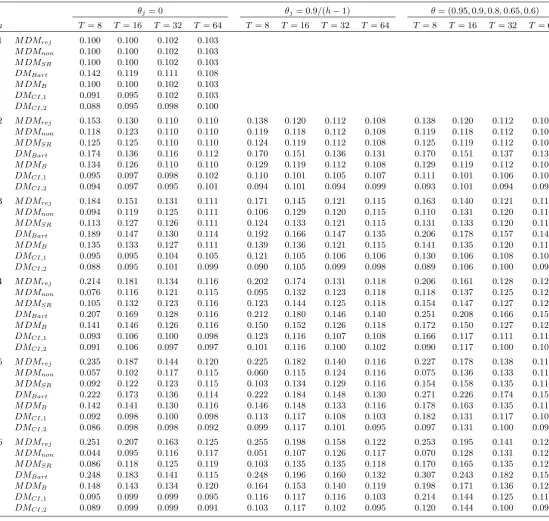
sample sizes. When h > 1, we …nd a similar picture of size behaviour to that in Table 3.
Speci…cally, M DMrej and DMBart can be substantially over-sized, although the over-size of
M DMrej is less severe than for the equal accuracy case, since here the encompassing test is
conducted against a one-sided alternative, hence only a proportion of the negative long-run
variances obtained induce a rejection of the null. Of the M DM-based approaches, M DMnon
o¤ers the best size control with size always below 0.14, whileM DMSRandM DMBsu¤er from
greater size distortion, although to a lesser extent than was found in the equal accuracy testing
context. DMCI;1 and DMCI;2 again have very good size behaviour across most settings, the
exceptions being when the errors are highly serially correlated and eitherT = 16together with
h = 5 or h = 6, where DMCI;1 and DMCI;2 can su¤er from a small amount of upward size
distortion, or T = 8 and h >2, in which case DMCI;1 can again be over-sized, whileDMCI;2
o¤ers greater size control in these cases.
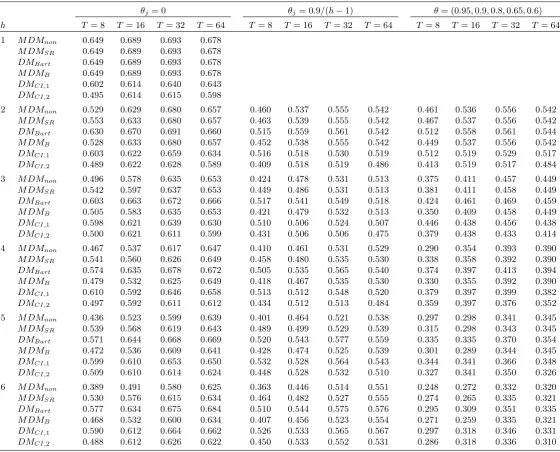
Turning to power for forecast encompassing tests, Table 6 gives results for the size-adjusted
powers ofM DMnon,M DMSR,DMBart,M DMB,DMCI;1 and DMCI;2 for the relevant DGPs
of section 3, withkvarying acrossT as speci…ed in that section; the critical values used for the size-adjustment are again obtained by simulation from the corresponding size experiment. The
relative power rankings of the tests are unchanged compared to tests for equal forecast accuracy,
therefore the comments and conclusions outlined above are equally applicable in this context.
We again …nd thatM DM has a power advantage over theDMCI tests forh= 1, whileDMCI;1
generally outperforms the other procedures for T = 8 and h > 1, and for the longer forecast
horizons when T is larger. DMCI;2 again has generally lower power than DMCI;1, although
this is only of real import when T = 8. Once again, therefore, M DM is to be recommended for one-step-ahead forecasts, but for multi-step-ahead forecasts, apart from a potential role for
M DMnon when a simple M DM-based modi…cation is desired, it is the DMCI;1 and DMCI;2
tests that are to be preferred. These tests o¤er the best …nite sample performance in terms
of size and relative power, with DMCI;2 recommended for T = 8 when h > 2, and DMCI;1
6
Simulations calibrated from empirical data
In order to ensure that our simulation results are representative of what is likely to be
en-countered in practical applications, we now consider a set of simulations for a DGP where the
sample sizes, forecast horizons and forecast error serial correlation settings are all calibrated
according to a particular application in the literature. Speci…cally, we follow the Dreger and
Wolters (2014) application where Euro-area in‡ation is forecast one, two and three years ahead
from an autoregressive model using quarterly data. We obtained HICP in‡ation data from the
authors for the period 1981Q1–2010Q4, and, following Dreger and Wolters, we construct 1-, 4-,
8- and 12-quarter in‡ation rates as follows
h t =
4
hlog(pct=pct h); h= 1;4;8;12
wherepctdenotes the consumer price index (HICP). The forecasting equation uses the
bench-mark model of Dreger and Wolters, based on prediction using current and lagged quarterly
in‡ation:
h
t+h = 1 1t + 2 1t 1+ 3 1t 2+ 4 1t 3+"t+h: (4)
Following Dreger and Wolters, at each forecast horizon we …rst estimate the model over the
initial in-sample period 1983Q1–2002Q4. The parameter estimates are then used to produce
the …rst h = 4, h = 8 and h = 12 forecasts for the periods 2003Q4, 2004Q4 and 2005Q4, respectively. The in-sample period is then extended by one observation and (4) is re-estimated,
with the results used to obtain the next forecast for 2004Q1 at h = 4, 2005Q1 at h = 8 and
2006Q1 at h = 12. Continuing in this recursive manner, the …nal forecast for each forecast horizon is obtained for time 2010Q4, therefore producing a total of T = 29forecasts forh= 4,
T = 25 forh = 8, and T = 21 for h= 12. Denoting the forecast at a given time and horizon by ^ht+h, we can obtain three forecast error series
eht+h= ht+h ^ht+h; h= 4;8;12:
To determine the degree of serial correlation present in the forecast errors, we …t moving average
processes to the three forecast error series, determining the order of MA process in each case
according to the Akaike information criterion, selecting from MA processes up to order h 1. We …nd the selected models to be M A(3), M A(2) and M A(4) for h = 4, h = 8 and h = 12,
respectively, with the …tted MA coe¢ cients given in Table 7. Although these MA parameters
have been estimated using a very small sample size, it can be seen that the values obtained are
not inconsistent with the settings adopted in the earlier simulation exercises.
Given the calibrations obtained from the Dreger and Wolters application, we repeat the
sim-ulation experiments considered in sections 3 and 5, but now with the settingsT =f29;25;21g,
h = f4;8;12g and the corresponding j values from Table 7. Accordingly, Table 8 reports
the frequency with which negative long-run variance estimates arise when using the standard
under both the respective null and alternative hypotheses. The settings under the alternative
for the three horizon/sample size pairings considered are R=f4;6;8g (for testing equal
accu-racy) and k=f2;1:8;1:8g (for encompassing testing), again chosen so that the test powers are broadly comparable across sample sizes. For h= 4, we observe a very low occurrence of
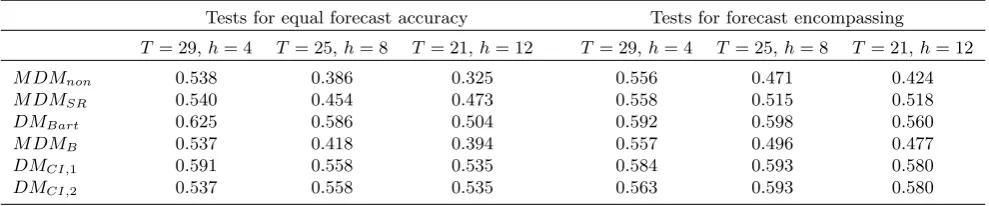
neg-ative long-run variance estimates, while for h = 8 the proportion of negative estimates across the simulations is in the region of 0.15, rising to around 0.33 for h = 12. These comments apply equally to tests for equal forecast accuracy and tests for forecast encompassing. The
sample sizes considered in this empirically calibrated exercise lie inbetween the T = 16 and
T = 32 settings used in the section 3 simulations, and two of the forecast horizons considered
are greater than the range considered in section 3. However, it is clear that the pattern of
frequencies for negative estimates is consistent with the earlier results, with a high incidence
of problematic negative outcomes as the forecast horizon increases. This further demonstrates
that the possibility of obtaining a negative long-run variance estimate is an empirically relevant
issue when applying standard tests for equal accuracy and encompassing in small samples.
Table 9 presents the empirical sizes of the di¤erent test procedures for the empirically
calibrated settings. Note that DMCI;1 and DMCI;2 are identical when T = 25 (h = 8) and
T = 21 (h = 12), hence di¤erences are only seen for the h = 4 results where T = 29. The
DMCI tests clearly o¤er the best size control of the procedures considered for tests for equal
forecast accuracy and forecast encompassing, and the two bandwidth settings in DMCI;1 and
DMCI;2 deliver similar size results. Given that here we consider longer forecast horizons than
in section 5, it is reassuring to see thatDMCI;1 andDMCI;2 retain good size control acrossh.
As would be expected given the earlier simulations, substantial over-size is seen for M DMrej
and DMBart, particularly for the longer forecast horizons. Of the other M DM-based tests,
M DMnon o¤ers the best size control as before, with a maximum size around 0.15 observed,
while M DMSR and M DMB can have size up to around 0.19 and 0.24 respectively. Table 10
reports the corresponding size-adjusted powers of the procedures, and, with the exception of
the badly over-sized DMBart test, DMCI;1 displays the best power performance, followed by
DMCI;2. In contrast, the best-sizedM DM-based procedure,M DMnon, su¤ers from relatively
low size-adjusted power forh= 8 andh= 12. These results clearly strengthen the case for use of DMCI;1 orDMCI;2 in practical applications.
7
Impact of model parameter estimation uncertainty
Beginning primarily with West (1996), much work on forecast evaluation testing has focused on
cases where the forecasts have been produced by estimated models, either non-nested or nested,
and more sophisticated methods have been proposed to properly account for the impact that
model parameter estimation uncertainty can have on the distributions of DM-type forecast
accuracy and encompassing tests in such circumstances. For reviews of this literature, see West
from estimated models, the original DM approach is asymptotically valid without the need for
any modi…cation. Examples are where the forecast models are non-nested, linear and estimated
by ordinary least squares (OLS), along with the loss function being mean squared forecast error,
or when the number of forecast observations is small relative to the number of observations used
for model estimation. In this section, we consider a set of simulations designed to examine the
same issues of negative long-run variance estimation and test size performance in small samples,
but now where the forecasts have …rst been obtained from estimated models. In order to focus
on tests that are asymptotically valid, we restrict attention to tests for equal mean squared
forecast error where the forecasts are obtained from non-nested linear models estimated by
OLS.
Our forecasting exercise involves an in-sample period for model estimation,t= 1; :::; N, and
an out-of-sample period for forecast evaluation,t=N+ 1; :::; N+T. We consider the following DGP
yt= 1x1t+ 2x2t+"t; t= 1; :::; N +T
where, without loss of generality, we interpret x1t and x2t to be predictor variables useful for
forecasting yt at horizon h. We set [x1t; x2t]0 N(0; I2) and, as our focus here is on the
impact of parameter estimation uncertainty rather than forecast error serial correlation, we
simply generate "t N(0;1), t = 1; :::; N +T, independently of [x1t; x2t]0. As in the j = 0
simulations of sections 3 and 5, we do not assume knowledge of this lack of serial correlation
when constructing the test statistics, so the results can be compared directly with the j = 0
sections of Tables 1 and 3. We consider two model-based forecasts, with the models given by
Model 1 : yt= 1x1t+e1t
Model 2 : yt= 2x2t+e2t
which are …rst estimated by OLS over the period t= 1; :::; N to give the parameter estimates ^
1 and ^2. The two forecast series are then speci…ed as
f1t = ^1x1t; t=N + 1; :::; N+T
f2t = ^2x2t; t=N + 1; :::; N+T
with the corresponding forecast errors
^
e1t = yt ^1x1t
^
e2t = yt ^2x2t:
The tests for equal forecast accuracy are then de…ned exactly as in section 4, but withe1t and
e2treplaced withe^1tande^2t, respectively. By setting 1 = 2, it is straightforward to show that
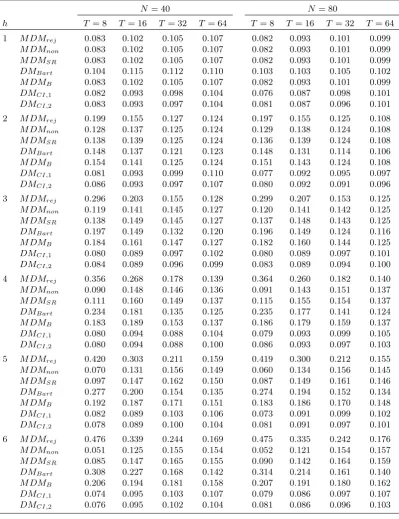
sizes, N = 40 and N = 80, combined with the same set of out-of-sample sizes and forecast horizons employed in the earlier simulations of sections 3 and 5.
Table 11 reports results for the frequency of negative long-run variance estimates. On
comparing these results (for both N = 40 and N = 80) with the j = 0 section of Panel A
of Table 1, we …nd that the results are almost identical, hence the presence of forecast model
parameter estimation uncertainty has almost no e¤ect on the prevalence of negative estimates.
Table 12 gives results for the empirical sizes of the test procedures, and while some minor
di¤erences are seen between the results forN = 40andN = 80, the results for the di¤erent in-sample sizes are broadly similar to each other, and there is little di¤erence between these results
and those for j = 0in Table 3. Once again, therefore, the impact of estimating the forecast
models is very slight, and the same comments made in section 5 apply here. The fundamental
…ndings of (i) a high frequency of negative long-run variance estimates when evaluating
multi-step-ahead forecasts using small numbers of out-of-sample forecast errors, and (ii) the DMCI
tests o¤ering the best size control among the alternative procedures considered, are therefore
equally relevant in the context of forecasts obtained from estimated models.
8
Conclusion
In this paper, we have highlighted that application of the standard DM-based tests for equal
forecast accuracy and forecast encompassing can often result in a negative long-run variance
estimate when dealing with multi-step-ahead predictions and small, but empirically relevant,
sample sizes. Having examined a number of possible approaches to dealing with this
prob-lem, we have found that the recently proposed testing approach of Coroneo and Iacone (2016),
which uses a weighted periodogram long-run variance estimator combined with …xed-bandwidth
asymptotics, o¤ers the best overall …nite sample size and power performance. Use of this test
with a bandwidth setting of T1=3 or T1=4 (the choice being determined by the sample size and forecast horizon involved) results in only modest size distortions, while power levels are
appealing relative to other approaches, permitting reliable inference even in the small
sam-ple/long horizon cases we consider. Aside from this preferred approach, a case could possibly
be made for a strategy that uses theM DM tests of Harveyet al. (1997, 1998) when a positive long-run variance estimate is obtained, and defaulting to a non-rejection of the null hypothesis
when a negative long-run variance arises; while this approach does not perform as well as the
Coroneo and Iacone (2016) procedure, it does have the advantage of simplicity, since no
ad-ditional computation beyond calculation of the M DM statistic is required. Finally, when the
forecast evaluation is being done with one-step-ahead predictions, no negative long-run variance
estimates can arise with the standard tests, and the M DM tests provide good size control and
superior power to the Coroneo and Iacone (2016) test.
The simulations conducted in this paper considered a range of sample sizes and forecast
focused throughout on normally distributed forecast errors, we also considered simulations based
on errors drawn from thet6 distribution, given that forecast errors often appear to display
fat-tailed behaviour. We found the results to be qualitatively similar to those based on normal
errors, hence our conclusions would be unchanged under such a forecast error assumption.
Finally, we note that the issue of negative long-run variance estimates would also be relevant
in the recommended test of Harvey and Newbold (2000) for multiple forecast encompassing
(where the null is that one forecast encompasses a number of competing predictors), since
this test employs a multivariate version of the M DM approach. It would be expected that the variance-covariance estimator in the test statistic could fail to be positive de…nite for small
samples and multi-step-ahead predictions, and in future work it would be interesting to consider
extensions of the above techniques to that context.
References
Andrews, D.W.K. (1991). Heteroskedasticity and autocorrelation consistent covariance matrix
estimation. Econometrica, 59, 817–858.
Andrews, D.W.K. and Monahan, J.C. (1992). An improved heteroskedasticity and
autocorre-lation consistent covariance matrix estimator. Econometrica, 60, 953–966.
Ashley, R. (2003). Statistically signi…cant forecasting improvements: how much out-of-sample
data is likely necessary? International Journal of Forecasting, 19, 229–239.
Ashley, R. and Tsang, K.P. (2014). Credible Granger-causality inference with modest sample
lengths: a cross-sample validation approach. Econometrics, 2, 72–91.
Bates, J.M. and Granger, C.W.J. (1969). The combination of forecasts. Operational Research
Quarterly, 20, 451–468.
Caporale, G.M. and Gil-Alana, L. (2014). Long-run and cyclical dynamics in the US stock
market. Journal of Forecasting, 33, 147–161.
Chow, H.K. and Choy, K.M. (2006). Forecasting the global electronics cycle with leading
indicators: A Bayesian VAR approach. International Journal of Forecasting, 22, 301–
315.
Clark, T.E. (1999). Finite-sample properties of tests for equal forecast accuracy. Journal of
Forecasting, 18, 489–504.
Clark, T.E. and McCracken, M. (2013). Advances in forecast evaluation. In Handbook of
Economic Forecasting, Vol. 2, Part B, Elliott, G. and Timmerman, A. (eds.), pp. 1107–
Clements, M.P. and Harvey, D.I. (2009). Forecast combination and encompassing. InPalgrave
Handbook of Econometrics, Vol. 2: Applied Econometrics, Mills, T.C. and Patterson, K.
(eds.), pp. 169–198, Palgrave Macmillan, Basingstoke.
Coroneo, L. and Iacone, F. (2016). Comparing predictive accuracy in small samples using
…xed-smoothing asymptotics. Discussion Paper, Department of Economics, University of
York.
Dib, A., Gammoudi, M. and Moran, K. (2008). Forecasting Canadian time series with the
New Keynesian model. Canadian Journal of Economics, 41, 138–165.
Diebold, F.X. and Mariano, R.S. (1995). Comparing predictive accuracy. Journal of Business
and Economics Statistics, 13, 253–263.
Dreger, C. and Wolters, J. (2014). Money demand and the role of monetary indicators in
forecasting euro area in‡ation. International Journal of Forecasting, 30, 303–312.
Harvey, D.I., Leybourne, S.J. and Newbold, P. (1997). Testing the equality of prediction mean
squared errors. International Journal of Forecasting, 13 281–291.
Harvey, D.I., Leybourne, S.J. and Newbold, P. (1998). Tests for forecast encompassing.
Jour-nal of Business and Economic Statistics, 16, 254–259.
Harvey, D.I., Leybourne, S.J. and Newbold, P. (1999). Forecast evaluation tests in the presence
of ARCH.Journal of Forecasting, 18, 435–445.
Harvey, D.I. and Newbold, P. (2000). Tests for multiple forecast encompassing. Journal of
Applied Econometrics, 15, 471–482.
Hering, A.S. and Genton, M.G. (2011). Comparing spatial predictions. Technometrics, 53,
414–425.
Hualde, J. and Iacone, F. (2017). Fixed bandwidth asymptotics for the studentized mean of
fractionally integrated processes. Economics Letters, 150, 39–43.
Mehl, A. (2009). The yield curve as a predictor and emerging economies. Open Economies
Review, 20, 683–716.
Qin, D., Cagas, M.A., Ducanes, G., Magtibay-Ramos, N. and Quising, P. (2008). Automatic
leading indicators versus macroeconometric structural models: A comparison of in‡ation
and GDP growth forecasting. International Journal of Forecasting, 24, 399–413.
West, K.D. (1996). Asymptotic inference about predictive ability. Econometrica, 64, 1067–
1084.
West, K.D. (2006). Forecast evaluation. InHandbook of Economic Forecasting, Vol. 1, Elliott,
Table 1. Frequency of negative long-run variance estimates in tests for equal forecast accuracy.
θj= 0 θj= 0.9/(h−1) θ= (0.95,0.9,0.8,0.65,0.6)
h T = 8 T = 16 T = 32 T = 64 T = 8 T = 16 T= 32 T = 64 T = 8 T = 16 T = 32 T = 64
Panel A.R= 1 (null)
2 0.074 0.015 0.001 0.000 0.036 0.003 0.000 0.000 0.035 0.004 0.000 0.000
3 0.175 0.064 0.013 0.000 0.131 0.032 0.003 0.000 0.101 0.019 0.002 0.000
4 0.275 0.120 0.031 0.002 0.231 0.077 0.016 0.001 0.182 0.047 0.004 0.000
5 0.352 0.175 0.055 0.008 0.325 0.141 0.034 0.004 0.297 0.081 0.012 0.001
6 0.422 0.217 0.085 0.017 0.406 0.186 0.060 0.008 0.367 0.121 0.024 0.001
Panel B.R >1(alternative)
2 0.057 0.007 0.001 0.000 0.038 0.002 0.000 0.000 0.037 0.002 0.000 0.000
3 0.169 0.052 0.009 0.000 0.134 0.028 0.003 0.000 0.113 0.016 0.001 0.000
4 0.268 0.107 0.027 0.002 0.228 0.075 0.015 0.000 0.191 0.047 0.004 0.000
5 0.347 0.166 0.052 0.007 0.331 0.135 0.033 0.004 0.310 0.081 0.011 0.001
6 0.430 0.211 0.085 0.016 0.414 0.189 0.060 0.007 0.368 0.130 0.024 0.001
Table 2. Frequency of negative long-run variance estimates in tests for forecast encompassing.
θj= 0 θj= 0.9/(h−1) θ= (0.95,0.9,0.8,0.65,0.6)
h T = 8 T = 16 T = 32 T = 64 T = 8 T = 16 T= 32 T = 64 T = 8 T = 16 T = 32 T = 64
Panel A.ρ= 1(null)
2 0.070 0.015 0.001 0.000 0.037 0.003 0.000 0.000 0.036 0.003 0.000 0.000
3 0.182 0.067 0.012 0.001 0.130 0.030 0.002 0.000 0.104 0.018 0.001 0.000
4 0.275 0.126 0.029 0.003 0.226 0.083 0.014 0.001 0.177 0.045 0.005 0.000
5 0.360 0.169 0.054 0.009 0.330 0.132 0.033 0.002 0.306 0.081 0.010 0.000
6 0.424 0.220 0.089 0.017 0.406 0.180 0.061 0.008 0.360 0.126 0.021 0.002
Panel B.ρ <1(alternative)
2 0.063 0.012 0.001 0.000 0.033 0.003 0.000 0.000 0.034 0.003 0.000 0.000
3 0.169 0.054 0.009 0.000 0.129 0.029 0.002 0.000 0.105 0.020 0.001 0.000
4 0.263 0.116 0.027 0.003 0.221 0.081 0.012 0.001 0.190 0.044 0.003 0.000
5 0.349 0.166 0.051 0.008 0.331 0.132 0.032 0.002 0.300 0.084 0.011 0.000
[image:21.595.42.560.331.511.2]Table 3. Empirical size of nominal 0.10-level tests for equal forecast accuracy.
θj= 0 θj= 0.9/(h−1) θ= (0.95,0.9,0.8,0.65,0.6)
h T= 8 T = 16 T = 32 T = 64 T = 8 T= 16 T = 32 T = 64 T = 8 T = 16 T= 32 T = 64
1 M DMrej 0.085 0.091 0.102 0.103
M DMnon 0.085 0.091 0.102 0.103
M DMSR 0.085 0.091 0.102 0.103
DMBart 0.107 0.103 0.108 0.105
M DMB 0.085 0.091 0.102 0.103
DMCI,1 0.085 0.087 0.099 0.098
DMCI,2 0.086 0.087 0.097 0.097
2 M DMrej 0.203 0.145 0.124 0.109 0.165 0.123 0.116 0.107 0.164 0.122 0.116 0.107
M DMnon 0.129 0.130 0.123 0.109 0.129 0.120 0.116 0.107 0.129 0.119 0.116 0.107
M DMSR 0.137 0.131 0.123 0.109 0.135 0.120 0.116 0.107 0.136 0.119 0.116 0.107
DMBart 0.150 0.125 0.118 0.107 0.185 0.158 0.154 0.142 0.186 0.159 0.155 0.142
M DMB 0.153 0.133 0.123 0.109 0.144 0.121 0.116 0.107 0.144 0.120 0.116 0.107
DMCI,1 0.081 0.086 0.095 0.102 0.092 0.086 0.097 0.099 0.092 0.085 0.097 0.099
DMCI,2 0.086 0.086 0.097 0.101 0.079 0.086 0.096 0.095 0.079 0.085 0.096 0.094
3 M DMrej 0.294 0.207 0.153 0.122 0.256 0.183 0.134 0.113 0.235 0.167 0.126 0.112
M DMnon 0.119 0.143 0.140 0.122 0.125 0.150 0.131 0.112 0.134 0.148 0.124 0.112
M DMSR 0.138 0.150 0.142 0.122 0.145 0.156 0.132 0.112 0.159 0.153 0.124 0.112
DMBart 0.193 0.151 0.130 0.114 0.234 0.193 0.162 0.146 0.261 0.209 0.175 0.159
M DMB 0.183 0.163 0.144 0.122 0.180 0.163 0.132 0.112 0.187 0.157 0.124 0.112
DMCI,1 0.082 0.092 0.094 0.098 0.109 0.099 0.100 0.097 0.120 0.094 0.094 0.095
DMCI,2 0.083 0.092 0.094 0.095 0.087 0.099 0.089 0.092 0.086 0.094 0.087 0.089
4 M DMrej 0.366 0.263 0.179 0.131 0.340 0.229 0.158 0.117 0.321 0.207 0.139 0.115
M DMnon 0.090 0.143 0.148 0.128 0.108 0.144 0.142 0.116 0.139 0.160 0.135 0.115
M DMSR 0.112 0.157 0.151 0.128 0.136 0.156 0.144 0.116 0.192 0.174 0.136 0.115
DMBart 0.230 0.178 0.139 0.114 0.272 0.204 0.169 0.145 0.341 0.248 0.194 0.166
M DMB 0.183 0.183 0.157 0.129 0.196 0.173 0.147 0.117 0.233 0.182 0.137 0.115
DMCI,1 0.074 0.091 0.095 0.092 0.108 0.100 0.097 0.093 0.153 0.101 0.097 0.098
DMCI,2 0.079 0.091 0.097 0.094 0.085 0.100 0.088 0.089 0.079 0.101 0.086 0.088
5 M DMrej 0.415 0.304 0.215 0.150 0.404 0.282 0.187 0.136 0.406 0.246 0.165 0.134
M DMnon 0.063 0.130 0.160 0.142 0.079 0.141 0.153 0.132 0.110 0.164 0.153 0.133
M DMSR 0.091 0.147 0.165 0.143 0.118 0.162 0.157 0.132 0.218 0.198 0.157 0.133
DMBart 0.269 0.191 0.150 0.123 0.313 0.229 0.176 0.153 0.410 0.278 0.217 0.186
M DMB 0.186 0.182 0.173 0.144 0.207 0.192 0.161 0.133 0.280 0.206 0.158 0.133
DMCI,1 0.079 0.093 0.097 0.097 0.107 0.106 0.103 0.099 0.198 0.108 0.103 0.102
DMCI,2 0.080 0.093 0.096 0.100 0.096 0.106 0.096 0.094 0.083 0.108 0.088 0.093
6 M DMrej 0.469 0.340 0.239 0.165 0.463 0.320 0.216 0.148 0.452 0.277 0.187 0.136
M DMnon 0.047 0.123 0.154 0.148 0.056 0.134 0.156 0.140 0.085 0.156 0.163 0.135
M DMSR 0.082 0.145 0.161 0.150 0.101 0.159 0.165 0.141 0.240 0.208 0.172 0.135
DMBart 0.301 0.227 0.162 0.129 0.350 0.250 0.184 0.151 0.474 0.312 0.236 0.188
M DMB 0.193 0.196 0.176 0.153 0.221 0.202 0.174 0.142 0.311 0.218 0.173 0.135
DMCI,1 0.077 0.092 0.100 0.097 0.102 0.106 0.111 0.100 0.241 0.118 0.107 0.100
Table 4. Size-adjusted power of nominal 0.10-level tests for equal forecast accuracy.
θj= 0 θj= 0.9/(h−1) θ= (0.95,0.9,0.8,0.65,0.6)
h T= 8 T = 16 T = 32 T = 64 T = 8 T= 16 T = 32 T = 64 T = 8 T = 16 T= 32 T = 64
1 M DMnon 0.710 0.820 0.677 0.699
M DMSR 0.710 0.820 0.677 0.699
DMBart 0.710 0.820 0.677 0.699
M DMB 0.710 0.820 0.677 0.699
DMCI,1 0.564 0.655 0.591 0.642
DMCI,2 0.357 0.655 0.528 0.555
2 M DMnon 0.454 0.688 0.638 0.679 0.396 0.594 0.521 0.559 0.384 0.595 0.520 0.556
M DMSR 0.480 0.689 0.638 0.679 0.404 0.596 0.521 0.559 0.402 0.596 0.520 0.556
DMBart 0.646 0.795 0.673 0.689 0.535 0.669 0.542 0.560 0.531 0.655 0.540 0.559
M DMB 0.443 0.686 0.638 0.679 0.389 0.596 0.521 0.559 0.384 0.593 0.520 0.556
DMCI,1 0.609 0.648 0.606 0.612 0.511 0.545 0.471 0.499 0.497 0.545 0.472 0.500
DMCI,2 0.374 0.648 0.533 0.538 0.326 0.545 0.416 0.438 0.330 0.545 0.416 0.437
3 M DMnon 0.385 0.574 0.601 0.656 0.340 0.479 0.466 0.509 0.283 0.399 0.390 0.420
M DMSR 0.433 0.596 0.605 0.656 0.376 0.490 0.466 0.509 0.305 0.401 0.390 0.420
DMBart 0.565 0.757 0.679 0.689 0.466 0.596 0.515 0.525 0.363 0.483 0.419 0.431
M DMB 0.393 0.565 0.601 0.656 0.349 0.478 0.465 0.509 0.287 0.396 0.389 0.420
DMCI,1 0.564 0.635 0.619 0.643 0.468 0.526 0.460 0.487 0.394 0.431 0.387 0.400
DMCI,2 0.374 0.635 0.556 0.558 0.307 0.526 0.437 0.415 0.290 0.431 0.346 0.352
4 M DMnon 0.388 0.505 0.531 0.638 0.339 0.441 0.454 0.523 0.249 0.310 0.303 0.361
M DMSR 0.506 0.561 0.540 0.639 0.401 0.466 0.459 0.523 0.278 0.315 0.301 0.361
DMBart 0.570 0.717 0.652 0.682 0.467 0.580 0.528 0.551 0.310 0.392 0.339 0.380
M DMB 0.428 0.524 0.535 0.638 0.353 0.429 0.456 0.523 0.249 0.308 0.301 0.361
DMCI,1 0.604 0.627 0.592 0.647 0.493 0.525 0.486 0.512 0.340 0.373 0.324 0.347
DMCI,2 0.389 0.627 0.529 0.571 0.332 0.525 0.451 0.460 0.256 0.373 0.300 0.310
5 M DMnon 0.389 0.476 0.483 0.599 0.319 0.413 0.436 0.516 0.197 0.235 0.259 0.294
M DMSR 0.513 0.556 0.507 0.603 0.425 0.462 0.448 0.518 0.232 0.241 0.257 0.294
DMBart 0.560 0.698 0.647 0.679 0.467 0.580 0.531 0.554 0.266 0.308 0.298 0.314
M DMB 0.418 0.517 0.498 0.602 0.364 0.428 0.446 0.519 0.243 0.235 0.256 0.294
DMCI,1 0.592 0.629 0.598 0.626 0.503 0.516 0.507 0.524 0.281 0.314 0.288 0.305
DMCI,2 0.395 0.629 0.533 0.526 0.322 0.516 0.444 0.448 0.234 0.314 0.261 0.257
6 M DMnon 0.318 0.441 0.461 0.577 0.297 0.387 0.397 0.505 0.185 0.225 0.205 0.267
M DMSR 0.505 0.545 0.488 0.581 0.419 0.471 0.417 0.506 0.193 0.230 0.203 0.268
DMBart 0.546 0.677 0.618 0.681 0.482 0.589 0.519 0.561 0.219 0.268 0.250 0.280
M DMB 0.433 0.506 0.482 0.583 0.374 0.429 0.405 0.505 0.202 0.227 0.201 0.267
DMCI,1 0.597 0.632 0.583 0.638 0.495 0.552 0.491 0.533 0.224 0.288 0.247 0.279
Table 5. Empirical size of nominal 0.10-level tests for forecast encompassing.
θj= 0 θj= 0.9/(h−1) θ= (0.95,0.9,0.8,0.65,0.6)
h T= 8 T = 16 T = 32 T = 64 T = 8 T= 16 T = 32 T = 64 T = 8 T = 16 T= 32 T = 64
1 M DMrej 0.100 0.100 0.102 0.103
M DMnon 0.100 0.100 0.102 0.103
M DMSR 0.100 0.100 0.102 0.103
DMBart 0.142 0.119 0.111 0.108
M DMB 0.100 0.100 0.102 0.103
DMCI,1 0.091 0.095 0.102 0.103
DMCI,2 0.088 0.095 0.098 0.100
2 M DMrej 0.153 0.130 0.110 0.110 0.138 0.120 0.112 0.108 0.138 0.120 0.112 0.108
M DMnon 0.118 0.123 0.110 0.110 0.119 0.118 0.112 0.108 0.119 0.118 0.112 0.108
M DMSR 0.125 0.125 0.110 0.110 0.124 0.119 0.112 0.108 0.125 0.119 0.112 0.108
DMBart 0.174 0.136 0.116 0.112 0.170 0.151 0.136 0.131 0.170 0.151 0.137 0.131
M DMB 0.134 0.126 0.110 0.110 0.129 0.119 0.112 0.108 0.129 0.119 0.112 0.108
DMCI,1 0.095 0.097 0.098 0.102 0.110 0.101 0.105 0.107 0.111 0.101 0.106 0.107
DMCI,2 0.094 0.097 0.095 0.101 0.094 0.101 0.094 0.099 0.093 0.101 0.094 0.099
3 M DMrej 0.184 0.151 0.131 0.111 0.171 0.145 0.121 0.115 0.163 0.140 0.121 0.114
M DMnon 0.094 0.119 0.125 0.111 0.106 0.129 0.120 0.115 0.110 0.131 0.120 0.114
M DMSR 0.113 0.127 0.126 0.111 0.124 0.133 0.121 0.115 0.131 0.133 0.120 0.114
DMBart 0.189 0.147 0.130 0.114 0.192 0.166 0.147 0.135 0.206 0.178 0.157 0.142
M DMB 0.135 0.133 0.127 0.111 0.139 0.136 0.121 0.115 0.141 0.135 0.120 0.114
DMCI,1 0.095 0.095 0.104 0.105 0.121 0.105 0.106 0.106 0.130 0.106 0.108 0.106
DMCI,2 0.088 0.095 0.101 0.099 0.090 0.105 0.099 0.098 0.089 0.106 0.100 0.097
4 M DMrej 0.214 0.181 0.134 0.116 0.202 0.174 0.131 0.118 0.206 0.161 0.128 0.121
M DMnon 0.076 0.116 0.121 0.115 0.095 0.132 0.123 0.118 0.118 0.137 0.125 0.121
M DMSR 0.105 0.132 0.123 0.116 0.123 0.144 0.125 0.118 0.154 0.147 0.127 0.121
DMBart 0.207 0.169 0.128 0.116 0.212 0.180 0.146 0.140 0.251 0.208 0.166 0.154
M DMB 0.141 0.146 0.126 0.116 0.150 0.152 0.126 0.118 0.172 0.150 0.127 0.121
DMCI,1 0.093 0.106 0.100 0.098 0.123 0.116 0.107 0.108 0.166 0.117 0.111 0.113
DMCI,2 0.091 0.106 0.097 0.097 0.101 0.116 0.100 0.102 0.090 0.117 0.100 0.104
5 M DMrej 0.235 0.187 0.144 0.120 0.225 0.182 0.140 0.116 0.227 0.178 0.138 0.119
M DMnon 0.057 0.102 0.117 0.115 0.060 0.115 0.124 0.116 0.075 0.136 0.133 0.119
M DMSR 0.092 0.122 0.123 0.115 0.103 0.134 0.129 0.116 0.154 0.158 0.135 0.119
DMBart 0.222 0.173 0.136 0.114 0.222 0.184 0.148 0.130 0.271 0.226 0.174 0.152
M DMB 0.142 0.141 0.130 0.116 0.146 0.148 0.133 0.116 0.178 0.163 0.135 0.119
DMCI,1 0.092 0.098 0.100 0.098 0.113 0.117 0.108 0.103 0.182 0.131 0.117 0.108
DMCI,2 0.086 0.098 0.098 0.092 0.099 0.117 0.101 0.095 0.097 0.131 0.100 0.099
6 M DMrej 0.251 0.207 0.163 0.125 0.255 0.198 0.158 0.122 0.253 0.195 0.141 0.124
M DMnon 0.044 0.095 0.116 0.117 0.051 0.107 0.126 0.117 0.070 0.128 0.131 0.123
M DMSR 0.086 0.118 0.125 0.119 0.103 0.135 0.135 0.118 0.170 0.165 0.135 0.123
DMBart 0.248 0.183 0.141 0.115 0.248 0.196 0.160 0.132 0.307 0.243 0.182 0.159
M DMB 0.148 0.143 0.134 0.120 0.164 0.153 0.140 0.119 0.198 0.171 0.136 0.123
DMCI,1 0.095 0.099 0.099 0.095 0.116 0.117 0.116 0.103 0.214 0.144 0.125 0.111
Table 6. Size-adjusted power of nominal 0.10-level tests for forecast encompassing.
θj= 0 θj= 0.9/(h−1) θ= (0.95,0.9,0.8,0.65,0.6)
h T= 8 T = 16 T = 32 T = 64 T = 8 T= 16 T = 32 T = 64 T = 8 T = 16 T= 32 T = 64
1 M DMnon 0.649 0.689 0.693 0.678
M DMSR 0.649 0.689 0.693 0.678
DMBart 0.649 0.689 0.693 0.678
M DMB 0.649 0.689 0.693 0.678
DMCI,1 0.602 0.614 0.640 0.643
DMCI,2 0.495 0.614 0.615 0.598
2 M DMnon 0.529 0.629 0.680 0.657 0.460 0.537 0.555 0.542 0.461 0.536 0.556 0.542
M DMSR 0.553 0.633 0.680 0.657 0.463 0.539 0.555 0.542 0.467 0.537 0.556 0.542
DMBart 0.630 0.670 0.691 0.660 0.515 0.559 0.561 0.542 0.512 0.558 0.561 0.544
M DMB 0.528 0.633 0.680 0.657 0.452 0.538 0.555 0.542 0.449 0.537 0.556 0.542
DMCI,1 0.603 0.622 0.659 0.634 0.516 0.518 0.530 0.519 0.512 0.519 0.529 0.517
DMCI,2 0.489 0.622 0.628 0.589 0.409 0.518 0.519 0.486 0.413 0.519 0.517 0.484
3 M DMnon 0.496 0.578 0.635 0.653 0.424 0.478 0.531 0.513 0.375 0.411 0.457 0.449
M DMSR 0.542 0.597 0.637 0.653 0.449 0.486 0.531 0.513 0.381 0.411 0.458 0.449
DMBart 0.603 0.663 0.672 0.666 0.517 0.541 0.549 0.518 0.424 0.461 0.469 0.459
M DMB 0.505 0.583 0.635 0.653 0.421 0.479 0.532 0.513 0.350 0.409 0.458 0.449
DMCI,1 0.598 0.621 0.639 0.630 0.510 0.506 0.524 0.507 0.446 0.438 0.456 0.438
DMCI,2 0.500 0.621 0.611 0.599 0.431 0.506 0.506 0.475 0.379 0.438 0.433 0.414
4 M DMnon 0.467 0.537 0.617 0.647 0.410 0.461 0.531 0.529 0.290 0.354 0.393 0.390
M DMSR 0.541 0.560 0.626 0.649 0.458 0.480 0.535 0.530 0.338 0.358 0.392 0.390
DMBart 0.574 0.635 0.678 0.672 0.505 0.535 0.565 0.540 0.374 0.397 0.413 0.394
M DMB 0.479 0.532 0.625 0.649 0.418 0.467 0.535 0.530 0.330 0.355 0.392 0.390
DMCI,1 0.610 0.592 0.646 0.658 0.513 0.512 0.548 0.520 0.379 0.397 0.399 0.382
DMCI,2 0.497 0.592 0.611 0.612 0.434 0.512 0.513 0.484 0.359 0.397 0.376 0.352
5 M DMnon 0.436 0.523 0.599 0.639 0.401 0.464 0.521 0.538 0.297 0.298 0.341 0.345
M DMSR 0.539 0.568 0.619 0.643 0.489 0.499 0.529 0.539 0.315 0.298 0.343 0.345
DMBart 0.571 0.644 0.668 0.669 0.520 0.543 0.577 0.559 0.335 0.335 0.370 0.354
M DMB 0.472 0.536 0.609 0.641 0.428 0.474 0.525 0.539 0.301 0.289 0.344 0.345
DMCI,1 0.599 0.610 0.653 0.650 0.532 0.528 0.564 0.543 0.344 0.341 0.366 0.348
DMCI,2 0.509 0.610 0.614 0.624 0.448 0.528 0.532 0.510 0.327 0.341 0.350 0.326
6 M DMnon 0.389 0.491 0.580 0.625 0.363 0.446 0.514 0.551 0.248 0.272 0.332 0.320
M DMSR 0.530 0.576 0.615 0.634 0.464 0.482 0.527 0.555 0.274 0.265 0.335 0.321
DMBart 0.577 0.634 0.675 0.684 0.510 0.544 0.575 0.576 0.295 0.309 0.351 0.335
M DMB 0.468 0.532 0.600 0.634 0.407 0.456 0.523 0.554 0.271 0.259 0.335 0.321
DMCI,1 0.590 0.612 0.664 0.662 0.526 0.533 0.565 0.567 0.297 0.318 0.346 0.331