EVOLVING COMPLEX SYSTEMS FROM SIMPLE MOLECULES
Jan Sadownik
A Thesis Submitted for the Degree of PhD at the
University of St. Andrews
2009
Full metadata for this item is available in Research@StAndrews:FullText
at:
http://research-repository.st-andrews.ac.uk/
Please use this identifier to cite or link to this item:
http://hdl.handle.net/10023/857
Evolving Complex Systems from
Simple Molecules
Jan Sadownik
A Thesis Presented for the Degree of
Doctor of Philosophy
in the
School of Chemistry
University of St Andrews
I, Jan Sadownik, hereby certify that this thesis has been written by me, that it is the record of work carried out by me and that it has not been submitted in any previous application for a higher degree.
date ………..… signature of candidate ………
I was admitted as a research student in January 2005 and as a candidate for the degree of Doctor of Philosophy in January 2005; the higher study for which this is a record was carried out in the University of St Andrews between 2005 and 2008.
date ………….. signature of candidate ……….
I hereby certify that the candidate has fulfilled the conditions of the Resolution and Regulations appropriate for the degree of Doctor of Philosophy in the University of St Andrews and that the candidate is qualified to submit this thesis in application for that degree.
date …………... signature of supervisor ………...
In submitting this thesis to the University of St Andrews I wish access to it to be subject to the following conditions: for a period of 1 year from the date of submission, the thesis shall be withheld from use.
I understand, however, that the title and abstract of the thesis will be published during this period of restricted access; and that after the expiry of this period the thesis will be made available for use in accordance with the regulations of the University Library for the time being in force, subject to any copyright in the work not being affected thereby, and a copy of the work may be made and supplied to any bona fide library or research worker, that my thesis will be electronically accessible for personal or research use, and that the library has the right to migrate my thesis into new electronic forms as required to ensure continued access to the thesis. I have obtained any third-party copyright permission that may be required in order to allow such access and migration.
Synopsis
Until very recently, synthetic chemistry has focussed on the creation of chemical entities with desirable properties through the programmed application of isolated chemical reactions, either individually or in a cascade that afford a target compound
selectively. By contrast, biological systems operate using a plethora of complex interconnected signaling and metabolic networks with multiple checkpoint controls
and feedback loops allowing biological systems to adapt and respond rapidly to external stimuli. Systems chemistryattempts to capture the complexity and emergent phenomena prevalent in the life sciences within a wholly synthetic chemical
framework. In this approach, complex phenomena are expressed by a group of synthetic chemical entities designed to interact and react with many partners within
the ensemble in programmed ways. In this manner, it should be possible to create synthetic chemical systems whose properties are not simply the linear sum of the attributes of the individual components.
Chapter 1 discusses the role of complex networks in various aspects of chemistry-related research from the origin of life to nanotechnology. Further, it introduces the concept of Systems chemistry, giving various examples of dynamic covalent networks, self-replicating systems and molecular logic gates, showing the applications of complex system research.
Chapter 2 discusses the components of replicator design. Further, it introduces a network based on recognition mediated reactions that is implemented by length-segregation of the substrates and displays properties of self-sorting.
Chapter 3 presents a fully addressable chemical system based on auto- and cross-catalytic properties of product templates. The system is described by Boolean logic operations with different template inputs giving different template outputs.
Chapter 4 introduces a dynamic network which fate is determined by a single recognition event. The replicator is capable of exploiting and dominating the exchanging pool of reagents in order to amplify its own formation at the expense of other species through the non-linear kinetics inherent in minimal replication.
Acknowledgements
I would like to thank my supervisor Prof Douglas Philp for all the help and guidance he has given me over the last four years.
I would like to thank all the members of the Philp group that I had the pleasure to work with. Firstly, a big thanks goes to Annick Vidonne as we started on the same day and together we shall finish. Not forgetting Dr Simon Turega, Dr Evan Wood, Dr Vicente del Amo, Peter Donnelly, Craig Robertson, Jürgen Huck, Izzaty Hassan and all the project students.
Special thanks goes to the technical staff at the University of St Andrews. Thanks to Melanja Smith and Tomas Lebl for NMR spectroscopy assistance. Caroline Horsburgh for mass spectrometry, Prof Alexandra Slawin for X-ray crystallography and Sylvia Williamson for elemental analysis.
I would like to thank my parents for never doubting in me and helping me through these four years away.
List of abbreviations
3-D three-dimensional
Ac acyl group
Boc tertbutoxycarbonyl group
CA carbonic anhydrase
d doublet
DCC dynamic covalent chemistry
DCL dynamic combinatorial library
DCM dichloromethane
dd doublet of doublets
DMF dimethylformamide
DMSO dimethyl sulfoxide
DNA deoxyribonucleic acid
DNP 1,5-dioxynaphthalene
EDC 1-ethyl-3-(3’-dimethylaminopropyl)carbodiimide
EDTA ethylene diamine tetra-acetic acid
EF enhancement factor
Et ethyl group
g gram(s)
h hour(s)
HMTA hexamethtlenetetraamine
HNA hexitol nucleic acid
HOBT 1-hydroxybenzotrialzol
HOMO highest occupied molecular orbital
HPLC high performance liquid chromatography
Ka association constant
Kd dissociation constant
kJ kilojoule(s)
LOMO lowest occupied molecular orbital
LUMO lowest unoccupied molecular orbital
M molar
m.p. melting point
MALDI-TOF matrix-assisted laser desorption/ionisation-time of flight mass
spectrometry
Me methyl group
MHz megahertz
min minute(s)
ml millilitre(s)
mM millimolar
mm millimetre(s)
mmol millimole(s)
NAD+
nicotinamide adenine dinucleotide
NASA National Aeronautics and Space Administration
nm nanometre(s)
NMR nuclear magnetic resonance
o ortho
p para
PET photoinduced electron transfer
Ph phenyl group
PNA peptide nucleic acid
ppm part(s) per million
p-RNA pyranosyl ribonucleic acid
PTSA p-toluenesulphonic acid
r.t. room temperature
RNA ribonucleic acids
s second(s) / singlet
t time / triplet
TFA trifluoroacetic acid
THF tetrahydrofuran
TLC thin layer chromatography
TMS tetramethylsilane
TNA threofuranosyl nucleic acid
TTF tetrathiafulvalene
Table of contents
Synopsis i
Acknowledgements ii
List of abbreviations iii
Table of contents v
1. Introduction
11.1 Preamble 1
1.2 Complex networks 1
1.3 The origin of life 5
1.4 The RNA World 7
1.5 Simple molecules and the metabolism-first scenario 11
1.6 Attempts in synthesising life 14
1.7 Nanotechnology 16
1.8 Systems chemistry 22
1.9 Dynamic combinatorial chemistry 23
1.10 Examples of dynamic covalent systems 28
1.11 Self-replicating systems 45
1.12 Logic operations in chemical systems 61
1.13 Aims and objectives 74
2. Length segregation in chemical networks
752.1 Integrating length segregation in self-replication design 75
2.2 Components and properties of efficient self-replicating systems 77
2.3 Synthesis and properties of a replicator 84
2.4 Achieving length segregation in synthesis 87
2.5 Substrate length and replication efficiency 89
2.6 Length segregation in a reaction network 94
3. Logic operations in a network of replicators
1023.1 Length segregation of an efficient replicator 102
3.2 Kinetic investigation of length segregated reactive pairs 103
3.3 Cross-catalysis in a replicator network 110
3.4 Replicator-based reaction network 112
3.5 One-input molecular logic in a reaction network 114
3.6 Two-input molecular logic in a reaction network 123
3.7 Conclusions 126
4. Coupling recognition-mediated reactions to
dynamic covalent systems
1284.1 Nitrone-imine exchange reaction 128
4.2 Synthesis of the dynamic combinatorial library 129
4.3 Coupling a DCL to an AB complex pathway reaction 134
4.4 Coupling the DCL to a self-replicator 146
4.5 Templating a dynamic reaction network 154
4.6 Analysis of network system-level properties 157
4.7 Competition between a replicator and an AB complex
pathway in a dynamic scenario 160
4.8 Conclusions 162
5. Dynamic reaction networks from simple molecules
164
5.1 Synthesis of a DCL from structurally simple substrates 164
5.2 Coupling the simple-substrate DCL to a self-replicator 166
5.3 Single component reactivity modification and DCL properties 168
5.4 Coupling the simple-substrate DCL to an AB complex reaction 171
5.5 Opening new reaction pathways by geometrical
modifications of DCL components 172
6. Future work and general conclusions
1886.1 Solubility issues 188
6.2 Expanding the logic 189
6.3 Selective enhancement from a DCL 190
6.4 General conclusions 192
7. Experimental
1947.1 General procedures 194
7.2 General NMR spectroscopy procedures 194
7.3 1
H NMR spectroscopy kinetic measurements and deconvolution
of data 197
7.4 Examples of 1
H NMR spectra in system analysis 195
7.5 19
F NMR spectroscopy kinetic measurements and deconvolution
of data 199
7.6 Examples of 19
F NMR spectra in system analysis 200
7.7 Synthetic procedures 202
1. Introduction
1.1 Preamble
The boundaries between the sciences are fading. Modern chemistry can only
progress in the company of biology, physics, mathematics and engineering.
Research is becoming interdisciplinary, feeding from many sources, in order to
achieve new goals. With more and more knowledge available at hand the trend is to
look at the broader picture, outside the constraints of one discipline. Such approach
can be applied at many levels: looking at chemistry in biology, looking at reactions in
reaction networks, looking at compounds in intractable mixtures.
Systems chemistry is an emerging area that attempts to incorporate these principles
in chemical research. Complex networks are often associated with sociological and
biological phenomena, but with the rise of modern analytical techniques they start to
find their way into experimental chemistry. The ideas of chemical networks are,
however, as old as life itself, being the focus of many prebiotic theories. Most
researchers agree the living form emerged from a simpler chemical system, but how
this transfer occurred is still a subject to an intense ongoing debate. Some answers
could be found if life was to be synthesised a priori in a laboratory. This feat has not yet been accomplished, but with the development of nanotechnology and molecular
biology one might expect very interesting results in the near future. The one thing for
sure is that a complex chemical system will lie at the heart of such assembly.
Systems chemistry incorporates many aspects of modern chemical research that
could be relevant to the development of the ideas above. Bridging the gap between
dynamic combinatorial chemistry, self-replication and molecular logic could help find
answers to questions ranging from the origin of life to nanofabrication of molecular
computers. In order to achieve these goals, it has to be realised that complex system
research is possible even with very simple molecules and the results could be highly
rewarding.
1.2 Complex networks
The study of complex networks1-3
is relevant to practically all fields of science, from
neurobiology to statistical physics. A network is an interconnected group or system. It
computers, molecules or proteins. The connections between the nodes could
represent acquaintance, sharing of information or influencing behaviour. The
properties of nodes and edges define the structure of the network (Figure 1). Nodes
can be of the same or different nature, some nodes can have more edges than
others and depending on what properties define a node some have a greater weight
than other members of the network. The connections can also be of different types
and weights with some nodes more strongly connected than other ones. A specific
type of connection is a directed edge, when one node can influence another but is
not influenced by it in return. Graphs composed of directed edges are themselves
called directed graphs, which can be either cyclic, meaning they contain closed loops
of edges, or acyclic, meaning they do not.1,2,3
Figure 1. Examples of various types of network architectures. (a) An undirected network with only a single type of node and a single type of edge. (b) A network with a number of discrete node and edge types. (c) A network with varying node and edge weights. (d) A directed network in which each edge has a direction.
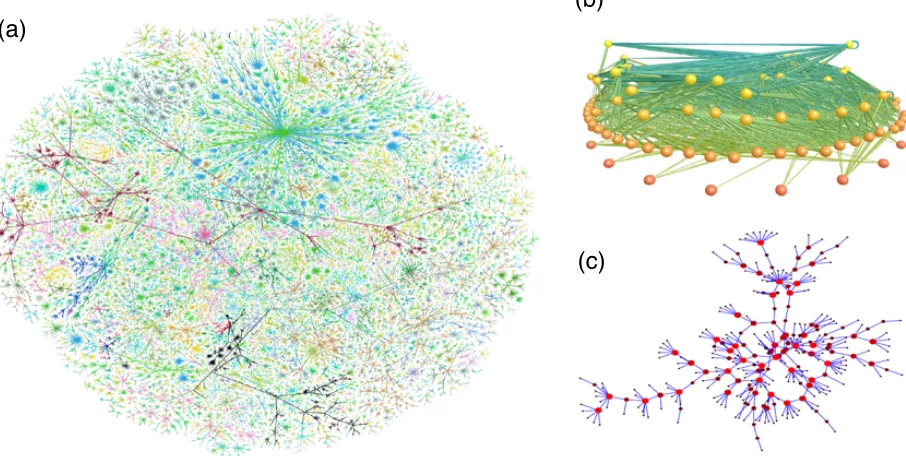
A significant problem with networks is data presentation. Even the most complex
physical structure can be presented with modern three-dimensional imaging
techniques as for example crystal structures of proteins. The most common way to
depict networks is a wiring diagram, which at a higher complexity turns into an
intricate tangle (Figure 2). Unfortunately, the higher the complexity of the system the
more interesting are its properties. The subtle long-distance connections across the
entire system are especially difficult to depict. The problem being that a change to
any single part of the network will have an effect on the whole system.
Figure 2. Examples of studied networks. (a) A visualisation of the network structure of the Internet. (b) A food web of predator-prey interactions between species in a freshwater lake. (c) A social network of sexual contacts. Figure taken from ref. 2.
Some other features of networks that make them inherently difficult to understand
include network evolution, which makes the diagram change over time. Again the
problem is too many interdependent variables that would have to be plotted against
time.
The most basic feature4 of any network is its architecture. A large number of nodes
represented on a two-dimensional plane can be connected in a number of ways. The
two extreme scenarios5
are either a regular network when neighbouring nodes are
connected in an orderly fashion or a totally random set of connections. However, like
with any assumptions the real life networks lie somewhere in between. The social or
biological networks are never fully ordered or fully random. There are several models
that try to define the transition state between random and ordered. One of them is a
small-world6
approach, in which not all nodes are neighbours, but most can be
reached from every other by a small number of hops or steps (Figure 3). (a)
(b)
Figure 3. Schematic representations of the regular, small-world and random networks.
This feature reflects the famous experiment7
by Milgram in the 1960s, which became
the basis for the six-degrees of separation theory, currently widely proven by
members of internet social networks e.g. Facebook. In theory, every person in a social network is connected to another person by maximum of six other people (often
referred to as six hand-shakes). This property exists to some extent as the result of
clustering which can be found in many networks. If node A is connected to node B
and node B to node C, then there is a heightened probability that A will also be
connected to C. In the language of social networks, the friend of your friend is also
likely to be your friend. This situation leads to some nodes having many more
connections than others, which is usually a feature of naturally occurring networks
and is defined as a scale-free8
property (Figure 4a). In such a system, the number of
connections per node ranges from a very large number for a small number of nodes
and relatively few for the rest. Such system displays the small-world properties as
well. These characteristics lead to the formation of a community structure9
in
networks (Figure 4b), in which network nodes are joined together in tightly knit
groups, between which there are only looser connections. The presence of
communities in networks is a signature of the hierarchical nature of complex
systems10
. Grouping nodes into communities is also one of the ways to simplify the
representation of the network and many ways to detect communities in a network are
being studied11-12
Figure 4. Complex network models. (a) A scale-free network with highly connected nodes (black). (b) A network with community structure of highly interlinked modules connected to each other by a few links.
A network of interacting proteins in living systems is sometimes called an
‘interactome’. The interactome possesses a scale-free topology with some proteins
interacting with a large number of partners. It has been shown13
that by a random
deletion of proteins in a model yeast system, the removal of the ‘hub’ proteins is
much more likely to lead to cell death than a removal of a peripheral protein.
1.3 The origin of life
Life is one of the most complex networks studied by man. The drive to understand
even the basic aspects of life is still a great challenge and comprehension of it as a
whole will most likely prove impossible. The emergence of life on Earth is a question
that has intrigued and challenged humans since the beginnings of science.
Understanding the innate complexity of living systems poses a series of important
questions, which will only be answered by a concerted effort involving chemistry,
biophysics, molecular biology, genetics, evolutionary research, geology, atmospheric
science and astronomy. All of these disciplines work at a different length scales,
ranging from single molecules to whole planet systems. Chemists are privileged to be
working at the very bottom of this ladder, at the most basic level that is closest to
life’s origin. Studying simple molecules that are capable of organising themselves into
more complex systems may bring us closer to understanding how non-living matter
transformed14-18 into living organisms (Figure 5). Since life is based on organic
compounds, the first issue is how did organic compounds appear on the early Earth.
However, this problem is not entirely relevant to a modern chemist. A major task is to
investigate how first cells emerged from these organic molecules and to define the
minimal requirements for a self-sustained chemical system capable of undergoing
Darwinian evolution, which is the definition of life proposed19
by the Exobiology
Program within NASA. This definition was used20 originally by Horowitz and Miller
and is considered as a general working definition by Luisi in his discussion21
on the
various definitions of life.14,15,16,17,18192021
Figure 5. Timeline of events pertaining to the early Earth, with approximate dates in billions of years before the present. Figure taken from ref. 47.
The search for the origin of life as a scientific research field, supported by solid
empirical experiment, dates back to the beginning of the 20th century with a small
tract published22
by Oparin. The progress in the field is driven by firstly understanding
the general principles of contemporary biological processes and then using these
observations to provide increasingly satisfactory explanations of life’s origin.
Chemical research in this area, however, has to be broadened, as we should not only
define life in its cellular form and how it came to be, but following Eschenmoser and
Kisakürek, we should consider23
that “the aim of an experimental aetiological
chemistry is not primarily to delineate the pathway along which our (natural) life on
Earth could have originated, but to provide decisive experimental evidence, through
the realisation of model systems that life can arise as a result of the organisation of
the organic matter”. This statement brings us towards the idea of artificial, engineered
life. Of course, the first attempts focus on creation of life in its minimal form. Two
different approaches exist. The first approach24-25 strips down an existing organism,
leaving behind only the necessary components needed to fulfil the definition of life.
This approach, however, still leaves hundreds of genes and thousands of different
monitor all of the basic life processes at molecular level. A second approach26-27
is to
gather the minimal amount of components needed for life inside a preassembled
compartment. This approach is more appealing to chemists as it relates to chemical
synthesis of complex, functional mixtures.
1.4 The RNA World
Before we can discuss the attempts to synthesise life, we have to identify the target
for this challenge. The target brings us back to the scenario of the early life on Earth.
One of the most popular theories is the so-called RNA World28-29.
The idea was
coined after the discovery that some RNA molecules, called ribozymes, possess30-32
catalytic properties and, thus, could have been33
the basis of life before DNA. For the
discovery34
of the enzymatic cleavage of RNA by RNA, Cech and Altman were
awarded the Nobel Prize in 1989. Ribozymes35 lack distinct functional groups, but
exhibit a strong potential to bind metal ions. It is postulated that in many cases the
presence of the specifically positioned metal ion is responsible for their catalytic
activity. 30,31,32333435
The hammerhead36
ribozyme (Figure 6), at ~40 nucleotides, is the smallest of the
naturally occurring ribozymes, and mediates replication within circular virus-like
RNAs that infect plants. Recent experiments show that the hammerhead motif is the
most efficient self-cleaving sequence that can be isolated from randomised pools of
RNA, suggesting that it may have arisen multiple times during the evolution of
functional RNA molecules37
. Consisting of three short helices connected at a
conserved sequence junction, the hammerhead catalyses site-specific cleavage of
one of its own phosphodiester bonds via nucleophilic attack of the adjacent 28-oxygen at the scissile phosphate. Divalent metal ions have been identified in the
structure of the hammerhead, but their role in the catalysis is still unclear. The same
phosphodiester transfer reaction is also catalysed by the hepatitis delta virus
ribozyme as well as the hairpin ribozyme, but ribozymes obtained through in vitro
selection techniques were found to catalyse a number of other reactions. These
ribozymes were identified to form38
a nucleotide from a base plus a sugar,
synthesise39-40
amide bonds, form41
Michael adducts such as those involved in the
methylation of uridine monophosphate to give thymidine monophosphate, and form42
Figure 6. (a) Secondary structure of the hammerhead ribozyme. Nucleotides important for catalytic activity are indicated; the cleavage site is indicated by a star. (b) Crystal structure of the hammerhead ribozyme. Figure adapted from ref. 30.
In the RNA World, RNA served as both the coding material and an enzyme-like
catalyst, probably assisted later on by metal ions, amino acids and other small
molecule cofactors. This scenario43-44 allows for replication without protein-based
enzymes. In the RNA World the first stage of evolution occurred when RNA
molecules, by performing their catalytic activities, assembled themselves from a
nucleotide soup. Next, they evolved in a self-replicating fashion and by recombination
and mutation gained new catalytic functions. The hypothesis45
states that as cellular
metabolism became more sophisticated there was an increasing demand for
biocatalysts providing the drive for the transition to protein-based enzymes.
Protein-based enzymes were templated by RNA and carried the same catalytic
properties as RNA only performed more efficiently, which led to the overtaking of the
ribozyme function by more complex proteins. Like all theories about the origin of life,
this one also has its drawbacks46. There is good evidence to suggest an RNA-based
life in the early stages of the development of Earth, but it is hard to believe that there
were no evolutionary processes, which operated before the emergence of RNA. The
problem of a spontaneous synthesis of RNA on early Earth is the same that every
chemist struggles with in the laboratory everyday. It is the problem of mixtures and
how to obtain the one single desired product out of them. Each of the components of
RNA would have been surrounded by several closely related analogues, which could
assemble in almost any combination. The question asked47
is how RNA emerged
from the ‘primordial soup’ and how it was possible to devise a self-replicating
mechanism that would operate independently from all other byproducts48 present in
the early Earth medium.
Pentose sugars such as ribose are a necessary component of nucleic acids, but it is
still unclear how ribose could have been specifically selected from the mixture of
sugars produced by the formose reaction, especially that ribose constitutes for less
than 1% of the reaction products. For example, the prebiotic synthesis of sugars from
formaldehyde can be biased by starting from glycoaldehyde phosphate, leading49
to
ribose 2,4-diphosphate as the predominant pentose sugar. Eschenmoser
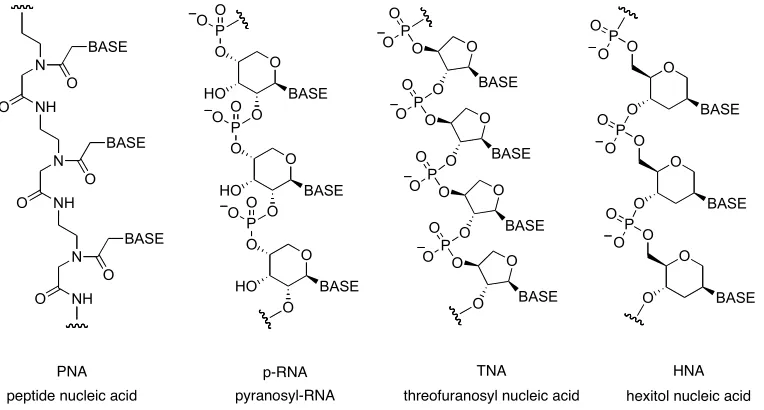
conducted50-52
an extensive study on RNA alternatives (Figure 7). The target was to
synthesise structures based on Watson-Crick base pairs53, but with different sugar
backbones and study their properties compared to naturally occurring RNA. It
became apparent that base pairing is not unique just for RNA and is not specific for
the double helix type of conformation. Also, RNA does not display the strongest
strand association, so it cannot be the feature that made ribose backboned polymers
the basis of modern life. For example pyranosyl-RNA displays higher base-pairing
strength than natural furanosyl-RNA. The research disqualified hexose-nucleic acids
as potential natural alternatives for pentose-based structures as the bulk of the
monomer unit disables the base-pairing. 50,51,52
53 N NH O O BASE N NH O O BASE N NH O O BASE O O HO O BASE P O O O O HO O BASE P O O O O HO O BASE P O O O O O BASE P O O O O O BASE P O O O O O BASE P O O O O O BASE P O O O O BASE O P O O O O BASE O P O O O O BASE O P O O
PNA p-RNA TNA HNA
[image:19.595.123.505.445.650.2]peptide nucleic acid pyranosyl-RNA threofuranosyl nucleic acid hexitol nucleic acid
Figure 7. Examples of nucleic acid analogues, which form stable base-pair duplexes.
Since the publication54 by Oro purines and pyrimidines are usually considered55
products of hydrogen cyanide condensation (Figure 8), but an entirely plausible
prebiotic route to polynucleotides has not yet been proposed. The main problem
way how such molecules could have emerged form a ‘primordial soup’. All of the
subunits would have to accumulate in sufficient amounts in the same time and space.
For example, prebiotic synthesis of purines and pyrimidines are clearly incompatible56
with those proposed for the synthesis of ribose. Prebiotic synthesis of nucleic acids is
improbable57 when considering a spontaneous assembly of all the necessary
components from a mixture of random clutter without any influence of catalysts.
HC N N C C
H NH
HC N
2 N C C C
NH2
H
N C C C
NH2
H HN
NH H2N
NH2 NH
N C
H2N NH2 HN
N N NH
N NH2 HC N
NH3
NH3
[image:20.595.96.530.211.348.2]C NH2 HN H 2 NH3 2 + 2 2 2 + HC N 5 adenine overall reaction NH3 2 +
Figure 8. Mechanism of formation of adenine from hydrogen cyanide.
One of the popular theories considers the involvement58
of natural clays as catalysts
for the polymerisation reaction and some theories consider59 clays as pre-RNA
inorganic genetic material. Ferris conducted60-61
an extensive survey on
polymerisation reactions of activated RNA monomers. Using montmorillonite clay it
was possible to synthesise 40-mer nucleotides. The size is comparable to the
hammerhead ribozyme and so the oligomer is long enough to carry catalytic
properties. The chemistry involved an activated RNA monomer that was allowed to
adsorb onto the clay and after one to three days a whole array of polynucleotides
was obtained. In addition, the linking regiochemistry is predominantly the correct 5’ to
3’ linkage and not the incorrect 5’ to 2’ linkage, which characterises the major product
in the absence of any template.
This synthetic route is very attractive partly because of the ready availability of the
catalyst, however, the clay used for the experiments was significantly different from
the native mineral found in Nature. The purification of montmorillonite for laboratory
use greatly enhances its catalytic properties making the polymerisation process
much more efficient than it would have been in the early Earth environment. The
second issue is the availability of activated monomers in the prebiotic scenario, as
containing a high-energy bond.
In the polynucleotides responsible for the structure of nucleic acids all ribose is in the
D-ribose configuration. This asymmetry indicates that at some point chirally pure
nucleic acid chains had to be synthesised. Selecting ribose over other sugars is
statistically very improbable and selecting only one of its enantiomers is even less
plausible. Orgel and coworkers gave62
an insight into a possible mechanism of such
‘symmetry breaking’. Orgel studied template-directed synthesis of poly(G) by poly(C).
When poly(D-C) was used as a template for enantiomerically pure D-guanosine
5’-phospho-2-methylimidazole (D-2-MeImpG) the reaction outcome were 3’,5’-linked
oligo(G)s ranging from dimers up to 30-mers. Far less efficient process was observed
when the same template was used to direct the formation from a racemic mixture of
monomers. No product greater than an octamer was observed. First of all the
(L-2-MeImpG) was incorporated less readily than the D-form and secondly once it was
incorporated into the chain it acted as an inhibitor for further elongation. The
cross-inhibition results when the incorporation of the D-monomer forces the base into a syn
conformation changing the orientation of the sugar-phosphate component in relation
to the template disabling the addition of the next monomer. This behaviour could
explain the favourable synthesis of only one of the enantiomers of the nucleic acids.
Even though life’s origin dates back billions of years, the ongoing debate about the
issues of the transformation of organic matter into life is still raging supported by
modern experimental chemistry.
1.5 Simple molecules and the metabolism-first scenario
The ideas concerning the origin of life can be divided into two major trends. The
vision of RNA with its self-replicating properties as being central to the emergence of
life falls into the ‘replication first’63
category. There is, however, an alternative
approach. It is the concept that small molecule interactions were64 central to the
origin of life. Simple organic molecules are more likely to have created a primitive
metabolism hence this idea is termed ‘metabolism-first’65
scenario. Dyson using a
purely hypothetical model suggested66
that complexity is the real key to the origin of
life. Given sufficient complexity, Dyson argues that the system must ‘crystallise’ into a
set of mutually catalytic molecules that possess the property of ‘closure’. Closure
The sequence of chemical reactions where any product is the same as a substrate of
some preceding step is often termed67 a hypercycle. The compounds involved in a
hypercycle are usually connected by cross catalysis and some or all of them display
autocatalytic behaviour. The cycle as a whole can also be viewed as being catalytic
since all of the components are utilised and subsequently returned to the system with
every turn of the cycle. The hypercycle can be found in the basic functions of life
such as the citric acid cycle or the replication of single-stranded RNA. Hypercycles
are a principle of natural self-organisation allowing an integration and coherent
evolution of a set of functionally coupled self-replicating entities. Hypercyclic
organisation68
is a minimal requirement to guarantee the evolution of a translational
apparatus. Primitive entities capable of replication would be most likely ineffective
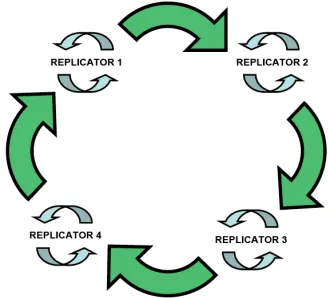
and error-prone. The simplest way to enhance their performance is to assemble the
self-replicators into a hypercycle (Figure 9). The replicators would not only catalyse
[image:22.595.229.393.370.519.2]their own formation but also the next species in the cycle.
Figure 9. Schematic representation of a hypercycle of replicators.
Through such network no replicator could exclude another. The aid given by one
entity to the next would ultimately be fed back to itself through the cycle. This
catalytic relationship would lead to the promotion of the best replicators and
evolution. The encapsulation of the hypercycle into compartments would lead to the
development of cells and competition between them.
This idea was extended69
by Shapiro who claimed that for a mixture of simple organic
compounds to evolve in the direction of life it would be necessary for the network to
develop processes of self-organisation. The hierarchy in the mixture would be
enhancement of concentration is established at the expense of other members of the
mixture or by synthesis from external substrates. Since the products of given
reactions in the cycle are also catalysts for other pathways, a rise in abundance of
one of the members in the mixture can influence another part of the cycle. Certainly
to drive the catalytic cycles of the system an external source of free energy is
necessary to counter the overall negative entropy of the process. Although all the
reactions in the metabolism scheme are reversible, it is possible for an irreversible
‘driver’ reaction that is coupled to an energy source transmitting energy into the cycle.
Even though in this theory metabolism developed before the emergence of molecules
capable of storing genetic information, it is still possible for the mixture to carry
heredity information that would be represented by the identity and concentration of its
components. All these properties can be accumulated in a term ‘compositional
genome’70
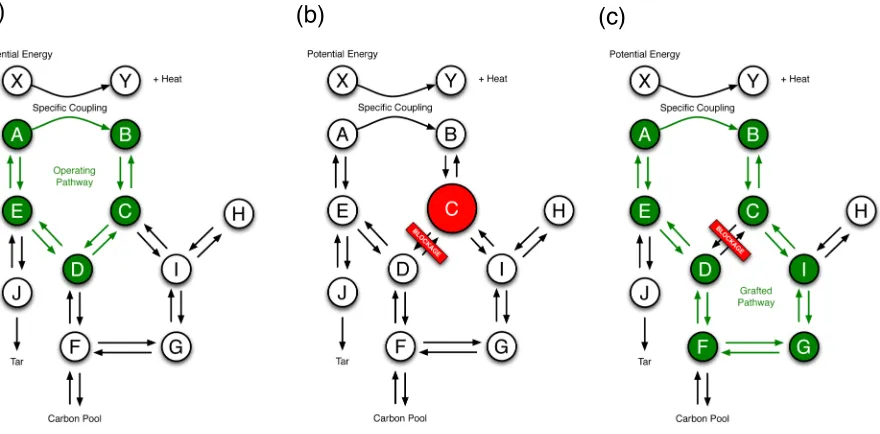
. The system, because of its hypercyclic topology (Figure 10) is able to
adapt to the changes in the environment. If by some natural ‘disaster’ one of the
paths is blocked, the system is capable of finding a way around the blockage.
Evolution of the system proceeds through such circumstances, where new pathways
are grafted71
onto the system and new catalytic interactions can form as a response
to the outside stimuli. Grafting refers to a mechanism of evolution in which two
previously independent autocatalytic systems symbiotically interact in a manner that
[image:23.595.97.537.495.712.2]increases the growth rate of both and leads to their mutual interdependence.
Figure 10. (a) A hypothetical system of simple organic molecules with a hypercyclic operating pathway. (b) A blockage of the C-D connection by a ‘natural disaster’ results in an accumulation of C. (c) The accumulation of C induces a new grafted pathway in order to bypass the blockage.
Through such behaviour, evolution could have started in a world containing no
instructional and catalytic polymers and subsequently lead to the formation of
biomolecules that are the basis of life as we know today. Of course, we probably will
never be able to comprehend and understand the entire network of interconnected
metabolic pathways that formed the prebiotic system, although the research into
complex systems is becoming an important part of many scientific disciplines.
1.6 Attempts in synthesising life
Cellular life72
cannot be described in terms of only RNA or any other
information-carrying polymer nor as metabolism or as compartment alone. Cellular life emerges
from the coupling among these three components. A container is necessary in order
to at least confine reactions in a limited space, where interactions are more likely to
occur73. It also provides a spatial location able to effectively facilitate division of
function between the cellular processes. Moreover, in modern cells, the membrane is
an active cell component74
, channelling nutrients in and waste products out of the cell
by means of specialised transport catalysts. A metabolism provides75
the source of
non-equilibrium and a means of energy storage required in order to build and
maintain cellular components. It is also required to allow cell growth76 to occur and
eventually replication into two different but similar copies.
The main component of a basic synthetic protocell77-78
would be an RNA molecule
that can act both as a template for the storage and transmission of genetic
information, and as an RNA polymerase that can replicate its own sequence. This
process has to take place in a compartment, because by keeping molecules that are
closely related together and disabling free mixing, advantageous mutations can lead
to preferential replication. This difference would lead to the formation of
compartments containing more efficient mutants than the original molecules giving
them advantage needed for evolution. The research79-81 towards synthesising an RNA
strand that would meet such requirements is developing quickly, however, it is a goal
still to be reached. 79,80,81
Modern cells base their compartmentalisation on lipid membranes and it would only
be sensible to try to incorporate such assemblies into artificial cells. It has been
proven such vesicles can self-assemble, which is a big advantage in synthetic
properties, including spontaneous growth and division. The specific membrane
structures proposed for the purpose of life synthesis are micelles, which are bilayer
vesicles82
. Such micelles have been shown83-85
to be able to self-replicate once their
growth becomes thermodynamically unstable when they reach a certain size.83,84,85
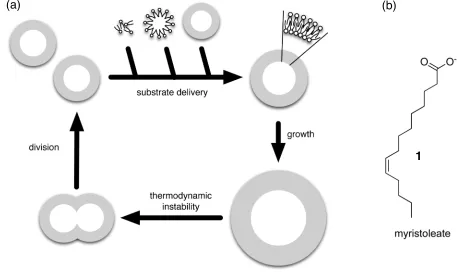
Szostak and coworkers proved86 experimentally that vesicles could grow and
replicate (Figure 11). Vesicles formed by fatty acids in water undergo87
spontaneous
assembly and growth. Szostak used myristoleate 1 vesicles adding dilute fatty acid
micelles to preformed vesicles slowly, over a 4 hour period. The reason behind using
high dilution was that vesicle growth could be enhanced and the formation of new
vesicles reduced by eliminating the transiently high micelle concentration present
immediately after micelle addition to vesicles. Examination of an initial population of
myristoleate vesicles, prepared by extrusion through 100 nm pore filters, revealed an
average diameter of approximately 90 nm. Slow addition of one equivalent of
myristoleate micelles resulted in a steady increase in average vesicle size, up to a
final mean diameter of 130 nm, consistent with quantitative incorporation of the new
myristoleate into the preformed vesicles and leading to a doubling of surface area.
The division of the vesicles was induced by extrusion through small-pore
polycarbonate membrane filters. 100 nm myristoleate vesicles, encapsulating 20 mM
calcein dye, were grown to 140 nm and then extruded through the pores to a final
mean size of 88 nm. The loss of the dye from inside of the vesicle was only slightly
greater than that demanded by the geometric constraints due to reduction in size.
This experiment proved vesicles could divide when subjected to mechanical stress,
Figure 11. (a) Modes of vesicle growth and division. Self-replicating membrane vesicles can grow when supplied with appropriate substrates and may divide either spontaneously or under the influence of external forces. (b) Structure of fatty acid cation, myristoleate 1 used by Szostak to create self-replicating vesicles.
The membrane used for creating an artificial cell should also allow for small
molecules to pass freely, while keeping the macromolecules encapsulated allowing
for a primitive feed. A further requirement for such system to be termed living is the
necessity for both replicating cycles, the ribozyme cycle and the membrane cycle, to
operate independently. Once this characteristic is achieved, the protocells can start
competing88
with each other and evolving in a way that neither of its components is
capable on its own. This feature is one of the characteristics of complex interacting
systems that are often targets of modern synthetic chemistry.
1.7 Nanotechnology
From the examples above we can clearly see that the search for the origin of life
leads us to investigate how organic matter is able to organise itself and through that
organisation develop new properties. This idea is also the theme89
for
nanotechnology, whose development is often related90 to the origin of life research.
According91
to Drexler the goal of nanotechnology is a self-replicating, programmable
architecture capable of atom-by-atom manipulation of both biological and
1
non-biological matter. Since Nature was able to create life by such an approach,
nanotechnology is believed to be a very powerful strategy for the creation of
machines and devices. The idea stirs up both enthusiasm and fear, since
nanotechnology is expected, for good and bad, to strongly influence92
the future of
mankind.
As in the search for the minimal life, there are two different approaches to
miniaturisation: the top-down and the bottom-up approach. The top-down approach is
the current technology of the electronics industry, which is able to manipulate
increasingly smaller pieces of matter by lithography and related techniques. It is now
apparent that the top-down approach is subject to limitations93-94
for dimensions
smaller than 50 nm. This gap is still very large on the scale of atoms and molecules.
Therefore, quoting95
Feynman, “there is still plenty of room at the bottom” for further
miniaturisation. The answer to closing the gap is the bottom-up approach, analogous
to creating a protocell from the basic components necessary for life, the idea is to use
atoms and molecules to build up to nanostructures. The ideal paradigm for the
bottom-up approach is self-assembly. In order for structures to self-assemble, shape,
proportions and properties of the final, desired structure are encoded in the
molecules used. Nature offers96
countless examples of functional self-assembly that
stimulate scientists to design artificial, non-living systems.
The term nanotechnology is used to describe97
phenomena in many areas of
chemistry. Organic chemists contribute mostly in the area of molecular devices89-101
.
This term describes organising organic molecules in complex functional manner for
the synthesis102-103
of molecular motors and machines. A major goal of this research
is to harness molecular motion, which use is widely spread in Nature. The targets are
mechanically interlocked molecules like catenanes104
and rotaxanes105
(Figure 12),
which allow for utilising the translational or rotational motion of their components.
Figure 12. Schematic representation of (a) [2]catenane and (b) [2]rotaxane. Arrows show possible large-amplitude modes of movement for one component relative to another.
The rotaxane has proven to have the biggest potential when it came to displaying
function. The nanodevices based on rotaxane topology include molecular
shuttles106-108, elevators109 and muscles110-111.106,107,108109110,111
The ability to manipulate single molecules by modern techniques is outstanding. The
tools to do so are again borrowed from Nature. The assembly is guided in most
cases either by donor-acceptor interactions between π-systems, hydrogen bonds or
metal-ligand interactions.
Stoddart’s pioneering work on the assembly112-113 of mechanically interlocked
molecules such as rotaxanes and catenanes was based on bipyridinium herbicide
paraquat as the electron acceptor. Two bipyridinium motifs were incorporated into a
macrocycle in order to create a π-electron deficient host. Guests that can be bound
into the rigid rectangular cavity include catechol and hydroquinone ethers114
,
1,5-dioxynaphthalene derivatives115, aromatic aminoacids116 and similar π-electron
rich structures. This methodology led Stoddart and coworkers to develop117-119
an
astounding array of molecular machines and supramolecular structures and devices
such as switches. A rotaxane by definition consists of a macrocycle threaded onto a
dumbbell shaped linear molecule. The bulky stoppers at the ends of the thread
prevent the macrocycle from dissociating from it creating a mechanical bond. Even
though in order to disassemble the rotaxane it is necessary to break a covalent bond
it is possible for the macrocycle to shift freely along the thread. It is possible to design
the thread in such a way that there would be two recognition sites for the macrocycle
making it possible that in a given set of conditions the ring will sit either on one
station or the other. In this particular case (Figure 13) the two sites are a benzidine
and a biphenol ring systems. The solution of the rotaxane 2a in acetonitrile when
analysed with 1
H NMR spectroscopy shows the macrocycle is associated
preferentially with the benzidine unit in an 84:16 ratio. This selectivity is due to a
higher affinity of the tetracationic cyclophane to the benzidine. The addition of
CF3COOD to the solution protonates the benzidine, which results in a repulsion of the
positively charged macrocycle from the now positively charged benzidine. The
analysis of the acidified solution reveals an exclusive population of rotaxanes with the
biphenol group inside the macrocycle cavity. The addition of pyridine to the solution
deprotonates the benzidine and reverts the system to the original equilibrium. 117,118,119
Si O O O HN NH O O O O O O O Si
N+ N+
N+
N+
Si O O O N+ N+ O O O O O O O Si
N+ N+
N+
N+
CF3COOD C5D5N
D H D
H
Figure 13. The shuttling of the macrocycle along the dumbbell-shaped thread is controlled by protonating\deprotonating the benzidine unit.
Leigh synthesised120
one of the first catenanes 5, self-assembled from commercially
available substrates 3 and 4 (Figure 14). The condensation of eight molecules into an
interlocked structure was driven purely by hydrogen bond recognition giving a 20%
yield in one step.
NH O
NH
O HN O
HN O NH O
NH
O HN O
HN O O
Cl
O Cl
NH2 H2N
[image:29.595.93.527.277.506.2]4 + 4
Figure 14. One step, eight-molecule condensation to give the [2]catenane 5.
2a
2b
3 4
Catenanes can be used as devices when it is possible to control their rotational
motion. For example, the behaviour of a [2]catenane 6 (Figure 15) with a similar
structure to the one described above can be altered with change of solvent. In
halogenated solvents such as CDCl3, the two macrocycles interact through hydrogen
bonds. Each of the identical rings adopts a different conformation, one effectively
acting as the host and the other as the guest. In a hydrogen-bond-disrupting solvent
such as [D6]DMSO, the preferred conformation has the amides exposed on the
surface where they can interact with the solvent, while the hydrophobic alkyl chains
are shielded inside the molecule to avoid the polar solvent. Such system can be
considered as a solvent sensitive switch.
H N O
HN O
NH O
NH
O O
O
O
O
HN O HN
O O
O O O N
O
N O
O
O
O
O O
O O O
H
H CDCl3
[D6]DMSO
Figure 15. Translational isomerism in an amphiphilic benzylic amide [2]catenane 6.
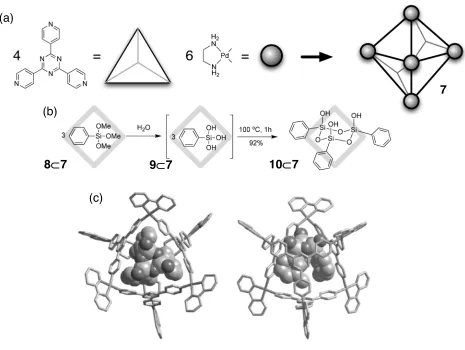
Some of the most outstanding examples of self-assembled structures come from the
laboratory of Fujita. Using multicomponent metal-ligand self-assembly it was
possible121,122 to create discreet 3-D hollow structures such as cages, cones,
capsules and boxes. The edges of the structures are designed rigid organic
compounds while the corners are metal atoms with specific coordination angles that
govern the overall geometry. The cages have various shapes with either triangular or
square sides. The structures obtained with this methodology are of exceptional size
with cavities large enough to act as molecular flasks to encapsulate guest molecules
and regulate or promote specific reactions (Figure 16).
Figure 16. A self-assembled coordination cage 7. (a) Synthesis scheme. (b) Synthesis of a siloxane trimer 10 inside the coordination cage 7. (c) Crystal structure of the siloxane trimer 10
trapped inside the cage 7. Figure adapted from ref. 125.
A coordination cage provides an isolated nanospace for molecules, where otherwise
labile species can be considerably stabilised in the protection of the cage. The
products are trapped most effectively and stabilised in a cage if they are prepared in situ from smaller components coming through the openings of the cage. The authors succeeded123-124
in preparing a labile siloxane trimer 10 as a stable form in the
self-assembled cage cavity 7. When the condensation reaction of
phenyltrialoxysilane 9 was carried out in the presence of the cage 7, cyclic trimer 10
was formed within the cavity in 92% isolated yield. In this reaction, three molecules
per cage were hydrolysed and subsequently condensed to form a trimer.
The substrates 8 for the reaction are small enough to enter into the cage but the
product 10 however, being larger, cannot escape the cage. Fujita compares this
synthesis to assembling a ship inside a bottle. Other reactions performed inside this
type of cages include125
photochemical oxidation of alkanes and [2+2] intermolecular
photodimerisation of olefins.
8⊂7 9⊂7 10⊂7
7
(a)
(b)
These examples show how, from a mixture of simple compounds under the right
conditions, very complex structures can spontaneously emerge. Over the last 20
years, creating more and more complex structures has been the target of
supramolecular chemistry. The idea of the ‘chemistry beyond the molecule’126
focuses on the interactions that involve non-covalent bonds and recognition and try to
encode the properties into the assembly, again trying to mimic Nature. The plethora
of examples shows how chemists embrace multi-component complex systems. This
idea led to combining these efforts under a common umbrella, leading to the
emergence of systems chemistry.
1.8 Systems chemistry
The fields of sociology and biology have given rise127 to the greatest weight of
publications concerning complex networks. Chemistry is often omitted in the field of
complexity and chemists themselves have a history of considering complex mixtures
as an unwanted necessity of their research. Synthetic chemists focused mostly on
devising single transformations that produce a desired compound with given
properties selectively. In such approaches mixtures of compounds are undesired and
need to be eliminated with various purification techniques. This situation is no longer
the case, since an insight128
into complex networks has been made possible by the
development of advanced analytical methods. The definition of complexity given129
by
Whitesides is that such a system is characterised by a high sensitivity to initial
conditions and any small changes in the environment. It also must consist of a large
number of independent interacting components and multiple pathways through which
these components might evolve.
The term ‘systems chemistry’ was first used130
in 2005 by von Kiedrowski in his paper
describing the kinetic and computational analysis of a nearly exponential organic
replicator. In this paper, von Kiedrowski claims new research “could open a door to a
field that may be termed systems chemistry, namely, the design of prespecified
dynamic behaviour”. In the same year, a systems chemistry workshop was held131
in
Italy where a more detailed definition was given describing systems chemistry as
“a new field of chemistry seen as the offspring of prebiotic and supramolecular
chemistry on the one hand and theoretical biology and complex systems research on
and incorporating them into ordered systems with emergent nonlinear properties. The
property of the system results from the interactions of its components and is not just
a simple sum of the properties of the mixture members in isolation. It should also be
possible to derive from the information collected from the system the individual
properties of the components simultaneously, providing one can find a way to
deconvolute such data.
Systems chemistry rather than a totally new area of chemistry is a title under which a
few already quite well established branches of chemistry can cooperate. Otto132
focuses mostly on the role of dynamic combinatorial chemistry (DCC) as being
central to developing complex systems, while von Kiedrowski130
strongly emphasises
the role of self-replicating autocatalytic cycles, both of which will be discussed further.
Other areas of development include molecular logic, oscillating reactions,
self-assembly and self-sorting processes. It seems that the mixture of different
approaches to systems chemistry is as complex as the systems it sets out to
describe. In my opinion, systems chemistry should focus on the emergent properties
of systems of distinctly interconnected species. The systems should be designed in
such a way as to direct the behaviour of the system with simple chemical inputs.
1.9 Dynamic combinatorial chemistry
Dynamic combinatorial chemistry133-135
is defined as combinatorial chemistry under
thermodynamic control. The objects of investigation in DCC are dynamic
combinatorial libraries (DCLs), which are currently considered a starting point for the
development of systems chemistry. A DCL is a mixture of compounds that
continuously interchange their subunits, resulting in a distribution of products, which
is thermodynamically controlled. A change of stability of one member will influence
other members, so the final equilibrium distribution is derived from the sum of the
stabilities of all species in a library. This property means that DCLs are addressable,
making them an interesting target for complex system research. 133,134,135
The first application that stood behind the development of DCC was drug
discovery136
. This area has emerged from combinatorial chemistry137-140
in which a
large static population of different compounds was synthesised using divergent
methods. The aim was to produce a library with as high structural diversity as
bioactivity or specific catalysis. Generation by synthetic methods of such large
libraries has its limitations, so it was only logical to find a new approach to introduce
diversity and complexity in a mixture. 137,138,139,140
Lehn discusses141
the transition from static libraries to dynamic ones introducing a
term virtual libraries. According to him, since all combinations of interchanging
compounds are possible even if some are not present in the pool, it makes the
assembly virtual. The term however did not come into general use and such systems
are commonly described as dynamic combinatorial libraries.
The first necessary condition to create a DCL is to find an appropriate reversible
connection process (Figure 17). The bond formed and broken can be both of
covalent and non-covalent nature. Dynamic covalent chemistry142
is a term often
used to describe the first case. The reaction used in a DCL has to meet a number of
requirements. Firstly, it has to be reversible on a reasonable time scale in the given
experimental conditions. Also it cannot interfere with other processes that the library
is subjected to. An interesting property that could be designed into the library is the
possibility of ‘freezing’ the exchange. If the reversible processes are stopped it would
be possible to analyse, separate and handle the library members without fear of their
R1 O O
R2
R3 O O
R4
R1 O O
R4
R3 O O
R2
R1 O O
R3 O O
R4 R2
base
Pd(0)
R1 O O
R3 O O
R2 R4
R1 N H O
R2
R3 N H O
R4
R1 N H O
R4
R3 N H O
R2 protease
or metal
R1 S O
R2
R3 SH
R1 S O
R3 base
R1 R2 O
R3SH base
R1 R2 O S R3
RO OR
R1 R2
R'O OR'
R3 R4
R'O OR'
R1 R2 RO OR
R3 R4 acid
RS SR
R1 R2
R'S SR'
R3 R4
R'S SR'
R1 R2 RS SR
R3 R4 acid
R1 N R2 R3 N R4 acid R1 N R4 R3 N R2
R1 N H N
R2 R3 N H N
R4 acid
R1 N H N
R4 R3 N H N
R2
R1 N O R2 R3 N O R4 acid
R1 N O R4 R3 N O R2
R1 R2 R3 R4
Grubbs catalyst
R1 R4 R3 R2
R1
R2 R3
R4
Mo
catalyst R1 R4
R3
R2
R1S S R2 R3S S R4 RS R1S S R4 R3S S R2
-R2 R1
R3 R3 R4
R4 R2
R1 R3
R4
R3 R4 acyl transfer reactions
acetal exchange
C=N exchange
other reversible covalent bonds transesterification transallylesterification transamidation transthioesterification Michael/retro-Michael reaction acetal exchange thiacetal exchange transimination hydrazone exchange oxime exchange alkene metathesis alkyne metathesis disulfide exchange Diels-Alder/ retro-Diels-Alder reaction
[image:35.595.85.524.67.707.2]R2 SH
The chemistry of the reversible covalent bond has many examples. The kinetics of
the formation of the covalent bond is generally slower than that of the non-covalent
bond since covalent bonds are much stronger. In order to form an exchanging library
it is often necessary to make use of catalysts that enable the process to occur on a
reasonable time scale. Sometimes the removal of the catalyst is a convenient way to
‘freeze’ the reaction. One of the properties of the bond is its symmetry (Figure 18).
Library design will change depending if bond-forming reactive groups are the same or
different. The symmetry of the bond dictates whether the building blocks will
self-oligomerise or only form alternate sequences. The symmetrical bond forms
larger libraries, but the unsymmetrical bond offers greater control over the structure
of the library members.
Figure 18. Schemes of dynamic combinatorial libraries created using (a) a symmetrical bond and (b) unsymmetrical bond, with reaction examples.
Examples of symmetrical bonds include disulfide bridges and alkene double bonds
formed in the metathesis reaction. The disulfide exchange143
reaction is of
considerable interest since it plays an important role in the folding144
of proteins. The
mechanism consists of one thiolate anion displacing another one from the disulfate.
Thiols can be readily oxidised to disulfides in the presence of air. Exchange between
disulfides145 can be easily initiated and is relatively quick in the presence of a catalytic
amount of thiol under neutral or mildly basic conditions. The advantage of using
neutral conditions is that the exchange is compatible with the presence of
biomolecules.
A whole family of exchange reactions involves the carbonyl group. The carbonyl
bonds are non-symmetrical and relatively labile, being broken reversibly when an
electronegative atom is adjacent to the reactive group. Esterification, for example, is
a reversible reaction and when synthesising esters the equilibrium is usually shifted
towards the condensation products by introducing an excess of one of the substrates
or by removing water from the reaction mixture. Achieving efficient ester exchange

![Figure 14. One step, eight-molecule condensation to give the [2]catenane 5.](https://thumb-us.123doks.com/thumbv2/123dok_us/8682122.378454/29.595.93.527.277.506/figure-step-molecule-condensation-catenane.webp)