University of Warwick institutional repository: http://go.warwick.ac.uk/wrap
This paper is made available online in accordance with
publisher policies. Please scroll down to view the document
itself. Please refer to the repository record for this item and our
policy information available from the repository home page for
further information.
To see the final version of this paper please visit the publisher’s website.
Access to the published version may require a subscription.
Author(s): Ma Li and R.C. Staunton
Article Title: Optimum Gabor filter design and local binary patterns for
texture segmentation
Year of publication: 2008
Link to published article:
http://dx.doi.org/10.1016/j.patrec.2007.12.001
Publisher statement: “NOTICE: this is the author’s version of a work
that was accepted for publication in Pattern Recognition Letters.
Changes resulting from the publishing process, such as peer review,
editing, corrections, structural formatting, and other quality control
mechanisms may not be reflected in this document. Changes may
have been made to this work since it was submitted for publication. A
definitive version was subsequently published in Pattern Recognition
Letters, [VOL29, ISSUE5, April2008, DOI:
OPTIMUM GABOR FILTER DESIGN AND LOCAL BINARY
PATTERNS FOR TEXTURE SEGMENTATION
Ma Li1 and R. C. Staunton2
1
School of Automation, Hangzhou Dianzi University, Hangzhou 310018, P.R. China,
2
School of Engineering, University of Warwick, Coventry CV4 7AL, UK, [email protected]
Corresponding author: R.C. Staunton. Phone: +44 2476 523980, Fax: +44 2476 418922
This paper was published in the Journal: Pattern Recognition Letters. The full reference is:-
Ma Li and R. C. Staunton, (2008)
Optimum Gabor Filter Design and Local Binary Patterns
for Texture Segmentation.
Pattern Recognition Letters, Vol. 29 (No. 4). pp. 664-672.
ABSTRACT
We present a novel approach to multi-texture image segmentation based on the formation of an effective texture feature vector. Texture sub-features are derived from the output of an optimized Gabor filter. The filter’s parameters are selected by an immune genetic algorithm, which aims at maximizing the discrimination between the multi-textured regions. Next the texture features are integrated with a local binary pattern, to form an effective texture descriptor with low computational cost, which overcomes the weakness of the single frequency output component of the filter. Finally, a K-nearest neighbor classifier is used to effect the multi-texture segmentation. The integration of the optimum Gabor filter and local binary pattern methods provide a novel solution to the task. Experimental results demonstrate the effectiveness of the proposed approach.
Keywords: Texture segmentation, Gabor filter, Local binary pattern, K-nearest neighbor, Immune
genetic algorithm.
1. INTRODUCTION
meaningful regions based on the surface textures of objects. Mathematically modeling image textures for the segmentation problem is very difficult as the textures are usually characterized by two-dimensional variations in intensity.
In the past decade, both Gabor filters and local binary patterns (LBP) have been separately recognized as texture detectors with good performance as shown by Ojala et al., (2002) , Topi et al. (2000) and Wu et al., (2001) . The former has optimal join localization both in the spatial and frequency domains, while the latter is widely used as a non-parametric statistical texture indicator. In recent years the filter-design approach to texture segmentation has been introduced in an effort to reduce the computational complexities of the previous filter-bank approaches as shown in Yang et al., (2003). Classifiers utilizing the wavelet and Fourier domains have also been researched that provide good discrimination between textures (see for example, Choi et al., 1999). However the proposed approach is to effectively combine what we will describe below as macro-features detected with the Gabor filter with micro-features from the LBP.
There has been much research into optimum Gabor filter design by genetic algorithm (GA) and by simulated annealing (SA). For example, see Tsai et al. (2001), but both have problems such as premature convergence to local minima, and both require substantive iterations. Recently, biological immune system models have been introduced into the traditional GA to enhance its evolutionary performance as demonstrated by Chen and Zhang (2004). In our approach, we have used the immune genetic algorithm (IGA) to effectively tackle the issue of premature convergence by utilizing its ability to maintain concentration and diversity as demonstrated by Li et al. (2005). It has been shown that a single optimized Gabor filter can be a highly effective discriminator for separating multi-textured images. However it has also been shown by Tsai et al. (2001), that performance degrades with an increasing number of texture classes within the image. In order to improve the segmentation performance, we have employed the LBP operator described by Topi et al. (2000) as a complementary tool to extract texture features from the Gabor filtered textured images. Finally our proposed approach uses a K-nearest neighbor (K-NN) classification to select and bound the individually textured regions. Our results have shown that the proposed combined classifier enabled a better discrimination between textures than either of the previous classifiers operating individually, and that it has worked well for a larger number of differently textured segments within the image.
The novelty of the proposed method concerns two aspects: (1) we use an IGA with affinity and diversity estimation to search for the optimum Gabor filter. This enabled the filter parameters to not only be found more quickly, but also with a reduced possibility of the selection process being stuck in a local minimum at the conclusion of the analysis, which would result in a sub-optimal filter being designed and (2) we use the combined texture features from a LBP statistical histogram and the averaged intensity output images from the optimized Gabor filter as features for a further K-NN classification. In the proposed method, the IGA based Gabor filter parameter search is implemented as a pre-processing stage that results in strong responses to individual texture patterns. The K-NN classifier as described by Hotta et al. (2004) produces texture partitions and the final feature extraction.
filter. The combined feature formation using the outputs of the LBP and the Gabor filter as inputs to the K-NN classifier is discussed in Section 4. Experimental results from the proposed method are discussed in Section 5, and conclusions are provided in the final section.
2. SINGLE GABOR FILTERS FOR TEXTURE SEGMENTAION
2.1 The Gabor function and Gabor filter
The Gabor filter has been extended to 2-D operation by Daugman (1985). A 2-D Gabor filter is an oriented complex sinusoidal grating modulated by a 2-D Gaussian function:
) , ( ) , ( )] ( 2 exp[ ) , ( ) ,
(x y g x y jUx Vy h x y jh x y
h = π + = R + I (1)
where (U,V)is a single spatial frequency, g(x,y) is the Gaussian function with scale parameter σ,
and hR(x,y) and hI(x,y) are the real and imaginary parts of h(x,y) respectively.
} 2 exp{ 2 1 ) , ( 2 2 2 2 σ πσ y x y x
g = − + (2)
The Gabor filter is a bandpass filter centered on frequency (U,V), with a bandwidth determined by σ. The parameters of the Gabor filter are represented by the spatial frequency U,V and the scale, σ. Usually, a radial frequency f = U2+V2 , with orientation θ =tan−1(V/U), are used in polar
coordinates to specify the filter (f, θ, σ). The Gabor filtered output of an image i(x,y) is obtained by the convolution of the image with the specified Gabor function. The local energy measure at a point (x,y)is defined as
) , , | , ( ) , , | , ( ) , , | ,
(x y f θ σ C2 x y f θ σ C2 x y f θ σ
E = R + I (3)
where ) , ( ) , ( ) , , | ,
(x y f i x l y mh l m
C R w w l w w m
R θ σ =
∑ ∑
=− =− + +and C (x,y| f, , ) i(x l,y m)hI(l,m) w w l w w m
I θ σ =
∑ ∑
=− =− + + (4)2.2 Problem statement
Based on the discussion above, the problem of multi-texture segmentation can be stated as follows: Consider the input image i(x,y) to be composed of multiple disjointed regions with distinct textures
L i
y x
ti( , ), =1,2,, . It is assumed that samples of each texture are available in advance, and the number, L, of different textures is given. Then the first stage of the proposed approach is to search for an optimal Gabor filter that will provide the greatest discrimination between the energy distributions of the differently textured regions in the feature image defined above. The next stage of the feature extraction concerns combining the output of a LBP texture indicator with the averaged intensities from the Gabor filtered image. In the final stage, a K-NN classification is applied to yield the labeled regions in the segmented images, each of which contain one of the L possible textures.
2.3 Design model for the Gabor filter
The optimum Gabor filter is the one with the highest sensitivity to the different patterns in each textured region. Considering the selectivity of the Gabor filters, the texture frequency is not exactly located at the peak of its spectrum with respect to actual textured images,while the energy of the power spectrum from one particular texture is aggregated within a specified small region. So an averaged power spectrum can be taken as an indicator of the texture’s properties instead of using spectral coefficients as demonstrated by Wu et al. (2001). The optimal filter is determined by maximizing the Fisher object function described by Fukunaga (1990):
= + + = −
= L j i I L
i j i M f E E Max f , , 2 , 1 ; 1 , , 2 , 1 ) , , , ( * * * min arg ) , , ( σ θ σ
θ (5)
3. IMMUNE GENETIC ALOGRITHM FOR GABOR FILTER DESIGN
3.1 Immune genetic algorithm
The IGA described by Chen and Zhang (2004); Jiao and Wang (2000); and Li et al. (2005) has been proposed in recent years. It works by combining some functions of the biological immune system with a genetic algorithm The IGA has some notable characteristics:- (1) Diversity Maintenance. The feature of antibody diversity is used to provide a higher possibility of finding super-individuals and to ensure fast convergence in the optimum antigen space; (2) Self-adjustment. Its ability to escape from local minima improves the global search capacity. The IGA computational procedure is outlined in the following steps:-
Step1. Generate the initial antibodies Step2. Evaluate the fitness of the antibodies
Step3. Calculate the concentration of the antibodies
Step4. Based on antibody concentration, perform a promotion /restraint mechanism using fused fitness
Step5. Form a temporary set containing super-individuals
Step6. Produce the next generation by the crossover and mutation operation
Step7. Evaluate the evolutionary criteria. If this is satisfied, the program ends. Otherwise, go to Step 2.
3.2 IGA Based Fitness Evaluation
IGA algorithms that combine some of the mechanisms of a biological immune system with a genetic algorithm have been proposed in recent years. They incorporate a concentration based selection mechanism and memory updating. This can give a superior performance to that of the traditional GA ensuring fast convergence, population diversity, and the avoidance of local minimum solutions. The IGA is described in full by Chen and Zhang (2004); and Jiao and Wang (2000),but as the fitness evaluation of an antibody is central to our argument, we have discussed this further here. Suppose that an immune system consists of N1 antibodies, each of which is composed of a binary string with length M1. Let each antibody x (the binary string) be further divided into three sub-segments corresponding to (f, θ, σ) respectively. As with affinity in the immune system, two forms of measurement are involved:- fitness and concentration. Concerning antibody concentration evaluation, the concentration is an indicator of the population’s similarity or affinity. As described by Chen and Zhang (2004), the similarity between an antibody x and an antibody y is given by
) 1
( 1
, ,
y x y
x H
B = + (6)
∑
=−= M
j ij ij
y
x p p
M H 1 2 , log 1 (7)
where pij is the number of times the antibody i occurs at the gene position j divided by N1. The concentration of an antibody, i, is given by
. 1 ,
∑
= = N y y x x N B C (8)Concerning fused fitness in the IGA, one measure for an antibody is composed of fitness Fit(x) as discussed in section 3.3, and the concentration of the antibody as given in Li et al. (2005) by,
1 0 ) 1 ( )
( + − < ≤
=αFit x α Cx α
p (9)
where
p
is then the fused fitness of an antibody, and is used for a sorting process to
determine the priority of the antibody in the population. The
C
xand α terms represent the
concentration measure and control factor respectively. The control factor is utilized to
maintain the antibodies with a high fitness, and to restrain extortionate antibodies that have
a high similarity rate. This ensures wide population diversity.
3.3 The Procedure for Optimal Filter Design
In the design procedure, L sub-images, called sample images, are formed. Each has about 6% of the total area of the original image, and each represents one type of texture. These are manually selected to represent different sample textures. The pre-design of the antibody’s structure is then carried out to choose the length of each of the three sub-segments for each parameter of the Gabor filter. In the IGA algorithm, given each pair of Gabor filter parameters f, θ, σ with respect to any antibody x, Eq. (3) is used first to calculate the feature images for each of the sample textures. Then the averaged power spectra are computed to form {E1,E2,,EL}, which have values of increasing power. The Fit(x) in Eq. (9) is similar to the Fisher function:
= + + = −
=1,2, , 1; 1, 2, , , ,θ,σ
min ) ( f given L I i j L i j i E E Max x Fit
Gabor filter. By using the IGA algorithm illustrated in section 3.1, a single optimum Gabor filter with maximum discrimination capacity between different textures has been selected based on a training set of sub-images.
4.FEATURE EXTRACTION USING LBP AND K-NN CLASSIFIER
4.1 Feature extraction with LBP
It has been found experimentally by Tsai et al. (2001), that a single Gabor filter has limited discrimination ability when used with multi-textured images. Specifically, the accuracy of the textured image segmentation gradually decreases as the number of distinct texture regions increases. An optimum Gabor filter can be selected using the Maxmin principle, as described above, to maximize the ratios between the locally averaged energies for the different texture classes. This maximizes the differences in the Gabor filter’s output for the individual texture patterns in the input image. Ideally the distributions of the filter’s output for each individual texture class will be distinct. However, the variance of the filter’s output for each class can be large resulting in an overlapping of the distributions and poor texture discrimination. The averaged intensity can be taken as a good texture indicator in general, but unfortunately, the magnitude of the averaged intensity differences become smaller as the number of texture classes increases. Inaccurate partitions occur, and the probability of individual pixels within an otherwise correctly bounded region being falsely labeled increases resulting in a salt and pepper noise in the segmented image. To overcome these problems, we have incorporated a second texture descriptor to complement the single Gabor filter scheme.
4.2. Feature vector and K-NN classifier
The motivation for forming integrated texture features comes from the essential differences between the Gabor filter and LBP measures. The outputs of the Gabor filter can be considered to be macro-features, that is they show general, averaged differences between distinct texture regions. In contrast the LBP codes can be considered as micro-features that indicate small variations on top of the averaged intensity in each texture region. The combination of both can solve the problems of multi-texture segmentation in a low complexity scheme, especially as the optimal Gabor filter is designed beforehand. In essence our approach is to combine these features in a vector, and use a distance measure to provide multi-texture segmentation with a low complexity process.
The K-NN is one of the most popular algorithms for data classification. Given the training data
} , , ,
{x1m x2m xmn
D= as a set of n labeled model vectors, the nearest neighbor classifier assigns a test vector xs∈R
d
which is a label associated with its closest neighbors in D, as described by Zhang and Zhou (2005). In our case, a feature vector xs consisting of two parts is formed from the probability distributions with B bins calculated from the LBP codes, and the averaged intensities within a small
region of a Gabor filtered texture-image. To calculate
L
(
x
s,
x
mk)
, the similarity measures betweenthe test vector xs and the kth model vector in a training set, a weighted Euclidean distance is defined as follows:
∑
= − + + − + = B i k B m B s k mi si k ms x x x x x
x L 1 2 / 1 ) 1 ( ) 1 ( 2 )) ( | | ( ) ,
( β (10)
where xmik and xsi are the ith component of the kth model vector in D and the ith component of the
test vector, respectively. The vector dimension d = B + 1, where B is the number of bins in the histogram distribution derived from the LBP codes. The first B components of the vector therefore concern the LBP measures and the last the Gabor filter measure.
5. EXPERIMENTAL RESULTS
5.1 IGA performance
In this section we present the experimental results of the IGA’s performance with respect to its evolutionary process and its robustness as the control parameters are varied. Fig. 1(a) shows the averaged fitness in population against the number of generations for both the IGA and a GA. The GA based search is slow in the early generations, whereas the fitness of the IGA increases rapidly to almost one within just a few generations. The fast convergence of the IGA is contributed to by the memory updating based on the balanced considerations of the higher fitness and diversity of antibodies in certain generations. There is no memory unit in the GA resulting in some outstanding individuals being dropped from consideration during the evolution. Fig.1 (b) shows fitness using the best and averaged individuals for the IGA. It shows that the population in the IGA keeps its variety since the fitness between the best and averaged individuals are quite different.
Fig.1. (a) Comparison between the evolutionary processes of the IGA and GA, (b) Fitness using the
best and average individuals for the IGA
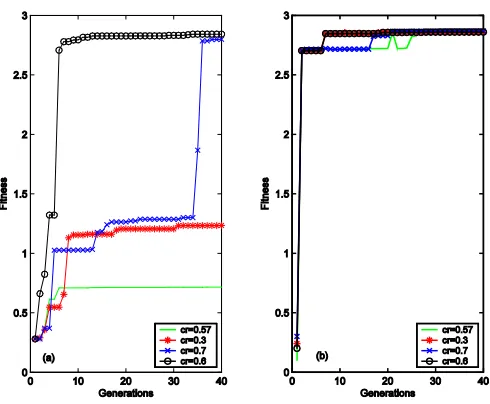
Fig. 2. Comparison of variations in crossover rate. (a) GA, (b) IGA.
5.2 Segmentation results
[image:11.612.184.429.82.284.2]Fig. 3 Segmentation results for a five-texture image.
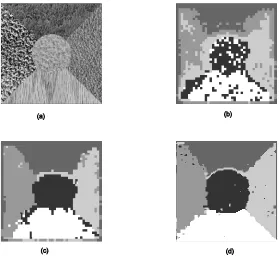
In Fig.4, the different feature extraction schemes have been compared to show the effectiveness of the proposed one. In each case the K-NN was used with k = 3. Fig. 4(a) shows the results when only the LBP based histogram patterns were taken as texture features. The segmentation is very poor with only part of the lower segment separated. Fig. 4(b) shows the result when only the averaged intensity from the Gabor filter output was used as the feature vector. The central segment has not been separated from the bottom segment. There are two reasons for these poor individual results:- (1) The LBP code, calculated in only a small 3x3 neighborhood, was not able to distinguish the different texture patterns. This may be improved if a larger scale LBP was used to evaluate the patterns. (2) The discrimination capacity of the averaged intensities modulated by the Gabor filter is limited for a single optimised filter. A better performance of the proposed feature formation scheme has been reached in Fig. 4(c) where both features have been integrated.
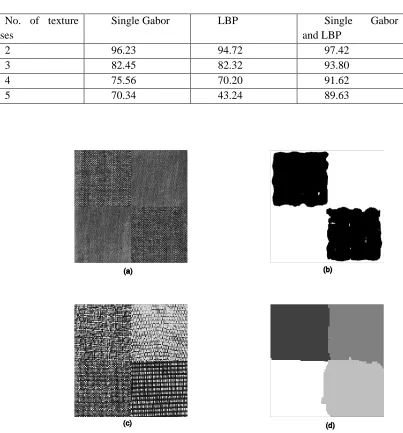
[image:12.612.161.440.71.331.2] [image:12.612.127.474.547.688.2]A further experiment was performed using our approach on a bi-textured image taken from Brodatz’s book of textures (D17 and D77). This image is shown in Fig. 5(a) and the segmented image in Fig. 5(b). The two textures have been correctly identified, but one texture has dominated the central meeting point and the boundaries are not perfectly straight. A four-textured image formed by a combination of textures D11, D21, D22 and D17 is shown in Fig. 5(c). The segmentation results are given in Fig.5 (d). Again there has been some pattern leakage at the central point and some of the boundaries are not straight.
[image:13.612.71.474.262.695.2]Experiments based on the proposed approach have shown that the IGA based search can be effectively applied for optimum Gabor filter design. Furthermore, integrating the LBP histograms with an optimised Gabor filter provided a novel way of extracting promising features from textured images, and improved the quality of the segmentation.
Table 1 Comparison of segmentation accuracy (%) for single and combined feature extraction algorithms
No. of texture classes
Single Gabor LBP Single Gabor
and LBP
2 96.23 94.72 97.42
3 82.45 82.32 93.80
4 75.56 70.20 91.62
5 70.34 43.24 89.63
[image:13.612.45.478.275.367.2]The analysis of the results in Table 1 shows the Single Gabor filter to be efficient for a small number of textured classes, but with a moderate increase to three or more, it could not discriminate texture differences reliably. A slightly poorer performance was noted for the LBP for two and three texture class images, but its performance reduced considerably for five classes. The LBP pattern-encoding scheme had a limited size of 3x3 pixels, but computed very efficiently. As with the Single Gabor filter, the LBP has poor performance in cases with many textured patterns. However by using the combination of a Single Gabor filter and the LBP, good results were obtained for images containing up to five textures.
Our combination of these two simple and easily computed classifiers has resulted in efficient, accurate segmentation. The optimised Gabor filter measures averaged intensity differences between texture regions, whereas in contrast, the LBP extracted texture pattern distributions for a small local area surrounding each pixel. We conclude the combination of these two diverse measures has resulted in a reliable classification scheme.
6. CONCLUSIONS
In this paper, a supervised approach to texture segmentation has been presented. The K-NN driven segmentation task focuses on the combination of the outputs from two texture measures. A texture sensitive indicator: a single Gabor filter, was optimized for the particular textures within an image by an IGA, which used a selection objective based on the Maxmin principle. It maximized the local Energy ratio between any two distinct texture classes. The first measure, a texture-feature component, was the intensity output from the Gabor filter averaged over a small region. The second measure was an LBP code-based probability distribution with B bins that acted on complementary texture features to that of the first measure. The measures were combined to form a fused feature vector. A procedure was applied to weight the contributions from each measure. Compared to other supervised schemes for texture segmentation, the novelty and advantages of the proposed method are as follows:- (1) The approach uses only a single Gabor filter instead of a bank of Gabor filters to reduce the computational load. The single filter can be realized because an IGA is used to select coefficients, which enable it to optimally distinguish between the taught patterns. The IGA has a higher convergence rate and is more robust to the control parameters used in the evolutionary process than the traditional GA; (2) By combining an LBP based histogram with an optimized Gabor filter, the segmentation accuracy was improved especially for cases with an increasing number of texture classes in the image.
Experiments on bi-textured, four-textured and five-textured images demonstrated the effectiveness of the methods proposed. It was verified by experiment that the fused texture-indicator that combined the optimum Gabor filtered image output and the probability distribution based on the LBP, was highly discriminating between textures. It was evident from the experiments that post-processing was still needed after the K-NN classification. In order to improve the K-NN’s performance, future work will be performed to study multiscale LBP statistics, and the addition of spatial information to the similarity measure used.
7. REFERENCES
Choi, H., Hendricks, B., Baraniuk, R., 1999. Analysis of multiscale texture segmentation using wavelet-domain hidden Markov models. In: Proceedings of the 33rd Asilomar Conference on Signal, System, and Computers, vol. 2, pp. 1287–1291..
Daugman, J. G., 1985. Uncertainty relation for resolution in space, spatial frequency, and orientation optimized by two-dimensional visual cortical filters, J. Opt. Soc. Am. A, 2(7), 1160-1169.
Fukunaga, K., 1990. Introduction to Statistical Pattern Recognition, second ed, Academic Press Inc., Boston.
Hotta, S., Kiyasu, S., Miyahara, S., 2004. Pattern recognition using average patterns of categorical k-nearest neighbors, Proc. of the 17th international conference on Pattern Recognition, 4, 412-415.
Jiao, L. C., Wang, L. L., 2000. A novel genetic algorithm based on Immunity, IEEE Trans. on SMC Part A, 30(5), 552-561.
Kittler, J., Illingworth, J., 1985. Relaxation labeling algorithms a review, Image and Vision Computing, 3(4), 206-216.
Li, Y., Zhang, Y. N., Cheng, Y. L., Zhao, R. C., Liao, G. S., 2005. An effective method for image
segmentation, Proceedings of the 4th international conference on Machine Learning and Cybernetics, 5404-5409.
Ojala, T., Pietikainen, M., Maenpaa, T., 2002. Multiresolution gray-scale and rotation invariant texture classification with Local Binary Patterns, IEEE Trans. PAMI, 24(7), 971-987.
Raghu, P. P., Yegnanarayana, B., 1996. Segmentation of Gabor filtered textures using deterministic relaxation, IEEE Trans on Image Processing, 5(12), 1625-1636.
Topi, M., Matti, P., Timo, O., 2000. Texture classification by multi-predicate local binary pattern operators, Proc. of the 15th international conference on Pattern Recognition (ICPR’2000), 3, 939-942.
Tsai, D. M., Wu, S. K., Chen, M. C., 2001. Optimal Gabor filter design for texture segmentation using stochastic optimization, Image and Vision Computing,19(5), 299-316.
Wu, C. B., Zhang, Y. J., Lin, X. G., Y. J., 2001. Optimal Gabor Filter Design for Bi-texture Image Segmentation, ACTA Electronica Sinica, 29(1), 48-59.
Yang, J. W., Liu, L. F., Jiang, T. Z., Fan, Y., 2003. A Modified Gabor filter design method for fingerprint image enhancement, Pattern Recognition Letters, 24(12), 1805-1817.