DEVELOPING A PERFORMANCE
MEASUREMENT SYSTEM FOR
SELF-RELIANCE.
Master Thesis
2015
2COLOFON
Name Student Gijs Spijkers
University University of Twente (UT)
Faculty Behavioral, Management and Social sciences
Education Program Health Sciences
Track Health Services and Management
Client Menzis
First supervisor UT Dr. ir. Fredo Schotanus
Second supervisor UT Prof. dr. Guus van Montfort
Supervisor Menzis Drs. Olivier van Noort
Master Thesis
2015
3ABSTRACT
Objective: The purpose of this study is to develop a performance measurement system that enables healthcare insurer Menzis to assess home care providers on how they perform on increasing self-reliance of clients. We formulated the following research question: How can Menzis determine to what extent a homecare provider is structurally improving the self-reliance of clients?
Study design: We developed performance indicators on the basis of six interviews with directors and managers of home care organizations and a participant observation performed by three home care providers out of the Menzis region. The indicators are organized, according to the model of Donabedian [1], in structure indicators, process indicators and outcome indicators. In addition, on the basis of the interviews, observation and a literature review, we have investigated whether there are client characteristics that influence the possibilities for a client to become (more) self-reliant.
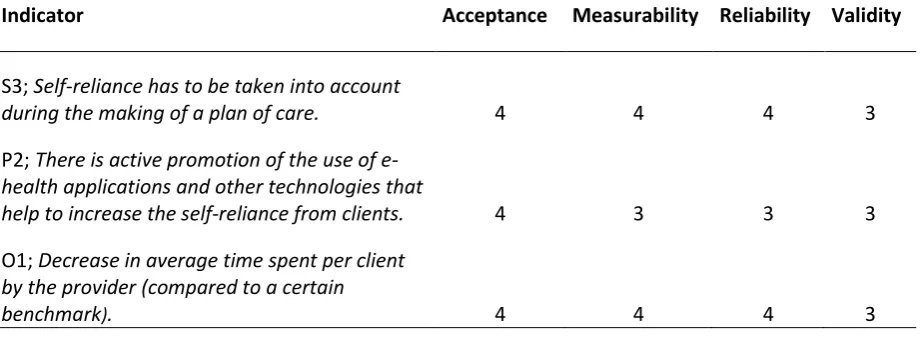
Results: The most important client characteristics that influence the possibilities for a client to become (more) self-reliant out of our research are: age, whether or not the client is a ‘new’ client and the health condition of the client. Subsequently, a total of fifteen indicators for assessing the extent to which a homecare provider is structurally improving the self-reliance of clients are formulated and thereafter assessed on acceptance, measurability, reliability and validity. The indicators with the highest acceptance, measurability, reliability and validity are listed in a basic list of indicators. This basic list consists out of the following indicators: (1, structure)Self-reliance has to be taken into account during the making of a plan of care, (2, process) there is active promotion of the use of e-health applications and other technologies that help to increase the self-reliance from clients and (3, outcome) decrease in average time spent per client by the provider (compared to a certain benchmark). In addition, we formulated two more lists based on different requirements.
Conclusion: We conclude that it is possible to conduct an overall assessment of a provider, on how they steer on self-reliance, in two ways; the first option is to perform a measurement of the indicators by healthcare purchasers. Another option for assessment with the indicators is to use them as an evaluation framework, that can be used in a conversation with the provider. We advice to use our indicators as an evaluation framework because the indicators are currently not enough reliable for a performance measurement. Besides that, we recommend Menzis to first gain some experience on performance measurement. Within the scope of an explorative research we made a start with formulating indicators. Further research is recommended to make a more reliable list of indicators, for instance by involving a broader set of organizations into the research.
Master Thesis
2015
4TABLE OF CONTENTS
1. Introduction ... 5
2. Literature review... 7
2.1 Self-reliance ... 7
2.2 Quality of care measurement... 8
2.3 Performance measurement ... 10
3. Method ... 12
3.1 Research Steps ... 12
3.2 Data sources ... 17
3.3 Data collection and analysis ... 18
3.2.1 Interviews ... 18
3.2.2 Participant observation ... 18
4. Results section ... 20
4.1 Client characteristics ... 20
4.2 Indicators ... 22
4.3 Assessment home care providers ... 33
5. Discussion ... 37
6. Conclusion ... 42
Master Thesis
2015
51. INTRODUCTION
The Dutch healthcare system performs well in international comparisons; the position of patient organizations is fairly well, and health services are easily accessible for all [2]. However, healthcare expenditure was 8.9 percent of the Gross Domestic Product (GDP) in 2007 [3] and raised to 11.9 percent of the GDP in 2011 [4]. Herewith the Netherlands ranks second on the OECD-ranking, the United States is the only country that has a higher healthcare expenditure in percentage of GDP on the OECD-ranking list (17.7 percent) [4]. The Netherlands get something back for their high investments in healthcare, according to the Euro Health Consumer Index, the Netherlands has the best quality of care in Europe [5]. This is in contrast with the USA, their high investments do not lead to a high quality of care in comparison with other countries [6].
Nevertheless, the Dutch government aims to reduce the growth of healthcare expenditures. Currently, there is much discussion in the Netherlands about the organization and expenditure of homecare. One specific subject that becomes increasingly important is district nursing. District nursing helps people to remain independent for a longer time when their health is getting worse (whether or not with help of carers and volunteers). The district nurse is mainly concerned with personal care and nursing, related to medical care or high risk to healthcare [7]. The goal of district nursing care is to increase the well-being of clients and prevent avoidable care. To achieve this goal, the district nurse focuses on prevention and self-management and working in a network with integrated primary care, municipality and volunteers (mantelzorgers) [7]. The longer period of independency leads to people using less care or at a later moment intensive care.
Per 1 January 2015 there are several changes in the organization of the healthcare system in the Netherlands, for instance the ‘Algemene wet bijzondere ziektekosten’ (AWBZ) is not applicable anymore. District nursing is moved to the so-called basic package per 1 January 2015. With this change everyone can directly, or via the general practitioner/"Wmo-loket” contact a district nurse. The district nurse assesses which type of care the client needs to live longer at home and coordinates the process of care with the client [8].
For this research we will focus on district nursing purchased by Menzis. Menzis is a health insurer in the Netherlands with approximately 2.1 million customers. In 2015 approximately 60.000 out of 2.1 million Menzis customers will make use of district nursing. For Menzis, the total purchasing budget for the health insurance act in 2015 is 5.5 billion. Out of this budget, approximately € 490 million is available for district nursing [7]. This budget of 490 million includes: target for personal care (€ 50 million), personal budget (PGB) (€ 80 million), extramuralisation (€ 33 million) and switching tasks with the municipalities (€ 5 million) [7]. The national budgeted expenditure for the health insurance act is € 44.4 billion of which € 3.1 billion is reserved for district nursing [9].
Master Thesis
2015
6 responsibility for the district nurses and their direct influences on the insurers costs. When insurers receive this information before and during contracting, they can select and reward the best and most expedient healthcare providers and improve and/or reject underperforming organizations.As said before, the goals of district nurses are to increase the well-being of clients, prevent avoidable care and increase the self-reliance from a client 1. Among other things, reliance and self-direction are increasingly seen as elements that contribute to a better quality of life [10]. Therefore, improving a clients self-reliance is very important for the quality of life. By improving self-reliance from clients, the average costs per client are likely to decrease. So, for insurers it is very useful to know in what way home care organizations steer on self-reliance and what results it yields. There is also an academic interest in this subject. There has been much research on the quality of care, but research specifically focused on the quality of district nursing in combination with self-reliance in order to reduce healthcare costs has not been performed yet.
In this research, we therefore focus on self-reliance. We aim to find out which indicators for home care providers indicate a proper way of working to increase self-reliance by clients. In order to achieve this objective, we formulated the following research question:
How can Menzis determine to what extent a homecare provider is structurally improving the self-reliance of clients?
Multiple sub questions have to be answered before a well-reasoned answer can be given at the main research question. The first sub question is about patient characteristics. This is of importance for a provider because the type of patients influence the quantity of delivered care. Besides that, when a provider has a severe client population it is more difficult for them to improve self-reliance. For further elaboration on this topic see Section 4.1.
To structure the second sub question, we use the categories defined by Donabedian [1], used for quality of care assessment. We elaborate on this topic in the literature review section. These categories are: structure, process and outcome. The third sub question is meant to give some possibilities of practical use of the indicators found in sub question two.
The sub questions are:
1) Which patient characteristics have most influence on the success rates of becoming more self-reliant?
2) Which characteristics on structure, process and outcome level indicate best that homecare
providers are structurally trying to improve the self-reliance from clients?
3) How can Menzis use the criteria/indicators for assessment of home care providers?
1
Master Thesis
2015
7 In the method section we will further elaborate on how we will come to an answer on the main research question, but first we will start with the literature research in the next section. After the method section, we present our main findings. Finally, we discuss our findings and present suggestions for further research.2. LITERATURE REVIEW
The literature review first considers our main research topic, self-reliance. The most important characteristics of self-reliance are discussed and we explain why self-reliance is likely to become an increasingly important concept. Subsequently, we discuss relevant literature for the sub questions. This will be done by explaining the model of Donabedian [1] under the subtitle ‘Quality of care measurement’, and by discussing relevant literature about criteria for measurement instruments. We will use the results of our literature review to get a better understanding of the subject self-reliance. The model of Donabedian will be used to make sure that we look to the whole process of care and can make a good assessment on quality. Subsequently, the literature review method is discussed in the method Chapter 3.
2.1 SELF-RELIANCE
In the changeable world of healthcare, self-reliance becomes increasingly important. Self-reliance and self-direction are increasingly seen as elements that contribute to a better quality of life [10]. Self-reliance could even be the key in the transition from a welfare state to the desired participatory society [11]. As self-reliance is our main research topic, we discuss this term in more detail in the next subsections.
In the international literature is little academic information available about our subject, self-reliance. A possible reason for this could be that it is a typical Dutch subject because of our ‘welfare state’. Nevertheless, we have to gain most of our information out of reports and policy documents.
The government wants people to live at home for a longer period [9] [10]. Because of this policy it becomes increasingly important for healthcare organizations to steer on self-reliance [10]. An example of this policy is the new social support law (Wmo). The Wmo is focused on promoting self-reliance and participation, and regulates personal support to achieve this [9]. The support is aimed at people who can stay at home as long as possible with help for themselves and for their carers [9]. The health insurance act states that insurers are responsible for the whole process of healthcare between home care and hospitalization [11]. So, there is also an important role for healthcare insurers in steering on/increasing self-reliance in the Dutch healthcare system.
Master Thesis
2015
8 opinion that they have provided too much care for their clients over the years and this could be the reason that clients became too dependent on care [10]. The responsibility must come back to the client [10].The most important goal for increasing self-reliance is to increase the quality of life from the client. To be able to be self-reliant a client must be capable to do independently, or with help of a informal carer, his activities of daily living (ADL) and perform a structured household [11]. To be self-reliant, the following activities of daily living are important: come in and out of bed, dressing and undressing, move, walk, sit down and get up again, bodily hygiene, toileting, eating /drinking, take medication, relaxation and social contact [11].
The district nurse has a directing role in increasing self-reliance. The district nurse should act as a contact for all inhabitants of a district or village and regulates care, welfare and housing for the customer [7]. In addition, the nurse has an important role in activating informal care and provides the right conditions to be self-reliant [7].
There are several tools available that are able to map/measure the degree of self-reliance and measure the activities mentioned above. Research by Vilans gives us the six most widely used instruments in the Netherlands to measure and map self-reliance [12]. It is about the following six instruments: self-reliance monitor, self-reliance matrix, effect start, self –reliance radar, self-reliance meter and the list of independency. During this research we will look if home care organizations use one of these instruments to measure self-reliance.
With this part of the literature research about self-reliance we hope we have demonstrated the importance of our subject. Besides that, we have used this information about self-reliance as preparation on our participant observation.
2.2 QUALITY OF CARE MEASUREMENT
According to Donabedian, we have to decide how quality is defined before we can start with assessing quality for our research [1]. It is important to define the research area and what elements will be included in the assessment. There are different levels on which the quality of care can be assessed. We will use these different levels to broaden our vision and make sure we will not miss important aspects. We discuss them below and also describe the relationship with our main research topic ‘self-reliance’.
The first level is the performance of physicians and other healthcare practitioners and can be separated into two elements: technical performance and interpersonal performance. “Technical performance depends on the knowledge and judgment used in arriving at the appropriate strategies of care and on skill in implementing those strategies” [1]. Interpersonal performance is about the process of communication between the patient and the healthcare provider, “through this exchange, the physician provides information about the nature of the illness and its management and motivates the patient to active collaboration in care”[1]. Steering on self-reliance takes for the largest part place at the interpersonal performance level.
Master Thesis
2015
9 are convenience, comfort, privacy and attributes used during care giving. The relation with self-reliance is particularly the use of tools who underset the process of care. This tools are examples of e-health such as a tablet for remote care.The third level at which can be assessed is care implemented by patients. At this level we assess the contributions to care of the patients themselves as well as of members of their families [1]. In the modern healthcare organization the responsibility for good quality is shared by provider and patient in combination with their relatives [10]. In this case the relation with self-reliance is that district nurses activate and steer ‘informal carers’ (mantelzorgers). The districts nurse involves the ‘informal carers’ in the care process, but also keeps an eye on them so they do not become overworked. Another example is that district nurses learn skills to clients, so they will become less dependent from care. There is one more level to assess quality of care and that is care received by the community. At this level we assess the social distribution of levels of quality in the community [1]. The quality of care in a community is influenced by many factors such as access to care and differences in quality between physicians. On this level the relation with self-reliance is access to care, but also the presence of social agencies that help clients to become or stay self reliant. For instance, the availability of a social district team who are able to support clients with problems about healthcare or housing.
In this research we will make use of the model of Donabedian. There are several similar frameworks available to assess and coordinate the quality of care, such as: Wmo quality of care framework, the Andersen behavior framework, the organizational design framework and the relational coordination framework [14]. We have chosen for the framework of Donabedian because it is a well-known model in healthcare research and it is flexible enough to apply in many situations [14].
Donabedian developed a model that can be used during the assessment of quality of care. The model provides a framework/method for examining health services and evaluate the quality of care [14]. The information from which inferences can be drawn about the quality of care can be classified under three categories [1]: “Structure”, “Process” and “Outcome”. These three categories are also part of our second sub question. We will explain them in more detail below:
Structure denotes the attributes of the settings in which care occurs. This includes the attributes of material resources (such as facilities, equipment and money), or human resources (such as the number and qualifications of personnel), and of organizational structure (such as medical staff organization, methods of peer review, and methods of reimbursement) [1][15]. Examples of structure indicators that we found in our research are that self-reliance has to be taken into account during the making of a plan of care and the availability of training facilities for clients and/or employees.
Master Thesis
2015
10 Outcome denotes the effects of care on the health status of patients and populations. Improvements in the patient’s knowledge and salutary changes in the patient’s behavior are included under a broad definition of health status, and so is the degree of the patient’s satisfaction with care [1] [15]. An example of an outcome indicator that we found during our research is a visible decrease in average time spent per client.2.3 PERFORMANCE MEASUREMENT
Measuring quality of care becomes increasingly important to providers, regulators and purchasers of care [16]. A way to measure and assess the quality of care is with the help of performance indicators. An indicator is developed to indicate something about the performance of an organization. In this research we will make use of performance indicators to assess home care organizations on how they try to improve the self-reliance of clients. It is important to keep in mind that indicators do not provide definitive answers but indicate potential problems or good quality of care [17].
Performance indicators can serve both for internal quality improvements as for external accountability [18]. The indicators we will draw will serve as indicators of external accountability (from the perspective of the care provider). In this research the home care organization has to show their performances and policy to the healthcare insurer. The use of performance indicators has many advantages. It creates transparency in healthcare and provides an incentive for performance improvements [19] [20].A drawback to the use of performance indicators is that it could create a significant administrative burden on healthcare institutions and professionals [18].
In order to carry out a proper assessment, the performance-indicators must meet certain design requirements. The design requirements are set to ensure that the final indicators have a certain quality and therefore can be used in a responsible way to compare healthcare providers (see method section for further information on these criteria).
To assess whether our performance-indicators will meet these design requirements of scientific usefulness we will make use of the ‘appraisal or indicators through research and evaluation’ (AIRE) instrument [21] (see the method section for further elaboration). We will use this in the form of a checklist in order to check the quality of the indicators. We have performed literature research on the topic performance measurement in health care to determine on what aspects we want to assess the indicators. Subsequently, we filtered criteria out of these articles and represent them in Table 1 below.
Master Thesis
2015
11Title Acceptability
/ Acceptance
Availability / Measurability
Feasi-bility
Relia-bility
Sensitivity to change
Validity
Research methods used in developing and applying quality indicators in primary care [17]
x x x
Using performance indicators to improve health care quality in the public sector: a review of the literature [22].
x x x x x
Indicators of Quality
in Health Care [23] x x x
Health Care Quality
Indicators Project [24] x x x x
Defining and classifying clinical indicators for quality improvement [16]
[image:11.595.55.528.75.434.2]x x x
Master Thesis
2015
123. METHOD
The method section first considers the research steps taken in our study and subsequently the different phases are explained in more detail. In Section 3.2 the data sources of our research are described and the last section of the method (3.3) is about the way of data collection (observation and interviews).
3.1RESEARCH STEPS
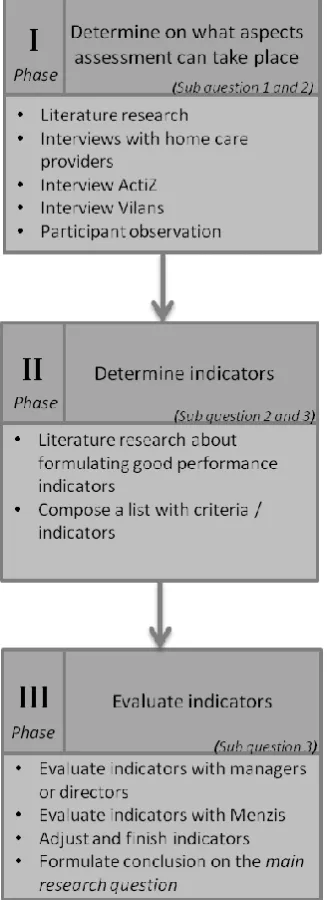
[image:12.595.74.238.287.738.2]The research process is summarized in Figure 1 below. In the next subsections we explain the research steps in more detail. We also mention in this figure which sub question(s) the central questions are in the respective phases. The different phases indicate what information is collected at which point time. Most information is taken to following phases. Therefore, some sub questions have overlap between the phases.
Master Thesis
2015
13 As shown in Figure 1, the method is divided into three different phases. In the first phase we determined on what aspects assessment will take place, in the second phase we determined the indicators and in the third phase we evaluated and adjusted the indicators. The final indicators could serve as differentiation criteria. Differentiation criteria could help Menzis with choosing the best home care providers during the process of contracting and tariffing. The start of the study consisted of describing the problem situation. Hereby we looked at which actors are involved and which interests they have in relation to measuring the performances of home care providers. In this step it became clear which individuals and organizations would be involved in the further research.Phase I; Elements of self-reliance
The first step in phase I was an extensive research on the elements of self-reliance. This is done by literature research and interviewing professionals. The literature research is done by searching in PubMed, Google Scholar and Scopus with ‘self-reliance’, ‘improving self-reliance’, ‘home-care’, ‘healthcare’, ‘health care’, ‘district nursing’, ‘client characteristics’ and ‘measurement quality of care’
as main search terms. We have also combined these terms in order to search more specifically. When we got less than 100 results on our searches, we have scanned the titles and subsequently read the abstract when the title was relevant for our research. When the abstract was relevant as well we have included the full article for further use in our research.
To gather information about internal processes of homecare organizations we have conducted interviews with directors and managers from various homecare organizations. The information gathered in these interviews is used as input for answering the first and second sub question and is used during the formation of indicators. We have chosen to gather information by conducting interviews - instead of a large scale survey - because we expect this yields the most valid and complete information that we need in our research. We expect this because of the fact that the interviewer can ask the respondent to explain his answer or ask new questions that are build on given answers from the respondent. Further information about the interviews will be provided under subtitle ‘Data collection’ on the next page.
Master Thesis
2015
14 The information gathered in phase I of Figure 1 is combined and used to answer the first sub question (client characteristics) and make a start of the second sub question (characteristics on structure, process and outcome level). The process of collecting the client characteristics was as follows: all aspects that are found in the literature research are included in the final list and when at least two times an aspect was mentioned during the interviews or observation they are also included in the final list of characteristics.Phase II; Formulating indicators
The research will be continued with literature research on formulating good indicators. This is done by searching in PubMed, Google, Google Scholar and Scopus on the same way as described in the previous paragraph. We have used the following search terms: ‘performing indicators’, ‘performance indicators’, ‘formulating performance indicators’, ‘performance measurement’, ‘healthcare’ and
‘health care’. We have also combined these terms in order to search more specifically. When we got less than 100 results on our searches, we have scanned the titles and subsequently read the abstract when the title was relevant for our research. When the abstract was relevant as well we have included the full article for further use in our research.
Formulating good indicators is of importance for this research because the final indicators are likely to affect the policy of an organization. The expectation is that care providers which meet the performance indicators will be favored by healthcare insurers. The insurer will reward care providers through, for instance, a contract extension or a financial reward. With help of the indicators the insurer is indirectly able to exert some control on the policy of healthcare providers, in this way they try to improve the process of increasing clients’ self-reliance.
The indicators will be formed out of the information that is obtained in phase I of the research. First, the interviews will be elaborated and after that the answers will be compared. All possible indicators that emerge from the interviews will be filtered out by expert view and subsequently checked on quality (see phase III for further elaboration). In addition to the interviews, the information gathered out of the participant observation will also be used. The information out of the participant observation is also obtained with an expert view. For instance, this can be a situation or way of working that is often observed. During the forming of indicators we will keep in mind that the indicators have to fit to the policy of Menzis. This is important because the final product has to be used by Menzis’ healthcare purchasers. An example of this could be that if Menzis stimulates a certain behavior of providers it would not be logical to set up an indicator that disapproves this behavior. At the end of phase II we have a list with possible indicators that have to be checked on quality before they can be used.
Phase III; Checking indicators
Master Thesis
2015
15 During these evaluations we explained how the indicators are established and we asked for feedback and their opinion about the quality of the indicators. With the feedback given by managers we adjusted the indicators when it was necessary. After the feedback sessions we checked the performance-indicators on quality with a multi criteria analysis using a checklist. Our checklist contained four criteria that were obtained out of our literature research. The four criteria that we used in our research are shown in Table 2 below. In the table you can also find the reason why we have chosen for these criteria. The information about acceptance, measurability, reliability and validity will is partly obtained during the feedback sessions with managers and directors of home care organizations.Criteria indicator Explanation
Home care organization accepts the indicator (acceptance)
In the first place we have to check whether or not there is enough support for the indicator by home care organizations and by Menzis. This is important because without the cooperation of home care organizations it is more difficult to obtain the necessary information. And the indicators will not be used when Menzis disagrees. In addition, it is important that performance indicators are also practicable and this can best be verified in collaboration with home care organizations. Furthermore, this is also likely to meet sensitivity to change of an indicator. If it is not possible to influence an indicator it is not likely there will be much support from home care providers and insurers.
(easily) Measurable For the practical feasibility of the indicators it is important that they are (easily) measurable. If an indicator is not measurable, or very hard to measure, it is not a suitable performance-indicator.
Reliability The reliability of an indicator is also important. The reliability of an indicator means how precise and consistent the performance is measured. For instance, the risk of measurement errors has a negative influence on the reliability.
Validity The validity shows whether the indicator measures what it is intended
to measure. In this research we must determine to what extent the performance indicators actually say something about the way of steering on self-reliance by home care organizations (construct validity).
Table 2: Criteria for indicators.
Master Thesis
2015
16 on acceptance and when all respondents were not convinced this indicator got one point on acceptance. The scores for measurability, reliability and validity are determined on interpretation of the lead researcher with input of the respondents. The reason for this other way of scoring is the knowledge of the respondents; not all respondents were able to say something about these criteria in relation to the indicators. In addition, each score has its own color to produce a clearly displayed table of indicators. See Table 3 for an overview. The maximum score an indicator could get is 16 (4*4). The final score for an indicator can be determined with the following formula [21]:
*100%
So, when an indicator has a total of 11 points, the final score for that indicator is 58%:
*100% = 58%.
Score Description Color
1: Strongly disagree
You are sure that the indicator does not meet the
criterion, or there is no information on. 1
2 - 3: Agree/ Disagree
You are not sure whether the criterion is met. Depending on the degree to which you think the
criterion is met you choose ‘agree’ or ‘disagree’. 2
3
4: Strongly agree You are sure that the indicator does meet the
[image:16.595.56.530.268.533.2]criterion. 4
Table 3: AIRE Instrument[21]
Master Thesis
2015
173.2DATA SOURCES
Menzis has a total of 107 contracts with home care providers in the region of Arnhem, Twente and Groningen. Thus, there are many organizations available to include in our study. Before choosing which organizations will be involved in our research we have set up some requirements. See Table 4 for these requirements.
Requirements Explanation
Organization has self-managing care teams
We have chosen for this requirement because in self-managing teams there is much responsibility for the district nurse. And we think these self-managing care teams are better able to look critical to self-reliance of clients. In organizations without self-managing teams they perform a more executive role.
Organization is among the 15 largest suppliers
We have set up this requirement because the 15 largest suppliers are responsible for 75% of the total cost for Menzis on district nursing. Because of this Menzis wants to increase cooperation with these providers. Involving these organizations in this research is preferable for Menzis.
Differences in average total cost per client
We try to find organizations with different average costs to find a possible cause for these differences in the observation study. The difference in average costs could be caused by different steering on self-reliance.
Geographic distribution As said before the Menzis region is spread into three different regions. In order to find out whether there are differences in these regions in steering on self-reliance we try to involve all three regions in our research.
Table 4: Suitability requirements for choosing providers to be involved in our research.
Master Thesis
2015
183.3 DATA COLLECTION AND ANALYSIS
As said before, the information that we need to compose indicators will be collected by interviews and observations. How this process is organized will be explained in the sections below.
3.2.1 INTERVIEWS
We have make use of interviews to gather information from different home care providers and produce data for academic analysis. During this research we have made use of the semi structured way of interviewing to gather qualitative information from different respondents. We asked pre-established open questions during the interviews and let space for divergence and adding questions. The interviews are recorded and worked out afterwards by expert view. Possible indicators, and other remarkable statements, that are mentioned during the interviews are filtered out and used for assessment.
We interviewed a director or manager from all organizations were the participant observation (see the previous subsection for more details about these organizations and why they were selected for our research) will took place. During this interviews we gathered background information from the structure and policy of an organization. We used this information in combination with the information raise out of the observation study to formulate conclusions. As an addition to the interviews with managers/directors of organizations that participate in the observation study, we also interviewed managers/directors of organizations that did not participate in the observation study. We did this to gather enough information for our analysis and make it more reliable.
To broaden our vision on self-reliance we also interviewed employees of Vilans and ActiZ. Vilans is a knowledge center for long-term care and does a lot of research on the topic self-reliance. ActiZ is the branch organization for healthcare organizations and is committed to the entrepreneurship within the market of care, housing, welfare and prevention. We used the output of the interviews as input for the final assessment criteria.
3.2.2 PARTICIPANT OBSERVATION
Master Thesis
2015
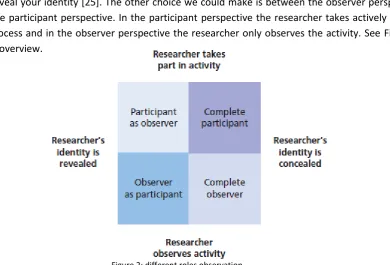
19 In the first two of these roles the researcher involves and observes an organization without their knowing, the researcher is concealing his identity in these situations. Naturally, this has as an advantage that the researcher is not influencing the behavior of the respondents who are studied [25]. With the second two observer roles the researcher reveals his purpose to those with whom he will mix in the research setting. Ethically, it is more accepted to choose one of the last two options and reveal your identity [25]. The other choice we could make is between the observer perspective and the participant perspective. In the participant perspective the researcher takes actively part in the process and in the observer perspective the researcher only observes the activity. See Figure 2 for an overview.Figure 2: different roles observation
In this research we have chosen for the observer as participant perspective. We chose for this perspective because we observed home care providers with whom Menzis has a long term relation, this relation must not be damaged by giving them wrong information about the research. Furthermore, another problem that could occur by not revealing your identity is that the researcher may lose his actual research target because he is too busy with building a good relationship of trust with the people he is observing [26].
Master Thesis
2015
204. RESULTS SECTION
In the results section we answer the sub questions using the information gained during the literature research, interviews and participant observation. We will start with the first sub question about client characteristics that influence the degree of self-reliance.
4.1 CLIENT CHARACTERISTICS
The answer on the first sub question is given by an overview of characteristics that influence the degree of self-reliance. These characteristics indicate a client appropriateness to become (more) self-reliant. The characteristics are composed out of information that is obtained during the observation study, interviews and literature research. See Table 5 on the next page for an overview of these characteristics and which source is used per indicator. All aspects that are collected out of the interviews, literature research and observation sessions are listed in the table.
One of the most important conditions to become more self-reliant is the motivation of a client. We have observed different clients in our study and concluded that there are many different types of clients. There are clients who are very motivated and ask the nurse how they can help or how to improve their lives. On the other hand there are also clients who apparently do not show initiatives. We assume motivated people are better able to become more self-reliant, this is also verified by district nurses during the observation.
Another aspect that contributes to increasing self-reliance is the age of clients. In the observation we have seen and heard that younger people are better able to become self-reliant again:
“It is easier to learn younger people to become more self-reliant, because they have in most cases more energy and are more vital”.
In the literature we found that they make a distinction between 75- and 75+ [28]. In addition to this aspect the respondents mentioned:
“It is easier to learn a certain behavior from the start of the treatment. Clients who already receive homecare for a longer period are more accustomed to certain patterns and it is difficult to adjust this”.
Master Thesis
2015
21 Other aspects that increase the chance to become more self-reliant are a high socio-economic status (SES) and having enough financial spending. People with a high SES have more knowledge of their restrictions and are better prepared for the effects. A quote out of the interviews is as follows:“People with a low social economic status claim that they ‘have a right to receive care’. It takes us more time and energy to make them aware of the need to improve self-reliance. People with a higher SES often have done some preparations”.
The financial situation of clients is of influence because clients with a large budget are better able to buy for instance some extra e-Health tools or private help.
The last aspect we found during our research is the availability of an active social network around the client, this are for instance informal caregivers who are willing to help. Informal carers are important to support the client with daily activities and managing care. During the observation it was noticeable that all nurses seek contact with the informal carer (if there was an informal carer available). The nurse talked about the situation of the client and asked if there were any problems. In some cases the nurse gave some tasks to the carer. With help of the carer there is more chance to improve self-reliance.
Client aspects Source
Clients who are motivated to keep in control of their own lives.
Observation
The new generation of clients (75 -) [28]. Observation / Interviews/ Literature
New clients. Observation / Interviews
Clients who have only restrictions or problems with: household / ADL (Activities of Daily Living), daytime activities and social activities or physical functioning and mobility [28].
Observation / Literature
Clients who have no restrictions or problems with psychological functioning or cognitive functioning [28].
Observation / Literature
Clients with a high socio-economic status. Interviews / Observation
Clients with enough financial spending. Interviews / Observation
Clients with an active social network around them [29].
Interviews/ Observation / Literature
Master Thesis
2015
22 4.2 INDICATORSThe second sub question is about characteristics on structure, process and outcome level that indicate structural improving on clients’ self-reliance. As said before, the indicators are formed out of information that is obtained during interviews and observations. The formulated indicators can be found in the column indicators of Table 6 on the next page. In the next subparagraph (4.3) is explained how and why these indicators are build up and composed out of the collected information. As mentioned before, the indicators are organized with help of the model of Donabedian (structure – process – outcome).
The indicators in the structure domain relate to the question: how is it organized (to improve self-reliance)? The most important elements that we found in this domain are for instance the vision of an organization and the availability of training facilities. Subsequently, the process indicators relate to the question: what is done? The most important elements out of this domain are for instance the use of e-health applications and a structural evaluation of the care plan of a client. Finally, the outcome domain is about the results. This domain has to answer the question: what is done? Important elements out of this domain are a decrease in average time per client and a decrease in the quantity of delivered ‘light’ care. Further explanation about the indicators will be given in the next subsection.
Domain Indicator Criterion 1;
Acceptance
Criterion 2;
Measurability
Criterion 3;
Reliability
Criterion 4;
Validity
Final score
Structure
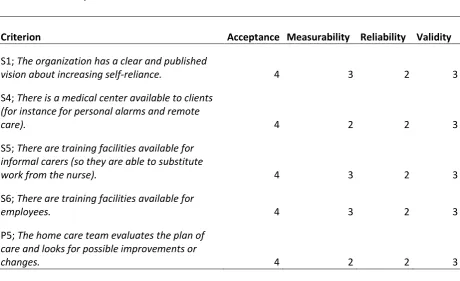
S.1 The organization has a clear and published vision about increasing self-reliance.
4 3 2 3 67%
S.2 Employees receive active steering on increasing self-reliance from the
management.
3 2 2 3 50%
S.3 Self-reliance has to be taken into account during the making of a plan of care.
4 4 4 3 92%
S.4 There is a medical center available to clients (for personal alarms and remote care).
Master Thesis
2015
23 S.5 There are training facilitiesavailable for informal carers (so they are able to substitute work from the nurse).
4 3 2 3 67%
S.6 There are training facilities available for employees.
4 3 2 3 67%
Process
P.1 There is a visible trend of the increase in the quantity of delivered AIV-care (Advice, Instruction and Education) within an organization.
2 1 1 2 17%
P.2 There is active promotion of the use of e-health applications and other technologies that help to increase the self-reliance from clients.
4 3 3 3 75%
P.3 The degree of self-reliance from clients is measured with a measuring instrument.
2 4 2 3 58%
P.4 The nurse evaluates the plan of care with the client and also looks for possible
improvements of the plan.
1 1 1 1 0%
P.5 The home care team evaluates the plan of care and looks for possible improvements or changes.
4 2 2 3 58%
Outcome
O.1 Decrease in average time spent per client by the provider (compared to a certain benchmark).
Master Thesis
2015
24 O.2 There is a visible decrease in‘light’ personal care.
4 4 2 2 67%
O.3 The measuring instruments (P.3) show that the self-reliance of clients has increased.
2 3 2 3 50%
O.4 The duration of a client in care has decreased (lead time).
2 4 4 2 67%
Table 6: Table with scores per indicator
In this subsection we will explain how the indicators are established and why they are chosen. Subsequently, we will describe the performed assessment on quality of the indicator. We will do this again in the order of structure, process and outcome.
S.1 The organization has a clear and published vision about increasing self-reliance.
Why did we include this indicator: We have included this indicator because we hold the view that having a clear vision is a prerequisite for steering well on self-reliance. To make sure that the delivered vision is official, we require that the vision must be published. This can for instance be done on the website of the provider. This indicator was often mentioned in interviews with homecare providers, they indicate that:
“Having a clear vision, and propagate it well within the organization, is very important to achieve successes in the field of self-reliance”.
A clear vision is required to carry out the current problems and solutions to everyone, both employees and clients. Everyone in the organization has to know why it should be different and how this should happen. A quote out of the interviews that indicates that an organization has a good vision is:
“Self-reliance has become part of our DNA”.
Assessment on quality of the indicator: The acceptance of this indicator is high, all respondents said that this is an important indicator. Therefore, this indicator gets four points on acceptance. A statement that captures this is as follows:
Master Thesis
2015
25 The indicator is relatively easy to measure, it is not difficult to determine for Menzis whether or not a clear vision is published. However, the policy of an organization has to be read and this could take some time. Therefore, this indicator will gain three points for measurability. The reliability and validity of this indicator have less quality. For reliability this indicator gets only two points because the assessment of the vision will be performed by expert view. So it depends on the person who will assess what the result is. For validity this indicator gets three points because there is no direct known correlation between a clear vision and increasing self-reliance. We still give three points because it is according to the care providers very important to have a clear vision to reach goals (increasing self-reliance). We do not give four points for validity in this situation because there is no scientific evidence for this connection. This argument applies to all indicators.S.2 Employees receive active steering on increasing self-reliance from the management.
Why did we include this indicator: This indicator builds on the previous indicator. It is not only important to have a clear vision, this vision must also be disseminated. A clear and progressive vision is worthless when it is not disseminated in the whole organization. The dissemination can for instance be done by organized meetings with employees or by standardized frameworks for each care team.
Assessment on quality of the indicator: Not all home care organizations are satisfied with this indicator, some organizations say that:
“Active steering doesn’t fit in our organization because our organization consists of self steering teams” or
“It depends on the structure of an organization, furthermore, increasing self-reliance is a social responsibility”.
Master Thesis
2015
26 S.3 Self-reliance has to be taken into account during the making of a plan of care.Why did we include this indicator: We have included this indicator in our assessment because we assume it is important to take self-reliance into account before the start of delivering care. The performed participant observation showed us that most organizations made use of a classification system for composing a plan of care (Omaha). With this classification system an action plan can be made to improve the self-reliance of clients. Besides that, the interviews and participations showed us that the family of a client always will be involved during the preparation of the plan of care. By doing this the district nurse can have a critical look at what care the client actually needs and what things they can do with help of the family (informal care). By actively involving the family in this process, the quantity of professional care can be minimized.
Assessment on quality of the indicator: All organizations we have spoken during the feedback sessions said that this is a very relevant indicator. One of the respondents said:
“This is the realization of indicator S.2, with this format we require everyone to look critical to the self-reliance of clients”.
According to the respondents this indicator is also easily measureable. Organizations can show which classification system they use and all client data inside the system can be shown too. Because everyone agrees with this indicator we give both the acceptance criterion as the measurability criterion of this indicator four points. The reliability will get four points because there are less different classification systems and for the assessor it is easy to determine whether or not the self-reliance will be taken into account in the system. The validity of this indicator is also quite high, when everyone is forced to look critical at the situation of self-reliance by clients there will be provided less unnecessary care and more self-reliant clients. We give three points for this criterion. A nuance on this indicator could be that you cannot make sure that all employees actually use the classification system in practice all the time. Hence, we expect that when the facilities around this system are well regulated it is likely that all employees will actively use such a classification system. This was confirmed by our performed observations.
S.4 There is a medical center available to clients (for instance for personal alarms and remote care).
Master Thesis
2015
27 Assessment on quality of the indicator: Not all organizations have the availability of a medical service center, but almost all organizations have the availability about subjects of a service center like personal alarms, this often goes directly via the district team. However, all respondents said that this is a relevant topic and expect that they will make developments on this topic in the future. Therefore, this indicator gets four points on the acceptance criterion. It is also easy to determine whether or not the organization has the availability of an medical service center, but on the other hand, it is not clear for everyone which subjects exactly belong to the medical service center. First there must be a clear framework with subjects who belong to the medical service center. Because of this unclearness about the exact content of a service center, both the measurability as the reliability get two points. The validity criterion gets three points because of the fact that a medical service center is a quite new and promising concept which can contribute to more self-reliance.S.5 There are training facilities available for informal carers (so they are able to substitute work from the nurse).
Why did we include this indicator: Some organizations offer training for informal carers. Training informal carers can lead to less dependency on professional care and therefore lead to less care costs and more self-reliance. The interviews revealed that there are often situations where:
“There is a carer available but they are too shy and do not exactly know what they can do to help”.
With support for carers this can be improved:
“We have set up a special training for carers so they are able to arrange care with the nurse”.
Furthermore, it is very important to keep an eye on the carers, it is not an exception that they become overloaded. Preventing this is also a subject of the course. During the observations we also noticed that if a carer is present, most of the time the partner of the client, they were actively involved in the process and were assigned tasks. With a training session, this process of cooperation may possibly be optimized.
Master Thesis
2015
28 S.6 There are training facilities available for employees.Why did we include this indicator: Besides the training for carers, a home care organization can also offer trainings facilities for their employees. In most cases, the district nurse of each team receives a training and will provide this information to the rest of the care team. The purpose of these trainings for district nurses is to be better able to indicate and compose a care plan. We expect that this will lead to more self-reliance because of the nurse has a more critical and professional point of view.
Assessment on quality of the indicator: This indicator is comparable in quality with the previous indicator (S.5). This is because of the fact that both indicators assess the training facilities. Therefore, this indicator gets the same scores for acceptance (four), measurability (two), reliability (two) and validity (three). It would be an option to merge this indicator with the previous indicator but we argue that the training facilities for informal carers are definitely different from the training facilities for employees. It requires different knowledge and facilities, besides that the presence of the one does not indicate the presence of the other. Therefore, we will not merge them into one indicator.
P.1 There is a visible trend of the increase in the quantity of delivered AIV-care (Advice, Instruction and Education) within an organization.
Why did we include this indicator: We expected that an increase in the quantity of AIV leads to more self-reliance because of the fact that clients received more training and advice in order to improve their lifestyle. In addition, the client learns to become independent again. Because they are well supervised and informed they will at some point have a better control over their disease and become more self-reliant according to several interviewees. The current situation could be compared with the situation of one or two years ago to make a comparison.
Assessment on quality of the indicator: All respondents agreed that this indicator says something about self-reliance, but it is unclear what exactly. In addition, AIV is a part of prevention and it is difficult to demonstrate the effect thereof. We therefore give two points for both the acceptance and validity of this indicator.
The amount of declared AIV is easily measurable, this data is available for the insurer. However, it is not possible to ascertain what is actually delivered at home. Organizations often have a certain amount of money to spend on AIV and that is consumed in most cases. In the interviews, the following statement was made:
“District nurses may only write a limited number of hours on AIV. Because of this limitation, you do not know whether you have the actual amount of AIV. The outcome of this measurement is likely to be not equal to the reality”.
Master Thesis
2015
29 P.2 There is active promotion of the use of e-health applications and other technologies that help toincrease the self-reliance from clients.
Why did we include this indicator: All respondents have high expectations of e-health applications in home care, they think that an increase in e-health applications will lead to more self-reliance for clients. This is indicated by the following quotes:
“We do a lot of investments in e-health to improve the home situation of the client” and
“We are in a digitization drive”.
Examples of promising e-health applications for home care are: remote care through video calls, ‘Medidos’ (helps users to remind that they have to take their medicines) and the ‘Obli’ (helps users adequate and regular drinking). All these examples are currently used in practice, but according to the respondents there is still much room for improvement and expansion. During the observations we have seen some of these e-health applications in practice, it looks promising but we have to keep in mind that it is not suitable for everyone.
Assessment on quality of the indicator: According to the respondents this is a relevant indicator, all home care organizations have some projects with e-health. The acceptance of this indicator will therefore be assessed with four points. The indicator is also easily measureable, the measurement could for instance be done by counting the number of deployed devices. In this case it is not suitable to assess a home care organization on their investments in euro’s because not all e-health applications have to be paid directly by themselves. Furthermore, high investments in e-health may indicate backlog. In addition to the e-health application provided by home care organizations, there are also applications available that can be downloaded on mobile devices outside the system of care. According to the respondents the expectation is that the number of these apps will increase. These apps outside the system of care influence the measurability and reliability of our indicator. Although, we still give three points for both measurability and reliability because we expect that this development will be substantially the same in all organizations. The validity of this indicator gets three points because e-health does not in any case lead to greater self-reliance, it is dependent on the client.
P.3 The degree of self-reliance from clients is measured with a measuring instrument.
Master Thesis
2015
30 Assessment on quality of the indicator: The interviews revealed that many respondents do not know about the tools to measure self-reliance. Furthermore, when we ask if organizations are willing to use one of these instruments they responded mostly dismissed. Quotes that support this are:“For me there is no need to get extra tools to measure self-reliance, I believe that every single person desires to be self-reliant”,
“We do not measure the degree of self-reliance because it is not convenient for my staff and clients” and
“We have to be careful that we should not exaggerate when it comes to measurements. I have great confidence in the quality and professionalism of the district nurse 2.0”.
Not all organizations were against more measurements, there are also proponents:
“Currently, we are investigating whether we can introduce a measurement tool in addition to the Omaha system. We want a simple measurement tool to monitor the self-reliance of clients and make comparisons between different care teams”.
Because of the fact that most organizations are against the implementation of additional measurement tools the indicator gets two points on the acceptance criterion. It is easy to determine whether or not a home care organization makes use of an additional measurement system, so the measurability of this indicator will be good. On the other hand, measuring self-reliance is fairly difficult. The outcome of the measurement has to be corrected for the type of client, some clients are not able to become more self-reliant for instance. However, for Menzis it is easy to determine whether or not a provider makes use of a measurement tool, therefore this indicator gets four points for the measurability criterion. Another problem is that an unambiguous measurement system for all Dutch home care providers is not available, therefore it is hard to compare organizations with different measurement methods with each other. Because of the availability of many different measurement tools this indicator gets two points for reliability. We assume that the use of a measurement tool indicates an active attitude towards steering on self-reliance, therefore this indicator gets three points for validity.
P.4 The nurse evaluates the plan of care with the client and also looks for possible improvements of the plan.
Master Thesis
2015
31 Assessment on quality of the indicator: All respondents stated that it is important to evaluate the plan of care with the client. However, not everyone believes that it actually contributes to increasing self-reliance. Besides that we found out by research that it is obligated for all home care organizations to evaluate the plan of care with the client. Hence, it will not be useful to assess organizations with these indicator because it is not distinctive. Because of that this indicator scores one on all criteria and will not be used.P.5 The home care team evaluates the plan of care and looks for possible improvements or changes.
Why did we include this indicator: Besides evaluating the plan of care with the client, the plan of care can also be evaluated within the care team. During the observations we have seen that teams evaluate the process of care around clients. The purpose of these evaluation sessions is to optimize the process of care by exchanging experiences and know-how about clients.
Assessment on quality of the indicator: All respondents believe that evaluating the plan of care contributes to more self-reliance for clients. The respondents indicate that it will be useful to have a good classification system to perform a good evaluation. With this classification system they are better able to compare the current situation of the client with the former situation. Because all organizations see the added value of evaluation the plan of care this indicator gets four points for the acceptance criterion. It is difficult to determine whether or not the evaluation actually takes place, all organizations can say that their teams evaluate the plan of care but is hard to prove. Hence, this indicator gets two points for measurability. Because it is difficult to determine to what extent the plan of care will be evaluated, the reliability criterion gets two points. The validity of this indicator is fairly good. We assume that organizations who structurally evaluate the plan of care are better able to improve self-reliance. Therefore this indicator gets three points on validity.
O.1 Decrease in average time spent per client by the provider (compared to a certain benchmark).
Why did we include this indicator: All respondents indicated in the interviews that an improvement in self-reliance will lead to a decrease in average time per client. This is caused by the fact that clients will receive less professional care when they become more self-reliant [12] [30]. Decrease in average time will be a good indicator when a trend can be visualized.
Master Thesis
2015
32 O.2 There is a visible decrease in ‘light’ personal care.Why did we include this indicator: We include this indicator because according to one of the respondents:
“An increase in self-reliance will be visualized by a decrease of delivered ‘light care’”.
This is caused by the fact that ‘light care’ could be first substituted by client or carers, with or without tools to support. With ‘light care’ we mean for instance putting on compression stockings and administering eye drops. However, we are aware that substitution is not possible in all situations. In our observations we found an example of this indicator; a nurse teaches a client how to clean a wound whereby the nurse is able to half the time of a visit the next times.
Assessment on quality of the indicator: According to all respondents this is a relevant indicator, but not all home care organizations see this development in their own organization. One respondent said:
“This could be caused by the fact that we already indicate strictly, we can not further scrimp”.
To avoid this it could be possible to compare the data of the last five year to show a trend. Because all respondents agreed, this indicator gets four points on acceptance. The indicator is also easily measureable. All respondents said that they have this data available. Hence, this indicator gets four points on measurability. A comment which affects the reliability and validity of this indicator is as follows:
“If you visit someone you can observe him or her and see if they are looking good, this can work preventively. This is a nuance on the data. This can only be tested by delving into the casuistry (why do you keep giving those two shower sessions)”.
Therefore, we give the reliability criterion two points. The validity criterion gets also two points because you have to know the casuistry behind the numbers to make a judgment.
O.3 The measuring instruments (P.3) show that the self-reliance of clients has increased.
Why did we include this indicator: This indicator builds on indicator P.3. In P.3 was asked if providers make use of a measurement system, a typical process indicator. However, the outcome of this measurement belongs to the outcome criteria. It will be useful for the assessment of an organization to get an insight in the results of the performed measurements.

![Table 3: AIRE Instrument [21]](https://thumb-us.123doks.com/thumbv2/123dok_us/9843978.485612/16.595.56.530.268.533/table-aire-instrument.webp)
![Table 12: Table with aspects for improving self-reliance [28] [29]](https://thumb-us.123doks.com/thumbv2/123dok_us/9843978.485612/38.595.68.502.78.388/table-table-aspects-improving-self-reliance.webp)