Source: getinge.com
Identifying the process-based design system of
isolation rooms
And providing a method for shared design decision-making by transforming complex
dependencies into a structured set of feasible design solutions
Bachelor Thesis
Department of Civil Engineering
01-07-2018
Tom Behage (s1717103)
Dr. Ir. R.S. de Graaf (University of Twente)
Prologue
The bachelor Civil Engineering from the University of Twente will be rounded off with a research report. This research report is commissioned by Royal HaskoningDHV. I would like to thank the people that supported me during my research.
Firstly, a special thanks to Xander van Ruissen. Xander, your guidance has been highly appreciated and your enthusiasm about the subject helped me during my research. Besides that, your view of life and strength inspired me on a personal level. I wish you the best.
Secondly, I would like to thank Robin de Graaf for his sharp feedback and his fresh view on the subject. Robin, thank you for helping me in being critical about my own work.
Finally, I would like to thank Erik Snip. Erik, you were the reason I was interested in this research in the first place. Also, thank you for keeping in contact and providing support during the research.
Definitions
- System = a set of connected items that operate together to fulfil one purpose. - Process = a series of actions that are needed in order to fulfil the purpose of a
system.
- Function = a specific action or task that a system is able to perform. A function is always formed by a verb and a noun. For example: disinfecting hands
or transporting patient.
- Function- carrier = an object or collection of objects fulfilling the action or task of a function.
- Business-case = an explanation or set of reasons describing improvements in a business, regarding costs and profits and attractive investments. - Tool = (in this report) a (software) program or feature of a (software)
program that helps you with particular activities.
- Patient = (in this report) customers of hospitals who are treated in their facility.
- Client = (in this report) the real estate department of a hospital, requesting a design of an isolation room.
- User = (in this report) the employees of a hospital that during their work have to deal with patients in isolation rooms.
Abstract
Royal HaskoningDHV has difficulties in identifying the isolation rooms’ processes, functions and their relations and dependencies. This sometimes leads to the feeling from the client of not being
understood. Besides that, it has the potential to lead to a mismatch between isolation room design and the client and user needs. Royal HaskoningDHV wants to solve this problem with a collaborative design-decision making tool, enhancing collaboration with the client in creating a spatial design of an isolation room. As a basis for creating this tool, the isolation rooms’ processes, functions and their dependencies need to be identified and a method for implementing this knowledge in a tool, improving collaboration in design decision-making, needs to be provided.
For this research, a generic isolation room is used. In this report, the first steps of the design process of an isolation room will be researched using various methods. Knowledge from theory and practice will be combined in analyses. Validation will be done by the work field.
To review the processes and functions of an isolation room, a FAST diagram is made. For reviewing the dependencies, a Functional Performance Specification is done on which an AIDA analysis is applied. As a result of this, the specific feasible solutions for an isolation room design and their main characteristics are presented.
After that, a research is conducted to review the implementation of this knowledge in a tool that improves collaboration in design decision-making. This resulted in a list of generic conditions and requirements for the wanted tool. Besides that, recommendations for further research about this implementation are given.
Table of Contents
Prologue ... 2
Definitions ... 3
Abstract ... 3
1. Preface ... 6
1.1. Introduction ... 6
1.2. Problem statement... 6
1.3. Research objective ... 6
1.4. Reading guide ... 7
2. Research plan ... 7
2.1. Concept thoughts ... 7
2.2. Context problem statement ... 7
2.3. Context research field ... 7
2.4. Research questions ... 9
2.5. Research limits and boundaries ... 9
2.6. Research setup ... 10
2.7. Research methods ... 11
2.7.1. Identify the needs and constraints ... 11
2.7.2. Research the problem ... 13
2.7.3. Develop possible solutions ... 14
2.7.4. Design decision-making tool ... 15
3. Identify the needs and constraints ... 15
3.1. Theory ... 15
3.2. Practice ... 19
3.3. Analysis ... 23
4. Research the problem ... 26
4.1. Theory ... 26
4.2. Practice ... 26
4.3. Analysis ... 26
5. Develop possible solutions ... 27
5.1. Theory ... 27
5.2. Practice ... 27
5.3. Analysis ... 27
6. Design decision-making tool ... 32
6.3. Analysis ... 34
7. Discussion ... 35
7.1. Assumptions ... 35
7.2. Integrity ... 35
7.3. Deduction ... 36
7.4. Added value of the research for RHDHV and the client ... 36
8. Recommendations ... 37
9. Conclusion ... 38
Bibliography ... 39
Appendix A ... 41
Appendix B ... 42
Appendix C ... 44
Appendix D ... 46
Appendix E ... 49
Appendix F ... 51
Appendix G ... 53
Appendix H ... 55
Appendix I ... 57
Appendix J ... 58
Appendix K ... 59
Appendix L ... 60
Appendix M ... 68
Appendix N ... 70
1.
Preface
1.1.
Introduction
Last year, the Norovirus broke out in the AZ Turnhout hospital due to malfunctioning of isolation measures. Several departments in the hospital needed to go on lockdown for 48 hours. All planned medical interventions and patient admissions to the hospital were postponed (Belga News Agency, 2017). Closure of hospital departments results in a negative cash flow, influencing the hospitals business-case. Besides that, due to negative publicity, the image of the hospital was damaged.
This example illustrates the need for good functioning containment measures. One of these measures is a facility like an isolation room. Well-functioning isolation rooms are crucial to the hospital business-case. When considering the hospital business-case from the perspective of the client in selecting a new isolation room design, the design should contribute to better health benefits and efficient health care. A hospital can be seen as a system which is striving for an optimal price-performance ratio (Sing & Lillrank, 2017).
1.2.
Problem statement
Even though the importance of isolation rooms is known, achieving a functional design of an isolation room, fulfilling the needs of the client, is still a challenge. This is caused by three main issues. Firstly, the dependencies between the clients business-case and isolation room design are not all fully understood. The actual design needs are difficult to identify, because the isolation room design is mainly based on demands from the real-estate department of a hospital, and not from the users of the room. Secondly, regulations in spatial design of isolation rooms are limited and sometimes even outdated. This makes the design highly dependent on experience and interpretations of the
engineer/consultant. Thirdly, due to the preferences, spatial- and functional factors of a single hospital, a large amount of different spatial alternatives for an isolation room design exist. The complexity of these three issues sometimes leads to the feeling from the client of not being understood. Besides that, it has the potential to lead to a mismatch between isolation room design and the client and user needs.
Royal HaskoningDHV wants to solve this problem with a collaborative design-decision making tool, enhancing collaboration with the client in creating a spatial design of an isolation room. This tool should give freedom of choice on essential criteria and provide an insight into the consequences of design decisions at an early stage. This makes it possible for clients to co-create their own spatial design and give feedback easily and quickly. However, implementing the design process of an isolation room in such a tool is still a challenge.
Problem statement
Royal HaskoningDHV has difficulties in identifying the isolation rooms’ processes, functions and their relations and dependencies, and how to implement these design elements in a collaborative design decision-making tool.
1.3.
Research objective
To cope with this problem, research is needed about the design system of an isolation room. Because this design system is not fully understood, identification of the processes, functions and their dependencies within the room should be done. This is the first step in creating the wanted collaborative design decision-making tool. After that, an assessment is needed about transforming this design system into a structured set of feasible design solutions. Finally, the question on how to implement the findings in a collaborative design decision-making tool needs to be researched.
Research objective
Identifying the isolation rooms’ processes, functions and their dependencies and providing a method for implementing this knowledge in a tool improving collaboration in design decision-making.
1.4.
Reading guide
This report is structured as follows: Firstly, an extended research plan will be given in chapter 2. Next, the report will be structured by the design process of an isolation room. Every chapter will represent one step in the design process with a corresponding research question. Chapter 3 represents the identification of the process and functions inside of an isolation room. Chapter 4 describes the possible function-carriers and their characteristics. In chapter 5, the dependencies and design consequences are researched. Chapter 6 gives the conditions and requirements needed for implementation in a collaborative design decision-making tool. Afterwards, the results of the analyses are discussed in chapter 7 and a conclusion is given in chapter 8.
2.
Research plan
To set up a well-structured research report, a research plan is needed. This research plan consists of the concept thoughts and research context that provides the background needed to understand the problem statement. It also includes research questions, the research scope and the research setup. The used methods are determined by a literature research.
2.1.
Concept thoughts
Before conducting research, Royal HaskoningDHV has put some concept thoughts on paper about the design of isolation rooms. These thoughts are put together in a mind map. This mind map describes the variables that influence the design of an isolation room, but does not include relations between variables. The mind map can be seen in Appendix A. This appendix is in Dutch, because this is how the document was delivered.
2.2.
Context problem statement
In this report, knowledge from outside and within Royal HaskoningDHV about the design decisions of an isolation room will be combined and documented. This captured knowledge will contribute to the data needed as input for a design decision-making tool. Also research will be done about what the structure of such a tool might look like, looking at its requirements and conditions.
Royal HaskoningDHV wants to improve the design process of an isolation room on four aspects; increased efficiency, improved quality, reduced risk and automation (RHDHV, 2018).
The tool as described in the research problem is related to this context. Firstly, efficiency can be improved if the tool has the ability to apply common data classification, knowledge sharing and efficient information exchange. Secondly, quality can be improved if the tool provides a better understanding between the design and the client needs. The tool should clarify the expectations of the client for the designer. Thirdly, risks can be reduced if the tool provides a greater level of transparency and openness in the design process for all parties. This can be realised when the focus lays on collaborative working. The tool should contribute on an interactive, client orientated design process. And finally, when the tool can automatically generate alternatives and their consequences, it can be seen as the first step in automation of the design process. Identifying the process-based system of a specific design can be seen as a basis for acceleration in digital engineering.
2.3.
Context research field
A literature research is done to get a better view of the current state and developments in the research field.
Principles of hospital design
‘Function follows design’ existed because hospitals were facilitated in existing buildings and were limited by their layout. Secondly, the concept changed to ‘Design follows functions’, where new facilities were designed with the purpose of the function in mind. Assets like isolation rooms were designed to maximize capacity utilization. When looking at the future, health care assets will be designed according to the idea of ‘Patient first, functions next, design later’ (Sing & Lillrank, 2017). Hereby, providing care for the patient is broader than just functional healthcare. New design functions are added in relation to the patient care needs, focussing on wellbeing and quality of life.
Principles of well-being
In the past the definition of being healthy was characterised by the absence of any disease.
Nowadays, the WHO mandates critics who see health as being able to deal with illness and integrate it in life (Huber, 2011). Many studies already focussed on this new definition of health in investigating the perception of patients toward a hospital design. In short, patients prefer a homely atmosphere, a supportive environment, good physical design, access to external areas and provision of facilities for recreation and leisure (Peters, 2017). Well-designed hospital facilities play an important role in improving the perception of patients and it is even suggested that is makes hospitals safer, improves the recovery of patients, and reduces the frequency of hospitals visitations (Sing & Lillrank, 2017).
Principles of isolation room design
In many health care facilities, patients with known or suspected infectious diseases are physically isolated from other patients in rooms called isolation rooms. Especially when the infection can be spread through the air, rooms with airflow-technical measures are needed.
Different types of isolation rooms exist (TNO, 2013):
- Airborne infection isolation rooms, where a negative pressure is maintained to keep the infection contained.
- Protective isolation rooms, where a positive pressure tries to keep infections away from the patient.
- Universal isolation rooms, where the surrounding is protected from the patient and the other way around. This room often has a negative pressured airlock room. This type of isolation room is most common due to its flexibility.
An air-lock is always part of the isolation room. The air-lock prevents a contaminated air flow when entering or leaving the room. Just as normal rooms in hospitals, isolation rooms can have different functions, for example nursing, intensive care or recovery. However, when just looking at the main processes of an isolation room, they all have the same function: Preventing contamination while supporting health benefits.
At this moment, there is a high flexibility in design of isolation rooms in health-care facilities in the Netherlands. Even though there are some design standards, the outcome of a design is mainly based on the designers experience and interpretations. The design standards that do exist are mostly about hygiene and ventilation. The most relevant design standards for Dutch isolation rooms are the following:
- Handboek ziekenhuisventilatie, published by TNO, author: Ph. J. Ham. (2002)
- Bouw- en inrichtingseisen isolatieafdeling Ventilatie isolatieafdeling, published by WIP (2004) revision 2009 1
- Strikte isolatie, published by WIP (2006) 1
- Het functioneren van isolatiekamers in ziekenhuizen, TNO 2012 R11119, published by TNO (2013)
- Richtlijn voor het classificeren en testen van luchtdoorlatendheid van de schil van schone ruimten en gelijksoortige gecontroleerde omgevingen. Versie 1.21, published by VCCN (2015) - Guidelines for environmental infection control in Health Care Facilities. Published by U.S.
2.4.
Research questions
As a result of the objective of the research, the main research question in this report is formulated.
Research question
What are the isolation rooms’ processes, functions and their relations and dependencies and how can they be implemented in a collaborative design decision-making tool for isolation room design,
preventing a mismatch between design and the client needs?
To give a clear answer to this question, this research question needs to be divided into different sub questions. These sub-questions will clarify the research steps in this report.
1. What does literature tell about the identification of process/function and design consequences?
2. What processes and functions can be identified in an isolation room? a. What processes and functions can be identified in literature? b. What processes and functions can be identified in practice?
3. What function-carriers relating to these processes and functions can be identified and what are their characteristics?
4. What are the dependencies between these function-carriers and how do they relate to design consequences?
a. How do the function-carriers depend on one another?
b. What are the design consequences resulting from decisions in function carriers?
5. What are the requirements and conditions for implementation of this research in a design decision-making tool, enhancing collaboration with the client?
2.5.
Research limits and boundaries
The research field connected to the research objective should be well-bounded. The boundaries of the research will define what is included in the research, what is excluded in the research and what abstractions are made. The research boundaries are as follows:
- A single generic isolation room is used in this research. This can be seen as a valid abstraction, because even though isolation rooms can have different purposes, the main processes influencing spatial design are the same.
- A boundary is needed to the amount of functions that are taken into account and the level of detail of these functions, the following statements are made: 1) Functions are broken down until they can be measured or validated. 2) The concept thoughts described earlier in section 2.1 form the basis for the grounds on which processes/functions are identified. This results in a certain abstraction level of the identified functions. This level of detail is chosen because, according to Royal HaskoningDHV, this level is valid as a basis for design decision-making in the early design phase.
- As a result of this research, feasible design solutions and their characteristics, grouped by main criteria, can be presented. Research about the transformation from feasible design solutions to one final design solution using a design decision-making tool is not included in this report. However, an advice on transforming the requirements and constraints of such a tool will be given.
- Analyses will be done on available information. If the researched theory and practice does not provide information about certain research aspects, recommendations will be given for further research.
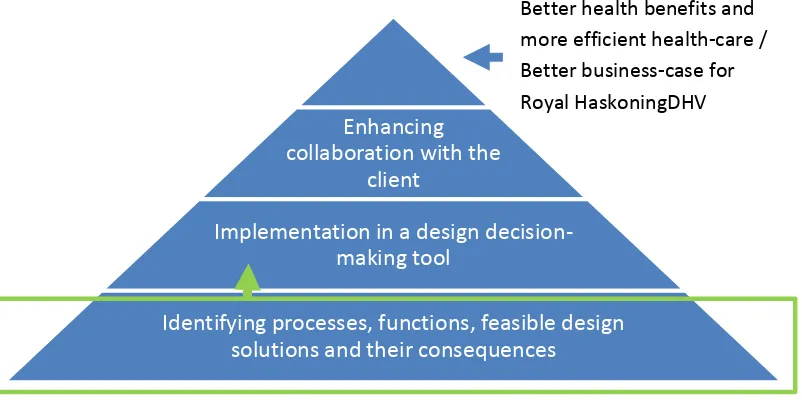
- The boundaries of this research thesis are illustrated in Figure 1 by the green box. The red arrow represents the question ‘how to implement the knowledge in a decision making tool?’
Figure 1 Research objectives and boundaries
2.6.
Research setup
When looking at the design of an isolation room, the whole cycle of the design process should be taken into account. This cycle represents a series of steps used in creating a functional design. The steps often need to be repeated after interacting with the client. This report will be structured by the design cycle of an isolation room as presented in Figure 2. The focus lies on the first three steps. Research question one will be answered by the underlying theory of how to realise the first three bold green steps. These three bold green steps representing research question two up and until four, and the arrow with ‘design-decision making tool’ representing research question 5. A step by step explanation of the design process cycle is given below.
Figure 2 Engineering Design Process (University of Colorado, 2018)
1. ‘Identifying the needs and constraints’ is about asking critical question on what will be created. Who is it for? What processes need to be fulfilled? What functions are wanted? And how are these functions structured?
2. ‘Research the problem’ is about getting a clear overview of what sub-solutions or technologies might be adaptable to the needs and what their characteristics are.
Enhancing
collaboration with the
client
Implementation in a design
decision-making tool
Identifying processes, functions, feasible design
solutions and their consequences
Better health benefits and more efficient health-care / Better business-case for Royal HaskoningDHV
[image:10.595.78.351.461.650.2]3. ‘Develop possible solutions’ is about creating possible solutions out of the combination of sub-solutions and identifying their consequences. In this step, it should be taken into account that it might not be possible to combine all sub-solutions due to dependencies.
4. ‘Select a promising solution’ is about revisiting the needs and research from the earlier steps, compare the best ideas, select one solution and make a plan to move forward with it. 5. ‘Build a prototype’ is about creating the provisional design. This provisional design verifies
whether the design meets the original objectives.
6. ‘Test and evaluate prototype’ is about communicating the results and getting feedback. 7. ‘Redesign as needed’ is about implementing this feedback, making revisions and drawing
new designs.
This research describes the first three steps in the design process by theory, practice and an analysis. Chapter three representing the step ’Identify the needs and constraints’, chapter four the step ‘Research the problem’, and chapter five the step ‘Develop possible solutions’.
Finally, in chapter six, the wanted design decision-making tool connecting the third and the fourth step in the design process will be researched by theory, practice and an analysis.
2.7.
Research methods
The main research strategy used in this report can be described as desk research in combination with interviews with experts. For this research strategy is chosen because there is a lot of information available on this subject, either in earlier conducted research or in the experience and knowledge of individuals. That is also why a survey is not needed. The first four research questions can be
classified as a descriptive research. A descriptive research describes and catalogues the researched subject using predefined systematics (Baarda & Bakker, 2017). The fifth research question can be classified as an explorative research. An explorative research aims at the development of a theory and or sharp formulation of hypothesis. Through explorative research answers to open issues are researched (Baarda & Bakker, 2017).
In this subchapter, research question 1 will be answered. A literature study will be done about the methodologies needed to answer the rest of the research questions.
2.7.1. Identify the needs and constraints
The first research step, identifying the needs and constraints, is directly linked to the different groups that have an interest in the design. To identify the needs and constraints by the viewpoints of the different interest groups, literature research will be done and experts will be interviewed.
Afterwards, the system of an isolation room will be summarised in a functional analysis.
Literature research
A literature research is done for identifying the needs of some of the different groups that have an interest in the design of an isolation room. A summary of the relevant information in the found literature will be presented.
Researching the interests of the patient will be mainly done by a literature research, because contact with this group is restricted in an isolation room. Besides that, a lot of patients should be interviewed or a survey should be held to get an overall view of all the needs. There is already a lot of research done about the interests of the patient in hospital design, so this theory can be used.
In-depth interviews
The theory behind the content of these consultations is based on the design aspects as described by the System Engineering Fundamentals. These design aspects help to make sure the processes for all the interests are covered during the interview (Department of defence, 2001):
- Customer aspects, which consist of the processes resulting from the patient expectations of the system in terms of mission objectives, healing environment, comfort, constraints, and measures of suitability.
- Functional aspects, which consist of the processes following from the necessary task or activity that must be accomplished. This will be processes in terms of services and handling. - Performance aspects, which consist of the question to what extent a process must be
executed, generally measured in terms of quantity, quality, coverage and time. This will be processes in terms of effectiveness, sustainability, flexibility, and risk and budget.
- Design aspects, which describe the relation between spatial aspects and processes. This will be processes in terms of accessibility and spatial requirements.
- Derived/allocated aspects, which consist of processes following from higher-level processes.
An example of the interview setup can be seen in Appendix B.
Functional analysis
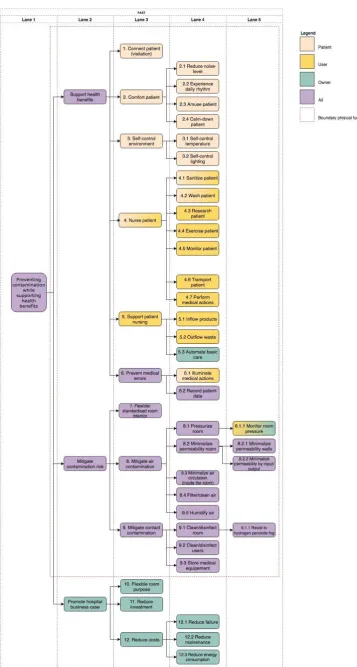
A functional analysis is done to summarise the interest of the different groups. The processes and functions following from these consultations are summarized in a FAST diagram, which stands for Functional Analysis System Technique (Woodhead, 2006). This method has some advantages. Firstly, creative thinking is stimulated because functions are solution-free. Instead of the demand for a tap with disinfecting gel, there is a demand for disinfecting hands, which leaves solutions and
possibilities for the next step in the design process open. Secondly, working with functions can lead to a better understanding of the system for designer and client. This method has the potential to bring things to mind that weren’t thought of in the beginning. A FAST diagram is made using the following steps (de Graaf, 2014).
1. Determine the task
The task can be seen as the main purpose the project has to fulfil, the main need from the client and the reason why the whole system exists. This task defines the main function in the diagram.
2. Determine the functions
Functions need to be identified and will form the basis of the diagram.
3. Determine the function type
This step consists of dividing the functions by type, in basic functions and support functions. Basic functions are essential to carry out the main function or task, as determined in step one. Without basic functions, the system cannot fulfil its purpose and all underlying functions will lose their value. It is possible that there are several layers or degrees of basic functions before they can be linked to supporting functions. Supporting functions are important for the acceptance from the groups having an interest in the final isolation room design. However, they are not essential for the task.
4. Determine the primary function structure
This step is about linking the functions and determining the primary function structure. Beginning with the main function, than the basic functions and by asking the how question finishing with supporting functions. The how and why questions need to be asked to link functions: The how
question forms the structure from general to specific (left to right in the diagram), the why question forms the structure from specific to general (right to left in the diagram).
5. Ordering the functions
6. Making the diagram
The last step consist of completing the diagram. This includes editing the layout and making a legend.
[image:13.595.69.526.162.316.2]Summary research methods
Table 1gives a summary of the used research methods for answering the second research question.
Table 1 Research methods for identifying the needs and constraints
Data source Data collection
method
Structural documentation method
Literature about interest groups Literature research Summary
Literature about patient needs Summary & FAST-method
Expert in integral design In depth-interviews Summary
Expert in the patient needs Summary & FAST-method
Expert in the user needs Expert in the owner needs Expert in technical design aspects Hospital real-estate department
Infection prevention specialist at a hospital
2.7.2. Research the problem
The second research step, researching the problem, is about getting a clear overview of what sub-solutions or technologies might be adaptable to the needs and about getting a clear overview of the characteristics of these sub-solutions. The sub-solutions and technologies should all be linked to a function, so they can be seen as function-carriers. Every function-carrier derived from a function has its own characteristics or criteria. On behalf of these characteristics, decisions can be made.
[image:13.595.63.530.480.554.2]Function-carriers and their characteristics will be determined by previous researched literature and by the experience of experts and will be summarised in a Functional Performance Specification (FPS) table. A template for the Functional Performance Specification is shown in Table 2.
Table 2 Template Functional Performance Specification
Performance characteristics
ID Function-carrier Criteria Performance
level
Bandwidth (regulations/ preferences)
The Functional Performance Specification creates an overview of function-carriers with their
corresponding function, performance characteristics (criteria and performance level) and bandwidth. This bandwidth can be given by regulations, but since the regulations of isolation rooms are quite flexible, the bandwidth can also describe a preference. Whenever possible, the performance level should be expressed in quantified terms (de Graaf, 2014). However, because of the abstraction level of this research, some performance levels may be given using the qualitative terms; ‘High, Medium or Low’. Qualitative terms can only be used if they are validated with experts or if a good reason is given.
Summary research methods
Table 3 Research methods for researching the problem
Data source Data collection
method
Structural documentation method
Literature about performance characteristics Data from previous findings
FPS-method Experience about performance characteristics
Integral meeting/ with an expert in system thinking, a hospital planner, a hospital architect, a hospital logistic expert and a hospital installation technique expert
In depth-interviews
Summary & FPS-method
2.7.3. Develop possible solutions
The third research step, developing possible solutions, can be divided into multiple aspects. First should be determined on which areas decisions are needed and what alternatives do exist within these decision areas. These alternatives correspond with the (grouped) function-carriers. Secondly, the dependencies between alternatives need to be identified. Not all combinations of alternatives are valid due to these dependencies. Thirdly, the criteria on which the solutions are tested will be determined. These criteria should take into account the needs of the different interest groups. Fourthly, every alternative should be given a score for each criterion. The values on these criteria follow from the functional performance specification. And finally, alternatives in different decision areas can be combined in solutions with their characteristics.
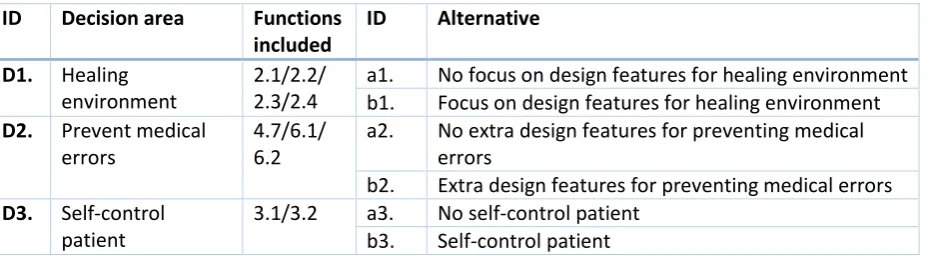
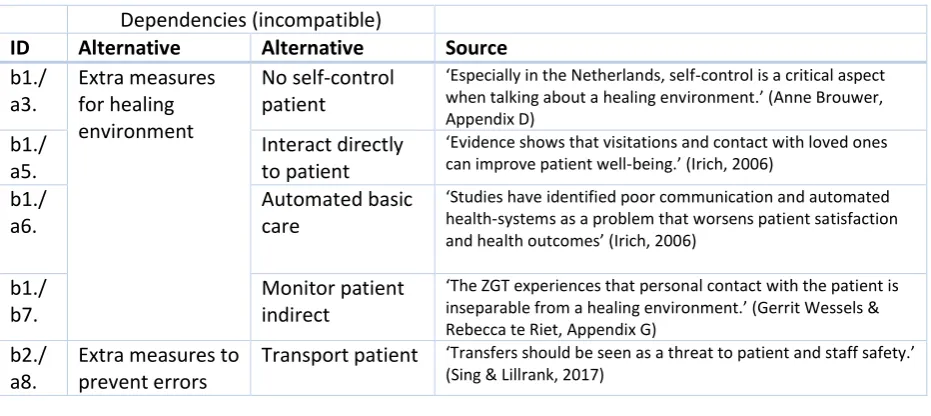
A feasibility assessment method using decision areas, alternatives and dependencies is AIDA. The purpose of this method can be found in the name: ‘Analysis of Interconnected Decision Areas’. This method transforms many relations involved in complex decisions in a set of multiple decision areas. Important is that this method does not automatically create solutions, but identifies potential solutions (N.F.M. Roozenburg, 1998).
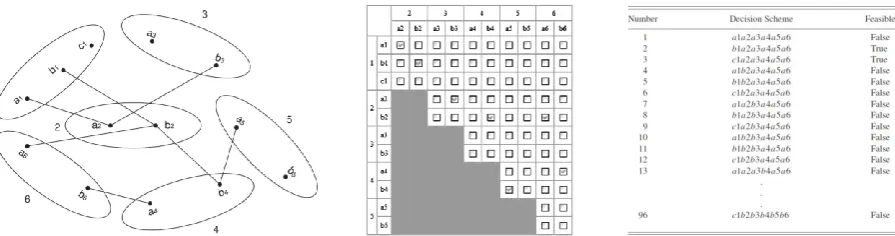
How does AIDA work? The decision areas and the alternatives need to be implemented in a matrix. After that, the dependencies between these alternatives need to be determined and documented in the matrix. Experience of experts is important in defining the feasibility of a design (Tayal, 2013). If two alternatives are negatively dependent, they are incompatible. This means that the two options are technically, economically, aesthetically, or for another reason not possible to combine in one design. AIDA presents these incompatibilities in a so called option graph. A line between options in this graph means that the options are incompatible. When systems are too complex for an option graph, models using an interaction matrix can help to define feasible solutions. Figure 3 gives examples of the possible elements of the AIDA method.
[image:14.595.77.525.550.668.2]Why is AIDA used for developing possible solutions? When designers find it hard to deal with
complex design relations and dependencies in the early design phase, a lot of times clients are forced to accept drastic assumptions and simplifications. This results in the loss of valuable information. AIDA is a method to prevent this loss of information, as it systematically relates and organizes different design decisions. Besides that, the interaction matrix of AIDA can be extended to link characteristics of solutions by different criteria and compare this with predefined performance needs. These aspects even give the possibility of a heuristic design process, in which clients themselves can learn from the different consequences resulting from design decisions (Campbell, 2004). The ability of AIDA to make this connection, directly relates to the research objective.
[image:15.595.65.526.253.313.2]Summary research methods
Table 4gives a summary of the used research methods for answering research question 4.
Table 4 Research methods for developing possible solutions
Data source Data collection
method
Structural documentation method
Previous in depth-interviews and literature research
Data from previous findings
Summary table & AIDA-method
2.7.4. Design decision-making tool
The fourth and final research step, providing a basis for implementing the design system in a collaborative design decision-making tool, is done by making a list of the conditions and
requirements for this implementation. This list is based on the context of design decision-making tools resulting from theory, experience of design decision-making tools resulting from practice, and the researched design system resulting from previous findings.
[image:15.595.69.519.477.549.2]Summary research methods
Table 5gives a summary of the used research methods for answering research question 5.
Table 5 Research methods for a design decision-making tool
Data source Data collection
method
Structural documentation method
Literature about design tool context Literature research Summary / List with conditions & requirements Expert in computer-based design tools In depth-interviews
Potential users of the tool (architects)
3.
Identify the needs and constraints
In this heading, research question 2 will be answered by theory, practice and an analysis. Which processes and functions are identified as relevant depends on the viewpoint from which you look at the design. Therefore, before identification of these relevant processes and functions, the different groups that have an interest in isolation room design will be researched. After that, the needs and constraints will be identified for the interest groups: patients, users, owner and designer.
3.1.
Theory
This subchapter describes the identified interest groups and their relevant processes and functions resulting from theory.
Interest groups
hospital design, the design team conducted a research about the different interest groups (LiBassi, 2017).
The research was founded on the idea of an evidence-based design, taking into account the needs of all interest groups. This resulted in a successful design of 126 patient rooms in the Cleveland Clinic Foundation’s Avon Hospital. The interest groups taken into account were designers, constructors, users, patients, advocacy groups, caregivers (e.g. doctors and nurses), support services professionals (e.g. the physiotherapists or the ICT department of a hospital), the C-suite (e.g. important senior executives as in CEO, CFO, COO, etc.), facilities operations (e.g. the real-estate department of the hospital) and general support services (e.g. cleaners). The mission and objectives came from the design came top down, but input from the research about the core interest groups was crucial to the successful design solution. The final design resulted in a positive impact to the quality of health-care and the working environment (LiBassi, 2017).
The results from the research from the Cleveland Clinic Foundation’s Avon Hospital can be seen as a basis of the interest groups of an isolation room. Consultation of all the groups taken into account in this research can be seen as the ideal way of identifying all the needs and constraints.
Interests of the patients
Especially in isolation rooms, the interests of the patients are very important. Because of their separation of other people, limited space and contents, lack of a view outside and closed doors, patients in isolation rooms are being sensitive to feelings of boredom, monotony and anxiety (Barratt, 2011). When talking about the processes and functions that are of the interests of the patient with regard to isolation room design, a big part is about healing environment.
Within healthcare buildings, healing environment is about the physical settings that support the healing process of patients. The idea is that the physical environment can make a difference in how quickly a patient recovers from or adapts to a disease or chronic condition. This might also result in a better working environment for all isolation room users. The design of healing environments is fundamentally based on creating positive emotions (Peters, 2017). If the idea of a healing environment wants to be taken seriously by the owners of the isolation room, it should also be attractive in terms of costs and benefits. Evidence-based research states that it is. A business analysis of a new US hospital consisting of 300 beds, concluded that inclusion of evidence-based healing environment design aspects added 5,3% to the initial building costs. Estimates of savings and
revenue gains from these aspects however conclude that these costs would be recaptured in just one year. But not only has the idea of a healing environment a positive effect on the hospital business-case, it also improves well-being and safety of their patients and other hospital users (Berry & Parker, 2004). In the section below, the main evidence-based patient needs resulting from the theory are described.
Connect patient
In normal patient rooms, privacy is a big factor within healing environment. Isolation rooms however are normally single-bedded, which makes the issue of privacy not applicable.
However patients will not influence each other, the patient might be influenced by visitations of friends and family or even staff. Even though visitations from family might be restricted in isolation rooms, evidence shows that visitations and contact with loved ones can improve patient well-being. Also staff communication to the patient is important. Studies have identified poor communication and automated health-systems as a problem that worsens patient satisfaction and health outcomes (Irich, 2006). This specific interest from the patient is mostly based on the culture of the healthcare facility. However, the design should contain space for visitations or a possibility to communicate with staff and loved ones without the risk of contamination. This can be described in the function:
Prevent medical errors
Another main concern of patients is that their healing process is extended by human or medical errors. Errors in the health-care can be a result from the health-care process or from the facility design. Two subjects relating to the facility design will be discussed.
Firstly, errors can occur when design of rooms and equipment is different for every facility. When striving for a design preventing medical errors, rooms and equipment should be standardised. When multiple isolation rooms are identical, nurses for example encounter exactly the same distribution, layout and lighting in every room. This makes routine tasks simpler and decreases errors (Grunden & Hagood, 2012). Standardisation of a room is however is directly linked to a flexible room interior. When a room interior is flexible, less specialized rooms are needed and medical errors will decline. A function following from this interest can be described as; ‘Flexible/standardised room interior’.
Evidence is also presented that errors can occur from inadequate lighting. Research shows a linear relationship between error and illuminance levels. The research showed for example that an
illuminance of 1570 lx at the workspace during medical procedures resulted in an error rate of 2,6%, while 480 lx in the same situation resulted in an error rate of 3,8% (Huisman et al., 2012). A function following from this interest of the patient can be described as; ‘illuminate medical actions’.
Comfort patient
There are several evidence-based factors influencing the comfort of the patient. Firstly, Research has concluded that hospitals internationally have to high noise levels when compared to the guidelines as issued by WHO. The WHO suggests that sound levels should not exceed 35 dB with a maximum of 40 dB overnight (Darbyshire & Young, 2013). As a result of noise, patients might encounter sleep loss, high blood pressure and heart rates, which worsen healing time. Also for staff noise can be the cause of stress and in some situations even heighten the risk of error. Noise in hospital rooms is caused by for example overhead gaging, moving bedrails, trolleys, equipment or staff shift changes. These sounds can be loudened by sound reflecting floors and ceilings, which also are the cause of sounds being carried further. Evidence shows that less noise in a hospital is not the result of just changing staff behaviour, but is mainly the result of appropriate design. Some proven design measures are the elimination or insulation of noise sources or the installation of sound-absorbing ceilings tiles (Irich, 2006). A function following from this interest can be described as; ‘Reduce noise-levels’.
Another aspect within the process of comforting the patient is their daily rhythm. There is evidence that daylight exposure in hospital rooms reduces depression, because the rhythm of day and night can be experienced. Mimicking natural daylight is also possible, using artificial circadian light in combination with soft colours and subtle movement. A daily rhythm cannot only be experienced in light, but also in temperature. Lower temperatures at night are appreciated by the patients (Peters, 2017). A function following from this interest can be described as; ‘Experience daily rhythm’.
Furthermore, research suggests stress and pain is reduced if the internal architecture represents calmness. Reduction of stress and pain can also be obtained if patients are in a surrounding where they have a pleasant view. For example a view of nature, people or one that provides information about outside activities are preferred distractions. Besides that, artwork can be effective for these purposes as well (Giplin, 2003). Besides that, technical elements inside of the room should be hidden (Huisman et al., 2012). Two functions following from this interest can be described as; ‘Amuse patient’ and ‘calm-down patient’.
Self-control environment
Guarantee safety
Several evidence-based factors influencing the safety and security of the patient do exist. The first factor is about transferring the patient. Even though transferring isolated patients is unusual, transfers should be seen as a threat to patient and staff safety. They are for example the cause of extended lengths of stay, stress, errors and costs. Also, transfers can involve lifting, which risks injuring patient or staff. A study has shown that 10.5% of back injuries in the US are associated with moving and assisting patients (Engst, Chhokar, & Miller, 2005). Besides that, when moving patients outside of the isolation room, contamination is a real threat.
A proven design measure preventing transfers is for example a flexible equipped headwall or acuity-adaptable room. Acuity-acuity-adaptable rooms have a treatment model that allows all stages of patient care from the time of admission to discharge. Evidence for this solution is given by Clarian Methodist Hospital, where after moving from specialised rooms to acuity-adaptable rooms, patient transfers decreased by 90% and medication errors by 70% (Singh & Lillrank, 2017). This aspect is directly linked to the aspect of preventing medical errors and also has the same function.
Hygiene
Hygiene is also crucial in order to ensure patient safety. Hygiene is associated with the materials used in a hospital. Many environmental surfaces and features become contaminated near infected
patients, and personnel may contaminate their gloves by touches these surfaces. Examples of surfaces that are often contaminated are overbed tables, computer keyboards, infusion pump buttons, door handles, blood pressure cuffs, bedside rails, chairs and other furniture (Huisman et al., 2012). An atmosphere of emotional wellbeing seems to stand in contrast with high standards of hygiene. However, if the architect takes hygiene into account, there is no need to see hygiene and a healing environment as incompatible. A design with tight corners is more difficult to clean than smooth edges. This smooth design may, however, have a negative impact in terms of logistics. Also, smart design materials can be used with functions such as self-cleaning or easy-to-clean, or a photocatalytic antimicrobial coating can be used (Reid, Whatley, & Spooner, 2018). A function following from this aspect is; ‘Clean/disinfect room’. Hygiene is not just about hygiene of the room, but also personal hygiene of the users. Research shows for example that hand-cleaning compliance worse when the object linked to this function are positioned several paces away from users’ movement paths (Irich, 2006). A function following from this aspect is ‘Clean/disinfect users’.
Interest of the users
The needs of this interest group is in theory not described specifically for an isolation room. Besides that, experts have a lot of knowledge available on this subject. Therefore, the interest of the users is researched using in-depth interviews later in this chapter.
Interest of the owner
The needs of this interest group is in theory not described specifically for an isolation room. Besides that, experts have a lot of knowledge available on this subject. Therefore, the interest of the owner is researched using in-depth interviews later in this chapter.
Interest of the designer
patterns are quite complex and specific to a particular design configuration. A function following from this interest can be described as; ‘Minimalize air circulation’.
Further research about the interest of the designer is done later in this chapter.
3.2.
Practice
Not all the needs in processes and functions can be identified by theory. Therefore, additional information from practice is researched. To make sure the identified patient needs from theory are valid, an interview is done. Besides that, interests from the other groups are researched by
[image:19.595.67.536.214.396.2]consultation of experts. In Table 6 an overview is given of the consulted experts.
Table 6 Consulted experts for identify needs and constraints
Expert Expertise Specialization Company Summary
Gerard Jansen Healthcare business developer
Integral design Royal HaskoningDHV Appendix C
Anne Brouwer Healthcare consultant Patient needs Royal HaskoningDHV Appendix D Marianca
Leeuwenburg – Boonk
Hospital planner User needs Royal HaskoningDHV Appendix E
Frans Lenting Project manager healthcare
Technical installations
Royal HaskoningDHV Appendix F
Gerrit Wessels Head of real-estate department Real-estate management Ziekenhuis Groep Twente (ZGT) Appendix G
Rebecca te Riet Infection prevention expert Infection prevention Ziekenhuis Groep Twente (ZGT) Appendix G
An example of the interview setup can be seen in Appendix B.
Interest groups
Identification of relevant processes and functions depends on the viewpoint from which you look at the design. The interest groups as experienced in practice can be described as follows; the patient, the user, the owner and the designer. Figure 4 displays the interest groups with their main concerns as experienced in practice (Gerard Jansen, Appendix C).
Figure 4 Groups that have an interest in isolation room design with their main needs (Gerard Jansen, Appendix C)
• Combining all needs • Pleasing the owner • Making a provit out of
the design project • Reduction of length of
stay
• Well-trained team • Return of capital invested
• Real-time information flow, communication • Avoiding medical errors • Design making their job
more easy • Noise, hygiene, natural
lighting
• Reliable health outcome • Communication with
family.
[image:19.595.121.453.503.758.2]Interest of the patient
The Interests of the patients as described in section 3.1 Theory are discussed and validated by an expert in the patient needs. These identified interests are a good representation of the interests of the patient in practice (Anne Brouwer, Appendix D).
As an addition, the continuity of the whole system can be seen as an important interest of the patient. When a technical system, for example a button to call the nurse, is malfunctioning, the patient can feel unheard or even panic. Especially in an isolation room this is critical. All systems have to be technically correct (Anne Brouwer, Appendix D).
Interests of the users
The users of an isolation room experience the results and consequences of isolation room design first hand. The processes and actions from these isolation room users shape the final design of the room. Functions following from the processes experienced by the users that influence isolation room design are described below.
Receive/dismiss patient
For receiving and dismissing a patient in an isolation room, the patient should be able to get in and out of the room while lying on his/her bed. It is not necessary for the bed to fit into an air-lock (Frans Lenting, Appendix F). A function following from this process is; ‘Transport patient’.
Registration patient data
The design should facilitate a place where patient data can be registered and saved. Also information updating the patient health record should be easy to implement. This place should be easy accessible for the user and has a relation to place where the medical interventions are carried out (Gerrit Wessels & Rebecca te Riet, Appendix G). The following function will be taken into account; ‘Record patient data’.
Minor interventions
The user should be able to carry out medical actions within the room. To do so, some design features are needed like electricity, medical gasses and extra lighting (Marianca Leeuwenburg – Boonk, Appendix E). This process is described by the function; ‘Perform medical actions’.
Research patient
Besides medical interventions, the room should also facilitate the basis needed to research a patient. Normally this is done outside of a patient room, but because of the contamination risk, basic
research in isolation rooms should be facilitated in the room itself (Marianca Leeuwenburg – Boonk, Appendix E). A function following from this process is; ‘Research patient’.
Rehabilitation exercises on bed, out of bed/ physical therapy
Space for movement is limited when a patient needs to stay inside of one room. Movement is however sometimes necessary van recovery of a patient. For extensive physical training, a patient may be given permission to leave the room, however minor exercises from a physiotherapist need to be carried out inside of the room (Gerrit Wessels & Rebecca te Riet, Appendix G). A function
following from this process is; ‘Exercise patient’.
Sanitary process
Monitoring the patient
Users need to check on the health status of every patient while making their round. It is important that the patient can be seen from within the air-lock or from the hallway (Gerrit Wessels & Rebecca te Riet, Appendix G). A function following from this process is; ‘Monitor patient’.
Patient Transporting
Even though the contamination risk is high when transporting an infected patient outside of the isolation room, a hospital sometimes chooses to do so. For instance when a medical action needs to take place that cannot be carried out inside of the room. In this case, a patient including the bed needs to be transported. Even though the process of receiving/dismissing is in a different point in the recovery cycle, the process with regard to design can be seen as the same as for patient
transportation. In both cases, the patient, including the bed, needs to leave or enter the room. So also the function for this process will be the same, namely; ‘Transport patient’.
Providing products
The patient needs to be provided with products needed for their life and health recovery. This can be drinks, food, disposables or medication. The design should support the inflow of these products (Marianca Leeuwenburg – Boonk, Appendix E). This results in the function; ‘Inflow products’.
Disposal of waste / medical waste
Produced waste might be labeled as contaminated. Therefore, disposal of waste and medical waste is a careful process (Marianca Leeuwenburg – Boonk, Appendix E). Overall, this function will be
described as; ‘Outflow waste’.
Cleaning
Hygiene is important inside of isolation rooms. The spatial design should be easy to clean and thereby facilitate support to the cleaner. Cleaning or disinfecting of an isolation room is more important than the cleaning of a normal patient room. That is why besides cleaning by hand, another, more efficient cleaning method is possible. This efficient cleaning method is a way of cleaning a room all in ones is using a machine for the nebulization of hydrogen peroxide. However, not every room can resist hydrogen peroxide fog, especially the ceilings. Also leakage of the room should be really low and the air exhaust should be able to be shut-down in a single room to contain this hydrogen peroxide fog. These are aspects that need to be taken into account when designing an isolation room (Gerrit Wessels & Rebecca te Riet, Appendix G). A function following from this cleaning method is; ‘Resist to hydrogen peroxide fog’.
Interests of the owners
The owner of an isolation room in a hospital is most of the time the real-estate department of the hospital. This group is interested in a functional design according to the patient and user their needs, but also looks at the design taking performance into account. Functionality supports the core of the isolation-room, because it addresses the problem that brings the patient to the facility in the first place. Performance is about how effective this function is carried out, looking at the whole life-cycle of the isolation room.
Preventing contamination
The main interest of the owner is in line with the core purpose of the room: Isolating patients to mitigate contamination risk, resulting in the function; ‘Mitigate contamination risk’. Contamination can happen in multiple ways, for example through air. The function ‘Mitigation air contamination’ can be broken down into several sub-functions (Frans Lenting, Appendix F):
- Pressurize room
- Minimalize air penetration walls - Minimalize room openings - Filter/clean air
Another aspect of mitigating the contamination risk is contact contamination, resulting from people walking in and out of the room or through waste and laundry. Contact contamination is the spread of contamination caused by particles carried on objects and persons. Users of an isolation room need to change their clothes in the air-lock to prevent this contact contamination. This air-lock should be big enough to divide ‘clean’ and ‘dirty’ objects. Besides that, medical equipment also needs to be disinfected in the air-lock when entering and leaving the room. This is also the reason why in isolation rooms, more medical equipment is stored inside of the room itself (Gerrit Wessels & Rebecca te Riet, Appendix G). Function following from this interest are; ‘Prevent contact contamination’ and ‘Store medical equipment’.
Patient healing
The core purpose of the room however is not just to prevent contamination, but also to improve patient healing in the same time, as is the main goal of the whole hospital. A function following from this interest can be described as; ‘Healing patient’. Functions for patient healing are already
described earlier in the report. However, the healing process requires inflow of product and outflow of waste. These functions are in conflict with preventing contamination. For this reason, basic actions for the healing process can be carried out by automated systems. A function following from this interest can be described as; ‘automate basic care’. Nevertheless, it is important to take into account that automated care is in conflict with comforting the patient by interacting directly (Anne Brouwer, Appendix D).
Flexible room purpose
Furthermore, another interest from the owner can be found in a flexible room design (Marianca Leeuwenburg – Boonk, Appendix E). There are not always patients who are contagious or need protection against contamination. In the ZGT hospital, isolation rooms are around half of the time not used for the purpose of preventing contamination (Gerrit Wessels & Rebecca te Riet, Appendix G). Hospitals do not want isolation rooms to be empty. To use the space efficiently, the owner of a hospital wants to use empty isolation rooms for another purpose, for example for normal nursing rooms. To make sure this is possible, isolation rooms need to be designed for a flexible purpose. A example of a design aspect resulting from a flexible purpose is a small air-lock. Big air-locks can be seen as lost space, since the space is occupied just during really small periods of time, especially when taking into account the room is sometimes used for another purpose. A function following from this interest can be described as; ‘flexible purpose room’.
Making profit
For the owner of an isolation room the healing process of a patient can be seen as business. In the end, investments need to be paid back and money needs to be made. This is the concern of the owner of the health-care facilities. Functions following from this interest can be described as; ‘Reduce investment’ and ‘Reduce costs’. Examples of costs can be costs as result of failure, maintenance or energy consumption (Frans Lenting, Appendix F).
Interests of the designer
The job of the designer is to combine all needs from the different groups and implement them in the final design. The designer should know which design solutions are available and which design
Mitigating the risk of contamination by air relates to the interlock time and the air-change rates of the lock and isolation room. The interlock time is the time needed between opening the two air-lock doors to prevent contamination. Air-change rates tell how many times the air inside of a room needs to be totally refreshed in one hour. The size of the air-lock is directly linked to the
contamination risk, since a bigger air-lock automatically mean that it takes longer to clean all air inside, which results in a longer interlock time. However, a smaller air-lock means less space to separate dirty and clean objects, which results in a higher risk of contact contamination. This is something the designer should take into account (Frans Lenting, Appendix F).
Another thing important for a designer with regard to air contamination is the settlement of the building. After construction, a building can still move a bit due to the applied loads. This may result in a different air permeability of the room over time, which can lead to a higher contamination risk (Frans Lenting, Appendix F).
All the functions identified before can be seen as interests from the designer. Even though the designer has to cope with some regulated technical specifications, there are no functions identified resulting just from the interests of the designer.
3.3.
Analysis
Analysing the theory and practice to answer research question 2 is done is this sub-chapter. First, the differences between theory and practice are verified. Afterwards, a functional analysis is done.
Verification theory and practice
It is possible that theory and practice do not give the same information. Therefore the results from literature research and expert interviews are compared.
Interest groups
On an abstract level, theory and practice identify the same interest groups for an isolation room design. However, when going into detail, the experts from Royal HaskoningDHV are not all familiar with the needs of each specific interest group at detail. Especially the interests of users like support services professionals or general support services. The four interest groups that are described in this report are known by theory and practice.
Interests of the patients
The interests of the patients are well known in both theory and practice. Since the focus of healthcare shifted to the patient, a lot of knowledge about the patient needs is produced. Not all theoretical knowledge is however applicable in practice and the interest of the patient might not always go in line with the interests of other groups. These dependencies are more known in practice and less described in theory.
Interests of the users
The interests of the users are in this report researched just by practice. Verification of theory and practice is therefore not possible.
Interests of the owner
The interests of the owner are in this report researched just by practice. Verification of theory and practice is therefore not possible.
Interests of the designer
Ideally, the designer has no interest in the design himself. However, the designer should guarantee the final design does comply with the existing regulations and determined safety level for
Functional analysis
As a result of the identified needs and constraints, a functional analysis can be done using a FAST diagram. Six steps are made in analyzing the identified processes and functions.
1. Determine the task
When looking at isolation rooms in health care facilities, the main task can be described as infection control or preventing contamination. This describes the process of protecting the isolated patient and the other patients in the hospital for contagious diseases. However, when only this would be the main task, patients could just be locked in to air tight boxes, without paying attention to their healing process. That is why another aspect needs to be implemented in the main task. An isolation room also needs to support the healing process of the isolated patient. So health benefits for all patients in the hospital are improved.
Task: Preventing contamination while supporting health benefits
Preventing contamination can have the purpose of protecting the patient, protecting the
surrounding (preventing a contamination outbreak) or both. Even though these purposes can have different technical function-carriers, their main functions are the same. Therefore, the task does not have to make a distinction between these purposes.
2. Determine the functions
The functions are determined by consulting experts. Also, evidence-based functions are determined by assessing literature. The functions as identified in this research are used to create the FAST diagram.
3. Determine the function type
This step consists of dividing the functions by type, in basic functions and support functions. Because of the abstraction level of this research and the freedom of choice with regard to function-carriers, the FAST diagram that will be made focusses mainly on the basic functions.
4. Determine the primary function structure
In this FAST diagram for isolation rooms, functions are broken down until they can be linked to function-carriers that can be validated. The function that follow from the needs of the owner, so the clients’ business-case, are an exception to these rule, since these functions do not describe physical objects.
5. Ordering the functions
This step consists of ordering the functions by different categories. These categories will be corresponding to the interest groups the functions are derived from. Hereby the differences and similarities in interests between groups are made visible. This is valuable information when trying to make a design that includes the needs of all interest groups. Because the designer has no specific functional interest in the design himself this group is not taken into account by ordering the functions.
6. Making the diagram
4.
Research the problem
In this heading, research question 3 will be answered by theory, practice and an analysis. Research will be done to provide an overview of the sub-solutions or technologies which might be adaptable to the different needs.
4.1.
Theory
Besides the researched literature in the previous chapter, the WIP design standards (WIP, 2004) & (WIP, 2006) and the RHDHV knowledge document (Lenting, 2017) are used to specify function-carriers, their characteristics and the regulations and preferences. When the researched literature, the WIP documents or the RHDHV knowledge document doesn’t give any bandwidth or preference for a criterion, the bandwidth will be left blank.
The result from this research is summarised in a Functional Performance Specification. Because of its size, the diagram is placed in the appendix, Appendix L.
4.2.
Practice
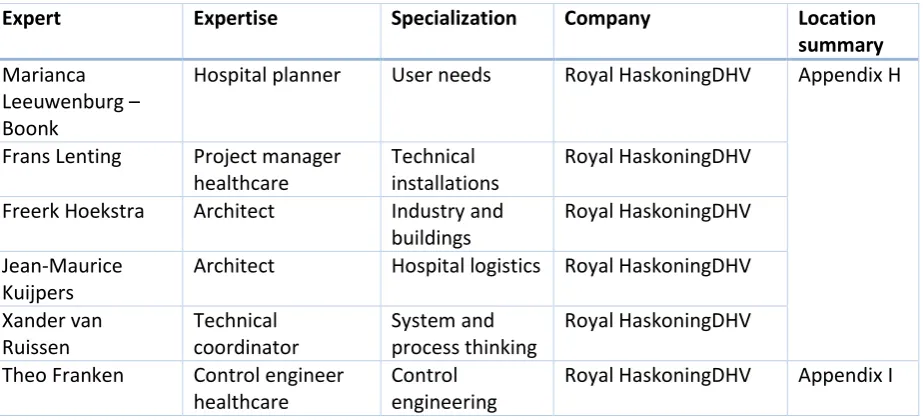
[image:26.595.70.532.367.577.2]To complement the identified function-carriers and their characteristics from theory, also research in practice is done. Besides the function-carriers and characteristics that can be identified as a result of the previous consultations, an integral design meeting is organised. The purpose of this integral design meeting was to identify the performance characteristic of the criterion ‘spatial constraint’. In Table 7 an overview is given of the consulted experts.
Table 7 Consulted experts for researching the problem
Expert Expertise Specialization Company Location
summary Marianca
Leeuwenburg – Boonk
Hospital planner User needs Royal HaskoningDHV Appendix H
Frans Lenting Project manager healthcare
Technical installations
Royal HaskoningDHV
Freerk Hoekstra Architect Industry and buildings
Royal HaskoningDHV
Jean-Maurice Kuijpers
Architect Hospital logistics Royal HaskoningDHV
Xander van Ruissen
Technical coordinator
System and process thinking
Royal HaskoningDHV
Theo Franken Control engineer healthcare
Control engineering
Royal HaskoningDHV Appendix I
The results from this analysis are summarised in a Functional Performance Specification. Because of its size, the diagram is placed in the appendix, Appendix L.
4.3.
Analysis
Analysing the theory and practice to answer research question 3 is done is this sub-chapter. To show relations between the identified functions and the identified function-carriers, these relations are added in the Functional Performance Specification.
The main function ‘promote hospital business case’ is not included in the functional performance specification, because this function cannot be described in physical objects.
[image:26.595.64.541.368.578.2]