Supervisors:
R. (Rike) Bron MSc.
Dr. M.D. (Maaike) Endedijk
Faculty of Behavioural, Management
and Social Sciences
Team learning in higher education: the
explication of shared mental models in
relation to educational design decisions
Acknowledgement
I am very proud to present to you my master thesis. With this thesis, the master programme of ‘’Educational Science and Technology’’ at the University of Twente is completed. This thesis is the result of nearly a year of hard work, some insecurities and a lot of learning experiences. While working on my thesis I received a lot of support from many people and therefore I would like to thank them.
At first, I would like to thank my first supervisor Rike Bron for her continuous support during the past year, for her patience, motivation and knowledge. I could not have done this without her. I would also like to thank Maaike Endedijk for being my second supervisor. Her guidance and support helped me to improve and complete the research.
Next to my supervisors I would like to thank my family, including my in-laws, and friends for supporting me during my master programme and final project. Thank you for your interest and for listening, even though you didn’t always understand what I was talking about. In special I would like to thank Kirsten, who I have met during the pre-master. Thank you for your help with my English language, but even more important: thank you for being my best friend.
Next to her, I would like to thank Anouk, Kristie and Robert for their English grammar and language support, without you it would not have been as good as it is now.
And last, but not least, I would like to thank my boyfriend Koen. I am very thankful that you have given me the time, faith and the opportunity to follow my heart to start and to complete this study.
To all of you, thank you, I could not have done this without your support.
Table of contents
Acknowledgement ... 2
Abstract ... 4
Introduction ... 5
Theoretical framework ... 6
Method ... 8
Research design ... 8
Sample ... 8
Procedure ... 8
Instrumentation ... 9
Data analysis ... 10
Results ... 11
Descriptives ... 11
Chi-square analysis ... 14
Qualitative analysis ... 14
Discussion and conclusion ... 20
References ... 23
Abstract
Due to more complex tasks and changing environments in professional and educational organizations, teamwork is becoming more common since teams are expected to be more creative and expeditious in solving problems. To have teams work together in a harmonious and effective way, team learning and a shared mental model must be considered. Previous research has shown that team learning leads to a shared mental model and that this results in team effectiveness. Most research measured team learning and the shared mental model through perceptions of team members. However, it is proven that the shared mental model is continuously changing through team member interaction. But, scarce research is focussed on this. Therefore, two different measures of the explication of the shared mental model are used in the current study to see how the shared mental model changes over time and how this leads to sustained decisions. In this descriptive qualitative multiple case study data of two higher education teacher teams are collected. Observations of higher education teacher team meetings are used to measure team learning processes and the shared mental model of the team. With use of the chi-square analysis, the Fisher’s exact test and qualitative analysis there are found some interesting results. Cognitive decisions have an important role in the facilitation of the transition from engaging in team learning to arriving at sustained decisions. In addition, action decisions are an important facilitator for cognitive decisions to become sustained decisions. Thereby is found that topics that were discussed multiple times have led to more sustained decisions than topics which were discussed less. Therefore, it is concluded that the explication of the shared mental model can facilitate the transition from engaging in team learning to arriving at sustained decisions in a positive way. The combination of qualitative and quantitative research methods provides a view on how the shared mental model develops over time and how sustained decisions can be reached.
Introduction
Professional and educational organisations are facing more complex tasks and changing environments than ever before (Dochy, Gijbels, Raes & Kyndt, 2014). Because of these complex tasks and the pressure to perform better in a short period of time, teamwork is becoming more common. Teams consist of a varying number of people with different backgrounds and in comparison to individuals, due to interaction within teams, new ideas are more likely to arise than in an individual’s mind alone, and as such, teams can produce more creative and innovative results (Akkerman, Admiraal, Simons & Niessen, 2006). Teams share responsibility and workload and therefore teams are a powerful tool to deal with complex tasks (Mathieu, Heffner, Goodwin, Salas & Cannon-Bowers, 2000; Akkerman et al., 2006; Van den Bossche, Gijselaers, Segers, Woltjer & Kirschner, 2011).
Although research has underlined the effectiveness of teamwork, it is still barely used in the teaching context of higher education. But, over the years, attention has grown for multidisciplinary education all over the world (Newell, 2009; Spelt, Biermans, Tobi, Luning & Muler, 2009; Akbari, Kashani & Hooshmand Chaijani, 2016). To provide multidisciplinary education, it is important that teachers of different backgrounds work together and share their knowledge. Most teachers in higher education are accustomed to work individually on subjects. However, to cope with the challenges of providing multidisciplinary education, collaboration between teachers is indispensable. It is known that a shared understanding of the task and how to perform this task (in the current study named the shared mental model) among the team members must be present to be effective. However, it can be a challenge to develop a shared mental model among the team members, due to a large variation in individual perspectives (Van den Bossche et al., 2006). To handle this, team members need to communicate by sharing, talking (co-construction) and discussing (constructive conflict) about team and task related subjects to reach an agreement which will be present in the shared mental model of the team. Therefore, it can be stated that team learning processes are essential to build and maintain a shared mental model (Van den Bossche et al., 2006; Decuyper, Dochy & Van den Bossche, 2010). Sometimes teams change their minds about subjects and through team learning processes new or different agreements can be reached. This means that the shared mental model can change or develop over time due to the team learning processes in teams.
Previous research was mainly focussed on perceptions of team members about team learning processes and the shared mental model (Langan-Fox et al., 2001; Van den Bossche et al., 2006). But, since perceptions do not give a realistic view on the shared mental model, observational methods are introduced. Recent studies of Van der Haar et al. (2013) and Raes et al. (2015) have used observational methods to study team learning behaviour and shared mental models in teams. However, these do not give insight in how team learning processes are building the shared mental model. By observing the team learning processes and shared mental models in the interaction of teams, a very realistic view can be created about how shared mental models are build, what they contain and how they develop over time.
Theoretical
framework
In this paper the term ‘team’ is used according to the definition of Kozlowski & Bell (2003):
Two or more individuals who (a) exist to perform organizationally relevant tasks, (b) share one or more common goals, (c) interact socially, (d) exhibit task interdependencies (i.e., work flow, goals, outcomes), (e) maintain and manage boundaries, and (f) are embedded in an organizational context that sets boundaries, constrains the team, and influences exchanges with other units in the broader entity (p. 334).
To let teams work successfully and harmonious together, previous research states that team learning must be considered. There are different ways to define team learning, on the one hand it can be seen as an outcome, on the other hand as a process. To start with, Edmondson, Dillon and Roloff (2007) define team learning as an outcome of team work. But, for example, Edmondson (1999) defines team learning as an ongoing process of reflection. London and Sessa (2006) define team learning also as a process but they define it more as a group process from moving from individual fragments to a group a whole. Van den Bossche (2006) defined team learning as: ‘’The process of building and maintaining a shared conception of a problem or task, distributing responsibility across members of the group, sharing expertise, and mutually constructing and negotiating cognition” (p. 5). This definition fits with the current study since it defines team learning as an essential component in the process of building and maintaining a shared mental model. Team learning occurs, consciously or unconsciously, while team members are working and communicating in teams (Decuyper, Dochy & van den Bossche, 2010). This means that team members are learning together, even when they are not aware of this phenomenon. According to Van den Bossche et al. (2011) there are three team learning processes which occur during team members’ interaction: sharing, co-construction and constructive conflict.
Sharing is the process wherein a team member shares (new) information about his personal knowledge, skills or thoughts while others are actively listening (Van den Bossche et al., 2011). When another team member adds information in the conversation, it is possible that sharing transforms into co-construction (Dochy et al., 2014).When team members start to refine, build on or modify the original information, we speak of co-construction because it may result in new insights, which contributes to the development of shared knowledge (Van den Bossche et al., 2006). Decuyper, Dochy and Van den Bossche (2010) state that when engaging in co-construction, ‘’team members take the interaction one step further as they engage in repeated cycles of acknowledging, repeating, paraphrasing, enunciating, questioning, concretizing, and completing the shared knowledge, competencies, opinions or creative thoughts” (p. 6). In this way team members are adjusting their own and other team members’ visions. This leads to shared knowledge, which was not yet available in the team (Van den Bossche et al., 2006). Sometimes team members do not agree with each other and diverge in their interpretations and perspectives. This difference may lead to a constructive conflict, in which team members go into a further elaboration and negotiation of the information to achieve a shared point of view (Van den Bossche et al., 2011). Sometimes a disagreement does not lead to a constructive conflict because e.g. team members could ignore the conflictual topic and move onto another topic, or a conflict could be a personal rejection which makes it not constructive and therefore it does not lead to new knowledge or beliefs of team members (Vangrieken, Dochy & Raes (2016). Constructive conflict is considered as the most important and complex process (Van den Bossche et al., 2011), because it is ‘’necessary to come to fundamental changes in thought and behaviour” (Dochy et al., 2014, p. 25).
through social interaction (Akkerman et al., 2007). We see the shared mental model as: each team member has the same idea, agreement and understanding about the team and their task in his or her mind. Therefore, it is very important for team functioning because it allows team members to predict the behaviour of other team members (Mathieu et al., 2000). Since the shared mental model must be present in each team members’ mind, it is important that each team member understands and agrees on the shared mental model (Van den Bossche et al., 2006). While team members are talking about a specific topic, they get a shared point of view on this topic and therefore it could be included in the shared mental model (Van den Bossche et al., 2011). But, sometimes team members discuss a topic again or a situation changes and this could lead to a reconsideration of a decision. This means that the shared mental model is dynamic and there is a possibility that the shared mental model adapts over time.
Previous research has been using questionnaires, interviews, concept mapping and observations to measure the shared mental model (Akkerman et al., 2007). Recent studies have found ways to measure the shared mental model by looking at the explication of the shared mental model by means of wrap-ups in team meetings. The shared mental model is explicated when team members get to a decision together and explicitly pronounce this decision, which is called a wrap-up. Wrap-ups are conclusions or decisions during or at the end of a team learning process. Since it is a conclusion or a decision during a team meeting, team members agree on the wrap-up, and therefore it will be present in their shared mental model. However, there are four different types of wrap-ups according to Raes et al. (2015). We speak of a postponed wrap-up when there is an agreement expressed to postpone a decision about the topic of discussion (Raes et al., 2015). This occurs when team members are not able to decide yet due to various reasons. It is called a cognitive wrap-up when there is an agreement about the topic and it is explicitly summarized or repeated as a conclusion of the discussion (Raes et al., 2015). Sometimes a cognitive up ends with an expressed explicit intention for action and therefore this is called an action wrap-up (Raes et al., 2015). And lastly, sometimes a team learning process does not end with a wrap-wrap-up, since none of the team members end the topic with an agreement or decision, this is what is called a no wrap-up (Raes et al., 2015). According to Van der Haar et al. (2013) team learning processes that do have a wrap-up have a greater impact on team effectiveness than team learning processes without a wrap-up. By measuring wrap-ups, it becomes possible to measure the actual shared mental model during team meetings instead of perceptions of the shared mental model afterwards. In addition, by measuring wrap-ups in different meetings of the same team, it becomes possible to measure how the shared mental model develops and how it adapts over time.
When teachers in higher education develop a course together, they must make an intended curriculum. The intended curriculum is a document wherein teachers decide on how to perform the curriculum, which contains educational design decisions such as; ‘’aims and objectives, content, learning activities, teacher role, materials and resources, grouping, location, time and assessment’’ (McKenney, Nieveen, & Van den Akker, 2006, p. 122). These educational design decisions are mostly discussed during teacher team meetings, and when team members agree to decide about a specific topic, this will be written in the intended curriculum. Therefore, the intended curriculum is seen as the ‘final’ shared mental model of the teacher team, which makes it possible to measure the sustainability of the decisions which are made during the teacher team meetings.
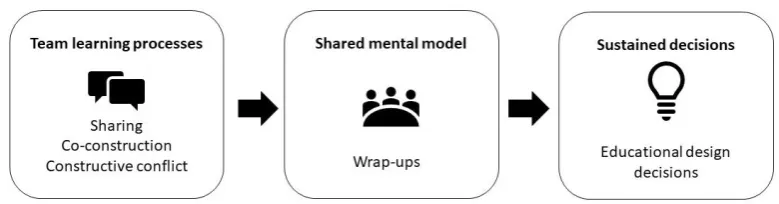
led to a decision which is present in the course manual. In figure 1 the research model of this study is displayed.
Figure 1. Research model of this study
The current study is focused on the following main research question:
1) How does explication of the shared mental facilitate the transition from engaging in team learning to arriving at sustained decisions?
To answer the research question, the following sub questions will be answered:
a) Which types of wrap-ups exist in episodes of sharing, co-construction and constructive conflict? b) How do different types of wrap-ups influence the sustainability of the decision?
c) How do shared mental models evolve during team learning discussions?
Method
Researchdesign
To find out how the explication of the shared mental model facilitates the transition from engaging in team learning to the arriving at sustained decisions, a descriptive mixed methods multiple case study was conducted.
Sample
Two teams from different faculties were selected to create an as best possible representation of the population, to make the current study generalisable. The two teams were picked because these teams met on regular basis which gave the opportunity to measure how the shared mental models develop over time.
In total, data from two teacher teams, with seven and eleven team members, of a university in the Netherlands were collected. Through innovation new teacher teams, of teachers which only new each other by face/which have never worked together, were formed to develop new courses. Team A (n1 = 7) developed a course for social science education and team B (n2 = 11) developed a course for technology science education. The team members met on regular basis wherein the development of the course was discussed. Team A met five times and team B four times, both in a timeframe of a half year. The duration of each team meeting varied between sixty to ninety minutes.
Procedure
curriculum is stated and thus the educational design decisions, that both teams created during the meetings were collected. The data was gathered during the development process of the course and ended at the start of the developed course. Prior to the start of the research, all participants signed an informed consent form to approve for the use of the data.
Instrumentation
After transcribing the team meetings, the word file was converted into an excel file in which further analysis took place. Only verbal communication was considered in the transcription. The transcript was segmented in episodes (a part of the transcript with one specific team learning process and topic), which were based on eleven education-related topics which were coded bottom-up (see Appendix A, table 7). The episodes with topic code Process were left out of the data since these episodes are only about rules, actions and materials for coordinating or structuring the team meeting or the design process itself and are therefore this does not give us usable information about the development of the intended curriculum.
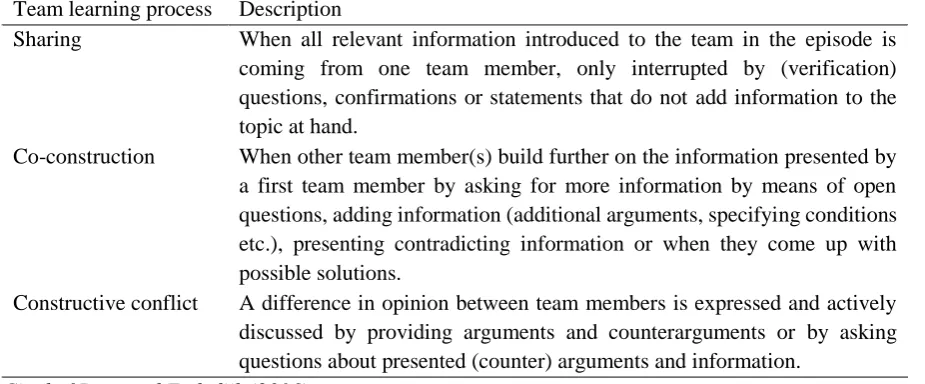
[image:9.595.70.533.452.644.2]Coding of team learning processes To measure team learning, the coding scheme of Bron and Endedijk (2016), which was based on the codebook of Raes et al. (2015), has been used, since they also studied team learning behaviour in higher education. Table 1 shows the team learning process codes including descriptions. Based on the interaction utterances in the episode was decided whether sharing, co-construction or constructive conflict was coded. Besides, there is considered that there is a hierarchy in team learning processes, this means that a co-construction episode also contains parts of sharing and that constructive conflict episodes can contain sharing and co-construction parts. For this reason, the most complex team learning process will be coded.
Table 1
Description of the three team learning processes
Team learning process Description
Sharing When all relevant information introduced to the team in the episode is coming from one team member, only interrupted by (verification) questions, confirmations or statements that do not add information to the topic at hand.
Co-construction When other team member(s) build further on the information presented by a first team member by asking for more information by means of open questions, adding information (additional arguments, specifying conditions etc.), presenting contradicting information or when they come up with possible solutions.
Constructive conflict A difference in opinion between team members is expressed and actively discussed by providing arguments and counterarguments or by asking questions about presented (counter) arguments and information.
Cited of Bron and Endedijk (2016)
During the development phase of the coding scheme, three coders regularly discussed the coding scheme with each other and adapted it. The interrater reliability is calculated in a previous research for three raters, based on 247 episodes. This resulted into an agreement of 86% with a Kohen’s Kappa of .68, which is ‘substantial’ according to Landis and Koch (1977).
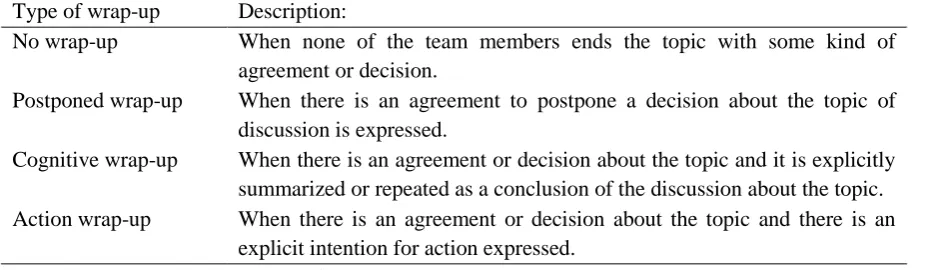
team learning processes, the codebook of Bron and Endedijk (2016) is used, which is based on the codebook of Raes et al. (2015). Four different types of wrap-ups were coded, which are presented in Table 2.
Table 2
Description of the four different types of wrap-ups
Type of wrap-up Description:
No wrap-up When none of the team members ends the topic with some kind of agreement or decision.
Postponed wrap-up When there is an agreement to postpone a decision about the topic of discussion is expressed.
Cognitive wrap-up When there is an agreement or decision about the topic and it is explicitly summarized or repeated as a conclusion of the discussion about the topic. Action wrap-up When there is an agreement or decision about the topic and there is an
explicit intention for action expressed. Based on Bron and Endedijk (2016)
The interrater reliability of two coders was based on 94 episodes, of which the coders had an agreement of 93% with a Cohen’s Kappa of .82 which is ‘almost perfect’ according to Landis and Koch (1977). To make a comparison with the course manual and to analyse the recurrence of specific topics, the content of the wrap-up was logged.
To measure the sustainability of the shared mental model the course manuals of the teams were collected. The course manual is a document for teachers who will teach in this course and for students, so they know what to expect during the course. In addition, these course manuals include the intended curriculum in which the educational design decisions are presented, which means that all characteristics of the course are written down.
Data analysis
Results
The purpose of the current study was to determine how wrap-ups facilitate the transition from engaging in team learning to arriving at sustained decisions, by looking at the development and the sustainability of the shared mental model. In this section the results of the current study are presented. First, descriptive statistics of the variables are provided. Subsequently, chi-square analysis and Fisher’s Exact tests have been conducted. In the end, qualitative analysis has been done to see how the shared mental model develops over time.
Descriptives
In total there were 214 episodes in all team meetings of which 26 episodes of sharing, 156 episodes of co-construction and 32 episodes of constructive conflict. In table 3, the occurrence of the different types of wrap-ups in the different team learning processes are shown.
Table 3
Crosstab with Team learning processes and Wrap-up, including Observed Frequencies, Expected Frequencies and Adjusted Residuals
Team learning process
Wrap-up
Total No
wrap-up
Postponed
wrap-up Action Cognitive
Sharing Observed Frequency 7 6 4 9 26
Expected Frequency 11.2 1.6 2.9 10.3
Adjusted Residual -1.8 3.9 .7 -.6
Co-construction Observed Frequency 71 5 19 61 156
Expected Frequency 67.1 9,5 17.5 62.0
Adjusted Residual 1.2 -2.9 .7 -.3
Constructive conflict Observed Frequency 14 2 1 15 32
Expected Frequency 13.8 1.9 3.6 12.7
Adjusted Residual .1 .0 -1.6 .9
Total Observed Frequency 92 13 24 85 214
Significant deviations of the observed frequency from the expected frequency are presented in Bold.
An important result was the large number of cognitive wrap-ups in the team learning processes. 85 of the 214 episodes were coded as cognitive, which indicates that a huge part of the episodes in the team meetings ended with a cognitive wrap-up. Also, another major part of the episodes is ended without a wrap up.
design decisions, for example; ‘[..] money is available’ and ‘the module coordinator will receive a compensation of 1 EC’. A last cause could be that however the decision in the wrap-up seems relevant in relation to the educational design decisions, it is for some reason not present in the course manual. For example: ‘The integral test could be made in two parts’, ‘Students can fail course [A] but still complete the course’, ‘The first four weeks will be about subject [X]’ and ‘Students will be judging each other’s professional attitude’. Since the content of the wrap-ups was not present in the course manual due to these four different reasons, each wrap-up was categorised as not present. Thereafter we found wrap-ups present in the course manual in two different ways. The first category is that the wrap-up is present (fully or partly) in the course manual, but that this is related to the development of a final wrap-up. The content is therefore leading to deciding, a step before making the decision. Wrap-ups were categorised as in development for example: ‘We need to think about how we will implement the evaluation’, ‘It is hard to make a decision about the materials; therefore, we need to discuss about it first’ and ‘Person [X] will check whether the exercises can be made in Dutch’. However, sometimes the content of the wrap-up is present in the course manual, but is it stated differently. This means that the shared mental model has changed. For example, a wrap-up with the following content was present: ‘For now we say that a grade between 4,5 and 5,5 may be compensated with a 7’ but the course manual states that compensating is only possible between a 5,0 and a 5,5. Therefore, these wrap-ups are also categorised as in development. The last option is, that the content of the wrap-up is very concrete and related to the educational design decisions. Therefore, we say that the wrap-up is fully present in the shared mental model and thus in the course manual. The following wrap-ups were for example coded as fully: ‘In total there will be four exams’, ‘The main language will be English’ and ‘Each student has to make an individual evaluation report’. In total 122 wrap-ups were categorised based on their presence in the course manual. The episodes without a wrap-up were not categorised since the content was not logged.
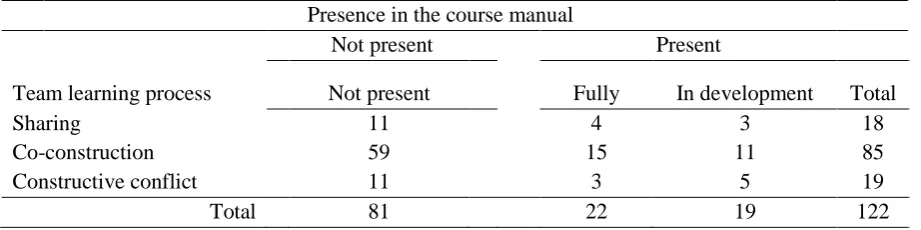
[image:12.595.70.531.551.666.2]An important result was that not present was categorised most (81 times, 66%) and in development was categorised least (19 times, 16%). In table 4, the presence in the course manual is divided by the team learning processes. In table 5, the presence in the course manual is divided by the wrap-ups.
Table 4
Frequencies of the presence in the course manual in the team learning processes
Presence in the course manual
Not present Present
Team learning process Not present Fully In development Total
Sharing 11 4 3 18
Co-construction 59 15 11 85
Constructive conflict 11 3 5 19
Table 5
Crosstab with Wrap-up and the presence in the course manual., including Observed Frequencies, Expected Frequencies and Adjusted Residuals
Wrap - up
Presence in course manual
Total Not present Fully In development
Postponed Observed Frequency 9 0 4 13
Expected Frequency 8.6 2.3 2.0
Adjusted Residual .2 -1.8 1.6
Action Observed Frequency 18 1 5 24
Expected Frequency 15.9 4.3 3.7
Adjusted Residual 1.0 -2.0 .8
Cognitive Observed Frequency 54 21 10 85
Expected Frequency 56.4 15.3 13.2
Adjusted Residual -1.0 2.9 -1.8
Total Observed Frequency 81 22 19 122
Significant deviations of the observed frequency from the expected frequency are presented in Bold.
Although there were a lot of cognitive wrap-ups, the analysis showed that 54 of the cognitive wrap-ups were not present in the course manual. Overall only 34% of the wrap-ups were present in the course manual, which means that almost two third of the wrap-ups were not present in the course manual.
Recurring topics Next to the content of the up, we logged whether the topic of the wrap-up recurred during the team meetings. We found that in total, 67 different topics were discussed during the team meetings. Team A discussed 36 different topics and team B 31 different topics. In table 6, the topics are divided by the times they recurred and how many times these topics were present in the course manual.
Table 6
Frequencies of recurring topics and the presence in the course manual
Presence in the course manual
Amount Recurrence Not present Fully In development Total
43 topics 1 time 33 4 6 43
11 topics 2 times 15 4 3 22
7 topics 3 times 13 3 5 21
6 topics 3+ times 21 12 3 36
Total: 67 topics Total 122 wrap-ups
[image:13.595.68.527.562.667.2]least once fully present in the course manual. In total this means that only 40 of the 122 wrap-ups are present in the course manual.
Chi-square analysis
In this chapter the Chi-square analysis and the Fisher’s Exact test have been performed to analyse if there are relationships between the variables team learning process, wrap-up, presence in the course manual and recurring topics.
Relationship between team learning process and wrap-up The results from the Chi-square test showed a significant relationship between team learning processes and wrap-ups, χ2 (6) = 19.283, p = .004. Results from the post-hoc analysis showed significant deviations from the expected frequencies in the team learning processes, as shown in table 3. Results showed that the postponed wrap-up in the sharing team learning process was observed more often than the expected frequency (AR = 3.9). On the contrary, the postponed wrap-up in the co-construction team learning process was observed less (AR = -2.9) than would be expected by chance.
Relationship between wrap-ups and the presence in the course manual Since the assumptions for the Chi-square analysis were not met, it was decided to use the Fisher’s Exact test. The results from the Fisher’s Exact test showed a significant relationship between wrap-ups and the presence in the course manual, p = .021. Results of the post-hoc analysis showed significant deviations from the expected frequencies of the presence in the course manual in the wrap-ups, as shown in table 5. Results showed that fully was categorised more to cognitive wrap-ups than the expected frequency (AR = 2.9). On the contrary, fully was categorised less (AR = -2.0) in action wrap-ups than would be expected by chance.
Team learning process and presence in course manual To analyse which team learning process is present in the shared mental model, the occurrence in the course manual was measured. Since the assumptions for the Chi-Square analysis were not met, it was decided to use the Fisher’s Exact test. The results from the Fisher’s exact test did not show a significant relationship between the team learning processes and the presence in the course manual, p = .620. This indicates that there is not an unequal distribution between the team learning processes and to what extent they are present in the course manual.
Recurring topics and presence in the course manual Since the assumptions for the Chi-Square analysis were not met, it was decided to use the Fisher’s Exact test. The results from the Fisher’s exact test did not show a significant relationship between the recurring topics and the presence in the course manual, p = .155. This indicates that there is not an unequal distribution between the recurring topics and to what extent they are present in the course manual.
Qualitative analysis
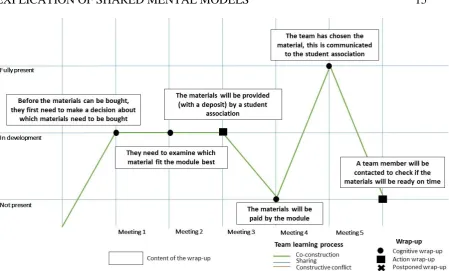
Figure 2. Graphic that demonstrates recurring topic Materials
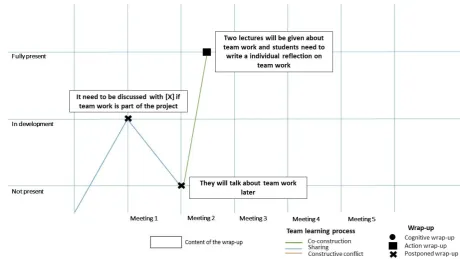
Figure 3.Graphic that demonstrates a recurring topic from team B
[image:16.595.99.560.189.448.2]Example 2 In figure 3 a graphic of a recurring topic of team B is demonstrated. Unlike team A, team B gets to agreements immediately after they start talking about it. The first three wrap-ups are all cognitive wrap-ups achieved by the co-construction team learning process. The wrap-ups were present in the course manual. In meeting four they first repeat that the chosen way of testing fits with the subject (which is not related to the educational design decisions) and then, in the last wrap-up, they make plans about how the tests will be implemented.
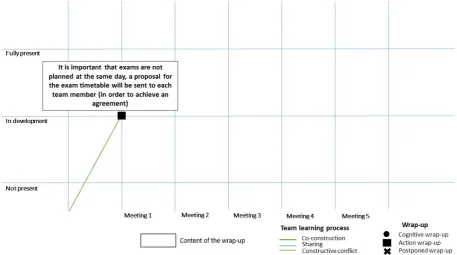
Figure 4. Graphic that demonstrates a recurring topic from team A
Figure 5. Graphic that demonstrates a recurring topic from team A
Example 4 In figure 5 a graphic of the topic compensation (Team A) is demonstrated. First the team is in conversation with each other about the possibility to compensate a grade between 4.5 and 5.5 with a 7 and decide that this is possible by having a cognitive wrap-up. However, two meetings later another team disagrees with the compensating rule and therefore they postpone the decision. In the last team meeting a team member shares that there is an agreement with the other team and that a grade between 5.0 and 5.5 may be compensated with a 7. This is an example of external influences on the decision making of the team.
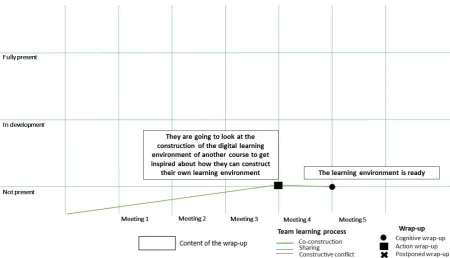
[image:17.595.72.523.460.718.2]Example 5 In figure 6 a graphic of the topic digital learning environment (Team A) demonstrated. Since the topic digital learning environment is part of the course, but not part of the educational design decisions, this topic is not present in the course manual. However, the digital learning environment needed to be developed. To get some inspiration the team looked at the digital learning environment of another team. In the last meeting the digital learning environment is ready.
Figure 7.Graphic that demonstrates a recurring topic from team B
Figure 8.Graphic that demonstrates a recurring topic from team B
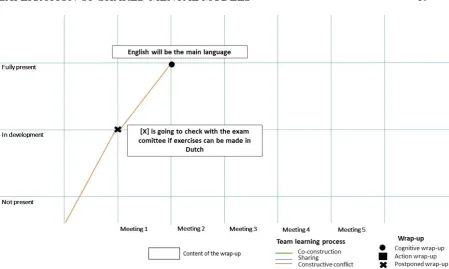
Example 7 In this example team members of team B have a constructive conflict about the main language of the course. Since they have a constructive conflict, team members diverge in their opinions and therefore the wrap-up is postponed. In the next meeting they still have a constructive conflict, however, the decision is made that the main language will be English.
Analysis of the examples
Discussion and conclusion
In this research we have gathered data from higher education teacher teams, which consisted of observations of team meetings and the course manuals of the teams. We have analysed the team meetings by coding the team learning processes, topics and the wrap-ups, and we have logged the content of the wrap-ups. To get a view on how the explication of the shared mental model facilitates the transition from engaging in team learning to arriving at sustained decisions, we made use of quantitative (Chi Square and Fisher’s exact) and qualitative analysis (by comparing the content of the wrap-ups with the educational design decisions of the team) of which the results will be discussed. Therefore, the following research question will be answered: How does explication of the shared mental model facilitate the transition from engaging in team learning to arriving at sustained decisions? To answer this question, the sub questions will be answered first.
Types of wrap-ups in team learning processes We found that all team learning processes can lead to all different types of decisions (no wrap-up, postponed wrap-up, action wrap-up and cognitive wrap-up). However, we found that the biggest part of the team learning processes did not result in a decision or a conclusion, which is in line with the results of Raes et al. (2015). Sometimes team members are just sharing information with each other and building further on the information somebody else shared before (Raes et al., 2015), which is also seen in the teacher team meetings of this study. This indicates that, when a topic does not end with a decision or conclusion, subsequently a decision will not be expressed. For instance, sometimes team members do not have enough knowledge to decide about a specific topic (for e.g. in example 3, figure 4) or the team members do not feel the need to decide or take an action yet (Raes et al, 2015). To sum up, team learning processes do not always result in (sustained) decisions. Since we wanted to measure the explication of the shared mental model, we did not analyse the content of the team learning processes without a decision or conclusion. However, future research should be focussed on this, since Raes et al. (2015) has mentioned that expressed decisions or conclusions are not necessary to add new knowledge to the shared mental model of the team.
We found that the sharing team learning process significantly lead more to postponed decisions. Which indicates that, when only one team member is speaking about a topic, this will lead more to decisions wherein deciding is postponed. We found that the sharing team learning process mostly occurs when a team member wants to introduce a new topic or when the team leader wants to share a list of the discussion points for the meeting. This indicates that the sharing team learning process is not resulting in a discussion, which is necessary to achieve mutual agreement according to Van den Bossche et al. (2006). Therefore, the result we found was expected to be found.
On the other hand, we found that the co-construction team learning process have led less to the postponed decision. This indicates that, when team members are discussing with each other, they do less conclude to postpone deciding. This is something we were expecting since teachers in teacher teams do not have a lot of time, due to other activities such as teaching, searching/developing study materials and doing research next to their task to develop their course together. Therefore, this could be a possible reason why the teacher teams in this research do not postpone a decision when they are already discussing with each other.
decisions, it is for some reason not adopted in the intended curriculum. We did not expect to find four different reasons; therefore, future research should be focussed on other ways to measure the explication of the shared mental model or the sustainability of decisions. What we do know is that decisions about the educational design decisions should be specific and concrete before they can be adopted in the intended curriculum. This is something we did not have any influence on.
We found that cognitive wrap-ups are significantly more adopted into the intended curriculum. The purpose of the co-construction team learning process is to get to know each other’s knowledge and ideas and to discuss these. By discussing, team members can achieve a shared point of view which could be adopted into the shared mental model. Therefore, we already expected that decisions out of co-construction are likely to be more adopted in the intended curriculums. Although this is in contrast with what is found in research of Van den Bossche et al. (2011) wherein is stated that co-construction does not contribute to and even hinder the development of the shared mental model. By way of contrast, research of Van den Bossche et al. (2011) stated that constructive conflict is necessary to make the development of the shared mental model possible, but we did not find these results. Future research is needed to further investigate what the facilitating role of co-construction and constructive conflict is to have decisions become sustained.
On the other hand, action wrap-ups are significantly less adopted in the intended curriculum. Action decisions are expressed when there is an agreement or decision about the topic and there is an explicit intention for action expressed. This indicates that action decisions are mostly expressed to implement the cognitive decision, by for e.g. stating an action to arrange something for the next meeting, which is in line with the findings of Raes et al. (2016). Since these are actions, which implement the cognitive decision, these decisions are less adopted in the intended curriculum and are therefore not leading to sustained decisions.
In addition, we did not find significant results that a specific team learning process or the amount of recurrence of a specific topic leads to more or less sustained decisions.
Development of shared mental models We found that the higher education teacher teams were discussing a lot of different topics. But, about more than a half of these topics only one decision was made, which were not adopted in the intended curriculum. This indicates that most of the times the decision was not sustained. However, we found that topics of which teams had made more decisions, were more adopted in the intended curriculum. This indicates, although we did not find significant results, that the more teams decide about a topic, it will more result in sustained decisions. In addition, we found that action decisions are mostly expressed to facilitate the cognitive decision. In this way team members are taking care that the cognitive decision will be executed.
On the contrary, we found that a decision cannot always be reached. This can be caused by various reasons. First, sometimes not all team members are present in the team meeting and therefore the deciding needs to be postponed to another meeting. This is, for e.g., the case when team members with relevant information or knowledge are not present. Secondly, sometimes other teams have an influence on the decisions of the team, which could cause for e.g. that the decision must be changed. Last, we found that team members, which are having a constructive conflict, are not always capable to come to a decision together. Sometimes an external source, like an examination committee, must give the redeeming answer.
model can facilitate the transition from engaging in team learning to arriving at sustained decisions in a positive way.
Limitations The first limitation is that we only focussed on the content of the wrap-ups. We did not measure the content of the no wrap-ups since we were interested in the explication of the shared mental model. Since the shared mental model is not explicated in the no wrap-ups, these were left behind. But, previous research has mentioned that although there is no decision or conclusion expressed, there is a possibility that team members do discuss topics of which new knowledge is adopted in the shared mental model (Raes et al., 2015). Therefore, it is important that future research should focus on this. A second limitation is that we do not know if team members have contact with each other outside of the team meetings, which is expected, and therefore we do not know what kind of influence this has on the shared mental model and on the sustainability of the decisions. However, it is not an easy task to keep up with all the communication that exists in teams. Therefore, future research should search for a way to measure this. A third limitation concerns the methods of observation since this is only limited to the observation of explicitly verbally spoken words. We did not include non-verbal communication, and this could have caused that we have missed for e.g. essential facial expressions or hand gestures. In addition, we do not know if team members were feeling not safe enough to express his or her disagreement with the decisions made in the team meetings, since Raes et al. (2015) state that a safe climate is necessary to have more team learning. Therefore, future research should be focussed on the measurement of the verbal and non-verbal communication. A fourth limitation is that we only used data of two teams. The small sample makes the generalisability questionable, but it did give the opportunity to zoom in at the development of the shared mental models of the teams, since this was very time consuming. It must be considered that there could have been other results if a larger sample was taken. The last limitation is that there was only one coder for the content of the wrap-up and for the presence in the intended curriculum. Therefore, we state that validation of the coding scheme is necessary.
References
Akbari, M., Kashani, S. H., & Hooshmand Chaijani, M. (2016). Sharing, Caring, and Responsibility in Higher Education Teams. Small Group Research, 47(5), 542-568. doi:10.1177/1046496416667609
Akkerman, S., Admiraal, W., Simons, R. J., & Niessen, T. (2006). Considering diversity: Multivoicedness in international academic collaboration. Culture & Psychology, 12(4), 461-485. doi: 10.1177/1354067X06069947
Akkerman, S., Van den Bossche, P., Admiraal, W., Gijselaers, W., Segers, M., Simons, R. J., & Kirschner, P. (2007). Reconsidering group cognition: From conceptual confusion to a boundary area between cognitive and socio-cultural perspectives? Educational Research Review, 2(1), 39-63. doi: 10.1016/j.edurev.2007.02.001
Bron, R., & Endedijk, M. D. (2016). The dynamic and emergent nature of team learning: Using machine learning techniques to automatically discern team learning processes from team conversations. Paper presented at the EARLI SIG 14 Conference,
Regensburg, Germany.
Decuyper, S., Dochy, F., & Van den Bossche, P. (2010). Grasping the dynamic complexity of team learning: An integrative model for effective team learning in organisations. Educational Research Review, 5(2), 111-133. doi: 10.1016/j.edurev.2010.02.00
Dochy, F., Gijbels, D., Raes, E., & Kyndt, E. (2014). Team learning in education and professional organisations. In International handbook of research in professional and practice-based learning (pp. 987-1020). Springer Netherlands. doi:10.1007/978-94-017-8902-8_36
Edmondson, A. (1999). Psychological safety and learning behavior in work teams. Administrative science quarterly, 44(2), 350-383. doi:10.2307/2666999
Edmondson, A. C., Dillon, J. R., & Roloff, K. S. (2007). 6 three perspectives on team learning: outcome improvement, task Mastery, and group process. The academy of management annals, 1(1), 269-314. doi:10.1080/078559811
Jonker, C. M., Van Riemsdijk, M. B., & Vermeulen, B. (2011). Shared mental models. In Coordination, organizations, institutions, and norms in agent systems vi (pp. 132-151). Springer Berlin Heidelberg. doi:10.1007/978-3-642-21268-0_8
Landis, J. R., & Koch, G. G. (1977). The measurement of observer agreement for categorical data. Biometrics, 159-174. doi:10.2307/2529310
Mathieu, J. E., Heffner, T. S., Goodwin, G. F., Salas, E., & Cannon-Bowers, J. A. (2000). The influence of shared mental models on team process and performance. Journal of applied
psychology, 85(2), 273. doi: 10.I037t/0021-9010.85.2.273
McKenney, S., Nieveen, N., & van den Akker, J. (2006). Design research from a curriculum perspective. Educational design research, 67-90.
Newell, W. H. (2010). Undergraduate general education. The Oxford handbook of interdisciplinarity, 360-371. doi:10.1093/oxfordhb/9780198733522.001.0001
Raes, E., Boon, A., Kyndt, E., & Dochy, F. (2015). Measuring team learning behaviours through observing verbal team interaction. Journal of Workplace Learning, 27(7), 476-500. doi: 10.1108/JWL-01-2015-0006
Raes, E., Kyndt, E., Decuyper, S., Van den Bossche, P., & Dochy, F. (2015). An Exploratory Study of Group Development and Team Learning. Human Resource Development Quarterly, 26(1), 5–30. doi:10.1002/hrdq.21201
Raes, E., Boon, A., Kyndt, E., & Dochy, F. (2016). Exploring the occurrence of team learning
Sessa, I. V., & London, M. (2006). Continuous learning in organizations. Individual, group, and organizational perspectives. Mahwah, NJ: Lawrence Erlbaum Associates. doi:10.4324/9781315820941
Spelt, E. J., Biemans, H. J., Tobi, H., Luning, P. A., & Mulder, M. (2009). Teaching and learning in interdisciplinary higher education: A systematic review. Educational Psychology Review, 21(4), 365. doi: 10.1007/s10648-009-9113-z
Van den Bossche, P., Gijselaers, W., Segers, M., Woltjer, G., & Kirschner, P. (2011). Team learning: building shared mental models. Instructional Science, 39(3), 283-301. doi: 10.1007/s11251-010-9128-
Van den Bossche, P., Gijselaers, W., Segers, M., & Kirschner, P. A. (2006). Social and cognitive factors driving teamwork in collaborative learning environments. Team learning beliefs and behaviors. Small Group Research, 37(5), 490–521. doi: 10.1177/1046496406292938
Van der Haar, S., Segers, M., & Jehn, K. A. (2013). Towards a contextualized model of team learning processes and outcomes. Educational research review, 10, 1-12.
doi: 10.1016/j.edurev.2013.04.001
Van der Haar, S., Wijenbergh, B., Van den Bossche P. & Segers, M. (2013). Team learning
behavior: A study in the setting of command and control teams. Paper to be presented at EARLI 2013, Munich, symposium on Team learning
Appendix A
Table 7Description of the eleven topic codes given to each episode
Topic code Description
Internal integration Episodes about how different parts of the course relate to each other, and how they can form a coherent whole.
External integration Episodes about how the course relates to and can be best embedded in the study program.
Teaching methods
Episodes about which teaching methods (lectures, practicals, demonstrations, self-study) will be used and why these will be used. Also episodes that concern the way in which students are grouped in the course (individual work, pairs, group work).
Materials Episodes about which materials (books, software, hardware, etc.) will be used and why these will be used.
Content Episodes about the content of the course.
Roster Episodes about planning and roster issues, such as the day-to-day planning of the course and specific deadline dates.
Task distribution
Episodes about task distribution among the team members and other parties involved in the course. Both in terms of workload and availability and in terms of different roles that need to be fulfilled by teachers in the course.
Organisation
Episodes about other organisation-related issues, such as availability of materials and rooms, course language, expected number of students in the course, etc.
Assessment Episodes about the assessment content and form, grading rules and planning of tests, both at the level of single tests and the grading of the entire course.
Evaluation Episodes about the (design of a) way in which students can provide feedback about the course.
Process Episodes about rules, actions and materials for coordinating or structuring the team meeting or the design process itself.