0 MASTERTHESIS
“The judgment of comparable criminal in-group and
out-group people from a social identity perspective”
Name: Lisa Hengemühle
Student number: s1160818
Date: 02.12.2018
University of Twente
Faculty of Behavioral Science
Master of Psychology
Master specialization: Conflict, Risk and Safety
First tutor: dr. ir. P. W. de Vries
1 Abstract
Objective Through the increased influx of Muslim refugee and especially through events such as the incidents in Cologne on New Year’s Eve 2016, a debate has arisen which views critically the presence and the behaviour of Muslim refugee. Although only a small number of the Muslim refugee show criminal behaviour, many Europeans, including Germans, show negative attitudes towards these people. Based on social identity
perspective, it is investigated, whether subjects such as in-group identification (feeling of in-group membership), contact, in-group prototypicality (thinking about the in-group) and out-group attitude (thinking about the out-group) possibly affect a difference in the judgement of criminal Germans and criminal Muslim refugee. It is expected that criminal Germans are judged more negatively than comparable criminal Muslim refugee and that the more negative the contact, the more negative the judgement of criminal out-group people. Furthermore, it is expected not only that the higher the in-group identification, the more negative the judgement scores of criminal in-group people but also that the higher the in-group prototypicality and lower the out-group attitude, the more negative the judgement of criminal in-group people.
Method The questionnaire (N = 135) was spread through different social media platforms and via e-mail, and it was filled in by 135 respondents. For the final analysis, 127
respondents were investigated. Data were collected through different subscales and by presenting 12 similar scenarios (12 with German a perpetrator, 12 with a Muslim refugee perpetrator) to the respondents.
Results As expected, in most of the scenarios, criminal Germans were judged on average more negatively than comparable Muslim refugee. By means of a correlation and
regression analysis, it became obvious that the assumptions that negative contact led to a more negative judgement of criminal out-group people and that high in-group
identification led to a more negative judgement of criminal in-group people, were applicable. Against the assumption, it was shown that in-group prototypicality and out-group attitude did not lead to a difference in in-out-group and out-out-group judgement.
2
In recent years, an increasing number of shocking pictures, which show the
tragedy of desperate people leaving their home countries, go around the world,
catching the attention of ordinary people and evoking enormous reactions and
discussions by European governments in offering help (Blommaert, 2015). These
pictures, such as the dead body of a young Kurdish child or of overloaded or crashed
boats with refugee on board, symbolise the refugee crisis. Often, these people come to
Europe on the Balkan route (a route which connects the Middle East and Europe
(Yazgan, Utku & Sirkeci, 2015; Vallaster, von Wallpach & Zenker, 2018).
In 2015 and 2016, the highest number of refugee reached Europe. The German
Federal Office for Migration and Refugee (BAMF, for its acronym in German) reports
that during this time, about 1.1 million refugee, mostly from Syria, Afghanistan and
Iraq, came to Germany (BAMF, 2016). These refugee are mostly “civilian war
refugees” in search of protection and a safe place to live (Vallaster, et al., 2018, p. 2).
Since the maximum rates in 2015, the number of refugee coming to Europe has
decreased significantly. The BAMF reports that in 2017, about 225.000 new refugee
came to Germany, a decline of 72.5% compared to the previous year (BAMF, 2017).
This regressive trend is also observable in 2018, when from January to August,
130,000 new refugee registered in Germany (BAMF, 2018).
The reasons why people become refugee can be multifunctional. As described
earlier, many refugee (e.g., from Syria, Iraq, Africa or Afghanistan) leave their
countries because of civil wars or expulsions, or they want to escape poverty and to
have a better life in Western countries (Vallaster, et al., 2018). Living in and
integrating into a new country, the refugee are confronted with many challenges, such
as learning a new language, extending their disrupted education, dealing with
discrimination and leaving behind family members in their home country (Holzberg,
Kolbe & Zaborowski, 2018). If refugee are not able to handle these challenges, it can
happen that they become discontent, show aggressions and become criminal.
Although there is an enormous influx into all of Europe, the different
European countries handle the refugee differently. The European Social Survey
explains that the continental European states (to which Germany belongs) and the
Nordic states mostly show a more positive attitude towards the incoming refugee,
compared to eastern, southern and central European states (Bordignon & Moriconi,
2017). The welcoming countries often invest a high amount of effort in integrating
3
professional skills (Bordignon & Moriconi, 2017, pp. 7-8). With these efforts, the
countries try to reduce the segregation of refugee, so that there is a lower chance that
they become isolated or show deviant behaviour. Nevertheless, these efforts often do
not succeed (Bordignon & Moriconi, 2017, p. 8).
Incidents and insurgences show that there is a high amount of non-acceptance
between native Germans and Muslim refugee, which results in criminal behaviour in
both groups (Holzberg, et al., 2018). Such incidents include the growing number of
refugee camps burned by racist Germans, or the mob of male Muslim refugee who
molested and assaulted young women in Cologne on New Year’s Eve 2016, stoking
fear and anxiety among Germans (Holzberg, et al., 2018).
Because it is mostly refugee with a Muslim migration background who come
to Germany (more than 60% of all registered refugee in Germany come from Islamic
states such as Syria, Iraq and Afghanistan) (BAMF, 2017, Vallaster, et al., 2018), the
current research only concentrates on Muslim refugee and native Germans.
As described earlier, there is a high amount of criminal behaviour observable
in both groups (native Germans and Muslim refugee). The aim of the study is to
investigate how judgements of criminal Muslim refugee are made and if differences to
common criminal Germans are observable. By investigating possible factors
influencing the different judgements of criminal Germans and Muslim refugee, it is
possible to derive and detectpossibleproblems or discrepancies in intergroup
relationships. With this knowledge, it may be possible to create interventions and
strategies to bring both groups closer and to reduce stereotypes and prejudices.
Therefore, some factors are investigated, (e.g., group identification’, ‘contact’,
‘in-group prototypicality’ and ‘out-‘in-group attitude’) that lean on the main principles and
ideas of social psychology (which investigates the formation of personal identity and
4
In social psychology, research is conducted into intergroup relationships in
order to show how people build their own identity. The focus of such research is to
detect possible factors influencing this process. One aspect of human identity is social
identity. This phenomenon describes the feeling of belonging to a social group and
includes high emotional and social significance of group membership (Tajfel 1972, in
Hogg & Terry, 2000). The social identity theory explains that a part of the own
identity, the “self-concept defined by our belonging to social groups” (Trepte, 2006,
p. 255). By comparing and categorizing themselves and others (which belong to
different social groups) and by evaluating these categorizations, people aim at
developing a positive social identity and achieving positive esteem and
self-enhancement (Trepte, 2006, p. 255-256). Tajfel (1979) explains that the definition of
a group occurs on the basis of three different components (Trepte, 2006, p. 256).
Firstly, there is the “cognitive component”, which is explained as the knowledge about group membership. Secondly, there is the “evaluative component”, which
describe the evaluation (positive or negative) of group membership. And at least,
there is the “emotional component”, which combines both components and describe
the emotions (negative or positive), which are associated with group membership and
which arises by its evaluations (Tajfel, 1979, in Trepte, 2006, p. 256). So, it can be
concluded that people earn self-esteem from the belonging of being part of a group
and by evaluating these group membership. The theory also holds that people are
motivated to “establish the positive distinctiveness of their group relative to other groups” (Dovidio, Gaertner & Saguy, 2008, p. 304). It is explained that these kind of
motivation is shown when people have to challenge their feelings of esteem or if they
are motivated to reduce uncertainty in certain situations (Dovidio, et al., 2008, p. 304).
It is well-known that people who show high identification and cohesion with their
group are more motivated both to maintain their group’s positive distinctiveness and
to show more in-group favouritism and often more out-group prejudice (Dovidio, et
al. 2008, p. 304)
In terms of deviant behaviour (e.g., criminality), the judgement between
out-group and in-out-group members can differ. Based on social identity theory, Marques,
Yzerbyt, and Leyens (1988) explain that a reason the judgement scores of deviant
in-group members are more extreme than the scores of comparable out-in-group people
might be that deviant in-group members are judged as more imperilling or threatening
5
in-group. As a result, group members tend to get rid of members who damage the
social identity, in order to keep up a positive image of the group.
Many studies show that deviant members of one’s own in-group are more
strongly devaluated and punished than out-group deviant members (Abrams, Palmer,
Rutland, Cameron & Van de Vyver, 2014; Marques, et al., 1988; Pinto, Marques,
Levine & Abrams, 2010).
This effect, which is called the “Black Sheep Effect”, is replicated in many
social contexts and seems to be dependent how strongly the group feels connected
(group cohesion) (Marques, et al., 1988). In different studies, so as by Pinto et al.
(2010), participants judged two in-group or out-group members who adopted
respectively a normative or deviant position. The result of these investigations was
that the participants tended to upgrade the normative in-group people and derogate the
comparing deviant in-group people (Pinto et al. 2010). In the case of the current
research, the in-group is defined as the native German population, and the out-group
is defined as Muslim refugee who come to Germany.
Furthermore, different studies show that people are reminded more often of
negative out-group behaviour than comparable negative in-group behaviour
(Hamilton & Trolier, 1986, in Bigler, Jones & Lobliner, 1997; p. 530). An explanation
is that people tend to ascribe negative out-group behaviour to dispositions, whereas
they ascribe negative in-group behaviour to situations (Bigler et al. 1997, p. 530).
Based on the above information and research results, it is generally expected
that Germans tend to judge criminal in-group members more negatively than
comparable out-group members. Therefore, the following hypothesis is formulated:
H1: Criminal in-group people are judged more negatively than comparable criminal out-group people.
Besides the aspect of social identity, the amount of integration and contact also
plays an important role in the judgement of criminal in-group and out-group people.
Because of the enormous numbers of refugee, the aspect of integration has become
more and more important. Cheung and Phillimore (2017) describe integration as a
process by which immigrants become integrated and accepted so that they become
part of society. They explain that many refugee are directly located to internal refugee
6
is difficult to reach. A successful integration is a very complex process in different
domains (social, economic, cultural and civil) and, in which many parties, for
example, politicians, local people and, refugee, must be involved (Cheung &
Phillimore, 2017). Furthermore, it is important that refugee achieve a feeling of social
cohesion and that they are active participants in society (Cheung & Phillimore, 2017).
A successful integration of refugee is very important because otherwise, there
are many negative aspects which can threaten the local people. If successful
integration occurs, people show feelings of stability, security and allegiance, while
disintegration results in feelings of exclusion, violence and disparity between the
out-group and in-out-group (Löffler, 2011). Perceived cultural threats, competition for jobs,
public services and social benefits can result in many people showing no interest in
integrating refugee but rather resenting and opposing their arrival (Toshkov &
Kortenska, 2015). Thus, it becomes obvious that internal psychological aspects such
as fear and resentment are possible factors preventing integration.
One factor of a possible successful integration is contact with individual
people. Having contact is important for a successful integration because it is a crucial
factor in reducing prejudices, stereotypes and negative predispositions (Sigelman &
Welsh, 1993). Allports contact theory states that interpersonal contact between
members of different groups of races tends to reduce prejudices between majority and
minority group members under “optimal conditions”, thus if there are equal status,
common goals or group support or cooperation (Allport, 1954, in Sigelman & Welsh,
1993; Berger, Brenick, Lawrence, Coco & Abu-Raiya, 2018). This effect can be
shown through the “Robbers Cave Experiment” by Sherif, in which it is obvious, that
prejudices between groups decrease when two members of different races work
intensively together in order to reach a similar goal(Sigelman & Welsh, 1993, pp.
781-782).
According to Berger et al. (2018), another aspect for an effective intergroup
contact is a friendship between members of different group of races. In such a case,
the out-group member is seen as an individual and not as a part of the out-group, so
that “individuating information” is highlighted (Aberson, 2015). Thus, it can be
concluded that if two persons communicate with each other, there is a chance to learn
and understand the counterpart much better, so that possible prejudices should
7
Incidents, such as the sexual mob in Cologne, which stoking fear and anxiety
among Germans are an example for negative contact between different groups
(Holzberg, et al., 2018). Such negative incidents often cause the building of prejudices
and the developing image which is made from the opposing group. A study by Barlow
et al. (2012), in which the interaction between Black and Muslim Australians and
asylum seekers is investigated by comparing the connection between the amount of
contact and prejudice support these findings, that negative contact is a stronger
predictor of building up prejudices than positive contact. In a second study, in which
the degree of contact between Black and White Americans is investigated, it appears
that negative contact is a stronger indicator for racism and discrimination (Barlow et
al., 2012, p. 1629). An explanation for the fact that negative contact is a stronger
predictor than positive contact is that it makes intergroup categories more salient and
that there is a connection observable between negative contact and increasing
prejudices, whereas positive contact is connected with tolerance and decreasing
prejudices (Barlow et al., 2012, pp. 1629-1630).
Because of the presented information, it can be observed that the type of
contact plays an important role in the judgement of out-group people. Consequently, it
can be assumed that negative contact effect the building of prejudices, discrimination
and racism much more than positive contact. As a result, it can be expected that there
is an observable negative correlation between the judgement of Muslim refugee and
the type of contact, the native people had with them. So, the following hypothesis is
formulated:
H2: The more negative the contact is judged between Germans and Muslim refugee, the more negative the judgement of criminal out-group people.
The difference between criminal in-group and out-group judgements will be lower if the contact between both groups is seen as negative.
Another aspect, from a social identity perspective, that possibly plays a role in
the judgement of criminal in-group and out-group people, is the in-group
identification.
In-group identification can be defined as: defining oneself as a group member;
the personal significance and importance of group membership for a sense of personal
8
feeling of closeness to the particular in-group because of psychological attachment
(Raffield, Greenlow, Price & Collard, 2016). Raffield et al. (2016) conclude that
people who “identify strongly with an in-group are more likely to regard themselves
as a member of the in-group, to view themselves as similar to the other members of
the in-group and to feel connected to the in-group’s other members” (p. 37).
By including the findings of Marques, et al. (1988), which state that the
judgement scores of deviant in-group members are more extreme than the scores of
comparable out-group people because deviant in-group members are judged as more
imperilling or threatening because they override existing social rules and disagree
with the social norms of the in-group (pp. 2-5), the following hypothesis is
formulated:
H3: The higher the in-group identification, the more negative are the judgement scores of criminal in-group people.
The difference between criminal in-group and out-group judgements will be lower if in-group identification is low.
The next theories are important in terms of opinion formation about others and
thus can be possible influences on the judgement of criminal in-group and out-group
people, are the intergroup theory (which explains the formation of out-group attitude)
and the in-group projection model (which explains in-group prototypicality).
Ratliff and Nosek (2011) describe the opinion formation of others as a process
which develops if people meet a new person who belongs to a known social group.
Then, an impression of the person is made based on stereotypically traits, which are
associated with the person’s group membership, or on individual traits that are unique
to this person (Ratliff & Nosek, 2011, p. 1693). Tajfel, Flament, Billig and Bundy
(1971) observe that in intergroup relations, people tend to categorise others into social
groups (Bigler, et al., 1997). This process is described in intergroup theory, which
also maintains that the mere presence of categories is sufficient to developing
prejudices and to discriminate another person or group (Bigler, et al. 1997, p. 530).
On the basis of these remarks, it can be said that opinion formation, which includes
out-group hate, is often a process based on stereotypes and prejudices ascribed to a
9
In creating an image of an out-group and by constructing an attitude, the
realistic group conflict theory can play an important role. According to Riek, Mania
and Gaertner (2006), a negative out-group attitude develops when an intergroup threat
is observable. This means that two different groups are in conflict with each other, for
example when the “potential success of one group threatens the well-being of the
other” (p. 336). Sherif and Sherif (1969) explain that if groups have complementary
goals, their relations will be positive, but if groups have conflicting goals, relations
will deteriorate (Riek, et al. 2006, p. 336). They conclude that "the resulting conflict
may increase in-group solidarity, which in turn widens the in-group/out-group
distinction, creating intergroup hostility” (Riek, et al., 2006, p. 336).
The in-group projection model developed by Wenzel and Mummendey is
based on Turner’s social categorisation theory and asserts that members of a group
compare themselves with members of another group (in this case, native Germans and
Muslim refugee) in a superordinate category (in this case, all Germans / Germany).
This means that members of a group more strongly project typical in-group
characteristics and properties onto a superordinate category than they project
out-group characteristics (Wenzel, Mummendey & Waldzus, 2008). The theory states that
in-group members are seen as more prototypical of the superordinate category
because the superordinate category is positively evaluated and seen as relevant to
individual self-identity. For this reason, in-group people project typical in-group
characteristics (stereotypes / prototypes) onto the superordinate category (Wenzel, et
al. 2008).
In an experiment, Wenzel and colleagues show that Germans connect more
prototypical German characteristics to the superordinate group of Europeans than to
Italians, who also project more prototypical Italian characteristics to the superordinate
group than to the other subgroup (Germans) (Wenzel, et al., 2008). Members of both
groups see their own in-group as more typical for Europe than the other group, and
they feel that their own characteristics conform most to the European characteristics
(Wenzel, et al., 2008). According to the theory, this process can lead to a
discrimination against groups seen as less typical within the superordinate group
(Wenzel, et al., 2008). In terms of the current study, it can be inferred that Germans
project more typical German characteristics onto the superordinate group (all
Germans / Germany) than onto the other subgroup (Muslim refugee). Research by
10
people see their own in-group as more prototypical of a superordinate category
compared to a minority group.
Based on these remarks, it can be expected that there is interdependency
between in-group prototypicality and out-group attitude. Thus, the following
hypothesis is formulated:
H4: The higher the in-group prototypicality and lower the out-group attitude, the more negative judgement of criminal in-group people.
The difference between criminal in-group and out-group judgements will be lower if in-group prototypicality is low and / or out-group
attitude is high.
The aim of the study is to investigate from a social identity perspective how
different factors, such as the way of contact, in-group identification, in-group
prototypicality and out-group attitude, influence the judgement of criminal in-group
and out-group people. To this end, a questionnaire was conducted, whereby each of
the factors was separately examined in order to detect possible correlations and
connections between the proposed factor and the judgement scores. The questionnaire
was widespread via social networks and via e-mail, and the participants were
randomly chosen.
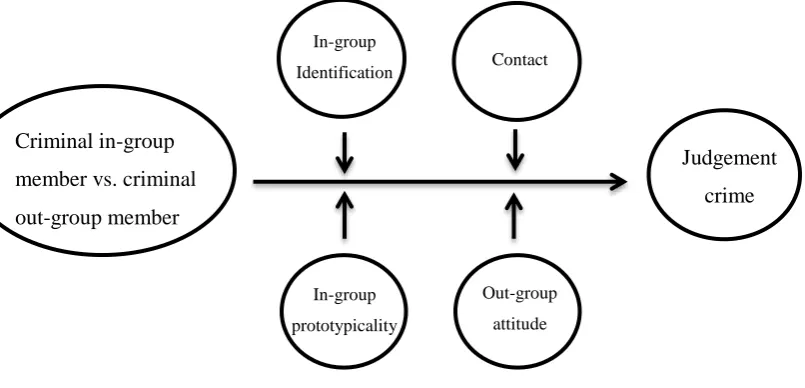
[image:11.595.66.469.540.734.2]The full conceptual model of the whole investigation looks like this:
Figure 1. Conceptual model.
Judgement crime In-group
Identification Contact
In-group prototypicality
Out-group attitude Criminal in-group
11 Method
Design. The research included four independent variables: ‘in-group
identification’, ‘contact’, ‘in-group prototypicality’, and “out-group attitude’. These
variables were measured through different scales, subscales of items that were
self-devised or inspired by the already existent scales of different earlier studies. The
dependent variables, namely the judgement of criminal behaviour by Germans and
Muslim refugee, were measured through in a total of 24 self-devised scenarios, that is,
12 with German and 12 with Muslim perpetrators, so that both groups can be
compared with each other.
In-group identification
The first independent variable, used in the study, was the measurement of
group identification. To what extent Germans identified themselves with her own
in-group (other Germans) was tested by means of 14 items of the ‘In-in-group identity scale’ developed by Leach et al. (2008), which were divided into five different
categories (‘Solidarity’, ‘Satisfaction’, ‘Centrality’, ‘Individual Self-Stereotyping’ and ‘In-Group Homogeneity’). Therefore, the respondents had to rate the respective item
on a 5-point Likert scale, which ranged from 1 (strongly disagree) to 5 (strongly
agree).
The reliability analysis revealed that the whole in-group identification scale
showed a reliability of Cronbach’s α = 0.83 and Gutman’s λ2 = 0.84. Both values
were on a high level, what means that the internal consistency of the scale was good
(Cronbach’s α = 0.83), and that 84% of the variance (Gutman’s λ2 = 0.84) was based
on true scores and 16% was based on errors.
Contact
The second independent variable, used in the study, was the measurement of
contact that Germans have had with Muslim refugee. This included on the one hand
the amount of contact between Germans and Muslim refugee and on the other hand
the classification of the contact (i.e., whether the contact was seen as negative or as
positive). In order to measure the amount of contact between Germans and Muslim
refugee, the respondents were at first asked with the following question: ‘Have you
ever had contact with Muslim refugee?’ Participants could answer with 1 (Yes) or 2
(No). In order to use the question for the further analysis, this question was
12
they perceived the contact as positive or negative. If they answered with ‘No’, they
did not answer the other questions regarding the amount of contact. If the first
question was answered with ‘Yes’, the following two questions were presented: ‘On average, how frequently do you have positive / good contact with Muslim refugee?’ and ‘On average, how frequently do you have negative / bad contact with Muslim
refugee?’ (In order to use the question for the reliability calculation of the scale, this
question was recoded). Both questions lean on the research questions of a study by
Pedersen and Griffiths (2006), which was used by Barlow et al. (2012). Both
questions were judged on a 5-point Likert scale from 1 (never) to 5 (always). For the
further analysis, a dummy codification was done on the basis of these three questions.
The first dummy (D1) is coded with the following:
1) a 0 for ‘no contact’ and for ‘neutral contact’
2) a 1 for ‘had contact’ and ‘positive contact’
3) a 0 for ‘had contact’ and ‘negative contact’ (see Table 1)
The second dummy (D2) is coded with:
1) a 0 for ‘no contact’ and for ‘neutral contact’
2) a 0 for ‘had contact’ and ‘positive contact’
[image:13.595.92.377.528.612.2]3) a 1 for ‘had contact’ and ‘negative contact’ (see Table 1)
Table 1
Overview of the dummy codification based on the first three questions relating to the construct ‘contact’
D1 D2
No contact / Neutral contact 0 0
Contact / Positive 1 0
13
1
The reliability analysis stated that the whole contact scale shows a reliability
of Cronbach’s α = 0.85 and Gutman’s λ2 = 0.91. Both values were on a high level,
what means that the internal consistency of the scale was excellent (Cronbach’s α =
0.91), and that 91% of the variance (Gutman’s λ2 = 0.91) was based on true scores and
9% was based on errors.
In-group prototypicality
The third independent variable was the measurement of in-group
prototypicality. In order to both gain an impression of, how Germans judge their own
in-group people (native Germans) related to Germans in general (Germany) and to
measure the perceived in-group prototypicality, the respondents were presented with
the following two statements: ‘Native Germans are representative of Germany’ and ‘The typical resident of Germany has a German background’ (Waldzus,
Mummendey, Wenzel & Weber, 2003). The statements were answered on a 5-point
Likert scale from 1 (strongly disagree) to 5 (strongly agree).
The reliability analysis revealed that the whole in-group prototypicality scale
shows a reliability of α = 0.91 and Gutman’s λ2 = 0.91. Both values were on a high
level, what means that the internal consistency of the scale was good (Cronbach’s α =
0.85), that 91% of the variance (Gutman’s λ2 = 0.91) was based on true scores and 9%
was based on errors.
Out-group attitude
The last independent variable, used in the research was the measurement of
out-group prototypicality. In order to measure the out-group attitude, (i.e., if and to
what degree Germans had prototypes of/or prejudices against Muslim refugee and
how the respondents think about Muslim refugee in general), the following statements
were presented: ‘Muslim refugee are an important and valuable part of our society’,
1
14 and ‘Muslim refugee are a disturbing and threatening part of our society’. Both
statements were judged on a 5-point Likert scale from 1 (strongly disagree) to 5
(strongly agree). Because the second question was negatively formulated, it was
recoded for the further analysis. After the recoding, the statement ranged from 1
(strongly agree) to 5 (strongly disagree). In addition the respondents judged different
out-group statements: ‘How positive / negative is your image of Muslim refugee in
Germany?’, ’In general, how competent do you think Muslim refugee in Germany
are?’, and ‘In general, how friendly do you think Muslim refugee in Germany are?’
(Fiske, Cuddy, Glick, & Xu, 2002). The first statement was judged on a 5-point Likert
scale from 1 (very negative) to 5 (very positive), the second from 1 (very
incompetent) to 5 (very competent) and the last from 1 (very unfriendly) to 5 (very
friendly).
The reliability analysis revealed that the whole out-group attitude scale shows
a reliability of Cronbach’s α = 0.62 and Gutman’s λ2 = 0.84. The Cronbach’s α value
(α = 0.62) was not very high, so that the internal consistency of the scale was
questionable. The Gutman’s λ2 (λ2 = 0.84) was on a high level, so that 84% of the
variance was based on true scores and 16% was based on errors.
Criminal in-group and out-group people
By means of 12 cases, which included different types of criminality, it was
investigated whether there is a difference between the judgements of criminal
in-group and out-in-group people. An example of such a scenario was the following: ‘A German is in possession of an illegal weapon.’ or comparably, ‘A Muslim refugee is in possession of an illegal weapon’. The scenarios were rated by means of a 5-point
Likert scale, which ranged from 1 (not severe) to 5 (very severe). In order to compare
the judgements and to detect if there were differences in the rating of severity between
both groups, the scenarios were equal for both groups. For the calculation of the
correlation scores and for the regression analysis, the difference scores of the two
variables were used.
The reliability analysis stated that the whole measurement of the 12 scenarios
of criminal Germans showed a reliability of α = 0.76 and Gutman’s λ2 = 0.81. The
measurement of the 12 scenarios of criminal Muslim refugee showed a reliability of α
= 0.82 and Gutman’s λ2 = 0.86. In both cases, the Cronbach’s alpha values (α = 0.76
and α = 0.82) were on a high level, so that the internal consistency of the scales was
15
that 81% or rather 86% of the variance was based on true scores and 19% or rather
14% was based on errors.
Control questions
At the end of the questionnaire, the respondents filled in four questions about
the honesty and reliability of their answers. These ‘control questions’ were adopted
and adjusted from the study by Karemaker (2014) and the questionnaire of Zebel
(2015). On a 3-point Likert scale, rated from 1 (Yes), 2 (No) and 3 (Neither yes nor
no), the respondents could state to which degree they confirmed their answers to the
questions. An example of a ‘control question’ was: ‘Did you understand all of the
questions?’
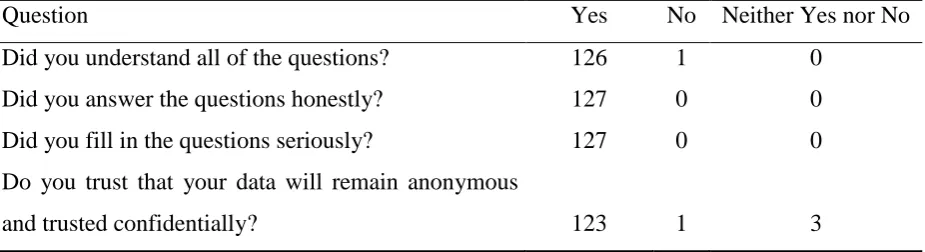
The analysis showed that the questions were mostly understandable for the
respondents. Furthermore, all respondents reported to have answered the questions
honestly and filled in the questions seriously. Most of the respondents also trusted that
their data would stay anonymous and would be treated confidentially. One respondent
stated that he did not trust the researcher, and three reported to have no opinion on
these questions (see Table 2). Thus, all in all, it can be concluded that the questions
were mostly seriously answered and, the results applicable to the following research.
After filling in the control questions, the respondents were informed of the aim
and the expectations of the study and asked if they confirmed that their data may be
[image:16.595.89.552.576.702.2]used for the research.
Table 2
Overview of the number of respondents who responded regarding the different
conditions of the control questions (N = 127)
Note: The frequencies of the 127 respondents are presented for each control question separately’. The control questions were adopted and adjusted from the study by Karemaker, M. (2014). Range of the scale: 3-point Likert scale, ranging from 1 = Yes, 2 = No, 3 = Neither yes nor no.
Question Yes No Neither Yes nor No
Did you understand all of the questions? 126 1 0
Did you answer the questions honestly? 127 0 0
Did you fill in the questions seriously? 127 0 0
Do you trust that your data will remain anonymous
16 Participants. In total, 135 participants took part in the study. The outlined
questionnaire was formulated in German and was widely circulated through social
media platforms (e.g. Facebook, Skype, Instagram and Twitter) via a link, or else
directly via e-mail. In total, eight respondents were excluded from the analysis. Three
of them were excluded, because they did not belong to the chosen target group
(Germans): one respondent was not considered, because he did not name his age, so it
was not clear if he was really at least 18 years old and if his data may be used or not):
and four respondents were excluded because they did not confirm that their data may
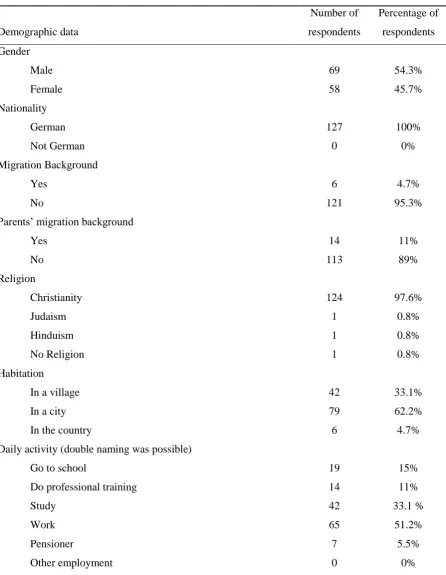
be used for scientific research. The analysis showed that 54.3% of the remaining 127
participants, who were between 18 and 82 years old (M = 29.78; SD = 13.28), were
male, and 45.7% were female (see Table 3). It also became clear that most of the
people who filled in the questionnaire did not have a migration background (95.3%);
they also reported that their parents did not have a migration background (89%), (see
Table 3). In addition, the analysis indicated that most respondents were Christians
17
Table 3
Overview of the respondents’ demographic data (N = 127)
Demographic data
Number of respondents
Percentage of respondents Gender
Male 69 54.3%
Female 58 45.7%
Nationality
German 127 100%
Not German 0 0%
Migration Background
Yes 6 4.7%
No 121 95.3%
Parents’ migration background
Yes 14 11%
No 113 89%
Religion
Christianity 124 97.6%
Judaism 1 0.8%
Hinduism 1 0.8%
No Religion 1 0.8%
Habitation
In a village 42 33.1%
In a city 79 62.2%
In the country 6 4.7%
Daily activity (double naming was possible)
Go to school 19 15%
Do professional training 14 11%
Study 42 33.1 %
Work 65 51.2%
Pensioner 7 5.5%
Other employment 0 0%
Procedure.The questionnaire was produced in German and was distributed
through the snowball principle. In order to collect as many respondents as possible in
18
platforms, such as Facebook, Skype, Instagram and Twitter. In addition, different
respondents were directly connected via e-mail or directly contacted. At the start, the
respondents were informed that participation in the study was completely voluntary,
that the study could be stopped at any time and that the data was processed
anonymously and exclusively used for this study (see Attachment 6). Once the
informed consent was filled in, the respondents were directly transferred to the
questionnaire with the different scales (i.e., regarding in-group identification,
prototypicality, contact, scenarios of the criminal Germans and criminal Muslim
refugee, control questions). After completing the questionnaire, the respondents were
thanked for their participation, and they were informed about the aim and the
expectations of the research. This information was provided at the end of the study so
that there was no influence on the respondents in answering the questions and in order
to avoid socially desired answers.
Results
In order to determine which of the previously presented hypotheses might be
affected and which of the chosen variables are influential, many different analyses
were done. In the following remarks, these analyses are demonstrated in detail.
Correlations
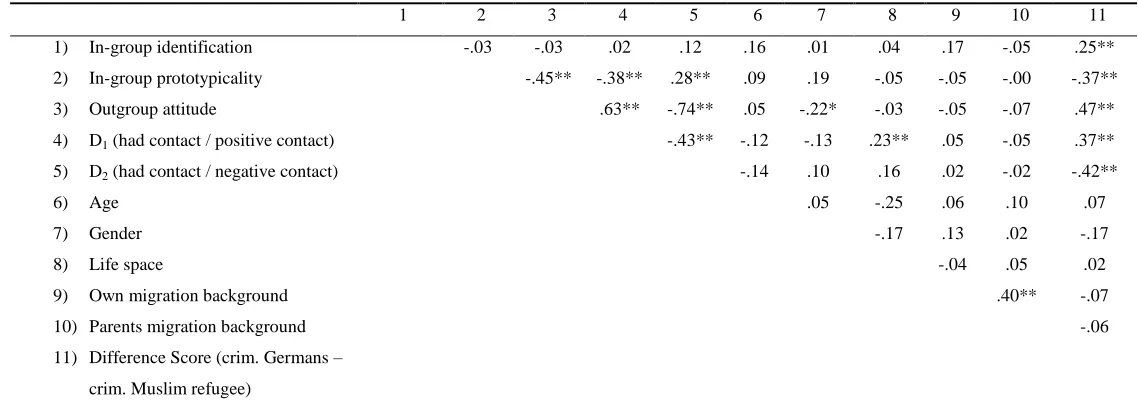
In order to investigate, which variables influence each other, a correlation
analysis was conducted. In the following, the most important correlations relevant
toward answering the research questions are summed up (see, Table 4):
1) In-group identification and the difference score of criminal Germans and
Muslim refugee were positively correlated with each other. This means
that it could be expected that the difference between the judgement of
criminal in-group and out-group behaviour will be larger if in-group
identification is high.
2) In-group prototypicality and out-group attitude were negatively correlated
with each other. Thus, it could be expected that people who showed high
in-group prototypicality (and thus saw native Germans as typical of a
German identity), showed a low out-group attitude (and thus saw Muslim
19
3) In-group prototypicality was negatively correlated with D1 and positively
correlated with D2, meaning that it could be expected that respondents who
showed a high in-group prototypicality (i.e., who saw native Germans as
typical for a German identity), have had negative and less contact with
Muslim refugee.
4) In-group prototypicality was negatively correlated with the difference
score between criminal Germans and Muslim refugee. This means that it
could be expected that the difference between the judgement of criminal
in-group and out-group behaviour would be lower if in-group
prototypicality was low.
5) Out-group attitude was positively correlated with D1 and negatively
correlated with D2. Therefore, it could be expected that Germans, who saw
Muslim refugee as disturbing and threatening, have also had negative and
frequent contact with Muslim refugee.
6) Out-group attitude was positively correlated with the difference score
between criminal Germans and Muslim refugee. This means that it could
be expected that the difference between the judgement of criminal in-group
and out-group would be lower if out-group prototypicality were high.
7) D1 and D2 were negatively correlated with each other, meaning that it
could be expected that people who have had positive contact with Muslim
refugee, could not have had negative contact with them.
8) D1 was positively correlated with the difference score between criminal
Germans and Muslim refugee. Thus, it could be expected that the
difference between the judgement of criminal in-group and out-group
people would be larger if Germans have had positive contact with Muslim
refugee.
9) D2 was negatively correlated with the difference score between criminal
Germans and Muslim refugee. This means that it could be expected that
the difference between the judgement of criminal in-group and out-group
people would be lower if Germans have had negative contact with Muslim
refugee.
The other correlations, which can be found in the correlation table, were not
relevant toward answering the research questions and are therefore not depicted in the
20 Table 4
Overview of the correlations between the different independent variables (N = 127)
Note: In each column, the Pearson correlation coefficient of each predictor is presented. * = Correlation is significant at the 0.05 level (2-tailed). ** = Correlation is significant at the 0.01 level (2-tailed).
1 2 3 4 5 6 7 8 9 10 11
1) In-group identification 2) In-group prototypicality 3) Outgroup attitude
4) D1 (had contact / positive contact)
5) D2 (had contact / negative contact)
6) Age 7) Gender 8) Life space
9) Own migration background 10) Parents migration background 11) Difference Score (crim. Germans –
crim. Muslim refugee)
21
In order to investigate whether there were significant differences between the
judgement scores of criminal Germans and Muslim refugee, a significance test in the
form of a paired sample t-test was done.
Significance test and analysis of the mean scores
The significance test indicated that there were significant differences in the
judgement scores (t (122) = 3.115, p < .01). In order to reflect the differences more
deeply, the overall mean score and the mean scores per scenario were separately
reflected. The overall mean scores of both groups of criminal people showed that
criminal Germans (M = 4.62, SD = 0.24; see Table 13 in Appendix) were more
negatively judged than criminal Muslim refugee (M = 4.54, SD = 0.31; see Table 13
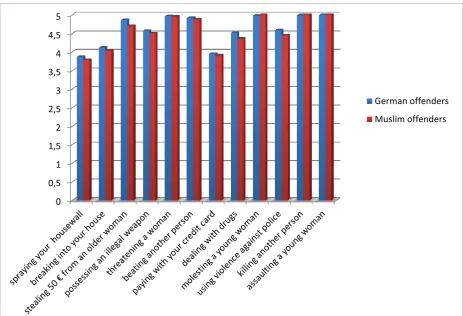
in Appendix). By comparing the different scenarios, it became clear that the most
scenarios were scored minimally higher (more negatively) by criminal in-group
people to comparable out-group people (see Figure 2). In contrast, it was conspicuous
that ‘…molesting a young woman’ and’…killing another person’ were scored
minimally higher when perpetrated by Muslim refugee (M = 5.00; M = 5.00; see
Figure 2) than by criminal German people (M = 4.98; M = 4.99; see Figure 2). In
addition, the scenario of ‘…assaulting a young woman’ was scored equally by both
groups (both M = 5.00, both SD = 0.00; see Table 13, Appendix). The exact values of
each scenario can be found in Table 13 (see Appendix).
In summary, so as said in the ‘Black Sheep Effect’, it can be concluded that
criminal in-group people are judged more negatively than comparable criminal
22 Figure 2. The bar diagram shows the average judgement scores of Germans and Muslim refugee by each scenario. The blue bar shows the average scores for German criminals, and the red bar show the average scores for criminal Muslim refugee.
Examining the demographic data revealed that six people reported having a
migration background. Consequently, it could be questioned, whether they also
judged criminal Germans more negatively, or whether they judged criminal Muslim
refugee more negatively (perhaps because they saw them as their in-group). In order
to investigate this question, a separate analysis was made, in which the mean scores
and standard deviations for criminal Germans and Muslim refugee were reflected
separately. In both conditions one person was not reflected. By comparing these
values, it became apparent that Germans with a migration background also judged
criminal Germans more negatively compared to criminal Muslim refugee (see Table
5).
0 0,5 1 1,5 2 2,5 3 3,5 4 4,5 5
[image:23.595.90.554.69.385.2]German offenders Muslim offenders
23
Table 5
Overview of the mean scores and standard deviations of the judgement scores for
criminal Germans and Muslim refugee by Germans with a migration background
compared to Germans without a migration background (N = 127)
Judgement scores Criminal Muslim
refugee __________________ M SD
Criminal Germans
________________ M SD Germans with a migration
background (N = 6)
Germans without a migration background (N = 121)
4.47 0.13
4.55 0.31
4.72 0.21
4.61 0.24 Note: M = Mean score, SD = Standard deviation.
In order to investigate the formulated research questions, the demonstrated
correlations (see Table 4) were analysed more deeply. To this end, a regression
analysis was conducted in which the variables and interactions relevant to answering
the research questions were investigated. Variables, not included in the regression
analysis were: ‘gender’, ‘age’, ‘living environment’, ‘own migration background’ and ‘parent’s migration background’.
Regression analysis
By means of the regression analysis, it was examined which predictors were
influential on the average judgement scores of criminal Germans and criminal Muslim
refugee and whether main- of interaction effects were observable. Therefore, a
regression analysis of the difference scores of Germans and Muslim refugee was
undertaken with the following (possible) predictors: ‘D1 (positive contact)’, ‘D2 (negative contact)’, ‘in-group identification’, ‘in-group prototypicality’ and ‘out-group attitude’. Furthermore, a possible interaction effect between out-‘out-group attitude
and in-group prototypicality (which was relevant for answering the fourth research
question) was investigated. The regression analysis showed that the predictors
presented above explained about 35% of the total variance (adjusted R2 = .34) of the
24
The coefficient table (in which main- and interaction effects are presented)
shows that D1 did not influence the difference judgement scores between criminal
Germans and criminal Muslim refugee (b = .07, SE = .04, t (121) = 1,58; p = .12; see
Table 6). In contrast, D2 had an influence on the difference judgement scores (b =
-.15, SE = .07, t (121) = -2,26; p = .03; see Table 6). The b-value was negative, so that
the variable had a negative influence. Thus, the difference between criminal Germans
and criminal Muslim refugee will be lower if there is negative contact observable
between both groups (Germans and Muslim refugee). In other words, connecting to
earlier findings, the ‘Black Sheep Effect’ will be lower if Germans reported having
negative contact with Muslim refugee. This implied that that the difference between
criminal in-group and out-group behaviour would be larger if the contact with Muslim
refugee was seen as negative. Thus, it can be concluded that hypothesis 2 (‘The more
negative the contact is judged between Germans and Muslim refugee, the more
negative the judgement of criminal out-group people.’) can be accepted.
Furthermore, it was shown that in-group identification influenced the
judgement of criminal in-group and out-group behaviour (b = .16, SE = .04, t (121) =
4.19; p = .00; see Table 6). The b-value was positive, which means that the difference
between criminal Germans and criminal Muslim refugee will be lower if in-group
identification is low. In other words, it can be determined that the ‘Black Sheep
Effect’, will be lower if in-group identification is low. Related to hypothesis 3 (‘The
higher the in-group identification, the more negative are the judgement scores of
criminal in-group people’), it can be concluded that the difference between criminal
in-group and out-group behaviour would be larger, if in-group identification were
high. This implied that people, who score high on the in-group identification scale,
also scored high on criminal in-group behaviour. Thus, hypothesis 3 can be accepted.
Moreover, it can be asserted both that in-group prototypicality and out-group
attitude did not affect the difference judgement scores (of criminal Germans and
criminal Muslim refugee) apart (both ps >.13, see Table 6) and that there was also
only a marginal observable interaction effect between both variables (b = .06, SE =
.03, t(121) = 1.95; p = .053; see Table 6). This means that neither variable led to a
difference in the judgements of criminal Germans and criminal Muslim refugee and
thus also did not affect the ‘Black Sheep Effect’. For these reasons, hypothesis 4 (‘The
higher the in-group prototypicality and lower the out-group attitude, the more
25
Table 6
Overview of the β, t, df (degree of freedom) and p-values of the different predictors
and of possible interactions relating to the difference score of criminal Germans and
criminal Muslim refugee (N=121)
β SE T df p
In-group identification .16 .04 4.19 6, 115 .00
In-group prototypicality -.04 .02 -1.52 6, 115 .13
Out-group attitude .02 .06 .43 6, 115 .67
D1 (had contact / positive contact) .07 .04 1.58 6, 115 .12
D2 (had contact / negative contact) -.15 .07 -2.26 6, 115 .03
In-group prototypicality *
Out-group attitude .06 .03 1.95 6, 115 .053
Because there was a marginal regression observable relating to the interaction
between in-group prototypicality and outgroup attitude, this interaction was deeper
reflected. Therefore, two groups are made (through a median split) on the basis of
in-group prototypicality (low vs. high in-in-group prototypicality). After that, for each of
both groups, correlations between the difference score and the ‘out-group attitude’
variable were investigated. For both groups (low and high in-group prototypicality),
positive correlations between the out-group attitude and the difference score were
observable (see Table 7). That means that there was no significant difference between
both groups (people with low in-group prototypicality and with high in-group
prototypicality) observable relating to the scores of the out-group attitude and the
26
Table 7
The correlations between the difference score and out-group attitude on the basis of
low and high in-group prototypicality (N = 123)
Note: In each column, the Pearson correlation coefficient of the predictors is presented. * = Correlation is significant at the 0.05 level (2-tailed). ** = Correlation is significant at the 0.01 level (2-tailed).
The same procedure was done on the basis of out-group attitude (low vs. high
out-group attitude), where correlations between the difference score and in-group
prototypicality were investigated. It was shown that there was a negative correlation
observable by a low out-group attitude and no correlation by a high out-group attitude
(see Table 8). That means that there was a difference between both groups (people
with a low in-group out-group attitude and with a high in-group attitude) observable
relating to the scores of the group prototypicality and the judgement of criminal
in-group and out-in-group people.
Table 8
The correlations between the difference score and in-group prototypicality on the
basis of low and high out-group attitude (N = 123)
Note: In each column, the Pearson correlation coefficient of the predictors is presented. * = Correlation is significant at the 0.05 level (2-tailed). ** = Correlation is significant at the 0.01 level (2-tailed).
Difference Score Outgroup Attitude Low IP Difference Score
Outgroup Attitude
1 .26*
.26* 1 High IP Difference Score
Outgroup Attitude
1 .53**
.53** 1
Difference Score In-group Prototypicality Low OA Difference Score
In-group Prototypicality
1 -.36**
-.36** 1 High OA Difference Score
In-group Prototypicality
1 -.16
[image:27.595.91.487.527.621.2]27 Discussion
The aim of the study was to investigate which predictors influence the
judgements of criminal in-group (Germans) and criminal out-group (Muslim refugee)
people. As possible predictors, the variables: ‘contact’, ‘in-group prototypicality’,
‘out-group attitude’ and ‘in-group identification’ are chosen.
The analysis showed that the average judgement scores of criminal Muslim
refugee are higher than comparable German criminals. The correlations of the
different variables shows that many relationships are observable. Thereby, it can be
seen that there are many positive correlations, for example between in-group
identification and the difference score of criminal Germans and Muslim refugee,
between in-group identification and the D2 variable, between out-group attitude and
D1, between out-group attitude and the difference score of criminal Germans and
criminal Muslim refugee and between D1 and the difference score of criminal
Germans and criminal Muslim refugee. Furthermore, many negative correlations are
observable: between group prototypicality and out-group attitude, between
in-group prototypicality and D1, between in-group prototypicality and the difference
score of criminal Germans and criminal Muslim refugee, between out-group attitude
and D2, between D1 and D2 and between D2 and the difference score of criminal
Germans and criminal Muslim refugee.
Apart from these findings, it is shown that more negative contact among
Germans and Muslim refugee, also lead to more negative judgement towards criminal
out-group people. Relating to the variable ‘in-group identification’, it can be
concluded that the higher the in-group identification, the more negative is the
judgement score of criminal in-group people. The other two predictors (‘in-group
prototypicality’ and ‘out-group attitude’) did not influence the judgement scores.
There was also only a marginal interaction effect observable between both variables.
By investigating this marginal interaction effect, it was shown that there was a
difference between both groups of out-group attitude (low vs. high out-group attitude)
observable relating to the scores of in-group prototypicality and the judgement of
criminal in-group and out-group people. By comparing low and high in-group
prototypicality, there was no difference observable relating to the scores of the
28 Theoretical reflection
Existing literature, such as Pinto (2010) or Marques, et al. (1988), determined
that criminal in-group members are viewed more critically because they overstep the
social norms of the own group. According to the ‘Black Sheep Effect’, social
in-group members form a more negative attitude towards the criminal in-in-group person,
in order to keep up the positive image of the group; they have no understanding for
the criminal in-group person and see him or her as a threat of damaging the social
identity (Pinto, 2010; Marques et al. 1988). These findings are also supported by the
current research, in which it is shown that criminal in-group people are on average
judged more negatively than comparable out-group people.
In addition to these findings, the current research shows that negative contact
had an influence on the judgement scores of criminal out-group people. The results
indicated that negative contact lead to more negative judgements of criminal
out-group people. This was expectable, since many studies, such as the presented study by
Barlow et al. (2012), support these findings. Barlow et al. (2012) conducted two
studies in which they investigated the interactions between the amount of contact and
the valence of prejudices between different groups of persons. Both studies came to
the same conclusion that negative contact was a strong predictor relating to building
up prejudices, racism, discrimination and avoidance (Barlow et al. 2012, p. 1629).
Additionally, the current research showed that in-group identification has an
influence on the judgement scores of in-group people. In terms of the research
hypothesis, it was concluded that a high amount of in-group identification is
connected with a more negative judgement of criminal in-group people. This was
expected, because much research, which is presented in the introduction, maintained
that a high amount of in-group identification can be connected with a positive image
of the in-group, because members see the group as a part of the social identity
(Raffield, et al. 2016). Simultaneously, the current research showed that criminal
in-group behaviour is judged as more extreme (more negatively) compared to criminal
out-group behaviour. This effect can be explained by the fact that deviant behaviour is
not accepted by in-group people, because they are expected to behave according to the
existing rules and norms of the group and not to disagree with existing social norms
(Marques, et al. 1988, pp. 2-5).
The current research also revealed that neither in-group prototypicality nor
29
only a marginal interaction effect observable between both variables, with differences
in low and high out-group attitude and no difference in low and high in-group
prototypicality relating to the scores of in-group prototypicality or rather out-group
attitude and the judgement of criminal in-group and out-group people. This was not
foreseeable, for several reasons: Besides the fact that in-group identification leads to
strong group cohesion and proximity, many studies presented in the introduction, such
as Wenzel, et al. (2008) and Ufkes et al. (2012), explain that people attribute
characteristics to their own in-group that are seen as typical of the superordinate
group (in-group prototypicality). Therefore, it was concluded that out-groups would
be judged more negatively because they differ from the characteristics, seen as typical
of a superordinate group. Because there are no conflicting findings in the literature,
which could support the presented results, it is difficult to find logical explanations for
them. It is possible that there are problems with the conceptual or methodological
structure of the research. It could be that the questions of the scales (or the respond
options) are not formulated very clearly. This may have led to the problem that the
respondents tended to score moderately on a question, because they did not want to
give a crass answer and that the questions are not suitable to answer the research
questions. Another problem could be that the order of the scales was not chosen in a
good manner, meaning that it is possible that the answer to a question from the
in-group identification scale influenced the answer on the out-in-group attitude scale. It
might be useful for further research toallow the respondent to randomly arrange the
scales, in order to detect or suspend such an effect.
Limitations of the research
This research is an empirical approach to the field of immigration research that
reflects specific aspects of social analysis relating to influences on the judgement of
criminal behaviour. As in all empirical research, some limitations are observable that
should be considered through a critical reflection on the research.
A limitation which can be detected in the elaboration of the research design, is
that the 12 chosen scenarios are partially very extreme (e.g., ‘molesting a young
woman’, ‘killing another person’ or ‘assaulting a young woman’), which can be seen
by the fact that on this scenarios, the judgement scores of both groups (criminal
in-group and comparable criminal out-in-group people) are the highest possible or nearly
the highest possible regarding all these scenarios, both values lie between 4.98 and
30
bad, so that it does not matter what the perpetrator looks like. In order to obtain better
results relating to declarative differences in the judgement scores, it is possible to
reformulate the scenarios by extenuating the criminal actions. Another approach could
be, to change the choice options, which are formulated very abstractly and do not
leave much space for the respondents to concretise their answers. In our case, the
respondents have the choice between ‘less severe’, to ‘very severe’, but because probably no one would score ‘less severe’ on a strong criminal action, the differences
in the answers are very small. The analysis of the results shows that most of the
respondents’ answers are between ‘severe’ and ‘very severe’, which implies that the
answer choices are not chosen very well.
A question which arises from the results is how the judgement scores for
Muslim refugee and Germans would look and possibly differ if the scenario’s
presented included not only criminal actions, but also everyday life actions. Such a
question might be: ’What would you say if your daughter introduced her boyfriend to you, and he is a Muslim refugee?’ Through this approach, it would be possible to
discover if Germans only judge Muslim refugee more negatively if they do something
criminal or if it is a general attitude from them. In this way, it might be possible to
draw a general conclusion or to restrict the results only to criminal actions.
Another question which emerges from the elaboration of the results is whether
there are differences in the judgement scores by a population which does not have
many refugee in comparison to a country in which more refugee arrive every year.
Research by Schweitzer, Perkoulidis, Krome, Ludlow and Ryan (2005) stated that
Australian people, who are confronted with a huge intake of new refugee every year,
have developed an increasingly realistic and symbolic sense of threat by the refugee,
which has resulted in a more negative attitude. Thus it can be assumed, that a
population that takes in a huge number of refugee every year shows more prejudices
and a more negative attitude towards the refugee which results in more negative
cognition of them.
Added value and new (contrary) findings
In social psychology, much research is done relating to the social identity
approach. Aspects such as intergroup relationships and social identity,2 the ‘Black
2
31
Sheep Effect’3, integration and contact,4 in-group identification,5 intergroup theory
and in-group projection model6 are investigated very diversely. For this reason, it can
be questioned, what value the current research adds. To answer this question, it can be
asserted that the current research very efficiently demonstrates a new manner of
investigating the ‘Black Sheep Effect’.
Most of the existing literature7 measures the ‘Black Sheep Effect’ on the basis
of a manipulated variable or by comparing a control and an experimental group. In
contrast, the current research demonstrates that it can also be effective to provide
respondents successively with 12 nearly equal scenario’s; which only differ in the
perpetrators (German criminals vs. Muslim refugee criminals), and not to distribute
the respondents according to the two groups of perpetrators (so that a group only
judges the criminal actions of one group of perpetrators).
Furthermore, as described previously, the current research shows contrary
results related to existing literature regarding in-group prototypicality and out-group
attitude. In most research,8 it is shown that people see their own in-group as more
prototypical, such that in-group people are evaluated more positively compared to
out-group people. In the current research, no influence is observable between in-group
prototypicality and out-group attitude, nor is there a difference in judgement by
criminal in-group and out-group people.
Suggestions for further research and implications
Based on the limitations presented above and on an examination of the
research design and the results, it is possible to make suggestions for further research.
A first suggestion is to choose not only more actions than the 12 presented
criminal scenarios’ but also other criminal actions. Such a selection would provide the
opportunity to compare the results with the current research in order to draw general
conclusions about the judgement of criminal behaviour by two different groups.
Another approach for further research could be, to not concentrate solely on
Muslim refugee. With the concretion of ‘Muslim refugee’, the respondents could not
specify their meaning as a whole. The respondents were asked to narrowly state their
3
Abrams et al. 2014; Marques et al., 1988; Pinto et al. 2010 4
Cheung & Phillimore, 2017; Sigelman & Welsh, 1993, Barlow et al. 2012, etc. 5
Raffield et al. 2016, etc. 6
Ratliff & Nosek, 2011; Wenzel, et al., 2008; Ufkes et al. 2012, etc. 7
Abrams et al. 2014; Marques, et al., 1988; Pinto et al. 2010 8
32
meaning relating to Muslim perpetrators, although they might think differently about
other groups of people. Thus, it might be possible, to replace ‘Muslim refugee’ with
’refugee’ in general. With this adjustment, it might be possible to gain a broader
overview of the judgement of a larger sample. This implies that the judgement scores
would be more representative, because they are related to a broader sample (refugee
in general) and not relating to a specified sample (Muslim refugee).
Regarding the questions, developed after the research, it might be interesting
to choose people from different cultures and countries (e.g., one population from
which no large intake of refugee and one population from which a large intake of
refugee is observable) in order to investigate if there are significant differences.
Based on the contrary results, related to in-group prototypicality and out-group
attitude, this study should be repeated (e.g., with other groups of perpetrators, or in
another population). Alternatively, more research in this field could be conducted in
order to investigate whether this results are an exception and are based possibly on a
faulty methodological approach or in order to show similar contrary results, so that it
can be concluded that the results can be seen as representative and not random.
Furthermore, it is possible for further research to create some strategies and
interventions by including the results of the current research, which state that in-group
identification and contact are predictors for the different judgement of criminal
in-group and out-in-group people. By creating interventions, based on these facts, it might
be possible to reduce prejudice, racism and discrimination and to bring both groups
closer together so that Muslim refugee are seen as a full part of the German society.
Conclusion
Based on the elaboration of this study, with the aim of investigating whether
the judgement scores of in-group and out-group criminals are influenced by variables
such as in-group identification, out-group attitude, in-group prototypicality and
contact, it can be concluded that in-group identification and contact affect the
judgement scores of criminal in-group and out-group people; meanwhile, in-group
prototypicality and out-group attitude cannot be seen as predictors. Furthermore, it
can be stated that criminal in-group people are judged more negatively than