Proceedings of the 45th Annual Meeting of the Association of Computational Linguistics, pages 800–807,
On the role of context and prosody in the interpretation of ‘okay’
Agust´ın Gravano, Stefan Benus, H´ector Ch´avez, Julia Hirschberg, Lauren Wilcox Department of Computer Science
Columbia University, New York, NY, USA
{agus,sbenus,hrc2009,julia,lgw23}@cs.columbia.edu
Abstract
We examine the effect of contextual and acoustic cues in the disambiguation of three discourse-pragmatic functions of the word okay. Results of a perception study show that contextual cues are stronger predictors of discourse function than acoustic cues. However, acoustic features capturing the pitch excursion at the right edge ofokay fea-ture prominently in disambiguation, whether other contextual cues are present or not.
1 Introduction
CUE PHRASES (also known asDISCOURSE MARK -ERS) are linguistic expressions that can be used to convey explicit information about the structure of a discourse or to convey a semantic contribution
(Grosz and Sidner, 1986; Reichman, 1985; Cohen, 1984). For example, the wordokaycan be used to convey a ‘satisfactory’ evaluation of some entity in the discourse (the movie was okay); as a backchan-nel in a dialogue to indicate that one interlocutor is still attending to another; to convey acknowledg-ment or agreeacknowledg-ment; or, in its ‘cue’ use, to start or fin-ish a discourse segment (Jefferson, 1972; Schegloff and Sacks, 1973; Kowtko, 1997; Ward and Tsuka-hara, 2000). A major question is how speakers indi-cate and listeners interpret such variation in mean-ing. From a practical perspective, understanding how speakers and listeners disambiguate cue phrases is important to spoken dialogue systems, so that sys-tems can convey potentially ambiguous terms with their intended meaning and can interpret user input correctly.
There is considerable evidence that the different
uses of individual cue phrases can be distinguished by variation in the prosody with which they are re-alized. For example, (Hirschberg and Litman, 1993) found that cue phrases in general could be disam-biguated between their ‘semantic’ and their ‘dis-course marker’ uses in terms of the type of pitch accent borne by the cue phrase, the position of the phrase in the intonational phrase, and the amount of additional information in the phrase. Despite the frequence of the word okay in natural dialogues, relatively little attention has been paid to the rela-tionship between its use and its prosodic realization. (Hockey, 1993) did find thatokaydiffers in terms of the pitch contour speakers use in uttering it, suggest-ing that a final rissuggest-ing pitch contour “categorically marks a turn change,” while a downstepped falling pitch contour usually indicates a discourse segment boundary. However, it is not clear which, if any, of the prosodic differences identified in this study are actually used by listeners in interpreting these po-tentially ambiguous items.
In this study, we address the question of how hear-ers disambiguate the interpretation ofokay. Our goal is to identify the acoustic, prosodic and phonetic fea-tures ofokaytokens for which listeners assign differ-ent meanings. Additionally, we want to determine the role that discourse context plays in this classi-fication: i.e., can subjects classifyokaytokens reli-ably from the word alone or do they require addi-tional context?
Below we describe a perception study in which listeners were presented with a number of spoken productions of okay, taken from a corpus of dia-logues between subjects playing a computer game. The tokens were presented both in isolation and in context. Users were asked to select the meaning
of each token from three of the meanings thatokay can take on: ACKNOWLEDGEMENT/AGREEMENT, BACKCHANNEL, and CUE OF AN INITIAL DIS -COURSE SEGMENT. Subsequently, we examined the acoustic, prosodic and phonetic correlates of these classifications to try to infer what cues listeners used to interpret the tokens, and how these varied by con-text condition. Section 2 describes our corpus. tion 3 describes the perception experiment. In Sec-tion 4 we analyze inter-subject agreement, introduce a novel representation of subject judgments, and ex-amine the acoustic, prosodic, phonetic and contex-tual correlates of subject classification ofokays. In Section 5 we discuss our results and future work.
2 Corpus
The materials for our perception study were selected from a portion of the Columbia Games Corpus, a collection of 12 spontaneous task-oriented dyadic conversations elicited from speakers of Standard American English. The corpus was collected and annotated jointly by the Spoken Language Group at Columbia University and the Department of Lin-guistics at Northwestern University.
Subjects were paid to play two series of com-puter games (the CARDSGAMESand the OBJECTS GAMES), requiring collaboration between partners to achieve a common goal. Participants sat in front of laptops in a soundproof booth with a curtain be-tween them, so that all communication would be ver-bal. Each player played with two different partners in two different sessions. On average, each session took 45m 39s, totalling 9h 8m of dialogue for the whole corpus. All interactions were recorded, digi-tized, and downsampled to 16K.
The recordings were orthographically transcribed and words were aligned by hand by trained annota-tors in a ToBI (Beckman and Hirschberg, 1994) or-thographic tier using Praat (Boersma and Weenink, 2001) to manipulate waveforms. The corpus con-tains 2239 unique words, with 73,831 words in total. Nearly all of the Objects Games part of the corpus has been intonationally transcribed, using the ToBI conventions. Pitch, energy and duration information has been extracted for the entire corpus automati-cally, using Praat.
In the Objects Games portion of the corpus each
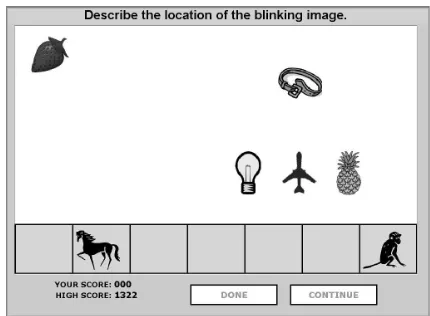
[image:2.612.316.531.382.540.2]player’s laptop displayed a gameboard containing 5– 7 objects (Figure 1). In each segment of the game, both players saw the same set of objects at the same position on each screen, except for one object (the TARGET). For one player (theDESCRIBER), this tar-get appeared in a random location among other ob-jects on the screen. For the other player (theFOL -LOWER), the target object appeared at the bottom of the screen. The describer was instructed to describe the position of the target object on their screen so that the follower could move their representation of the target to the same location on their own screen. After the players had negotiated what they deter-mined to be the best location, they were awarded up to 100 points based on the actual match of the target location on the two screens. The game pro-ceeded in this way through 14 tasks, with describer and follower alternating roles. On average, the Ob-jects Games portion of each session took 21m 36s, resulting in 4h 19m of dialogue for the twelve ses-sions in the corpus. There are 1484 unique words in this portion of the corpus, and 36,503 words in total.
Figure 1: Sample screen of the Objects Games.
choose the most appropriate category for each to-ken, or indicate with ‘?’ if they could not make a decision. They were allowed to read the transcripts and listen to the speech as they labeled.
For our perception experiment we chose materials from the tokens of the most frequent of our labeled affirmative words, okay, from the Objects Games, which contained most of these tokens. Altogether, there are 1151 instances ofokayin this part of the corpus; it is the third most frequent word, follow-ing the, with 4565 instances, and of, with 1534. At least two labelers agreed on the functional cat-egory of 902 (78%) okaytokens. Of those tokens, 286 (32%) were classified as BACKCHANNEL, 255 (28%) as ACKNOWLEDGEMENT/AGREEMENT, 141 (16%) as CUE BEGINNING, 116 (13%) as PIVOT BEGINNING (a function that combines Acknowl-edgement/agreement and Cue beginning), and 104 (11%) as one of the other functions. We sampled from tokens the annotators had labeled as Cue be-ginning discourse segment, Backchannel, and Ac-knowledgement/agreement, the most frequent cate-gories in the corpus; we will refer to these below simply as ‘C’, ‘B’, and ‘A’ classes, respectively.
3 Experiment
We next designed a perception experiment to ex-amine naive subjects’ perception of these tokens of okay. To obtain good coverage both of the (labeled) A, B, and C classes, as well as the degrees of po-tential ambiguity among these classes, we identified 9 categories ofokaytokens to include in the experi-ment: 3 classes (A, B, C)×3 levels of labeler agree-ment (UNANIMOUS,MAJORITY,NO-AGREEMENT). ‘Unanimous’ refers to tokens assigned to a particu-lar class label by all 3 labelers, ‘majority’ to tokens assigned to this class by 2 of the 3 labelers, and ‘no-agreement’ to tokens assigned to this class by only 1 labeler. To decrease variability in the stimuli, we selected tokens only from speakers who produced at least one token for each of the 9 conditions. There were 6 such speakers (3 female, 3 male), which gave us a total of 54 tokens.
To see whether subjects’ classifications of okay were dependent upon contextual information or not, we prepared two versions of each token. The iso-lated versions consisted of only the wordokay
ex-tracted from the waveform. For the contextualized versions, we extracted two full speaker turns for eachokay including the full turn1containing the tar-getokayplus the full turn of the previous speaker. In the following three sample contexts, pauses are indi-cated with ‘#’, and the targetokays are underlined:
Speaker A: yeah # um there’s like there’s some space there’s Speaker B: okay # I think I got it
Speaker A: but it’s gonna be below the onion Speaker B: okay
Speaker A: okay # alright # I’ll try it # okay Speaker B: okay the owl is blinking
The isolatedokaytokens were single channel au-dio files; the contextualized okay tokens were for-matted so that each speaker was presented to sub-jects on a different channel, with the speaker uttering the targetokayconsistently on the same channel.
The perception study was divided into two parts. In the first part, each subject was presented with the 54 isolated okay tokens, in a different ran-dom ordering for each subject. They were given a forced choice task to classify them as A, B, or C, with the corresponding labels (Acknowledge-ment/agreement, Backchannel, and Cue beginning) also presented in a random order for each token. In the second part, the same subject was given 54 con-textualized tokens, presented in a different random order, and asked to make the same choice.
We recruited 20 (paid) subjects for the study, 10 female, and 10 male, all between the ages of 20 and 60. All subjects were native speakers of Standard American English, except for one subject who was born in Jamaica but a native speaker of English. All subjects reported no hearing problems. Subjects per-formed the study in a quiet lab using headphones to listen to the tokens and indicating their classification decisions in a GUI interface on a lab workstation. They were given instructions on how to use the in-terface before each of the two sections of the study.
For the study itself, for each token in theisolated
condition, subjects were shown a screen with the three randomly ordered classes and a link to the to-ken’s sound file. They could listen to the sound files as many times as they wished but were instructed not to be concerned with answering the questions
“correctly”, but to answer with their immediate re-sponse if possible. However, they were allowed to change their selection as many times as they liked before moving to the next screen. In the contex-tualizedcondition, they were also shown an
ortho-graphic transcription of part of the contextualized to-ken, to help them identify the targetokay. The mean duration of the first part of the study was 25 minutes, and of the second part, 27 minutes.
4 Results
4.1 Subject ratings
The distribution of class labels in each experimental condition is shown in Table 1. While this distribu-tion roughly mirrors our selecdistribu-tion of equal numbers of tokens from each previously-labeled class, in both parts of the study more tokens were labeled as A (acknowledgment/agreement) than as B ( backchan-nel) or C (cue to topic beginning). This supports the hypothesis thatacknowledgment/agreementmay function as the default interpretation ofokay.
Isolated Contextualized
[image:4.612.335.519.68.142.2]A 426 (39%) 452 (42%) B 324 (30%) 306 (28%) C 330 (31%) 322 (30%) Total 1080 (100%) 1080 (100%) Table 1: Distribution of label classes in each
study condition.
We examined inter-subject agreement using Fleiss’ κmeasure of inter-rater agreement for
mul-tiple raters (Fleiss, 1971).2 Table 2 shows Fleiss’κ
calculated for each individual label vs. the other two labels and for all three labels, in both study condi-tions. From this table we see that, while there is very little overall agreement among subjects about how to classify tokens in the isolated condition,
agree-ment is higher in thecontextualizedcondition, with
a moderate agreement for class C (κscore of .497).
This suggests that context helps distinguish thecue beginning discourse segmentfunction more than the other two functions ofokay.
2 This measure of agreement above chance is interpreted as follows: 0 = None, 0 - 0.2 = Small, 0.2 - 0.4 = Fair, 0.4 - 0.6 = Moderate, 0.6 - 0.8 = Substantial, 0.8 - 1 = Almost perfect.
Isolated Contextualized
A vs. rest .089 .227 B vs. rest .118 .164 C vs. rest .157 .497
[image:4.612.322.531.327.398.2]all .120 .293
Table 2: Fleiss’κfor each label class
in each study condition.
Recall from Section 3 that theokay tokens were chosen in equal numbers from three classes accord-ing to the level of agreement of our three original labelers (unanimous, majority, and no-agreement), who had the full dialogue context to use in making their decisions. Table 3 shows Fleiss’ κ measure
now grouped by amount of agreement of the orig-inal labelers, again presented for each context con-dition. We see here that the inter-subject agreement
Isolated Context. OL
[image:4.612.92.278.382.455.2]no-agreement .085 .104 -majority .092 .299 -unanimous .158 .452 -all .120 .293 .312 Table 3: Fleiss’κin each study condition, grouped
by agreement of the three original labelers (‘OL’).
also mirrors the agreement of the three original la-belers. In both study conditions, tokens which the original labelers agreed on also had the highest κ
scores, followed by tokens in the majority and no-agreement classes, in that order. In all cases, tokens which subjects heard in context showed more agree-ment than those they heard in isolation.
The overallκis small at .120 for theisolated
con-dition, and fair at .293 for thecontextualized
con-dition. The three original labelers also achieved fair agreement at .312.3 The similarity between the
lat-ter twoκscores suggests that the full context
from these results that context is of considerable im-portance in the interpretation of the word okay, al-though even a very limited context appears to suf-fice.
4.2 Representing subject judgments
In this section, we present a graphical representa-tion of subject decisions, useful for interpreting, vi-sualizing, and comparing the way our subjects in-terpreted the different tokens of okay. For each in-dividualokay in the study, we define an associated three-dimensional VOTE VECTOR, whose compo-nents are the proportions of subjects that classified the token as A, B or C. For example, if a particu-larokaywas labeled as A by 5 subjects, as B by 3, and as C by 12, then its associated vote vector is
5 20,
3 20,
12 20
[image:5.612.334.520.334.433.2]
= (0.25,0.15,0.6). Following this def-inition, the vectors A= (1,0,0), B= (0,1,0) and C = (0,0,1) correspond to the ideal situations in which all 20 subjects agreed on the label. We call these vectors theUNANIMOUS-VOTE VECTORS.
[image:5.612.72.299.394.523.2]Figure 2.i shows a two-dimensional representa-tion that illustrates these definirepresenta-tions. The black dot
Figure 2: 2D representation of a vote vector (i) and of the cluster centroids (ii).
represents the vote vector for our example okay, the vertices of the triangle correspond to the three unanimous-vote vectors (A,BandC), and the cross in the center of the triangle represents the vote vector of a three-way tie between the labelers 1
3, 1 3,
1 3
. We are thus able to calculate the Euclidean dis-tance of a vote vector to each of the unanimous-vote vectors. The shortest of these distances corresponds to the label assigned by the plurality4 of subjects.
Also, the smaller that distance, the higher the inter-subject agreement for that particular token. For our 4Pluralityis also known assimple majority: the candidate who gets more votes than any other candidate is the winner.
exampleokay, the distances toA,BandCare 0.972, 1.070 and 0.495, respectively; its plurality label is C. In our experiment, each okayhas two associated vote vectors, one for each context condition. To illustrate the relationship between decisions in the
isolatedand thecontextualizedconditions, we first
grouped each condition’s 54 vote vectors into three clusters, according to their plurality label. Figure 2.ii shows the cluster centroids in a two-dimensional representation of vote vectors. The filled dots corre-spond to the cluster centroids of theisolated
condi-tion, and the empty dots, to the centroids of the con-textualizedcondition. Table 4 shows the distances
in each condition from the cluster centroids (denoted
Ac, Bc, Cc) to the respective unanimous-vote
vec-tors (A, B, C), and also the distance between each pair of cluster centroids.
Isolated Contextualized d(Ac,A) .54 .44 (–18%) d(Bc,B) .57 .52 (–10%) d(Cc,C) .52 .28 (–47%) d(Ac, Bc) .41 .48 (+17%) d(Ac, Cc) .49 .86 (+75%) d(Bc, Cc) .54 .91 (+69%)
Table 4: Distances from the cluster centroids (Ac, Bc,Cc) to the unanimous-vote vectors (A,B,C)
and between cluster centroids, in each condition.
In the isolated condition, the three cluster
cen-troids are approximately equidistant from each other —that is, the three word functions appear to be equally confusable. In the contextualized
condi-tion, while Cc is further apart from the other two
centroids, the distance betweenAcand Bcremains
4.3 Features of the okay tokens
In this section, we describe a set of acoustic, prosodic, phonetic and contextual features which may help to explain why subjects interpretokay dif-ferently. Acoustic features were extracted automat-ically using Praat. Phonetic and prosodic features were hand-labeled by expert annotators. Contextual features were considered only in the analysis of the
contextualizedcondition, since they were not
avail-able to subjects in theisolatedcondition.
We examined a number of phonetic features to de-termine whether these correlated with subject clas-sifications. We first looked at the production of the three phonemes in the target okay (/oU/, /k/, /eI/),
noting the following possible variations:
• /oU/: [], [A], [5], [O], [OU], [m], [N], [@], [@U].
• /k/: [G], [k], [kx], [q], [x].
• /eI/: [e], [eI], [E], [e@].
We also calculated the duration of each phone and of the velar closure. Whether the targetokaywas at least partially whispered or not, and whether there was glottalization in the targetokaywere also noted. For each target okay, we also examined its du-ration and its maximum, mean and minimum pitch and intensity, as well as the speaker-normalized ver-sions of these values.5 We considered its pitch slope,
intensity slope, and stylized pitch slope, calculated over the whole targetokay, its last 50, 80 and 100 milliseconds, its second half, its second syllable, and the second half of its second syllable, as well.
We used the ToBI labeling scheme (Pitrelli et al., 1994) to label the prosody of the target okays and their surrounding context.
• Pitch accent, if any, of the targetokay(e.g., H*, H+!H*, L*).
• Break index after the targetokay(0-4).
• Phrase accent and boundary tone, if any, fol-lowing the targetokay(e.g., L-L%, !H-H%). For contextualized tokens, we included several fea-tures related to the exchange between the speaker uttering the target okay (Speaker B) and the other speaker (Speaker A).
5Speaker-normalized features were normalized by comput-ingz-scores (z= (X−mean)/st.dev) for the feature, where
meanandst.devwere calculated from allokays uttered by the speaker in the session.
• Number of words uttered bySpeaker Ain the context, before and after the targetokay. Same forSpeaker B.
• Latency ofSpeaker AbeforeSpeaker B’s turn. • Duration of silence ofSpeaker Bbefore and
af-ter the targetokay.
• Duration of speech bySpeaker Bimmediately before and after the targetokayand up to a si-lence.
4.4 Cues to interpretation
We conducted a series of Pearson’s tests to look for correlations between the proportion of subjects that chose each label and the numeric features described in Section 4.3, together with two-sidedt-tests to find
whether such correlations differed significantly from zero. Tables 5 and 6 show the significant results (two-sided t-tests, p < 0.05) for the isolated and contextualizedconditions, respectively.
Acknowledgement/agreement r
duration of realization of /k/ –0.299
Backchannel r
stylized pitch slope over 2nd half 2nd syl. 0.752 pitch slope over 2nd half of 2nd syllable 0.409 speaker-normalized maximum intensity –0.372 pitch slope over last 80 ms 0.349 speaker-normalized mean intensity –0.327 duration of realization of /eI/ 0.278
word duration 0.277
Cue to discourse segment beginning r
stylized pitch slope over the whole word –0.380 pitch slope over the whole word –0.342 pitch slope over 2nd half of 2nd syllable –0.319 Table 5: Features correlated to the proportion of
votes for each label.Isolatedcondition.
Table 5 shows that in theisolatedcondition,
sub-jects tended to classify tokens ofokayas Acknowl-edgment/agreement (A) which had a longer realiza-tion of the /k/ phoneme. They tended to classify tokens as Backchannels (B) which had a lower in-tensity, a longer duration, a longer realization of the /eI/ phoneme, and a final rising pitch. They tended
Acknowledgement/agreement r
latency ofSpkr AbeforeSpkr B’s turn –0.528 duration of silence bySpkr Bbeforeokay–0.404 number of words bySpkr Bafterokay –0.277
Backchannel r
pitch slope over 2nd half of 2nd syllable 0.520 pitch slope over last 80 ms 0.455 number of words bySpkr Abeforeokay 0.451 number of words bySpkr Bafterokay –0.433 duration of speech bySpkr Bafterokay –0.413 latency ofSpkr AbeforeSpkr B’s turn –0.385 duration of silence bySpkr Bbeforeokay 0.295 intensity slope over 2nd syllable –0.279
Cue to discourse segment beginning r
[image:7.612.316.539.69.130.2]latency ofSpkr AbeforeSpkr B’s turn 0.645 number of words bySpkr Bafterokay 0.481 number of words bySpkr Abeforeokay –0.426 pitch slope over 2nd half of 2nd syllable –0.385 pitch slope over last 80 ms –0.377 duration of speech bySpkr Bafterokay 0.338 Table 6: Features correlated to the proportion of votes for each label.Contextualizedcondition.
In thecontextualizedcondition, we find very
dif-ferent correlations. Table 6 shows that nearly all of the strong correlations in this condition involve con-textual features, such as the latency beforeSpeaker B’s turn, or the number of words by each speaker be-fore and after the targetokay. Notably, only one of the features that show strong correlations in the iso-latedcondition shows the same strong correlation in
thecontextualizedcondition: the pitch slope at the
end of the word. In both conditions subjects tended to label tokens with a final rising pitch contour as B, and tokens with a final falling pitch contour as C. This supports (Hockey, 1993)’s findings on the role of pitch contour in disambiguatingokay.
We next conducted a series of two-sided Fisher’s exact tests to find correlations between subjects’ la-belings ofokayand the nominal features described in Section 4.3. We found significant associations be-tween the realization of the /oU/ phoneme and the
okayfunction in theisolatedcondition (p <0.005). Table 7 shows that, in particular, [m] seems to be the preferred realization for Bokays, while [@] seems to
be the preferred one for Aokays, and [OU] and [O]
for A and Cokays.
? [A] [5] [OU] [O] [N] [@U] [@] [] [m]
A 0 0 5 6 4 0 0 8 0 0
B 2 0 4 1 0 1 0 1 1 5
C 1 1 2 3 4 0 1 3 0 0
Table 7: Realization of the /oU/ phoneme, grouped
by subject plurality label.Isolatedcondition only.
Notably, we did not find such significant asso-ciations in the contextualized condition. We did
find significant correlations in both conditions, how-ever, between okay classifications and the type of phrase accent and boundary tone following the target (Fisher’s Exact Test,p < 0.05for theisolated
[image:7.612.78.294.71.352.2]con-dition,p <0.005for thecontextualizedcondition).
Table 8 shows that L-L% tends to be associated with A and C classes, H-H% with B classes, and L-H% with A and B classes. In this case, such correlations are present in theisolated condition, and sustained
or enhanced in thecontextualizedcondition.
H-H% H-L% L-H% L-L% other
Isolated
A 0 2 4 8 9
B 3 3 1 5 3
C 1 1 0 8 5
Context.
A 0 2 3 10 10
B 4 3 2 1 2
C 0 1 0 10 5
Table 8: Phrase accent and boundary tone, grouped by subject plurality label.
Summing up, when subjects listened to theokay tokens in isolation, with only their acoustic, prosodic and phonetic properties available, a few features seem to strongly correlate with the perception of word function; for example, maximum intensity, word duration, and realizing the /oU/ phoneme as
[m] tend to be associated with backchannel, while the duration of the realization of the /k/ phoneme, and realizing the /oU/ phoneme as [@] tend to be
as-sociated withacknowledgment/agreement.
[image:7.612.317.537.346.452.2]might override the effect of most acoustic, prosodic and phonetic features of okay. There is nonethe-less one notable exception: word final intonation — captured by the pitch slope and the ToBI labels for phrase accent and boundary tone — seems to play a central role in the interpretation of both isolated and contextualizedokays.
5 Conclusion and future work
In this study, we have presented evidence of differ-ences in the interpretation of the function of isolated and contextualizedokays. We have shown that word final intonation strongly correlates with the subjects’ classification ofokays in both conditions. Addition-ally, the higher degree of inter-subject agreement in the contextualized condition, along with the strong correlations found for contextualized features, sug-gests that context, when available, plays a central role in the disambiguation of okay. (Note, how-ever, that further research is needed in order to assess whether these features are indeed, in fact, perceptu-ally important, both individuperceptu-ally and combined.)
We have also presented results suggesting that ac-knowledgment/agreement acts as a default function for both isolated an contextualized okays. Further-more, while that function remains confusable with backchannel in both conditions, the availability of some context helps in distinguishing those two func-tions fromcue to topic beginning.
These results are relevant to spoken dialogue sys-tems in suggesting how syssys-tems can convey the cue wordokaywith the intended meaning and can inter-pret users’ productions ofokaycorrectly. How these results extend to other cue words and to other word functions remains an open question.
As future work, we will extend this study to in-clude the over 5800 occurrences ofalright, gotcha, huh, mmhm, okay, right, uhhuh, yeah, yep, yes, yup in the entire Games Corpus, and all 10 discourse functions mentioned in Section 2, as annotated by our three original labelers. Since we have observed considerable differences in conversation style in the two parts of the corpus (the Objects Games elicited more ‘dynamic’ conversations, with more overlaps and interruptions than the Cards Games), we will compare cue phrase usage in these two settings. Fi-nally, we are also interested in examining speaker
entrainment in cue phrase usage, or how subjects adapt their choice and production of cue phrases to their conversation partner’s.
Acknowledgments
This work was funded in part by NSF IIS-0307905. We thank Gregory Ward, Elisa Sneed, and Michael Mulley for their valuable help in collecting and la-beling the data, and the anonymous reviewers for helpful comments and suggestions.
References
Mary E. Beckman and Julia Hirschberg. 1994. The ToBI annotation conventions.Ohio State University.
Paul Boersma and David Weenink. 2001. Praat: Doing phonetics by computer.http://www.praat.org.
Robin Cohen. 1984. A computational theory of the func-tion of clue words in argument understanding. 22nd Conference of the ACL, pages 251–258.
Joseph L. Fleiss. 1971. Measuring nominal scale agree-ment among many raters. Psychological Bulletin,
76(5):378–382.
Barbara J. Grosz and Candace L. Sidner. 1986. Atten-tion, Intentions, and the Structure of Discourse. Com-putational Linguistics, 12(3):175–204.
Julia Hirschberg and Diane Litman. 1993. Empirical Studies on the Disambiguation of Cue Phrases. Com-putational Linguistics, 19(3):501–530.
Beth Ann Hockey. 1993. Prosody and the role of okay and uh-huh in discourse. Proceedings of the Eastern States Conference on Linguistics, pages 128–136.
Gail Jefferson. 1972. Side sequences. Studies in social interaction, 294:338.
Jacqueline C. Kowtko. 1997. The function of intonation in task-oriented dialogue. Ph.D. thesis, University of
Edinburgh.
John Pitrelli, Mary Beckman, and Julia Hirschberg. 1994. Evaluation of prosodic transcription labeling reliability in the ToBI framework. InICSLP94,
vol-ume 2, pages 123–126, Yokohama, Japan.
Rachel Reichman. 1985.Getting Computers to Talk Like You and Me: Discourse Context, Focus, and Seman-tics: (an ATN Model). MIT Press.
Emanuel A. Schegloff and Harvey Sacks. 1973. Opening up closings.Semiotica, 8(4):289–327.