Forest-Based Translation
Haitao Mi† Liang Huang‡ Qun Liu†
†Key Lab. of Intelligent Information Processing ‡Department of Computer & Information Science Institute of Computing Technology University of Pennsylvania
Chinese Academy of Sciences Levine Hall, 3330 Walnut Street P.O. Box 2704, Beijing 100190, China Philadelphia, PA 19104, USA
{htmi,liuqun}@ict.ac.cn [email protected]
Abstract
Among syntax-based translation models, the tree-based approach, which takes as input a parse tree of the source sentence, is a promis-ing direction bepromis-ing faster and simpler than its string-based counterpart. However, current tree-based systems suffer from a major draw-back: they only use the 1-best parse to direct the translation, which potentially introduces translation mistakes due to parsing errors. We propose a forest-based approach that trans-lates a packed forest of exponentially many parses, which encodes many more alternatives than standardn-best lists. Large-scale exper-iments show an absolute improvement of 1.7 BLEU points over the 1-best baseline. This result is also 0.8 points higher than decoding with 30-best parses, and takes even less time.
1 Introduction
Syntax-based machine translation has witnessed promising improvements in recent years. Depend-ing on the type of input, these efforts can be di-vided into two broad categories: the string-based systems whose input is a string to be simultane-ously parsed and translated by a synchronous gram-mar (Wu, 1997; Chiang, 2005; Galley et al., 2006), and the tree-based systems whose input is already a parse tree to be directly converted into a target tree or string (Lin, 2004; Ding and Palmer, 2005; Quirk et al., 2005; Liu et al., 2006; Huang et al., 2006). Compared with their string-based counterparts, tree-based systems offer some attractive features: they are much faster in decoding (linear time vs. cubic
time, see (Huang et al., 2006)), do not require a binary-branching grammar as in string-based mod-els (Zhang et al., 2006), and can have separate gram-mars for parsing and translation, say, a context-free grammar for the former and a tree substitution gram-mar for the latter (Huang et al., 2006). However, de-spite these advantages, current tree-based systems suffer from a major drawback: they only use the 1-best parse tree to direct the translation, which po-tentially introduces translation mistakes due to pars-ing errors (Quirk and Corston-Oliver, 2006). This situation becomes worse with resource-poor source languages without enough Treebank data to train a high-accuracy parser.
One obvious solution to this problem is to take as inputk-best parses, instead of a single tree. Thisk -best list postpones some disambiguation to the de-coder, which may recover from parsing errors by getting a better translation from a non 1-best parse. However, a k-best list, with its limited scope, of-ten has too few variations and too many redundan-cies; for example, a 50-best list typically encodes a combination of 5 or 6 binary ambiguities (since
25 < 50 < 26), and many subtrees are repeated across different parses (Huang, 2008). It is thus inef-ficient either to decode separately with each of these very similar trees. Longer sentences will also aggra-vate this situation as the number of parses grows ex-ponentially with the sentence length.
We instead propose a new approach, forest-based translation (Section 3), where the decoder trans-lates a packed forest of exponentially many parses,1
1There has been some confusion in the MT literature
regard-ing the term forest: the word “forest” in “forest-to-strregard-ing rules”
VP
PP
P
yˇu
x1:NPB
VPB
VV
jˇux´ıng
AS
le
x2:NPB
[image:2.612.312.523.56.490.2]→heldx2withx1
Figure 1: An example translation rule (r3in Fig. 2).
which compactly encodes many more alternatives than k-best parses. This scheme can be seen as a compromise between the string-based and tree-based methods, while combining the advantages of both: decoding is still fast, yet does not commit to a single parse. Large-scale experiments (Section 4) show an improvement of 1.7 BLEU points over the 1-best baseline, which is also 0.8 points higher than decoding with30-best trees, and takes even less time thanks to the sharing of common subtrees.
2 Tree-based systems
Current tree-based systems perform translation in two separate steps: parsing and decoding. A parser first parses the source language input into a 1-best tree T, and the decoder then searches for the best derivation (a sequence of translation steps)d∗ that converts source treeT into a target-language string among all possible derivationsD:
d∗= arg max
d∈D P(d|T). (1)
We will now proceed with a running example translating from Chinese to English:
(2) À
B`ush´ı Bush
Æ
yˇu with/and
Sh¯al´ong Sharon1
>L
jˇux´ıng hold
le pass.
hu`ıt´an talk2
“Bush held a talk2with Sharon1”
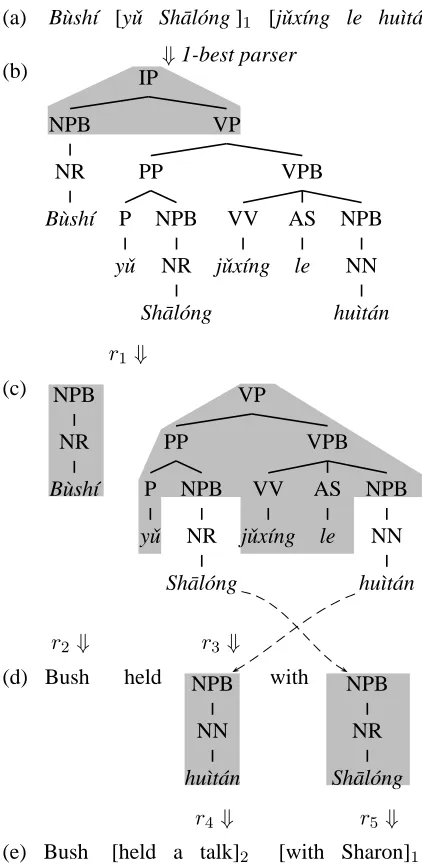
Figure 2 shows how this process works. The Chi-nese sentence (a) is first parsed into tree (b), which will be converted into an English string in 5 steps. First, at the root node, we apply ruler1 preserving top-level word-order between English and Chinese,
(r1) IP(x1:NPBx2:VP)→x1x2
(Liu et al., 2007) was a misnomer which actually refers to a set of several unrelated subtrees over disjoint spans, and should not be confused with the standard concept of packed forest.
(a) B`ush´ı [yˇu Sh¯al´ong ]1 [jˇux´ıng le hu`ıt´an ]2
⇓1-best parser
(b) IP
NPB
NR
B`ush´ı
VP
PP
P
yˇu NPB
NR
Sh¯al´ong
VPB
VV
jˇux´ıng AS
le
NPB
NN
hu`ıt´an
r1 ⇓
(c) NPB
NR
B`ush´ı
VP
PP
P
yˇu NPB
NR
Sh¯al´ong
VPB
VV
jˇux´ıng AS
le
NPB
NN
hu`ıt´an
r2⇓ r3 ⇓
(d) Bush held NPB
NN
hu`ıt´an
with NPB
NR
Sh¯al´ong
r4⇓ r5 ⇓
(e) Bush [held a talk]2 [with Sharon]1
Figure 2: An example derivation of tree-to-string trans-lation. Shaded regions denote parts of the tree that is pattern-matched with the rule being applied.
which results in two unfinished subtrees in (c). Then ruler2grabs the B`ush´ı subtree and transliterate it
(r2) NPB(NR(B`ush´ı))→Bush.
[image:2.612.65.303.65.145.2]More formally, a (tree-to-string) translation rule (Huang et al., 2006) is a tupleht, s, φi, wheretis the source-side tree, whose internal nodes are labeled by nonterminal symbols inN, and whose frontier nodes are labeled by source-side terminals in Σ or vari-ables from a setX ={x1, x2, . . .};s∈(X ∪∆)∗is the target-side string where∆is the target language terminal set; andφis a mapping fromX to nonter-minals inN. Each variablexi ∈ X occurs exactly
once intand exactly once ins. We denoteRto be the translation rule set. A similar formalism appears in another form in (Liu et al., 2006). These rules are in the reverse direction of the original string-to-tree transducer rules defined by Galley et al. (2004).
Finally, from step (d) we apply rulesr4andr5
(r4) NPB(NN(hu`ıt´an))→a talk
(r5) NPB(NR(Sh¯al´ong))→Sharon
which perform phrasal translations for the two re-maining subtrees, respectively, and get the Chinese translation in (e).
3 Forest-based translation
We now extend the tree-based idea from the previ-ous section to the case of forest-based translation. Again, there are two steps, parsing and decoding. In the former, a (modified) parser will parse the in-put sentence and outin-put a packed forest (Section 3.1) rather than just the 1-best tree. Such a forest is usu-ally huge in size, so we use the forest pruning algo-rithm (Section 3.4) to reduce it to a reasonable size. The pruned parse forest will then be used to direct the translation.
In the decoding step, we first convert the parse for-est into a translation forfor-est using the translation rule set, by similar techniques of pattern-matching from tree-based decoding (Section 3.2). Then the decoder searches for the best derivation on the translation forest and outputs the target string (Section 3.3).
3.1 Parse Forest
Informally, a packed parse forest, or forest in short, is a compact representation of all the derivations (i.e., parse trees) for a given sentence under a context-free grammar (Billot and Lang, 1989). For
example, consider the Chinese sentence in Exam-ple (2) above, which has (at least) two readings de-pending on the part-of-speech of the word yˇu, which can be either a preposition (P “with”) or a conjunc-tion (CC “and”). The parse tree for the preposiconjunc-tion case is shown in Figure 2(b) as the 1-best parse, while for the conjunction case, the two proper nouns (B`ush´ı and Sh¯al´ong) are combined to form a coordi-nated NP
NPB0,1 CC1,2 NPB2,3
NP0,3 (*)
which functions as the subject of the sentence. In this case the Chinese sentence is translated into
(3) “ [Bush and Sharon] held a talk”.
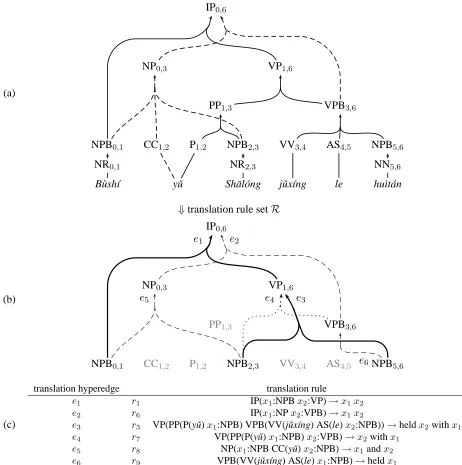
Shown in Figure 3(a), these two parse trees can be represented as a single forest by sharing common subtrees such as NPB0,1 and VPB3,6. Such a forest has a structure of a hypergraph (Klein and Manning, 2001; Huang and Chiang, 2005), where items like NP0,3are called nodes, and deductive steps like (*) correspond to hyperedges.
More formally, a forest is a pairhV, Ei, whereV
is the set of nodes, andEthe set of hyperedges. For a given sentencew1:l =w1. . . wl, each nodev∈V
is in the form ofXi,j, which denotes the
recogni-tion of nonterminalX spanning the substring from positionsithroughj(that is,wi+1. . . wj). Each
hy-peredgee ∈ E is a pair htails(e),head(e)i, where head(e) ∈ V is the consequent node in the deduc-tive step, andtails(e)∈V∗is the list of antecedent nodes. For example, the hyperedge for deduction (*) is notated:
h(NPB0,1, CC1,2, NPB2,3), NP0,3i.
There is also a distinguished root node TOP in each forest, denoting the goal item in parsing, which is simply S0,lwhere S is the start symbol andlis the
sentence length.
3.2 Translation Forest
(a)
IP0,6
NP0,3
NPB0,1
NR0,1
B`ush´ı
CC1,2
yˇu
VP1,6
PP1,3
P1,2 NPB2,3
NR2,3
Sh¯al´ong
VPB3,6
VV3,4
jˇux´ıng
AS4,5
le
NPB5,6
NN5,6
hu`ıt´an
⇓translation rule setR
(b)
IP0,6
NP0,3
NPB0,1 CC1,2
VP1,6
PP1,3
P1,2 NPB2,3
VPB3,6
VV3,4 AS4,5 NPB5,6 e5
e2
e6 e4 e3
e1
(c)
translation hyperedge translation rule
e1 r1 IP(x1:NPBx2:VP)→x1x2
e2 r6 IP(x1:NPx2:VPB)→x1x2
e3 r3 VP(PP(P(yˇu)x1:NPB) VPB(VV(jˇux´ıng) AS(le)x2:NPB))→heldx2withx1
e4 r7 VP(PP(P(yˇu)x1:NPB)x2:VPB)→x2withx1
e5 r8 NP(x1:NPB CC(yˇu)x2:NPB)→x1andx2
e6 r9 VPB(VV(jˇux´ıng) AS(le)x1:NPB)→heldx1
Figure 3: (a) the parse forest of the example sentence; solid hyperedges denote the 1-best parse in Figure 2(b) while dashed hyperedges denote the alternative parse due to Deduction (*). (b) the corresponding translation forest after applying the translation rules (lexical rules not shown); the derivation shown in bold solid lines (e1ande3) corresponds to the derivation in Figure 2; the one shown in dashed lines (e2,e5, ande6) uses the alternative parse and corresponds to the translation in Example (3). (c) the correspondence between translation hyperedges and translation rules.
parse forest, and try to pattern-match each transla-tion ruleragainst the local sub-forest under nodev. For example, in Figure 3(a), at node VP1,6, two rules r3 andr7 both matches the local subforest, and will thus generate two translation hyperedgese3 ande4 (see Figure 3(b-c)).
[image:4.612.75.537.63.528.2]Pseudocode 1 The conversion algorithm. 1: Input: parse forestHpand rule setR
2: Output: translation forestHt
3: for each nodev∈Vp in top-down order do
4: for each translation ruler∈ Rdo
5: vars ←match(r, v) ⊲variables
6: ifvars is not empty then
7: e← hvars, v, s(r)i
8: add translation hyperedgeetoHt
involve multiple parse hyperedges. For example,
match(r3,VP1,6) = (NPB2,3, NPB5,6),
which covers three parse hyperedges, while nodes in gray do not pattern-match any rule (although they are involved in the matching of other nodes, where they match interior nodes of the source-side tree fragments in a rule). We can thus construct a transla-tion hyperedge frommatch(r, v)tovfor each node
vand ruler. In addition, we also need to keep track of the target strings(r)specified by ruler, which in-cludes target-language terminals and variables. For example,s(r3) = “heldx2withx1”. The subtrans-lations of the matched variable nodes will be sub-stituted for the variables in s(r) to get a complete translation for nodev. So a translation hyperedgee
is a triplehtails(e),head(e), siwheresis the target string from the rule, for example,
e3=h(NPB2,3,NPB5,6),VP1,6,“heldx2withx1”i.
This procedure is summarized in Pseudocode 1.
3.3 Decoding Algorithms
The decoder performs two tasks on the translation forest: 1-best search with integrated language model (LM), andk-best search with LM to be used in min-imum error rate training. Both tasks can be done ef-ficiently by forest-based algorithms based onk-best parsing (Huang and Chiang, 2005).
For 1-best search, we use the cube pruning tech-nique (Chiang, 2007; Huang and Chiang, 2007) which approximately intersects the translation forest with the LM. Basically, cube pruning works bottom up in a forest, keeping at mostk+LM items at each node, and uses the best-first expansion idea from the Algorithm 2 of Huang and Chiang (2005) to speed
up the computation. An +LM item of nodevhas the form(va⋆b), whereaandb are the target-language
boundary words. For example,(VPheld1,6 ⋆Sharon)is an +LM item with its translation starting with “held” and ending with “Sharon”. This scheme can be eas-ily extended to work with a generaln-gram by stor-ingn−1words at both ends (Chiang, 2007).
For k-best search after getting 1-best derivation, we use the lazy Algorithm 3 of Huang and Chiang (2005) that works backwards from the root node, incrementally computing the second, third, through thekth best alternatives. However, this time we work on a finer-grained forest, called translation+LM for-est, resulting from the intersection of the translation forest and the LM, with its nodes being the +LM items during cube pruning. Although this new forest is prohibitively large, Algorithm 3 is very efficient with minimal overhead on top of 1-best.
3.4 Forest Pruning Algorithm
We use the pruning algorithm of (Jonathan Graehl, p.c.; Huang, 2008) that is very similar to the method based on marginal probability (Charniak and John-son, 2005), except that it prunes hyperedges as well as nodes. Basically, we use an Inside-Outside algo-rithm to compute the Viterbi inside costβ(v)and the Viterbi outside costα(v)for each nodev, and then compute the meritαβ(e)for each hyperedge:
αβ(e) =α(head(e)) + X
ui∈tails(e)
β(ui) (4)
Intuitively, this merit is the cost of the best derivation that traversese, and the differenceδ(e) =αβ(e)−
β(TOP)can be seen as the distance away from the globally best derivation. We prune away a hyper-edge e if δ(e) > p for a thresholdp. Nodes with all incoming hyperedges pruned are also pruned.
4 Experiments
We can extend the simple model in Equation 1 to a log-linear one (Liu et al., 2006; Huang et al., 2006):
d∗= arg max
d∈D P(d|T)
λ0·eλ1|d|·P
lm(s)λ2·eλ3|s|
on target translation. The derivation probability con-ditioned on 1-best tree, P(d | T), should now be replaced byP(d|Hp)whereHp is the parse forest,
which decomposes into the product of probabilities of translation rulesr∈d:
P(d|Hp) =
Y
r∈d
P(r) (6)
where eachP(r)is the product of five probabilities:
P(r) = P(t|s)λ4 ·Plex(t|s)λ5·
P(s|t)λ6·Plex(s|t)λ7 · P(t|Hp) λ8
. (7)
Here t and s are the source-side tree and target-side string of rule r, respectively, P(t | s) and
P(s | t) are the two translation probabilities, and
Plex(·) are the lexical probabilities. The only extra term in forest-based decoding isP(t | Hp)
denot-ing the source side parsdenot-ing probability of the current translation rule r in the parse forest, which is the product of probabilities of each parse hyperedgeep
covered in the pattern-match oftagainstHp (which
can be recorded at conversion time):
P(t|Hp) =
Y
ep∈Hp,epcovered byt
P(ep). (8)
4.1 Data preparation
Our experiments are on Chinese-to-English transla-tion, and we use the Chinese parser of Xiong et al. (2005) to parse the source side of the bitext. Follow-ing Huang (2008), we modify the parser to output a packed forest for each sentence.
Our training corpus consists of 31,011 sentence pairs with 0.8M Chinese words and 0.9M English words. We first word-align them by GIZA++ refined by “diagand” from Koehn et al. (2003), and apply the tree-to-string rule extraction algorithm (Galley et al., 2006; Liu et al., 2006), which resulted in 346K translation rules. Note that our rule extraction is still done on 1-best parses, while decoding is onk-best parses or packed forests. We also use the SRI Lan-guage Modeling Toolkit (Stolcke, 2002) to train a trigram language model with Kneser-Ney smooth-ing on the English side of the bitext.
We use the 2002 NIST MT Evaluation test set as our development set (878 sentences) and the 2005
0.230 0.232 0.234 0.236 0.238 0.240 0.242 0.244 0.246 0.248 0.250
0 5 10 15 20 25 30 35
BLEU score
average decoding time (secs/sentence) 1-best
p=5
p=12
k=10
k=30
k=100
k-best trees
[image:6.612.322.538.67.226.2]forests decoding
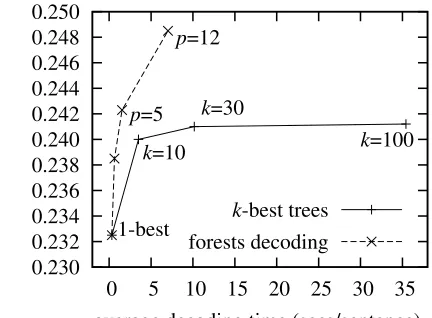
Figure 4: Comparison of decoding on forests with decod-ing onk-best trees.
NIST MT Evaluation test set as our test set (1082 sentences), with on average 28.28 and 26.31 words per sentence, respectively. We evaluate the transla-tion quality using the case-sensitive BLEU-4 met-ric (Papineni et al., 2002). We use the standard min-imum error-rate training (Och, 2003) to tune the fea-ture weights to maximize the system’s BLEU score on the dev set. On dev and test sets, we prune the Chinese parse forests by the forest pruning algo-rithm in Section 3.4 with a threshold ofp= 12, and then convert them into translation forests using the algorithm in Section 3.2. To increase the coverage of the rule set, we also introduce a default transla-tion hyperedge for each parse hyperedge by mono-tonically translating each tail node, so that we can always at least get a complete translation in the end.
4.2 Results
The BLEU score of the baseline 1-best decoding is 0.2325, which is consistent with the result of 0.2302 in (Liu et al., 2007) on the same training, develop-ment and test sets, and with the same rule extrac-tion procedure. The corresponding BLEU score of Pharaoh (Koehn, 2004) is 0.2182 on this dataset.
0 5 10 15 20 25
0 10 20 30 40 50 60 70 80 90 100
Percentage of sentences (%)
i (rank of the parse tree picked by the decoder) forest decoding
[image:7.612.70.299.54.218.2]30-best trees
Figure 5: Percentage of the i-th best parse tree being picked in decoding. 32% of the distribution for forest de-coding is beyond top-100 and is not shown on this plot.
and produces consistently better BLEU scores. With pruning threshold p = 12, it achieved a BLEU score of 0.2485, which is an absolute improvement of 1.6% points over the 1-best baseline, and is statis-tically significant using the sign-test of Collins et al. (2005) (p <0.01).
We also investigate the question of how often the
ith-best parse tree is picked to direct the translation (i = 1,2, . . .), in both k-best and forest decoding schemes. A packed forest can be roughly viewed as a (virtual)∞-best list, and we can thus ask how of-ten is a parse beyond top-kused by a forest, which relates to the fundamental limitation ofk-best lists. Figure 5 shows that, the 1-best parse is still preferred 25% of the time among 30-best trees, and 23% of the time by the forest decoder. These ratios decrease dramatically asiincreases, but the forest curve has a much longer tail in largei. Indeed, 40% of the trees preferred by a forest is beyond top-30, 32% is be-yond top-100, and even 20% bebe-yond top-1000. This confirms the fact that we need exponentially largek -best lists with the explosion of alternatives, whereas a forest can encode these information compactly.
4.3 Scaling to large data
We also conduct experiments on a larger dataset, which contains 2.2M training sentence pairs. Be-sides the trigram language model trained on the En-glish side of these bitext, we also use another tri-gram model trained on the first 1/3 of the Xinhua portion of Gigaword corpus. The two LMs have
dis-approach\ruleset TR TR+BP
[image:7.612.333.518.60.115.2]1-best tree 0.2666 0.2939 30-best trees 0.2755 0.3084 forest (p= 12) 0.2839 0.3149
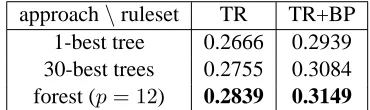
Table 1: BLEU score results from training on large data.
tinct weights tuned by minimum error rate training. The dev and test sets remain the same as above.
Furthermore, we also make use of bilingual phrases to improve the coverage of the ruleset. Fol-lowing Liu et al. (2006), we prepare a phrase-table from a phrase-extractor, e.g. Pharaoh, and at decod-ing time, for each node, we construct on-the-fly flat translation rules from phrases that match the source-side span of the node. These phrases are called syn-tactic phrases which are consistent with synsyn-tactic constituents (Chiang, 2005), and have been shown to be helpful in tree-based systems (Galley et al., 2006; Liu et al., 2006).
The final results are shown in Table 1, where TR denotes translation rule only, and TR+BP denotes the inclusion of bilingual phrases. The BLEU score of forest decoder with TR is 0.2839, which is a 1.7% points improvement over the 1-best baseline, and this difference is statistically significant (p <0.01). Using bilingual phrases further improves the BLEU score by 3.1% points, which is 2.1% points higher than the respective 1-best baseline. We suspect this larger improvement is due to the alternative con-stituents in the forest, which activates many syntac-tic phrases suppressed by the 1-best parse.
5 Conclusion and future work
Acknowledgement
Part of this work was done while L. H. was visit-ing CAS/ICT. The authors were supported by Na-tional Natural Science Foundation of China, Con-tracts 60736014 and 60573188, and 863 State Key Project No. 2006AA010108 (H. M and Q. L.), and by NSF ITR EIA-0205456 (L. H.). We would also like to thank Chris Quirk for inspirations, Yang Liu for help with rule extraction, Mark Johnson for posing the question of virtual ∞-best list, and the anonymous reviewers for suggestions.
References
Sylvie Billot and Bernard Lang. 1989. The structure of shared forests in ambiguous parsing. In Proceedings of ACL ’89, pages 143–151.
Eugene Charniak and Mark Johnson. 2005. Coarse-to-fine-grainedn-best parsing and discriminative rerank-ing. In Proceedings of the 43rd ACL.
David Chiang. 2005. A hierarchical phrase-based model for statistical machine translation. In Proceedings of ACL, pages 263–270, Ann Arbor, Michigan, June. David Chiang. 2007. Hierarchical phrase-based
transla-tion. Comput. Linguist., 33(2):201–228.
Michael Collins, Philipp Koehn, and Ivona Kucerova. 2005. Clause restructuring for statistical machine translation. In Proceedings of ACL, pages 531–540, Ann Arbor, Michigan, June.
Yuan Ding and Martha Palmer. 2005. Machine trans-lation using probabilistic synchronous dependency in-sertion grammars. In Proceedings of ACL, pages 541– 548, Ann Arbor, Michigan, June.
Michel Galley, Mark Hopkins, Kevin Knight, and Daniel Marcu. 2004. What’s in a translation rule? In HLT-NAACL, pages 273–280, Boston, MA.
Michel Galley, Jonathan Graehl, Kevin Knight, Daniel Marcu, Steve DeNeefe, Wei Wang, and Ignacio Thayer. 2006. Scalable inference and training of context-rich syntactic translation models. In Proceed-ings of COLING-ACL, pages 961–968, Sydney, Aus-tralia, July.
Liang Huang and David Chiang. 2005. Better k-best parsing. In Proceedings of Ninth International Work-shop on Parsing Technologies (IWPT-2005), Vancou-ver, Canada.
Liang Huang and David Chiang. 2007. Forest rescoring: Faster decoding with integrated language models. In Proceedings of ACL, pages 144–151, Prague, Czech Republic, June.
Liang Huang, Kevin Knight, and Aravind Joshi. 2006. Statistical syntax-directed translation with extended
domain of locality. In Proceedings of AMTA, Boston, MA, August.
Liang Huang. 2008. Forest reranking: Discriminative parsing with non-local features. In Proceedings of ACL, Columbus, OH.
Dan Klein and Christopher D. Manning. 2001. Parsing and Hypergraphs. In Proceedings of the Seventh In-ternational Workshop on Parsing Technologies (IWPT-2001), 17-19 October 2001, Beijing, China.
Philipp Koehn, Franz Joseph Och, and Daniel Marcu. 2003. Statistical phrase-based translation. In Proceed-ings of HLT-NAACL, Edmonton, AB, Canada. Philipp Koehn. 2004. Pharaoh: a beam search decoder
for phrase-based statistical machine translation mod-els. In Proceedings of AMTA, pages 115–124. Dekang Lin. 2004. A path-based transfer model for
ma-chine translation. In Proceedings of the 20th COLING, Barcelona, Spain.
Yang Liu, Qun Liu, and Shouxun Lin. 2006. Tree-to-string alignment template for statistical machine trans-lation. In Proceedings of COLING-ACL, pages 609– 616, Sydney, Australia, July.
Yang Liu, Yun Huang, Qun Liu, and Shouxun Lin. 2007. Forest-to-string statistical translation rules. In Pro-ceedings of ACL, pages 704–711, Prague, Czech Re-public, June.
Franz J. Och. 2003. Minimum error rate training in sta-tistical machine translation. In Proceedings of ACL, pages 160–167.
Kishore Papineni, Salim Roukos, Todd Ward, and Wei-Jing Zhu. 2002. Bleu: a method for automatic evalu-ation of machine translevalu-ation. In Proceedings of ACL, pages 311–318, Philadephia, USA, July.
Chris Quirk and Simon Corston-Oliver. 2006. The im-pact of parse quality on syntactically-informed statis-tical machine translation. In Proceedings of EMNLP. Chris Quirk, Arul Menezes, and Colin Cherry. 2005.
Dependency treelet translation: Syntactically informed phrasal SMT. In Proceedings of ACL, pages 271–279, Ann Arbor, Michigan, June.
Andreas Stolcke. 2002. SRILM - an extensible lan-guage modeling toolkit. In Proceedings of ICSLP, vol-ume 30, pages 901–904.
Dekai Wu. 1997. Stochastic inversion transduction grammars and bilingual parsing of parallel corpora. Computational Linguistics, 23(3):377–404.
Deyi Xiong, Shuanglong Li, Qun Liu, and Shouxun Lin. 2005. Parsing the Penn Chinese Treebank with seman-tic knowledge. In Proceedings of IJCNLP 2005, pages 70–81, Jeju Island, South Korea.