Partial Parsing from Bitext Projections
Prashanth Mannem and Aswarth Dara
Language Technologies Research Center International Institute of Information Technology
Hyderabad, AP, India - 500032
{prashanth,abhilash.d}@research.iiit.ac.in
Abstract
Recent work has shown how a parallel corpus can be leveraged to build syntac-tic parser for a target language by project-ing automatic source parse onto the target sentence using word alignments. The pro-jected target dependency parses are not al-ways fully connected to be useful for train-ing traditional dependency parsers. In this paper, we present a greedy non-directional parsing algorithm which doesn’t need a fully connected parse and can learn from partial parses by utilizing available struc-tural and syntactic information in them. Our parser achieved statistically signifi-cant improvements over a baseline system that trains on only fully connected parses for Bulgarian, Spanish and Hindi. It also gave a significant improvement over pre-viously reported results for Bulgarian and set a benchmark for Hindi.
1 Introduction
Parallel corpora have been used to transfer in-formation from source to target languages for Part-Of-Speech (POS) tagging, word sense disam-biguation (Yarowsky et al., 2001), syntactic pars-ing (Hwa et al., 2005; Ganchev et al., 2009; Jiang and Liu, 2010) and machine translation (Koehn, 2005; Tiedemann, 2002). Analysis on the source sentences was induced onto the target sentence via projections across word aligned parallel corpora.
Equipped with a source language parser and a word alignment tool, parallel data can be used to build an automatic treebank for a target language. The parse trees given by the parser on the source sentences in the parallel data are projected onto the target sentence using the word alignments from the alignment tool. Due to the usage of automatic source parses, automatic word alignments and dif-ferences in the annotation schemes of source and
target languages, the projected parses are not al-ways fully connected and can have edges missing (Hwa et al., 2005; Ganchev et al., 2009). Non-literal translations and divergences in the syntax of the two languages also lead to incomplete pro-jected parse trees.
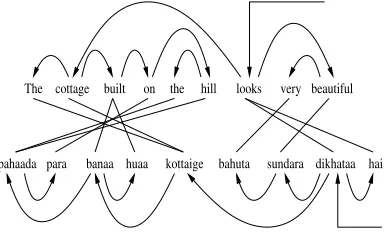
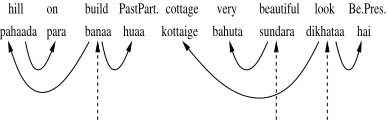
Figure 1 shows an English-Hindi parallel sen-tence with correct source parse, alignments and target dependency parse. For the same sentence, Figure 2 is a sample partial dependency parse pro-jected using an automatic source parser on aligned text. This parse is not fully connected with the
words banaa, kottaige anddikhataa left without
any parents.
para bahuta hai
The cottage built on the hill looks very beautiful
[image:1.612.322.514.385.504.2]pahaada banaa huaa kottaige sundara dikhataa
Figure 1: Word alignment with dependency
parses for an English-Hindi parallel sentence
To train the traditional dependency parsers (Ya-mada and Matsumoto, 2003; Eisner, 1996; Nivre, 2003), the dependency parse has to satisfy four
constraints: connectedness, single-headedness,
acyclicity andprojectivity(Kuhlmann and Nivre, 2006). Projectivity can be relaxed in some parsers (McDonald et al., 2005; Nivre, 2009). But these parsers can not directly be used to learn from par-tially connected parses (Hwa et al., 2005; Ganchev et al., 2009).
In the projected Hindi treebank (section 4) that was extracted from English-Hindi parallel text,
only 5.9% of the sentences had full trees. In
Spanish and Bulgarian projected data extracted by Ganchev et al. (2009), the figures are 3.2% and 12.9% respectively. Learning from data with such high proportions of partially connected depen-dency parses requires special parsing algorithms
which are not bound by connectedness. Its only
during learning that the constraint doesn’t satisfy. For a new sentence (i.e. during inference), the parser should output fully connected dependency tree.
para bahuta hai
[image:2.612.102.295.196.256.2]pahaada banaa huaa kottaige sundara dikhataa on build cottage very beautiful look hill PastPart. Be.Pres.
Figure 2: A sample dependency parse with partial parses
In this paper, we present a dependency pars-ing algorithm which can train on partial projected parses and can take rich syntactic information as features for learning. The parsing algorithm con-structs the partial parses in a bottom-up manner by performing a greedy search over all possible rela-tions and choosing the best one at each step with-out following either left-to-right or right-to-left traversal. The algorithm is inspired by earlier non-directional parsing works of Shen and Joshi (2008) and Goldberg and Elhadad (2010). We also pro-pose an extended partial parsing algorithm that can learn from partial parses whose yields are partially contiguous.
Apart from bitext projections, this work can be extended to other cases where learning from
par-tial structures is required. For example, while
bootstrapping parsers high confidence parses are extracted and trained upon (Steedman et al., 2003; Reichart and Rappoport, 2007). In cases where these parses are few, learning from partial parses might be beneficial.
We train our parser on projected Hindi, Bulgar-ian and Spanish treebanks and show statistically significant improvements in accuracies between training on fully connected trees and learning from partial parses.
2 Related Work
Learning from partial parses has been dealt in dif-ferent ways in the literature. Hwa et al. (2005) used post-projection completion/transformation
rules to get full parse trees from the projections and train Collin’s parser (Collins, 1999) on them. Ganchev et al. (2009) handle partial projected parses by avoiding committing to entire projected tree during training. The posterior regularization based framework constrains the projected syntac-tic relations to hold approximately and only in ex-pectation. Jiang and Liu (2010) refer to align-ment matrix and a dynamic programming search algorithm to obtain better projected dependency trees. They deal with partial projections by break-ing down the projected parse into a set of edges and training on the set of projected relations rather than on trees.
While Hwa et al. (2005) requires full projected parses to train their parser, Ganchev et al. (2009) and Jiang and Liu (2010) can learn from partially projected trees. However, the discriminative train-ing in (Ganchev et al., 2009) doesn’t allow for richer syntactic context and it doesn’t learn from all the relations in the partial dependency parse. By treating each relation in the projected depen-dency data independently as a classification in-stance for parsing, Jiang and Liu (2010) sacrifice the context of the relations such as global struc-tural context, neighboring relations that are crucial for dependency analysis. Due to this, they report that the parser suffers from local optimization dur-ing traindur-ing.
The parser proposed in this work (section 3) learns from partial trees by using the available structural information in it and also in neighbor-ing partial parses. We evaluated our system (sec-tion 5) on Bulgarian and Spanish projected depen-dency data used in (Ganchev et al., 2009) for com-parison. The same could not be carried out for Chinese (which was the language (Jiang and Liu, 2010) worked on) due to the unavailability of pro-jected data used in their work. Comparison with the traditional dependency parsers (McDonald et al., 2005; Yamada and Matsumoto, 2003; Nivre, 2003; Goldberg and Elhadad, 2010) which train on complete dependency parsers is out of the scope of this work.
3 Partial Parsing
A standard dependency graph satisfies four graph
constraints: connectedness, single-headedness,
single-a)
para
pahaada banaa huaa kottaige bahuta sundara dikhataa hai hill on build PastPart. cottage very beautiful look Be.Pres.
b)
para bahuta hai
pahaada banaa huaa kottaige sundara dikhataa
c)
para banaa huaa kottaige sundara dikhataa hai pahaada
bahuta
d)
hai banaa huaa kottaige sundara dikhataa pahaada
bahuta para
e)
hai banaa kottaige sundara dikhataa pahaada
bahuta para huaa
f)
banaa kottaige sundara dikhataa pahaada
bahuta
para huaa hai
g)
sundara
bahuta hai
pahaada
para
banaa kottaige dikhataa
huaa
h)
hai pahaada
para
sundara
bahuta
banaa kottaige dikhataa
[image:3.612.97.521.58.319.2]huaa
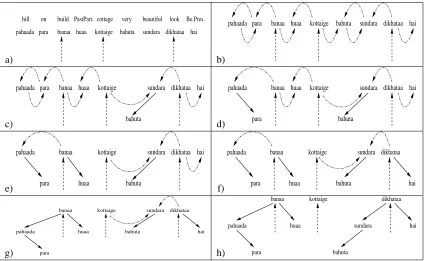
Figure 3: Steps taken by GNPPA. The dashed arcs indicate the unconnected words in unConn. The
dotted arcs indicate the candidate arcs incandidateArcsand the solid arcs are the high scoring arcs that
are stored inbuiltPPs
headedness, acyclicity and projectivity constraints while not necessarily being connected i.e. all the words need not have parents.
Given a sentence W=w0· · ·wn with a set of
directed arcsAon the words inW,wi → wj
de-notes a dependency arc fromwitowj, (wi,wj) A.wiis the parent in the arc andwjis the child in the arc.−→∗ denotes the reflexive and transitive clo-sure of the arc. wi
∗ −
→ wjsays thatwidominates
wj, i.e. there is (possibly empty) path fromwito wj.
A node wi is unconnected if it does not have
an incoming arc. Ris the set of all such
uncon-nected nodes in the dependency graph. For the
example in Figure 2, R={banaa, kottaige,
dikhataa}. Apartial parserooted at nodewi denoted byρ(wi)is the set of arcs that can be
tra-versed from nodewi. Theyieldof a partial parse
ρ(wi) is the set of nodes dominated by it. We
use π(wi)to refer to the yield ofρ(wi)arranged in the linear order of their occurrence in the
sen-tence. Thespanof the partial tree is the first and
last words in its yield.
The dependency graph D can now be
rep-resented in terms of partial parses by D =
(W, R, %(R))whereW={w0 · · ·wn}is the
sen-tence, R={r1 · · ·rm}is the set of unconnected nodes and %(R)={ρ(r1)· · ·ρ(rm)}is the set of partial parses rooted at these unconnected nodes.
w0 is a dummy word added at the beginning of
W to behave as a root of a fully connected parse.
A fully connected dependency graph would have
only one element w0 in R and the dependency
graph rooted at w0 as the only (fully connected)
parse in%(R).
We assume the combined yield of%(R) spans
the entire sentence and each of the partial parses in
%(R) to be contiguous and non-overlapping with
one another. A partial parse is contiguousif its
yield is contiguous i.e. if a nodewj π(wi), then
all the words between wi andwj also belong to
π(wi). A partial parseρ(wi)isnon-overlappingif the intersection of its yieldπ(wi)with yields of all other partial parses is empty.
3.1 Greedy Non-directional Partial Parsing Algorithm (GNPPA)
Given the sentenceW and the set of unconnected
nodes R, the parser follows a non-directional
the highest score at each stage. This process is re-peated until parents for all the nodes that do not
belong toRare chosen.
Algorithm 1 lists the outline of the greedy non-directional partial parsing algorithm (GNPPA). builtPPs maintains a list of all the partial
parses that have been built. It is initialized
in line 1 by considering each word as a
sep-arate partial parse with just one node.
can-didateArcs stores all the arcs that are possi-ble at each stage of the parsing process in a
bottom up strategy. It is initialized in line 2
using the method initCandidateArcs(w0· · ·wn).
initCandidateArcs(w0 · · ·wn)adds two candidate arcs for each pair of consecutive words with each other as parent (see Figure 3b). If an arc has one
of the nodes inRas the child, it isn’t included in
candidateArcs.
Algorithm 1Partial Parsing Algorithm
Input: sentencew0· · ·wnand set of partial tree roots
un-Conn={r1· · ·rm}
Output: set of partial parses whose roots are inunConn
(builtPPs={ρ(r1)· · ·ρ(rm)})
1: builtPPs={ρ(r1)· · ·ρ(rn)} ← {w0· · ·wn}
2: candidateArcs= initCandidateArcs(w0· · ·wn)
3: whilecandidateArcs.isNotEmpty()do
4: bestArc= argmax
ci candidateArcs
score(ci,−→w)
5: builtPPs.remove(bestArc.child) 6: builtPPs.remove(bestArc.parent) 7: builtPPs.add(bestArc)
8: updateCandidateArcs(bestArc,
candidateArcs,builtPPs,unConn) 9: end while
10: returnbuiltPPs
Once initialized, the candidate arc with the highest score (line 4) is chosen and accepted into builtPPs. This involves replacing the best
arc’s child partial parse ρ(arc.child) and parent
partial parse ρ(arc.parent) over which the arc
has been formed with the arc ρ(arc.parent) →
ρ(arc.child) itself inbuiltPPs(lines 5-7). In Figure
3f, to accept the best candidate arcρ(banaa)→
ρ(pahaada), the parser would remove the nodes ρ(banaa) andρ(pahaada) inbuiltPPsand add ρ(banaa)→ρ(pahaada) tobuiltPPs(see Fig-ure 3g).
After the best arc is accepted, thecandidateArcs
has to be updated (line 8) to remove the arcs that are no longer valid and add new arcs in the
con-text of the updatedbuiltPPs. Algorithm 2 shows
the update procedure. First, all the arcs that end on the child are removed (lines 3-7) along with the arc from child to parent. Then, the
immedi-ately previous and next partial parses of the best arc inbuiltPPsare retrieved (lines 8-9) to add pos-sible candidate arcs between them and the partial parse representing the best arc (lines 10-23). In the example, between Figures 3b and 3c, the arcs ρ(kottaige) → ρ(bahuta) and ρ(bahuta)
→ ρ(sundara) are first removed and the arc ρ(kottaige) →ρ(sundara) is added to can-didateArcs. Care is taken to avoid adding arcs that
end on unconnected nodes listed inR.
The entire GNPPA parsing process for the ex-ample sentence in Figure 2 is shown in Figure 3.
Algorithm 2updateCandidateArcs(bestArc, can-didateArcs,builtPPs,unConn)
1: baChild= bestArc.child 2: baParent= bestArc.parent 3: for allarccandidateArcsdo
4: if arc.child =baChildor
(arc.parent =baChildand
arc.child =baParent) then
5: removearc
6: end if
7: end for
8: prevPP=builtPPs.previousPP(bestArc) 9: nextPP=builtPPs.nextPP(bestArc) 10: if bestArc.direction ==LEFTthen
11: newArc1= new Arc(prevPP,baParent) 12: newArc2= new Arc(baParent,prevPP) 13: end if
14: if bestArc.direction ==RIGHTthen
15: newArc1= new Arc(nextPP,baParent) 16: newArc2= new Arc(baParent,nextPP) 17: end if
18: ifnewArc1.parent∈/unConnthen
19: candidateArcs.add(newArc1) 20: end if
21: ifnewArc2.parent∈/unConnthen
22: candidateArcs.add(newArc2) 23: end if
24: return candidateArcs
3.2 Learning
The algorithm described in the previous section
uses a weight vector −→w to compute the best arc
from the list of candidate arcs. This weight vec-tor is learned using a simple Perceptron like algo-rithm similar to the one used in (Shen and Joshi, 2008). Algorithm 3 lists the learning framework for GNPPA.
For a training sample with sentencew0 · · ·wn, projected partial parses projectedPPs={ρ(ri) · · ·
ρ(rm)}, unconnected words unConn and weight
vector−→w, thebuiltPPsandcandidateArcsare ini-tiated as in algorithm 1. Then the arc with the highest score is selected. If this arc belongs to
the parses in projectedPPs, builtPPs and
a)
para hai
pahaada banaa huaa kottaige bahuta sundara dikhataa hill on build PastPart. cottage very beautiful look Be.Pres.
b)
para hai
pahaada banaa huaa kottaige bahuta sundara dikhataa
c)
hai
bahuta
pahaada para banaa huaa kottaige sundara dikhataa
d)
hai
para bahuta
[image:5.612.101.521.59.216.2]pahaada banaa huaa kottaige sundara dikhataa
Figure 4: First four steps taken by E-GNPPA. The blue colored dotted arcs are the additional candidate
arcs that are added tocandidateArcs
algorithm 1. If it doesn’t, it is treated as a neg-ative sample and a corresponding positive
candi-date arc which is present both projectedPPs and
candidateArcsis selected (lines 11-12).
The weights of the positive candidate arc are in-creased while that of the negative sample (best arc) are decreased. To reduce over fitting, we use aver-aged weights (Collins, 2002) in algorithm 1.
Algorithm 3Learning for Non-directional Greedy Partial Parsing Algorithm
Input: sentencew0· · ·wn, projected partial parses
project-edPPs, unconnected wordsunConn, current−→w
Output: updated−→w
1: builtPPs={ρ(r1)· · ·ρ(rn)} ← {w0· · ·wn}
2: candidateArcs= initCandidateArcs(w0· · ·wn)
3: whilecandidateArcs.isNotEmpty()do
4: bestArc= argmax
ci candidateArcs
score(ci,−→w)
5: ifbestArc∈projectedPPsthen
6: builtPPs.remove(bestArc.child) 7: builtPPs.remove(bestArc.parent) 8: builtPPs.add(bestArc)
9: updateCandidateArcs(bestArc,
candidateArcs,builtPPs,unConn)
10: else
11: allowedArcs ={ci|cicandidateArcs&&ci
projectedArcs}
12: compatArc= argmax
ci allowedArcs
score(ci,−→w)
13: promote(compatArc,−→w) 14: demote(bestArc,−→w) 15: end if
16: end while
17: returnbuiltPPs
3.3 Extended GNPPA (E-GNPPA)
The GNPPA described in section 3.1 assumes that
the partial parses are contiguous. The
exam-ple in Figure 5 has a partial tree ρ(dikhataa)
which isn’t contiguous. Its yield doesn’t
con-tainbahutaandsundara. We call such non-contiguouspartial parses whose yields encompass the yield of an other partial parse aspartially con-tiguous. Partially contiguous parses are common in the projected data and would not be parsable by
the algorithm 1 (ρ(dikhataa)→ρ(kottaige)
would not be identified).
para bahuta hai
[image:5.612.321.515.364.424.2]pahaada banaa huaa kottaige sundara dikhataa hill on build PastPart.cottage very beautiful look Be.Pres.
Figure 5: Dependency parse with a partially con-tiguous partial parse
In order to identify and learn from relations which are part of partially contiguous partial parses, we propose an extension to GNPPA. The extended GNPAA (E-GNPPA) broadens its scope while searching for possible candidate arcs given R and builtPPs. If the immediate previous or the next partial parses over which arcs are to be formed are designated unconnected nodes, the parser looks further for a partial parse over which it can form arcs. For example, in Figure 4b, the arc ρ(para) → ρ(banaa) can not be added to the candidateArcs since banaa is a designated
unconnected node in unConn. The E-GNPPA
looks over the unconnected node and adds the arc
ρ(para) → ρ(huaa) to the candidate arcs list
candidateArcs.
E-GNPPA differs from algorithm 1 in lines 2 and 8. The E-GNPPA uses an extended
Parent and Child par.pos,chd.pos,par.lex,chd.lex
Sentence Context par-1.pos,par-2.pos,par+1.pos,par+2.pos,par-1.lex,par+1.lex chd-1.pos,chd-2.pos,chd+1.pos,chd+2.pos,chd-1.lex,chd+1.lex
Structural Info leftMostChild(par).pos, rightMostChild(par).pos, leftSibling(chd).pos, rightSibling(chd).pos
[image:6.612.104.510.59.135.2]Partial Parse Context previousPP().pos, previousPP().lex, nextPP().pos, nextPP().lex
Table 1: Information on which features are defined. pardenotes the parent in the relation andchdthe
child. .pos and .lex is the POS and word-form of the corresponding node. +/-i is the previous/next
ith word in the sentence. leftMostChild() and rightMostChild() denote the left most and right most
children of a node. leftSibling() and rightSibling() get the immediate left and right siblings of a node.
previousPP() and nextPP() return the immediate previous and next partial parses of the arc inbuiltPPsat
the state.
candidateArcs in line 2 and an extended proce-dureupdateCandidateArcsExtendedto update the candidateArcsafter each step in line 8. Algorithm 4 shows the changes w.r.t algorithm 2. Figure 4 presents the steps taken by the E-GNPPA parser for the example parse in Figure 5.
Algorithm 4updateCandidateArcsExtended (bestArc,candidateArcs,builtPPs,unConn)
· · ·lines 1 to 7 of Algorithm 2· · ·
prevPP=builtPPs.previousPP(bestArc)
whileprevPP∈unConndo
prevPP=builtPPs.previousPP(prevPP)
end while
nextPP=builtPPs.nextPP(bestArc)
whilenextPP∈unConndo
nextPP=builtPPs.nextPP(nextPP)
end while
· · ·lines 10 to 24 of Algorithm 2· · ·
3.4 Features
Features for a relation (candidate arc) are defined on the POS tags and lexical items of the nodes in the relation and those in its context. Two kinds of context are used a) context from the input sen-tence (sentence context) b) context inbuiltPPsi.e.
nearby partial parses (partial parse context).
In-formation from the partial parses (structural info) such as left and right most children of the par-ent node in the relation, left and right siblings of the child node in the relation are also used. Ta-ble 1 lists the information on which features are defined in the various configurations of the three language parsers. The actual features are combi-nations of the information present in the table. The set varies depending on the language and whether its GNPPA or E-GNPPA approach.
While training, no features are defined on
whether a node is unconnected (present in
un-Conn) or not as this information isn’t available
during testing.
4 Hindi Projected Dependency Treebank
We conducted experiments on English-Hindi par-allel data by transferring syntactic information from English to Hindi to build a projected depen-dency treebank for Hindi.
The TIDES English-Hindi parallel data con-taining 45,000 sentences was used for this
pur-pose 1 (Venkatapathy, 2008). Word alignments
for these sentences were obtained using the widely used GIZA++ toolkit in grow-diag-final-and mode (Och and Ney, 2003). Since Hindi is a morpho-logically rich language, root words were used in-stead of the word forms. A bidirectional English POS tagger (Shen et al., 2007) was used to POS tag the source sentences and the parses were ob-tained using the first order MST parser (McDon-ald et al., 2005) trained on dependencies extracted from Penn treebank using the head rules of Ya-mada and Matsumoto (2003). A CRF based Hindi POS tagger (PVS. and Gali, 2007) was used to POS tag the target sentences.
English and Hindi being morphologically and syntactically divergent makes the word alignment and dependency projection a challenging task. The source dependencies are projected using an approach similar to (Hwa et al., 2005). While they use post-projection transformations on the projected parse to account for annotation differ-ences, we use pre-projection transformations on the source parse. The projection algorithm
pro-1
duces acyclic parses which could be unconnected and non-projective.
4.1 Annotation Differences in Hindi and English
Before projecting the source parses onto the tar-get sentence, the parses are transformed to reflect the annotation scheme differences in English and Hindi. While English dependency parses reflect the PTB annotation style (Marcus et al., 1994), we project them to Hindi to reflect the annotation scheme described in (Begum et al., 2008). The differences in the annotation schemes are with re-spect to three phenomena: a) head of a verb group containing auxiliary and main verbs, b) preposi-tions in a prepositional phrase (PP) and c) coordi-nation structures.
In the English parses, the auxiliary verb is the head of the main verb while in Hindi, the main verb is the head of the auxiliary in the verb group. For example, in the Hindi parse in Figure 1,
dikhataais the head of the auxiliary verbhai. The prepositions in English are realized as
post-positions in Hindi. While prepositions are the
heads in a preposition phrase, post-positions are the modifiers of the preceding nouns in Hindi. In
pahaada para(on the hill),hillis the head
of para. In coordination structures, while
En-glish differentiates between how NP coordination and VP coordination structures behave, Hindi an-notation scheme is consistent in its handling. Left-most verb is the head of a VP coordination struc-ture in English whereas the rightmost noun is the head in case of NP coordination. In Hindi, the con-junct is the head of the two verbs/nouns in the co-ordination structure.
These three cases are identified in the source tree and appropriate transformations are made to the source parse itself before projecting the rela-tions using word alignments.
5 Experiments
We carried out all our experiments on paral-lel corpora belonging to Hindi, English-Bulgarian and English-Spanish language pairs. While the Hindi projected treebank was obtained using the method described in section 4, Bulgar-ian and Spanish projected datasets were obtained using the approach in (Ganchev et al., 2009). The datasets of Bulgarian and Spanish that contributed to the best accuracies for Ganchev et al. (2009)
Statistic Hindi Bulgarian Spanish
N(Words) 226852 71986 133124
N(Parent==-1) 44607 30268 54815
P(Parent==-1) 19.7 42.0 41.1
N(Full trees) 593 1299 327
N(GNPPA) 30063 10850 19622
P(GNPPA) 16.4 26.0 25.0
N(E-GNPPA) 35389 12281 24577
[image:7.612.316.518.61.180.2]P(E-GNPPA) 19.3 29.4 30.0
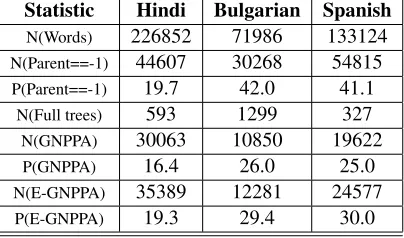
Table 2: Statistics of the Hindi, Bulgarian and Spanish projected treebanks used for experiments. Each of them has 10,000 randomly picked parses. N(X) denotesnumber of X
and P(X) denotespercentage of X. N(Words) is the number of words. N(Parents==-1) is the number of words without a parent. N(Full trees) is the number of parses which are fully connected. N(GNPPA) is the number of relations learnt by GNPPA parser and N(E-GNPPA) is the number of relations learnt by E-GNPPA parser. Note that P(GNPPA) is calculated as N(GNPPA)/(N(Words) - N(Parents==-1)).
were used in our work (7 rules dataset for Bulgar-ian and 3 rules dataset for Spanish). The Hindi, Bulgarian and Spanish projected dependency tree-banks have 44760, 39516 and 76958 sentences re-spectively. Since we don’t have confidence scores for the projections on the sentences, we picked 10,000 sentences randomly in each of the three
datasets for training the parsers2. Other methods
of choosing the 10K sentences such as those with the max. no. of relations, those with least no. of unconnected words, those with max. no. of con-tiguous partial trees that can be learned by GNPPA parser etc. were tried out. Among all these, ran-dom selection was consistent and yielded the best
results. The errors introduced in the projected
parses by errors in word alignment, source parser and projection are not consistent enough to be ex-ploited to select the better parses from the entire projected data.
Table 2 gives an account of the randomly cho-sen 10k cho-sentences in terms of the number of words, words without parents etc. Around 40% of the words spread over 88% of sentences in Bulgarian and 97% of sentences in Spanish have no parents. Traditional dependency parsers which only train from fully connected trees would not be able to learn from these sentences. P(GNPPA) is the per-centage of relations in the data that are learned by the GNPPA parser satisfying the contiguous par-tial tree constraint and P(E-GNPPA) is the
per-2Exactly 10K sentences were selected in order to compare
Parser Hindi Bulgarian Spanish
Punct NoPunct Punct NoPunct Punct NoPunct
Baseline 78.70 77.39 51.85 55.15 41.60 45.61
GNPPA 80.03* 78.81* 77.03* 79.06* 65.49* 68.70*
[image:8.612.146.470.60.125.2]E-GNPPA 81.10*† 79.94*† 78.93*† 80.11*† 67.69*† 70.90*†
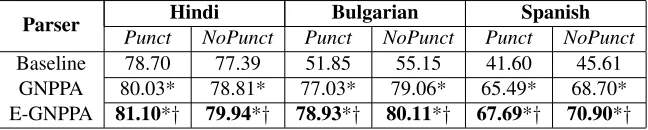
Table 3: UAS for Hindi, Bulgarian and Spanish with the baseline, GNPPA and E-GNPPA parsers trained
on 10k parses selected randomly.Punctindicates evaluation with punctuation whereasNoPunctindicates
without punctuation. * next to an accuracy denotes statistically significant (McNemar’s and p<0.05)
improvement over the baseline.†denotes significance over GNPPA
centage that satisfies the partially contiguous con-straint. E-GNPPA parser learns around 2-5% more no. of relations than GNPPA due to the relaxation in the constraints.
The Hindi test data that was released as part of the ICON-2010 Shared Task (Husain et al., 2010) was used for evaluation. For Bulgarian and Span-ish, we used the same test data that was used in the work of Ganchev et al. (2009). These test datasets had sentences from the training section of the CoNLL Shared Task (Nivre et al., 2007) that had lengths less than or equal to 10. All the test datasets have gold POS tags.
A baseline parser was built to compare learning from partial parses with learning from fully con-nected parses. Full parses are constructed from partial parses in the projected data by randomly assigning parents to unconnected parents, similar to the work in (Hwa et al., 2005). The uncon-nected words in the parse are selected randomly one by one and are assigned parents randomly to complete the parse. This process is repeated for all the sentences in the three language datasets. The parser is then trained with the GNPPA algorithm on these fully connected parses to be used as the baseline.
Table 3 lists the accuracies of the baseline, GNPPA and E-GNPPA parsers. The accuracies are unlabeled attachment scores (UAS): the
per-centage of words with the correct head. Table
4 compares our accuracies with those reported in (Ganchev et al., 2009) for Bulgarian and Spanish.
5.1 Discussion
The baseline reported in (Ganchev et al., 2009) significantly outperforms our baseline (see Table 4) due to the different baselines used in both the works. In our work, while creating the data for the baseline by assigning random parents to un-connected words, acyclicity and projectivity
con-Parser Bulgarian Spanish
Ganchev-Baseline 72.6 69.0
Baseline 55.15 45.61
Ganchev-Discriminative 78.3 72.3
GNPPA 79.06 68.70
E-GNPPA 80.11 70.90
Table 4: Comparison of baseline, GNPPA and E-GNPPA with baseline and discriminative model from (Ganchev et al., 2009) for Bulgarian and Spanish. Evaluation didn’t include punctuation.
straints are not enforced. Ganchev et al. (2009)’s baseline is similar to the first iteration of their dis-criminative model and hence performs better than ours. Our Bulgarian E-GNPPA parser achieved a 1.8% gain over theirs while the Spanish results are lower. Though their training data size is also 10K, the training data is different in both our works due to the difference in the method of choosing 10K sentences from the large projected treebanks.
The GNPPA accuracies (see table 3) for all the three languages are significant improvements over the baseline accuracies. This shows that learning from partial parses is effective when compared to imposing the connected constraint on the partially projected dependency parse. Even while project-ing source dependencies durproject-ing data creation, it is better to project high confidence relations than look to project more relations and thereby intro-duce noise.
The E-GNPPA which also learns from partially contiguous partial parses achieved statistically
sig-nificant gains for all the three languages. The
gains across languages is due to the fact that in the 10K data that was used for training, E-GNPPA
parser could learn 2− 5% more relations over
GNPPA (see Table 2).
30 40 50 60 70 80
0 1 2 3 4 5 6 7 8 9 10
Unlabeled Accuracy
Thousands of sentences
[image:9.612.122.301.75.201.2]Bulgarian Hindi Spanish hn-baseline bg-baseline es-baseline
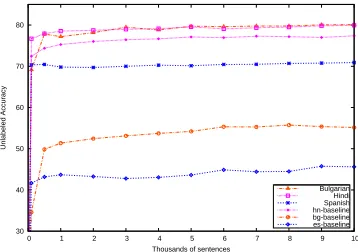
Figure 6: Accuracies (without punctuation) w.r.t varying training data sizes for baseline and E-GNPPA parsers.
GNPPA parser for the three languages when train-ing data size is varied. The parsers peak early with less than 1000 sentences and make small gains with the addition of more data.
6 Conclusion
We presented a non-directional parsing algorithm that can learn from partial parses using
syntac-tic and contextual information as features. A
Hindi projected dependency treebank was devel-oped from English-Hindi bilingual data and ex-periments were conducted for three languages Hindi, Bulgarian and Spanish. Statistically sig-nificant improvements were achieved by our par-tial parsers over the baseline system. The parpar-tial parsing algorithms presented in this paper are not specific to bitext projections and can be used for learning from partial parses in any setting.
References
R. Begum, S. Husain, A. Dhwaj, D. Sharma, L. Bai, and R. Sangal. 2008. Dependency annotation scheme for indian languages. InIn Proceedings of The Third International Joint Conference on Natural Language Processing (IJCNLP), Hyderabad, India. Michael John Collins. 1999. Head-driven statistical
models for natural language parsing. Ph.D. thesis, University of Pennsylvania, Philadelphia, PA, USA. AAI9926110.
Michael Collins. 2002. Discriminative training meth-ods for hidden markov models: theory and experi-ments with perceptron algorithms. InProceedings of the ACL-02 conference on Empirical methods in natural language processing - Volume 10, EMNLP
’02, pages 1–8, Morristown, NJ, USA. Association for Computational Linguistics.
Jason M. Eisner. 1996. Three new probabilistic mod-els for dependency parsing: an exploration. In Pro-ceedings of the 16th conference on Computational linguistics - Volume 1, pages 340–345, Morristown, NJ, USA. Association for Computational Linguis-tics.
Kuzman Ganchev, Jennifer Gillenwater, and Ben Taskar. 2009. Dependency grammar induction via bitext projection constraints. InProceedings of the Joint Conference of the 47th Annual Meeting of the ACL and the 4th International Joint Conference on Natural Language Processing of the AFNLP: Vol-ume 1 - VolVol-ume 1, ACL-IJCNLP ’09, pages 369– 377, Morristown, NJ, USA. Association for Compu-tational Linguistics.
Yoav Goldberg and Michael Elhadad. 2010. An effi-cient algorithm for easy-first non-directional depen-dency parsing. InHuman Language Technologies: The 2010 Annual Conference of the North American Chapter of the Association for Computational Lin-guistics, HLT ’10, pages 742–750, Morristown, NJ, USA. Association for Computational Linguistics. Samar Husain, Prashanth Mannem, Bharath Ambati,
and Phani Gadde. 2010. Icon 2010 tools contest on indian language dependency parsing. In Proceed-ings of ICON 2010 NLP Tools Contest.
Rebecca Hwa, Philip Resnik, Amy Weinberg, Clara Cabezas, and Okan Kolak. 2005. Bootstrapping parsers via syntactic projection across parallel texts. Nat. Lang. Eng., 11:311–325, September.
Wenbin Jiang and Qun Liu. 2010. Dependency parsing and projection based on word-pair classification. In Proceedings of the 48th Annual Meeting of the As-sociation for Computational Linguistics, ACL ’10, pages 12–20, Morristown, NJ, USA. Association for Computational Linguistics.
P. Koehn. 2005. Europarl: A parallel corpus for statis-tical machine translation. InMT summit, volume 5. Citeseer.
Marco Kuhlmann and Joakim Nivre. 2006. Mildly non-projective dependency structures. In Proceed-ings of the COLING/ACL on Main conference poster sessions, pages 507–514, Morristown, NJ, USA. As-sociation for Computational Linguistics.
Mitchell P. Marcus, Beatrice Santorini, and Mary A. Marcinkiewicz. 1994. Building a large annotated corpus of english: The penn treebank. Computa-tional Linguistics, 19(2):313–330.
Jens Nilsson and Joakim Nivre. 2008. Malteval: an evaluation and visualization tool for dependency parsing. In Proceedings of the Sixth International Language Resources and Evaluation (LREC’08), Marrakech, Morocco, may. European Language Resources Association (ELRA). http://www.lrec-conf.org/proceedings/lrec2008/.
Joakim Nivre, Johan Hall, Sandra K¨ubler, Ryan Mc-donald, Jens Nilsson, Sebastian Riedel, and Deniz Yuret. 2007. The CoNLL 2007 shared task on de-pendency parsing. InProceedings of the CoNLL Shared Task Session of EMNLP-CoNLL 2007, pages 915–932, Prague, Czech Republic. Association for Computational Linguistics.
Joakim Nivre. 2003. An Efficient Algorithm for Pro-jective Dependency Parsing. InEighth International Workshop on Parsing Technologies, Nancy, France. Joakim Nivre. 2009. Non-projective dependency
pars-ing in expected linear time. InProceedings of the Joint Conference of the 47th Annual Meeting of the ACL and the 4th International Joint Conference on Natural Language Processing of the AFNLP, pages 351–359, Suntec, Singapore, August. Association for Computational Linguistics.
Franz Josef Och and Hermann Ney. 2003. A sys-tematic comparison of various statistical alignment models.Computational Linguistics, 29(1):19–51. Avinesh PVS. and Karthik Gali. 2007. Part-Of-Speech
Tagging and Chunking using Conditional Random Fields and Transformation-Based Learning. In Pro-ceedings of the IJCAI and the Workshop On Shallow Parsing for South Asian Languages (SPSAL), pages 21–24.
Roi Reichart and Ari Rappoport. 2007. Self-training for enhancement and domain adaptation of statisti-cal parsers trained on small datasets. In Proceed-ings of the 45th Annual Meeting of the Associa-tion of ComputaAssocia-tional Linguistics, pages 616–623, Prague, Czech Republic, June. Association for Com-putational Linguistics.
Libin Shen and Aravind Joshi. 2008. LTAG depen-dency parsing with bidirectional incremental con-struction. InProceedings of the 2008 Conference on Empirical Methods in Natural Language Process-ing, pages 495–504, Honolulu, Hawaii, October. As-sociation for Computational Linguistics.
L. Shen, G. Satta, and A. Joshi. 2007. Guided learn-ing for bidirectional sequence classification. In Pro-ceedings of the 45th Annual Meeting of the Associa-tion for ComputaAssocia-tional Linguistics (ACL).
Mark Steedman, Miles Osborne, Anoop Sarkar, Stephen Clark, Rebecca Hwa, Julia Hockenmaier, Paul Ruhlen, Steven Baker, and Jeremiah Crim. 2003. Bootstrapping statistical parsers from small datasets. InProceedings of the tenth conference on
European chapter of the Association for Computa-tional Linguistics - Volume 1, EACL ’03, pages 331– 338, Morristown, NJ, USA. Association for Compu-tational Linguistics.
Jrg Tiedemann. 2002. MatsLex - a multilingual lex-ical database for machine translation. In Proceed-ings of the 3rd International Conference on Lan-guage Resources and Evaluation (LREC’2002), vol-ume VI, pages 1909–1912, Las Palmas de Gran Ca-naria, Spain, 29-31 May.
Sriram Venkatapathy. 2008. Nlp tools contest - 2008: Summary. InProceedings of ICON 2008 NLP Tools Contest.