Collocation Extraction beyond the Independence Assumption
Gerlof Bouma
Universit¨at Potsdam, Department Linguistik Campus Golm, Haus 24/35
Karl-Liebknecht-Straße 24–25 14476 Potsdam, Germany
Abstract
In this paper we start to explore two-part collocation extraction association measures that do not estimate expected probabili-ties on the basis of the independence as-sumption. We propose two new measures based upon the well-known measures of mutual information and pointwise mutual information. Expected probabilities are de-rived from automatically trained Aggregate Markov Models. On three collocation gold standards, we find the new association mea-sures vary in their effectiveness.
1 Introduction
Collocation extraction typically proceeds by scor-ing collocation candidates with an association mea-sure, where high scores are taken to indicate likely collocationhood. Two well-known such measures are pointwise mutual information (PMI) and mu-tual information (MI). In terms of observing a com-bination of wordsw1,w2, these are:
i(w1, w2) = log
p(w1, w2)
p(w1)p(w2)
, (1)
I(w1, w2) =
X
x∈{w1,¬w1}
y∈{w2,¬w2}
p(x, y)i(x, y). (2)
PMI (1) is the logged ratio of the observed bi-gramme probability and the expected bibi-gramme probability under independence of the two words in the combination. MI (2) is the expected outcome of PMI, and measures how much information of the distribution of one word is contained in the distribu-tion of the other. PMI was introduced into the collo-cation extraction field by Church and Hanks (1990). Dunning (1993) proposed the use of the likelihood-ratio test statistic, which is equivalent to MI up to a constant factor.
Two aspects of (P)MI are worth highlighting. First, the observed occurrence probabilitypobs is compared to the expected occurrence probability
pexp. Secondly, the independence assumption un-derlies the estimation ofpexp.
The first aspect is motivated by the observa-tion that interesting combinaobserva-tions are often those that areunexpectedly frequent. For instance, the bigrammeof theis uninteresting from a colloca-tion extraccolloca-tion perspective, although it probably is amongst the most frequent bigrammes for any En-glish corpus. However, we can expect to frequently observe the combination by mere chance, simply because its parts are so frequent. Looking atpobs andpexptogether allows us to recognize these cases (Manning and Sch¨utze (1999) and Evert (2007) for more discussion).
The second aspect, the independence assump-tion in the estimaassump-tion of pexp, is more problem-atic, however, even in the context of collocation extraction. As Evert (2007, p42) notes, the assump-tion of “independence is extremely unrealistic,” be-cause it ignores “a variety of syntactic, semantic and lexical restrictions.” Consider an estimate for
pexp(the the). Under independence, this estimate will be high, astheitself is very frequent. However, with our knowledge of English syntax, we would saypexp(the the)is low. The independence assump-tion leads to overestimated expectaassump-tion andthe the will need to be very frequent for it to show up as a likely collocation. A less contrived example of how the independence assumption might mislead collo-cation extraction is when bigramme distribution is influenced by compositional, non-collocational, se-mantic dependencies. Investigating adjective-noun combinations in a corpus, we might find thatbeige clothgets a high PMI, whereasbeige thoughtdoes not. This does not make the former a collocation or multiword unit. Rather, what we would measure is the tendency to use colours with visible things and not with abstract objects. Syntactic and semantic
associations between words are real dependencies, but they need not becollocationalin nature. Be-cause of the independence assumption, PMI and MI measure these syntactic and semantic associa-tions just as much as they measure collocational association. In this paper, we therefore experimen-tally investigate the use of a more informedpexpin the context of collocation extraction.
2 Aggregate Markov Models
To replace pexp under independence, one might consider models with explicit linguistic infor-mation, such as a POS-tag bigramme model. This would for instance give us a more realistic
pexp(the the). However, lexical semantic informa-tion is harder to incorporate. We might not know exactly what factors are needed to estimatepexp and even if we do, we might lack the resources to train the resulting models. The only thing we know about estimatingpexp is that we need more information than a unigramme model but less than a bigramme model (as this would makepobs/pexp uninformative). Therefore, we propose to use Ag-gregate Markov Models (Saul and Pereira, 1997; Hofmann and Puzicha, 1998; Rooth et al., 1999; Blitzer et al., 2005)1for the task of estimatingpexp. In an AMM, bigramme probability is not directly modeled, but mediated by a hidden class variablec:
pamm(w2|w1) =
X
c
p(c|w1)p(w2|c). (3)
The number of classes in an AMM determines the amount of dependency that can be captured. In the case of just one class, AMM is equivalent to a uni-gramme model. AMMs become equivalent to the full bigramme model when the number of classes equals the size of the smallest of the vocabular-ies of the parts of the combination. Between these two extremes, AMMs can capture syntactic, lexical, semantic and even pragmatic dependencies.
AMMs can be trained with EM, using no more information than one would need for ML bigramme probability estimates. Specifications of the E- and M-steps can be found in any of the four papers cited above – here we follow Saul and Pereira (1997). At each iteration, the model components are updated
1
These authors use very similar models, but with differing terminology and with different goals. The term AMM is used in the first and fourth paper. In the second paper, the models are referred to as Separable Mixture Models. Their use in collocation extraction is to our knowledge novel.
according to:
p(c|w1)←
P
wn(w1, w)p(c|w1, w)
P
w,c0n(w1, w)p(c0|w1, w)
, (4)
p(w2|c)←
P
wn(w, w2)p(c|w, w2)
P
w,w0n(w, w0)p(c|w, w0)
, (5)
wheren(w1, w2)are bigramme counts and the pos-terior probability of a hidden category c is esti-mated by:
p(c|w1, w2) =
p(c|w1)p(w2|c)
P
c0p(c0|w1)p(w2|c0)
. (6)
Successive updates converge to a local maximum of the AMM’s log-likelihood.
The definition of the counterparts to (P)MI with-out the independence assumption, the AMM-ratio and AMM-divergence, is now straightforward:
ramm(w1, w2) = log
p(w1, w2)
p(w1)pamm(w2|w1)
, (7)
damm(w1, w2) =
X
x∈{w1,¬w1}
y∈{w2,¬w2}
p(x, y)ramm(x, y).(8)
The free parameter in these association measures is the number of hidden classes in the AMM, that is, the amount of dependency between the bigramme parts used to estimatepexp. Note that AMM-ratio and AMM-divergence with one hidden class are equivalent to PMI and MI, respectively. It can be expected that in different corpora and for differ-ent types of collocation, differdiffer-ent settings of this parameter are suitable.
3 Evaluation
3.1 Data and procedure
these canonical measures, too. However, the re-sults will not be state-of-the-art: for the datasets investigated below, there are more effective extrac-tion methods based on supervised machine learning (Pecina, 2008).
The first gold standard used is the German adjective-noun dataset (Evert, 2008). It contains 1212 A-N pairs taken from a German newspaper corpus. We consider three subtasks, depending on how strict we define true positives. We used the bigramme frequency data included in the resource. We assigned all types with a token count≤5 to one type, resulting in AMM training data of 10k As, 20k Ns and 446k A-N pair types.
The second gold standard consists of 5102 Ger-man PP-verb combinations, also sampled from newspaper texts (Krenn, 2008). The data con-tains annotation for support verb constructions (FVGs) and figurative expressions. This resource also comes with its own frequency data. After fre-quency thresholding, AMMs are trained on 46k PPs, 7.6k Vs, and 890k PP-V pair types.
Third and last is the English verb-particle con-struction (VPC) gold standard (Baldwin, 2008), consisting of 3078 verb-particle pairs and annota-tion for transitive and intransitive idiomatic VPCs. We extract frequency data from the BNC, follow-ing the methods described in Baldwin (2005). This results in two slightly different datasets for the two types of VPC. For the intransitive VPCs, we train AMMs on 4.5k Vs, 35 particles, and 43k pair types. For the transitive VPCs, we have 5k Vs, 35 parti-cles and 54k pair types.
All our EM runs start with randomly initialized model vectors. In Section 3.3 we discuss the impact of model variation due to this random factor.
3.2 Results
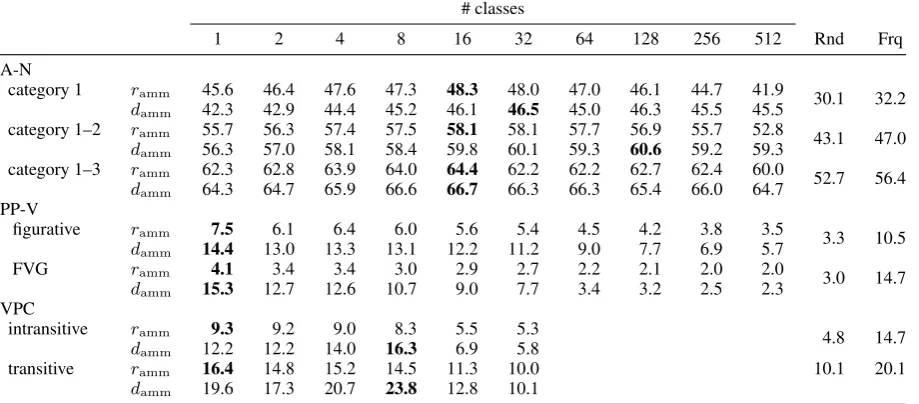
German A-N collocations The top slice in
Ta-ble 1 shows results for the three subtasks of the A-N dataset. We see that using AMM-basedpexp initially improves average precision, for each task and for both the ratio and the divergence measure. At their maxima, the informed measures outper-form both baselines as well as PMI and MI/log-likelihood ratio (# classes=1). The AMM-ratio per-forms best for 16-class AMMs, the optimum for AMM-divergence varies slightly.
It is likely that the drop in performance for the larger AMM-based measures is due to the AMMs learning the collocations themselves. That is, the
AMMs become rich enough to not only capture the broadly applicative distributional influences of syntax and semantics, but also provide accurate
pexps for individual, distributionally deviant combi-nations – like collocations. An accuratepexpresults in a low association score.
One way of inspecting what kind of dependen-cies the AMMs pick up is to cluster the data with them. Following Blitzer et al. (2005), we take the 200 most frequent adjectives and assign them to the category that maximizesp(c|w1); likewise for nouns andp(w2|c). Four selected clusters (out of 16) are given in Table 2.2The esoteric class 1
con-tains ordinal numbers and nouns that one typically uses those with, including references to temporal concepts. Class 2 and 3 appear more semantically motivated, roughly containing human and collec-tive denoting nouns, respeccollec-tively. Class 4 shows a group of adjectives denoting colours and/or po-litical affiliations and a less coherent set of nouns, although the noun cluster can be understood if we consider individual adjectives that are associated with this class. Our informal impression from look-ing at clusters is that this is a common situation: as a whole, a cluster cannot be easily characterized, although for subsets or individual pairs, one can get an intuition for why they are in the same class. Unfortunately, we also see that some actual collo-cations are clustered in class 4, such asgelbe Karte ‘warning’ (lit.: ‘yellow card’) anddickes Auto‘big
(lit.: fat) car’.
German PP-Verb collocations The second slice
in Table 1 shows that, for both subtypes of PP-V collocation, betterpexp-estimates lead todecreased average precision. The most effective AMM-ratio and -distance measures are those equivalent to (P)MI. Apparently, the betterpexps are unfortunate for the extraction of the type of collocations in this dataset.
The poor performance of PMI on these data – clearly below frequency – has been noticed before by Krenn and Evert (2001). A possible explanation for the lack of improvement in the AMMs lies in the relatively high performing frequency baselines. The frequency baseline for FVGs is five times the
2
# classes
1 2 4 8 16 32 64 128 256 512 Rnd Frq
A-N
category 1 ramm 45.6 46.4 47.6 47.3 48.3 48.0 47.0 46.1 44.7 41.9
30.1 32.2 damm 42.3 42.9 44.4 45.2 46.1 46.5 45.0 46.3 45.5 45.5
category 1–2 ramm 55.7 56.3 57.4 57.5 58.1 58.1 57.7 56.9 55.7 52.8 43.1 47.0
damm 56.3 57.0 58.1 58.4 59.8 60.1 59.3 60.6 59.2 59.3
category 1–3 ramm 62.3 62.8 63.9 64.0 64.4 62.2 62.2 62.7 62.4 60.0 52.7 56.4
damm 64.3 64.7 65.9 66.6 66.7 66.3 66.3 65.4 66.0 64.7 PP-V
figurative ramm 7.5 6.1 6.4 6.0 5.6 5.4 4.5 4.2 3.8 3.5
3.3 10.5
damm 14.4 13.0 13.3 13.1 12.2 11.2 9.0 7.7 6.9 5.7
FVG ramm 4.1 3.4 3.4 3.0 2.9 2.7 2.2 2.1 2.0 2.0
3.0 14.7
damm 15.3 12.7 12.6 10.7 9.0 7.7 3.4 3.2 2.5 2.3
VPC
intransitive ramm 9.3 9.2 9.0 8.3 5.5 5.3
4.8 14.7
damm 12.2 12.2 14.0 16.3 6.9 5.8
transitive ramm 16.4 14.8 15.2 14.5 11.3 10.0 10.1 20.1
[image:4.595.72.532.71.273.2]damm 19.6 17.3 20.7 23.8 12.8 10.1
Table 1: Average precision for AMM-based association measures and baselines on three datasets.
Cl Adjective Noun
1 dritt‘third’,erst‘first’,f¨unft‘fifth’,halb‘half’,kommend
‘next’,laufend‘current’,letzt‘last’,nah‘near’,paar‘pair’,
vergangen‘last’,viert‘fourth’,wenig‘few’,zweit ‘sec-ond’
Jahr‘year’, Klasse‘class’, Linie‘line’,Mal‘time’,Monat
‘month’,Platz‘place’,Rang‘grade’,Runde‘round’,Saison
‘season’,Satz‘sentence’,Schritt‘step’,Sitzung‘session’, Son-ntag‘Sunday’,Spiel‘game’,Stunde‘hour’,Tag‘day’,Woche
‘week’,Wochenende‘weekend’ 2 aktiv‘active’,alt‘old’,ausl¨andisch‘foreign’,betroffen
‘concerned’,jung‘young’,lebend‘alive’,meist‘most’,
unbekannt‘unknown’,viel‘many’
Besucher‘visitor’,B¨urger‘citizens’,Deutsche‘German’,Frau
‘woman’,Gast‘guest’,Jugendliche‘youth’,Kind‘child’,Leute
‘people’,M¨adchen‘girl’,Mann‘man’,Mensch‘human’, Mit-glied‘member’
3 deutsch‘German’,europ¨aisch‘European’,ganz‘whole’,
gesamt‘whole’,international‘international’,national ‘na-tional’,¨ortlich‘local’,ostdeutsch‘East-German’,privat
‘private’,rein‘pure’,sogenannt‘so-called’,sonstig‘other’,
westlich‘western’
Betrieb ‘company’,Familie ‘family’, Firma‘firm’, Gebiet
‘area’, Gesellschaft ‘society’, Land ‘country’, Mannschaft
‘team’, Markt ‘market’, Organisation ‘organisation’, Staat
‘state’,Stadtteil‘city district’,System‘system’,Team‘team’,
Unternehmen‘enterprise’,Verein‘club’,Welt‘world’ 4 blau‘blue’,dick‘fat’,gelb‘yellow’,gr¨un‘green’,linke
‘left’,recht‘right’,rot‘red’,schwarz‘black’,white‘weiß’
Auge‘eye’,Auto‘car’,Haar‘hair’,Hand‘hand’,Karte‘card’,
Stimme‘voice/vote’
Table 2: Selected adjective-noun clusters from a 16-class AMM.
random baseline, and MI does not outperform it by much. Since the AMMs provide a better fit for the more frequent pairs in the training data, they might end up providing too goodpexp-estimates for the true collocations from the beginning.
Further investigation is needed to find out whether this situation can be ameliorated and, if not, whether we can systematically identify for what kind of collocation extraction tasks using bet-terpexps is simply not a good idea.
English Verb-Particle constructions The last
gold standard is the English VPC dataset, shown in the bottom slice of Table 1. We have only used class-sizes up to 32, as there are only 35 particle types. We can clearly see the effect of the largest AMMs approaching the full bigramme model as
average precision here approaches the random base-line. The VPC extraction task shows a difference between the two based measures: AMM-ratio does not improve at all, remaining below the frequency baseline. AMM-divergence, however, shows a slight decrease in precision first, but ends up performing above the frequency baseline for the 8-class AMMs in both subtasks.
Cl Verb Particle 1 break, bring, come, cut, drive, fall, get, go, lay, look, move, pass, push,
put, run, sit, throw, turn, voice, walk
across, ahead, along, around, away, back, back-ward, down, forback-ward, into, over, through, together
2 accord, add, apply, give, happen, lead, listen, offer, pay, present, refer, relate, return, rise, say, sell, send, speak, write
astray, to
3 know, talk, tell, think about
4 accompany, achieve, affect, cause, create, follow, hit, increase, issue, mean, produce, replace, require, sign, support
[image:5.595.68.526.80.164.2]by
Table 3: Selected verb-particle clusters from an 8-class AMM on transitive data.
collocation extraction by decreasing the impact of verb-preposition associations that are due to PP-selecting verbs. Class 4 shows a third type of distri-butional generalization: the verbs in this class are all frequently used in the passive.
3.3 Variation due to local optima
We start each EM run with a random initializa-tion of the model parameters. Since EM finds local rather than global optima, each run may lead to different AMMs, which in turn will affect AMM-based collocation extraction. To gain insight into this variation, we have trained 40 16-class AMMs on the A-N dataset. Table 4 gives five point sum-maries of the average precision of the resulting 40 ‘association measures’. Performance varies con-siderably, spanning 2–3 percentage points in each case. The models consistently outperform (P)MI in Table 1, though.
Several techniques might help to address this variation. One might try to find a good fixed way of initializing EM or to use EM variants that reduce the impact of the initial state (Smith and Eisner, 2004, a.o.), so that a run with the same data and the same number of classes will always learn (al-most) the same model. On the assumption that an average over several runs will vary less than indi-vidual runs, we have also constructed a combined
pexp by averaging over 40pexps. The last column
Variation in avg precision
min q1 med q3 max Comb
A-N
cat 1 ramm 46.5 47.3 47.9 48.4 49.1 48.4 damm 44.4 45.4 45.8 46.1 47.1 46.4 cat 1–2 ramm 56.7 57.2 57.9 58.2 59.0 58.2 damm 58.1 58.8 59.2 59.4 60.4 60.0 cat 1–3 ramm 63.0 63.7 64.2 64.6 65.3 64.6 damm 65.2 66.0 66.4 66.6 67.6 66.9
Table 4: Variation on A-N data over 40 EM runs and result of combiningpexps.
in Table 4 shows this combined estimator leads to good extraction results.
4 Conclusions
In this paper, we have started to explore collocation extraction beyond the assumption of independence. We have introduced two new association measures that do away with this assumption in the estima-tion of expected probabilities. The success of using these association measures varies. It remains to be investigated whether they can be improved more.
A possible obstacle in the adoption of AMMs in collocation extraction is that we have not provided any heuristic for setting the number of classes for the AMMs. We hope to be able to look into this question in future research. Luckily, for the AN and VPC data, the best models are not that large (in the order of 8–32 classes), which means that model fit-ting is fast enough to experiment with different set-tings. In general, considering these smaller models might suffice for tasks that have a fairly restricted definition of collocation candidate, like the tasks in our evaluation do. Because AMM fitting is un-supervised, selecting a class size is in this respect no different from selecting a suitable association measure from the canon of existing measures.
Future research into association measures that are not based on the independence assumption will also include considering different EM variants and other automatically learnable models besides the AMMs used in this paper. Finally, the idea of us-ing an informed estimate of expected probability in an association measure need not be confined to (P)MI, as there are many other measures that employ expected probabilities.
Acknowledgements
References
Timothy Baldwin. 2005. The deep lexical acquisition of english verb-particle constructions. Computer Speech and Language, Special Issue on Multiword Expressions, 19(4):398–414.
Timothy Baldwin. 2008. A resource for evaluating the deep lexical acquisition of English verb-particle con-structions. InProceedings of the LREC 2008 Work-shop Towards a Shared Task for Multiword Expres-sions (MWE 2008), pages 1–2, Marrakech.
John Blitzer, Amir Globerson, and Fernando Pereira. 2005. Distributed latent variable models of lexical co-occurrences. InTenth International Workshop on Artificial Intelligence and Statistics.
Kenneth W. Church and Patrick Hanks. 1990. Word association norms, mutual information, and lexicog-raphy.Computational Linguistics, 16(1):22–29.
Ted Dunning. 1993. Accurate methods for the statis-tics of surprise and coincidence. Computational Lin-guistics, 19(1):61–74.
Stefan Evert. 2007. Corpora and collocations. Ex-tended Manuscript of Chapter 58 of A. L¨udeling and M. Kyt¨o, 2008,Corpus Linguistics. An International Handbook, Mouton de Gruyter, Berlin.
Stefan Evert. 2008. A lexicographic evaluation of Ger-man adjective-noun collocations. InProceedings of the LREC 2008 Workshop Towards a Shared Task for Multiword Expressions (MWE 2008), pages 3–6, Marrakech.
Thomas Hofmann and Jan Puzicha. 1998. Statisti-cal models for co-occurrence data. TechniStatisti-cal report, MIT. AI Memo 1625, CBCL Memo 159.
Brigitte Krenn and Stefan Evert. 2001. Can we do better than frequency? a case study on extracting PP-verb collocations. InProceedings of the ACL Work-shop on Collocations, Toulouse.
Brigitte Krenn. 2008. Description of evaluation re-source – German PP-verb data. InProceedings of the LREC 2008 Workshop Towards a Shared Task for Multiword Expressions (MWE 2008), pages 7– 10, Marrakech.
Chris Manning and Hinrich Sch¨utze. 1999. Foun-dations of Statistical Natural Language Processing. MIT Press, Cambridge, MA.
Pavel Pecina. 2008. A machine learning approach to multiword expression extraction. InProceedings of the LREC 2008 Workshop Towards a Shared Task for Multiword Expressions (MWE 2008), pages 54– 57, Marrakech.
Mats Rooth, Stefan Riester, Detlef Prescher, Glenn Car-rol, and Franz Beil. 1999. Inducing a semantically annotated lexicon via em-based clustering. In Pro-ceedings of the 37th Annual Meeting of the Associ-ation for ComputAssoci-ational Linguistics, College Park, MD.
Lawrence Saul and Fernando Pereira. 1997. Aggre-gate and mixed-order markov models for statistical language processing. InProceedings of the Second Conference on Empirical Methods in Natural Lan-guage Processing, pages 81–89.