The Effect of Higher-Order Dependency Features in Discriminative
Phrase-Structure Parsing
Gregory F. Coppola and Mark Steedman
School of Informatics The University of Edinburgh
[email protected] [email protected]
Abstract
Higher-order dependency features are known to improve dependency parser ac-curacy. We investigate the incorporation of such features into a cube decoding
phrase-structure parser. We find consid-erable gains in accuracy on the range of standard metrics. What is especially in-teresting is that we find strong, statisti-cally significant gains on dependency re-covery onout-of-domain tests (Brown vs. WSJ). This suggests that higher-order de-pendency features are not simply over-fitting the training material.
1 Introduction
Higher-order dependency features encode more complex sub-parts of a dependency tree struc-ture than first-order, bigram head-modifier rela-tionships.1 The clear trend in dependency
pars-ing has been that the addition of such higher-order features improves parse accuracy (McDonald & Pereira, 2006; Carreras, 2007; Koo & Collins, 2010; Zhang & Nivre, 2011; Zhang & McDonald, 2012). This finding suggests that the same ben-efits might be observed in phrase-structure pars-ing. But, this is not necessarily implied. Phrase-structure parsers are generally stronger than de-pendency parsers (Petrov et al., 2010; Petrov & McDonald, 2012), and make use of more kinds of information. So, it might be that the infor-mation modelled by higher-order dependency fea-tures adds less of a benefit in the phrase-structure case.
1Examples of first-order and higher-order dependency
features are given in§3.2.
To investigate this issue, we experiment using Huang’s (2008) cube decoding algorithm. This algorithm allows structured prediction with non-local features, as discussed in§2. Collins’s (1997) strategy of expanding the phrase-structure parser’s dynamic program to incorporate head-modifier de-pendency information would not scale to the com-plex kinds of dependencies we will consider. Us-ing Huang’s algorithm, we can indeed incorporate arbitrary types of dependency feature, using a sin-gle, simple dynamic program.
Compared to the baseline, non-local feature set of Collins (2000) and Charniak & Johnson (2005), we find that higher-order dependencies do in fact tend to improve performance signifi-cantly on both dependency and constituency ac-curacy metrics. Our most interesting finding, though, is that higher-order dependency features show a consistent and unambiguous contribution to the dependency accuracy, both labelled and un-labelled, of our phrase-structure parsers on out -of-domain tests (which means, here, trained on
WSJ, but tested onBROWN). In fact, the gains are
even stronger on out-of-domain tests than on in-domain tests. One might have thought that higher-order dependencies, being rather specific by na-ture, would tend to pick out only very rare events, and so only serve to over-fit the training material, but this is not what we find. We speculate as to what this might mean in§5.2.
The cube decoding paradigm requires a first-stage parser to prune the output space. For this, we use the generative parser of Petrov et al. (2006). We can use this parser’s model score as a fea-ture in our discriminative model at no additional cost. However, doing so conflates the contribu-tion to accuracy of the generative model, on the one hand, and the discriminatively trained,
written, features, on the other. Future systems might use the same or a similar feature set to ours, but in an architecture that does not include any generative parser. On the other hand, some systems might indeed incorporate this generative model’s score. So, we need to know exactly what the generative model is contributing to the accu-racy of a generative-discriminative model combi-nation. Thus, we conduct experiments in sets: in some cases the generative model score is used, and in others it is not used.
Compared to the faster and more psycholog-ically plausible shift-reduce parsers (Zhang & Nivre, 2011; Zhang & Clark, 2011), cube decod-ing is a computationally expensive method. But, cube decoding provides a relatively exact envi-ronment with which to compare different feature sets, has close connections with modern phrase-based machine translation methods (Huang & Chi-ang, 2007), and produces very accurate parsers. In some cases, one might want to use a slower, but more accurate, parser during the training stage of a semi-supervised parser training strategy. For ex-ample, Petrov et al. (2010) have shown that a fast parser (Nivre et al., 2007) can be profitably trained from the output of a slower but more accurate one (Petrov et al., 2006), in a strategy they call uptrain-ing.
We make the source code for these experiments available.2
2 Phrase-Structure Parsing with Non-Local Features
2.1 Non-Local Features
To decode using exact dynamic programming (i.e., CKY), one must restrict oneself to the use of only
local features. Local features are those that fac-tor according to the individual rule productions of the parse. For example, a feature indicating the presence of the rule S → NP VP is local.3 But,
a feature that indicates that the head word of this S is, e.g., joined, is non-local, because the head word of a phrase cannot be determined by look-ing at a slook-ingle rule production. To find a phrase’s head word (or tag), we must recursively find the
2See http://gfcoppola.net/code.php. This
software is available for free for non-profit research uses.
3A feature indicating that, e.g., the first word dominated
by S isPierreis also local, since the words of the sentence are constant across hypothesized parses, and words can be referred to by their position with respect to a given rule pro-duction. See Huang (2008) for more details.
head phrase of each local rule production, until we reach a terminal node (or tag node). This recursion would not be allowed in standard CKY. Many dis-criminative parsers have used only local features (Taskar et al., 2004; Turian et al., 2007; Finkel et al., 2008). However, Huang (2008) shows that the use of non-local features does in fact contribute substantially to parser performance. And, our de-sire to make heavy use of head-word dependency relations necessitates the use of non-local features.
2.2 Cube Decoding
While the use of non-local features destroys the ability to do exact search, we can still do inex-act search using Huang’s (2008) cube decoding
algorithm.4 A tractable first-stage parser prunes
the space of possible parses, and outputs aforest, which is a set of rule production instances that can be used to make a parse for the given sentence, and which is significantly pruned compared to the entire space allowed by the grammar. The size of this forest is at most cubic in the length of the sen-tence (Billot & Lang, 1989), but implicitly repre-sents exponentially many parses. To decode, we fix an beam width ofk(an integer). Then, when
parsing, we visit each nodenin the same
bottom-up order we would use for Viterbi decoding, and compute a list of the topkparses ton, according
to a global linear model (Collins, 2002), using the trees that have survived the beam at earlier nodes.
2.3 The First-Stage Parser
As noted, we require a first-stage parser to prune the search space.5 As a by-product of this pruning
procedure, we are able to use the model score of the first-stage parser as a feature in our ultimate model at no additional cost. As a first-stage parser, we use Huang et al.’s (2010) implementation of theLA-PCFGparser of Petrov et al. (2006), which
uses a generative, latent-variable model.
3 Features
3.1 Phrase-Structure Features
Our phrase-structure feature set is taken from Collins (2000), Charniak & Johnson (2005), and
4This algorithm is closely related to the algorithm for
phrase-based machine translation using a language model (Huang & Chiang, 2007).
5All work in this paradigm has used a generative parser as
Huang (2008). Some features are omitted, with choices made based on the ablation studies of Johnson & Ural (2010). This feature set, which we call Φphrase, contains the following, mostly
non-local, features, which are described and depicted in Charniak & Johnson (2005), Huang (2008), and Johnson & Ural (2010):
• CoParThe depth (number of levels) of
par-allelism between adjacent conjuncts
• CoParLenThe difference in length between adjacent conjuncts
• EdgesThe words or (part-of-speech) tags on the outside and inside edges of a given XP6 • NGramsSub-parts of a given rule production • NGramTree An n-gram of the input sen-tence, or the tags, along with the minimal tree containing thatn-gram
• HeadTree A sub-tree containing the path from a word to its maximal projection, along with all siblings of all nodes in that path
• HeadsHead-modifier bigrams • RuleA single rule production
• TagThe tag of a given word
• WordThe tag of and first XP above a word • WProjThe tag of and maximal projection of
a word
Headsis a first-order dependency feature.
3.2 Dependency Parsing Features
McDonald et al. (2005) showed that chart-based dependency parsing, based on Eisner’s (1996) al-gorithm, could be successfully approached in a discriminative framework. In this earliest work, each feature function could only refer to a sin-gle, bigram head-modifier relationship, e.g., Mod-ifier, below. Subsequent work (McDonald & Pereira, 2006; Carreras, 2007; Koo & Collins, 2010) looked at allowing features to access more complex,higher-orderrelationships, including tri-gram and 4-gram relationships, e.g., all features
apart from Modifier, below. With the ability to incorporate non-local phrase-structure parse fea-tures (Huang, 2008), we can recognize depen-dency features of arbitrary order (cf. Zhang & McDonald (2012)). Our dependency feature set, which we callΦdeps, contains:
• Modifierhead and modifier
6The tags outside of a given XP are approximated using
the marginally most likely tags given the parse.
• Siblinghead, modifierm, andm’s nearest in-ner sibling
• Grandchild head, modifier m, and one of m’s modifiers
• Sibling+Grandchildhead, modifierm,m’s
nearest inner sibling, and one ofm’s
modi-fiers
• Grandchild+Grandsibling head, modifier
m, one ofm’s modifiersg, andg’s inner
sib-ling
These features are insensitive to arc labels in the present experiments, but future work will incorpo-rate arc labels. Each feature class contains more and less lexicalized versions.
3.3 Generative Model Score Feature
Finally, we have a feature set, Φgen,
contain-ing only one feature function. This feature maps a parse to the logarithm of theMAX-RULE -PRODUCTscore of that parse according to theLA -PCFG parsing model, which is trained separately.
This score has the character of a conditional like-lihood for the parse (see Petrov & Klein (2007b)).
4 Training
We have two feature sets Φphrase and Φdeps, for
which we fix weights using parallel stochastic op-timization of a structuredSVMobjective (Collins,
2002; Taskar et al., 2004; Crammer et al., 2006; Martins et al., 2010; McDonald et al., 2010). To the single feature in the setΦgen (i.e. the
genera-tive model score), we give the weight1.
The combined models,Φphrase+deps,Φphrase+gen,
andΦphrase+deps+gen, are then model combinations
of the first three. The combination weights for these combinations are obtained using Och’s (2003) Minimum Error-Rate Training (MERT).
The MERT stage helps to avoid feature
under-training (Sutton et al., 2005), and avoids the prob-lem of scaling involved in a model that contains mostly boolean features, but one, real-valued, log-scale feature. Training is conducted in three stages (SVM,MERT,SVM), so that there is no influence of
any data outside the given training set (WSJ2-21)
on the combination weights.
5 Experiments 5.1 Methods
All models are trained on WSJ2-21, with WSJ22
Test Set
WSJ BROWN
Type Model F1 UAS LAS F1 UAS LAS
G LA-PCFG 90.3 93.7 91.5 85.1 88.7 85.0
D phrase 91.2 93.9 91.0 86.1 89.4 85.1
deps — 93.3 — — 89.3 —
phrase+deps 91.7 94.4 91.5 86.4 90.1 85.9
[image:4.595.148.456.61.187.2]G+D phrase+gen 92.1 94.7 92.6 87.0 90.0 86.5 phrase+deps+gen 92.4 94.9 92.8 87.4 90.7 87.1
Table 1: Performance of the various models in cube decoding experiments, on the WSJ test set
(in-domain) and the BROWN test set (out-of-domain). G abbreviates generative, D abbreviates
discrim-inative, and G+D a combination. Some cells are empty because Φdeps features are only sensitive to
unlabelled dependencies. Best results in D and G+D conditions appear in bold face.
Test Set
Hypothesis WSJ BROWN
Greater Lesser F1 UAS LAS F1 UAS LAS
phrase+deps phrase .042 .029 .018 .140 .022 .009
phrase+deps deps — <.001 — — .012 —
phrase+gen phrase .013 .003 <.001 .016 .090 <.001
phrase+deps+gen phrase+gen .030 .122 .151 .059 .008 .020
phrase+deps+gen phrase+deps .019 .020 <.001 .008 .040 <.001
Table 2: Results of statistical significance evaluations of hypotheses of the formX’s accuracy is greater than Y’son the various test sets and metrics. Bold face indicatesp < .05.
optimization, as is standard. The test sets are
WSJ23 (in-domain test set), andBROWN9
(out-of-domain test set) from the Penn Treebank (Mar-cus et al., 1993).7 We evaluate using harmonic
mean between labelled bracket recall and preci-sion (EVALBF1), unlabelled dependency accuracy
(UAS), and labelled dependency accuracy (LAS).
Dependencies are extracted from full output trees using the algorithm of de Marneffe & Manning (2008). We chose this dependency extractor, firstly, because it is natively meant to be run on the output of phrase-structure parsers, rather than on gold trees with function tags and traces still present, as is, e.g., thePenn-Converterof Johans-son & Nugues (2007). Also, this is the extractor that was used in a recent shared task (Petrov & McDonald, 2012). We useEVALB andeval.pl to
calculate scores.
For hypothesis testing, we used the paired boot-strap test recently empirically evaluated in the con-text ofNLPby Berg-Kirkpatrick et al. (2012). This
7Following Gildea (2001), theBROWNtest set is usually
divided into10parts. If we start indexing at0, then the last (test) section has index9. We received theBROWNdata splits from David McClosky, p.c.
involves drawingbsubsamples of sizenwith
re-placement from the test set in question, and check-ing relative performance of the models on the sub-sample (see the reference). We use b = 106 and
n= 500in all tests.
5.2 Results
The performance of the models is shown in Table 1, and Table 2 depicts the results of significance tests of differences between key model pairs.
We find that adding in the higher-order depen-dency feature set,Φdeps, makes a statistically
sig-nificant improvement in accuracy on most met-rics, in most conditions. On the in-domain WSJ
test set, we find that Φphrase+deps is significantly
better than either of its component parts on all metrics. But, Φphrase+deps+gen is significantly
bet-ter than Φphrase+gen only on F1, but not on UAS
orLAS. However, on theout-of-domain BROWN
tests, we find that addingΦdeps always adds
con-siderably, and in a statistically significant way, to bothLASandUAS. That is, not only isΦphrase+deps
[image:4.595.115.487.262.375.2]bet-ter on dependency recovery thanΦphrase+gen, which
represents the previous state-of-the-art in this vein of research (Huang, 2008). This result is perhaps counter-intuitive, in the sense that one might have supposed that higher-order dependency features, being highly specific by nature, might only have only served to over-fit the training material. How-ever, this result shows otherwise. Note that the dependency features include various levels of lex-icalization. It might be that the more unlexical-ized features capture something about the struc-ture of correct parses, that transfers well out-of-domain. Future work should investigate this. And, it of course remains to be seen how this result will transfer to other train-test domain pairs.
To our knowledge, this is the first work to specifically separate the role of the generative model feature from the other features of Collins (2000) and Charniak & Johnson (2005). We note that, even without the Φgen feature, the
discrimi-native parsing models are very strong, but adding
Φgennevertheless yields considerable gains. Thus,
while a fully discriminative model, perhaps im-plemented using a shift-reduce algorithm, can be expected to do very well, if the best accuracy is necessary (e.g., in a semi-supervised training strat-egy), it still seems to pay to use the generative-discriminative model combination. Note that the
LAS scores of our models without Φgen are
rela-tively weak. This is presumably largely because our dependency features are, at present, not sen-sitive to arc labels, so our results probably under-estimate the capability of our general framework with respect to labelled dependency recovery.
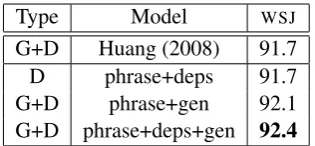
Table 3 compares our work with Huang’s (2008). Note that our model Φphrase+gen uses
es-sentially the same features as Huang (2008), so the fact that ourΦphrase+genis noticeably more
ac-curate on F1 is presumably due to the benefits
in reduced feature under-training achieved by the
MERTcombination strategy. Also, ourΦphrase+deps
model is as accurate as Huang’s, without even us-ing the generative model score feature. Table 4 compares our work to McClosky et al.’s (2006) domain adaptation work with the Charniak & Johnson (2005) parser. Their three models shown have been trained on: i) the WSJ (supervised,
out-of-domain), ii) the WSJ plus 2.5 million
sen-tences of automatically labelled NANC newswire
text (semi-supervised, out-of-domain), and iii) the
BROWN corpus (supervised, in-domain). We test
Type Model WSJ
[image:5.595.338.496.61.134.2]G+D Huang (2008) 91.7 D phrase+deps 91.7 G+D phrase+gen 92.1 G+D phrase+deps+gen 92.4
Table 3: Comparison of constituency parsing re-sults in the cube decoding framework, on theWSJ
test set. On G+D, D, see Table 1.
Parser Training Data BROWNF1
CJ WSJ 85.2
CJ WSJ+NANC 87.8
CJ BROWN 88.4
Our Best WSJ 87.4
Table 4: Comparison of our best model,
Φphrase+deps+gen, on BROWN, with the Charniak &
Johnson (2005) parser, denotedCJ, as reported in
McClosky et al. (2006). Underline indicates best trained onWSJ, bold face indicates best overall.
on BROWN. We see that our best (WSJ-trained)
model is over 2% more accurate (absolute F1
difference) than the Charniak & Johnson (2005) parser trained on the same data. In fact, our best model is nearly as good as McClosky et al.’s (2006) self-trained, semi-supervised model. Of course, the self-training strategy is orthogonal to the improvements we have made.
6 Conclusion
We have shown that the addition of higher-order dependency features into a cube decoding phase-structure parser leads to statistically significant gains in accuracy. The most interesting finding is that these gains are clearly observed on out-of-domain tests. This seems to imply that higher-order dependency features do not merely over-fit the training material. Future work should look at other train-test domain pairs, as well as look at ex-actly which higher-order dependency features are most important to out-of-domain accuracy.
Acknowledgments
References
Berg-Kirkpatrick, T., Burkett, D., & Klein, D. (2012). An empirical investigation of statistical significance in NLP. InEMNLP, 995–1005. Billot, S., & Lang, B. (1989). The structure of
shared forests in ambiguous parsing. In ACL, 143–151.
Carreras, X. (2007). Experiments with a higher-order projective dependency parser. In Pro-ceedings of the CoNLL Shared Task Session of EMNLP-CoNLL 2007, 957–961.
Charniak, E., & Johnson, M. (2005). Coarse-to-fine n-best parsing and MaxEnt discriminative reranking. InACL, 173–180.
Collins, M. (1997). Three generative, lexicalised models for statistical parsing. InACL, 16–23. Collins, M. (2000). Discriminative reranking for
natural language parsing. InICML, 175–182. Collins, M. (2002). Discriminative training
meth-ods for Hidden Markov Models: theory and experiments with perceptron algorithms. In
EMNLP, 1–8.
Crammer, K., Dekel, O., Keshet, J., Shalev-Shwartz, S., & Singer, Y. (2006). Online passive-aggressive algorithms. JMLR, 7, 551– 585.
Eisner, J. (1996). Three new probabilistic mod-els for dependency parsing: An exploration. In
COLING, 340–345.
Finkel, J. R., Kleeman, A., & Manning, C. D. (2008). Efficient, feature-based, conditional random field parsing. InACL, 959–967. Gildea, D. (2001). Corpus variation and parser
performance. InEMNLP, 167–202.
Huang, L. (2008). Forest reranking: Discrimina-tive parsing with non-local features. In ACL, 586–594.
Huang, L., & Chiang, D. (2007). Forest rescor-ing: Faster decoding with integrated language models. InACL.
Huang, Z., Harper, M., & Petrov, S. (2010). Self-training with products of latent variable gram-mars. InEMNLP, 12–22.
Johansson, R., & Nugues, P. (2007). Extended constituent-to-dependency conversion for En-glish. InProc. of the 16th Nordic Conference on Computational Linguistics (NODALIDA), 105– 112.
Johnson, M., & Ural, A. E. (2010). Reranking the Berkeley and Brown parsers. In HLT-NAACL, 665–668.
Koo, T., & Collins, M. (2010). Efficient third-order dependency parsers. InACL, 1–11. Marcus, M. P., Santorini, B., & Marcinkiewicz,
M. A. (1993). Building a large annotated corpus of English: The Penn Treebank.Computational Linguistics, 19(2), 313–330.
de Marneffe, M.-C., & Manning, C. D. (2008). The Stanford typed dependencies representa-tion. InColing 2008: Proceedings of the work-shop on Cross-Framework and Cross-Domain Parser Evaluation, 1–8.
Martins, A. F., Gimpel, K., Smith, N. A., Xing, E. P., Figueiredo, M. A., & Aguiar, P. M. (2010). Learning structured classifiers with dual coordinate ascent. Technical report, DTIC Doc-ument.
McClosky, D., Charniak, E., & Johnson, M. (2006). Reranking and self-training for parser adaptation. InACL, 337–344.
McDonald, R., & Pereira, F. (2006). Online learn-ing of approximate dependency parslearn-ing algo-rithms. InEACL, 81–88.
McDonald, R. T., Crammer, K., & Pereira, F. C. N. (2005). Online large-margin training of depen-dency parsers. InACL, 91–98.
McDonald, R. T., Hall, K., & Mann, G. (2010). Distributed training strategies for the structured perceptron. InHLT-NAACL, 456–464.
Nivre, J., Hall, J., Nilsson, J., Chanev, A., Eryigit, G., K¨ubler, S., Marinov, S., & Marsi, E. (2007). Maltparser: A language-independent system for data-driven dependency parsing. Natural Lan-guage Engineering, 13(2), 95–135.
Och, F. J. (2003). Minimum error rate training in statistical machine translation. InACL, 160– 167.
Petrov, S., Barrett, L., Thibaux, R., & Klein, D. (2006). Learning accurate, compact, and inter-pretable tree annotation. InACL, 433–440. Petrov, S., Chang, P.-C., Ringgaard, M., &
Al-shawi, H. (2010). Uptraining for accurate deter-ministic question parsing. InEMNLP, 705–713. Petrov, S., & Klein, D. (2007a). Discriminative log-linear grammars with latent variables. In
Petrov, S., & Klein, D. (2007b). Improved infer-ence for unlexicalized parsing. InHLT-NAACL, 404–411.
Petrov, S., & McDonald, R. (2012). Overview of the 2012 shared task on parsing the web. Notes of the First Workshop on Syntactic Analysis of Non-Canonical Language (SANCL).
Sutton, C., Sindelar, M., & McCallum, A. (2005). Feature bagging: Preventing weight undertrain-ing in structured discriminative learnundertrain-ing. In
HLT-NAACL.
Taskar, B., Klein, D., Collins, M., Koller, D., & Manning, C. D. (2004). Max-margin parsing. InEMNLP, 1–8.
Turian, J., Wellington, B., & Melamed, I. D. (2007). Scalable discriminative learning for nat-ural language parsing and translation. InNIPS, 1409–1416.
Zhang, H., & McDonald, R. (2012). General-ized higher-order dependency parsing with cube pruning. InEMNLP, 238–242.
Zhang, Y., & Clark, S. (2011). Shift-reduce CCG parsing. InACL, 683–692.