Munich Personal RePEc Archive
Return on Universal Education: SSA
Case Study on Bihar
Dinda, Soumyananda
Department of Economics, The University of Burdwan, Department
of Economics, Sidho-Kanho-Birsha University
25 January 2015
Return on Universal Education: SSA Case Study on Bihar
Soumyananda Dinda
Department of Economics, University of Burdwan, West Bengal, India
Email: [email protected]
Abstract
Mass universal education is a necessary condition for initiation of economic development in
underdeveloped and backward state like Bihar in India. The Govt. of India has taken initiative for
universal mass education and prime focus is on Sarbha Shikhsha Abhijan (SSA). This study attempts
to assess the impact of universal education programme such as SSA in Bihar. The difference –in-
difference (DD) approach is used here to measure the impact of SSA treatment on unorganised sector
in Bihar. This study finds that literate people earn Rs. 43 higher than that of illiterate, and SSA is
giving additional return nearly more than Rs. 600 Crore per annum only from small and tiny
enterprise in urban Bihar.
Key Words: DD, Difference –in-Difference, Control group, Treatment, SSA, Universal Mass Education, Bihar, income, Return on Education, unorganised sector, development.
1. Introduction
Education is the cornerstone of economic growth and social development. Schooling is
desirable for individual as well as for society. At macro level, a better-educated workforce
enhances a nation’s stock of human capital that is crucial for raising productivity and
economic development (Barro, 1996; Romer, 1986; Lucas, 1988; Ravallion and Chen, 1997).
One of the crucial problems of economic development is the problem of accounting for
income pattern and related other social issues; one of them is the educational externality
(Lucas 1988). There are different opinions regarding the presence of external effect of human
capital. However, it is difficult to capture the externality of human capital. In Lucas (1988),
human capital is found to have positive external effect on aggregate production function. In
the presence of external effect, the social and private return to human capital differs. There
exists a substantial empirical literature relating human capital accumulation to economic
growth. In 50s and 60s Gary Becker, Jacob Mincer, T.W. Schultz and other economists focus
on the role of education on economic development. Recently, Lucas (1988), Barro (1991),
education externalities improve literature on it. The positive externalities associated with
human capital are given importance in the new growth theories, and in most of these dynamic
models externality result in the returns to scale in the production sector. Basic question here
is: How do we measure the educational externalities? Applying difference in difference (DD)
approach, this paper attempts to assess the impact of education, especially measuring the
returns of education.
Truly, acquiring education is an investment in the sense that one gives up something now in
the hope of getting more back in future. For that reason, education is often described as
‘human capital’, the title of a famous book by Gary Becker. So, spending on education should
be considered as the investment. Like all investments, how the future gain compares to the
current sacrifice is critical in determining whether education is a good investment or not.
What is the factor motivating individual to determine for acquiring education. The basic
assumptions are (i) earning of individual depends on year of schooling; i.e., one individual
has s year of (post compulsory) schooling, earning is W(s). (ii) Assume there is no direct cost
but cost of education is only forgone earnings. (iii) Assume everyone lives forever. So,
present discount value (PDV) of s years of education is:
Taking log of both sides of the above equation can be written as
First order condition can be written as
Acquiring education up to the point where the increase in log earnings is equal to the rate at
which future earnings are discounted.
Suppose all individuals are identical and require different levels of education in equilibrium,
then must be the case that
is equalised for different levels of s. The coefficient on s is the measure of r– rate of return to
education1.
Economics scholars have invested much energy in identifying the value of educational
investment, to determine whether governments and individuals are investing optimally. Much
of this work stems from the work of Becker (1962) that introduced the concept of treating
investment in education as a capital investment. Since then research scholars mainly focus on
1From empirical findings it is clear that typical OLS estimates from an earnings function are about 2.2 – 12.8
percent which suggests that education is a good investment.
1 ( )rt rS
s
PDV e W s dt W s e
r
log
PDV
log
W S
rS
log
r
log PDV logW S rS log r
'W s
r
estimation of the return to education investment2. However, estimates of the return vary
significantly, depending on the data sets used, the assumptions made and the estimation
techniques.
Furthermore, attempts at estimating a single rate of return may not be very informative if
returns to education differ by education level, or differ across populations (including by
social strata). This may be particularly important for policy responses, but ironically gets
masked by methodological debates. Similarly, economists often fail to take into account the
risk associated with education investment decisions. Risk may play an important role in an
individual’s education investment decision, and indeed a government’s educational
investment level, and should be taken into consideration when testing rationality and
optimality of education investment (see Heckman, Lochner, and Todd 2008) and the
comprehensive review in Heckman et al. (2006)). In addition, as most cogently argued by
Oreopoulos and Salvanes (2011), the return to education may be much wider than the private
financial returns that is the focus of so much of the economics literature, and perhaps
economics as a profession has allowed a major body of research on the non-pecuniary returns
(which may create private returns through externalities that are as great – if not greater – than
the direct effect of education on earnings) to become dominated by the other social sciences.
Education is the key treatment that may remove major hindrance of social development and
economic growth. Educated workforce enhances a nation’s stock of human capital which
increases productivity and economic development (Barro 1996; Romer 1986; Lucas 1988;
Ravallion and Chen 1997). Education is associated with high rates of return, both private and
social. So, schooling is desirable for all. There is an increasing focus on achieving universal
primary education in developing countries like India. In this context, primary education has
the highest social rates of return in developing countries (Psacharooulos and Patrinos 2004).
Is it true in India? How far is it true in backward state like Bihar also? This study attempts to
answer this question focusing on universal primary education in Bihar.
The government of India has launched the Sarbha Shikha Avijan (SSA) to improve the
literacy level and endeavours to achieve universal primary education since 1987-88. Across
states this SSA programme is more or less successful. In this context, especially this paper
focuses on Bihar, which is one of the least developed states in India. Recently a high rate of
2
growth is observed and consequently speedy development starts to gain momentum in Bihar.
Basic question what is the reason behind it. There are several reasons but one of them is the
improvement of education level in Bihar. Has any impact of education on Bihar economy? In
other word, what is the return of education in Bihar? How do we measure it?
This study attempts to answer the above questions especially in the context of Bihar. This
paper is organised as follows: Section 2 explains the methodological issues. Section 3
describes data. Section 4 analyses results, and finally concludes.
2. Methodology: Difference in Difference Approach
Recently the most popular identification strategy in applied work is the difference in
difference (DD) methodology (see Dinda 2015 for details). Application of DD is a very
simple random assignment with treatment and comparison. One group is treated with
intervention and other is control group. DD is the application of two-way fixed effects model
having cross sectional and time series data. So, basically we have pre and post data for group
receiving intervention. Suppose treatment intervention occurs at ti and we observe outcome
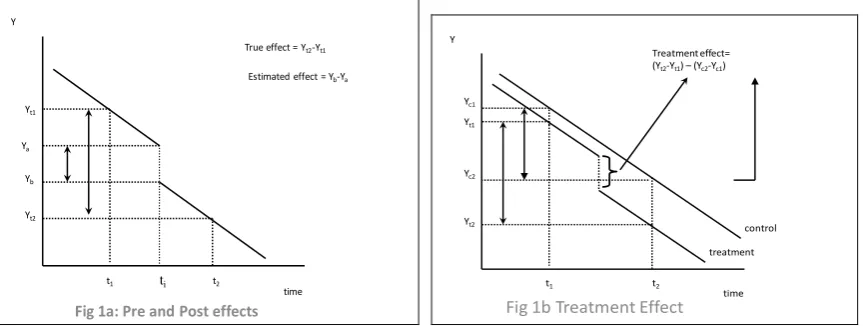
Yt1 at t1 and post treatment outcome Yt2 at t2. Fig 1 (Fig 1a & Fig 1b) show the treatment
effect. Using time series data, true effect is the difference between pre and post observed
outcome, i.e., (Yt2–Yt1) but actual estimated effect of the treatment is (Yb–Ya).
Fig 1a: Pre and Post effects
time Y
t1 t2
Ya
Yb
Yt1
Yt2
True effect = Yt2-Yt1
Estimated effect = Yb-Ya
ti
Fig 1b Treatment Effect
time Y
t1 t2 Yt1
Yt2
treatment control Yc1
Yc2
Treatment effect= (Yt2-Yt1) –(Yc2-Yc1)
We use time series of untreated group to establish what would have occurred in the absence
of the intervention. Here, the key concept is the control (c) and treatment (t). Table 1 display
[image:5.595.76.508.442.605.2]Table 1: Difference in Difference approach
Difference in Difference
Before After
Difference Group 1
(Treat)
Yt1 Yt2 ΔYt
= Yt2-Yt1
Group 2 (Control)
Yc1 Yc2 ΔYc
=Yc2-Yc1
Difference ΔΔY
ΔYt– ΔYc
Control group identifies the time path of outcomes that would have happened in the absence
of the treatment. In this example, Y changes by (Yc2 – Yc1) even without the intervention.
Treatment group identifies the time path of outcomes that would have happened in the
intervention of the treatment. In this case, Y changes by (Yt2 – Yt1) with the intervention.
Here, impact measurement is the difference in the change in outcomes, i.e., (Yt2–Yt1) –(Yc2–Yc1),
or, treatment effect is ( ∆∆Y = ) ∆Yt - ∆Yc .
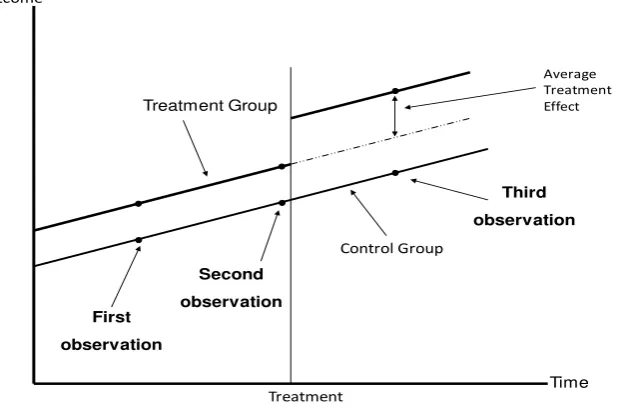
Fundamental assumption that trends (slopes) are same in treatments and controls. It is true for sometimes. Truly we need minimum three time point observations as depicting in fig 2.
Time
Treatment Outcome
Treatment Group
Control Group
Average Treatment Effect
First
observation
Second
observation
Third
[image:6.595.72.215.70.152.2]observation
Fig 2: Pre and Post Observations
Following Dinda (2015), We evaluate the impact of treatment or program on an outcome Y over population individuals.
Model
Suppose there are two groups indexed by treatment status T = 0, 1; where 0 and 1 indicate
individuals who do not receive treatment (i.e., the control group) and individuals who receive
treatment (i.e., treatment group), respectively. Assume that we observe individuals in two
time periods, t = 0, 1 where 0 indicates a time period before the treatment group receives
treatment (i.e. pre-treatment), and 1 indicates a time period after the treatment group receives
[image:6.595.112.423.339.545.2]individuals will typically have two observations each, one pre-treatment and one
post-treatment. For the sake of notation let 𝑌̅̅̅̅0𝑇 and 𝑌̅̅̅̅1𝑇 be the sample averages of the outcome for
the treatment group before and after treatment, respectively, and let 𝑌̅̅̅̅0𝐶 and 𝑌̅̅̅̅1𝐶 be the
corresponding sample averages of the outcome for the control group. Subscripts correspond
to time period and superscripts to the treatment status.
2.2 Modelling the Outcome
The outcome Yi is modelled by the following equation
𝑌𝑖 = 𝛽0+ 𝛽1 𝑇𝑖+ 𝛽2 𝑡𝑖+ 𝛽3 (𝑇𝑖∗ 𝑡𝑖) + 𝜀𝑖 (1)
where the 𝛽0, 𝛽1, 𝛽2, 𝛽3, coefficients are all unknown parameters and εi is a random,
unobserved "error" term which contains all determinants of Yi which the model omits. By
inspecting the equation we should observe the coefficients and have the following
interpretation
𝛽0 = constant term, 𝛽1 = treatment group specific effect (to account for average permanent
differences between treatment and control), 𝛽2 = time trend common to control and treatment
groups, 𝛽3 = true effect of treatment
The purpose of the program evaluation is to find a “good” estimate of δ, 𝛿̂, given the data that
we have available.
2.3 Assumptions for an Unbiased Estimator
A reasonable criterion for a good estimator is that it be unbiased which means that "on
average" the estimate will be correct, or mathematically that the expected value of the
estimator
𝐸[𝛽̂] = 𝛽3 3
The assumptions we need for the difference in difference estimator to be correct are given by
the following
1) The model in equation (Outcome) is correctly specified. For example, the additive
structure imposed is correct.
2) The error term is on average zero: E [εi] = 0. Not a hard assumption with the constant
term 𝛽0 put in.
3) The error term is uncorrelated with the other variables in the equation:
Cov (εi, Ti) = 0
Cov (εi, ti) = 0
the last of these assumptions, also known as the parallel-trend assumption, is the most
critical.
Under these assumptions we can use equation (Outcome) to determine that expected values
of the average outcomes are given by
𝐸[𝑌0𝑇] = 𝛽0+ 𝛽1
𝐸[𝑌1𝑇] = 𝛽0+ 𝛽1+ 𝛽2+ 𝛽3
𝐸[𝑌0𝐶] = 𝛽0
𝐸[𝑌1𝐶] = 𝛽0+ 𝛽2
These equations are helpful to identify the estimated impact of a treatment.
2 The Difference in Difference Estimator
Before explaining the difference in difference estimator it is best to review the two simple
difference estimators and understand what can go wrong with these. Understanding what is
wrong about as an estimator is as important as understanding what is right about it.
2.1 Simple Pre versus Post Estimator
Consider first an estimator based on comparing the average difference in outcome Yi before
and after treatment in the treatment group alone3.
𝛿̂ = 𝑌̅1 1𝑇− 𝑌̅0𝑇 (D1) Taking the expectation of this estimator we get
𝐸[𝛿̂ ] = 𝐸[𝑌̅1 1𝑇] − 𝐸[𝑌̅0𝑇]
= [𝛽0+ 𝛽1+ 𝛽2+ 𝛽3] – [𝛽0+ 𝛽1]
= 𝛽2+ 𝛽3
which means that this estimator will be biased so long as 𝛽2 ≠ 0, i.e. if a time-trend exists in
the outcome Yi then we will confound the time trend as being part of the treatment effect.
2.2 Simple Treatment versus Control Estimator
Next consider the estimator based on comparing the average difference in outcome Yi
post-treatment, between the treatment and control groups, ignoring pre-treatment outcomes4.
𝛿2
̂ = 𝑌̅1𝑇− 𝑌̅1𝐶 (D2) Taking the expectation of this estimator we get
𝐸[𝛿̂ ] = 𝐸[𝑌̅2 1𝑇] − 𝐸[𝑌̅1𝐶]
= [𝛽0+ 𝛽1+ 𝛽2+ 𝛽3] – [𝛽0+ 𝛽2]
3
This would be the estimate one would get from an OLS estimate on a regression equation of the form on the sample from the treatment group only.
4
= 𝛽1+ 𝛽3
So, this estimator is biased so long as 𝛽1 ≠ 0, i.e. there exist permanent average differences
in outcome Yi between the treatment groups. The true treatment effect will be confounded by
permanent differences in treatment and control groups that existed prior to any treatment.
Note that in a randomized experiments, where subjects are randomly selected into treatment
and control groups, β1 should be zero as both groups should be nearly identical: in this case
this estimator may perform well in a controlled experimental setting typically unavailable in
most program evaluation problems seen in economics.
2.3 The Difference in Difference Estimator
The difference in difference (or "double difference") estimator is defined as the difference in
average outcome in the treatment group before and after treatment minus the difference in
average outcome in the control group before and after treatment5 : it is literally a “difference
of differences”.
𝛿̂ = (𝑌̅𝐷𝐷 1𝑇− 𝑌̅0𝑇) − (𝑌̅1𝐶− 𝑌̅0𝐶) (DD) Taking the expectation of this estimator we will see that it is unbiased
𝐸[𝛿̂ ] = 𝐸[𝑌̅𝐷𝐷 1𝑇] − 𝐸[𝑌̅0𝑇] − (𝐸[𝑌̅1𝐶] − 𝐸[𝑌̅0𝐶])
=( [𝛽0+ 𝛽1+ 𝛽2+ 𝛽3] – [𝛽0+ 𝛽1]) – ([𝛽0+ 𝛽2]- 𝛽0)
= [𝛽2+ 𝛽3] – (𝛽2)
= 𝛽3
This estimator can be seen as taking the difference between two pre-versus-post estimators
seen above in (D1), subtracting the control group’s estimator, which captures the time trend
𝛽2, from the treatment group’s estimator to get 𝛽3. We can also rearrange terms in equation
(DD) to get 𝛿̂ = (𝑌̅𝐷𝐷 1𝑇− 𝑌̅1𝐶) − (𝑌̅0𝑇− 𝑌̅0𝐶) in which it can be interpreted as taking the
difference of two estimators of the simple treatment versus control type seen in equation
(D2). The difference estimator for the pre-period is used to estimate the permanent difference
β1, which is then subtracted away from the post-period estimator to get 𝛽3.
Now, in this context, simple econometrics model is Yit = β0 + β1Tit+ β2Ait + β3TitAit + εit ,
where Tit is individual treated and Ait is in the period when treatment occurs. TitAit is the
interaction term, treatment individual after the intervention.
5
T ab le 2 :
Yit = β0 + β1Tit + β2Ait + β3TitAit + εit
Before After
Difference
Group 1 (Treat)
β0+ β1 β0+ β1+ β2+ β3 ΔYt
= β2+ β3
Group 2 (Control)
β0 β0+ β2 ΔYc
= β2
Difference ΔΔY = β3
This DD methodology is used in several studies. Here, we also use the DD for a case study on
the return on education in Bihar. For this purpose we collect primary data from a field survey.
Data
We have collected data on unorganised sector focusing on the small and tinny enterprises
covering major urban Bihar during January – July, 2010. The small and tinny enterprises are
mostly self-employed (including street vendors) and do their own business as their livelihood.
They provide service to the municipal people and contribute to the urban economy. Total
number of business unit (population) in this specific unorganised sector in urban Bihar is
nearly than 3.5 lakhs. It mainly covers major municipal areas of towns and cities in Bihar.
Data are collected in different (three) rounds for cross checking and verifications. So, here,
we have a cross section data including thin and densely populated area. Using stratified
random sampling technique we have collected data taking several parameters. Finally, our
sample size is 2588. These data represent whole urban Bihar covering all districts towns
which are consist of words, roads, streets, lane and bye lanes etc.
Our main focus is to measure the impact of Sarbha Sikhsha Avijan (SSA) applying difference
in difference (DD) approach. Here, we consider that SSA is a treatment which has applied in
Bihar since early 1990s. We can apply DD methodology to assess the impact of SSA only
having control and treatment groups in pre and post SSA. In this context, we identify and set
up illiterate and literate as control and treatment groups, respectively. Individual has reported
their age in year. Now, using the ‘age’ variable we can identify individual weather he/she has
received the treatment of SSA or not, and hence we have pre and post SSA groups. SSA
starts in early 1990s in Bihar. Hence, individual did not receive SSA treatment if he /she was
born before 1988, otherwise, his/her age is more than 22 years and they belong to pre SSA;
(control) individual can be divided into sub-groups according to their age more than 22 years
or less such as pre and post control and pre and post treatment SSA. Thus, as per treatment
(SSA) and its availability during their childhood we formulate minimum 2x2 groups, i.e., pre
and post control as well as pre and post treatment groups in Bihar. Now, we investigate the
impact of SSA treatment in Bihar focusing different variables such as income, inequality, etc.
Results
Income of individual is considered here as outcome. For our purpose, we measure the return
of SSA treatment. There is a huge income difference between literate and illiterate. Fig 3
[image:11.595.73.354.299.450.2]shows the monthly income difference between educated and illiterate.
Fig 3: Income difference
2800 2900 3000 3100 3200 3300 3400 Illiterate
Educated
Income (monthly)
Income also varies among literate people as per their education level. Fig 4 shows the
monthly income differences among educated people.
Fig 4: Income difference among educated people
3300 3400 3500 3600 3700 3800 3900 4000 4100 4200
Primary Upper Primary Secondary Higher edu
Primary results suggest that literacy drive (or education) has impact on income, but question
[image:11.595.73.338.544.704.2]we examine alpha t- test for income of literate versus illiterate and the alpha t is 4.46 and
statistically significant. Table 4 displays pair wise alpha t-test and their significance levels.
Economic returns of secondary and higher education are higher than that of primary
[image:12.595.89.511.176.277.2]education.
Table 4: Alpha t- test
Education Level Illiterate Primary Upper Primary Secondary
Educated 4.46***
Illiterate -
Primary 2.08**
Upper Primary 2.69*** 0.61
Secondary 7.46*** 3.71*** 2.3**
[image:12.595.111.489.322.441.2]Higher Education 5.36*** 2.06** 1.17 -0.39
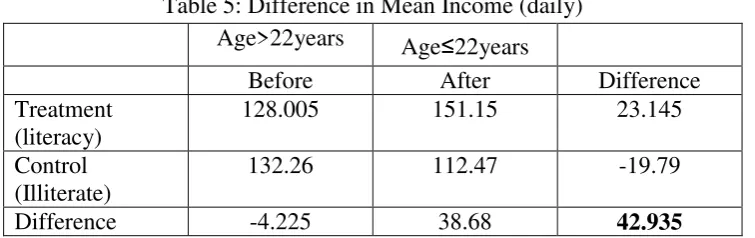
Table 5: Difference in Mean Income (daily)
Age>22years Age≤22years
Before After Difference
Treatment (literacy)
128.005 151.15 23.145
Control (Illiterate)
132.26 112.47 -19.79
Difference -4.225 38.68 42.935
Table 5 presents the mean daily income differences using DD approach. Before SSA
treatment, average income of literate and illiterate are Rs. 128.0 and Rs. 132.26, respectively.
Post SSA treatment, average income of literate and illiterate are Rs. 151.15 and Rs. 112.47,
respectively. Mean daily income of literate is Rs. 38.68 more compare to illiterate in the post
SSA period. It suggests that on an average daily income of literate people earn Rs. 38.68
more compare to illiterate in the post SSA treatment period. Average daily income of literate
people rises by Rs. 23.15 due to SSA treatment. Applying DD approach, average daily
income of literate people is higher than that of illiterate due to SSA treatment. Literate people
earn on an average daily income of Rs. 42.93 or Rs 43 more than illiterate. Literate people
earn more annually Rs 12900 to Rs. 14200 compare to illiterate and estimated additional
annual income of Bihar is nearly Rs.645 Crore. Hence, literacy has positive impact on
income level of self employed people in the small and tiny enterprise sector in urban
economy of Bihar.
This paper attempts to assess the impact of mass universal education programme such as
Sarbha Shiksha Abhijan (SSA) in Bihar. Applying difference –in difference (DD) approach,
this paper attempts to measure the returns of SSA mass education in Bihar. SSA is giving
return more than Rs. 600 per annum only from small and tiny enterprise in urban Bihar. Now,
the govt. of Bihar realises the importance of universal primary education and has taken
initiative to improve education level, and automatically Bihar economy starts to growth with
overall development.
References:
Acemoglu, D. & Angrist, J.D. (2001). How Large are Human-Capital Externalities? Evidence
from Compulsory-Schooling Laws. In B. Bernanke & K. Rogoff, NBER Macroeconomics
Annual (9-59). Cambridge: National Bureau of Economic Research.
Ashenfelter, O. Harmon, C. & Oosterbeek, H. (1999). A Review of Estimates of the
Schooling/Earnings Relationship, with Tests for Publication Bias.” Labour Economics, 6 (3),
453–470.
Becker, G.S. (1962). Investment in Human Capital: A Theoretical Analysis. The Journal of
Political Economy, 70 (5), 9–49.
Card, D. (1999). The Causal Effect of Education on Earnings. In Ashenfelter, O. and Card,
D., Handbook of Labor Economics. Rotterdam: Elsevier.
Chevalier, A. (2011). Subject Choice and Earning of UK Graduates. Economics of Education
Review, Special Issue.
Dee, T.S. (2004). Are There Civic Returns to Education?.” Journal of Public Economics 88
(9-10), 1697–1720.
de la Fuente, A. & Ciccone, A. (2003). Human Capital in a Global and Knowledge-Based
Economy. European Commission: DG Employment and Social Affairs.
Devereux, P. & Fan, W. (2011). Earnings Returns to the British Education Expansion.
Economics of Education Review, Special Issue.
Dickson, Matt R. and Sarah Smith. 2011. “What Determines the Return to Education: An
Extra Year or a Hurdle Cleared?” Economics of Education Review, Special Issue.
Dinda, S. (2015). A Note on DD Approach. MPRA Paper 63949.
Green, F. & Zhu, Y. (2010). "Overqualification, Job Dissatisfaction, and Increasing
Harmon, C.P., Oosterbeek, H. & Walker, I. (2003). The Returns to Education:
Microeconomics. Journal of Economic Surveys, 17 (2), 115–155.
Harmon, C.P., Hogan, V. & Walker, I. (2003). Dispersion in the economic return to
schooling. Labour Economics, 10 (2), 205-214.
Haveman, R.H. & Wolfe. B.L. (1984). Schooling and Economic Well-Being: The Role of
Nonmarket Effects. Journal of Human Resources, 19 (3), 377–407.
Heckman, J.J., Lochner, L. & Todd, P. (2006). Earnings Functions, Rates of Return and
Treatment Effects: The Mincer Equation and Beyond. In E. Hanushek & F.Welch,
Handbook of the Economics of Education, 307–458, Rotterdam:Elsevier.
Harmon, C. (2011). Economic Returns to Education: What we know, what we don’t know,
and where we are going – some brief pointers. IZA Policy Paper No. 29.
Heckman, J.J., Lochner, L. & Todd P. (2008). Earnings Functions and Rates of Return.
Journal of Human Capital, 2 (1), 1–31.
Heckman, J.J., Tobias, J. & Vytlacil, E. (2001). Four parameters of interest in the evaluation
of social programs. Southern Economic Journal, 68 (2), 419-442.
Heckman, J.J. & Urzua, S. (2009). Comparing IV With Structural Models: What Simple IV
Can and Cannot Identify. National Bureau of Economic Research Working Paper 14706.
Heckman, J.J. & Vytlacil, E. (2005). Structural Equations, Treatment Effects and
Econometric Policy Evaluation. Econometrica, 73 (3), 669–738.
Henderson, Daniel J., Solomon J. Polachek and Le Wang. 2011. “Heterogeneity in Schooling
Rates of Return.” Economics of Education Review, Special Issue.
Lochner, Lance. 2004. “Education, Work, and Crime: A Human Capital Approach.”
International Economic Review 45 (3): 811–843.
Melnik, A., Pollatschek, M.A. & Comay, Y. (1973). The Option Value of Education and the
Optimal Path for Investment in Human Capital. International Economic Review, 14 (2), 421–
435.
Milligan, K., Moretti, E. & Oreopoulos, P. (2004). Does education improve citizenship?
Evidence from the United States and the United Kingdom. Journal of Public Economics, 88
(9), 1667–1695.
Oreopoulos, P. (2007). Do dropouts drop out too soon? Wealth, health and happiness from
compulsory schooling. Journal of Public Economics, 91 (11-12), 2213–2229.
Oreopoulos, P. & Salvanes, K.G. (2011). Priceless: The Nonpecuniary Benefits of Schooling.
Journal of Economic Perspectives, 25 (1), 159–84.
Returns. American Economic Review, 93 (3), 948–964.
Park, S. (2011). Returning to School for Higher Returns. Economics of Education Review,
Special Issue.
Walker, I. & Zhu, Y. (2008). The College Wage Premium and the Expansion of Higher
Education in the UK. Scandinavian Journal of Economics, 110 (4), 695-709.
Walker, I. & Zhu, Y. (2011). Differences by Degree: Evidence of the Net Financial Rates of
Return to Undergraduates. Economics of Education Review, Special Issue.
Psacharopoulos, G. and Patrinos, H. (2004). Returns to investment in education: A further