Web Discourse
Ivan Habernal
∗German Institute for Educational Research and Technische Universit¨at Darmstadt
Iryna Gurevych
∗∗Technische Universit¨at Darmstadt and German Institute for Educational Research
The goal of argumentation mining, an evolving research field in computational linguistics, is to design methods capable of analyzing people’s argumentation. In this article, we go beyond the state of the art in several ways. (i) We deal with actual Web data and take up the challenges given by the variety of registers, multiple domains, and unrestricted noisy user-generated Web discourse. (ii) We bridge the gap between normative argumentation theories and argumentation phenomena encountered in actual data by adapting an argumentation model tested in an exten-sive annotation study. (iii) We create a new gold standard corpus (90k tokens in 340 documents) and experiment with several machine learning methods to identify argument components. We offer the data, source codes, and annotation guidelines to the community under free licenses. Our findings show that argumentation mining in user-generated Web discourse is a feasible but challenging task.
1. Introduction
The art ofargumentation has been studied since the early work of Aristotle, dating back to the 4th century BCE (Aristotle and Kennedy [translator] 1991). It has been exhaustively examined from different perspectives, such as philosophy, psychology,
∗Ubiquitous Knowledge Processing Lab (UKP-DIPF), German Institute for Educational Research, Schloßstraße 29, D-60486 Frankfurt am Main, Germany and Technische Universit¨at Darmstadt, Ubiquitous Knowledge Processing (UKP) Lab, TU Darmstadt - FB 20a Hochschulstrasse 10, D-64289 Darmstadt, Germany. E-mail:[email protected]
∗∗Technische Universit¨at Darmstadt, Ubiquitous Knowledge Processing (UKP) Lab, TU Darmstadt - FB 20a Hochschulstrasse 10, D-64289 Darmstadt, Germany and Ubiquitous Knowledge Processing Lab
(UKP-DIPF), German Institute for Educational Research, Schloßstraße 29, D-60486 Frankfurt am Main, Germany.
Submission received: 2 April 2015; revised version received: 20 April 2016; accepted for publication: 14 June 2016.
communication studies, cognitive science, formal and informal logic, linguistics, com-puter science, educational research, and many others. In a recent and critically well-acclaimed study, Mercier and Sperber (2011) even claim that argumentation is what drives humans to perform reasoning. From the pragmatic perspective, argumenta-tion can be seen as a verbal activity oriented towards the realization of a goal (Micheli 2011) or more in detail as a verbal, social, and rational activity aimed at convincing a reasonable critic of the acceptability of a standpoint by putting forward a constellation of one or more propositions to justify this standpoint (van Eemeren, Grootendorst, and Snoeck Henkemans 2002).
Analyzing argumentation from the computational linguistics point of view has very recently led to a new field called argumentation mining(Green et al. 2014). Despite the lack of an exact definition, researchers within this field usually focus on analyzing discourse on the pragmatics level and applying a certain argumentation theory to model and analyze textual data1at hand.
Our motivation for argumentation mining stems from a practicalinformation seek-ing perspective from the user-generated content on the Web. For example, when users search for information in user-generated Web content to facilitate their personal decision-making related to controversial topics, they lack tools to overcome the current information overload. One particular use-case example dealing with a forum post discussing private versus public schools is shown in Figure 1. Here, the lengthy text on the left-hand side is transformed into an argument gist on the right-hand side by (i) analyzing argument components and (ii) summarizing their content. Figure 2 shows another use-case example, in which users search for reasons that underpin certain standpoints in a given controversy (which ishomeschoolingin this case). In general, the output of automatic argument analysis performed on the large scale in Web data can provide users with analyzed arguments to a given topic of interest, find the evidence for the given controversial standpoint, or help to reveal flaws in argumentation of others.
Satisfying these information needs cannot be directly tackled by current meth-ods (e.g., opinion mining, question answering,2or summarization3), and requires novel approaches within the argumentation mining field. Although user-generated Web con-tent has already been considered in argumentation mining, many limitations and re-search gaps can be identified in the existing rere-search. First, the scope of the current approaches is restricted to a particular domain or register—for example, hotel reviews (Wachsmuth et al. 2014), Tweets related to local riot events (Llewellyn et al. 2014), student essays (Stab and Gurevych 2014a), airline passenger rights and consumer protection (Park and Cardie 2014), or renewable energy sources (Goudas et al. 2014). Second, not all related works are tightly connected to argumentation theories, resulting in a gap between the substantial research in argumentation itself and its adaptation in natural language processing (NLP) applications. Third, as an emerging research area, argumentation mining still suffers from a lack of labeled corpora, which is crucial for designing, training, and evaluating the algorithms. Although some works have dealt with creating new data sets, the reliability (in terms of inter-annotator agreement) of the
1 Despite few recent multi-modal approaches to process argumentation and persuasion (e.g., Brilman and Scherer 2015), the main mode of argumentation mining is natural language text.
2 These research fields are still related and complementary to argumentation mining. For example, personal decision-making queries (such asShould I homeschool my children?) might be tackled by research exploiting social question-answering sites.
Original text
The public schooling system is not as bad as some may
think. Some mentioned that those who are educated in the
public schools are less educated, well I actually think it
would be in the reverse. Student who study in the private
sector actually pay a fair amount of fees to do so and I
believe that the students actually get let off for a lot more
than anyone would in a public school. And its all because
of the money. In a private school, a student being expelled
or suspended is not just one student out the door, its the
rest of that students schooling life fees gone. Whereas in a
public school, its just the student gone. I have always gone
to public schools and when I finished I got into University. I
do not feel disadvantaged at all.
Extracted argument gist
I claim that public schools are good
be-causestudents in private schools are only source of money. I can back-up my
ar-gument: I have always gone to public
schools and when I finished I got into University. I do not feel disadvantaged at
all. On the other handsome mentioned
that those who are educated in the public schools are less educated.
Figure 1
Motivation example 1: Extracting argument gist by means of analyzing the argument structure and summarizing the argument components. Theboldphrases are generated automatically and invoke the component function; Madnani et al. (2012) refers to these organizational elements as
shells.Doc#4733, forum post, public-private schools.
Reasons for homeschooling
•Schools provide a totally unstimulating envi-ronment.
•Lesson plans (and the national curriculum) are the death of real education.
• Evidence including our own suggests strongly that this kind of education prepares children to enter further and higher education, or the workforce - and offers them the freedom to learn in the ways that suit them best.
• We teach our children how to learn, not merely how to pass tests.
Reasons against homeschooling
• Keeping your kids away from knowledge that you don’t like is a moral crime.
•Religious zealotry is no excuse for raising a kid devoid of a proper education.
•Consciously depriving a child of an adequate education solely because ”father knows best,” or thinks he does, is tantamount to child abuse.
Figure 2
Motivation example 2: Extracting evidence for a certain standpoint with respect to a given controversial topic. All statements are taken from the corpus introduced in this article.
annotated resources is often unknown (Feng and Hirst 2011; Mochales and Moens 2011; Walton 2012; Villalba and Saint-Dizier 2012; Florou et al. 2013).
So far, no fully fledged descriptive argumentation theory based on empirical research has been developed, thus the feasibility of adapting argumentation models to the Web discourse represents an open issue.
These challenges can be formulated into the following research questions:
r
Can we adapt models from argumentation theories that have been usuallylacking empirical evidence on large real-world corpora for modeling argumentation in user-generated Web content?
r
What are the desired properties of the argumentation model and is there atrade-off between model complexity and annotation reliability?
r
What phenomena are typical of argumentation on the Web, how shouldwe approach their modeling, and what challenges do they pose?
r
What is the impact of different controversial topics and are theredifferences in argumentation between various registers?
r
What computational approaches can be used to analyze arguments on theWeb?
In this article, we push the boundaries of the argumentation mining field by focus-ing on several novel aspects. We tackle these research questions as well as the previously discussed challenges and issues. First, we target user-generated Web discourse from several domains across various registers to examine how argumentation is communi-cated in different contexts. Second, we bridge the gap between argumentation theories and argumentation mining by selecting the argumentation model based on research into argumentation theories and related fields in communication studies or psychology. In particular, we adapt normative models from argumentation theory to perform em-pirical research in NLP and support our application of argumentation theories with an in-depth reliability study. Finally, we use state-of-the-art NLP techniques in order to build robust computational models for analyzing arguments that are capable of dealing with a variety of genres on the Web.4
1.1 Our Contributions
We create anew corpuswhich is, to the best of our knowledge, the largest corpus that has been annotated within the argumentation mining field to date. We choose several target domains from educational controversies, such ashomeschooling,single-sex educa-tion, andmainstreaming.5A novel aspect of the corpus is its coverage of different registers
ofuser-generated Web content, such as comments on articles, discussion forum posts,
blog posts, as well as professional newswire articles.
Because the data come from a variety of sources and no assumptions about their actual content with respect to argumentation can be drawn, we conduct two extensive
4 We used the data set and core methods from this article in our subsequent publication (Habernal and Gurevych 2015). The main difference is that this article focuses mainly on corpus annotation, analysis, and argumentation on Web data in general, whereas in Habernal and Gurevych (2015) we explored whether methods for recognizing argument components benefit from using semi-supervised features obtained from noisy debate portals.
annotation studies. In the first study, we tackle the problem of relatively high “noise” in the retrieved data. In particular, not all of the documents are related to the given topics in a way that makes them candidates for further deep analysis of argumentation (this study results into 990 annotated documents). In the second study, we discuss the selection of an appropriate argumentation model based on evidence in argumentation research and propose a model that is suitable for analyzing micro-level argumentation in user-generated Web content. Using this model, we annotate 340 documents (approx. 90,000 tokens), reaching substantial inter-annotator agreement. We provide a hand analysis of all the phenomena typical to argumentation that are prevalent in our data. These findings may also serve as empirical evidence to issues that are at the forefront of current argumentation research.
From the computational perspective, we experiment on the annotated data using various machine learning methods in order to extract argument structure from doc-uments. We propose several novel feature sets and identify configurations that run best in in-domain and cross-domain scenarios. To foster research in the community, we provide the annotated data as well as all the experimental software under free license.6
The rest of the article is structured as follows. First, we provide an essential background in argumentation theory in Section 2. Section 3 surveys related work in several areas. Then we introduce the data set and two annotation studies in Section 4. Section 5 presents our experimental work and discusses the results and errors, and Section 6 concludes this article.
2. Theoretical Background
Let us first present some definitions of the termargumentationitself. Ketcham (1917, page 3) defines argumentation asthe art of persuading others to think or act in a definite way. It includes all writing and speaking which is persuasive in form.According to MacEwan (1898), argumentation is the process of proving or disproving a proposition. Its purpose is to induce a new belief, to establish truth or combat error in the mind of another. Freeley and Steinberg (2008, page 2) narrow the scope of argumentation toreason giving in communicative situations by people whose purpose is the justification of acts, beliefs, attitudes, and values.Although these definitions vary, the purpose of argumentation remains the same—to persuade others.
We would like to stress that our perception of argumentation goes beyond somehow limitedgiving reasons(Freeley and Steinberg 2008; Damer 2013). Rather, we see the goal of argumentation as to persuade (Ketcham 1917; Mercier and Sperber 2011; Nettel and Roque 2011).Persuasion can be defined as a successful intentional effort at influencing another’s mental state through communication in a circumstance in which the persuadee has some measure of freedom (O’Keefe 2002, page 5); although, as O’Keefe (2011) points out, there is no correct or universally endorsed definition of either “persuasion” or “argumentation.” However, broader understanding of argumentation as a means of persuasion allows us to take into account not only reasoned discourse but also non-reasoned mechanisms of influence, such as emotional appeals (Blair 2011).
Having an argumentas a product within the argumentation process, we should now define it. One typical definition is that an argument is a claim supported by rea-sons (Schiappa and Nordin 2013, page 6). The term claim has been used since the 1950’s, introduced by Toulmin (1958)—and in argumentation theory it is a synonym for
standpointorpoint of view. It refers to what is at issue in the sense of what is being argued about. The presence of a standpoint is thus crucial for argumentation analysis. However, the claim as well as other parts of the argument might be implicit; this is known as
enthymematic argumentation, which is rather usual in ordinary argumentative
discourse (Amossy 2009).
One fundamental problem with the definition and formal description of arguments and argumentation is that there is no agreement even among argumentation theorists. As van Eemeren et al. (2014, page 29) admit in their very recent and exhaustive survey of the field, ”as yet, there is no unitary theory of argumentation that encompasses the logi-cal, dialectilogi-cal, and rhetorical dimensions of argumentation and is universally accepted. The current state of the art in argumentation theory is characterized by the coexistence of a variety of theoretical perspectives and approaches, which differ considerably from each other in conceptualization, scope, and theoretical refinement.”
2.1 Argumentation Models
Despite the missing consensus on the ultimate argumentation theory, various argu-mentation models have been proposed that capture arguargu-mentation on different levels. Argumentation models abstract from the language level to a concept level that stresses the links between the different components of an argument or how arguments relate to each other (Prakken and Vreeswijk 2002). Bentahar, Moulin, and B´elanger (2010) propose a taxonomy of argumentation models that is horizontally divided into three categories:micro-levelmodels,macro-levelmodels, andrhetoricalmodels.
In this article, we deal with argumentation on themicro-level(also called argumen-tation as a product or monological models). Micro-level argumenargumen-tation focuses on the structure of a single argument. By contrast, macro-levelmodels (also called dialogical models) and rhetoricalmodels highlight the process of argumentation in a dialogue (Bentahar, Moulin, and B´elanger 2010, page 215). In other words, we examine the structure of a single argument produced by a single author in terms of its components, not the relations that can exist among arguments and their authors in time. A detailed discussion of these different perspectives can be found in Blair (2004), Johnson (2000), Reed and Walton (2003), Micheli (2011), O’Keefe (1982), and Rapanta, Garcia-Mila, and Gilabert (2013).7
2.2 Dimensions of Argument
The models mentioned here focus basically only on one dimension of the argument, namely, the logos dimension. According to the classical Aristotelian theory (Aristo-tle and Kennedy [translator] 1991), argument can exist in three dimensions, which are logos, pathos, and ethos. The logosdimension represents a proof by reason, an attempt to persuade by establishing a logical argument. For example, syllogism be-longs to this argumentation dimension (Amossy 2009; Rapp and Wagner 2012). The
pathosdimension makes use of appealing to emotions of the receiver and impacts its
cognition (Micheli 2008). Theethosdimension of argument relies on the credibility of the arguer. This distinction will have practical impact later in Section 4.4, which deals with argumentation on the Web.
2.3 Original Toulmin Model
We conclude the theoretical section by presenting one (micro-level) argumentation model in detail: a widely used conceptual model of argumentation introduced by Toulmin (1958), which we will henceforth denote asToulmin original model.8 This model will play an important role later in the annotation studies (Section 4.4) and experimental work (Section 5.1). The model consists of six parts, referred to asargument components, where each component plays a distinct role.
Claim is an assertion put forward publicly for general acceptance (Toulmin, Rieke, and Janik 1984, page 29) or the conclusion we seek to establish by our arguments (Freeley and Steinberg 2008, page 153).
Data (Grounds) This is the evidence to establish the foundation of the claim (Schiappa and Nordin 2013) or, as simply put by Toulmin, “the data represent what we have to go on” (Toulmin 2003, page 90). The name of this concept was later changed to groundsin Toulmin, Rieke, and Janik (1984).
Warrant The role ofwarrantis to justify a logical inference from thegroundsto theclaim.
Backing is a set of information that stands behind the warrant. It assures its trust-worthiness.
Qualifier limits the degree of certainty under which the argument should be accepted.
It is the degree of force that thegroundsconfer on theclaimin virtue of thewarrant (Toulmin 2003, page 93).
Rebuttal presents a situation in which theclaimmight be defeated.
A schema of Toulmin’s original model is shown in Figure 3. The lines and arrows symbolize implicit relations between the components. An example of an argument rendered using Toulmin’s scheme can be seen in Figure 4.
We believe that this theoretical overview should provide sufficient background for the argumentation mining research covered in this article; for further references, we recommend, for example, van Eemeren et al. (2014).
3. Related Work in Computational Linguistics
We structure the related work into three sub-categories, namely,argumentation mining, stance detection, and persuasion and on-line dialogs, as these areas are closest to this article’s focus. For a recent overview of general discourse analysis see (Webber, Egg, and Kordoni 2012). Apart from these, research on computer-supported argumentation has been also very active; see, for example, Scheuer et al. (2010) for a survey of various models and argumentation formalisms from the educational perspective or Schneider, Groza, and Passant (2013), who examine argumentation in the Semantic Web.
Claim Data
Backing
So
Since
Warrant
Rebuttal Qualifier
Unless
[image:8.486.51.241.62.128.2]On account of
Figure 3
Original Toulmin’s model of argument.
[Harry was born in Bermuda.]Data Since[A man born in Bermuda will generally be a British subject.]WarrantOn account of[The following statuses and other legal provisions: (...)]Backing So,[presumably]QualifierUnless[Both his parents were aliens]Rebuttal[Harry is a British subject.]Claim
Figure 4
Example of an argument using Toulmin’s model (Toulmin 2003).
3.1 Argumentation Mining
The argumentation mining field has been evolving very rapidly in recent years, re-sulting in several workshops co-located with major NLP conferences. We first present related work with a focus on annotations and then review experiments with classifying argument components, schemes, or relations.
3.1.1 Annotation Studies.One of the first papers dealing with annotating argumentative discourse was Argumentative Zoning for scientific publications (Teufel, Carletta, and Moens 1999). Later, Teufel, Siddharthan, and Batchelor (2009) extended the original seven categories to 15 and annotated 39 articles from two domains, where each sentence is assigned a category. The obtained Fleiss’κwere 0.71 and 0.65. In their approach, they tried to deliberately ignore the domain knowledge and rely only on general, rhetorical, and logical aspects of the annotated texts. In contrast to our work, argumentative zoning is specific to scientific publications and has been developed solely for that task.
Reed and Rowe (2004) presentedAraucaria, a tool for argumentation diagramming that supports both convergent and linked arguments, missing premises (enthymemes), and refutations. They also released theAracuariaDBcorpus, which has later been used for experiments in the argumentation mining field. However, the creation of the data set in terms of annotation guidelines and reliability is not reported—these limitations, as well as its rather small size, have been noted (Feng and Hirst 2011).
Biran and Rambow (2011) identified justifications for subjective claims in blog threads and Wikipedia talk pages. The data were annotated, with claims and their justifications reaching κ=0.69, but a detailed description of the annotation approach was missing.
Schneider et al. (2013) annotated Wikipedia talk pages about deletion using 17 Walton’s schemes (Walton 2007), reaching a moderate agreement (Cohen’s κ=0.48) and concluded that their analysis technique can be reused, although “it is intensive and difficult to apply.”
reached Krippendorff’sαU=0.72 for argument components and Krippendorff’sα= 0.81 for relations between components.
Rosenthal and McKeown (2012) annotated sentences that are opinionated claims, in which the author expresses a belief that should be adopted by others. Two anno-tators labeled sentences as claims without any context and achieved Cohen’sκ=0.50 (2,000 sentences from LiveJournal) and 0.56 (2,000 sentences from Wikipedia).
Aharoni et al. (2014) performed an annotation study in order to find context-dependent claims and three types of context-context-dependent evidence in Wikipedia that were related to 33 controversial topics. The claim and evidence were annotated in 104 articles. The average Cohen’sκbetween a group of 20 expert annotators was 0.40. Compared with our work, the linguistic properties of Wikipedia are qualitatively differ-ent from other user-generated contdiffer-ent, such as blogs or user commdiffer-ents (Ferschke 2014). Wacholder et al. (2014) annotated “argument discourse units” in blog posts and criticized the Krippendorff’sαU measure. They proposed a new inter-annotator metric by taking the most overlapping part of one annotation as the “core” and all annotations as a “cluster.” The data were extended by Ghosh et al. (2014), who annotated “targets” and “callouts” on the top of the units.
Park and Cardie (2014) annotated about 10k sentences from 1,047 documents into four types of argument propositions with Cohen’sκ=0.73 on 30% of the data set. Only 7% of the sentences were found to be non-argumentative.
Faulkner (2014) used Amazon Mechanical Turk to annotate 8,179 sentences from student essays. Three annotators decided whether the given sentence offered reasons for or against the main prompt of the essay (or no reason at all; 66% of the sentences were found to be neutral and easy to identify). The achieved Cohen’sκwas 0.70.
The research has also been active on non-English data sets. Goudas et al. (2014) focused on user-generated Greek texts. They selected 204 documents and manually annotated sentences that contained an argument (760 out of 16,000). They distinguished claims and premises, but the claims were always implicit. However, the annotation agreement was not reported; neither was the number of annotators or the guidelines. A study on annotation of arguments was conducted by Peldszus and Stede (2013b), who evaluate agreement among 26 “naive” annotators (annotators with very little training). They manually constructed 23 German short texts, each of them containing exactly one central claim, two premises, and one objection (rebuttal or undercut), and analyzed annotator agreement on this artificial data set. Peldszus (2014) later achieved higher inter-rater agreement with expert annotators on an extended version of the same data. Kluge (2014b) built a corpus of argumentative German Web documents, con-taining 79 documents from seven educational topics, which were annotated by three annotators according to the claim-premise argumentation model. The corpus comprises 70,000 tokens and the inter-annotator agreement was 0.40 (Krippendorff’sαU). Houy et al. (2013) targeted argumentation mining of German legal cases.
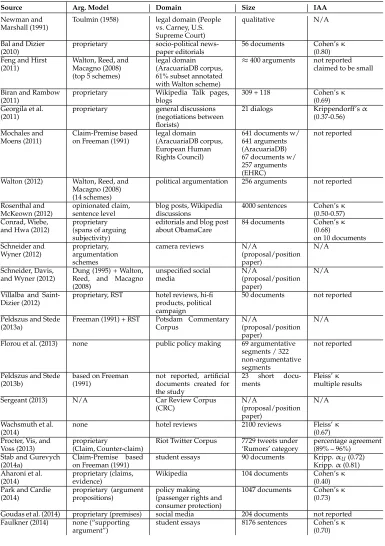
Table 1 gives an overview of annotation studies with their respective argumentation model, domain, size, and agreement. It also contains other studies outside of computa-tional linguistics and a few proposals and position papers.
Table 1
Previous works on annotating argumentation. IAA = Inter-annotator agreement; N/A = not applicable.
Source Arg. Model Domain Size IAA
Newman and Marshall (1991)
Toulmin (1958) legal domain (People vs. Carney, U.S. Supreme Court)
qualitative N/A
Bal and Dizier (2010)
proprietary socio-political news-paper editorials
56 documents Cohen’sκ (0.80) Feng and Hirst
(2011)
Walton, Reed, and Macagno (2008) (top 5 schemes)
legal domain (AracuariaDB corpus, 61% subset annotated with Walton scheme)
≈400 arguments not reported claimed to be small
Biran and Rambow (2011)
proprietary Wikipedia Talk pages, blogs
309 + 118 Cohen’sκ (0.69) Georgila et al.
(2011)
proprietary general discussions (negotiations between florists)
21 dialogs Krippendorff’sα (0.37-0.56)
Mochales and Moens (2011)
Claim-Premise based on Freeman (1991)
legal domain (AracuariaDB corpus, European Human Rights Council)
641 documents w/ 641 arguments (AracuariaDB) 67 documents w/ 257 arguments (EHRC)
not reported
Walton (2012) Walton, Reed, and Macagno (2008) (14 schemes)
political argumentation 256 arguments not reported
Rosenthal and McKeown (2012)
opinionated claim, sentence level
blog posts, Wikipedia discussions
4000 sentences Cohen’sκ (0.50-0.57) Conrad, Wiebe,
and Hwa (2012)
proprietary (spans of arguing subjectivity)
editorials and blog post about ObamaCare
84 documents Cohen’sκ (0.68)
on 10 documents Schneider and
Wyner (2012)
proprietary, argumentation schemes
camera reviews N/A
(proposal/position paper)
N/A
Schneider, Davis, and Wyner (2012)
Dung (1995) + Walton, Reed, and Macagno (2008) unspecified social media N/A (proposal/position paper) N/A
Villalba and Saint-Dizier (2012)
proprietary, RST hotel reviews, hi-fi products, political campaign
50 documents not reported
Peldszus and Stede (2013a)
Freeman (1991) + RST Potsdam Commentary Corpus
N/A
(proposal/position paper)
N/A
Florou et al. (2013) none public policy making 69 argumentative segments / 322 non-argumentative segments
not reported
Peldszus and Stede (2013b)
based on Freeman (1991)
not reported, artificial documents created for the study
23 short docu-ments
Fleiss’κ multiple results
Sergeant (2013) N/A Car Review Corpus (CRC)
N/A
(proposal/position paper)
N/A
Wachsmuth et al. (2014)
none hotel reviews 2100 reviews Fleiss’κ (0.67) Procter, Vis, and
Voss (2013)
proprietary
(Claim, Counter-claim)
Riot Twitter Corpus 7729 tweets under ‘Rumors’ category
percentage agreement (89% – 96%) Stab and Gurevych
(2014a)
Claim-Premise based on Freeman (1991)
student essays 90 documents Kripp.αU(0.72) Kripp.α(0.81) Aharoni et al.
(2014)
proprietary (claims, evidence)
Wikipedia 104 documents Cohen’sκ (0.40) Park and Cardie
(2014)
proprietary (argument propositions)
policy making (passenger rights and consumer protection)
1047 documents Cohen’sκ (0.73)
Goudas et al. (2014) proprietary (premises) social media 204 documents not reported Faulkner (2014) none (“supporting
argument”)
for classifying whether a sentence belongs to an argumentative element or not, using the same corpus.
Stab and Gurevych (2014b) classified sentences to four categories (none, major claim, claim, premise) using their previously annotated corpus (Stab and Gurevych 2014a) and reached a 0.72 macro-F1 score. In contrast to our work, their documents are expected to comply with a certain structure of argumentative essays and are assumed to always contain argumentation.
Biran and Rambow (2011) identified justifications on the sentence level using a naive Bayes classifier over a feature set based on statistics from the RST Treebank, namely,n-grams that were manually processed by deleting n-grams that “seemed ir-relevant, ambiguous or domain-specific.”
Llewellyn et al. (2014) experimented with classifying tweets into several argumen-tative categories, namely, claims and counter-claims (with and without evidence) and verification inquiries previously annotated by Procter, Vis, and Voss (2013). They used unigrams, punctuation, and POS as features in three classifiers.
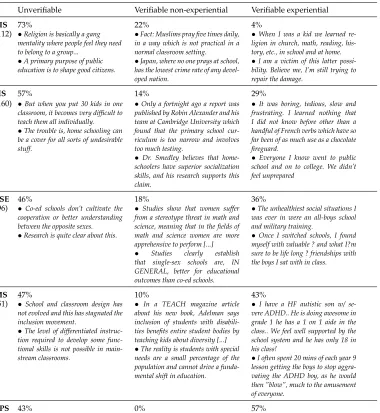
Park and Cardie (2014) classified propositions into three classes (unverifi-able, verifiable experimental, and verifiable experimental) and ignored non-argumentative texts. Using multi-class support vector machine (SVM) and a wide range of features (n-grams, POS, sentiment clue words, tense, person) they achieved MacroF1=0.69.
Peldszus (2014) experimented with a rather complex labeling schema of argu-ment segargu-ments, but the data were artificially created for the task and manually cleaned (such as removing segments that did not meet the criteria or non-argumentative segments).
In the first step of their two-phase approach, Goudas et al. (2014) sampled the data set to be balanced and identified argumentative sentences withF1=0.77, using the maximum entropy classifier. For identifying premises, they used BIO encoding of tokens and achieved anF1score of 0.42 using conditional random fields (CRFs).
Saint-Dizier (2012) developed a Prolog engine using a lexicon of 1,300 words and a set of 78 hand-crafted rules with the focus on a particular argument structure, “reasons supporting conclusions,” in French.
Taking the dialogical perspective, Cabrio and Villata (2012) built upon an argumen-tation framework proposed by Dung (1995), which models arguments within a graph structure and provides a reasoning mechanism for resolving accepted arguments. For identifying support and attack, they relied on existing research on textual entailment (Dagan et al. 2009), namely, using the off-the-shelfEDITSsystem. The test data were taken from a debate portalDebatepediaand covered 19 topics. Evaluation was performed in terms of measuring the acceptance of the “main argument” using the automatically recognized entailments, yielding anF1 score of about 0.75. In contrast to our work, which deals with micro-level argumentation, Dung’s model is an abstract framework intended to model dialogical argumentation.
3.2 Stance Detection
Research related to argumentation mining also involvesstance detection. In this case, the whole document (discussion post, article) is assumed to represent the writer’s standpoint on the discussed topic. Because the topic is stated as a controversial question, the author is eitherfororagainstit.
Somasundaran and Wiebe (2009) built a computational model for recognizing stances in dual-topic debates about named entities in the electronic products domain by combining preferences learned from the Web data and discourse markers from PDTB (Prasad et al. 2008). Hasan and Ng (2013) determined stance in online ideological debates on four topics using data from createdebate.com, utilizing supervised machine learning and features ranging from n-grams to semantic frames. Predicting stance of posts in Debatepedia as well as external articles using a probabilistic graphical model was presented in Gottipati et al. (2013). This approach also used sentiment lexicons and Named Entity Recognition as a preprocessing step and achieved accuracy about 0.80 in binary prediction of stances in debate posts.
Recent research has involved joint modeling, taking into account information about the users, the dialog sequences, and others. Hasan and Ng (2012) proposed a machine learning approach to debate stance classification by leveraging contextual information and author’s stances towards the topic. Qiu, Yang, and Jiang (2013) introduced a computational debate side model to cluster posts or users by sides for general threaded discussions using a generative graphical model utilizing words from various subjec-tivity lexicons as well as all adjectives and adverbs in the posts. Qiu and Jiang (2013) proposed a graphical model for viewpoint discovery in discussion threads. Burfoot, Bird, and Baldwin (2011) exploited the informal citation structure in U.S. Congressional floor-debate transcripts and used a collective classification, which outperforms methods that consider documents in isolation.
Some works also utilize argumentation-motivated features. Park, Lee, and Song (2011) dealt with contentious issues in Korean newswire discourse. Although they annotate the documents with “argument frames,” the formalism remains unexplained and does not refer to any existing research in argumentation. Walker et al. (2012) incorporated features with some limited aspects of the argument structure, such as cue words signaling rhetorical relations between posts, POS generalized dependencies, and a representation of the parent post (context) to improve stance classification over 14 topics from convinceme.net.
3.3 Online Persuasion
Another stream of research has been devoted to persuasion in online media, which we consider as a more general research topic than argumentation.
to link statements in arguments and found out that 4- and 5-year-olds and adults are sensitive to the connectives. Le (2004) presented a study of persuasive texts and argumentation in newspaper editorials in French.
A coarse-grained view on dialogs in social media was examined by Bracewell, Tomlinson, and Wang (2013), who proposed a set of 15 social acts (such as agreement, disagreement, or supportive behavior) to infer the social goals of dialog participants and presented a semi-supervised model for their classification. Their social act types were inspired by research in psychology and organizational behavior and were motivated by work in dialog understanding. They annotated a corpus in three languages using in-house annotators and achievedκin the range from 0.13 to 0.53.
Georgila et al. (2011) focused on cross-cultural aspects of persuasion or argumenta-tion dialogs. They developed a novel annotaargumenta-tion scheme stemming from different liter-ature sources on negotiation and argumentation as well as from their original analysis of the phenomena. The annotation scheme is claimed to cover three dimensions of an utterance, namely, speech act, topic, and response or reference to a previous utterance. They annotated 21 dialogs and reached Krippendorff’sαbetween 0.38 and 0.57.
Summary of Related Work Section.Given the broad landscape of various approaches to argument analysis and persuasion studies presented in this section, we would like to stress some novel aspects of the current article. First, we aim to adapt a model of argument based on research by argumentation scholars, both theoretical and empirical. We pose several pragmatical constraints, such as register independence (generalization over several registers). Second, our emphasis is on reliable annotations and sufficient data size (about 90k tokens). Third, we deal with fairly unrestricted Web-based sources, so additional steps of distinguishing whether the texts are argumentative are required. Argumentation mining has been a rapidly evolving field with several major venues in 2015. We encourage readers to consult an upcoming survey article by Lippi and Torroni (2016) or the proceedings of the Second Argumentation Mining workshop (Cardie 2015) to keep up with recent developments. However, to the best of our knowledge, the main findings of this article have not yet been made obsolete by any related work.
4. Annotation Studies and Corpus Creation
This section describes the process of data selection, annotation, curation, and evaluation with the goal of creating a new corpus suitable for argumentation mining research in the area of computational linguistics. As argumentation mining is an evolving disci-pline without established and widely accepted annotation schemes, procedures, and evaluation, we want to keep this overview detailed to ensure full reproducibility of our approach. Given the wide range of perspectives on argumentation itself (van Eemeren et al. 2014), variety of argumentation models (Bentahar, Moulin, and B´elanger 2010), and high costs of discourse or pragmatic annotations (Prasad et al. 2008), creating a new, reliable corpus for argumentation mining represents a substantial effort.
4.1 Topics and Registers
As a main field of interest in the current study, we chose controversies in education. One distinguishing feature of educational topics is their breadth of sub-topics and points of view, as they attract researchers, practitioners, parents, students, and policy-makers. We assume that this diversity leads to the linguistic variability of the educa-tion topics and thus represents a challenge for NLP. In cooperaeduca-tion with researchers from the German Institute for International Educational Research,9 we identified the following current controversial topics in education in English-speaking countries: (1) homeschooling; (2) public versus private schools; (3) redshirting—intentionally delaying the entry of an age-eligible child into kindergarten, allowing their child more time to mature emotionally and physically (Huang and Invernizzi 2013); (4)prayer in
schools—whether prayer in schools should be allowed and taken as a part of
edu-cation or banned completely; (5) single-sex education—single-sex classes (boys and girls separate) versus mixed-sex classes (“co-ed”); and (6) mainstreaming—including children with special needs into regular classes.
Because we were also interested in whether argumentation differs across registers,10 we included four different registers, namely, (1) user commentsto newswire articles or to blog posts; (2) posts in discussion forums (forum posts); (3) blog posts; and (4) newswirearticles.11 Throughout this work, we will refer to each article, blog post, comment, or forum posts as adocument. This variety of sources covers mainly user-generated content except newswire articles, which are written by professionals and undergo an editing procedure by the publisher. Because many publishers also host blog-like sections on their portals, we consider as blog posts all content that is hosted on personal blogs or clearly belong to a blog category within a newswire portal.
4.2 Raw Corpus Statistics
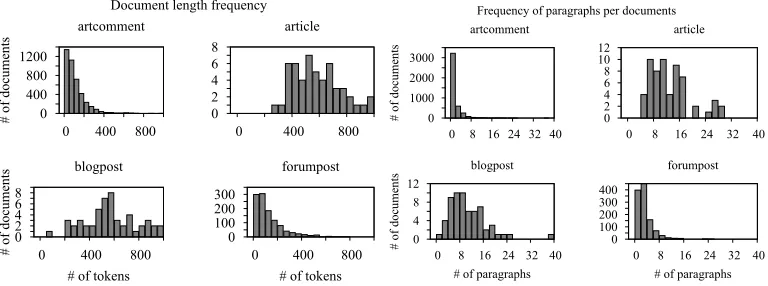
Given the six controversial topics and four different registers, we compiled a collection of plain-text documents, which we call the raw corpus. It contains 694,110 tokens in 5,444 documents. As a coarse-grained analysis of the data, we examined the lengths and the number of paragraphs (see Figure 5). Comments and forum posts follow a similar distribution, being shorter than 300 tokens on average. By contrast, articles and blogs are longer than 400 tokens and have 9.2 paragraphs on average. The process of compiling the raw corpus and its further statistics are described in detail in Appendix A.
4.3 Annotation Study 1: Identifying Persuasive Documents in Forums and Comments
The goal of this study was to select documents suitable for a fine-grained analysis of arguments. In a preliminary study on annotating argumentation using a small
9http://www.dipf.de.
10 The distinction between registers is based on the situational context and the functional characteristics (Biber and Conrad 2009, page 6).
Document length frequency
0 400 800 1200
0 400 800
# of documents
artcomment 0 2 4 6 8
0 400 800
article 0 2 4 6 8
0 400 800
# of documents
# of tokens blogpost
0 100 200 300
0 400 800
# of tokens forumpost
Frequency of paragraphs per documents
0 1000 2000 3000
0 8 16 24 32 40
# of documents
artcomment 0 2 4 6 8 10 12
0 8 16 24 32 40
article
0 4 8 12
0 8 16 24 32 40
# of documents
# of paragraphs blogpost 0 100 200 300 400
0 8 16 24 32 40
[image:15.486.54.438.64.207.2]# of paragraphs forumpost
Figure 5
Number of documents with a certain number of tokens (left) and paragraphs (right) in the
raw corpus.
sample (50 random documents) of forum posts and comments from the raw corpus, we found that many documents convey no argumentation at all, even in discussions about controversies. We observed that such contributions do not intend to persuade; these documents typically contain story-sharing, personal worries, user interaction (asking questions, expressing agreement), off-topic comments, and others. Such characteristics are typical of online discussions in general, but they have not been examined with respect to argumentation or persuasion. Indeed, we observed that there are (1) docu-ments that are completely unrelated and (2) docudocu-ments that are related to the topic, but do not contain any argumentation. This issue has been identified among argumentation theorists—for example, asexternal relevanceby Paglieri and Castelfranchi (2014). Similar findings were also confirmed in related literature in argumentation mining, although never tackled empirically (Garcia-Villalba and Saint-Dizier 2014; Park and Cardie 2014). These documents are thus not suitable for analyzing argumentation.
In order to filter documents that are suitable for argumentation annotation, we defined a binary document-level classification task. The distinction is made between either persuasive documents or non-persuasive (which includes all other sorts of texts, such as off-topic, story sharing, unrelated dialog acts, etc.).
4.3.1 Annotation Study.The two annotated categories wereon-topic persuasiveand non-persuasive.12 Three annotators with near-native English proficiency annotated a set of 990 documents (a random subset of comments and forum posts) reaching a Fleiss’κ of 0.59. The final label was selected by majority voting. The annotation study took an average of 15 hours per annotator, with approximately 55 annotated documents per hour. The resulting labels were derived by majority voting. Out of 990 documents, 524 (53%) were labeled as on-topic persuasive. We will refer to this corpus asgold data persuasive.
Sources of Disagreement.We examined all disagreements between annotators and dis-covered some typical problems, such as implicitness or topic relevance. First, the
authors often express their stance towards the topicimplicitly, so it must be inferred by the reader. To do so, certain common-ground knowledge is required. However, such knowledge heavily depends on many aspects, such as the reader’s familiarity with the topic or her cultural background, as well as the context of the source Web site or the discussion forum thread. This also applies for sarcasm and irony. Second, the decision whether a particular topic ispersuasivewas always made with respect to the controversial topic under examination. Some authorsshift the focusto a particular aspect of the given controversy or a related issue, making the document less relevant.
4.3.2 Discussion.We achieved moderate13 agreement between the annotators, although the definition of persuasiveness annotation might seem a bit fuzzy.14 We found dif-ferent amounts of persuasion in the specific topics. For instance, prayer in schools or private vs. public schoolsattract persuasive discourse, while other discussed controversies often contain non-persuasive discussions (represented by redshirting and mainstream-ing). Although these two topics are also highly controversial, the participants of online discussions seem to not attempt to persuade but they rather exchange in-formation, support others in their decisions, and so forth. This was also con-firmed by socio-psychological researchers. Ammari, Morris, and Schoenebeck (2014) show that parents of children with special needs rely on discussion sites for ac-cessing information and social support and that, in particular, posts containing humor, achievement, or treatment suggestions are perceived to be more socially appropriate than posts containing judgment, violence, or social comparisons. According to Nicholson and Leask (2012), in the online forum, parents of autistic children were seen to understand the issue because they had lived it. Assuming that participants in discussions related to young children (e.g., redshirting or mainstream-ing) are usually women (mothers), gender can also play a role. In a study of on-line persuasion, Guadagno and Cialdini (2002) conclude that women chose to bond rather than compete (women feel more comfortable cooperating, even in a compet-itive environment), whereas men are motivated to compete if necessary to achieve independence.
4.4 Annotation Study 2: Annotating Micro-structure of Arguments
The goal of this study was to annotate documents on a detailed level with respect to an argumentation model. First, we will present the annotation scheme. Second, we will
13 Following the terminology proposed by Landis and Koch (1977, page 165), although they claim that the divisions are clearly arbitrary.For a detailed discussion on interpretation of agreement values, see for example Artstein and Poesio (2008).
describe the annotation process. Finally, we will evaluate the agreement and draw some conclusions.
4.4.1 Argumentation Model Selection.Given the theoretical background briefly introduced in Section 2, we motivate our selection of the argumentation model with the following requirements. First, the scope of this work is to capture argumentation within a single document, thus focusing on micro-level models. Second, there should exist empirical evidence that such a model has been used for analyzing argumentation in previous works, so it is likely to be suitable for our purpose of argumentative discourse analysis in user-generated content. Regarding the first requirement, two typical examples of micro-level models are Toulmin’s model(Toulmin 1958) and Walton’s schemes (Walton, Reed, and Macagno 2008). Let us now elaborate on the second requirement.
Walton’s Schemes.Walton’s argumentation schemes are claimed to be general and do-main independent. Nevertheless, evidence from the computational linguistics field shows that the schemes lack coverage for analyzing real argumentation in natural language texts. In examining real-world political argumentation from Walton (2005), Walton (2012) found that 37.1% of the arguments collected did not fit any of the 14 schemes he had chosen so he created new schemes ad hoc. Cabrio, Tonelli, and Villata (2013) selected five argumentation schemes from Walton and mapped these patterns to discourse relation categories in the Penn Discourse TreeBank (PDTB) (Prasad et al. 2008), but later they had to define two new argumentation schemes that they discovered in PDTB. Similarly, Ong, Litman, and Brusilovsky (2014) admitted that the schemes are ambiguous and hard to directly apply for annotation, therefore they modified the schemes and created new ones that matched the data.
Although Macagno and Konstantinidou (2012) show several examples of two ar-gumentation schemes applied to a few selected arguments in classroom experiments, empirical evidence presented by Anthony and Kim (2014) reveals many practical and theoretical difficulties of annotating dialogues with schemes in classroom deliberation, providing many details on the arbitrary selection of the subset of the schemes and the ambiguity of the scheme definitions, concluding that the presence of the authors during the experiment was essential for inferring and identifying the argument schemes (Anthony and Kim 2014, page 93).
Toulmin Model.Although this model (refer to Section 2.3) was designed to be applicable to real-life argumentation, there are numerous studies criticizing both the clarity of the model definition and the differentiation between elements of the model. Ball (1994) claims that the model can be used only for the most simple arguments and fails on the complex ones. Additionally, Freeman (1991) and other argumentation theorists criticize the usefulness of Toulmin’s framework for the description of real-life argumentative texts. However, others have advocated the model and claimed that it can be applied to the people’s ordinary argumentation (Simosi 2003; Dunn 2011).
build on a simplified Toulmin model for scripted construction of arguments in computer-supported collaborative learning. Garcia-Mila et al. (2013) coded utterances into categories from Toulmin’s model in persuasion and consensus-reaching among stu-dents. Weinberger and Fischer (2006) analyze asynchronous discussion boards in which learners engage in an argumentative discourse with the goal of acquiring knowledge. For coding the argument dimension, they created a set of argumentative moves based on Toulmin’s model. Given this empirical evidence, we decided to build upon Toulmin’s model.
4.4.2 Adaptation of Toulmin’s Model of Argumentation in User-generated Web Discourse.In this annotation task, a sequence of tokens (e.g., a phrase, a sentence, or any arbitrary text span) is labeled with a corresponding argument component (such as theclaim, the grounds, and others). There are no explicit relations between these annotation spans as the relations are implicitly encoded in the pragmatic function of the components in Toulmin’s model.
In order to prove the suitability of Toulmin’s model, we analyzed 40 random documents from thegold data persuasivedata set using the original Toulmin model as presented in Section 2.3.15 We took into account several criteria for assessment, such as frequency of occurrence of the components or their importance for the task. We proposed some modifications of the model based on the following observations.
No Qualifier.Authors do not state the degree of cogency (the probability of theirclaim, as proposed by Toulmin). Thus we omittedqualifierfrom the model because of its absence in the data.
No Warrant.Thewarrantas a logical explanation why one should accept the claim given the evidence is almost never stated. As pointed out by Toulmin (2003, page 92), “data are appealed to explicitly, warrants implicitly.” This observation has also been made by Voss (2006). Also, according to van Eemeren, Grootendorst, and Kruiger (1987, page 205), the distinction of warrant is perfectly clear only in Toulmin’s examples, but the definitions fail in practice. We omittedwarrantfrom the model.
Attacking the Rebuttal.Rebuttalis a statement that attacks theclaim, thus playing a role of an opposing view. In reality, the authors often attack the presented rebuttals by another counter-rebuttal in order to keep the whole argument’s position consistent. Thus we introduced a new component—refutation—which is used for attacking the rebuttal. Annotation ofrefutationwas conditioned by the explicit presence ofrebuttaland enforced by the annotation guidelines. The chainrebuttal–refutationis also known as the
procatalepsisfigure in rhetoric, in which the speaker raises an objection to his own ar-gument and then immediately answers it. By doing so, the speaker hopes to strengthen the argument by dealing with possible counter-arguments before the audience can raise them (Walton 2007, page 106).
Implicit Claim.The claim of the argument should always reflect the main standpoint with respect to the discussed controversy. We observed that this standpoint is not always
explicitly expressed, but remains implicit and must be inferred by the reader. Therefore, we allow the claim to be implicit. In such a case, the annotators must explicitly write down the (inferred) stance of the author.
Multiple Arguments in One Document. By definition, Toulmin’s model is intended to model a single argument, with theclaimin its center. However, we observed in our data that some authors elaborate on both sides of the controversy equally and put forward an argument for each side (byargumenthere we mean theclaimand itspremises,backings, etc.). Therefore we allow multiple arguments to be annotated in one document. At the same time, we restrained the annotators from creating complex argument hierarchies.
Terminology.Toulmin’sgroundshave an equivalent role to apremisein the classical view of an argument (Reed and Rowe 2006; van Eemeren et al. 2014) in terms that they offer the reasons why one should accept the standpoint expressed by the claim. As this terminology has been used in several related works in the argumentation mining field (Mochales and Moens 2011; Peldszus and Stede 2013b; Ghosh et al. 2014; Stab and Gurevych 2014a), we will keep this convention and denote thegroundsaspremises.
The Role of Backing.One of the main critiques of the original Toulmin model was the vague distinction betweengrounds,warrant, andbacking(Freeman 1991; Newman and Marshall 1991; Hitchcock 2003). The role ofbackingis to give additional support to the warrant, but there is nowarrantin our model anymore. However, what we observed during the analysis was the presence of someadditional evidence. Such evidence does not play the role of thegrounds(premises) as it is not meant as a reason supporting the claim, but it also does not explain the reasoning, thus is not awarranteither. It usually supports the whole argument and is stated by the author as a certain fact. Therefore, we extended the scope ofbackingas an additional support to the whole argument.
The annotators were instructed to distinguish between premises and backing, so thatpremisesshould cover generally applicable reasons for the claim, whereasbacking is a single personal experience or statements that give credibility or attribute certain expertise to the author. As a sanity check, the argument should still make sense after removingbacking(would only be considered “weaker”).
4.4.3 Model Definition.We call the model a modified Toulmin model. It contains five argument components, namely, claim, premise, backing, rebuttal, and refutation. When annotating a document, any arbitrary token span can be labeled with an argument component; the components do not overlap. The spans are not known in advance and the annotator thus chooses the span and the component type at the same time. All components are optional (they do not have to be present in the argument) except the claim, which is either explicit or implicit (see above). If a token span is not labeled by any argument component, it is not considered as a part of the argument and is later denoted asnone(this category is not assigned by the annotators).
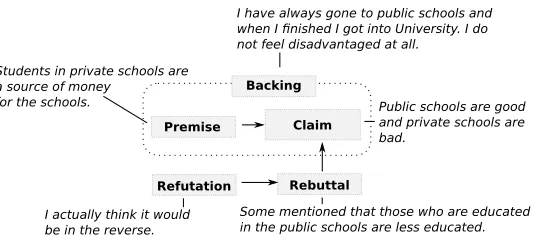
An example analysis of a forum post is shown in Figure 6. Figure 7 then shows a diagram of the analysis from that example (the content of the argument components was shortened or rephrased).
Doc#4733 (forumpost, public-private-schools)[claim: The public schooling system is not as bad as some may think.][::::::rebuttal:::::::Some:::::::::mentioned:::that:::::those::::who:::are::::::::educated
:
in:::the::::::public::::::schools:::are:::less:::::::::educated,] [refutation: well I actually think it would be in the reverse.] [premise: Student who study in the private sector actually pay a fair amount of fees to do so and I believe that the students actually get let off for a lot more than anyone would in a public school. And its all because of the money.
In a private school, a student being expelled or suspended is not just one student out the door, its the rest of that students schooling life fees gone. Whereas in a public school, its just the student gone.]
. . . .
[backing:. .I . . . .have . . . .always. . . .gone . .to. . . .public. . . .schools. . . . .and. . . .when. .I . . . .finished. .I . . . .got. . . . .into. . . .University. .I . . . .do . . . .not . . . . .feel . . . .disadvantaged. . .at . . . . .all.]
Figure 6
An annotation example using themodified Toulmin model.
Claim Premise
Backing
Rebuttal Refutation
Public schools are good and private schools are bad.
Students in private schools are a source of money
for the schools.
Some mentioned that those who are educated in the public schools are less educated. I actually think it would
be in the reverse.
[image:20.486.52.322.220.341.2]I have always gone to public schools and when I finished I got into University. I do not feel disadvantaged at all.
Figure 7
Modified Toulmin’s model used for annotation of arguments with an instantiated example from a single discussion forum post onpublic vs. private schools(see Figure 6). The arrows show relations between argument components; the relations are implicit and inherent in the model. By contrast to the example of theoriginal Toulmin modelin Figure 3, we do not propose any
connective phrases to the relations (such asso,unless, etc.).
refined. In the second phase, we wanted to extend the range of annotated registers, so we selected 148 comments and forum posts as well as 41 blog posts. After the second phase, the annotation guidelines were final.16
In the final phase, we extended the range of annotated registers and added newswire articles from the raw corpus in order to test whether the annotation guide-lines (and inherently the model) was general enough. Therefore we selected 96 com-ments/forum posts, 8 blog posts, and 8 articles for this phase. A detailed inter-annotator agreement study on documents from this final phase is reported in Section 4.4.6.
The annotations were very time-consuming. In total, each annotator spent 35 hours annotating over the course of five weeks. Discussions and consolidation of the gold data took another 6 hours. Comments and forum posts required an average of 4 minutes per document to annotate, whereas blog posts and articles required an average of 14 minutes per document. Examples of annotated documents from the gold data are listed in Appendix A.
16 The annotation guidelines are available under CC-BY-SA license at
Table 2
Topic and register distribution in thegold standard Toulmincorpus.
Topic\Register Comment Forum post Blog post Article Total
Homeschooling 32 12 11 1 56
Mainstreaming 12 5 3 1 21
Prayer in schools 31 14 10 0 55
Public vs. private 117 10 7 0 134
Redshirting 19 13 4 1 37
Single-sex education 14 12 9 2 37
[image:21.486.51.444.281.368.2]Total 216 73 46 5 340
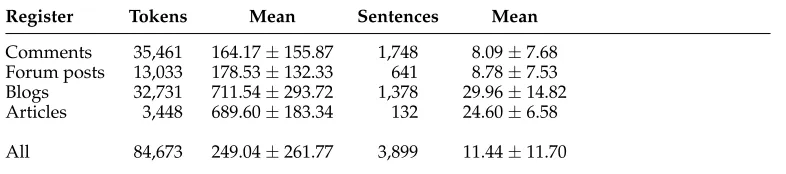
Table 3
Gold standard Toulmincorpus statistics.
Register Tokens Mean Sentences Mean
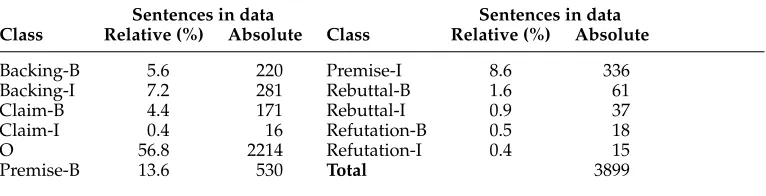
Comments 35,461 164.17±155.87 1,748 8.09±7.68 Forum posts 13,033 178.53±132.33 641 8.78±7.53 Blogs 32,731 711.54±293.72 1,378 29.96±14.82 Articles 3,448 689.60±183.34 132 24.60±6.58
All 84,673 249.04±261.77 3,899 11.44±11.70
Discarding Documents During Annotation.We discarded 11 documents out of the total 351 annotated documents. Five forum posts, although annotated aspersuasivein the first annotation study, were at a deeper look a mixture of two or more posts with missing quotations,17 therefore unsuitable for analyzing argumentation. Three blog posts and two articles were found not to be argumentative (the authors took no stance to the discussed controversy) and one article was an interview, which the current model cannot capture (a dialogical argumentation model would be required).
For each of the 340 documents, the gold standard annotations were obtained using majority vote. If simple majority voting was not possible (different boundaries of the argument component together with a different component label), the gold standard was set after discussion among the annotators. We will refer to this corpus as thegold
standard Toulmin corpus. The distribution of topics and registers in this corpus is
shown in Table 2, and Table 3 presents some lexical statistics.
4.4.5 Annotation Set-up.Based on pre-studies, we set the minimal unit for annotation astoken.18 The documents were pre-segmented using the Stanford Core NLP sentence
17 All of them came from the same source Web site, which does not support any HTML formatting of quotations.
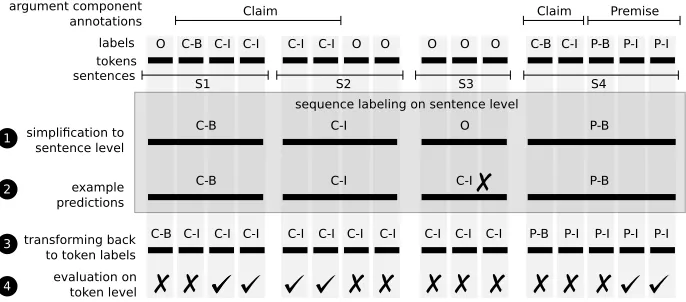
splitter (Manning et al. 2014) embedded in the DKPro Core framework (Eckart de Castilho and Gurevych 2014). Annotators were asked to stick to the sentence level by default and label entire pre-segmented sentences. They should switch to annotations on the token level only if (a) a particular sentence contained more than one argument component, or (b) if the automatic sentence segmentation was wrong. Given the “noise” in user-generated Web data (wrong or missing punctuation, casing, etc.), this was often the case.
Annotators were also asked to rephrase (summarize) each annotated argument component into a simple statement when applicable, as shown in Figure 7. This was used as a first sanity checking step, as each argument component is expected to be a coherent discourse unit. For example, if a particular occurrence of apremisecannot be summarized/rephrased into one statement, this may require further splitting into two or morepremises.
For the actual annotations, we developed a custom-made Web-based application that allowed users to switch between different granularity of argument components (tokens or sentences), to annotate the same document in different argument “dimen-sions” (logos and pathos), and to write a summary for each annotated argument component.
4.4.6 Inter-annotator Agreement. As a measure of annotation reliability, we rely on Krippendorff’s unitized alpha (αU) (Krippendorff 2004). To the best of our knowledge, this is the only agreement measure that is applicable when bothlabels andboundaries of segments are to be annotated.
Although the measure has been used in related annotation work (Ghosh et al. 2014; Kluge 2014a; Stab and Gurevych 2014a), there is one important detail that has not been properly communicated. The αU is computed over a continuum of the smallest units, such as tokens. This continuum corresponds to a single document in the original Krippendorff’s work. However, there are two possible extensions to multiple docu-ments (a corpus), namely (a) to compute αU for each document first and then report an average value, or (b) to concatenate all documents into one large continuum and compute αU over it. The first approach with averaging yielded an extremely high standard deviation ofαU (i.e., avg. = 0.253; std. dev. = 0.886; median = 0.476 for the claim). This says that some documents are easy to annotate whereas others are harder, but interpretation of such an averaged value has no evidence either in Krippendorff (2004) or other papers based upon it. Thus we use the other methodology and treat the whole corpus as a single long continuum (which yields in the example ofclaim=αU 0.541).19
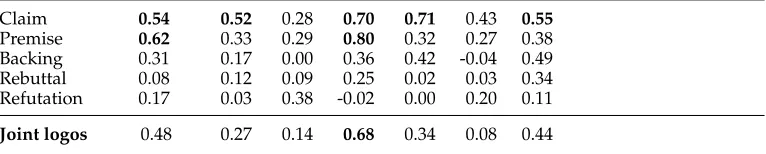
Table 4 shows the inter-annotator agreement as measured on documents from the last annotation phase (see Section 4.4.4). The overall αU for all register types, topics, and argument components is 0.48 in the logosdimension (annotated with the
score (Nguyen, Nguyen, and Shimazu 2009) for embedded clauses and 0.92 for non-embedded (Zhang et al. 2013). To the best of our knowledge, there is no available out-of-box solution for clause segmentation, thus we tooksentencesas another level of segmentation. Nevertheless, pre-segmenting the text to clauses and their relation to argument components deserves future investigation. 19 Another pitfall of theαUmeasure when documents are concatenated to create a single continuum is
that its value depends on the order of the documents (the annotated spans, respectively). We did the following experiment: Using 10 random annotated documents, we created all 362,880 possible concatenations and measured theαUfor each permutation. The resulting standard error was 0.002,
so the influence of the ordering is rather low. Still, each reportedαUwas averaged from 100 random
Table 4
Inter-annotator agreement (Krippendorff’sαU) across various registers, topics, and argument components.Boldvalues emphasizeαU≥0.50. Joint logos is a jointαUfor all argument components in the logos dimension (claim,premise,backing,rebuttal,refutation). HS = homeschooling; RS = redshirting; PIS = prayer in schools; SSE = single sex education; MS = mainstreaming; PPS = private vs. public schools.
All topics HS RS PIS SSE MS PPS
(a) Comments + Forum posts
Claim 0.59 0.52 0.36 0.70 0.69 0.51 0.55
Premise 0.69 0.35 0.31 0.80 0.47 0.16 0.38 Backing 0.48 0.15 0.06 0.36 0.54 0.14 0.49 Rebuttal 0.37 0.12 0.03 0.25 -0.02 0.80 0.34 Refutation 0.08 0.03 -0.01 -0.02 – 0.32 0.11
Joint logos 0.60 0.28 0.19 0.68 0.49 0.16 0.44
(b) Articles + Blog posts
Claim 0.22 -0.02 -0.03 – – 0.33 –
Premise 0.24 0.02 0.24 – -0.04 0.40 –
Backing -0.03 0.18 -0.20 – 0.26 -0.20 –
Rebuttal 0.01 – 0.08 – -0.08 -0.08 –
Refutation 0.34 – 0.40 – -0.01 -0.01 –
Joint logos 0.09 0.05 0.01 – 0.08 0.04 –
(c) Articles + Blog posts + Comments + Forum posts
Claim 0.54 0.52 0.28 0.70 0.71 0.43 0.55
Premise 0.62 0.33 0.29 0.80 0.32 0.27 0.38 Backing 0.31 0.17 0.00 0.36 0.42 -0.04 0.49 Rebuttal 0.08 0.12 0.09 0.25 0.02 0.03 0.34 Refutation 0.17 0.03 0.38 -0.02 0.00 0.20 0.11
Joint logos 0.48 0.27 0.14 0.68 0.34 0.08 0.44
modified Toulmin model). Such agreement can be considered as moderate by the measures proposed by Landis and Koch (1977), however, direct interpretation of the agreement value lacks consensus (Artstein and Poesio 2008, page 591). Similar inter-annotator agreement numbers were achieved in the relevant work in argumentation mining (refer to Table 1 in Section 3.1; although most of the numbers are not directly comparable, as different inter-annotator metrics were used on different tasks).
There is a huge difference in αU regarding the registers between comments + forums posts (αU 0.60, Table 4a) and articles + blog posts (αU 0.09, Table 4b) in the logos dimension. If we break down the value with respect to the individual argument components, the agreement onclaimandpremiseis substantial in the case of comments and forum posts (0.59 and 0.69, respectively). By contrast, these argument components were annotated only with a fair agreement in articles and blog posts (0.22 and 0.24, respectively).
in schools(0.68) orprivate vs. public schools(0.44), for some topics it remains rather slight, such as in the case ofredshirting(0.14) ormainstreaming(0.08).
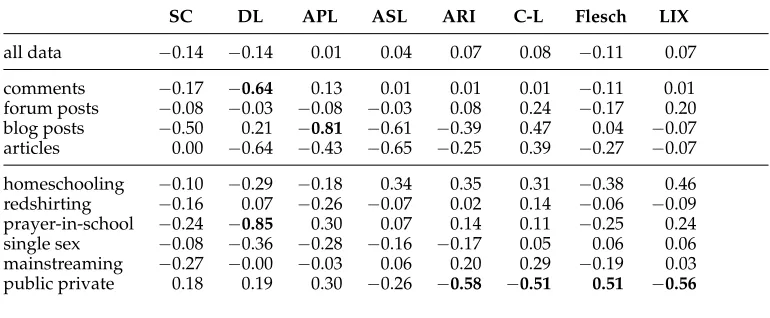
4.4.7 Causes of Disagreement—Quantitative Analysis.First, we examine the disagreement in annotations by posing the following research question:Are there any measurable proper-ties of the annotated documents that might systematically cause low inter-annotator agreement? We use Pearson’s correlation coefficient betweenαUon each document and the partic-ular property under investigation. We investigated the following set of measures.
r
Full sentence coverage ratiorepresents a ratio of argument componentboundaries that are aligned to sentence boundaries. The value is 1.0 if all annotations in the particular document are aligned to sentences and 0.0 if no annotations match the sentence boundaries. Our hypothesis was that automatic segmentation to sentences was often incorrect, therefore annotators had to switch to the token-level annotations and this might have increased disagreement on boundaries of the argument components.
r
Document length,paragraph length, andaverage sentence length. Ourhypotheses was that the length of documents, paragraphs, or sentences negatively affects the agreement.
r
Readability measures. We tested four standard readability measures, namely,Ari(Senter and Smith 1967),Coleman-Liau(Coleman and Liau 1975),Flesch (Flesch 1948), andLix(Bj ¨ornsson 1968) to identify whether readability of the documents plays any role in annotation agreement.
Correlation results are listed in Table 5. We observed the following statistically significant (p<0.05) correlations. First,document lengthnegatively correlates with agree-ment incomments. The longer the comment was the lower the agreement was. Second, average paragraph lengthnegatively correlates with agreement inblog posts. The longer the paragraphs in blogs were, the lower agreement was reached. Third, allreadability scores negatively correlate with agreement in thepublic vs. private schooldomain, meaning that the more complicated the text in terms of readability, the lower agreement was reached. We observed no significant correlation in sentence coverage and average sentence length measures. We cannot draw any general conclusion from these results, but we can state that some registers and topics, given their properties, are more challenging to annotate than others.
Probabilistic Confusion Matrix. Another qualitative analysis of disagreements between annotators was performed by constructing a probabilistic confusion matrix (Cinkov´a, Holub, and Kr´ıˇz 2012) on the token level.20 The largest disagreements, as can be seen in Table 6, is caused by rebuttal and refutationconfused with none (0.27 and 0.40, re-spectively). This is another sign that these two argument components were very hard to annotate. As shown in Table 4, theαU was also low—0.08 forrebuttaland 0.17 for refutation.