35
Aligning Discourse and Argumentation Structures using Subtrees and
Redescription Mining
Laurine Huber1, Yannick Toussaint1,
Charlotte Roze1,Mathilde Dargnat2 and Chloé Braud1
1 Université de Lorraine, CNRS, Inria, LORIA (UMR 7503), F-54000 Nancy, France
2ATILF, Université de Lorraine, CNRS (UMR 7118), Nancy, France
et Institut des Sciences Cognitives Marc Jannerod, CNRS (UMR 5304), Bron, France [email protected]
Abstract
In this paper, we investigate similarities be-tween discourse and argumentation structures by aligning subtrees in a corpus containing both annotations. Contrary to previous works, we focus on comparing sub-structures and not only relation matches. Using data mining tech-niques, we show that discourse and argumen-tation most often align well, and the double an-notation allows to derive a mapping between structures. Moreover, this approach enables the study of similarities between discourse structures and differences in their expressive power.
1 Introduction
This paper presents preliminary results in align-ing different text structure representations. Usalign-ing graph and redescription mining, we compare ar-gumentative and discourse trees. The former rep-resents the way arguments are organized through support or attack relations, the latter accounts for the coherence of texts by linking segments with semantico-pragmatic relations.
Aligning structures such as argumentation and discourse trees could help to understand the links between these representations, to build some bridges between theories, or to allow a better un-derstanding of the expressive power of the differ-ent formalisms.
The arg-microtexts-multilayer corpus1 (Stede et al.,2016) provides three representations of short texts: RST trees (Mann and Thompson, 1988),2 SDRT graphs (Lascarides and Asher,2007), and argumentation (ARG) structures as described in (Peldszus and Stede, 2013), based on Freeman’s theory (Freeman,1991).
In this preliminary study, we focus on RST and ARG annotations. We propose to describe each
1
https://github.com/peldszus/ arg-microtexts
2https://www.sfu.ca/rst/
text by two views, one corresponding to the set of subtrees extracted from the RST tree, and the other to the subtrees extracted from the ARG tree. The best alignment between subtrees is computed thanks to a redescription mining approach.
2 Related Work
A manual analysis of the correspondences be-tween RST and argumentation relations (Peldszus and Stede,2016) has already shown that a 1-to-1 mapping leads to some mismatches. For exam-ple, 39% of thesupports, 72% of therebuts, and 33% of the undercuts do not have a cor-responding RST edge. These mismatches have been explained by granularity differences in anno-tations. Thus, we propose here to consider align-ment at the level of subtrees allowing more com-plex combinations of relations.
Cabrio et al.(2013) showed that 5 Argumenta-tion Schemes (AS) from (Walton et al.,2008) can be mapped to Penn Discourse TreeBank (PDTB) relations (Prasad et al.,2008). They built an hy-pothetical mapping of AS to PDTB relations, and extracted 10 examples from the PDTB. Two an-notators had to say whether the AS definition was relevant to the example, and the measured Cohen’s kappa showed a significant agreement (κ= 0.71). Though their goal was to study the link between argumentation and discourse, their approach was based on both human hypothesis and human anno-tation. Unlike them, we propose an automatic ap-proach based on data mining. To our knowledge, it is the first generic and systematic approach for mapping discourse and argumentation.
3 Methodology
ARG annotation
RST annotation
CC
_
_ und _
_ sup
sup reb
ARG tree derivation
CC
_
_ conces _
_ conj
reason reason
[image:2.595.94.480.62.307.2]RST tree derivation
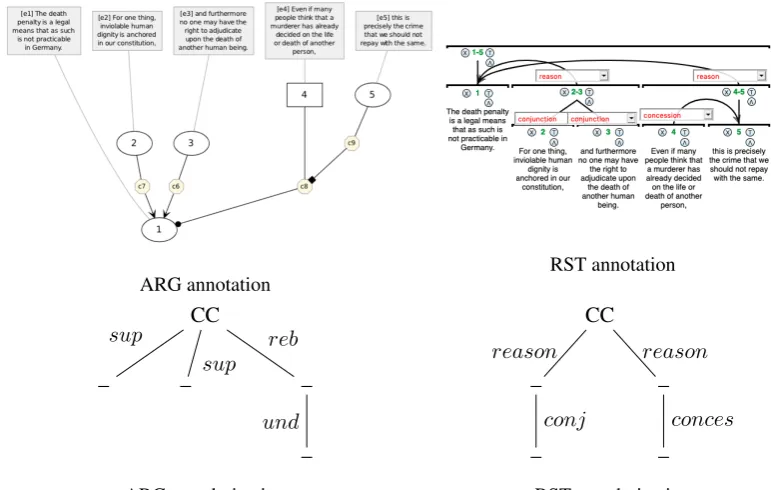
Figure 1: Textmicro_b006annotated in ARG and RST and trees derived from annotations
into two labeled trees. Then, RST and ARG trees being considered separately, subgraph mining ex-tracts all subtrees common to at least 2 texts. Each subtree becomes a feature used for describing one of the two views (i.e. RST and ARG) of each text. In the last step, redescription mining searches for alignments between features of the RST view and features of the ARG view.
3.1 Encoding RST and ARG representations into trees
RST and ARG representations are encoded into two distinct trees, refered as initial RST or ARG trees in the following. In both ARG and RST trees, we labelCCthe root node, to represent the central claim and the main nucleus respectively.3
As we do not consider the text but only the structure, and because we do not consider the se-quentiality of the units in the texts proposed by (Wachsmuth et al., 2017), other nodes are left unlabeled (-). These unlabeled nodes represent the Argumentative Units (AUs) in ARG trees and the Discourse Units (DUs) in RST trees.4 La-bels on the edges correspond to the argumenta-tive or discursive relations between AUs and DUs, respectively. Trees are built in a straightforward
3
The “most nuclear" unit or central unit (Stede,2008). 4An AU can comprise multiple DUs, to express that mul-tiple DUs form an argument only when combined.
way, except in ARG representations when some relations are not directed to an AU but to a re-lation (undercut for example). Inspired from
Wachsmuth et al.(2017), we make them target the premise of the undercutted relation (see ARG tree example in Figure1).
3.2 Creating two views
In this step, we extract subtrees from the whole set of RST initial trees on the one hand, and subtrees from ARG initial trees on the other hand. Each subtree is given a unique identifier and becomes a boolean feature to be associated with texts: a text has a feature if the subtree is in its initial tree.
Extracting subtrees gSpan (Graph-Based Sub-structure Pattern Mining) (Yan and Han,2002) is an algorithm to extract frequent subtrees from a graphsetGS. Informally, a graphhis asubtreeof
a graphgifhis contained ing, andhisfrequent
if, given a support thresholdσs, at leastsgraphs
ofGScontainh. We applied gSpan,5on the ARG
treeset and the RST treeset withσs= 2.
Building the data-tables From the gSpan runs, we represent the boolean features in two binary
data-tables, called views, where the rows corre-spond to the texts and the columns to the features.
3.3 Redescription Mining
In data analysis, redescription mining (Galbrun and Miettinen,2017) is the task of finding two dis-tinct characterizations of the same set of objects (i.e. texts in this experiment). Inputs of redescrip-tion mining are the views of the texts. The goal is to find two boolean expressions, called queries, q1andq2, whereq1andq2are formulae over the features of the ARG view and the RST view re-spectively, and where the support ofq1andq2are sufficiently similar, so that they explain (approx-imately) the same set of texts. This similarity is measured by the Jaccard index:
J(q1, q2) = supp(q1∧q2)
supp(q1∨q2) (1)
where supp(q)is the number of texts where q occurs. In other words, Jaccard quantifies how big the overlapping between the objects that evaluate true in q1 and those that evaluate true in q2 is.
The exploration strategy of ReRemi is based on atomic updates. First, the algorithm computes the Jaccard for all possible pairs of atomic queries, in other words all redescriptions that can be built from one feature for each view. These pairs are ranked following their Jaccard in a decreasing or-der and the n best pairs are kept. Starting with the best pair, the algorithm applies operations (ad-dition, deletion, edition) on either query to im-prove the candidate redescription until no further improvement of the Jaccard can be done. The first redescription has been built. The algorithm then iterates on the remaining best pairs. We use the ReReMi Algorithm (Galbrun and Miettinen,
2012) implemented in Siren with the predefined parameters of the tool. Conjunctions and disjunc-tions are allowed in the queries but the length of a query is restricted to 4. This length restriction has an impact on the redescriptions that are found. The algorithm must maximize the Jaccard with maxi-mum 4 features in each query. Thus some patterns that we may want to observe do not appear in the queries, because if they where used instead of an-other, they will make the Jaccard lower.
4 Data
The corpus contains 112 micro-texts, each of them answering a controversial issue (e.g., “Should Germany introduce the death penalty?"). We
use 2 of the 3 types of annotations provided: the RST and argumentation representations ( Peld-szus and Stede, 2015). RST trees are annotated with 28 relations, with 2 to 12 relations per tree, the most frequent relations are: reason (180),
concession(65),list(63),conjunction
(44), antithesis (32), elaboration (37), and cause (20). ARG trees have 2 to 9 rela-tions, 5 distinct relations are annotated, the most frequent beingsupport(263),rebut(108) and
undercut(63).
gSpan produces 311 RST and 98 ARG features, both sharing at least 2 objects.6 The most frequent RST feature occurs in 105 texts while the most fre-quent ARG feature occurs in 94 texts. Only 22 RST features are shared by more than 10 texts, and 18 ARG features are shared by more than 13 texts.
5 Results
q1 q2 J(q1,q2) # texts
Rd1 a57 r40∨r65∨r123 0.691 54
Rd2 a58 r61∨r119∨r125 0.351 13
[image:3.595.309.526.338.386.2]Rd3 a23∨a59 r125 0.3 8
Table 1: Examples 3 redescriptions. aXandrX corre-spond resp. to ARG and RST subtrees.
Table1gives three redescription examples over the 31 obtained. For reason of space, we mainly comment and discuss these three redescriptions. Rd1 has the highest Jaccard value (0.691). The support value is 54, meaning that 54 texts share both the left and the right part of the redescription. Rd2is a specialisation of Rd1, and, finally,Rd3
is a redescription where the conjunction is on the argumentation side. Subtrees corresponding to the query features are drawn in Figure2,3and4.
CC
_ _ sup sup
CC
_
_ list reason
CC
_ _
reason reason CC
_ motivation
[image:3.595.315.520.581.643.2]a57 r123 r65 r40
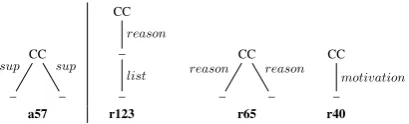
Figure 2: Subtrees corresponding to features ofRd1.
The 54 texts described byRd1all contain fea-ture a57 in their ARG tree, but the disjunction on the RST query emphasizes a difference in the granularity of ARG and RST formalisms. More precisely from the 54 texts, 30 containr123, 22
6Because the parameterσ
CC
_ _ _ sup
supsup
CC
_ _
_ conj reason reason
CC
_
_ joint reason
CC
_
_ _ list list
reason
[image:4.595.79.285.62.118.2]a58 r61 r119 r125
Figure 3: Subtrees corresponding to features ofRd2.
CC
_
_ und _
_ sup
sup reb
CC
_ _ _ _
sup
sup
sup sup
a23 a59
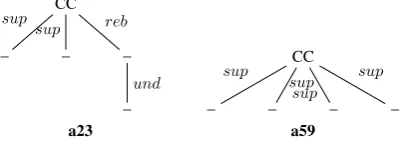
Figure 4: Subtrees corresponding to ARG features of
Rd3, forr125feature see Figure4
contain r65, 2 contain r40. In other words, in half of the data, when the ARG structure con-tains twosupportpointing to the CC, the RST tree includes either a reason relation followed by two list, or tworeason relations, or one
motivationdirected to theCC. The objects de-scribed by Rd2 and Rd3 are also described by Rd1 soRd2 and Rd3 can be seen as specialisa-tions ofRd1.Rd2can be read in the same way as Rd1, namely from 23 texts containinga58, 13 are aligned with eitherr61(3), orr119(3) orr125
(7). Contrary to Rd1 and Rd2, the disjunction on the ARG side inRd3suggests that the feature
r125(appearing 8 texts) can be mapped into two different ARG structures: a59 which concerns 2 texts, anda23which concerns 5 texts.
6 Discussion
A 1(ARG)-to-many(RST) mapping: One in-teresting question that arises, when looking at Rd1, concerns the disjunction on the discourse side, i.e. different discourse structures that rep-resent the same argumentative structure. Thus, this redescription could be an illustration of granu-larity difference between the two representations, RST being more fine-grained than ARG. However, by looking more precisely at the texts, we distin-guish two different issues related to granularity as described below.
Granularity in labeling relations: We observe that an edge labeled by a given ARG relation can be aligned with RST edges with different labels. The explanation could be that a limited set of 5 re-lations is used to annotate argumentation while the annotators were given a larger set of 28 relations
to annotate discourse.
As shown in (Peldszus and Stede, 2016), a
supportrelation can correspond in fact to sev-eral distinct RST relations, most often reason
and justification (found in another re-description), but also motivation, as also found via our extraction procedure. The lower fre-quency of motivation compared to reason
could come from the fact that the latter is more generic, the former being used only to motivate actions (Carlson and Marcu,2001).
Granularity in structure: Rd1seems to imply a similarity between RST structures described by
r123 andr65, that is a listembedded under areason, and tworeasondirected to the CC. Thelistrelation links comparable items, which is not mandatory for tworeasonsannotated in-dependently. This fine level of granularity is not expressed in ARG trees.
Moreover, for the two cases with a
motivation relation, we notice that the embedded node is in fact annotated either with a
listor with a conjunction, the latter being very similar to the former and thus corresponding to another compatible structure. Note here that we do not extract a subtree parallel to r123
but involving a motivation by applying our method: while this structure exists, it only appears once in the data, and thus does not meet our minimum support criterion. Lowering the support treshold is an option, it could be compared to the use of a relation grouping to allow an automatic recognition a priori of similar RST labels.
If we assume that discourse structures are more fine grained than argumentation structures, we could parametrised ReReMi to extract only atomic ARG queries to obtain a redescription of each sin-gle ARG structure. However, the following study ofRd3comes to contradict this hypothesis.
Depth and width of the subtrees: Some re-descriptions with lower support and Jaccard con-cern deeper or larger subtrees than in Rd1. For example in Rd2, the a58 subtree includes a57,
[image:4.595.81.284.155.226.2]the multinuclear RST relations conjunction
and list express an additional support in ARG.
However, we observe that a new subtree, namely r119, occurs in the RST part of Rd2. This non parallel new subtree being mapped to
a58still needs further investigation.
A many(ARG)-to-1(RST) mapping: As RST structures are more fine grained than argumenta-tion structures, we could expect ARG structures to be aligned with a disjunction of RST structures. However, the other way around is also true. Rd3
emphasizes that some RST (r125) structures are aligned with a disjunction of ARG structures.
The r125 RST tree contains 3 lists in a reason related to CC. On the ARG side,
a23 contains twosupportsand a sequence of
rebut andundercutdirected to the CC. The third expectedsupportfora23to partially map
r125comes from the following assertion: if anX undercutsaY, which in turnrebutstheCC, thenXis in asupportrelation toCC.
The patterna59is founded in 5 texts, but only 2 of them containr125in their RST representation. Here, 4supportnodes in ARG are mapped to 3
lists in RST. For these 2 texts, the fourth ex-pectedsupportrelation comes from deeper ele-ments in the trees. In one of the texts, a segment that is in ae-elaborationin one of thelist
element is used as asupportin the ARG tree. In the second text, arestatementplays the same role. Thus, nodes involved in these substructures are split into twosupportsin the ARG annota-tion. Despite a small Jaccard, this many-to-1 map-ping is very informative.
Weakness due to tree representation: One weakness of our tree representation is that we omit the position of the segments in the text. Doing this for ARG and RST subtrees extraction allows to consider the subtrees regardless of their place in the text. However, features aligned by a redescrip-tion do not necessarily refer to the same part of the text.
In Figure 1, while text b006 illustrates Rd1, the segments contained ina57 andr123do not correspond: a correct mapping would align both
supportin ARG with theconjunction em-bedded in the reason in RST (segments 2 and 3). In the same way, the ARG undercut and
rebut in sequence would have been mapped to
the RSTconcessionandreasonin sequence (segments 4 and 5).
7 Conclusion
The alignment of text structures can be done with redescription mining applied on subtrees. The au-tomatic process, compared to manual methods, enables a systematic comparison of different for-malisms. Applied to a small corpus of argumen-tative texts, this preliminary experiment demon-strates the effectiveness of our approach to com-pare structures in different frameworks, but also to get insights on the encoding used within a specific formalism.
Several improvements are currently under study. First, as we only used the predefined pa-rameters of ReRemi, we can reparametrize it. We can restrict the ARG side of the redescription to an atomic query in order to associate a conjunction of RST subtrees to each ARG subtree. We may also reparametrize ReReMi to get a higher num-ber of redescriptions and possibly longer queries. Indeed, the 4-features limitation in a query blocks the emergence of more interesting features (deeper subtrees) in the redescriptions.
Second, tree representations should include links to text segments in order to enable a fairer alignement between ARG and RST structures.
Finally, the methodology could also be ex-tended to other formalisms (e.g. SDRT), or used to provide a grouping of substructures from one theory to another.
8 Acknowledgement
This work was supported partly by the french PIA project "Lorraine Université d’Excellence“, refer-ence ANR-15-IDEX-04-LUE, and the PEPS blanc from CNRS (INS2I).
References
volume 8143, pages 1–17. Springer, Berlin, Heidel-berg.
Lynn Carlson and Daniel Marcu. 2001. Discourse tag-ging reference manual. Technical report, University of Southern California Information Sciences Insti-tute.
James B Freeman. 1991. Dialectics and the macrostructure of arguments: a theory of argument structure. Foris Publications, Berlin.
Esther Galbrun and Pauli Miettinen. 2012. From black and white to full color: extending redescription min-ing outside the Boolean world. Statistical Analysis
and Data Mining: The ASA Data Science Journal,
5(4):284–303.
Esther Galbrun and Pauli Miettinen. 2017. Redescrip-tion Mining. SpringerBriefs in Computer Science. Springer International Publishing.
Alex Lascarides and Nicholas Asher. 2007.Segmented Discourse Representation Theory: Dynamic Seman-tics With Discourse Structure. In Harry Bunt and Reinhard Muskens, editors, Computing Meaning, volume 3. Springer Netherlands, Dordrecht.
William Mann and Sandra Thompson. 1988. Rhetori-cal structure theory: Towards a functional theory of text organization. TEXT, 8:243–281.
Andreas Peldszus and Manfred Stede. 2013. From Argument Diagrams to Argumentation Mining in Texts: A Survey. International Journal of Cogni-tive Informatics and Natural Intelligence (IJCINI), 7(1):1–31.
Andreas Peldszus and Manfred Stede. 2015. An an-notated corpus of argumentative microtexts. In Pro-ceedings of the First European Conference on Ar-gumentation: Argumentation and Reasoned Action, volume 2, pages 801–816.
Andreas Peldszus and Manfred Stede. 2016. Rhetori-cal structure and argumentation structure in mono-logue text. In Proceedings of the Third Workshop
on Argument Mining (ArgMining2016), pages 103–
112, Berlin, Germany. Association for Computa-tional Linguistics.
Rashmi Prasad, Nikhil Dinesh, Alan Lee, Eleni Milt-sakaki, Livio Robaldo, Aravind Joshi, and Bonnie Webber. 2008. The Penn discourse treebank 2.0. In
Proceedings of the Sixth International Language
Re-sources and Evaluation (LREC 2008), Marrakech,
Morocco. European Language Resources Associa-tion (ELRA).
Manfred Stede. 2008. Rst revisited: Disentangling nu-clearity. Subordination ’versus’ Coordination’ in Sentence and Text, pages 33–59.
Manfred Stede, Stergos Afantenos, Andreas Peldszus, Nicholas Asher, and Jérémy Perret. 2016. Paral-lel discourse annotations on a corpus of short texts.
In Proceedings of the Tenth International Confer-ence on Language Resources and Evaluation (LREC 2016), Paris, France. European Language Resources Association (ELRA).
Henning Wachsmuth, Giovanni Da San Martino, Dora Kiesel, and Benno Stein. 2017. The impact of modeling overall argumentation with tree kernels. In Proceedings of the 2017 Conference on Empiri-cal Methods in Natural Language Processing, pages 2379–2389, Copenhagen, Denmark. Association for Computational Linguistics.
Douglas Walton, Christopher Reed, and Fabrizio Macagno. 2008. Argumentation Schemes. Cam-bridge University Press, CamCam-bridge.