1151
Syntax-Enhanced Neural Machine Translation with Syntax-Aware Word
Representations
Meishan Zhang1 and Zhenghua Li2 and Guohong Fu3∗and Min Zhang2
1. School of New Media and Communication, Tianjin University, China 2. School of Computer Science and Technology, Soochow University, China
3. Institute of Artificial Intelligence, Soochow University, China
{zhli13, minzhang}@suda.edu.cn,
Abstract
Syntax has been demonstrated highly effec-tive in neural machine translation (NMT). Pre-vious NMT models integrate syntax by rep-resenting 1-best tree outputs from a well-trained parsing system, e.g., the representa-tive Tree-RNN and Tree-Linearization meth-ods, which may suffer from error propaga-tion. In this work, we propose a novel method to integrate source-side syntax implicitly for NMT. The basic idea is to use the interme-diate hidden representations of a well-trained end-to-end dependency parser, which are re-ferred to as syntax-aware word representations (SAWRs). Then, we simply concatenate such SAWRs with ordinary word embeddings to en-hance basic NMT models. The method can be straightforwardly integrated into the widely-used sequence-to-sequence (Seq2Seq) NMT models. We start with a representative RNN-based Seq2Seq baseline system, and test the effectiveness of our proposed method on two benchmark datasets of the Chinese-English and English-Vietnamese translation tasks, re-spectively. Experimental results show that the proposed approach is able to bring significant BLEU score improvements on the two datasets compared with the baseline, 1.74 points for Chinese-English translation and 0.80 point for English-Vietnamese translation, respectively. In addition, the approach also outperforms the explicit Tree-RNN and Tree-Linearization methods.
1 Introduction
In the past few years, neural machine transla-tion (NMT) has drawn increasing interests due to its simplicity and promising performance (Bah-danau et al., 2014; Jean et al., 2015; Luong and Manning, 2015; Luong et al., 2015; Shen et al., 2016; Vaswani et al., 2017). The widely used
∗Corresponding author.
教育 是 现代 文明 的 基石
Education is modern civilization ’s cornerstone top
root
amod
assmod assm attr
•An example of input dependency tree.
Input
教育 是 现代
文明
的
基石
Encoder
o1
o2
o3
o4
o5
o6
Decoder head=1, top head=0, root head=4, amod head=6, assmod head=4, assm head=2, attr
[image:1.595.311.523.229.427.2]•SAWRs, where the encoder outputs are used as inputs for NMT similar to source-side word embeddings.
Figure 1: An example to illustrate our method of en-coding source dependency syntax, where the English translation is “Education is the cornerstone of modern civilization” for the source Chinese input.
sequence-to-sequence (Seq2Seq) framework com-bined with attention mechanism achieves signif-icant improvement over the traditional statistical machine translation (SMT) models on a variety of language pairs, such as Chinese-English (Shi et al., 2016; Mi et al., 2016; Vaswani et al., 2017; Cheng et al., 2018). Under an encoder-decoder ar-chitecture, the Seq2Seq framework first encodes the source sentence into a sequence of hidden vec-tors, and then incrementally predicts the target sentence (Cho et al., 2014a).
et al., 2017; Bastings et al., 2017; Hashimoto and Tsuruoka, 2017).
As a straightforward method, tree-structured re-current neural network (Tree-RNN) can elegantly model the source-side syntax and globally en-code the whole trees. Eriguchi et al. (2016), Chen et al. (2017a) and Yang et al. (2017) show that Tree-RNN can effectively integrate syntax-oriented trees into Seq2Seq NMT models.
Regardless of the effectiveness of Tree-RNN, we find that it suffers from a severe low-efficiency problem because of the heterogeneity of different syntax trees, which leads to increasing difficul-ties for batch computation compared with sequen-tial inputs. Even with deliberate batching method of Neubig et al. (2017), our preliminary experi-ments show that Tree-RNN with gated recurrent unit (GRU) can lead to nearly four times slower performance when it is integrated into a classical Seq2Seq system.
To solve the problem,Tree-Linearization is a good alternative for syntax encoding. The main idea is to linearize syntax trees into sequential symbols, and then exploit the resulting sequences as inputs for NMT. Li et al. (2017) propose a depth-first method to traverse a constituent tree, converting it into a sequence of symbols mixed with sentential words and syntax labels. Similarly, Wu et al. (2017b) combine several strategies of tree traversing for dependency syntax integration.
In this work, we present an implicit syntax en-coding method for NMT, enhancing NMT models by syntax-aware word representations (SAWRs). Figure 1 illustrates the basic idea, where trees are modeled indirectly by sequential vectors extracted from an encoder-decoder dependency parser. On the one hand, the method avoids the structural het-erogeneity and thus can be integrated efficiently, and on the other hand, it does not require discrete 1-best tree outputs, alleviating the error propaga-tion problem induced from syntax parsers. Con-cretely, the vector outputs are extracted from the encoding outputs of the encoder-decoder depen-dency parser. As shown in Figure 1, the encoding outputs, denoted aso = o1· · ·o6, are then
inte-grated into Seq2Seq NMT models by directly con-catenated with the source input word embeddings after a linear projection.
We start with a Seq2Seq baseline with attention mechanism (Bahdanau et al., 2014) for study, fol-lowing previous studies of the same research line,
and then integrate source dependency syntax by SAWRs. We conduct experiments on Chinese-English and Chinese-English-Vietnamese translation tasks, respectively. The results show that our method is very effective in source syntax integration. With source dependency syntax, the performances of Chinese-English and English-Vietnamese trans-lation can be significantly boosted by 1.74 BLEU points and 0.80 BLEU points, respec-tively. We also compare the method with the representative Tree-RNN and Tree-Linearization approaches of syntax integration, finding that our method is able to achieve larger improve-ments than the two approaches for both tasks. All the codes are released publicly available at https://github.com/zhangmeishan/SYN4NMT un-der Apache License 2.0.
2 Baseline
We take the simple yet effective Seq2Seq model with attention mechanism proposed by Luong et al. (2015) as our baseline. Under the stan-dard encoder-decoder architecture, an encoder first maps the source-language input sentence into a sequence of hidden vectors, and a decoder then incrementally predicts the target output sentence. In particular, we should notice that several recent models (Vaswani et al., 2017; Zheng et al., 2017; Cheng et al., 2018) which have been shown to be more powerful can also serve as our baseline, since these models focus on very different aspects of NMT, which could be potentially complemen-tary with our focus of syntax integration. We will demonstrate it by experimental analysis as well.
2.1 Encoder
In the encoder part, a single-layer bi-directional recurrent neural network (Bi-RNN) is employed to encode the sentence in order to capture fea-tures from the current word and the unbounded left and right contextual words. Given a source-language input sentencex=x1· · ·xnand its
em-bedding sequence ex1· · ·exn, the Bi-RNN
pro-duces an encoding sequence of dense vectorsh=
h1· · ·hi· · ·hn:
hi =−→hi⊕←h−i,
− →
hi=rnnL(exi,−→hi−1)
←h−
i=rnnR(exi,←h−i+1)
(1)
where rnnL/R can be either GRU (Cho et al.,
paper for efficiency following Chen et al. (2017a).
2.2 Decoder
The decoder part incrementally predicts the target word sequencey = y1· · ·ym, whose translation
probability is defined as follows:
p(y|x) =
m Y
j=1
p(yj|y1· · ·yj−1,h). (2)
The training objective is to maximize the proba-bility of the reference translation. During evalu-ation, we aim to search for a target sentence with the highest probability for a given source sentence. The probability of thej-th target word is
com-puted by a two-layer feed-forward neural network:
p(yj|y1· · ·yj−1,h) =g(sj−1,cj), (3)
wheresj−1 = rnntgt(eyj−1 ⊕cj−1,sj−2)is the
output of a left-to-right RNN over the predicted words, and the cj/cj−1 is the weighted sum over
the encoding sequence h of the source sentence
via the attention mechanism, which is computed as follows:
cj =
n X
k=1
αj,khk
αj,k =
exp(βj,k) Pn
l=1exp(βj,l)
βj,l =sTj−1Wahl
(4)
whereWais the model parameter in attention.
3 Our Method
Syntax information has been demonstrated to be valuable for NMT. Previously, there were two rep-resentative approaches to encode syntax into an NMT model. The first approach directly repre-sents an input syntax tree byTree-RNN, and then uses the Tree-RNN outputs as additional encoder inputs for NMT. The second approach models source syntax trees indirectly by first converting a hierarchical tree into a sequence of symbols, and then use the symbols as inputs for NMT. The sec-ond method is referred to asTree-Linearization
here.
Tree-RNN is able to represent the syntax struc-tures fully and comprehensively. However, be-cause of the heterogeneity of different syntax trees, this approach suffers serious inefficiency
encoder decoder
input
embedding projection
Bi-RNN
L L L
decoder
parser output
translation output
encoder
Figure 2: The framework of the SAWR approach, where the left part shows the encoder-decoder of a su-pervised dependency parsing model and the right part shows the NMT encoder-decoder.
problem as the increased difficulty of batch com-putation for GPU neural comcom-putation. The second approach exploits an alternative sequence to sub-stitute the original trees, which solves the ineffi-ciency problem. But it may bring loss of syntax information because the hierarchical tree structure is no longer maintained in the new representation, which could be potentially useful for NMT.
Both the two syntax integration approaches are based on discrete 1-best outputs of a supervised dependency parser, which may suffer from the er-ror propagation problem. Incorrect syntax trees as inputs for NMT may produce erroneous outputs, leading to inappropriate translation results. In or-der to alleviate the problem, we present a novel method not using the discrete parsing outputs.
[image:3.595.322.510.61.224.2]We focus on supervised dependency parsing models which can be formalized as an encoder-decoder architecture, and exploit the encoder out-puts as the inout-puts for our Seq2Seq NMT model. The encoder outputs are sequences of dense vec-tors aligning with the source sentential words, as shown in Figure 1, and thus they could be eas-ily combined with the encoder part of our NMT model. We refer to this method as SAWR for brief. Our approach takes the implicit hidden out-puts from a supervised parser as inout-puts for NMT, which greatly reduces the direct influence brought from discrete 1-best parser outputs.
[image:3.595.131.231.412.493.2]the projection module in Figure 2:
si=W oi+b (5)
where o=o1· · ·on is the encoder output of a
parsing model, W and b are model parameters.
Then we concatenate the resulting vectors with the source embeddings as inputs for the baseline Bi-RNN Encoder. Thus the encoder process can be formalized as follows:
h=Bi-RNN ex1 ⊕s
1,· · · ,exn⊕sn
. (6)
Noticeably, the SAWR method can be regarded as an adaption of joint learning as well. We can train both dependency parsing and machine translation model parameters concurrently. In this work, we focus on the machine translation task and do not involve the training objective of de-pendency parsing. However, we can still fine-tune model parameters of the encoder part of de-pendency parsing by back-propagating the train-ing losses of NMT into this part as well.
Actually, SAWRs are also similar to the ELMO embeddings (Peters et al., 2018). ELMO learns context word representations by using language model as objective, while SAWRs learn syntax-aware word representations by using dependency parsing as objective. On the other hand, compared with the Tree-RNN and Tree-Linearization meth-ods which encode syntax trees by neural networks directly, SAWRs are less sensitive to the output syntax trees. Thus the SAWR method can alleviate the error propagation problem.
4 Experiments 4.1 Settings
Data. We conduct experiments on the Chinese-English and Chinese-English-Vietnamese translation tasks, respectively. For Chinese-English, we use the par-allel training data from the publicly available LDC corpora,1 with 28.3M Chinese words and 34.5M
English words, respectively, consisting of 1.25M sentence pairs, and test model performances on the NIST datasets, using NIST MT02 as the de-velopment data, and MT03-06 as test datasets. For English-Vietnamese, we use the standard IWSLT 2015 dataset,2 which consists of about 133K
sen-tence pairs, and evaluate our models by exploiting
1LDC2002E18, LDC2003E07, LDC2003E14, Hansards portion of LDC2004T07, LDC2004T08 and LDC2005T06.
2https://nlp.stanford.edu/projects/nmt/
the TED tst2012 and tst2013 as the development and test datasets, respectively.
For the source side sentences, we construct vo-cabularies of the most frequent 50K words, while for the target side sentences, we apply byte-pair encodings (BPE) (Sennrich et al., 2016) with 32K merges to obtain subword units, and construct the target vocabularies by the most frequent 32K sub-words. During training, we use only the sentence pairs whose source and target lengths both are no longer than 50 and 150for Chinese-English and
English-Vietnamese translations, respectively.
Evaluation. We use the case insensitive 4-gram BLEU score as the main evaluation met-rics (Papineni et al., 2002), and adopt the script
multi-bleu.perl in the Mose toolkit.3
Sig-nificance tests are conducted based on the best-BLEU results for each approach by using boot-strap resampling (Koehn, 2004).
Alternatively, in order to compare the effective-ness of our model with other syntax integration methods, we implement a Tree-RNN approach and aTree-Linearizationapproach, respectively:
• Tree-RNN: We build a one-layer bi-directional Tree-RNN with GRU over input word embeddings, producing syntax-enhanced word representations, which are then fed into the encoder of NMT as basic inputs. The method is similar to the model proposed by Chen et al. (2017a).
• Tree-Linearization: We first convert
depen-dency trees into constituent trees (Sun and Wan, 2013), and then feed it into the NMT model proposed by Li et al. (2017).
Hyperparameters. We set the dimension sizes of all hidden neural layers to 1024, except the in-put layers for RNNs (i.e. inin-put word embeddings and the projection layer of SAWR), which are set to 512. We initialize all model parameters by ran-dom uniform distribution between[−0.1,0.1]. We
apply dropout on the output layer of word transla-tion with a ratio of 0.5.
We adopt the Adam algorithm (Kingma and Ba, 2014) for parameter optimization, with the initial learning rate of 5 ×10⁻⁴, the gradient clipping
threshold of 5, and the mini-batch size of 80. Dur-ing translation, we employ beam search for decod-ing with the beam size of 5.
System MT03 MT04 MT05 MT06 Average/∆
Baseline 36.44 39.35 36.26 36.32 37.09
SAWR 38.42 40.60 38.27 38.04 38.83/+1.74
Tree-RNN 38.12 40.35 37.86 37.32 38.41/+1.32 Tree-Linearization 37.95 40.24 37.64 37.44 38.32/+1.23
Previous Work
Chen et al. (2017a) 35.64 36.63 34.35 30.57 34.30/+2.59
[image:5.595.141.458.60.196.2]Li et al. (2017) 34.9 38.6 35.5 35.6 36.15/+1.45 Chen et al. (2017b) 35.91 38.73 34.18 33.76 35.65/+1.52
Table 1: Final results of Chinese-English translation. All syntax-integrated approaches are significantly better than the baseline system (p <0.05).
Source-Side Parsing. We employ the state-of-the-art BiAffine dependency parser recently pro-posed by Dozat and Manning (2016) to obtain the source-side dependency syntax information. The BiAffine parser can also be understood as an encoder-decoder model, where the encoder part is a three-layer bi-directional LSTM over the input words, and the decoder uses BiAffine operations to score all candidate dependency arcs and finds the highest-scoring trees via dynamic programming.
For Chinese-English translation, we train the dependency parser on Chinese Treebank 7.0 with Stanford dependencies,4 using 50K random
sen-tences as the training data and the remaining as the test data. The parser achieves 81.02%
pars-ing accuracy (labeled attached score, LAS) on the test dataset. For English-Vietnamese translation, we train the dependency parser on English WSJ corpus, following the same data split as Dozat and Manning (2016), and obtaining a LAS of93.84%
on the test dataset.5
4.2 Speed Comparison
All our experiments are run on a single GPU NVIDIA TITAN Xp. We report the averaged one-epoch training time on the Chinese-English translation dataset (consuming all 125M sentence pairs) as follows:
Baseline 105 min
SAWR 142 min Tree-RNN 498 min Tree-Linearization 137 min
4 https://nlp.stanford.edu/software/stanford-dependencies.shtml
5For simplicity, we use only words as inputs for both Chi-nese and English dependency parsing, avoiding the influences brought by other inputs, such as automatic POS tags.
The SAWR system spends averaged 142 minutes,6
37 minutes slower than the baseline model. The Tree-Linearization spends averaged 137 minutes per epoch, which is the fastest syntax integration method. Our SAWR approach spends 5 more min-utes than Tree-Linearization, appropriate 3.5% of the total spend time per epoch, which could be negligible. The Tree-RNN model spends 498 min-utes per epoch, nearly four times slower than the baseline model.7 According to the results, we can
conclude that the Tree-RNN model is highly inef-ficient for encoding dependency syntax, whereas the SAWR and Tree-Linearization are almost as efficient as the baseline Seq2Seq system.
4.3 Main Results
4.3.1 Chinese-English Translation
Table 1 shows the main results of all approaches on Chinese-English datasets. Considering the ef-fect of random initialization, we train three indi-vidual models for each approach, and use the av-eraged BLEU scores for fair comparisons.
According to the results, we can see that all syntax-integrated approaches can bring significant improvements over the baseline system, which de-notes that syntax is highly effective for Chinese-English machine translation. In addition, the pro-posed SAWR approach obtains the largest BLEU improvements, averaged∆ = 1.74BLEU points
better than the baseline system. The Tree-RNN and Tree-Linearization approaches bring
improve-6We exclude the time consumed by the encoder part of the dependency parsing model for fair comparisons, as other methods require to perform parsing in an offline way.
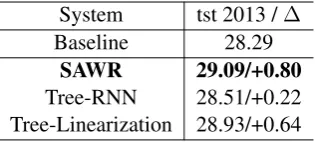
[image:5.595.101.252.644.705.2]System tst 2013 /∆
Baseline 28.29
SAWR 29.09/+0.80
Tree-RNN 28.51/+0.22 Tree-Linearization 28.93/+0.64
Table 2: Final Results on the IWSLT 2015 English-Vietnamese translation task. Only SAWR is signifi-cantly better than the baseline system (p <0.05).
ments of averaged∆ = 1.32and∆ = 1.23BLEU
points, respectively. The results show that our im-plicit syntax-aware encoding method is better than Tree-RNN and Tree-Linearization.
We compare our NMT models with other state-of-the-art methods as well. The results are just for reference since experimental details could be very different. In particular, we list the relative im-provements over the corresponding baseline mod-els by integrating syntax structures, which are cal-culated according to their papers. All these studies exploit lower baselines compared with our mod-els. The Tree-RNN and Tree-Linearization are es-sentially similar to Chen et al. (2017a) and Li et al. (2017), respectively. As shown, our approaches can still obtain large improvements based on a stronger baseline.
4.3.2 English-Vietnamese Translation
Table 2 shows the final results on the IWSLT 2015 English-Vietnamese translation task. The over-all tendency is similar to that of Chinese-English translation. The syntax information can boost the translation performances by using any of the three approaches. The SAWR approach gives the best translation performance, significantly outperform the baseline system by∆ = 0.80 BLEU points.
While although the other two approaches bring better performances, the improvements are not significant. The results demonstrate the advantage of the proposed implicit SAWR approach. By not using the 1-best parser outputs, our approach can reduce the error propagation problem, thus bring larger improvements with syntax.
In particular, we find that the increases of BLEU scores are smaller than that of Chinese-English translation by integrating syntactic features. The averaged BLEU increases are 0.55 for
English-Vietnamese and 1.43 for Chinese-English. The
possible reason may be due to that the source En-glish sentences are more grammatically rigorous
Parser MT03 MT04 MT05 MT06 Average no Tune 38.42 40.60 38.27 38.04 38.83
[image:6.595.103.261.62.133.2]Tune 37.33 39.45 36.93 37.03 37.69
Table 3: The influence of fine-tuning parser parameters in the SAWR system.
than Chinese sentences. For example, the English functional words such as “of” and “‘s” which indi-cate the possessive relationship, should be always kept in sentences by standard, while their Chinese correspondence “的” may be omitted in sentences.
4.4 Analysis
In this section, we conduct analysis on Chinese-English translation from different aspects to bet-ter understand the SAWR approach of integrating source-side dependency syntax for NMT.
4.4.1 Fine-Tuning Syntax-Oriented Inputs
The SAWR approach directly uses the encoder outputs of a dependency parser as extra inputs for NMT. In the above experiments, we keep the parser model parameters fixed, letting them unin-fluenced from NMT optimization. Actually, this part can be further fine tuned along with the NMT learning, by treating them as one kind model pa-rameters. Thus there arises a question that whether fine-tuning the parser model parameters can bring better performance.
As an interesting attempt, we can simultane-ously fine tune the parameters of both the parser and the Seq2Seq NMT model during training. Fig-ure 3 shows the results. We can see that fine-tuning decreases the average BLEU score by 38.83 − 37.69 = 1.14significantly. This may be because
that fine-tuning disorders the representation ability of the parser and makes its function more overlap-ping with other network components. This further demonstrates that pretrained syntax-aware word representations are helpful for NMT.
4.4.2 Alignment Study
Alignment quality is an important metric to il-lustrate and evaluate machine translation outputs. Here we study how syntax features influence the alignment results for NMT. We approximate the alignment scores by the attention probabilities as shown in Equation 4.8 For better understanding
System MT03 MT04 MT05 MT06 Average/∆
Baseline×3 40.90 43.25 40.64 40.16 41.24
SAWR×3 41.94 44.59 41.91 41.97 42.60/+1.36
Tree-RNN×3 42.03 44.15 41.50 41.41 42.27/+1.03
[image:7.595.134.463.60.146.2]Tree-Linearization×3 41.74 44.23 41.32 41.44 42.18/+0.94 Hybrid 42.72 45.14 42.38 42.15 43.10/+1.86
Table 4: Ensemble performances, where the Hybrid model denotes SAWR + Tree-RNN + Tree-Linearization.
System ... (modern)现代 ... (’s)的 ...
Baseline
SAWR
Tree-RNN
Tree-Linearization
Figure 3: Alignments for the baseline and syntax-integrated systems, where the same example in Figure 1 is analyzed and the target English word is “of”.
the effectiveness of syntax, we choose the target-side English word “of” for comparison, which is a grammatical functional word.
Figure 3 shows the alignment probability dis-tributions returned by different approaches. Intu-itively, this word should be aligned with the Chi-nese word “的(de)”. But according to the results,
we can see that only the SAWR model distributes a high attention score to it, which is consistent with our intuition. The other three models are all aligned to the source word “现代(modern)” with
high confidence over 85%. The possible reason for “of” being aligned to “现代 (modern)” could
be due to that “of modern” is a high-frequency col-location in the training corpora.
4.4.3 Ensemble Study
Here we perform model ensembles to examine the divergences of the three syntax-integration approaches (Zhou et al., 2017b; Denkowski and Neubig, 2017). Intuitively, the hetero-approach ensemble which combines three NMT models of different methods should obtain bet-ter performances than homo-approach ensembles which combine three NMT models of the same method, since NMT models of different syntax-integrations approaches have larger divergences.
Table 4 shows the results. First, we can see that ensemble is one effective technique to im-prove the translation performances. More
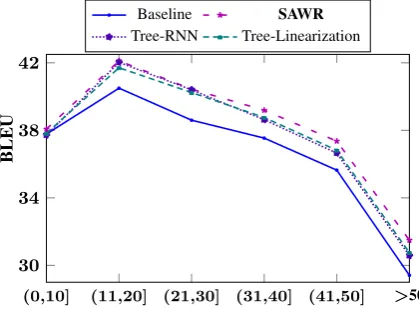
impor-(0,10] (11,20] (21,30] (31,40] (41,50] >50 30
34 38 42
BLEU
Baseline SAWR
Tree-RNN Tree-Linearization
Figure 4: The effect of source input length.
tantly, the results show that the heterogeneous en-semble achieves averaged BLEU improvements by 43.10−41.24 = 1.86 points, better than the
gains achieved by all three homo-approach ensem-bles, denoting that the three approaches could be mutually complementary in representing depen-dency syntax, and the resulting models of the three approaches are highly diverse.
4.4.4 Analysis by Source Sentence Length
Intuitively, by introducing the source syntax into the NMT model, relations between long-distance words are explicitly modeled by dependency trees, thus we can expect that models enhanced by source syntax are able to bring better translations for longer sentences. Figure 4 shows the perfor-mances of the baseline and all syntax-enriched models in terms of source sentence lengths, where we bin all the MT03-MT06 sentences by their lengths into six intervals. The results show that the BLEU scores are improved significantly when source sentential lengths are over 10, which con-firms our intuition.
4.4.5 Effect of Parsing Performance
[image:7.595.310.520.194.350.2] [image:7.595.73.289.194.293.2]System MT03 MT04 MT05 MT06 Average/∆
Transformer 40.45 42.76 40.09 39.67 40.74
SAWR 41.63 43.60 41.68 40.21 41.78/+1.04
[image:8.595.143.457.61.135.2]Tree-RNN 41.24 43.38 41.04 40.02 41.42/+0.68 Tree-Linearization 41.12 43.02 41.04 39.86 41.26/+0.52
Table 5: Final results based on the transformer. Only the SAWR results are significantly better (p <0.05).
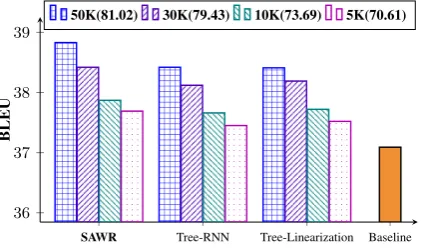
SAWR Tree-RNN Tree-Linearization Baseline 36
37 38 39
BLEU
50K(81.02) 30K(79.43) 10K(73.69) 5K(70.61)
Figure 5: The effect of dependency parsing perfor-mances on our proposed approaches.
trained on 50K sentences, we retrain three weaker dependency parsers on 30K, 10K and 5K sen-tences, respectively. Figure 5 shows the NMT BLEU scores and the parsing accuracies. It is clear that the parsing accuracy directly influences the translation quality, indicating the effectiveness and importance of exploiting syntactic information.
4.4.6 Transformer as Baseline
Here we conduct experiments based on the trans-former NMT model (Vaswani et al., 2017), which is a stronger baseline, to further ver-ify the effectiveness of our proposed method. This also demonstrates that the proposed SAWR method does not limit to a certain NMT base-line. Concretely, we extend the bottom word rep-resentations by incorporating syntactic encodings
s=s1· · ·sn(shown in Equation 5) into them, and
then feed them into the transformer encoder by a linear projection layer to align with the input dimension. We implement RNN and Tree-Linearization for Transformer in a similar way, only adapting the source input word representing. We adopt a widely-used setting with 8 heads, 6 layers and the hidden dimension size of 512.
Table 5 shows the results. As shown, the trans-former results are indeed much better than RNN-based baseline. The BLEU scores show an aver-age increase of40.74−37.09 = 3.65. In addition,
we can see that syntax information can still give
positive influences based on the transformer. The SAWR approach can also outperform the base-line system significantly. Particularly, we find that our SAWR approach is much more effective than the Tree-RNN and Tree-Linearization approaches. The results further demonstrate the effectiveness of SAWRs in syntax integration for NMT.
5 Related Work
By explicitly expressing the structural connections between words and phrases, syntax trees been demonstrated helpful in SMT (Liu et al., 2006; Cowan et al., 2006; Marton and Resnik, 2008; Xie et al., 2011; Li et al., 2013; Williams et al., 2016). Although the representative Seq2Seq NMT models are able to capture latent long-distance re-lations by using neural network structures such GRU and LSTM (Sutskever et al., 2014; Wu et al., 2016), recent studies show that explicitly integrat-ing syntax trees into NMT models can brintegrat-ing fur-ther gains (Sennrich and Haddow, 2016; Shi et al., 2016; Zhou et al., 2017a; Wu et al., 2017a; Aha-roni and Goldberg, 2017). Under the NMT setting, the exploration of syntax trees could be more flex-ible, because of the strong capabilities of neural network in representing arbitrary structures.
[image:8.595.77.288.182.306.2]syn-tactic tags. The method is as effective as Tree-RNN approaches yet more effective. Noticeably, all these studies focus on constituent trees.
There have been several studies for NMT us-ing dependency syntax. Hashimoto and Tsuruoka (2017) propose to combine the head information with sequential words together as source encoder inputs, where their input trees are latent depen-dency graphs. Recently, there are several studies by using convolutional neural structures to repre-sent source dependency trees, where tree nodes are modeled individually (Chen et al., 2017b; Bast-ings et al., 2017). Wu et al. (2017b) build a syn-tax enhanced encoder by multiple Bi-RNNs over several different word sequences based on differ-ent traversing orders over dependency trees, i.e., the original sequential order and several tree-based orders. All these methods require certain extra ef-forts to encode the source dependency syntax over a baseline Seq2Seq NMT.
6 Conclusion
We proposed a novel syntax integration method, SAWR, to incorporate source dependency-based syntax for NMT. It encodes dependency syntax implicitly, not requiring discrete syntax trees as inputs. Experiments showed that the method can bring significantly better performances for both Chinese-English and English-Vietnamese transla-tion tasks. In additransla-tion, we compared the method with two approaches based on Tree-RNN and Tree-Linearization, which has been previously ex-ploited for syntax integration, finding that our method is more effective and meanwhile very ef-ficient. We conducted several experimental analy-ses to study our proposed methods deeper.
Acknowledgments
We thank all anonymous reviewers for their valu-able comments. We thank Huadong Chen, Haoran Wei and Zaixiang Zheng for their help in imple-menting baseline neural machine translation mod-els. This work is supported by National Natu-ral Science Foundation of China (NSFC) grants 61525205, U1836222, and 61672211.
References
Roee Aharoni and Yoav Goldberg. 2017. Towards string-to-tree neural machine translation. In Pro-ceedings of the 55th ACL, pages 132–140.
Dzmitry Bahdanau, Kyunghyun Cho, and Yoshua Ben-gio. 2014. Neural machine translation by jointly learning to align and translate. arXiv preprint arXiv:1409.0473.
Joost Bastings, Ivan Titov, Wilker Aziz, Diego Marcheggiani, and Khalil Simaan. 2017. Graph convolutional encoders for syntax-aware neural ma-chine translation. InProceedings of EMNLP, pages
1957–1967.
Huadong Chen, Shujian Huang, David Chiang, and Ji-ajun Chen. 2017a. Improved neural machine trans-lation with a syntax-aware encoder and decoder. In
Proceedings of ACL, pages 1936–1945.
Kehai Chen, Rui Wang, Masao Utiyama, Lemao Liu, Akihiro Tamura, Eiichiro Sumita, and Tiejun Zhao. 2017b. Neural machine translation with source dependency representation. InProceedings of EMNLP, pages 2846–2852.
Yong Cheng, Zhaopeng Tu, Fandong Meng, Junjie Zhai, and Yang Liu. 2018. Towards robust neural machine translation. InACL.
Kyunghyun Cho, Bart van Merrienboer, Dzmitry Bah-danau, and Yoshua Bengio. 2014a. On the proper-ties of neural machine translation: Encoder–decoder approaches. InProceedings of SSST-8, pages 103–
111.
Kyunghyun Cho, Bart van Merrienboer, Caglar Gul-cehre, Dzmitry Bahdanau, Fethi Bougares, Holger Schwenk, and Yoshua Bengio. 2014b. Learning phrase representations using rnn encoder–decoder for statistical machine translation. InEMNLP, pages
1724–1734.
Brooke Cowan, Ivona Ku˘cerov´a, and Michael Collins. 2006. A discriminative model for tree-to-tree trans-lation. InProceedings of EMNLP, pages 232–241.
Michael Denkowski and Graham Neubig. 2017. Stronger baselines for trustable results in neural ma-chine translation. InThe First Workshop on Neural Machine Translation (NMT).
Timothy Dozat and Christopher D Manning. 2016. Deep biaffine attention for neural dependency pars-ing.arXiv preprint arXiv:1611.01734.
Akiko Eriguchi, Kazuma Hashimoto, and Yoshimasa Tsuruoka. 2016. Tree-to-sequence attentional neu-ral machine translation. In Proceedings of ACL,
pages 823–833.
Kazuma Hashimoto and Yoshimasa Tsuruoka. 2017. Neural machine translation with source-side latent graph parsing. In Proceedings of EMNLP, pages
125–135.
S´ebastien Jean, Orhan Firat, Kyunghyun Cho, Roland Memisevic, and Yoshua Bengio. 2015. Montreal neural machine translation systems for wmt’15. In
Diederik Kingma and Jimmy Ba. 2014. Adam: A method for stochastic optimization. arXiv preprint arXiv:1412.6980.
Philipp Koehn. 2004. Statistical significance tests for machine translation evaluation. In Proceedings of EMNLP 2004, pages 388–395.
Philipp Koehn and Rebecca Knowles. 2017. Six chal-lenges for neural machine translation. In Pro-ceedings of the First Workshop on Neural Machine Translation, pages 28–39.
Filippos Kokkinos and Alexandros Potamianos. 2017. Structural attention neural networks for improved sentiment analysis. InProceedings of EACL, pages
586–591.
Jiwei Li, Thang Luong, Dan Jurafsky, and Eduard Hovy. 2015. When are tree structures necessary for deep learning of representations? InProceedings of the EMNLP, pages 2304–2314.
Junhui Li, Philip Resnik, and Hal Daum´e III. 2013. Modeling syntactic and semantic structures in hier-archical phrase-based translation. InProceedings of NAACL, pages 540–549.
Junhui Li, Deyi Xiong, Zhaopeng Tu, Muhua Zhu, Min Zhang, and Guodong Zhou. 2017. Modeling source syntax for neural machine translation. In Proceed-ings of ACL, pages 688–697.
Yang Liu, Qun Liu, and Shouxun Lin. 2006. Tree-to-string alignment template for statistical machine translation. InProceedings of ACL, pages 609–616.
Minh-Thang Luong and Christopher D Manning. 2015. Stanford neural machine translation systems for spo-ken language domains. In Proceedings of IWSLT 2015, pages 76–79.
Thang Luong, Hieu Pham, and Christopher D. Man-ning. 2015. Effective approaches to attention-based neural machine translation. In Proceedings of the 2015 EMNLP, pages 1412–1421.
Yuval Marton and Philip Resnik. 2008. Soft syntac-tic constraints for hierarchical phrased-based trans-lation. InProceedings of ACL, pages 1003–1011.
Haitao Mi, Baskaran Sankaran, Zhiguo Wang, and Abe Ittycheriah. 2016. Coverage embedding mod-els for neural machine translation. InProceedings of EMNLP, pages 955–960.
Makoto Miwa and Mohit Bansal. 2016. End-to-end re-lation extraction using lstms on sequences and tree structures. InACL, pages 1105–1116.
Graham Neubig, Yoav Goldberg, and Chris Dyer. 2017. On-the-fly operation batching in dynamic computa-tion graphs. In Conference on Neural Information Processing Systems (NIPS).
Kishore Papineni, Salim Roukos, Todd Ward, and Wei-Jing Zhu. 2002. Bleu: a method for automatic eval-uation of machine translation. In Proceedings of ACL, pages 311–318.
Matthew Peters, Mark Neumann, Mohit Iyyer, Matt Gardner, Christopher Clark, Kenton Lee, and Luke Zettlemoyer. 2018. Deep contextualized word repre-sentations. InProceedings of NAACL, pages 2227–
2237.
Rico Sennrich and Barry Haddow. 2016. Linguistic input features improve neural machine translation. InProceedings of the First Conference on Machine Translation, pages 83–91.
Rico Sennrich, Barry Haddow, and Alexandra Birch. 2016. Neural machine translation of rare words with subword units. In Proceedings of the 54th ACL,
pages 1715–1725, Berlin, Germany.
Shiqi Shen, Yong Cheng, Zhongjun He, Wei He, Hua Wu, Maosong Sun, and Yang Liu. 2016. Minimum risk training for neural machine translation. In Pro-ceedings of ACL, pages 1683–1692.
Xing Shi, Inkit Padhi, and Kevin Knight. 2016. Does string-based neural mt learn source syntax? In Pro-ceedings of EMNLP, pages 1526–1534.
Weiwei Sun and Xiaojun Wan. 2013. Data-driven, pcfg-based and pseudo-pcfg-based models for chi-nese dependency parsing. TACL (TACL), 1(1):301–
314.
Ilya Sutskever, Oriol Vinyals, and Quoc V Le. 2014. Sequence to sequence learning with neural net-works. InNIPS, pages 3104–3112.
Kai Sheng Tai, Richard Socher, and Christopher D. Manning. 2015. Improved semantic representations from tree-structured long short-term memory net-works. InACL, pages 1556–1566.
Zhiyang Teng and Yue Zhang. 2016. Bidirectional tree-structured lstm with head lexicalization. arXiv preprint arXiv:1611.06788.
Ashish Vaswani, Noam Shazeer, Niki Parmar, Jakob Uszkoreit, Llion Jones, Aidan N Gomez, Łukasz Kaiser, and Illia Polosukhin. 2017. Attention is all you need. InNIPS, pages 6000–6010.
Philip Williams, Rico Sennrich, Matt Post, and Philipp Koehn. 2016. Syntax-based statistical machine translation. Synthesis Lectures on Human Language Technologies, 9(4):1–208.
Shuangzhi Wu, Dongdong Zhang, Nan Yang, Mu Li, and Ming Zhou. 2017a. Sequence-to-dependency neural machine translation. InProceedings of ACL,
pages 698–707.
Shuangzhi Wu, Ming Zhou, and Dongdong Zhang. 2017b. Improved neural machine translation with source syntax. InProceedings of IJCAI 2017, pages
Yonghui Wu, Mike Schuster, Zhifeng Chen, Quoc V Le, Mohammad Norouzi, Wolfgang Macherey, Maxim Krikun, Yuan Cao, Qin Gao, Klaus Macherey, et al. 2016. Google’s neural ma-chine translation system: Bridging the gap between human and machine translation. arXiv preprint arXiv:1609.08144.
Jun Xie, Haitao Mi, and Qun Liu. 2011. A novel dependency-to-string model for statistical machine translation. InProceedings of EMNLP, pages 216–
226.
Baosong Yang, Derek F. Wong, Tong Xiao, Lidia S. Chao, and Jingbo Zhu. 2017. Towards bidirectional hierarchical representations for attention-based neu-ral machine translation. InProceedings of the 2017 Conference on EMNLP, pages 1432–1441.
Xingxing Zhang, Liang Lu, and Mirella Lapata. 2016. Top-down tree long short-term memory networks. InProceedings of NAACL, pages 310–320.
Zaixiang Zheng, Hao Zhou, Shujian Huang, Lili Mou, Xinyu Dai, Jiajun Chen, and Zhaopeng Tu. 2017. Modeling past and future for neural machine trans-lation. arXiv preprint arXiv:1711.09502.
Hao Zhou, Zhaopeng Tu, Shujian Huang, Xiaohua Liu, Hang Li, and Jiajun Chen. 2017a. Chunk-based bi-scale decoder for neural machine translation. In
Proceedings of the 55th ACL, pages 580–586.
Long Zhou, Wenpeng Hu, Jiajun Zhang, and Chengqing Zong. 2017b. Neural system combina-tion for machine translacombina-tion. InProceedings of ACL,
pages 378–384.