Proceedings of the 2019 Conference on Empirical Methods in Natural Language Processing and the 9th International Joint Conference on Natural Language Processing, pages 5382–5392,
5382
A Syntax-aware Multi-task Learning Framework for
Chinese Semantic Role Labeling
Qingrong Xia, Zhenghua Li∗, Min Zhang
Institute of Artificial Intelligence, School of Computer Science and Technology, Soochow University, China
[email protected], {zhli13, minzhang}@suda.edu.cn
Abstract
Semantic role labeling (SRL) aims to identify the predicate-argument structure of a sentence. Inspired by the strong correlation between syntax and semantics, previous works pay much attention to improve SRL performance on exploiting syntactic knowledge, achieving significant results. Pipeline methods based on automatic syntactic trees and multi-task learn-ing (MTL) approaches uslearn-ing standard syntac-tic trees are two common research orienta-tions. In this paper, we adopt a simple uni-fied span-based model for both span-based and word-based Chinese SRL as a strong baseline. Besides, we present a MTL framework that includes the basic SRL module and a depen-dency parser module. Different from the com-monly used hard parameter sharing strategy in MTL, the main idea is to extract implicit syntactic representations from the dependency parser as external inputs for the basic SRL model. Experiments on the benchmarks of Chinese Proposition Bank 1.0 and CoNLL-2009 Chinese datasets show that our proposed framework can effectively improve the perfor-mance over the strong baselines. With the ex-ternal BERT representations, our framework achieves new state-of-the-art 87.54 and 88.5 F1 scores on the two test data of the two bench-marks, respectively. In-depth analysis are con-ducted to gain more insights on the proposed framework and the effectiveness of syntax.
1 Introduction
Semantic role labeling (SRL) is a fundamental and important task in natural language processing (NLP), which aims to identify the semantic struc-ture (Who did what to whom, when and where,
etc.) of each given predicate in a sentence. Seman-tic knowledge has been widely exploited in many down-stream NLP tasks, such as information
ex-∗Corresponding author.
昨天 Yesterday
, ,
汤姆 Tom
买 [Root]
bought
了 一双 a pair of
鞋 shoes
。 . adv
punc
subj adjct
obj punc
adv root
AM-TMP A0 V A1
[image:1.595.321.511.222.308.2]AM-TMP A0 买.01 A1
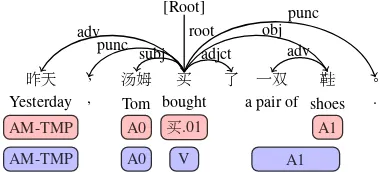
Figure 1: Example of span-based (blue blocks) and word-based (red blocks) SRL formulations in a sen-tence, where the top part is its dependency tree.
traction (Bastianelli et al.,2013), machine transla-tion (Liu and Gildea,2010;Gao and Vogel,2011) and question answering (Shen and Lapata, 2007;
Wang et al.,2015a).
There are two formulations of SRL in the com-munity according to the definition of semantic roles. The first is calledspan-based SRL, which
employs a continuous word span as a semantic role and follows the manual annotations in the Prop-Bank (Palmer et al., 2005) and NomBank (
Mey-ers et al., 2004). The second is word-basedSRL
(Surdeanu et al., 2008), also called
dependency-based SRL, whose semantic role is usually
syn-tactic or semantic head word of the manually an-notated word span. Figure1gives an example of the two forms in a sentence, where “bought” is the given predicate.
Intuitively, syntax and semantics are strongly correlative. For example, the semanticA0andA1
roles are usually the syntactic subject and object, as shown in Figure 1. Inspired by the correla-tion, researchers try to improve SRL performance by exploring various ways to integrate syntactic knowledge (Roth and Lapata, 2016; He et al.,
2018b; Swayamdipta et al., 2018). In contrast,
some recent works (He et al., 2017; Tan et al.,
2018;Cai et al.,2018) propose deep neural
in-formation, achieving promising results. Most re-cently, He et al. (2018a); Li et al. (2019) extend the span-based models to jointly tackle the predi-cate and argument identification sub-tasks of SRL. Compared with the large amount of research for English SRL, Chinese SRL works are rare, mainly because of the limited amount of data and lack of attention of Chinese researchers. For Chinese, the commonly used datasets are Chinese Proposi-tion Bank 1.0 (CPB1.0) (span-based) (Xue,2008) and CoNLL-2009 Chinese (word-based) (Hajiˇc
et al., 2009). The CPB1.0 dataset follows the
same annotation guideline with the English Prop-Bank benchmark (Palmer et al., 2005). Wu and
Palmer (2015) present a top model based
selec-tion preference approach to improve Chinese SRL. Since the amount of CPB1.0 dataset is small,Xia
et al. (2017) exploit heterogeneous SRL data to
improve the performance via a progressive learn-ing approach. The CoNLL-2009 benchmark is released by the CoNLL-2009 shared task (Hajiˇc
et al.,2009). Previous works (Marcheggiani et al.,
2017;He et al., 2018b; Cai et al., 2018) mainly
focus on building more powerful models or ex-ploring the usage of external knowledge on this dataset.
Inspired by the development of neural models and exploration of syntactic information, this pa-per proposes a MTL framework to extract syntac-tic representations as the external input features for the simple unified SRL model. The contribu-tions of our paper are three-folds:
1. We introduce a simple unified model for span-based and word-based Chinese SRL. 2. We propose a MTL framework to extract
implicit syntactic representations for SRL model, which significantly outperforms the baseline model.
3. Detailed analysis gains crucial insights on the effectiveness of our proposed framework.
We conduct experiments on the benchmarks of CPB1.0 and CoNLL-2009. The results show that our framework achieves new state-of-the-art 87.54 and 88.5 F1 scores on the two test data, respec-tively.
2 Basic SRL Model
Motivated by the recently presented span-based models (He et al., 2018a; Li et al., 2019) for
jointly predicting predicates and arguments, we in-troduce a simple unified span-based model. For-mally, given a sentence s = w1, w2, ..., wn, the span-based model aims to predict a set of labeled predicate-argument relationshipsY ⊆ P × A × R, whereP = {w1, w2, ..., wn}is the set of all can-didate predicates, A = {(wi, ..., wj)|1 ≤ i ≤
j ≤n}is the set of all candidate arguments, and Ris the set of the semantic roles. FollowingHe
et al.(2018a), we also include a null labelin the
role set Rindicating no relation between the fo-cused predicate and argument. The model objec-tive is to optimize the probability of the predicate-argument-role tuplesy∈ Y in a sentences, which
is formulated as:
P(y|s) = Y
p∈P,a∈A,r∈R
P(y(p,a,r)|s)
= Y
p∈P,a∈A,r∈R
eφ(p,a,r)
P
r0∈Reφ(p,a,r 0)
(1)
whereφ(p, a, r) =φp(p) +φa(a) +φr(p, a)is the score of the predicate-argument-relation tuple. We directly adopt the model architecture ofHe et al.
(2018a) as our basic SRL model with a
modifica-tion on the argument representamodifica-tion. The architec-ture of the basic SRL module is shown in the right part of Figure2, and we will describe it in the fol-lowing subsections.
2.1 Input Layer
FollowingHe et al.(2018a);Li et al. (2019), we employ CNNs to encode Chinese characters for each wordwiinto its character representation, de-noted asrepchari . Then, we concatenaterepchari
with the word embedding embword
i to represent the word-level features as our basic model in-put. In addition, we also employ BERT represen-tations (Devlin et al., 2019) to boost the perfor-mance of our baseline model, which we denote as
repBERTi . Formally, the input representation of
wiis:
xi =repchari ⊕embwordi ⊕repBERTi (2)
, where⊕is the concatenation operation. Our ba-sic SRL model and BERT-enhanced baseline de-pend on whether including the BERT representa-tionrepBERTi or not.
2.2 BiLSTM Encoder
Input representation
BiLSTMs
买 bought
Biaffine Scorer
了
MLP Scorer
买 bought
Predicate Representation
了 一双
a pair of
鞋 shoes
[image:3.595.92.508.61.281.2]X Argument Representation
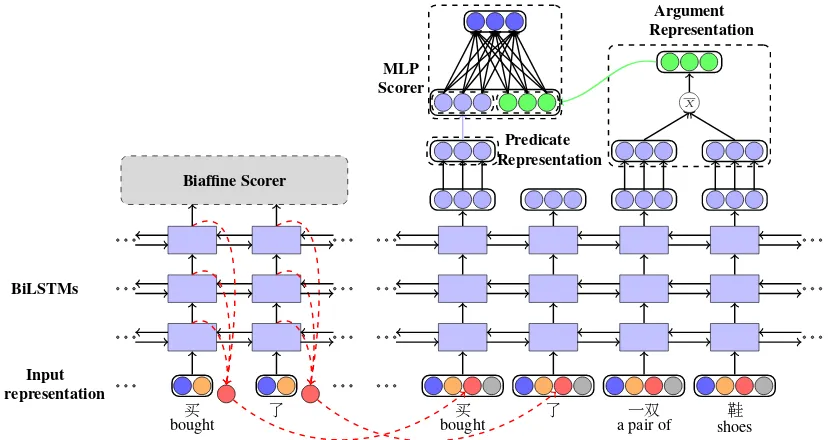
Figure 2: The detailed architecture of our proposed framework, where the left part is the dependency parser and the right part is the basic SRL module, respectively.
Zhang et al.,2016b) to encode long-range
depen-dencies and obtain rich representations denoted as
hifor time stampi. The highway connections are used to alleviate the gradient vanishing problem when training deep neural networks.
2.3 Predicate and Argument Representations
We directly employ the output of the top BiLSTM as the predicate representation at each time stamp. For all the candidate arguments, we simplify the representations by employing the mean operation over the BiLSTM outputs within the correspond-ing argument spans, which achieves similar results compared with the attention-based span represen-tations (He et al., 2018a) on English SRL in our preliminary experiments. Formally,
reppi =hi
repaj,k =mean(hj, ...,hk)
(1≤i≤n; 1≤j≤k≤n)
(3)
Specifically, for word-based SRL, we only need to set the length of candidate arguments to be 1.
2.4 MLP Scorer
We employ the MLP scorers as the scoring func-tions to determine whether the candidate predi-cates or arguments need to be pruned. Another MLP scorer is employed to compute the score of whether the focused candidate predicate and
argu-ment can compose a semantic relation.
φp(p) =wp>MLPp(reppi)
φa(a) =wa>MLPa(repaj,k)
φr(p, a) =wr>MLPr([reppi;repaj,k]) (4)
3 Proposed Framework
Our framework includes two modules, a basic SRL module and a dependency parser module, as shown in Figure 2. In this section, we will first describe the architecture of the employed depen-dency parser, and then illustrate the integration of the syntactic parser into the basic SRL model.
3.1 Dependency Parser Module
(a)
Dep SRL Dep SRL
[image:4.595.101.263.60.186.2](b)
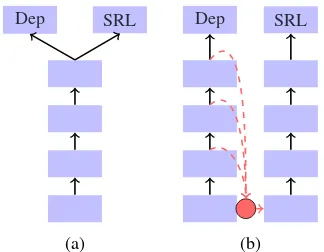
Figure 3: Comparison between the architectures of hard parameter sharing (a) and our proposed implicit representation integration (b).
3.2 Details of Integration
Multi-task learning (MTL) approaches can effec-tively exploit the standard dependency trees to improve the SRL performance, regarding depen-dency parsing as the auxiliary task. Hard pa-rameter sharing (Ruder, 2017) is the most com-monly used method in MTL, which shares several common layers between tasks and keeps the task-specific output layers, as illustrated by the sub-figure a in Figure3. We propose a better way to integrate the focused two tasks in this work. In the following, we will describe the intuition and details of the integration on the two tasks.
As is well known, the hard parameter sharing approach can provide representations for all the shared tasks and reduce the probability of over-fitting on the main task. However, this kind of sharing strategy somewhat weakens the represen-tation framework maintains distinct model param-eters for each task, due to the neutralization of knowledge introduced by the auxiliary task. Dif-ferent from the hard parameter sharing strategy, we propose to integrate the syntactic information into the input layer of the basic SRL module, as illustrated by sub-figure b of Figure3. And Figure
2 shows the detailed architecture. First, we ex-tract all the 3 BiLSTM hidden outputs of the de-pendency parser as the syntactic representations. Second, we employ the normalized weights to sum the extracted representations as the final syntac-tic representation for wordwi, denoted asrepsyni . Formally,
repsyni = X
1≤j≤N
αj∗hji (5)
where N is the layer number of the highway BiL-STMs, and αj is the j−th softmax weight.
Fi-nally, the extracted syntactic representations are fed into the input layer of the SRL module, and concatenated with the original SRL module input. We design this framework for several considera-tions: 1) the proposed framework keeps the own model parameters for each task, thereby maximiz-ing task-specific information for the main task, 2) the dependency parser module can be updated by the gradients returned from the extracted syntactic representations, which can encourage it to produce semantic preferred representations.
3.3 Training Objective
Given the sets of SRL dataSand dependency data D, the framework loss function is defined as the sum of the negative log-likelihood loss of the two tasks:
− X
(Y∗
s,Xs)∈S
logP(Ys∗|Xs)
+α X
(Yd∗,Xd)∈D
logP(Yd∗|Xd)
(6)
whereYs∗ andYd∗are gold semantic and syntactic
structures respectively, andα is a corpus
weight-ing factor to control the loss contribution of the dependency data in each batch as discussed in the experiments.
4 Experiments
4.1 Settings
We evaluate the proposed MTL framework on two commonly used benchmark datasets of Chinese: Chinese Proposition Bank 1.0 (CPB1.0) (span-based) (Xue, 2008) and CoNLL-2009 (word-based) (Hajiˇc et al., 2009). Following previous works, we report the results of span-based SRL in two setups: pre-identified predicates and end-to-end. For word-based SRL, we only report the
results in thepre-identified predicatessetting.
Fol-lowing Roth and Lapata (2016), we employ the mate-tools1(Bj¨orkelund et al.,2010) for the pred-icate disambiguation, which achieves 94.87% and 94.91% F1 scores on the CoNLL-2009 Chinese development and test data respectively.
Dependency Parsing Data. We employ the
Chinese Open Dependency Treebank2constructed at Soochow University. The treebank construction
1https://code.google.com/archive/p/mate-tools/ 2
project aims to continually build a large-scale Chi-nese dependency treebank that covers up-to-date texts from different domains and sources (Peng
et al.,2019). So far, CODT contains 67,679
sen-tences from 9 different domains or sources.
BERT Representations. Recently, BERT
(Bidirectional Encoder Representations from Transformers) is proposed byDevlin et al.(2019), which makes use of Transformers to learn contex-tual representations between words. In this paper, we use the pre-trained Chinese model3 to extract the BERT representations for our span-based and word-based SRL datasets. We extract the fixed BERT representations from the last four hidden layers of the pre-trained model. Finally, we also employ the normalized weighted sum operation to obtain the final BERT representation for each wordwi, denoted asrepBERTi .
Hyperparameters. We employ word2vec
(Mikolov et al., 2013) to train the Chinese word
embeddings on the Chinese Gigaword dataset4. The Chinese char embeddings are randomly ini-tialized, and the dimension is 100. We employ the CNN to get the Chinese char representations, which has window size of 3, 4 and 5, and the out-put channel size is 100. For other parameter set-tings in the SRL module, we mostly follow the work of He et al. (2018a). As for the pruning of candidate predicates and arguments, we choose the pruning ratios according to the training data, using λp = 0.4 for predicates andλa = 0.8for arguments with up to 30 words.
Training Criterion. We choose Adam
(Kingma and Ba, 2015) optimizer with 0.001 as
the initial learning rate and 0.1% as the decay rate for every 100 steps. Each data batch is composed of both SRL and dependency instances. We ran-domly shuffle the SRL and dependency training datasets if the smaller SRL data is used up. All baseline models are trained for at most 180,000 steps, and 100,000 steps for other models. In ad-dition, we pick the best model on the development data for testing. We apply 0.5 dropout to the word embeddings and Chinese character representations and 0.2 dropout to all hidden layers. We employ variational dropout masks that are shared across all timesteps (Gal and Ghahramani,2016) for the highway BiLSTMs, with 0.4 dropout rate.
Evaluation. We adopt the official scripts
pro-3
https://github.com/google-research/bert# pre-trained-models
4
https://catalog.ldc.upenn.edu/LDC2003T09
vided by CoNLL-20055 and CoNLL-20096 for span-based and word-based SRL evaluation, re-spectively. We conduct significant tests using the Dan Bikel’s randomized parsing evaluation com-parer.
4.2 Syntax-aware Methods
To illustrate the effectiveness and advantage of our proposed framework7 (Integration of Implicit Representations, IIR), we conduct several exper-iments with the recently employed syntax-aware methods on CPB1.0 dataset for comparison:
• Tree-GRUXia et al. (2019) investigate
sev-eral syntax-aware methods for the English span-based SRL, showing the effectiveness of introducing syntactic knowledge into the SRL task. We only compare with the Tree-GRU method, since the other methods are all predicate-specific and hence not fit into our basic SRL model.
• FIR Following Yu et al. (2018) and Zhang
et al.(2019), we extract the outputs of
BiL-STMs as the fixed implicit representations (FIR) from a pre-trained biaffine parser. In detail, we train the biaffine parser with the same training data used in our framework, and employ the combination of development data of CDT (997 sentences) and PCTB7 (998 sentences) as the development data. The biaffine parser achieves 79.71% UAS and 74.74% LAS on the combined development data.
• HPSWe employ the commonly used hard
pa-rameter sharing (HPS) strategy of MTL as a strong baseline, which shares the word and char embeddings and 3-layer BiLSTMs be-tween the dependency parser and the basic SRL module.
4.3 Main Results
Results of Syntax-aware Methods. Table 1
shows the results of these syntax-aware methods on CPB1.0 dataset. First, the first line shows the results of our baseline model, which only employs the word embeddings and char representations as the inputs of the basic SRL model. Second, the
5
http://www.cs.upc.edu/˜srlconll/st05/st05.html 6
https://ufal.mff.cuni.cz/conll2009-st/scorer. html
7
Dev Test
Methods P R F1 P R F1
Baseline 81.52 82.17 81.85 80.95 80.01 80.48
Baseline + Dep (Tree-GRU) 82.35 80.24 81.28 82.10 78.11 80.06 Baseline + Dep (FIR) 83.56 83.05 83.30 83.38 81.93 82.65
Baseline + Dep (HPS) 82.58 84.15 83.36 83.22 83.81 83.51
[image:6.595.101.498.65.171.2]Baseline + Dep (IIR) 83.12 83.66 83.39 84.49 83.34 83.91
Table 1: Experimental results of syntax-aware methods we compare on CPB1.0 dataset.
Tree-GRU method only achieves 80.06 F1 score on the test data, which even didn’t catch up with the baseline model. We think this is caused by the relatively low accuracy in Chinese dependency parsing. Third, the FIR approach outperforms the baseline by 2.17 F1 score on the test data, demon-strating the effectiveness of introducing fixed im-plicit syntactic representations. Forth, the HPS strategy achieves more significant performance by 83.51 F1 score. Finally, our proposed framework achieves the best performance of 83.91 F1 score among these methods, outperforming the baseline by 3.43 F1 score. All the improvements are sta-tistically significant (p < 0.0001). From these
experimental results, we can conclude that: 1) the quality of syntax has a crucial impact on the methods which depend on the systematic depen-dency trees, like Tree-GRU, 2) the implicit syn-tactic features have the potential to improve the down-stream NLP tasks, and 3) learning the syn-tactic features with the main task performs better than extract them from a fixed dependency parser.
Results on CPB1.0. Table2shows the results
of our baseline model and proposed framework us-ing external dependency trees on CPB1.0, as well as the corresponding results when adding BERT representations. It is clear that adding dependency trees into the baseline SRL model can effectively improve the performance (p < 0.0001), no
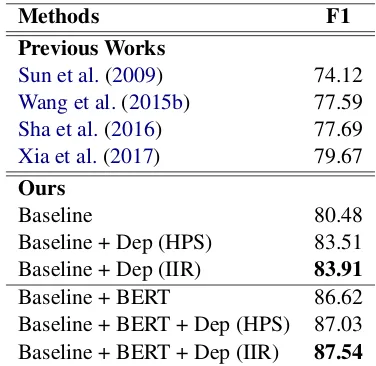
mat-ter whether employ the BERT representations or not. Especially, our proposed framework (IIR) consistently outperforms the hard parameter shar-ing strategy. So we only report the results of our proposed framework in later experiments. Our fi-nal results outperforms the best previous model
(Xia et al.,2017) by 7.87 and 4.24 F1 scores with
BERT representations or not, respectively.
Table 3 shows the results of our framework in the end-to-end setting. To our best knowledge,
we are the first to present the results of
end-to-Methods F1
Previous Works
Sun et al.(2009) 74.12
Wang et al.(2015b) 77.59
Sha et al.(2016) 77.69
Xia et al.(2017) 79.67
Ours
Baseline 80.48
Baseline + Dep (HPS) 83.51 Baseline + Dep (IIR) 83.91
Baseline + BERT 86.62
Baseline + BERT + Dep (HPS) 87.03 Baseline + BERT + Dep (IIR) 87.54
Table 2: Results and comparison with previous works on CPB1.0 test set.
end on the CPB1.0 dataset. We achieve the
re-sult of 85.57 in F1 score, which is a strong base-line for later works. It is clear that our framework can still achieve better results compared with the strong baseline, which employs BERT representa-tions as the external input.
Results on CoNLL-2009. Table 4 shows the
results of our framework and comparison with previous works on the CoNLL-2009 Chinese test data. Our baseline achieves nearly the same
per-Dev Test
Methods F1 F1
Ours
Baseline 80.37 79.29
Baseline + Dep (IIR) 82.39 81.73
Baseline + BERT 85.30 85.26 Baseline + BERT + Dep (IIR) 85.92 85.57
[image:6.595.321.509.217.400.2] [image:6.595.312.524.620.726.2]Methods P R F1 Previous Works
Roth and Lapata(2016) 83.2 75.9 79.4
Marcheggiani et al.(2017) 84.6 80.4 82.5
He et al.(2018b) 84.2 81.5 82.8
Cai et al.(2018) 84.7 84.0 84.3
Ours
Baseline 83.7 84.8 84.2
Baseline + Dep (IIR) 84.6 85.7 85.1
Baseline + BERT 87.8 89.2 88.5
[image:7.595.77.287.61.217.2]Baseline + BERT + Dep (IIR) 88.0 89.1 88.5
Table 4: Results and comparison with previous works on CoNLL-2009 Chinese test set.
0-10 11-20 21-30 31-40 41-MAX
80 85 90 95
F1
(%)
Baseline
Baseline + Dep (IRI) Baseline + BERT
Baseline + BERT + Dep (IRI)
Figure 4: F1 scores regarding to the sentence length of the CoNLL-2009 Chinese dev data.
formance withCai et al.(2018), which is an end-to-end neural model that consists of BiLSTM en-coder and biaffine scorer. Our proposed frame-work outperforms the best reported result (Cai
et al., 2018) by 0.8 F1 score and brings a
signif-icant improvement (p < 0.0001) of 0.9 F1 score
over our baseline model. Our experimental result boosts to 88.5 F1 score when the framework is enhanced with BERT representations. However, compared with the results in the settings without BERT, the improvement is fairly small (88.53 -88.47 = 0.06 F1 score,p > 0.1)8of the proposed
framework, which we will discuss in Section5.3.
5 Analysis
In this section, we conduct detailed analysis to un-derstand the improvements introduced by our pro-posed framework.
5.1 Long-distance Dependencies
To analyze the effect of the proposed framework regarding to the distance of sentence lengths, we report the F1 scores of different sets of sentence
8Following previous works, we only retrain the experimental results with one decimal point
A0 A1 A2 ADV DIS LOC MNR TMP
60 65 70 75 80 85 90
80.63 82.51
73.51 83.87
71.71
76.03 76.22
78.58 82.56
85.25
74.33 84.74
71.38
76.55 76.7
80.19
Accurac
y(%)
[image:7.595.319.513.65.187.2]Baseline Baseline + Dep (IRI)
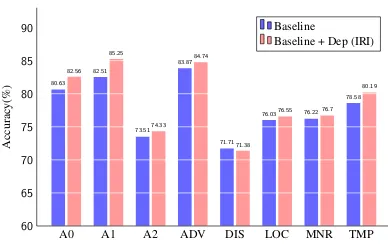
Figure 5: Accuracy comparison of different semantic roles between Baseline andBaseline + Dep (IIR) on
CoNLL-2009 dev data.
lengths, as shown in Figure 4. We can see that improvements are obtained for nearly all sets of sentences, especially on the sentences with long-distance. It demonstrate thatsyntactic knowledge is beneficial for SRL and effective to capture long-distance dependencies.
5.2 Improvements on Semantic Roles
To find which semantic roles benefit from our syntax-aware framework, we report the F1 scores on several semantic role labels in Figure 5. We can see that syntax helps most on the A0andA1
roles, which is consistent with the intuition that the semanticA0andA1roles are usually the
syn-tactic subject and object of a verb predicate. Other adjunct semantic roles likeADV,LOC,MNRand TMPall benefit from the introduction of syntactic
information. There is an interesting finding that theDISrole obtains worse performance when
in-troduce syntactic information. We conduct error analysis on this phenomena, and we found that the framework mostly confuses DIS with ADV. The
possible reason is that the two semantic roles are both labeled asadvin syntax.
5.3 Integration with BERT
BERT is employed to boost the performance of our basic SRL model and our proposed frame-work. Compared with results in the settings with-out BERT, the improvements of our framework over the BERT-enhanced baseline are fairly small on CoNLL-2009, as shown by the last two lines in Table4. To analyze the difference between the two models (Baseline + BERTandBaseline + BERT + Dep (IIR)), we conduct an analysis on the sentence
[image:7.595.77.282.268.371.2]Fig-70 75 80 85 90 95 100
70 75 80 85 90 95 100
F1 (%)
F1
[image:8.595.97.266.60.224.2](%)
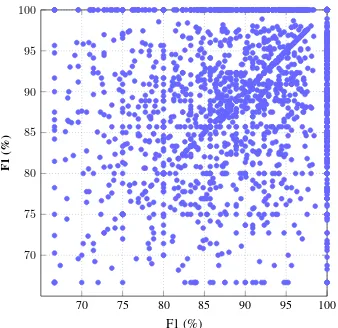
Figure 6: Sentence F1 scores comparison on CoNLL-2009 Chinese test data, where the x axis presents the F1 scores ofBaseline + BERTand y axis shows the F1
scores ofBaseline + BERT + Dep (IIR), respectively.
ure6, we can see that most of the scatter points are off the diagonal line, demonstrating strong differ-ences between the two models. Based on this find-ing, how to better integrate syntactic knowledge and BERT representations becomes an interesting and meaningful question, and we leave it for future work.
6 Related Work
Traditional discrete-feature-based SRL works
(Swanson and Gordon, 2006; Zhao et al., 2009)
mainly make heavy use of syntactic information. Along with the impressive development of neural-network-based approaches in the NLP community, much attention has been paid to build more pow-erful neural model without considering any syn-tactic information. Zhou and Xu (2015) employ deep stacked BiLSTMs and achieve strong per-formance for span-based English SRL. He et al.
(2017) extend their work (Zhou and Xu, 2015) by employing several advanced practices in recent deep learning literature, leading to significant im-provements. Tan et al. (2018) present a strong self-attention based model, achieving significant improvements. Inspired by the span-based model proposed byLee et al.(2017) for coreference res-olution, He et al. (2018a); Ouchi et al. (2018) present similar span-based models for SRL which can exploit span-level features. For word-based
SRL, Marcheggiani et al. (2017) propose a
sim-ple and fast syntax-agnostic model with rich input representations. Cai et al.(2018) present an end-to-end model with BiLSTMs and biaffine scorer
to jointly handle the predicate disambiguation and the argument labeling sub-tasks.
Apart from the above syntax-free works, re-searchers also pay much attention on improving the neural-based SRL approaches by introducing syntactic knowledge. Roth and Lapata(2016) in-troduce the dependency path embeddings to the neural-based model and achieve substantial im-provements. Marcheggiani and Titov (2017) em-ploy the graph convolutional neural networks on top of the BiLSTM encoder to encode syntactic information. He et al. (2018b) propose a k-th order argument pruning algorithm based on sys-tematic dependency trees. Strubell et al. (2018) propose a self-attention based neural MTL model which incorporate dependency parsing as a aux-iliary task for SRL. Swayamdipta et al. (2018) propose a MTL framework using hard parame-ter strategy to incorporate constituent parsing loss into semantic tasks, i.e. SRL and coreference res-olution, which outperforms their baseline by +0.8 F1 score. Xia et al. (2019) investigate and com-pare several syntax-aware methods on span-based SRL, showing the effectiveness of integrating syn-tactic information.
Compared with the large amount of works on English SRL, Chinese SRL works are rare, mainly because of the limitation of datasize and lack of attention of Chinese researchers.Sun et al.(2009) treat the Chinese SRL as a sequence labeling prob-lem and build a SVM-based model by exploiting morphological and syntactic features. Wang et al.
(2015b) build a basic BiLSTM model and
intro-duce a way to exploit heterogeneous data by shar-ing word embeddshar-ings. Xia et al.(2017) propose a progressive model to learn and transfer knowledge from heterogeneous SRL data. The above works are all focus on the span-based Chinese SRL, and we compare with their results in Table2. Different from them, we propose a MTL framework to inte-grate implicit syntactic representations into a sim-ple unified model on both span-based and word-based SRL, achieving substantial improvements.
In addition to the hard parameter sharing strat-egy that we discuss in Section3.2, partial param-eter sharing strategy is also a commonly studied approach in MTL and domain adaptation. Kim
et al. (2016) introduce simple neural extensions
et al.(2017) explore a multitask learning approach which shares parameters across formalisms for se-mantic dependency parsing. In addition, Peng
et al. (2018) present a multi-task approach for
frame-semantic parsing and semantic dependency parsing with latent structured variables.
7 Conclusion
This paper proposes a syntax-aware MTL frame-work to integrate implicit syntactic representations into a simple unified SRL model. The experimen-tal results show that our proposed framework can effectively improve the basic SRL model, even when the basic model is enhanced with BERT representations. Especially, our proposed frame-work is more effective at utilizing syntactic infor-mation, compared with the hard parameter shar-ing strategy of MTL. By utilizshar-ing BERT repre-sentations, our framework achieves new state-of-the-art performance on both span-based and word-based Chinese SRL benchmarks, i.e. CPB1.0 and CoNLL-2009 respectively. Detailed analy-sis shows that syntax helps most on the long sen-tences, because of the long-distance dependencies captured by syntax trees. Moreover, the compari-son of sentence performance indicates that there is still a lot of work to do to better integrate syntactic information and BERT representation.
Acknowledgments
We thank our anonymous reviewers for their help-ful comments. This work was supported by Na-tional Natural Science Foundation of China (Grant No. 61525205, 61876116, 61432013) and a project funded by the Priority Academic Program Development of Jiangsu Higher Education Institu-tions.
References
Emanuele Bastianelli, Giuseppe Castellucci, Danilo Croce, and Roberto Basili. 2013. Textual inference and meaning representation in human robot interac-tion. InProceedings of JSSP, pages 65–69.
Anders Bj¨orkelund, Bernd Bohnet, Love Hafdell, and Pierre Nugues. 2010. A high-performance syntactic and semantic dependency parser. InProceedings of COLING, pages 33–36.
Jiaxun Cai, Shexia He, Zuchao Li, and Hai Zhao. 2018. A full end-to-end semantic role labeler, syntactic-agnostic over syntactic-aware? In Proceedings of COLING, pages 2753–2765.
Jacob Devlin, Ming-Wei Chang, Kenton Lee, and Kristina Toutanova. 2019. Bert: Pre-training of deep bidirectional transformers for language understand-ing. InProceedings of NAACL-HLT, pages 4171–
4186.
Timothy Dozat and Christopher D Manning. 2017. Deep biaffine attention for neural dependency pars-ing. InProceedings of ICIR.
Yarin Gal and Zoubin Ghahramani. 2016. A theoret-ically grounded application of dropout in recurrent neural networks. In Proceedings of NIPS, pages
1019–1027.
Qin Gao and Stephan Vogel. 2011. Corpus expan-sion for statistical machine translation with semantic role label substitution rules. InProceedings of ACL,
pages 294–298.
Jan Hajiˇc, Massimiliano Ciaramita, Richard Johans-son, Daisuke Kawahara, Maria Ant`onia Mart´ı, Llu´ıs M`arquez, Adam Meyers, Joakim Nivre, Sebastian Pad´o, Jan ˇStˇep´anek, et al. 2009. The CoNLL-2009 shared task: Syntactic and semantic dependencies in multiple languages. In Proceedings of CoNLL: Shared Task, pages 1–18. ACL.
Luheng He, Kenton Lee, Omer Levy, and Luke Zettle-moyer. 2018a. Jointly predicting predicates and ar-guments in neural semantic role labeling. In Pro-ceedings of ACL, pages 364–369.
Luheng He, Kenton Lee, Mike Lewis, and Luke Zettle-moyer. 2017. Deep semantic role labeling: What works and whats next. InProceedings of ACL, pages
473–483.
Shexia He, Zuchao Li, Hai Zhao, and Hongxiao Bai. 2018b. Syntax for semantic role labeling, to be, or not to be. InProceedings of ACL, pages 2061–2071.
Young-Bum Kim, Karl Stratos, and Ruhi Sarikaya. 2016. Frustratingly easy neural domain adaptation. InProceedings of COLING, pages 387–396.
Diederik P Kingma and Jimmy Ba. 2015. Adam: A method for stochastic optimization. InProceedings of ICLR.
Kenton Lee, Luheng He, Mike Lewis, and Luke Zettle-moyer. 2017. End-to-end neural coreference resolu-tion. InProceedings of EMNLP, pages 188–197.
Zuchao Li, Shexia He, Hai Zhao, Yiqing Zhang, Zhu-osheng Zhang, Xi Zhou, and Xiang Zhou. 2019. De-pendency or span, end-to-end uniform semantic role labeling. InProceedings of AAAI.
Ding Liu and Daniel Gildea. 2010. Semantic role fea-tures for machine translation. In Proceedings of COLING, pages 716–724.
Diego Marcheggiani and Ivan Titov. 2017. Encoding sentences with graph convolutional networks for se-mantic role labeling. In Proceedings of EMNLP,
pages 1506–1515.
Adam Meyers, Ruth Reeves, Catherine Macleod, Rachel Szekely, Veronika Zielinska, Brian Young, and Ralph Grishman. 2004. The nombank project: An interim report. InProceedings of HLT-NAACL.
Tomas Mikolov, Ilya Sutskever, Kai Chen, Greg S Cor-rado, and Jeff Dean. 2013. Distributed representa-tions of words and phrases and their compositional-ity. InProceedings of NIPS, pages 3111–3119.
Hiroki Ouchi, Hiroyuki Shindo, and Yuji Matsumoto. 2018. A span selection model for semantic role labeling. InProceedings of EMNLP, pages 1630–
1642.
Martha Palmer, Daniel Gildea, and Paul Kingsbury. 2005. The proposition bank: An annotated cor-pus of semantic roles. Computational linguistics,
31(1):71–106.
Hao Peng, Sam Thomson, and Noah A Smith. 2017. Deep multitask learning for semantic dependency parsing. InProceedings of ACL, pages 2037–2048.
Hao Peng, Sam Thomson, Swabha Swayamdipta, and Noah A Smith. 2018. Learning joint semantic parsers from disjoint data. In Proceedings of NAACL-HLT, pages 1492–1502.
Xue Peng, Zhenghua Li, Min Zhang, Rui Wang, Yue Zhang, and Luo Si. 2019. Overview of the nlpcc 2019 shared task: Cross-domain dependency pars-ing. In Proceedings of The 8th CCF International Conference on Natural Language Processing and Chinese Computing (NLPCC).
Michael Roth and Mirella Lapata. 2016. Neural se-mantic role labeling with dependency path embed-dings. InProceedings of ACL, pages 1192–1202.
Sebastian Ruder. 2017. An overview of multi-task learning in deep neural networks. arXiv preprint arXiv:1706.05098.
Lei Sha, Sujian Li, Baobao Chang, Zhifang Sui, and Tingsong Jiang. 2016. Capturing argument relation-ship for chinese semantic role labeling. In Proceed-ings of EMNLP, pages 2011–2016.
Dan Shen and Mirella Lapata. 2007. Using semantic roles to improve question answering. In Proceed-ings of EMNLP-CoNLL, pages 12–21.
Rupesh K Srivastava, Klaus Greff, and J¨urgen Schmid-huber. 2015. Training very deep networks. In Pro-ceedings of NIPS, pages 2377–2385.
Emma Strubell, Patrick Verga, Daniel Andor, David Weiss, and Andrew McCallum. 2018. Linguistically-informed self-attention for semantic role labeling. In Proceedings of EMNLP, pages
5027–5038.
Weiwei Sun, Zhifang Sui, Meng Wang, and Xin Wang. 2009. Chinese semantic role labeling with shallow parsing. In Proceedings of EMNLP, pages 1475–
1483.
Mihai Surdeanu, Richard Johansson, Adam Meyers, Llu´ıs M`arquez, and Joakim Nivre. 2008. The conll-2008 shared task on joint parsing of syntactic and semantic dependencies. InProceedings of CoNLL,
pages 159–177.
Reid Swanson and Andrew S Gordon. 2006. A com-parison of alternative parse tree paths for labeling semantic roles. In Proceedings of COLING/ACL,
pages 811–818.
Swabha Swayamdipta, Sam Thomson, Kenton Lee, Luke Zettlemoyer, Chris Dyer, and Noah A Smith. 2018. Syntactic scaffolds for semantic structures. InProceedings of EMNLP, pages 3772–3782.
Zhixing Tan, Mingxuan Wang, Jun Xie, Yidong Chen, and Xiaodong Shi. 2018. Deep semantic role la-beling with self-attention. InProceedings of AAAI,
pages 4929–4936.
Hai Wang, Mohit Bansal, Kevin Gimpel, and David McAllester. 2015a. Machine comprehension with syntax, frames, and semantics. In Proceedings of ACL-IJCNLP, pages 700–706.
Zhen Wang, Tingsong Jiang, Baobao Chang, and Zhi-fang Sui. 2015b. Chinese semantic role labeling with bidirectional recurrent neural networks. In Pro-ceedings of EMNLP, pages 1626–1631.
Shumin Wu and Martha Palmer. 2015. Can selectional preferences help automatic semantic role labeling? In Proceedings of the Fourth Joint Conference on Lexical and Computational Semantics, pages 222–
227.
Qiaolin Xia, Lei Sha, Baobao Chang, and Zhifang Sui. 2017. A progressive learning approach to chinese srl using heterogeneous data. InProceedings of ACL,
pages 2069–2077.
Qingrong Xia, Zhenghua Li, Min Zhang, Zhang Meis-han, Guohong Fu, Rui Wang, and Luo Si. 2019. Syntax-aware neural semantic role labeling. In Pro-ceedings of AAAI.
Nianwen Xue. 2008. Labeling chinese predicates with semantic roles. Computational linguistics,
34(2):225–255.
Nan Yu, Meishan Zhang, and Guohong Fu. 2018. Transition-based neural rst parsing with implicit syntax features. InProceedings of COLING, pages
559–570.
Meishan Zhang, Yue Zhang, and Guohong Fu. 2016a. Transition-based neural word segmentation. In Pro-ceedings of ACL, pages 421–431.
Yu Zhang, Guoguo Chen, Dong Yu, Kaisheng Yaco, Sanjeev Khudanpur, and James Glass. 2016b. High-way long short-term memory rnns for distant speech recognition. In Proceedings of ICASSP, pages
5755–5759.
Hai Zhao, Wenliang Chen, and Chunyu Kit. 2009. Se-mantic dependency parsing of nombank and prop-bank: An efficient integrated approach via a large-scale feature selection. InProceedings of EMNLP,
pages 30–39.
Jie Zhou and Wei Xu. 2015. End-to-end learning of semantic role labeling using recurrent neural net-works. In Proceedings of ACL-IJCNLP, pages