Proceedings of the 2011 Conference on Empirical Methods in Natural Language Processing, pages 1363–1372,
Watermarking the Outputs of Structured Prediction with an
application in Statistical Machine Translation.
Ashish Venugopal1 Jakob Uszkoreit1 David Talbot1 Franz J. Och1 Juri Ganitkevitch2
1Google, Inc. 2Center for Language and Speech Processing
1600 Amphitheatre Parkway Johns Hopkins University
Mountain View, 94303, CA Baltimore, MD 21218, USA
{avenugopal,uszkoreit,talbot,och}@google.com [email protected]
Abstract
We propose a general method to water-mark and probabilistically identify the structured outputs of machine learning al-gorithms. Our method is robust to lo-cal editing operations and provides well defined trade-offs between the ability to identify algorithm outputs and the qual-ity of the watermarked output. Unlike previous work in the field, our approach does not rely on controlling the inputs to the algorithm and provides probabilistic guarantees on the ability to identify col-lections of results from one’s own algo-rithm. We present an application in statis-tical machine translation, where machine translated output is watermarked at mini-mal loss in translation quality and detected with high recall.
1 Motivation
Machine learning algorithms provide structured results to input queries by simulating human be-havior. Examples include automatic machine translation (Brown et al., 1993) or automatic text and rich media summarization (Goldstein et al., 1999). These algorithms often estimate some portion of their models from publicly avail-able human generated data. As new services that output structured results are made avail-able to the public and the results disseminated on the web, we face a daunting new challenge: Machine generated structured results contam-inate the pool of naturally generated human data. For example, machine translated output
and human generated translations are currently both found extensively on the web, with no auto-matic way of distinguishing between them. Al-gorithms that mine data from the web (Uszko-reit et al., 2010), with the goal of learning to simulate human behavior, will now learn mod-els from this contaminated and potentially self-generated data, reinforcing the errors commit-ted by earlier versions of the algorithm.
It is beneficial to be able to identify a set of encountered structured results as having been generated by one’s own algorithm, with the pur-pose of filtering such results when building new models.
Problem Statement: We define a
struc-tured result of a queryqasr={z1· · ·zL}where
the order and identity of elementszi are
impor-tant to the quality of the resultr. The structural aspect of the result implies the existence of alter-native results (across both the order of elements and the elements themselves) that might vary in their quality.
Given a collection of N results, CN =
r1· · ·rN, where each resultrihaskranked
alter-natives Dk(qi) of relatively similar quality and
queriesq1· · ·qN are arbitrary and not controlled
by the watermarking algorithm, we define the watermarking task as:
Task. Replaceri withri0 ∈Dk(qi) for some
sub-set of results in CN to produce a watermarked
collection CN0
such that:
• CN0 is probabilistically identifiable as having
been generated by one’s own algorithm.
• the degradation in quality from CN to the
watermarkedCN0 should be analytically con-trollable, trading quality for detection per-formance.
• C0
N should not be detectable as
water-marked content without access to the gen-erating algorithms.
• the detection ofC0
N should be robust to
sim-ple edit operations performed on individual resultsr∈ CN0 .
2 Impact on Statistical Machine Translation
Recent work(Resnik and Smith, 2003; Munteanu and Marcu, 2005; Uszkoreit et al., 2010) has shown that multilingual parallel documents can be efficiently identified on the web and used as training data to improve the quality of statisti-cal machine translation.
The availability of free translation services (Google Translate, Bing Translate) and tools (Moses, Joshua), increase the risk that the con-tent found by parallel data mining is in fact gen-erated by a machine, rather than by humans. In this work, we focus on statistical machine trans-lation as an application for watermarking, with the goal of discarding documents from training if they have been generated by one’s own algo-rithms.
To estimate the magnitude of the problem, we used parallel document mining (Uszkoreit et al., 2010) to generate a collection of bilingual document pairs across several languages. For each document, we inspected the page content for source code that indicates the use of trans-lation modules/plug-ins that translate and pub-lish the translated content.
We computed the proportion of the content within our corpus that uses these modules. We find that a significant proportion of the mined parallel data for some language pairs is gener-ated via one of these translation modules. The top 3 languages pairs, each with parallel trans-lations into English, are Tagalog (50.6%), Hindi (44.5%) and Galician (41.9%). While these proportions do not reflect impact on each lan-guage’s monolingual web, they are certainly high
enough to affect machine translations systems that train on mined parallel data. In this work, we develop a general approach to watermark structured outputs and apply it to the outputs of a statistical machine translation system with the goal of identifying these same outputs on the web. In the context of the watermarking task defined above, we output selecting alternative translations for input source sentences. These translations often undergo simple edit and for-matting operations such as case changes, sen-tence and word deletion or post editing, prior to publishing on the web. We want to ensure that we can still detect watermarked translations de-spite these edit operations. Given the rapid pace of development within machine translation, it is also important that the watermark be robust to improvements in underlying translation qual-ity. Results from several iterations of the system within a single collection of documents should be identifiable under probabilistic bounds.
While we present evaluation results for sta-tistical machine translation, our proposed ap-proach and associated requirements are applica-ble to any algorithm that produces structured results with several plausible alternatives. The alternative results can arise as a result of inher-ent task ambiguity (for example, there are mul-tiple correct translations for a given input source sentence) or modeling uncertainty (for example, a model assigning equal probability to two com-peting results).
3 Watermark Structured Results
Selecting an alternativer0 from the space of al-ternativesDk(q) can be stated as:
r0= arg max
r∈Dk(q)
w(r, Dk(q), h) (1)
where w ranks r ∈ Dk(q) based on r’s
presen-tation of a watermarking signal computed by a hashing operation h. In this approach, w and its component operation h are the only secrets
A specific implementation ofwwithin our wa-termarking approach can be evaluated by the following metrics:
• False Positive Rate: how often non-watermarked collections are falsely identi-fied as watermarked.
• Recall Rate: how often watermarked col-lections are correctly identified as water-marked.
• Quality Degradation: how significantly does C0
N differ from CN when evaluated by
task specific quality metrics.
While identification is performed at the col-lection level, we can scale these metrics based on the size of each collection to provide more task sensitive metrics. For example, in machine translation, we count the number of words in the collection towards the false positive and re-call rates.
In Section 3.1, we define a random hashing operation h and a task independent implemen-tation of the selector function w. Section 3.2 describes how to classify a collection of water-marked results. Section 3.3 and 3.4 describes re-finements to the selection and classification cri-teria that mitigate quality degradation. Follow-ing a comparison to related work in Section 4, we present experimental results for several lan-guages in Section 5.
3.1 Watermarking: CN → CN0
We define a random hashing operationhthat is applied to result r. It consists of two compo-nents:
• A hash function applied to a structured re-sult r to generate a bit sequence of a fixed length.
• An optional mapping that maps a single candidate result r to a set of sub-results. Each sub-result is then hashed to generate a concatenated bit sequence forr.
A good hash function produces outputs whose bits are independent. This implies that we can treat the bits for any input structured results
as having been generated by a binomial distri-bution with equal probability of generating 1s vs 0s. This condition also holds when accu-mulating the bit sequences over a collection of results as long as its elements are selected uni-formly from the space of possible results. There-fore, the bits generated from a collection of un-watermarked results will follow a binomial
dis-tribution with parameter p = 0.5. This result
provides a null hypothesis for a statistical test on a given bit sequence, testing whether it is likely to have been generated from a binomial distribution binomial(n, p) wherep= 0.5 andn
is the length of the bit sequence.
For a collectionCN =r1· · ·rN, we can define
a watermark ranking function w to systemati-cally select alternatives r0i ∈ Dk(q), such that
the resulting C0
N is unlikely to produce bit
se-quences that follow thep= 0.5 binomial distri-bution. A straightforward biasing criteria would be to select the candidate whose bit sequence ex-hibits the highest ratio of 1s. w can be defined as:
w(r, Dk(q), h) =
#(1, h(r))
|h(r)| (2)
whereh(r) returns the randomized bit sequence for result r, and #(x, ~y) counts the number of occurrences ofx in sequence~y. Selecting alter-natives results to exhibit this bias will result in watermarked collections that exhibit this same bias.
3.2 Detecting the Watermark
To classify a collection CN as watermarked or
non-watermarked, we apply the hashing opera-tion h on each element in CN and concatenate
the sequences. This sequence is tested against the null hypothesis that it was generated by a binomial distribution with parameter p = 0.5. We can apply a Fisherian test of statistical sig-nificance to determine whether the observed dis-tribution of bits is unlikely to have occurred by chance under the null hypothesis (binomial with
p= 0.5).
We consider a collection of results thatrejects
by:
p−value = Pn(X≥x) (3)
=
n
X
i=x
n i
pi(1−p)n−i (4)
wherexis the number of 1s observed in the col-lection, andnis the total number of bits in the sequence. Comparing this p-value against a de-sired significance level α, we reject the null hy-pothesis for collections that have Pn(X ≥x)<
α, thus deciding that such collections were gen-erated by our own system.
This classification criteria has a fixed false positive rate. Setting α = 0.05, we know that 5% of non-watermarked bit sequences will be
falsely labeled as watermarked. This parameter
αcan be controlled on an application specific ba-sis. By biasing the selection of candidate results to produce more 1s than 0s, we have defined a watermarking approach that exhibits a fixed false positive rate, a probabilistically bounded detection rate and a task independent hashing and selection criteria. In the next sections, we will deal with the question of robustness to edit operations and quality degradation.
3.3 Robustness and Inherent Bias
We would like the ability to identify water-marked collections to be robust to simple edit operations. Even slight modifications to the ele-ments within an itemrwould yield (by construc-tion of the hash funcconstruc-tion), completely different bit sequences that no longer preserve the biases introduced by the watermark selection function. To ensure that the distributional biases intro-duced by the watermark selector are preserved, we can optionally map individual results into a set of sub-results, each one representing some lo-cal structure ofr. his then applied to each sub-result and the sub-results concatenated to represent
r. This mapping is defined as a component of theh operation.
While a particular edit operation might af-fect a small number of sub-results, the majority of the bits in the concatenated bit sequence for
r would remain untouched, thereby limiting the damage to the biases selected during
watermark-ing. This is of course no defense to edit opera-tions that are applied globally across the result; our expectation is that such edits would either significantly degrade the quality of the result or be straightforward to identify directly.
For example, a sequence of wordsr=z1· · ·zL
can be mapped into a set of consecutiven-gram sequences. Operations to edit a wordzi inr will
only affect events that consider the wordzi. To
account for the fact that alternatives in Dk(q)
might now result in bit sequences of different lengths, we can generalize the biasing criteria to directly reflect the expected contribution to the watermark by defining:
w(r, Dk(q), h) =Pn(X ≥#(1, h(r))) (5)
wherePn gives probabilities from binomial(n=
|h(r)|, p= 0.5).
Inherent collection level biases: Our null
hypothesis is based on the assumption that col-lections of results draw uniformly from the space of possible results. This assumption might not always hold and depends on the type of the re-sults and collection. For example, considering a text document as a collection of sentences, we can expect that some sentences might repeat more frequently than others.
This scenario is even more likely when ap-plying a mapping into sub-results. n-gram se-quences follow long-tailed or Zipfian distribu-tions, with a small number ofn-grams contribut-ing heavily toward the total number ofn-grams in a document.
false positive rate on non-watermarked collec-tions. For a given significance level α, an ideal mapping would result in false positive rates close toα as well.
Figure 1 shows false positive rates from 4 al-ternative mappings, computed on a large corpus of French documents (see Table 1 for statistics). Classification decisions are made at the collec-tion level (documents) but the contribucollec-tion to the false positive rate is based on the number of words in the classified document. We con-sider mappings from a result (sentence) into its 1-grams, 1−5-grams and 3−5 grams as well as the non-mapping case, where the full result is hashed.
Figure 1 shows that the 1-grams and 1− 5-gram generate sub-results that result in heav-ily biased false positive rates. The 3−5 gram mapping yields false positive rates close to their theoretically expected values. 1 Small devia-tions are expected since documents make differ-ent contributions to the false positive rate as a function of the number of words that they repre-sent. For the remainder of this work, we use the 3-5 gram mapping and the full sentence map-ping, since the alternatives generate inherently distributions with very high false positive rates.
3.4 Considering Quality
The watermarking described in Equation 3 chooses alternative results on a per result basis, with the goal of influencing collection level bit sequences. The selection criteria as described will choose the most biased candidates available in Dk(q). The parameter k determines the
ex-tent to which lesser quality alternatives can be chosen. If all the alternatives in each Dk(q) are
of relatively similar quality, we expect minimal degradation due to watermarking.
Specific tasks however can be particularly sen-sitive to choosing alternative results. Discrimi-native approaches that optimize for arg max se-lection like (Och, 2003; Liang et al., 2006; Chi-ang et al., 2009) train model parameters such
1In the final version of this paper we will perform
sam-pling to create a more reliable estimate of the false posi-tive rate that is not overly influenced by document length distributions.
that the top-ranked result is wellseparated from its competing alternatives. Different queries also differ in the inherent ambiguity expected from their results; sometimes there really is just one correct result for a query, while for other queries, several alternatives might be equally good.
By generalizing the definition of the w func-tion to interpolate the estimated loss in quality and the gain in the watermarking signal, we can trade-off the ability to identify the watermarked collections against quality degradation:
w(r, Dk(q), fw) =λ∗gain(r, Dk(q), fw)
−(1−λ)∗loss(r, Dk(q))
(6)
Loss: The loss(r, Dk(q)) function reflects the
quality degradation that results from selecting alternativer as opposed to the best ranked can-didate in Dk(q)). We will experiment with two
variants:
lossrank(r, Dk(q)) = (rank(r)−k)/k
losscost(r, Dk(q)) = (cost(r)−cost(r1))/cost(r1)
where:
• rank(r): returns the rank ofrwithinDk(q).
• cost(r): a weighted sum of features (not normalized over the search space) in a log-linear model such as those mentioned in (Och, 2003).
• r1: the highest ranked alternative inD
k(q).
lossrank provides a generally applicable criteria
to select alternatives, penalizing selection from deep within Dk(q). This estimate of the
qual-ity degradation does not reflect the generating model’s opinion on relative quality. losscost
con-siders the relative increase in the generating model’s cost assigned to the alternative trans-lation.
Gain: The gain(r, Dk(q), fw) function reflects
the gain in the watermarking signal by selecting candidate r. We simply define the gain as the
0 0.2 0.4 0.6 0.8 1
0.05 0.10 0.25 0.5
portion of documents
p-value threshold expected
observed
(a) 1-grams mapping
0 0.2 0.4 0.6 0.8 1
0.05 0.10 0.25 0.5
portion of documents
p-value threshold expected
observed
(b) 1−5-grams mapping
0 0.2 0.4 0.6 0.8 1
0.05 0.10 0.25 0.5
portion of documents
p-value threshold expected
observed
(c) 3−5-grams mapping
0 0.2 0.4 0.6 0.8 1
0.05 0.10 0.25 0.5
portion of documents
p-value threshold expected
observed
[image:6.612.122.484.73.330.2](d) Full result hashing
Figure 1: Comparison of expected false positive rates against observed false positive rates for different sub-result mappings.
4 Related Work
Using watermarks with the goal of transmitting a hidden message within images, video, audio and monolingual text media is common. For structured text content, linguistic approaches like (Chapman et al., 2001; Gupta et al., 2006) use language specific linguistic and semantic expansions to introduce hidden watermarks. These expansions provide alternative candidates within which messages can be encoded. Re-cent publications have extended this idea to ma-chine translation, using multiple systems and expansions to generate alternative translations. (Stutsman et al., 2006) uses a hashing function to select alternatives that encode the hidden message in the lower order bits of the transla-tion. In each of these approaches, the water-marker has control over the collection of results into which the watermark is to be embedded.
These approaches seek to embed a hidden message into a collection of results that is
se-lected by the watermarker. In contrast, we
ad-dress the condition where the input queries are not in the watermarker’s control.
The goal is therefore to introduce the water-mark into all generated results, with the goal of probabilistically identifying such outputs. Our approach is also task independent, avoiding the need for templates to generate additional al-ternatives. By addressing the problem directly within the search space of a dynamic program-ming algorithm, we have access to high quality alternatives with well defined models of qual-ity loss. Finally, our approach is robust to local word editing. By using a sub-result mapping, we increase the level of editing required to obscure the watermark signal; at high levels of editing, the quality of the results themselves would be significantly degraded.
5 Experiments
We evaluate our watermarking approach applied to the outputs of statistical machine translation under the following experimental setup.
corpora represent translations into 4 diverse tar-get languages, using English as the source lan-guage. Each document in this corpus can be considered a collection of un-watermarked struc-tured results, where source sentences are queries and each target sentence represents a structured result.
Using a state-of-the-art phrase-based statisti-cal machine translation system (Och and Ney, 2004) trained on parallel documents identified by (Uszkoreit et al., 2010), we generate a set of 100 alternative translations for each source sentence. We apply the proposed watermarking approach, along with the proposed refinements that address task specific loss (Section 3.4) and robustness to edit operations (Section 3.3) to generate watermarked corpora.
Each method is controlled via a single param-eter (like k or λ) which is varied to generate alternative watermarked collections. For each parameter value, we evaluate the Recall Rate and Quality Degradation with the goal of find-ing a settfind-ing that yields a high recall rate, min-imal quality degradation. False positive rates are evaluated based on a fixed classification sig-nificance level of α = 0.05. The false posi-tive and recall rates are evaluated on the word level; a document that is misclassified or cor-rectly identified contributes its length in words towards the error calculation. In this work, we useα= 0.05 during classification corresponding to an expected 5% false positive rate. The false positive rate is a function of h and the signifi-cance level α and therefore constant across the parameter valueskand λ.
We evaluate quality degradation on human translated test corpora that are more typical for machine translation evaluation. Each test cor-pus consists of 5000 source sentences randomly selected from the web and translated into each respective language.
We chose to evaluate quality on test corpora to ensure that degradations are not hidden by imperfectly matched web corpora and are con-sistent with the kind of results often reported for machine translation systems. As with the clas-sification corpora, we create watermarked ver-sions at each parameter value. For a given
pa--1.4 -1.2 -1 -0.8 -0.6 -0.4 -0.2 0
0.5 0.6 0.7 0.8 0.9 1
BLEU loss
[image:7.612.329.530.85.234.2]recall FRENCH max K-Best FRENCH model cost gain FRENCH rank gain
Figure 2: BLEU loss against recall of watermarked content for the baseline approach (max K-best), rank and cost interpolation.
rameter value, we measure false positive and re-call rates on the classification corpora and qual-ity degradation on the evaluation corpora.
Table 1 shows corpus statistics for the classi-fication and test corpora and non-watermarked BLEU scores for each target language. All source texts are in English.
5.1 Loss Interpolated Experiments
Our first set of experiments demonstrates base-line performance using the watermarking crite-ria in Equation 5 versus the refinements sug-gested in Section 3.4 to mitigate quality degra-dation. Theh function is computed on the full sentence result r with no sub-event mapping. The following methods are evaluated in Figure 2.
• Baseline method (labeled “max K-best”): selects r0 purely based on gain in water-marking signal (Equation 5) and is param-eterized by k: the number of alternatives considered for each result.
• Rank interpolation: incorporates rank into
w, varying the interpolation parameterλ.
• Cost interpolation: incorporates cost into
w, varying the interpolation parameterλ.
Classification Quality
Target # words # sentences #documents #words #sentences BLEU %
Arabic 200107 15820 896 73592 5503 12.29
French 209540 18024 600 73592 5503 26.45
Hindi 183676 13244 1300 73409 5489 20.57
[image:8.612.76.539.71.157.2]Turkish 171671 17155 1697 73347 5486 13.67
Table 1: Content statistics for classification and quality degradation corpora. Non-watermarked BLEU scores are reported for the quality corpora.
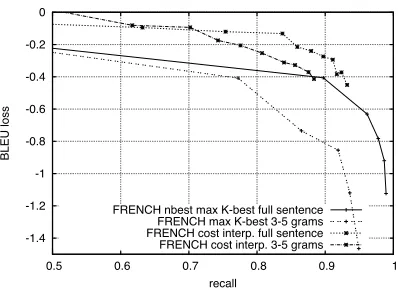
We consider 0.2% BLEU loss as a thresh-old for acceptable quality degradation. Each method is judged by its ability to achieve high recall below this quality degradation threshold. Applying cost interpolation yields the best results in Figure 2, achieving a recall of 85% at 0.2% BLEU loss, while rank interpolation achieves a recall of 76%. The baseline approach of selecting the highest gain candidate within a depth ofkcandidates does not provide sufficient parameterization to yield low quality degrada-tion. At k= 2, this method yields almost 90% recall, but with approximately 0.4% BLEU loss.
5.2 Robustness Experiments
In Section 5.2, we proposed mapping results into sub-events or features. We considered alterna-tive feature mappings in Figure 1, finding that mapping sentence results into a collection of 3-5 grams yields acceptable false positive rates at varied levels ofα.
Figure 3 presents results that compare mov-ing from the result level hashmov-ing to the 3-5 gram sub-result mapping. We show the impact of the mapping on the baseline maxK-best method as well as for cost interpolation. There are sub-stantial reductions in recall rate at the 0.2% BLEU loss level when applying sub-result map-pings in cases. The cost interpolation method recall drops from 85% to 77% when using the 3-5 grams event mapping. The observed false positive rate of the 3-5 gram mapping is 4.7%.
By using the 3-5 gram mapping, we expect to increase robustness against local word edit operations, but we have sacrificed recall rate due to the inherent distributional bias discussed in Section 3.3.
-1.4 -1.2 -1 -0.8 -0.6 -0.4 -0.2 0
0.5 0.6 0.7 0.8 0.9 1
BLEU loss
recall
FRENCH nbest max K-best full sentence FRENCH max K-best 3-5 grams FRENCH cost interp. full sentence FRENCH cost interp. 3-5 grams
Figure 3: BLEU loss against recall of watermarked content for the baseline and cost interpolation meth-ods using both result level and 3-5 gram mapped events.
5.3 Multilingual Experiments
[image:8.612.330.529.224.369.2]0.6 0.65 0.7 0.75 0.8 0.85 0.9 0.95 1
Arabic French Hindi Turkish
recall
[image:9.612.73.293.75.206.2]sentence-level 3-to-5 grams
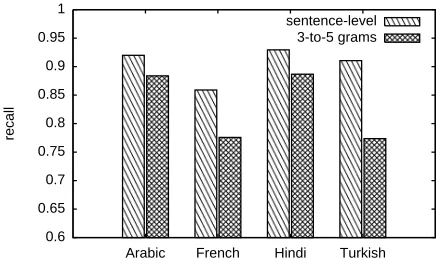
Figure 4: Loss of recall when using 3-5 gram mapping vs sentence level mapping for Arabic, French, Hindi and Turkish translations.
achieves recall of 85% at 0.2% BLEU loss, while the other languages achieve over 90% recall at the same BLEU loss threshold. Using a sub-result mapping degrades quality for each lan-guage pair, but changes the relative perfor-mance. Turkish experiences the highest rela-tive drop in recall, unlike French and Arabic, where results are relatively more robust to using sub-sentence mappings. This is likely a result of differences in n-gram distributions across these languages. The languages considered here all use space separated words. For languages that do not, like Chinese or Thai, our approach can be applied at the character level.
6 Conclusions
In this work we proposed a general method to watermark and probabilistically identify the structured outputs of machine learning algo-rithms. Our method provides probabilistic bounds on detection ability, analytic control on quality degradation and is robust to local edit-ing operations. Our method is applicable to any task where structured outputs are generated with ambiguities or ties in the results. We ap-plied this method to the outputs of statistical machine translation, evaluating each refinement to our approach with false positive and recall rates against BLEU score quality degradation.
Our results show that it is possible, across sev-eral language pairs, to achieve high recall rates (over 80%) with low false positive rates (between 5 and 8%) at minimal quality degradation (0.2%
BLEU), while still allowing for local edit opera-tions on the translated output. In future work we will continue to investigate methods to mit-igate quality loss.
References
Thorsten Brants, Ashok C. Popat, Peng Xu, Franz J. Och, and Jeffrey Dean. 2007. Minimum error rate training in statistical machine translation. In Pro-ceedings of the 2007 Joint Conference on Empir-ical Methods in Natural Language Processing and Computational Natural Language Learning. Peter F. Brown, Vincent J.Della Pietra, Stephen
A. Della Pietra, and Robert. L. Mercer. 1993. The mathematics of statistical machine transla-tion: Parameter estimation. Computational Lin-guistics, 19:263–311.
Mark Chapman, George Davida, and Marc Rennhardway. 2001. A practical and effec-tive approach to large-scale automated linguistic steganography. InProceedings of the Information Security Conference.
David Chiang, Kevin Knight, and Wei Wang. 2009. 11,001 new features for statistical machine trans-lation. InNorth American Chapter of the Associa-tion for ComputaAssocia-tional Linguistics - Human Lan-guage Technologies (NAACL-HLT).
Jade Goldstein, Mark Kantrowitz, Vibhu Mittal, and Jaime Carbonell. 1999. Summarizing text docu-ments: Sentence selection and evaluation metrics. InResearch and Development in Information Re-trieval, pages 121–128.
Gaurav Gupta, Josef Pieprzyk, and Hua Xiong Wang. 2006. An attack-localizing watermarking scheme for natural language documents. In Pro-ceedings of the 2006 ACM Symposium on Informa-tion, computer and communications security, ASI-ACCS ’06, pages 157–165, New York, NY, USA. ACM.
Percy Liang, Alexandre Bouchard-Cote, Dan Klein, and Ben Taskar. 2006. An end-to-end dis-criminative approach to machine translation. In Proceedings of the Joint International Conference on Computational Linguistics and Association of Computational Linguistics (COLING/ACL, pages 761–768.
Dragos Stefan Munteanu and Daniel Marcu. 2005. Improving machine translation performance by ex-ploiting non-parallel corpora. Computational Lin-guistics.
alignment template approach to statistical ma-chine translation. Computational Linguistics. Franz Josef Och. 2003. Minimum error rate training
in statistical machine translation. In Proceedings of the 2003 Meeting of the Asssociation of Com-putational Linguistics.
Philip Resnik and Noah A. Smith. 2003. The web as a parallel corpus. computational linguistics. Com-putational Linguistics.
Ryan Stutsman, Mikhail Atallah, Christian Grothoff, and Krista Grothoff. 2006. Lost in just the translation. InProceedings of the 2006 ACM Symposium on Applied Computing.