E P I D E M I O L O G Y
Adjuvant endocrine therapy initiation and persistence in a diverse
sample of patients with breast cancer
Christopher R. Friese• T. May Pini• Yun Li•Paul H. Abrahamse •
John J. Graff•Ann S. Hamilton• Reshma Jagsi•Nancy K. Janz•
Sarah T. Hawley•Steven J. Katz •Jennifer J. Griggs
Received: 19 March 2013 / Accepted: 21 March 2013
ÓSpringer Science+Business Media New York 2013
Abstract Adjuvant endocrine therapy for breast cancer reduces recurrence and improves survival rates. Many patients never start treatment or discontinue prematurely. A better understanding of factors associated with endocrine therapy initiation and persistence could inform practitio-ners how to support patients. We analyzed data from a longitudinal study of 2,268 women diagnosed with breast cancer and reported to the Metropolitan Detroit and Los Angeles SEER cancer registries in 2005–2007. Patients were surveyed approximately both 9 months and 4 years after diagnosis. At the 4-year mark, patients were asked if they had initiated endocrine therapy, terminated therapy, or were currently taking therapy (defined as persistence). Multivariable logistic regression models examined factors associated with initiation and persistence. Of the 743 patients eligible for endocrine therapy, 80 (10.8 %) never initiated therapy, 112 (15.1 %) started therapy but dis-continued prematurely, and 551 (74.2 %) dis-continued use at the second time point. Compared with whites, Latinas (OR 2.80, 95 % CI 1.08–7.23) and black women (OR 3.63,
95 % CI 1.22–10.78) were more likely to initiate therapy. Other factors associated with initiation included worry about recurrence (OR 3.54, 95 % CI 1.31–9.56) and inadequate information about side effects (OR 0.24, 95 % CI 0.10–0.55). Factors associated with persistence included two or more medications taken weekly (OR 4.19, 95 % CI 2.28–7.68) and increased age (OR 0.98, 95 % CI 0.95–0.99). Enhanced patient education about potential side effects and the effectiveness of adjuvant endocrine therapy in improving outcomes may improve initiation and persistence rates and optimize breast cancer survival.
Keywords Breast neoplasmsAromatase inhibitors Selective estrogen receptor modulatorsMedication taking Health services research
Introduction
Adjuvant endocrine therapy for invasive breast cancer has well-established benefits in reducing recurrence and improving survival. Tamoxifen [1] and aromatase inhibi-tors [2] reduce mortality and longer duration of therapy provides greater benefit versus shorter duration [1, 3–5]. Despite this, not all eligible patients initiate (ever take) or persist with (defined as completing a prescribed course of clinically indicated) endocrine therapy [6–9].
The favorable efficacy data have culminated in clinical practice guidelines that recommend 5 years of adjuvant endocrine therapy—tamoxifen and, in postmenopausal women, aromatase inhibitors or sequential therapy with both tamoxifen and aromatase inhibitors for all women who have a hormone receptor-positive tumor over 1 cm [10–12]. Two clinical trials recently documented efficacy when endocrine therapy was extended to 10 years [13,14]. C. R. Friese (&)Y. LiP. H. AbrahamseR. Jagsi
N. K. JanzS. T. HawleyS. J. KatzJ. J. Griggs
University of Michigan, 400 North Ingalls #4162, Ann Arbor, MI, USA
e-mail: [email protected]
T. M. Pini
M.D. Anderson Cancer Center, Houston, TX, USA
J. J. Graff
Cancer Institute of New Jersey, Robert Wood Johnson Medical School, New Brunswick, NJ, USA
A. S. Hamilton
Keck School of Medicine, University of Southern California, Los Angeles, CA, USA
These data may encourage clinicians to prescribe therapy beyond the current 5-year recommendation. Common side effects of all agents include hot flashes and vaginal dis-charge or dryness. Serious side effects, such as thrombo-embolism and uterine cancer, have been reported with tamoxifen. Although the aromatase inhibitors are generally well tolerated [15], their use can cause loss of bone mineral density and arthralgias [16].
Initiation of treatment and persistence remains a contin-uing challenge to clinicians. While rates of guideline-con-cordant prescribing of adjuvant hormonal therapy are high [17–19], a number of studies have documented that long-term persistence with prescribed endocrine therapy for breast cancer is alarmingly low [6–9,20–26]. Between 33 and 40 % of patients terminate therapy before the recommended 5-year period, a discontinuation rate that is substantively higher than that reported in clinical trials [27]. The high termination rate is consistent, however, with studies of medication use for other chronic conditions [28,29]. Chronic care researchers have proposed several factors that may influence suboptimal use of endocrine therapy. Patient attributes such as older age, greater uncertainty about the marginal benefit of treatment, clinical indication for treat-ment, and more comorbid conditions have been associated with lower persistence, as have side effects from therapy [21, 22,30] and higher out-of-pocket costs [31–33].
There are noteworthy gaps in our understanding of adjuvant endocrine therapy initiation and persistence. These include a lack of studies investigating endocrine therapy use in populations not identified through clinical trials, convenience samples, or enrolled in specific health plans, the absence of data obtained directly from patients, and a reliance on cross-sectional designs. To address these gaps, we examined data on factors associated with endo-crine therapy initiation and persistence in women diag-nosed with invasive breast cancer, selected from two Surveillance, Epidemiology and End Results (SEER) population-based cancer registries in the US, who partici-pated in a longitudinal study.
Methods
Study sample and data collection
Our sampling strategy has been reported previously [34]. Women who lived in Los Angeles county or the Detroit metropolitan area who were between 20 and 79 years of age, diagnosed with AJCC stages I–III breast cancer or ductal carcinoma in situ (DCIS) between June 2005 and February 2007, and reported to the Los Angeles County and Metropolitan Detroit SEER tumor registries were eligible to participate. The recruitment strategy included a
20 % random sample of non-Hispanic whites, all eligible black patients in Detroit and Los Angeles, and all eligible Latinas in Los Angeles. We did not survey Asian women in Los Angeles due to a concurrent study in that population. We excluded women with diagnoses of inflammatory breast cancer or metastatic disease at presentation, women for whom we did not have race/ethnicity information, and women who could not complete a questionnaire in English or Spanish. The final analyses included only women with invasive disease that was estrogen or progesterone recep-tive posirecep-tive. We excluded women who were too ill or incompetent or whose doctor refused permission to contact the participant. We obtained a 73.1 % response rate [34].
We used a modified version of the Dillman survey method to maximize response rates, which involved intensive telephone follow-up, second mailings of materi-als, and phone interviews when required [35]. Women were surveyed at two points in time: a baseline survey *9 months after diagnosis (range of 5–14 months after diagnosis) and a follow-up survey*4 years later (range of 36–65 months after initial diagnosis). After physician notification of our intention to contact their patients, we mailed eligible patients a recruitment letter, questionnaire, and a $10 cash gift. Non-responders received a postcard reminder at 3 weeks, followed by a telephone call and an option to complete the questionnaire by telephone. To increase Latina participation, we used surnames to identify women who were likely to report Latina ethnicity and provided study materials in both English and Spanish [36]. Clinical data from the SEER registries were merged with survey data obtained by patients at both time points. Study procedures received approval from the Institutional Review Boards of the University of Michigan, the University of Southern California, and Wayne State University.
Measures
Dependent variables
therapy in the past week and also reported ‘‘no’’ to ever taking endocrine therapy.
Independent variables
The SEER registries provided the following information: age at diagnosis, race/ethnicity (white, Latina, black), stage (I, II, III), grade (1, 2, 3, or unknown), tumor size (in cm), and estrogen/progesterone receptor status. The baseline questionnaire completed by patients *9 months after diagnosis assessed the presence of comorbid conditions (none, 1, 2 or more), education (high school or less, some college, college graduate), and married or partnered (yes/no). In addition to the outcome measures defined above, the follow-up questionnaire completed *4 years after diagnosis queried patients on their primary provider for cancer follow-up (surgeon, medical oncologist, or other) and whether patients had received enough information from their doctor about endocrine therapy (yes/no). The number of medications taken weekly (none, 1, 2 or more) was asked at the follow-up survey and was included in analyses of the persistence outcome only. Two scales were included in the follow-up questionnaire to measure medication beliefs and worry about recurrence. To assess medication beliefs, items modified from the previously validated beliefs about med-icine questionnaire [37] assessed patients’ agreement about statements with regard to medicine, including ‘‘medicines do more harm than good.’’ Five items on a five-point Likert scale were used and a mean score (range of 1–5), with higher scores reflecting more positive beliefs toward med-ication use. As in our previous report [38], worry about recurrence was measured on a five-point Likert scale from three items: concern the cancer would recur in the same breast, the other breast, or in another part of the body. An overall worry score was calculated as a mean across the three items. Higher scores reflect greater worry about recurrence (range 1–5; Cronbach alpha=0.86). For mod-eling purposes, we categorized the worry about recurrence score into three levels: low (B2.0 on a 5-point scale), medium (2.1–4.0), and high ([4.0). Finally, women who never initiated endocrine therapy or discontinued therapy prematurely were asked their reasons for doing so. These included physician instructions to discontinue, concerns for side effects, and cost/insurance issues. Participants could select multiple responses to this question.
Statistical analyses
We first calculated descriptive statistics for the entire analytical sample and the subgroups of women who initi-ated or persisted with therapy. To compare the patients who initiated (or persisted) with those who did not initiate
(or persist), we used Chi square tests for categorical vari-ables and ANOVA for continuous varivari-ables. Several clin-ical variables that may influence use of endocrine therapy were included in all analyses. These include tumor stage, tumor grade, and age. Additional measures described above were candidates for model inclusion. To achieve model parsimony, backward variable selection procedures were used to eliminate non-clinical variables that did not reach the statistical significance level of 0.10. All analyses were adjusted for geographic location (Los Angeles versus Detroit). Odds ratios (OR) and 95 % confidence intervals (95 % CI) were calculated and presented. TheFtests were used to examine the overall association of independent variables with the outcome of interest. Finally, we used descriptive statistics to examine reported reasons for non-initiation of and non-persistence with adjuvant endocrine therapy.
Survey weighting
In the initial descriptive statistics and multivariable mod-els, we incorporated survey weights to make our statistical inference representative of the population. We created design weights to account for oversampling of blacks and Latinas, as well as disproportionate selection across loca-tions. We also weighted the sample for non-response to recognize that certain patient characteristics are likely to influence response to both the baseline and follow-up questionnaire. Multivariable logistic regression models were used to create the non-response weights, with the final weight calculated as the product of the design and non-response weights. All statistical tests were two-sided, and a p value\.05 was considered statistically significant. All analyses were performed using STATA (College Station, TX).
Results
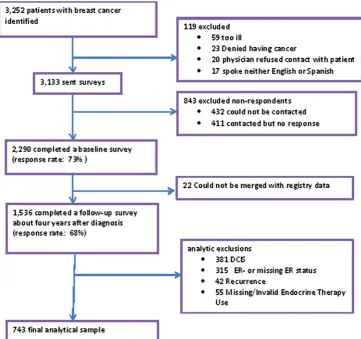
These analyses are based on 743 respondents with invasive disease (see Fig.1 for details on how the analytic sample was derived). 1,536 women completed both the baseline and follow-up surveys. To restrict our sample to women who met clinical indications for endocrine therapy, we excluded 793 respondents: those who did not have invasive disease (n=381), had negative or unknown ER and/or PR receptor status (n =315), had experienced a recurrence at the time of our follow-up survey (n=42), or had incom-plete data on study measures (n=55).
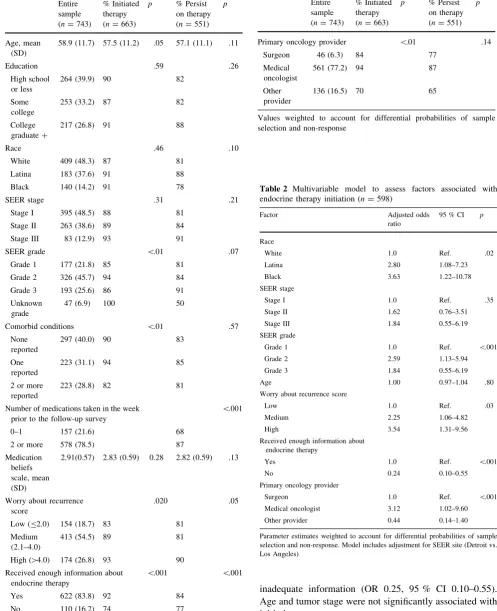
Table1shows the characteristics of the study sample and the distribution of the outcome variables, initiation, and persistence. In the bivariate analyses, significant differ-ences were observed on rates of endocrine therapy initia-tion by age, SEER tumor grade, the presence of comorbid conditions, worry about recurrence score, receipt of infor-mation about endocrine therapy, and primary provider for cancer care follow-up. Initiation rates varied by the pres-ence of comorbid conditions (p\.01) with 82, 94, and 90 % for women with two or more conditions, one con-dition, and none, respectively. The degree of worry about recurrence was significantly associated with the rate of initiation (p=0.02); patients with higher worry about recurrence had higher rates of initiation (93, 89, and 83 % for high, medium, and low worry scores, respectively).
In bivariate analyses (Table1), fewer variables differed significantly on the persistence outcome. Weekly medica-tion use was associated with different rates of persistence (p\.001) with 87 % of patients who took two or more medications weekly persisting on therapy, compared with a persistence rate of 68 % for women who took fewer than two medications weekly. Higher scores on the worry about recurrence scale were associated with significantly higher rates of persistence (p=.05). Those who reported that
they did not receive adequate information about endo-crine therapy had lower rates of persistence (77 vs. 84 %, p\.001).
Factors associated with endocrine therapy initiation After backward variable selection procedures, several variables were removed from the initiation model, includ-ing tumor size, comorbid conditions, education, marital status, and the medication belief scale. The final weighted multivariable model is presented in Table2. Initiation of therapy was associated with the Latina ethnicity (OR 2.80, 95 % CI 1.08–7.23), black race versus non-Hispanic white (OR 3.63, 95 % CI 1.22–10.78), and grade 2 tumors (vs. Grade 1, OR 2.59, 95 % CI 1.13–5.94). Women with higher scores on the worry about recurrence scale were more likely to report initiation (medium vs. low OR 2.25, 95 % CI 1.06–4.82; high vs. low OR 3.54, 95 % CI 1.31–9.56), as were women who reported that their primary provider for cancer follow-up was a medical oncologist rather than a surgeon (OR 3.21, 95 % CI 1.02–9.60). Women who reported that they had received inadequate information about endocrine therapy were significantly less likely to initiate treatment than women who did not report Fig. 1 The derivation of the
[image:4.595.180.542.58.397.2]inadequate information (OR 0.25, 95 % CI 0.10–0.55). Age and tumor stage were not significantly associated with initiation.
Table 1 Participant characteristics by initiation and persistence of endocrine therapy
Entire sample (n=743)
% Initiated therapy (n=663)
p % Persist on therapy (n=551)
p
Age, mean (SD)
58.9 (11.7) 57.5 (11.2) .05 57.1 (11.1) .11
Education .59 .26
High school or less
264 (39.9) 90 82
Some college
253 (33.2) 87 82
College graduate?
217 (26.8) 91 88
Race .46 .10
White 409 (48.3) 87 81
Latina 183 (37.6) 91 88
Black 140 (14.2) 91 78
SEER stage .31 .21
Stage I 395 (48.5) 88 81
Stage II 263 (38.6) 89 84
Stage III 83 (12.9) 93 91
SEER grade \.01 .07
Grade 1 177 (21.8) 85 81
Grade 2 326 (45.7) 94 84
Grade 3 193 (25.6) 86 91
Unknown grade
47 (6.9) 100 50
Comorbid conditions \.01 .57
None reported
297 (40.0) 90 83
One reported
223 (31.1) 94 85
2 or more reported
223 (28.8) 82 81
Number of medications taken in the week prior to the follow-up survey
\.001
0–1 157 (21.6) 68
2 or more 578 (78.5) 87
Medication beliefs scale, mean (SD)
2.91(0.57) 2.83 (0.59) 0.28 2.82 (0.59) .13
Worry about recurrence score
.020 .05
Low (B2.0) 154 (18.7) 83 81
Medium (2.1–4.0)
413 (54.5) 89 81
High ([4.0) 174 (26.8) 93 90
Received enough information about endocrine therapy
\.001 \.001
Yes 622 (83.8) 92 84
No 110 (16.2) 74 77
Table 2 Multivariable model to assess factors associated with endocrine therapy initiation (n=598)
Factor Adjusted odds
ratio
95 % CI p
Race
White 1.0 Ref. .02
Latina 2.80 1.08–7.23
Black 3.63 1.22–10.78
SEER stage
Stage I 1.0 Ref. .35
Stage II 1.62 0.76–3.51
Stage III 1.84 0.55–6.19
SEER grade
Grade 1 1.0 Ref. \.001
Grade 2 2.59 1.13–5.94
Grade 3 1.84 0.55–6.19
Age 1.00 0.97–1.04 .80
Worry about recurrence score
Low 1.0 Ref. .03
Medium 2.25 1.06–4.82
High 3.54 1.31–9.56
Received enough information about endocrine therapy
Yes 1.0 Ref. \.001
No 0.24 0.10–0.55
Primary oncology provider
Surgeon 1.0 Ref. \.001
Medical oncologist 3.12 1.02–9.60
Other provider 0.44 0.14–1.40
[image:5.595.300.544.293.620.2]Parameter estimates weighted to account for differential probabilities of sample selection and non-response. Model includes adjustment for SEER site (Detroit vs. Los Angeles)
Table 1 continued
Entire sample (n=743)
% Initiated therapy (n=663)
p % Persist on therapy (n=551)
p
Primary oncology provider \.01 .14
Surgeon 46 (6.3) 84 77
Medical oncologist
561 (77.2) 94 87
Other provider
136 (16.5) 70 65
Factors associated with endocrine therapy persistence at 4 years
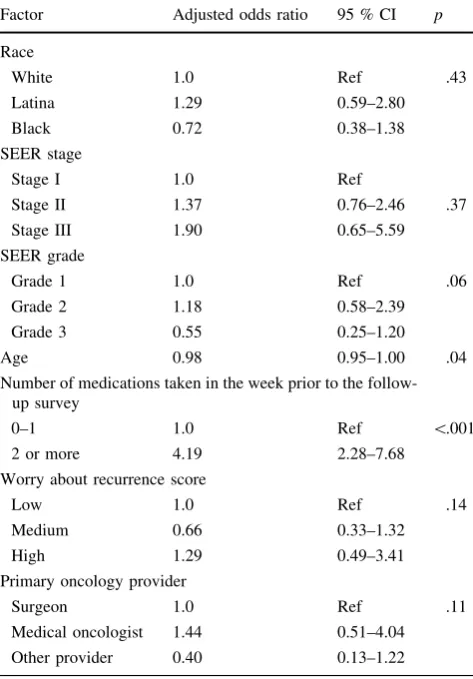
Table3 shows the weighted multivariable model for per-sistence with measures retained after backward variable selection procedures. Lower likelihood of persistence was associated significantly with increasing age (OR 0.98, OR 0.95–1.00, p\.04). Compared with those who reported taking none or one medication weekly, women who took two or more medications weekly as reported in the follow-up survey were more likely to persist on therapy (OR 4.19, 95 % CI 2.28–7.68). No significant differences in persis-tence were observed by race/ethnicity, tumor stage, tumor grade, worry about recurrence, or type of provider for follow-up oncology care.
Reasons for non-initiation and non-persistence
Therapy-eligible participants who never initiated ther-apy (n =80) were asked why they did not, and these
unweighted descriptive responses are shown in Table4. Participants could choose multiple responses. Clinician factors were primarily cited, including statements such as doctor said they did not need therapy (n=27, 33.8 %) or the doctor left it up to the patient (n=17, 21.3). Reported patient factors included concerns about side effects (n =23, 28.8 %) and cost (n=4, 5.0 %). Patient factors were cited by many of the 112 women who discontinued treatment; 45 (40.2 %) cited side effects, 28 (25 %) cited concerns about the risks from the medication, and 26 (23.2 %) reported a general dislike of medication (see Table5).
Discussion
[image:6.595.308.544.319.459.2]The majority of women in our population-based sample eligible for endocrine therapy both initiated and persisted
Table 3 Multivariable model to assess factors associated with endocrine therapy persistence (n=539)
Factor Adjusted odds ratio 95 % CI p
Race
White 1.0 Ref .43
Latina 1.29 0.59–2.80
Black 0.72 0.38–1.38
SEER stage
Stage I 1.0 Ref
Stage II 1.37 0.76–2.46 .37
Stage III 1.90 0.65–5.59
SEER grade
Grade 1 1.0 Ref .06
Grade 2 1.18 0.58–2.39
Grade 3 0.55 0.25–1.20
Age 0.98 0.95–1.00 .04
Number of medications taken in the week prior to the follow-up survey
0–1 1.0 Ref \.001
2 or more 4.19 2.28–7.68
Worry about recurrence score
Low 1.0 Ref .14
Medium 0.66 0.33–1.32
High 1.29 0.49–3.41
Primary oncology provider
Surgeon 1.0 Ref .11
Medical oncologist 1.44 0.51–4.04
Other provider 0.40 0.13–1.22
Parameter estimates weighted to account for differential probabilities of sample selection and non-response. Model includes adjustment for SEER site (Detroit vs. Los Angeles)
Table 4 Reasons for never initiating endocrine therapy (n=80)
Never initiated n(%)
Clinician factors
Doctor said I did not need 27 (33.8)
Doctor left it up to me 17 (21.3)
Doctor never discussed 6 (7.5)
Patient factors
Worried about side effects 23 (28.8)
Doctor recommended, but I chose not to 15 (18.8)
[image:6.595.51.288.345.685.2]Too expensive 4 (5.0)
Table 5 Reasons for premature discontinuation of endocrine therapy (n=112)
Discontinued n(%)
Patient factors
Side effects 45 (40.2)
Worried about risks 28 (25.0)
Dislike medication 26 (23.2)
I was not sure if it was helping 25 (22.3)
Too expensive 21 (18.8)
I had taken it long enough 20 (17.9)
I wanted to move on from cancer 14 (16.1)
I stopped for insurance reasons 8 (7.1)
Clinician factors
Doctor told me to stop 28 (25.0)
Completed course of treatment 14 (12.5)
[image:6.595.306.545.506.693.2]on therapy: Of the 743 patients eligible for endocrine therapy, 80 (10.8 %) never initiated therapy, 112 (15.1 %) started therapy but discontinued prematurely, and 551 (74.2 %) continued use at the second time point. Our findings are consistent with previously published reports. A study that used commercial claims data to assess adherence with adjuvant anastrozole therapy [8] showed that women enrolled in three different insurance plans had adherence rates of 62–79 % by the third year of treatment. Women in our study were treated more recently (2005–2010) compared with a timeframe of 2002–2004 in above-cited study [8]. A single-site study performed in 2006 reported similar rates of initiation and persistence [39].
Blacks and Latinas had the highest rates of initiation and persistence in our sample. Ours is not the first study to document null findings or higher rates of treatment com-pletion in groups historically considered disadvantaged. Recent reports have documented the absence of racial disparities in adjuvant endocrine therapy in the Medicare [40] and Medicaid [41] populations, as well in the receipt of systemic chemotherapy [34, 42]. Poverty, insurance coverage, family support, and overall treatment experi-ences are contextual factors that may explain endocrine therapy persistence [43–46]. Our study did not examine the effects of peer support or breast cancer navigator programs, both of which may have supported blacks and Latinas through treatment during the study period.
Patients who initiated endocrine therapy expressed more worry about recurrence, regardless of tumor stage and grade. While clinicians educate patients to mitigate the anxiety surrounding a breast cancer diagnosis, health behaviorists assert that perceived susceptibility is a strong motivator for desired health behaviors [47]. In our study and in a report by others [25], women who reported receiving less information about endocrine therapy were less likely to initiate therapy. Adequacy of information was associated with initiation, but not per-sistence. This suggests that clinicians need to address patient information needs regarding therapy prior to initiation of treatment. Treatment initiation was higher for women who saw medical oncologists as opposed to other providers for their follow-up cancer care. It is likely that patients who saw medical oncologists may have clearer indications for endocrine therapy. Other providers of follow-up oncology care may benefit from additional education or resources to support patients receiving endocrine therapy. Women who took two or more medications at the time of the follow-up survey were more likely to persist with endocrine therapy, which suggests that women who were less experienced in medication use prior to a breast cancer diagnosis may be at risk for low persistence.
Patients who did not initiate treatment cited provider factors as the primary reason. These responses likely reflect physician judgment that endocrine therapy is not warranted in these cases. It is interesting to note that few patients endorsed insurance coverage as a reason for not starting therapy, despite the findings from previous investigators [48]. However, a total of 32 patients cited drug expense or insurance issues as one of many reasons for not initiating or persisting with therapy. In our sample, patient attitudes about endocrine therapy and medication in general were associated with premature termination. Side effects, safety concerns, and a general dislike of medication were the most often-cited factors. Severe side effects were the largest predictor of discontinuation of tamoxifen in a prior study [25]. These findings from a population-based sample of patients are timely considering the ATLAS trial results reported at the 2012 San Antonio Breast Cancer Sympo-sium. In this clinical trial, women who completed 10 years of adjuvant tamoxifen therapy compared with 5 years had significantly lower recurrence and breast cancer mortality rates [13]. Outside of a clinical trial, clinicians may be challenged to maintain patients on therapy for 10 years if side effects are a key barrier to persistence. Aggressive supportive care and consultation with oncology pharma-cists may be important interventions to consider if the duration of endocrine therapy is extended in forthcoming clinical practice guidelines.
There are several limitations of this study. First, we relied on patient self-report of initiation and persistence to endocrine therapy. We were unable to ascertain if patients who did not initiate were not offered a prescription for endocrine therapy. Measurement of medication use with prescription data or the clinical record would strengthen the validity of our findings [49]. The data was derived from a sample of women who completed surveys at approximately 9 months and 4 years after breast cancer diagnosis. Our sample of women is more likely to persist on therapy than women in the general population. Because routine medi-cation use was measured only at the 4-year follow-up survey, we cannot assess the degree to which routine medical use influences initiation of therapy. Another lim-itation of this study is that the study participants were recruited from only two sites—Los Angeles county and Metropolitan Detroit—with three racial and ethnic groups: white, black, and Latina women. While our study sample is diverse, findings may not be generalizable to other popu-lations or geographic settings.
with endocrine therapy. Persistence is associated with younger age and concurrent medication use. Care settings without medical oncologists may benefit from additional resources to support eligible patients. Non-persistence was largely related to patient attitudes toward therapy. These findings highlight the need for additional education and support strategies for women—regardless of race or eth-nicity—at risk for not initiating or persisting on adjuvant endocrine therapy to optimize treatment and reduce breast cancer recurrence and improve survival.
Acknowledgments This work was funded by Grants R01 CA109696 and R01 CA088370 from the National Cancer Institute to the Uni-versity of Michigan. Dr. Friese was supported by a Pathway to Independence Award from the National Institute for Nursing Research (R00NR01570). Dr. Katz was supported by an Established Investigator Award in Cancer Prevention, Control, Behavioral, and Population Sciences Research from the National Cancer Institute (K05CA111340). Dr. Jagsi was supported by a Mentored Research Scholar Grant from the American Cancer Society (MRSG-09-145-01). The collection of Los Angeles County cancer incidence data was supported by the California Department of Public Health as part of the statewide cancer reporting program mandated by California Health and Safety Code §103885. The National Cancer Institute’s Surveil-lance, Epidemiology, and End Results Program under contract N01-PC-35139 was awarded to the University of Southern California. Contract N01-PC-54404 and agreement 1U58DP00807-01 were awarded to the Public Health Institute. The collection of metropolitan Detroit cancer incidence data was supported by the National Cancer Institute’s Surveillance, Epidemiology, and End Results Program under contract N01-PC-35145.
Conflict of interest The authors declare they have no conflict of interest.
Ethical standards Institutional Review Boards of the University of Michigan, the University of Southern California, and Wayne State University approved the study described in this work.
References
1. Early Breast Cancer Trialists’ Collaborative Group (2005) Effects of chemotherapy and hormonal therapy for early breast cancer on recurrence and 15-year survival: an overview of the randomised trials. Lancet 365:1687–1717
2. Forbes JF, Cuzick J, Buzdar A, Howell A, Tobias JS, Baum M (2008) Effect of anastrozole and tamoxifen as adjuvant treatment for early-stage breast cancer: 100-month analysis of the ATAC trial. Lancet Oncol 9:45–53
3. Yood MU, Owusu C, Buist DS et al (2008) Mortality impact of less-than-standard therapy in older breast cancer patients. J Am Coll Surg 206:66–75
4. Swedish Breast Cancer Cooperative Group (1996) Randomized trial of two versus 5 years of adjuvant tamoxifen for postmeno-pausal early stage breast cancer. J Natl Cancer Inst 88:1543–1549 5. Sacco M, Valentini M, Belfiglio M et al (2003) Randomized trial of 2 versus 5 years of adjuvant tamoxifen for women aged 50 years or older with early breast cancer: Italian Interdisciplin-ary Group Cancer Evaluation Study of Adjuvant Treatment in Breast Cancer 01. J Clin Oncol 21:2276–2281
6. Weaver KE, Camacho F, Hwang W, Anderson R, Kimmick G. Adherence to adjuvant hormonal therapy and its relationship to breast cancer recurrence and survival among low-income women. Am J Clin Oncol 2012. doi:10.1097/COC.0b013e3182436ec1 Accessed 29 Sept 2012
7. Hershman DL, Shao T, Kushi LH et al (2011) Early discontin-uation and non-adherence to adjuvant hormonal therapy are associated with increased mortality in women with breast cancer. Breast Cancer Res Treat 126:529–537
8. Partridge AH, Lafountain A, Mayer E, Taylor BS, Winer E, Asnis-Alibozek A (2008) Adherence to initial adjuvant anas-trozole therapy among women with early-stage breast cancer. J Clin Oncol 26:556–562
9. Partridge AH, Wang PS, Winer EP, Avorn J (2003) Nonadher-ence to adjuvant tamoxifen therapy in women with primary breast cancer. J Clin Oncol 21:602–606
10. National Comprehensive Cancer Network. NCCN Clinical Practice Guidelines in Oncology: Breast Cancer. Version 3.2012. http://www.nccn.org/professionals/physician_gls/pdf/breast.pdf. Accessed 1 Oct 2012
11. Goldhirsch A, Wood WC, Gelber RD, Coates AS, Thurlimann B, Senn HJ (2003) Meeting highlights: updated international expert consensus on the primary therapy of early breast cancer. J Clin Oncol 21:3357–3365
12. Thuerlimann B (2001) International consensus meeting on the treatment of primary breast cancer 2001, St. Gallen, Switzerland. Breast Cancer 8:294–297
13. Davies C, Hongchao P, Godwin J, et al (2012) ATLAS. 10 v 5 years of adjuvant tamoxifen (TAM) in ER?disease: effects on outcome in the first and in the second decade after diagnosis. CTRC–AACR San Antonio Breast Cancer Symposium, San Antonio
14. Jin H, Tu D, Zhao N et al (2012) Longer-term outcomes of Letrozole versus placebo after 5 years of tamoxifen in the NCIC CTG MA.17 trial: analyses adjusting for treatment crossover. J Clin Oncol 30(7):718–721
15. Buzdar A, Howell A, Cuzick J et al (2006) Comprehensive side-effect profile of anastrozole and tamoxifen as adjuvant treatment for early-stage breast cancer: long-term safety analysis of the ATAC trial. Lancet Oncol 7:633–643
16. Henry NL, Giles JT, Ang D et al (2008) Prospective character-ization of musculoskeletal symptoms in early stage breast cancer patients treated with aromatase inhibitors. Breast Cancer Res Treat 111:365–372
17. Mariotto A, Feuer EJ, Harlan LC, Wun LM, Johnson KA, Abrams J (2002) Trends in use of adjuvant multi-agent chemo-therapy and tamoxifen for breast cancer in the United States: 1975–1999. J Natl Cancer Inst 94:1626–1634
18. Harlan LC, Clegg LX, Abrams J, Stevens JL, Ballard-Barbash R (2006) Community-based use of chemotherapy and hormonal therapy for early-stage breast cancer: 1987–2000. J Clin Oncol 24:872–877 19. Hebert-Croteau N, Brisson J, Latreille J, Gariepy G, Blanchette
C, Deschenes L (1999) Time trends in systemic adjuvant treat-ment for node-negative breast cancer. J Clin Oncol 17:1458–1464 20. Lash TL, Silliman RA, Guadagnoli E, Mor V (2000) The effect of less than definitive care on breast carcinoma recurrence and mortality. Cancer 89:1739–1747
21. Atkins L, Fallowfield L (2006) Intentional and non-intentional non-adherence to medication amongst breast cancer patients. Eur J Cancer 42:2271–2276
22. Demissie S, Silliman RA, Lash TL (2001) Adjuvant tamoxifen: predictors of use, side effects, and discontinuation in older women. J Clin Oncol 19:322–328
24. Grunfeld EA, Hunter MS, Sikka P, Mittal S (2005) Adherence beliefs among breast cancer patients taking tamoxifen. Patient Educ Couns 59:97–102
25. Kahn KL, Schneider EC, Malin JL, Adams JL, Epstein AM (2007) Patient centered experiences in breast cancer: predicting long-term adherence to tamoxifen use. Med Care 45:431–439 26. Lash TL, Fox MP, Westrup JL, Fink AK, Silliman RA (2006)
Adherence to tamoxifen over the five-year course. Breast Cancer Res Treat 99:215–220
27. Chlebowski RT, Geller ML (2006) Adherence to endocrine therapy for breast cancer. Oncology. 71:1–9
28. DiMatteo MR (2004) Variations in patients’ adherence to medical recommendations: a quantitative review of 50 years of research. Med Care 42:200–209
29. Osterberg L, Blaschke T (2005) Adherence to medication. N Engl J Med 353:487–497
30. Owusu C, Buist DS, Field TS et al (2008) Predictors of tamoxifen discontinuation among older women with estrogen receptor: positive breast cancer. J Clin Oncol 26:549–555
31. Doshi JA, Zhu J, Lee BY, Kimmel SE, Volpp KG (2009) Impact of a prescription copayment increase on lipid-lowering medica-tion adherence in veterans. Circulamedica-tion 119:390–397
32. Piette JD, Heisler M (2004) Problems due to medication costs among VA and non-VA patients with chronic illnesses. Am J Manag Care 10:861–868
33. Piette JD, Heisler M, Krein S, Kerr EA (2005) The role of patient-physician trust in moderating medication nonadherence due to cost pressures. Arch Intern Med 165:1749–1755 34. Griggs JJ, Hawley ST, Graff JJ et al (2012) Factors associated
with receipt of breast cancer adjuvant chemotherapy in a diverse population-based sample. J Clin Oncol 30:3058–3064
35. Dillman DA (2007) Mail and Internet Surveys: the tailored design method, 2nd edn. Wiley, New York
36. Hamilton AS, Hofer TP, Hawley ST et al (2009) Latinas and breast cancer outcomes: population-based sampling, ethnic identity, and acculturation assessment. Cancer Epidemiol Bio-markers Prev 18:2022–2029
37. Horne R, Weinman J (1999) Patients’ beliefs about prescribed medicines and their role in adherence to treatment in chronic physical illness. J Psychosom Res 47:555–567
38. Janz NK, Hawley ST, Mujahid MS et al (2011) Correlates of worry about recurrence in a multiethnic population-based sample of women with breast cancer. Cancer 117:1827–1836
39. Danilak M, Chambers CR (2012) Adherence to adjuvant endo-crine therapy in women with breast cancer. J Oncol Pharm Pract Aug 15 (epub ahead of print)
40. Yen TW, Czypinski LK, Sparapani RA et al (2011) Socioeco-nomic factors associated with adjuvant hormone therapy use in older breast cancer survivors. Cancer 117:398–405
41. Yung RL, Hassett MJ, Chen K (2012) et al. Initiation of adjuvant hormone therapy by Medicaid insured women with nonmetastatic breast cancer. J Natl Cancer Inst 104:1102–1105
42. Lipscomb J, Gillespie TW, Goodman M et al (2012) Black-white differences in receipt and completion of adjuvant chemotherapy among breast cancer patients in a rural region of the US. Breast Cancer Res Treat 133:285–296
43. Kimmick GG, Anderson R, Camacho F et al (2009) Adjuvant hormonal therapy use among insured, low-income women with breast cancer. J Clin Oncol 27:3445–3551
44. Land SR, Cronin WM, Wickerham DL et al (2011) Cigarette smoking, obesity, physical activity, and alcohol use as predictors of chemoprevention adherence in the national surgical adjuvant breast and bowel project p-1 breast cancer prevention trial. Cancer Prev Res 4:1393–1400
45. Lin JH, Zhang SM, Manson JE (2011) Predicting adherence to tamoxifen and breast cancer adjuvant therapy and prevention. Cancer Prev Res. 4:1360–1365
46. Friese CR (2012) Disparities in breast cancer care delivery: solving a complex puzzle. Breast Cancer Res Treat 133:297–299 47. Janz NK, Becker MH (1984) The health belief model: a decade
later. Health Educ Q 11:1–47
48. Wu XC, Lund MJ, Kimmick GG et al (2011) Influence of race, insurance, socioeconomic status, and hospital type on receipt of guideline-concordant adjuvant systemic therapy for loco regional breast cancers. J Clin Oncol 30(2):142–150