Knowledge Base Inference using Bridging Entities
Bhushan Kotnis Indian Institute of Science [email protected]
Pradeep Bansal Indian Institute of Science [email protected]
Partha Talukdar Indian Institute of Science
Abstract
Large-scale Knowledge Bases (such as NELL, Yago, Freebase, etc.) are often sparse, i.e., a large number of valid rela-tions between existing entities are missing. Recent research have addressed this prob-lem by augmenting the KB graph with ad-ditional edges mined from a large text cor-pus while keeping the set of nodes fixed, and then using the Path Ranking Algo-rithm (PRA) to perform KB inference over this augmented graph. In this paper, we extend this line of work by augmenting the KB graph not only with edges, but also withbridging entities, where both the edges and bridging entities are mined from a 500 million web text corpus. Through experiments on real-world datasets, we demonstrate the value of bridging entities in improving the performance and running time of PRA in the KB inference task.
1 Introduction
Large-scale knowledge bases (KB) like Freebase (Bollacker et al., 2008), Yago (Suchanek et al., 2007), NELL (Mitchell et al., 2015) can be use-ful in a variety of applications like natural lan-guage question answering, semantic search en-gines, etc. These knowledge bases consist of mil-lions of real world entities and relationships be-tween them which are stored in the form of a di-rected graph where links represent relations and nodes represent the entities. Although such KBs contain millions of entities, they are still very sparse, i.e., they are missing a large number of relations between existing entities (West et al., 2014).
[image:1.595.325.509.202.277.2]Performing inference over the knowledge graph for predicting relations between two entities is one way of densifying the KB graph. For example,
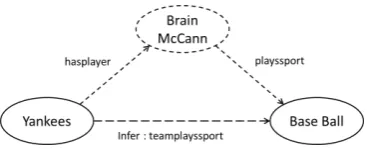
Figure 1: Example showing how addition of the
bridging entity,Brian McCain, and the two edges incident on it can help the PRA algorithm (Lao and Cohen, 2010) to infer the initially missing relation instanceteamPlaysSport(Yankees, BaseBall). The original KB graph consisted only of two nodes,
YankeesandBaseball, and no edges.
from (Germany, playsinTournament, FIFA) and
(FIFA, tournamentofSport, Soccer), we can infer
(Germany, playsSport, Soccer). The Path Ranking Algorithm (PRA) (Lao and Cohen, 2010), (Lao et al., 2011) performs such an inference by learning inference rules over the knowledge graph.
If the knowledge graph is sparse, i.e., if there are a very few or no paths between source and target entities, then PRA is unable to predict the existence of a relation. To address this shortcom-ing, (Lao et al., 2012) augmented the knowledge graph with paths obtained from an external corpus. The added paths consisted of unlexicalized depen-dency labels obtained from a dependepen-dency parsed external corpus. To improve the expressivity of the added paths, instead of the unlexicalized la-bels, (Gardner et al., 2013) augmented the KB graph with verbs (surface relations) from a corpus containing over 600 million Subject-Verb-Object (SVO) triples. These verbs act as edges that con-nect previously unconcon-nected entities thereby in-creasing the connectivity of the KB graph which can potentially improve PRA performance.
However, na¨ıvely adding these edges increases the feature sparsity which degrades the discrim-inative ability of the logistic regression classifier
used in PRA. This can be addressed by adding la-tent relations obtained by clustering the surface re-lations, instead of directly adding the surface rela-tions. This reduces feature sparsity and has been shown to improve PRA inference (Gardner et al., 2013) , (Gardner et al., 2014).
In this article we propose a scheme for aug-menting the KB using paths obtained by mining noun phrases that connect two SVO triples from an external corpus. We term these noun phrases asbridging entitiessince they bridge two KB re-lations to form a path. This is different from the scheme in (Gardner et al., 2013) and (Gardner et al., 2014), which adds edges between KB nodes by mining surface relations from an external cor-pus. We search for such bridging entities in the corpus by performing a limited depth DFS (depth first search) on the corpus graph in anon-demand
fashion.
We term this procedure as On-Demand Aug-mentation (ODA), because the search can be per-formed during test time in an on-demand man-ner. In contrast, the previous approaches of adding edges or embeddings to the KB (Gardner et al., 2013), and vector space random walk PRA (Gard-ner et al., 2014) are batch procedures. As we shall see in Section 4, due to a limited search space, on-demand augmentation is much faster compared to algorithms in (Gardner et al., 2013; Gardner et al., 2014). Furthermore, since edges are not added blindly, on-demand augmentation does not increase feature sparsity which is responsible for performance degradation. Our experiments sug-gest that ODA provides better performance than (Gardner et al., 2013) and nearly the same pre-diction performance as provided by (Gardner et al., 2014), but in both cases with the added ad-vantage of faster running time and greater flex-ibility due to its online and on-demand nature. The code along with the results can be obtained at https://github.com/malllabiisc/pra-oda.
2 Related Work
Using surface level relations and noun phrases for extracting meaningful relational facts is not a new idea (Hearst, 1992),(Brin, 1999), (Etzioni et al., 2004). However, none of them make use of Knowledge Bases for improving information ex-traction.
The Path Ranking Algorithm (PRA) first pro-posed in (Lao and Cohen, 2010) was used for
per-forming inference over a KB in (Lao et al., 2011). It was extended by (Lao et al., 2012), to improve the inference by augmenting the KB with syntactic information obtained from a dependency parsed corpus. Augmenting the KB for improving PRA inference using surface relations mined from an external corpus and using latent edge labels ob-tained by performing PCA on the surface relations was explored in (Gardner et al., 2013). Instead of hard mapping of surface relations to latent em-beddings, (Gardner et al., 2014) perform a ‘soft’ mapping using vector space random walks. This allows the random walker to traverse an edge se-mantically similar to the current edge type more frequently than other edges.
Although, like others, we too use an external corpus to augment the KB, the crucial difference in our approach is that apart from adding surface relations, we also add bridging entities that enable us to create new paths in the KB. Furthermore, the procedure is targeted so that only paths that play a part in inferring the relations that are of interest are added. Thus, the number of paths added in this manner is much lower than the number of surface relations added using the procedure in (Gardner et al., 2013). As we shall see in Section 4, this results in a more effective algorithm with faster runtime.
3 Method
3.1 Background: Path Ranking Algorithm (PRA)
We first present a brief overview of the Path Rank-ing Algorithm (PRA) (Lao and Cohen, 2010). The PRA uses paths as features for a logistic regres-sion classifier which predicts if the given relation exists between a pair of entities. For a given pair of entitiessandt, thepath typeconnectingstot
form the feature vector. Apath typesπ is an or-dered set of relations. Paths with the same oror-dered relations but different intermediate or terminal en-tities belong to the same path type. For example,
s1 −→v0 x1 −→v1 t1 ands2 −→v0 x2 −→v1 t2 belong
to path type −→v0 −→v1 . The value of a feature, is
taken to beP(s → t;π), whereP(s → t;π) is the probability of reachingtfromsby traversing paths of typeπ. PRA approximates these proba-bilities by running a random walk (RW) on the KB graph. LetF = {π1, π2, ..., πk} be the set of all
path types. For predicting the existence of relation
Query Candidate Answer Path added by PRA-ODA with bridging entity (in bold) sportsteamPositionForSport(right handed
pitcher, ?) baseball right handed pitcher
playsfor−→ Chicago Cubsplay−→baseball
[image:3.595.61.525.60.125.2]riverFlowsThroughCity(Moselle, ?) Koblenz Moselleflows into−→ Rhinemeet at−→ Koblenz teamPlaysInLeague(Cleveland Indians, ?) MLB Cleveland Indians−→playDetroit Tigersblew−→MLB
Table 1: Examples of paths involving bridging entities (marked in bold) added to the KB by PRA-ODA.
confidence thatr exists betweensandt. It does so by first assigning weights to the features in the training phase. The score is given by
S(s, t, r) =X
π∈F
P(s→t;π)×θr
π (1)
whereθr
π is the weight learned by the logistic
gression classifier during training specially for re-lation r and path type π. During the test phase, since targets are not available, the PRA gathers candidate targets by performing a random walk and then computes feature vectors and the score.
3.2 PRA-SVO and PRA-VS
PRA-SVO and PRA-VS are the systems proposed in (Gardner et al., 2013) and (Gardner et al., 2014) respectively, where the KB graph is augmented with edges mined from a large subject-verb-object (SVO) triple corpus. In these two systems, only new edges are added over the fixed set of nodes, and the augmentation happens in a batch, offline setting. In contrast, PRA-ODA, the method pro-posed in the paper, also expands the set of nodes through bridging entities, and performs the aug-mentation in an on-demand manner.
3.3 PRA On-Demand Augmentation (PRA-ODA)
Training: Let s and t be any two KB entities and lets(n) andt(n) be their corresponding noun
phrase representations or aliases. We search for bridging entities x1, x2, ..xn by performing
lim-ited depth first search (DFS) starting withsnsuch
that we obtain a paths ALIAS−→ s(n) −→v0 x1 −→v1
... v−→n−1 x
n −→vn t(n) ALIAS−→ t, wherevi are verbs
present in the corpus graph. This is done for all
n≤dmax−1, wheredmaxis the maximum depth
of DFS. We add an ‘ALIAS’ edge between the KB entity and its noun phase representation. The use-fulness of bridging entities is illustrated in Fig. 1.
We mine bridging entities from a corpus con-taining over 600 million SVO triples which were obtained from the ClueWeb09 corpus (Callan et
al., 2009) parsed using the MALT parser (Nivre et al., 2007). We use Mongo DB to store the triples as an adjacency list. During training time, for any relation that is being inferred, both the source and its corresponding target entities are known. A lim-ited depth DFS is performed for all depths less then dmax on the SVO graph with the aliases of
subject entity acting as the starting points. Such aliases are available for the NELL and Freebase knowledge bases. The DFS is said to discover a path if the terminating entity of the path matches any alias of the target entity. We choose to use aliases to perform string match, since it is easy to change the softness of the match by simply adding more aliases. This is done for all training source-target pairs. A few examples of added paths are shown in Table 1.
The SVO graph is noisy since it is obtained by parsing the ClueWeb corpus which was obtained by scraping the web. To reduce noise, we add the topK most frequent discovered SVO path types, whereKis a tunable parameter. By SVO path type we refer to a set of ordered verbs mined from the SVO corpus. There is a possibility that the bridg-ing entities, extracted from the corpus, may be present in the KB. If the bridging entity matches any alias, then it is treated as an alias to an existing KB entity. If not, then the bridging entity is added to the KB as a new entity. To avoid overfitting we add negative data to the training set. Further-more, only high quality expressive bridging enti-ties result in meaningful and discriminative paths. Although the quality of bridging entities depend on the corpus, low quality bridging entities can be filtered out by adding negative training data. Low quality bridging entities connect source tar-get pairs from both positive and negative training sets, and hence are eliminated by the sparse lo-gistic regression classifier. The negative dataset is generated using the closed world assumption by performing a random walk.
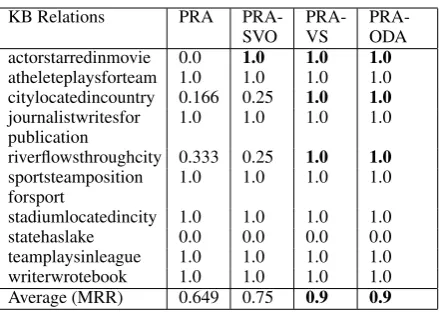
KB Relations PRA
PRA-SVO PRA-VS PRA-ODA actorstarredinmovie 0.0 1.0 1.0 1.0
atheleteplaysforteam 1.0 1.0 1.0 1.0 citylocatedincountry 0.166 0.25 1.0 1.0
journalistwritesfor
publication 1.0 1.0 1.0 1.0
riverflowsthroughcity 0.333 0.25 1.0 1.0
sportsteamposition
forsport 1.0 1.0 1.0 1.0
stadiumlocatedincity 1.0 1.0 1.0 1.0
statehaslake 0.0 0.0 0.0 0.0
[image:4.595.74.294.59.215.2]teamplaysinleague 1.0 1.0 1.0 1.0 writerwrotebook 1.0 1.0 1.0 1.0 Average (MRR) 0.649 0.75 0.9 0.9
Table 2: Comparison of Mean Reciprocal Rank (MRR) metric for 10 relations from NELL (higher is better). PRA-SVO, PRA-VS are the systems proposed in (Gardner et al., 2013; Gardner et al., 2014). PRA-ODA is the approach proposed in this paper. Improvements in ODA over PRA-SVO is statistically significant with p < 0.007, with PRA-SVO as null hypothesis.
classifier.
Query Time: The set of target entities corre-sponding to a source entity and the relation be-ing predicted is not available durbe-ing query (test) time. We use all the entities included in the range of the relation being predicted as candidate target entities. For example, if the relation is riverFlow-sThroughCity, the candidate target set would in-clude entities in the KB that arecities. The DFS is now performed starting from source entities as during training, but this time only restricting to paths with positive weights learned during train-ing. Any path (along with bridging entities) found during this search are added to the KB, and the PRA algorithm is now run over this augmented graph.
4 Experiments
We used the implementation of PRA provided by the authors of (Gardner et al., 2014). For our ex-periments, we used the same 10 NELL relation data as used in (Gardner et al., 2014). The aug-mentation resulted in the addition of 1086 paths during training and 1430 paths during test time.
We split the NELL data into 60% training data, 15 % development data and 25% test data. Values for dmax, and K, the most
fre-quent paths, were obtained by tuning on a development set for 4 relations (athleteplaysfor-sport,actorstarredinmovie,citylocatedincountry
Timings (seconds) PRA
PRA-SVO PRA-VS PRA-ODA Training 635.6 574.5 564.2 913.3
Test 354.3 322.0 301.2 436.7
Batch augmentation n/a 797 797 n/a Embedding
compu-tation n/a n/a 812 n/a
[image:4.595.306.527.61.145.2]Total Time 989.9 1693.5 2474.4 1350 Table 3: Runtime comparison for the entire ex-periment (lower is better). PRA-SVO, PRA-VS are the systems proposed in (Gardner et al., 2013; Gardner et al., 2014). PRA-ODA is the approach proposed in this paper. Between the two top per-forming systems, i.e., PRA-ODA and PRA-VS, PRA-ODA is faster by a factor of 1.8.
and journalistwritesforpublication). The hyper-parameter values dmax = 2, K = 10 reported
the highest MRR and were used for the rest of the relations. For the L1 and L2 regularization parameters in the logistic regression classifier, we used the same values as used in (Gardner et al., 2013; Gardner et al., 2014), viz.,L1 = 0.005, and
L2 = 1.0. This is because the parameters were
reported to be robust, and seemed to work well even when the knowledge base was augmented.
An additional advantage of the proposed algo-rithm is that it can also be run on the top of any PRA based algorithm such as the PRA-SVO and PRA-VS.
5 Conclusion
In this paper, we investigated the usefulness of adding paths to a Knowledge Base for improving its connectivity by mining bridging entities from an external corpus. While previous KB augmen-tation methods focused only on augmenaugmen-tation us-ing mined surface verbs while keepus-ing the node set fixed, we extended these approaches by also addingbridging entitiesin an online fashion. We used a large corpus of 500 million web text corpus to mine these additional edges and bridging enti-ties. Through experiments on real-world datasets, we demonstrate that the proposed approach is not only comparable or better than other state-of-the-art baselines, but more importantly provides faster overall runtime compared with the alternatives.
Acknowledgment
This work is supported in part by a gift from Google.
References
Kurt Bollacker, Colin Evans, Praveen Paritosh, Tim Sturge, and Jamie Taylor. 2008. Freebase: A collaboratively created graph database for structur-ing human knowledge. InProceedings of the 2008 ACM SIGMOD International Conference on Man-agement of Data, SIGMOD ’08, pages 1247–1250, New York, NY, USA. ACM.
Sergey Brin. 1999. Extracting patterns and relations from the world wide web. In Paolo Atzeni, Alberto Mendelzon, and Giansalvatore Mecca, editors, The World Wide Web and Databases, volume 1590 of
Lecture Notes in Computer Science, pages 172–183. Springer Berlin Heidelberg.
J. Callan, M. Hoy, C. Yoo, and L. Zhao. 2009. Clueweb09 data set. boston.lti.cs.cmu.edu.
Oren Etzioni, Michael Cafarella, Doug Downey, Stan-ley Kok, Ana-Maria Popescu, Tal Shaked, Stephen Soderland, Daniel S. Weld, and Alexander Yates. 2004. Web-scale information extraction in know-itall: (preliminary results). In Proceedings of the 13th International Conference on World Wide Web, WWW ’04, pages 100–110, New York, NY, USA. ACM.
Matt Gardner, Partha Pratim Talukdar, Bryan Kisiel, and Tom Mitchell. 2013. Improving learning and
inference in a large knowledge-base using latent syntactic cues. In Proceedings of the 2013 Con-ference on Empirical Methods in Natural Language Processing, EMNLP 2013, 18-21 October 2013, Seattle, Washington, USA, A meeting of SIGDAT, a Special Interest Group of the ACL, pages 833–838.
Matt Gardner, Partha Pratim Talukdar, Jayant Krish-namurthy, and Tom Mitchell. 2014. Incorporat-ing vector space similarity in random walk inference over knowledge bases. InProceedings of the 2014 Conference on Empirical Methods in Natural Lan-guage Processing, EMNLP 2014, October 25-29, 2014, Doha, Qatar, A meeting of SIGDAT, a Special Interest Group of the ACL, pages 397–406.
Marti A. Hearst. 1992. Automatic acquisition of hy-ponyms from large text corpora. InProceedings of the 14th Conference on Computational Linguistics - Volume 2, COLING ’92, pages 539–545, Strouds-burg, PA, USA. Association for Computational Lin-guistics.
Ni Lao and William W. Cohen. 2010. Relational re-trieval using a combination ofpath constrained ran-dom walks.Machine Learning, 81(1):53–67.
Ni Lao, Tom Mitchell, and William W. Cohen. 2011. Random walk inference and learning in a large scale knowledge base. InProceedings of the Conference on Empirical Methods in Natural Language Pro-cessing, EMNLP ’11, pages 529–539, Stroudsburg, PA, USA. Association for Computational Linguis-tics.
Ni Lao, Amarnag Subramanya, Fernando Pereira, and William W. Cohen. 2012. Reading the web with learned syntactic-semantic inference rules. In Pro-ceedings of the 2012 Joint Conference on Empirical Methods in Natural Language Processing and Com-putational Natural Language Learning, EMNLP-CoNLL ’12, pages 1017–1026, Stroudsburg, PA, USA. Association for Computational Linguistics.
T. Mitchell, W. Cohen, E. Hruschka, P. Talukdar, J. Bet-teridge, A. Carlson, B. Dalvi, M. Gardner, B. Kisiel, J. Krishnamurthy, N. Lao, K. Mazaitis, T. Mohamed, N. Nakashole, E. Platanios, A. Ritter, M. Samadi, B. Settles, R. Wang, D. Wijaya, A. Gupta, X. Chen, A. Saparov, M. Greaves, and J. Welling. 2015. Never-ending learning. InProceedings of AAAI.
Joakim Nivre, Johan Hall, Jens Nilsson, Atanas Chanev, G¨ulsen Eryigit, Sandra K¨ubler, Svetoslav Marinov, and Erwin Marsi. 2007. Maltparser: A language-independent system for data-driven de-pendency parsing. Natural Language Engineering, 13(02):95–135.