RESEARCH ARTICLE
Physiological responses to elevated temperature across the
geographic range of a terrestrial salamander
Alexander J. Novarro1,*, Caitlin R. Gabor2, Cory B. Goff2, Tori D. Mezebish3, Lily M. Thompson4and Kristine L. Grayson4
ABSTRACT
Widespread species often possess physiological mechanisms for coping with thermal heterogeneity, and uncovering these mechanisms provides insight into species’ responses to climate change. The emergence of non-invasive corticosterone (CORT) assays allows us to rapidly assess physiological responses to environmental change on a large scale. We lack, however, a basic understanding of how temperature affects CORT, and whether temperature and CORT interactively affect performance. Here, we examined the effects of elevated temperature on CORT and whole-organism performance in a terrestrial salamander, Plethodon cinereus, across a latitudinal gradient. Using water-borne hormone assays, we found that raising ambient temperature from 15 to 25°C increased CORT release at a similar rate for salamanders from all sites. However, CORT release rates were higher overall in the warmest, southernmost site. Elevated temperatures also affected physiological performance, but the effects differed among sites. Ingestion rate increased in salamanders from the warmer sites but remained the same for those from cooler sites. Mass gain was reduced for most individuals, although this reduction was more dramatic in salamanders from the cooler sites. We also found a temperature-dependent relationship between CORT and food conversion efficiency (i.e. the amount of mass gained per unit food ingested). CORT was negatively related to food conversion efficiency at 25°C but was unrelated at 15°C. Thus, the energetic gains of elevated ingestion rates may be counteracted by elevated CORT release rates experienced by salamanders in warmer environments. By integrating multiple physiological metrics, we highlight the complex relationships between temperature and individual responses to warming climates.
KEY WORDS: Corticosterone, Performance, Amphibian, Ectotherm, Plethodontid, Climate, Water-borne hormones
INTRODUCTION
Ectothermic organisms may be disproportionately vulnerable to temperature extremes, which are expected to become more common under anthropogenic climate change. The ability of ectotherms to perform physiological tasks is temperature dependent and often co-varies with latitude as a result of adaptation to local climates or
developmental plasticity (Addo-Bediako et al., 2000; Deutsch et al., 2008; Terrell et al., 2013). Local adaptation and developmental plasticity generate geographic patterns in thermal physiology, and knowledge of these patterns is critical for assessing the vulnerability of species and populations to projected climate change (Huey et al., 2012). For example, populations that are active near, or above, their thermal optimum for performance and that have a limited acclimation capacity are highly sensitive to climate warming (Huey et al., 2012). Further, climate change may be happening too quickly for animals to evolutionarily track temperature shifts through climatic niche evolution (Quintero and Wiens, 2013). In this scenario, species that lack physiological plasticity or behavioral responses to fluctuating conditions will be the most susceptible to environmental change.
One method for detecting the physiological effects of
environmental change is measuring changes in circulating
glucocorticoids (GCs) via activation of the hypothalamic-pituitary-adrenal axis (hypothalamic-pituitary-interrenal axis in amphibians; Sapolsky et al., 2000). Typically studied as a metric in response to acute or chronic stress, the GC corticosterone (CORT) can also serve as a measure of physiological function under a particular set of environmental conditions. An acute GC response mobilizes energy stores, while suppressing growth, digestion and reproduction in vertebrates and is a mechanism for maintaining homeostasis (Greenberg and Wingfield, 1987; Romero, 2004; Sapolsky et al., 2000). Extreme temperatures can disrupt homeostasis and the GC response may be an important adaptive mechanism for responding to temperature extremes in ectotherms. Both temperature and GC production also affect metabolism (Preest and Cree, 2008; Sykes and Klukowski, 2009), so GC responses have the potential to mitigate or exasperate the energetic consequences of extreme temperatures. In some cases, animals that are chronically exposed to an external stimulus may downregulate GC responses to subsequent stimuli (Rich and Romero, 2005). For ectotherms that are chronically exposed to elevated temperatures, downregulating GC responses should reduce the energetic costs of warming (Narayan and Hero, 2014). Further, GC responses may differ among populations or closely related species that occupy habitats with different temperatures. For example, Telemeco and Addis (2014) found that GC responses to temperature (measured as changes in CORT levels)
differed between northern and southern alligator lizards (Elgaria
coeruleaandElgaria multicarinata, respectively) so that CORT was elevated at low temperatures in the southern species only. For the southern species, CORT release may act as an adaptive response to cold temperatures by increasing metabolic rates, which are generally depressed in cold environments.
Measuring multiple physiological metrics may aid in our understanding of organismal responses to temperature warming or
cooling. For example, fish (creek chub,Semotilus atromaculatus)
from streams within agricultural areas, which are warmer and have
Received 27 January 2018; Accepted 31 July 2018
1Department of Biology, University of Maryland, College Park, MD 20742, USA. 2Department of Biology, Texas State University, San Marcos, TX 78666, USA. 3Department of Animal and Avian Sciences, University of Maryland, College Park, MD 20742, USA.4Department of Biology, University of Richmond, Richmond, VA 23173, USA.
*Author for correspondence ([email protected])
A.J.N., 0003-1806-7273; C.R.G., 0001-7584-1451; K.L.G., 0000-0003-1710-0457
Journal
of
Experimental
lower dissolved oxygen than forested streams, exhibited GC responses similar to those from forested areas when exposed to high-temperature conditions in the laboratory (Blevins et al., 2013). In this same study, Blevins and colleagues (2013) showed that fish from agricultural and forested populations differed in physiological performance. Fish from the agricultural area consumed 15% less energy (measured as resting metabolic rate) in response to elevated temperatures, relative to fish from the forested area. In other words, when populations are repeatedly exposed to higher temperatures, attenuation of the GC response can act as an adaptive mechanism for reducing metabolic expenditure, thereby reducing energetic costs in an otherwise costly environment. These results highlight the need to record multiple physiological metrics and raise questions regarding the interactions between temperature- and GC-induced changes in performance.
Thermal sensitivity of physiological responses often varies among individuals from geographically distinct populations. In addition to hormonal changes, these responses can include whole-organism physiological performance traits, which determine how well an individual performs a dynamic and ecologically relevant
task (Lailvaux and Husak, 2014). According to the‘hotter is better’
hypothesis, species from warmer localities should have higher maximal performance than species from colder localities (Huey and Kingsolver, 1989). A core assumption of this hypothesis is that cold-adapted populations cannot overcome the rate-depressing effects of low temperature on biochemical reactions (Hochachka and Somero, 2002). As a result, warm-adapted populations attain higher maximal performance. Whereas species-level comparisons largely confirm that hotter is better, population-level comparisons have mixed results (Knies et al., 2009; Phillips et al., 2014). A recent study found evidence that hotter is better for energy assimilation (i.e. the amount of energy acquired after accounting for metabolic losses) across salamander populations separated by >450 km along a latitudinal gradient, but not among populations separated by >900 m in elevation (Clay and Gifford, 2017). In other words, the
spatial scale used to test the‘hotter is better’hypothesis matters. A
limitation of past physiological studies is that they often measured thermal physiology in single populations or compared extreme ends of the geographic range (e.g. north versus south or high elevation versus low elevation; reviewed in Spicer and Gaston, 2009). Recent studies of physiological rates across landscapes have demonstrated the importance of range-wide sampling in identifying populations that are most susceptible to environmental change (Buckley et al., 2014; Crespi et al., 2015; Deutsch et al., 2008).
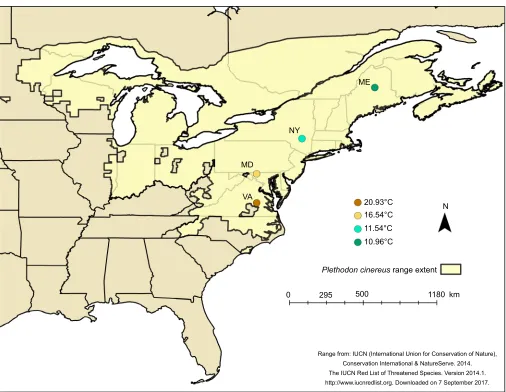
In this study, we examined the effects of elevated temperature on CORT (i.e. the dominant amphibian GC) and physiological performance (i.e. ingestion rate and mass gain) among eastern
red-backed salamanders,Plethodon cinereus(Green 1818), across a
1100 km latitudinal gradient (Fig. 1). We predicted that CORT would increase when salamanders were exposed to elevated temperatures, but that salamanders from warmer sites would exhibit a smaller increase in CORT release rates compared with salamanders from cooler environments as an adaptive short-term response to higher temperatures. With regard to physiological performance, we predicted that ingestion rate would be greater in salamanders from warmer sites, in accordance with the hotter is better hypothesis, and that a greater ingestion rate would reduce mass loss after exposure to elevated temperatures. Additionally, we explored the relationship between CORT release rates and food conversion efficiency (i.e. the amount of mass gained per unit food ingested) and tested whether this relationship was temperature dependent. In salamanders, elevated CORT is associated with
decreased body mass and increased metabolic rate (reviewed in Woodley, 2017), so we predicted that an increase in individual CORT release rates would reduce food conversion efficiency and lead to long-term ecological consequences. Our study extends prior work by examining whether physiological traits provide insights into thermal sensitivity across the geographic range of a widespread species.
MATERIALS AND METHODS Study species
The genus Plethodon consists of lungless salamanders (family
Plethodontidae) that are restricted to terrestrial habitat and thus lack a larval stage (Petranka, 1998). The eastern red-backed salamander (P. cinereus) is the most widely distributedPlethodonspecies in the eastern USA (Fig. 1). It occupies more than half of the geographic
distribution of the entire genus (1.8 million out of 3.1 million km2)
and is the only Plethodon species found in the northernmost
1.23 million km2of the genus’range (Adams and Church, 2011).
AlthoughP. cinereusis a model system for plethodontid behavior
(Jaeger et al., 2016), we know little about the physiological traits that allow this species to occupy such a large geographic range.
Most physiological studies of P. cinereusare restricted to single
populations (Heatwole, 1962; Homyack et al., 2010; Hutchinson, 1961; Merchant, 1970; Spotila, 1972; but see Markle, 2015, for a comparative study of critical thermal limits across the southwestern portion of the species range). Here, we compared physiological
responses to elevated temperature inP. cinereusacross a latitudinal
gradient from Virginia to Maine (Fig. 1).
Salamander collection and husbandry
In August and September 2016, we collectedP. cinereusfrom 4 sites
spanning 8.3° latitude and >1100 km (ME, NY, MD and VA; Fig. 1). Collection occurred prior to the breeding season, which occurs from October to December (Petranka, 1998). At each site, we
hand-captured 16–17 adult salamanders (>32 mm snout–vent length,
SVL; Sayler, 1966) and transported them back to the lab in individually labeled containers. We based this sample size on a previous study, which found that sample sizes of 15 or 16 salamanders provided enough statistical power to detect a
significant difference in CORT release rates (Gabor et al., 2016).
We did not discriminate by sex because of collecting limitations, but
analyses using independent t-tests indicated that our variables of
interest did not differ among the sexes (CORT:P=0.42; ingestion
rate: P=0.22; mass change: P=0.49). To avoid the potentially
confounding physiological effects of color polymorphism
(described in Fisher-Reid et al., 2013, and Moreno, 1989), we only collected individuals that clearly displayed the striped, rather than unstriped, phenotype. At the time of collection, we measured SVL, tail length and mass, and determined sex using the candling method (described by Gillette and Peterson, 2001). After collection, salamanders were transported to temperature-controlled chambers and held at a constant temperature of 15°C, where they underwent an acclimation period of 4 weeks. We housed each salamander individually in a plastic container (18×14×12 cm) lined with a moist unbleached paper towel and a crumpled moist paper towel to
use as a retreat. Salamanders were fed 1–3 black soldier fly larvae, 3–
5 crickets (6.4 mm) or 15–20 large flightless fruit flies (Drosophila
hydei) weekly and sprayed with spring water ad libitum. Salamanders were held in incubators with fluorescent lighting set on a 12 h:12 h dark:light cycle throughout the entirety of this study. Animals were collected with permission from Maine Department
of Inland Fisheries and Wildlife ( permit #2016-483), Maryland
Journal
of
Experimental
Department of Natural Resources ( permit #56409), New York State Department of Environmental Conservation ( permit #2007) and Virginia Department of Game and Inland Fisheries ( permit #056084). Interstate transport was permitted under a Federal Fish and Wildlife injurious species permit ( permit #MA90136B-0) and vertebrate research was approved by the University of Maryland ( protocol FR-15-72) and University of Richmond IACUC ( protocol 16-10-001).
Thermal CORT response experiment
We examined the GC response of salamanders to elevated temperature using a water-borne CORT assay (Gabor et al., 2013) which provides an integrated measure reflecting an average of blood GCs that have been metabolized and excreted from urine and feces, and possibly through the skin, over a period of cumulative exposure (Santymire et al., 2018; Sheriff et al., 2011). We measured CORT release rates for each salamander at an average temperature (15°C) and an elevated temperature (25°C). The average temperature treatment was within the range of thermal preferences for
P. cinereus in a laboratory setting (12–22°C) and is a common
maintenance temperature forPlethodonstudies (Clay and Gifford,
2017; Feder and Pough, 1975; Gabor and Jaeger, 1995). We chose to raise the temperature to 25°C for several reasons: it is above the
thermal preference of this species (Feder and Pough, 1975), it reflects a realistically high body temperature in natural conditions (A.J.N., unpublished data) and it is sublethal (Hutchinson, 1961).
After acclimating salamanders to the average temperature for 4 weeks, we collected the first CORT sample from each salamander using a water-borne assay, as described below. Salamanders remained at this temperature for an additional 24 h,
and then we increased the ambient temperature by 2.5°C day−1
until reaching 25°C. Salamanders remained in this elevated, likely physiologically challenging, thermal environment for 48 h, after which we repeated the water-borne assay at 25°C to collect a second CORT sample while maintaining the elevated temperature. We fed all salamanders 24 h prior to collecting each CORT sample to maintain their weekly feeding schedule and to minimize the potential effects of hunger or feeding frequency on CORT. All salamanders survived this process and did not show external signs of distress or illness.
Water-borne hormone assays
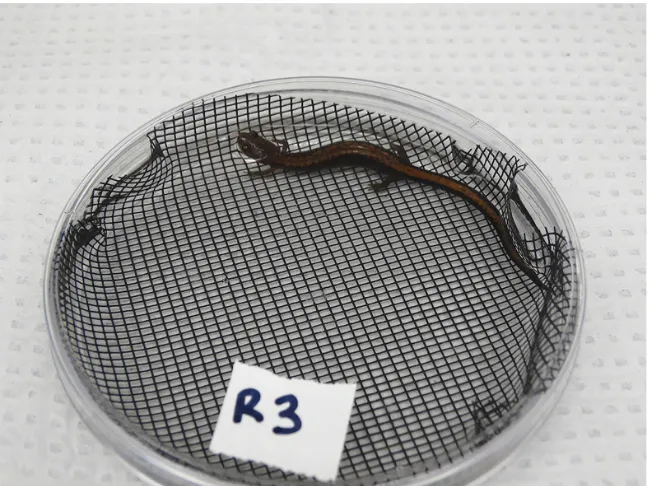
To collect water-borne samples for hormone analysis, we placed each salamander individually in 45 ml of bottled spring water in a standard-size Petri dish (100×15 mm) for 1 h (following Gabor et al., 2016; Fig. 2). We also ran blank controls using spring water
ME
NY
MD
VA
20.93°C N
16.54°C
11.54°C
0 295 500 1180 km
Range from: IUCN (International Union for Conservation of Nature), Conservation International & NatureServe. 2014. The IUCN Red List of Threatened Species. Version 2014.1. http://www.iucnredlist.org. Downloaded on 7 September 2017.
10.96°C
[image:3.612.52.558.53.445.2]Plethodon cinereus range extent
Fig. 1. Salamander collection sites in the eastern USA.The coloration of the points indicates the site heat value, a measure of daily maximum surface temperature averaged over 35 years. We collected 16–17 salamanders from each site.
Journal
of
Experimental
samples (3 different samples as a result of different sample times) and subtracted the relevant values from the CORT release rates of each salamander (spring water CORT ranged from 2.61 to
8.79 pg ml−1of sample water). All sampling events were scheduled
between 15:00 h and 17:00 h to avoid circadian fluctuations of CORT (Dunn et al., 1972). We placed a piece of mesh lining in the bottom of each Petri dish to aid in removing salamanders, while minimizing sample loss (Fig. 2). After 1 h, we lifted the mesh out of each Petri dish to transfer the salamander back to its housing container while leaving the water sample in the dish. We poured the water sample from each Petri dish into a labeled Falcon tube, and
immediately stored all samples in a−20°C freezer (Ellis et al., 2004).
The Petri dishes and mesh lining were cleaned with 95% ethanol and rinsed with spring water before use. We extracted CORT from water following Gabor et al. (2016) and re-suspended the CORT residue
with 95% EIA buffer and 5% ethanol for a total of 220μl. We
measured CORT in duplicate for all samples using a CORT enzyme-immunoassay (EIA) kit (Cayman Chemical Company, Inc., cat. no. 501320, Ann Arbor, MI, USA) on a spectrophotometer plate reader set to 405 nm (Biotek ELX 800, Winooski, VT, USA). This assay is 100% cross-reactive with CORT, 15.8% with 11-deoxycorticosterone and 3.4% with prednisolone.
We validated the use of water-borne CORT collection methods fromP. cinereuson Cayman Chemical EIA plates using a pooled sample of CORT from 10 non-experimental animals (following Gabor et al., 2016). We assessed parallelism of the serial dilution curve (1:1 to 1:32) using the pooled sample. The CORT dilution curve was not significantly different from the standard curve
(comparison of slopes, t9=−0.894, P=0.39). To determine
quantitative recovery, we spiked the pooled sample with each of eight standards in addition to the un-spiked pooled sample. The minimum observed recovery was 89%. We found a linear
relationship between observed and expected slopes (β=1.2,
F1,6=457.38,R2=0.99,P<0.001). Using a pooled control sample
run in quadruplicate on each plate, our intra-plate variation on 5 plates ranged from 0.51% to 13.7% and the overall inter-plate variation was 15.7%. The sensitivity of the CORT EIA plates ranged
between 37.5 and 1004.3 pg ml−1on average.
Physiological performance experiment
In addition to GC response, we were interested in whether temperature differentially affected ingestion rate and mass gain among sites. After collecting the second water-borne CORT sample from each individual, we continued to expose salamanders to 25°C and fasted them for 10 days to ensure the clearing of gut contents. Following the fasting period, we began a controlled feeding trial in which we offered 50 fruit flies to each salamander, recorded the number of flies remaining after 24 h, and replenished flies that were eaten (adapted from Clay and Gifford, 2017). We repeated this procedure (counting flies and replenishing) for 5 consecutive days, recorded the number of remaining flies on day 6, and removed all leftover flies. We calculated ingestion rate as the total number of flies consumed during each trial, corrected for salamander mass (g), and divided by 5 days. To calculate mass gain, we weighed salamanders 24 h before and 48 h after each 5 day controlled feeding trial. Prior to each measurement, we placed salamanders in water for approximately 30 s and gently patted them dry with a paper towel to minimize variation in water mass (Fraser, 1980). To correct for among-individual variation in initial body mass, we calculated percentage change in mass.
After completing the feeding trial at 25°C, we brought the
temperature back down to 15°C by decreasing it at 2.5°C day−1and
fed salamanders a maintenance ration of fruit flies. Salamanders fasted for 10 days while adjusting to the 15°C environment prior to the next feeding trial. In total, we measured ingestion rate and mass
gain for 8 salamanders from each site at each temperature (n=32).
There was a single mortality from the NY population during the physiological performance experiment, so we removed that individual from the performance dataset. Because of differences in the availability of experimental salamanders, a different set of VA salamanders was used for CORT sampling to those used for controlled feeding trials. Thus, we excluded the VA salamanders for analyses that required paired CORT and performance data but used VA salamanders in population-level comparisons of performance. Overall, we had paired CORT and performance data for 23
salamanders representing 3 sites: MD (n=8), ME (n=8) and
[image:4.612.48.372.57.300.2]NY (n=7).
Fig. 2. Water-borne corticosterone (CORT) collection procedure.We collected water-borne CORT samples by placing each salamander in 45 ml of spring water in a Petri dish for 1 h. We lined the bottom of each Petri dish with mesh screen to provide a textured surface for the salamanders to stand on, and to easily remove the salamander from the Petri dish while leaving the water sample behind for collection.
Journal
of
Experimental
Analyses
Following Gabor et al. (2016), we multiplied CORT ( pg ml−1h−1)
by 220μl (the volume of the resuspension solution) to account for
resuspension and divided by the mass of each individual (g) to
obtain standardized CORT in pg g−1 h−1. CORT data were
ln-transformed for statistical analyses. For all analyses, we used the environmental temperature experienced at each collection site (described below) as an explanatory variable, rather than using site as a categorical variable. We chose to use continuous rather than categorical data for two reasons. First, we were interested in whether salamander populations exhibit physiological adaptations or acclimation based on the temperatures they experience in the wild. Second, differences in thermal conditions between the collection sites were not evenly distributed; therefore, it would be inappropriate to simply rank them based on latitudinal or elevational distribution.
To obtain climatological data for our field sites, we downloaded daily maximum ground surface temperatures for each collection site
from 1980 to 2015 from NASA’s Daily Surface Weather and
Climatological Summaries (DAYMET) database (Thornton et al., 1997). We chose to use ground surface temperature, rather than air
temperature, becauseP. cinereusis a small salamander that spends
the majority of its time on the forest floor. Further, we chose maximum daily temperature because we were interested in relative heat exposure at each of the field sites. We used mean daily maximum temperature, averaged over a 35 year period, as a representative site temperature for all analyses. Hereafter, we refer to our metric for site temperature as the site heat value to avoid confusion with temperature treatments in the laboratory.
All models were run using packagesnlme(version 3.1-131) and
stats(version 3.4.0) in R statistical software (http://www.R-project. org/). To test whether CORT release rates were related to site heat value and whether they differed between the 15 and 25°C temperature treatments, we used a linear mixed-effects model (LMM) fitted by maximum likelihood. The model included site heat value, temperature treatment and the interaction between site heat value and temperature treatment as fixed effects. We nested salamander within temperature treatment as a random effect to account for the repeated sampling of each salamander at 15 and 25°C.
We were also interested in whether the relative change in CORT
from 15 to 25°C varied among sites. Thus, we calculated a Q10
temperature coefficient (i.e. the rate at which a physiological response changes with a 10°C increase in temperature) for each salamander as the rate at which CORT changed from the average to the elevated temperature treatment (McNab, 2002).
Q10¼
CORT25C
CORT15C
10C=ð25C15CÞ
: ð1Þ
AQ10value greater than 1 indicates an increase in CORT release
rate after exposure to the elevated temperature, relative to CORT
release rate at the average temperature, whereas aQ10value less than
1 indicates a decrease in CORT release rate after exposure to the
elevated temperature. To determine whetherQ10varied among sites,
we fitted a linear model withQ10as the response variable and site
heat value as the explanatory variable. Additionally, we used a generalized LMM with a binomial error structure to determine
whether the probability of having aQ10value greater than or less
than 1 was related to site heat value.
We compared ingestion rate and mass gain among sites using LMMs fitted by maximum likelihood. The models included site heat value, temperature treatment and the interaction between these
terms as fixed effects and either ingestion rate or mass gain as the response variable. We ran an additional analysis to determine whether food conversion efficiency varied with CORT release rate at the individual level, and whether the strength of this relationship was affected by temperature treatment. Food conversion efficiency has long been used as a performance metric in agricultural and fisheries sciences and is sensitive to temperature (Bedford and Classen, 1992; Brett et al., 1969; Handeland et al., 2008; Imsland et al., 2000; Jonassen et al., 2000). As an index of food conversion efficiency, we obtained residual values from a linear regression of mass gain on total ingestion (i.e. the total number of flies consumed during a feeding trial), with temperature treatment as an interactive
effect (R2=0.30, d.f.=42, P<0.001). Thus, food conversion
efficiency index reflects the amount of mass gained per unit ingestion for each individual relative to the mean in each temperature treatment. To determine whether CORT release rates and temperature were interactively related to food conversion efficiency, we ran a LMM with temperature treatment, CORT and the interaction between temperature and CORT as the explanatory variables and food conversion efficiency as the response variable. For all LMMs described above, we nested salamander within temperature treatment as a random effect to account for the repeated sampling of each salamander at 15 and 25°C. Statistical error is reported as s.e.m. consistently throughout the results.
RESULTS
Thermal CORT response experiment
We found that overall salamander CORT release rates were
positively related to site heat value (β=0.12±0.02, χ2=33.07,
d.f.=63;P<0.001) and were significantly higher after exposure to
an elevated temperature, which is outside the preferred thermal
range of P. cinereus, than at the average temperature (χ2=33.91,
P<0.001; Fig. 3A). Across all sites, exposure to an elevated
temperature raised CORT release rates by an average of 0.71±
0.41 pg g−1h−1. The interaction term (site heat value×temperature
treatment) was not significant (χ2=0.08, P=0.78), meaning that
CORT release rate responded similarly to the elevated temperature across sites. Removing the random effects (individual nested within temperature treatment) significantly decreased the goodness of fit,
as indicated by a likelihood ratio test (P<0.001), suggesting that
individual was an important source of variation in our data. To better understand the effects of elevated temperature on
individual CORT release rates, we calculatedQ10values for each
salamander. A linear model determined that site heat value was not a
significant predictor ofQ10(d.f.=63,P=0.41). We found an average
Q10value of 2.69±0.42, indicating that CORT release rates were
2.69 times greater at the elevated temperature, compared with the
average temperature treatment. However,Q10values varied widely
among individuals (Fig. 3B). Overall, 77% (50/65) of individuals
had aQ10value greater than 1 and experienced a 3.30±0.51 rate of
increase in CORT release after exposure to an elevated temperature,
whereas the other 23% (15/65) had a Q10value less than 1 and
experienced a 0.67±0.06 rate of decrease in CORT release after exposure to the elevated temperature. The probability of an
individual having aQ10value greater than or less than 1 was not
significantly related to site heat value (z=0.04, d.f.=63,P=0.97).
Physiological performance experiment
We found an interactive effect of site heat value and temperature
treatment on ingestion rate (χ2=33.02, d.f.=63,P<0.001; Fig. 4A).
The slope of the relationship between ingestion rate and site heat
value was 5 times greater in the 25°C treatment than in the 15°C
Journal
of
Experimental
treatment (β15°C=0.38±0.25, β25°C=1.91±0.28). At 25°C,
salamanders from the warmest sites (MD and VA) ingested an
average of 32.77±2.01 and 33.73±2.01 flies g−1day−1, respectively,
whereas salamanders from the coolest sites (ME and NY) ingested
an average of 14.65±1.47 and 19.04±2.93 flies g−1 day−1,
respectively. Similarly, we found a significant interactive effect of
site heat value and temperature treatment on mass gain (χ2=3.96,
d.f.=63,P=0.047; Fig. 4B). The slope of the relationship between
mass gain and site heat value was negative in the 15°C treatment but
positive in the 25°C treatment (β15°C=−0.32±0.25, β25°C=0.34±
0.34). On average, the mass of individuals increased by 6.85±0.93% in the 15°C treatment and 0.96±1.13% in the 25°C treatment. Across all sites, 41% (13/32) of salamanders lost mass in the 25°C treatment, whereas only 9% (3/32) of salamanders lost mass in the 15°C treatment.
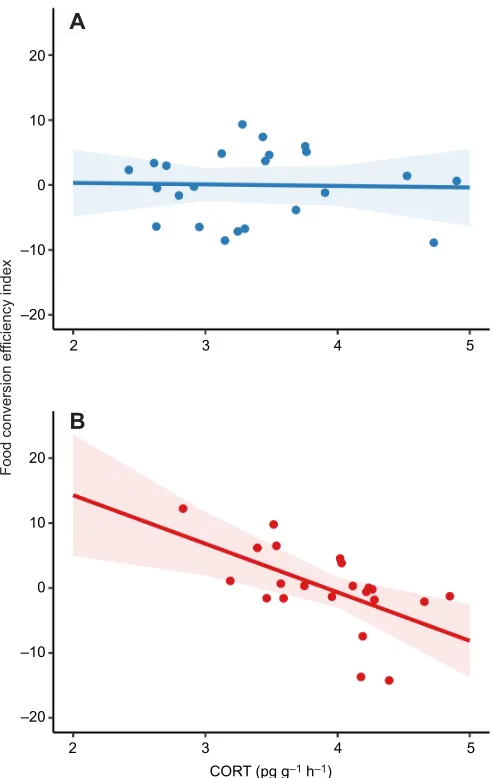
To explore the association between CORT release rates and physiological performance, we tested the relationship between CORT and food conversion efficiency index in salamanders that underwent hormone sampling and controlled feeding trials. We found that CORT release rate and temperature treatment were
interactively related to food conversion efficiency index (χ2=6.89,
d.f.=20, P=0.009; Fig. 5). In the 25°C treatment, an increase in
CORT release rate was related to a decrease in food conversion efficiency, indicating that individuals with higher CORT release stored less energy per unit ingestion than individuals with a lower
CORT release rate (β25°C=−7.48±2.89). In the 15°C treatment, the
relationship between CORT release rate and food conversion
efficiency was virtually absent (β15°C=−0.23±1.67).
DISCUSSION
Our results suggest that thermal sensitivity differs between
physiological traits and across a latitudinal gradient inP. cinereus.
The ability of individuals to adjust CORT and performance may result in an improved ability to maintain homeostasis and allow populations to persist across a range of environmental conditions.
10 15 20 25 30 35
15 25
Ingestion rate (flies g
–1
day
–1
)
−5 0 5 10
15 25
Temperature treatment (°C)
Change in mass (%)
A
B
VA
ME
MD
NY
VA
ME
MD
[image:6.612.64.395.52.441.2]NY
Fig. 4. Population variation in thermal performance.Points represent mean ingestion rate (A) and change in mass (B) for salamanders from each collection site in the 15°C (n=32) and 25°C (n=32) temperature treatments. Error bars represent s.e.m. and point colors indicate the site heat value. Using linear mixed-effects models, we found an interactive effect of site heat value and temperature treatment on ingestion rate (P<0.001) and mass gain (P=0.047). 2.5
3.0 3.5 4.0 4.5 5.0 5.5
15 25
Temperature treatment (°C)
COR
T
(pg g
–1
h
–1
)
0 3 6 9 12
10 12 14 16 18 20 22
Site heat value (°C)
Q10
VA
ME
MD
NY
A
[image:6.612.266.554.58.446.2]B
Fig. 3. CORT response to an elevated temperature.(A) Relationship between mean CORT release rate and experimental temperature for salamanders from each collection site at 15°C (n=65) and 25°C (n=65). Salamander CORT release rates were positively related to site heat value (P<0.001) and were significantly higher at 25°C than at 15°C (P<0.001). (B) Lack of a relationship between site heat value andQ10temperature coefficients, or the rate at which CORT changed with a 10°C increase in temperature (n=65). A linear model determined that site heat value was not a significant predictor ofQ10(P=0.41). A single outlier (site heat index=11.54,Q10=24.82) was excluded for visualization purposes, but was included in all analyses. Error bars represent s.e.m. and point colors indicate the site heat value (see A for locations).
Journal
of
Experimental
Using an integrated measure of CORT (i.e. from water-borne assays), we found that CORT release rates were positively related to site heat value and were consistently higher when salamanders were exposed to an elevated temperature. Contrary to predictions, the rate at which CORT release increased when salamanders transitioned from 15 to 25°C did not vary among sites. This result suggests that salamanders from warmer sites may lack the ability to downregulate CORT, which may be maladaptive, despite living near the edge of
the species’southern range. Alternatively, the higher CORT release
rates observed in the southernmost population could be an adaptive response to living in overall higher temperatures than the other populations. Higher CORT may mediate a behavioral response such as retreating below ground and aid in maintaining homeostasis. Future studies could differentiate between these hypotheses by further testing whether these salamanders show a physiological response to additional stressors.
As for performance, salamanders from warmer sites responded strongly to the elevated temperature by increasing ingestion rate,
whereas salamanders from cooler sites did not. This response was predicted because both higher temperatures and higher CORT increase metabolism (Preest and Cree, 2008; Sykes and Klukowski, 2009). The elevated temperatures reduced mass gain in all four sites, although this reduction was more dramatic for salamanders from cooler sites. Finally, we found a temperature-dependent relationship between CORT release rates and food conversion efficiency where salamanders with higher CORT release had lower food conversion efficiency at 25°C but CORT release was unrelated to food conversion at 15°C. Thus, the energetic gains of elevated ingestion rates may be counteracted by higher CORT release rates experienced by salamanders exposed to an elevated temperature.
When faced with elevated temperatures, salamanders from all collection sites experienced increased CORT release rates. This finding confirms that body temperature influences CORT release
rates in P. cinereus and that CORT release rates are greater, on
average, in warmer temperatures. Very few studies have measured the effects of temperature on CORT responses in amphibians, but
our results are similar to those found in cane toads (Rhinella marina;
Narayan et al., 2012). Narayan and colleagues (2012) found that although urinary CORT metabolite concentrations (another integrated measure of CORT) rose during a 24 h acclimation
period, R. marina consistently exhibited higher CORT at 25°C
relative to 15°C. Additionally, our study also revealed geographic variation in CORT release rates, which increased on average as site heat value increased, indicating that temperatures experienced in the wild may have long-lasting effects on salamander CORT. The observed trend was largely driven by elevated CORT release rates in salamanders from the southernmost, warmest collection site (Richmond, VA). CORT is often released in response to external conditions to mobilize energy stores and initiate an escape response (Sapolsky et al., 2000). If salamanders living near the edge of the southern range have higher body temperatures and therefore higher metabolic rates, on average, then elevated CORT may have a
maladaptive effect on an individual’s energy budget, while also
potentially mediating adaptive behavioral responses such as retreating below ground to reduce body temperatures. Additional behavioral studies would provide insights as to whether higher CORT facilitates adaptive responses to thermal fluctuations, such as retreating below ground.
Salamanders from all of our study sites experienced a similar increase in CORT release rates following the elevation in temperature. This was surprising, as amphibians have been shown to modulate or downregulate endocrine sensitivity to warming after repeated exposure to high temperatures in the laboratory (Narayan and Hero, 2014). We predicted that populations towards the edge of the southern range would downregulate CORT in response to an elevated temperature as they experience repeated exposure to heat in natural conditions. However, it is possible that behavioral avoidance of suboptimal temperatures is great enough to homogenize the frequency of extreme heat experienced among our study sites. As previously mentioned, increased CORT may mediate behavioral avoidance of high temperatures, which would aid in avoiding lethal
temperatures. At our southernmost site,P. cinereusavoids extreme
heat and desiccation by retreating below ground for a significant portion of the year, from May to September (KL.G., unpublished data). Behavioral thermoregulation may reduce thermal selection for local adaptation of physiological traits (Buckley et al., 2015), which in this case we expected to manifest as the downregulation of CORT release rates in warmer temperatures.
Although sites experienced a similar increase in mean CORT release rates when exposed to an elevated temperature, the degree to
A
B
2 3 4 5
2 –20
Food conversion ef
ficiency index
CORT (pg g–1 h–1) –10
0 10 20
–20 –10 0 10 20
[image:7.612.52.298.56.445.2]3 4 5
Fig. 5. Relationship between individual CORT release rate and food conversion efficiency index in sites with paired hormone and performance data (ME, NY and MD).Temperature treatments are shown separately for clarity: (A) 15°C (n=23) and (B) 25°C (n=23). Regression lines and 95% confidence intervals were fitted using a linear mixed-effects model with salamander nested within temperature treatment as a random effect. CORT release rates and temperature treatment were interactively related to food conversion efficiency index (P=0.009).
Journal
of
Experimental
which CORT increased from 15 to 25°C varied widely among individuals within each site. In our study, 77% of individuals experienced an increase in CORT release rate after exposure to the
elevated temperature, indicated by aQ10value greater than 1. For
these individuals, CORT was 1.01–10.7 times higher in the elevated
temperature treatment (although a single outlier from NY experienced a 24.8-fold increase in CORT release rate in the elevated temperature). When compared with another amphibian,
R. marina, in which CORT increased 1.51-fold from 15 to 25°C and
1.43-fold from 25 to 35°C, many of theQ10values observed in our
study are quite high. These highQ10values suggest that the CORT
release rates of P. cinereus are relatively sensitive to elevated
temperatures. The other 23% of salamanders used in the CORT experiment experienced a decrease in CORT release after exposure to
the elevated temperature, indicated by a Q10 less than 1. Such
reductions in CORT release rates with increasing temperature have
also been shown in reptiles, specifically in the Children’s python
(Antaresia children; Dupoué et al., 2013). Researchers suggested that snakes may release more CORT as a means of coping with suboptimal temperatures. It is possible that individuals with higher thermal optima experience greater physiological consequences at lower temperatures, and potentially respond to that environmental condition with an
increase in CORT. Regardless of the cause, variation in Q10
temperature coefficients may act as a basis for future plasticity in response to climate change (Ghalambor et al., 2007; Urban et al., 2014).
Our study revealed geographic variation in thermal performance in
accordance with the‘hotter is better’hypothesis (Angilletta, 2009;
Huey and Kingsolver, 1989). When exposed to an elevated
temperature,P. cinereusfrom northern populations maintained low
ingestion rates and consequently lost mass. In contrast, the southernmost populations effectively responded to the elevated temperature by capturing and ingesting more prey, thereby counteracting energy loss in warmer temperatures. This pattern may
be explained by differences in life history strategies ofP. cinereus
across their range. Salamanders from colder localities endure longer winters and a shorter growing season than those from warmer
localities. In the 15°C treatment,P. cinereusfrom the northernmost
site (Millinocket, ME) gained the most mass while consuming the least amount of energy. Our findings suggest that the Maine population may have had depressed metabolic rates and/or allocated more energy towards mass gain (i.e. growth and fat storage) at 15°C relative to the other populations. There is evidence for both metabolic depression and fat storage in temperate
salamanders. When acclimated to warmer temperatures,
salamanders may use metabolic depression as a mechanism for coping with thermal stressors (Bernardo and Spotila, 2006; Markle, 2015). Although metabolic depression has not been explicitly tested as a means of maximizing fat storage during the limited growing season in cold-adapted salamanders, it plays an important role in torpor, hibernation and estivation in other taxa (Guppy and Withers,
1999). In addition to potential metabolic depression,P. cinereusfrom
high elevations are known to allocate more energy towards tail fat storage than those from low elevations (Takahashi and Pauley, 2010). Although salamanders from Maine seem to possess successful strategies for coping with a shorter growing season, they suffered the greatest loss of mass when exposed to an elevated temperature.
An important precursor to using an integrated measure of CORT release rates as a biomarker for the effects of environmental
change is linking CORT with performance and fitness
consequences. We provide evidence for a temperature-dependent relationship between CORT release rates and whole-organism
physiological performance. CORT release rates were unrelated to food conversion efficiency index in the 15°C treatment but were negatively related to food conversion efficiency index in the 25°C treatment. Thus, it seems that elevated temperatures may have greater ecological consequences for individuals with higher CORT release rates. We propose that the increased metabolic demands imposed by CORT and elevated temperatures can overwhelm an
individual’s ability to maintain a positive energy budget. Our
proposed explanation is supported by prior models of
thermodynamic constraints on physiological rates described by the Boltzmann factor (Angilletta et al., 2010), as well as previous studies of metabolic rates in plethodontid salamanders. In
P. cinereus, mass-corrected metabolic rate increases exponentially with increases in temperature (Homyack et al., 2010). Red-legged
salamanders (Plethodon shermani) with chronically elevated
plasma CORT also have higher metabolic rates (Wack et al., 2012). To date, there is mixed evidence for a relationship between CORT and performance in lungless salamanders. Salamanders with chronically elevated CORT have a weaker immune response (i.e. slower wound healing) than control individuals (Thomas and Woodley, 2015). A suppressed immune response may be a result of energetic tradeoffs, where chronically stressed individuals allocate more energy towards physiological maintenance than immune responses (Korfel et al., 2015). By contrast, increased levels of plasma CORT did not affect locomotor performance in Allegheny
dusky salamanders (Desmognathus ochrophaeus), although other
stressors (i.e. handling and low pH) reduced performance (Ricciardella et al., 2010; Woodley et al., 2014). More research on geographic patterns of physiological performance in relation to environmental change is needed to understand the mechanisms underlying the observed variation in performance and its relationship to CORT.
Environmental disturbances ultimately affect fitness in wild
populations through changes in individual physiology and
performance (Jeffrey et al., 2015). Thus, understanding cause-and-effect relationships between environmental disturbances and animal physiology allows us to make predictions about population-level
responses to environmental change (Cooke and O’Connor, 2010;
Wikelski and Cooke, 2006). Our results suggest that southern
populations ofP. cinereusmay be more resilient to climate warming
than northern populations, because they exhibit greater flexibility in performance (i.e. ingestion rate) when exposed to high temperatures. Although salamander CORT release rates responded similarly to an elevated temperature among our study sites, salamanders from the southern sites were able to increase ingestion rate and thereby compensate for increased metabolic demands. Taken together, our results suggest that populations may be more resilient to environmental change when they possess flexible behavioral responses for coping with elevated temperatures (Herstoff and Urban, 2013).
Acknowledgements
We thank Sarah Via for providing incubators and Alexa Bely for providing research facilities, equipment and technical support. We also thank Sarah Bailey, Melissa Marquez, Hannah Whittaker, Sarah Timko and Christian Law for assistance with field collection and animal husbandry. We thank Alex Baugh, Alexa Bely, Maile Neel, Chris Rowe, Paul Leisnham and two anonymous reviewers for helpful feedback on this manuscript.
Competing interests
The authors declare no competing or financial interests.
Author contributions
Conceptualization: A.J.N., C.R.G., K.L.G.; Methodology: A.J.N., C.R.G., C.B.G., L.M.T., K.L.G.; Software: A.J.N., L.M.T.; Validation: A.J.N., C.R.G., C.B.G., L.M.T.,
Journal
of
Experimental
K.L.G.; Formal analysis: A.J.N., C.R.G., C.B.G.; Investigation: A.J.N., C.R.G., C.B.G., T.D.M., L.M.T., K.L.G.; Resources: A.J.N., C.R.G., K.L.G.; Data curation: A.J.N., L.M.T.; Writing - original draft: A.J.N., C.R.G.; Writing - review & editing: A.J.N., C.R.G., C.B.G., T.D.M., L.M.T., K.L.G.; Visualization: A.J.N., L.M.T.; Supervision: A.J.N., C.R.G., L.M.T., K.L.G.; Project administration: A.J.N., C.R.G., L.M.T., K.L.G.; Funding acquisition: A.J.N., K.L.G.
Funding
Funding for this study was provided by the University of Richmond School of Arts and Sciences.
Data availability
Data used in analyses have been deposited in the Dryad digital repository (Novarro et al., 2018): https://doi.org/10.5061/dryad.g32q0h0
References
Adams, D. C. and Church, J. O.(2011). The evolution of large-scale body size clines inPlethodonsalamanders: evidence of heat-balance or species-specific artifact?Ecography34, 1067-1075.
Addo-Bediako, A., Chown, S. L. and Gaston, K. J.(2000). Thermal tolerance, climatic variability and latitude.Proc. R. Soc. Lond. B.267, 739-745.
Angilletta, M. J. (2009). Thermal Adaptation: A Theoretical and Empirical Synthesis. Oxford, UK: Oxford University Press.
Angilletta, M. J., Huey, R. B. and Frazier, M. R.(2010). Thermodynamic effects on organismal performance. Is hotter better?Physiol. Biochem. Zool.83, 197-206. Bedford, M. R. and Classen, H. L.(1992). Reduction of intestinal viscosity through
manipulation of dietary rye and pentosanase concentration is effected through changes in the carbohydrate composition of the intestinal aqueous phase and results in improved growth rate and food conversion efficiency of broiler chicks. J. Nutr.122, 560-569.
Bernardo, J. and Spotila, J. R.(2006). Physiological constraints on organismal response to global warming: mechanistic insights from clinally varying populations and implications for assessing endangerment.Biol. Lett.2, 135-139.
Blevins, Z. W., Effert, E. L., Wahl, D. H. and Suski, C. D.(2013). Land use drives the physiological properties of a stream fish.Ecol. Indic.24, 224-235. Brett, J. R., Shelbourn, J. E. and Shoop, C. T.(1969). Growth rate and body
composition of fingerling sockeye salmon,Oncorhynchus nerka, in relation to temperature and tation size.J. Fish. Res. Bd. Canada26, 2363-2394. Buckley, L. B., Nufio, C. R. and Kingsolver, J. G.(2014). Phenotypic clines,
energy balances and ecological responses to climate change.J. Anim. Ecol.83, 41-50.
Buckley, L. B., Ehrenberger, J. C. and Angilletta, M. J.(2015). Thermoregulatory behaviour limits local adaptation of thermal niches and confers sensitivity to climate change.Funct. Ecol.29, 1038-1047.
Clay, T. A. and Gifford, M. E.(2017). Population level differences in thermal sensitivity of energy assimilation in terrestrial salamanders.J. Therm. Biol.64, 1-6. Cooke, S. J. and O’Connor, C. M.(2010). Making conservation physiology relevant
to policy makers and conservation practitioners.Conserv. Lett.3, 159-166. Crespi, E. J., Rissler, L. J., Mattheus, N. M., Engbrecht, K., Duncan, S. I.,
Seaborn, T., Hall, E. M., Peterson, J. D. and Brunner, J. L. (2015). Geophysiology of wood frogs: landscape patterns of prevalence of disease and circulating hormone concentrations across the eastern range.Integr. Comp. Biol. 55, 602-617.
Deutsch, C. A., Tewksbury, J. J., Huey, R. B., Sheldon, K. S., Ghalambor, C. K., Haak, D. C. and Martin, P. R.(2008). Impacts of climate warming on terrestrial ectotherms across latitude.Proc. Natl. Acad. Sci.105, 6668-6672.
Dunn, J., Scheving, L. and Millet, P.(1972). Circadian variation in stress-evoked increases in plasma corticosterone.Am. J. Physiol.223, 402-406.
Dupoué, A., Brischoux, F., Lourdais, O. and Angelier, F.(2013). Influence of temperature on the corticosterone stress-response: an experiment in the children’s python (Antaresia childreni).Gen. Comp. Endocrinol.193, 178-184. Ellis, T., James, J. D., Stewart, C. and Scott, A. P.(2004). A non-invasive stress
assay based upon measurement of free cortisol released into the water by rainbow trout.J. Fish Biol.65, 1233-1252.
Feder, M. E. and Pough, F. H.(1975). Temperature selection by the red-backed salamander,Plethodon c. cinereus(Green) (Caudata: Plethodontidae).Comp.
Biochem. Physiol.50A, 91-98.
Fisher-Reid, M. C., Engstrom, T. N., Kuczynski, C. A., Stephens, P. R. and Wiens, J. J.(2013). Parapatric divergence of sympatric morphs in a salamander: incipient speciation on Long Island?Mol. Ecol.22, 4681-4694.
Fraser, D. F. (1980). On the environmental control of oocyte maturation in a plethodontid salamander.Oecologia46, 302-307.
Gabor, C. R. and Jaeger, R. G.(1995). Resource quality affects the agonistic behavior of territorial salamanders.Anim. Behav.49, 71-79.
Gabor, C. R., Bosch, J. and Davis, D. R.(2013). A non-invasive water-borne hormone assay for amphibians.Amphib-reptil.34, 151-162.
Gabor, C. R., Zabierek, K. C., Kim, D. S., da Barbiano, L. A., Mondelli, M. J., Bendik, N. F. and Davis, D. R.(2016). A non-invasive water-borne assay of stress hormones in aquatic salamanders.Copeia104, 172-181.
Ghalambor, C. K., McKay, J. K., Carroll, S. P. and Reznick, D. N.(2007). Adaptive versus non-adaptive phenotypic plasticity and the potential for contemporary adaptation in new environments.Funct. Ecol.21, 394-407.
Gillette, J. R. and Peterson, M. G.(2001). The benefits of transparency: candling as a simple method for determining sex in red-backed salamanders (Plethodon cinereus).Herpetol. Rev.32, 233-235.
Greenberg, N. and Wingfield, J. C.(1987). Stress and reproduction: reciprocal relationships. In Hormones and Reproduction in Fishes, Amphibians, and Reptiles(ed. D. O. Norris and R. E. Jones), pp. 461-503. Boston, MA: Springer. Guppy, M. and Withers, P.(1999). Metabolic depression in animals: physiological perspectives and biochemical generalizations.Biol. Rev. Camb. Philos. Soc.74, 1-40.
Handeland, S. O., Imsland, A. K. and Stefansson, S. O.(2008). The effect of temperature and fish size on growth, feed intake, food conversion efficiency and stomach evacuation rate of Atlantic salmon post-smolts.Aquaculture283, 36-42. Heatwole, H.(1962). Environmental factors influencing local distribution and activity
of the salamander,Plethodon cinereus.Ecology43, 460-472.
Herstoff, E. and Urban, M. C.(2013). Will pre-adaptation buffer the impacts of climate change on novel species interactions?Ecography36, 001-009. Hochachka, P. W. and Somero, G. N.(2002).Biochemical Adaptation: Mechanism
and Process in Physiological Evolution.Oxford, UK: Oxford University Press.
Homyack, J. A., Haas, C. A. and Hopkins, W. A.(2010). Influence of temperature and body mass on standard metabolic rate of eastern red-backed salamanders (Plethodon cinereus).J. Therm. Biol.35, 143-146.
Huey, R. B. and Kingsolver, J. G. (1989). Evolution of thermal sensitivity of ectotherm performance.Trends Ecol. Evol.4, 131-135.
Huey, R. B., Kearney, M. R., Krockenberger, A., Holtum, J. A. M., Jess, M. and Williams, S. E.(2012). Predicting organismal vulnerability to climate warming: roles of behaviour, physiology and adaptation. Philos. Trans. R. Soc. Lond. B. Biol. Sci.367, 1665-1679.
Hutchinson, V. H.(1961). Critical thermal maxima in salamanders.Physiol. Zool. 34, 91-125.
Imsland, A. K., Foss, A., Naevdal, G., Cross, T., Bonga, S. W., Ham, E. V. and Stefansson, S. O. (2000). Countergradient variation in growth and food conversion efficiency of juvenile turbot.J. Fish Biol.57, 1213-1226.
Jaeger, R. G., Gollmann, B., Anthony, C. D., Gabor, C. R. and Kohn, N. R.(2016). Behavioral Ecology of the Eastern Red-backed Salamander: 50 Years of
Research. Oxford, U.K: Oxford University Press.
Jeffrey, J. D., Hasler, C. T., Chapman, J. M., Cooke, S. J. and Suski, C. D.(2015). Linking landscape-scale disturbances to stress and condition of fish: Implications for restoration and conservation.Integr. Comp. Biol.55, 618-630.
Jonassen, T. M., Imsland, A. K., Fitzgerald, R., Bonga, S. W., Ham, E. V., Naevdal, G., Stefánsson, M. O. and Stefansson, S. O.(2000). Geographic variation in growth and food conversion efficiency of juvenile Atlantic halibut related to latitude.J. Fish Biol.56, 279-294.
Knies, J. L., Kingsolver, J. G. and Burch, C. L.(2009). Hotter is better and broader: thermal sensitivity of fitness in a population of bacteriophages.Am. Nat. 173, 419-430.
Korfel, C. A., Chamberlain, J. D. and Gifford, M. E.(2015). A test of energetic trade-offs between growth and immune function in watersnakes.Oecologia179, 343-351.
Lailvaux, S. P. and Husak, J. F.(2014). The life history of whole-organism performance.Q. Rev. Biol.89, 285-318.
Markle, T. M.(2015). Ecology and evolution of geographic range size variation in North American plethodontid salamanders: perspectives from thermal physiology.
PhD thesis, University of Minnesota, St Paul, MN, USA.
McNab, B. K.(2002).The Physiological Ecology of Vertebrates: A View From Energetics. Ithaca, New York: Cornell University Press.
Merchant, H.(1970). Estimated energy budget of the red-backed salamander,
Plethodon cinereus. PhD thesis, Rutgers University, Bridgeton, NJ, USA.
Moreno, G.(1989). Behavioral and physiological differentiation between the color morphs of the salamander,Plethodon cinereus.J. Herpetol.23, 335-341. Narayan, E. J. and Hero, J.-M.(2014). Repeated thermal stressor causes chronic
elevation of baseline corticosterone and suppresses the physiological endocrine sensitivity to acute stressor in the cane toad (Rhinella marina).J. Therm. Biol.41, 72-76.
Narayan, E. J., Cockrem, J. F. and Hero, J.-M.(2012). Effects of temperature on urinary corticosterone metabolite responses to short-term capture and handling stress in the cane toad (Rhinella marina).Gen. Comp. Endocrinol.178, 301-305. Novarro, A. J., Gabor, C. R., Goff, C. B., Mezebish, T. D., Thompson, L. M. and Grayson, K. L. (2018). Data from: Physiological responses to elevated temperature across the geographic range of a terrestrial salamander.Dryad Digital Repository.
Petranka, J. W. (1998). Salamanders of the United States and Canada. Washington, D. C: Smithsonian Institution Press.
Journal
of
Experimental
Phillips, B. L., Llewelyn, J., Hatcher, A., Macdonald, S. and Moritz, C.(2014). Do evolutionary constraints on thermal performance manifest at different organizational scales?J. Evol. Biol.27, 2687-2694.
Preest, M. R. and Cree, A.(2008). Corticosterone treatment has subtle effects on thermoregulatory behavior and raises metabolic rate in the New Zealand common gecko,Hoplodactylus maculatus.Physiol. Biochem. Zool.81, 641-650. Quintero, I. and Wiens, J. J.(2013). Rates of projected climate change dramatically
exceed past rates of climatic niche evolution among vertebrate species.Ecol. Lett. 16, 1095-1103.
Ricciardella, L. F., Bliley, J. M., Feth, C. C. and Woodley, S. K.(2010). Acute stressors increase plasma corticosterone and decrease locomotor activity in a terrestrial salamander (Desmognathus ochrophaeus). Physiol. Behav. 101, 81-86.
Rich, E. L. and Romero, L. M.(2005). Exposure to chronic stress downregulates corticosterone responses to acute stressors.Am. J. Physiol. Regul. Integr. Comp.
Physiol.288, R1628-R1636.
Romero, L. M.(2004). Physiological stress in ecology: Lessons from biomedical research.Trends Ecol. Evol.19, 249-255.
Santymire, R. M., Manjerovic, M. B. and Sacerdote-Velat, A.(2018). A novel method for the measurement of glucocorticoids in dermal secretions of amphibians.Conserv. Physiol.6, 1-12.
Sapolsky, R. M., Romero, L. M. and Munck, A. U.(2000). How do glucocorticoids influence stress responses? Integrating permissive, suppressive, stimulatory, and preparative actions.Endocr. Rev.21, 55-89.
Sayler, A. (1966). The reproductive ecology of the red-backed salamander,
Plethodon cinereus, in Maryland.Copeia1966, 183-193.
Sheriff, M. J., Dantzer, B., Delehanty, B., Palme, R. and Boonstra, R.(2011). Measuring stress in wildlife: techniques for quantifying glucocorticoids.Oecologia 166, 869-887.
Spicer, J. and Gaston, K. J.(2009).Physiological diversity: Ecological implications. Hoboken, New Jersey: John Wiley & Sons.
Spotila, J. R.(1972). Role of temperature and water in the ecology of lungless salamanders.Ecol. Monogr.42, 95-125.
Sykes, K. L. and Klukowski, M.(2009). Effects of acute temperature change, confinement and housing on plasma corticosterone in water snakes,Nerodia
sipedon(Colubridae: Natricinae). J. Exp. Zool. A Ecol. Genet. Physiol.311,
172-181.
Takahashi, M. and Pauley, T.(2010). Resource allocation and life history traits of Plethodon cinereusat different elevations.Am. Midl. Nat.163, 87-94.
Telemeco, R. S. and Addis, E. A.(2014). Temperature has species-specific effects on corticosterone in alligator lizards.Gen. Comp. Endocrinol.206, 184-192. Terrell, K. A., Quintero, R. P., Murray, S., Kleopfer, J. D., Murphy, J. B., Evans,
M. J., Nissen, B. D. and Gratwicke, B.(2013). Cryptic impacts of temperature variability on amphibian immune function.J. Exp. Biol.216, 4204-4211. Thomas, J. R. and Woodley, S. K.(2015). Treatment with corticosterone delays
cutaneous wound healing in male and female salamanders. Gen. Comp. Endocrinol.216, 33-38.
Thornton, P. E., Running, S. W. and White, M. A.(1997). Generating surfaces of daily meteorological variables over large regions of complex terrain.J. Hydrol. 190, 214-251.
Urban, M. C., Richardson, J. L. and Freidenfelds, N. A.(2014). Plasticity and genetic adaptation mediate amphibian and reptile responses to climate change. Evol. Appl.7, 88-103.
Wack, C. L., DuRant, S. E., Hopkins, W. A., Lovern, M. B., Feldhoff, R. C. and Woodley, S. K.(2012). Elevated plasma corticosterone increases metabolic rate in a terrestrial salamander.Comp. Biochem. Physiol. A Mol. Integr. Physiol.161, 153-158.
Wikelski, M. and Cooke, S. J.(2006). Conservation physiology.Trends Ecol. Evol. 21, 38-46.
Woodley, S. K.(2017). Life in the slow lane: stress responses in plethodontid salamanders.Herpetologica73, 259-268.
Woodley, S. K., Freeman, P. and Ricciardella, L. F. (2014). Environmental acidification is not associated with altered plasma corticosterone levels in the stream-side salamander,Desmognathus ochrophaeus.Gen. Comp. Endocrinol. 201, 8-15.