Original citation:
Onah, Daniel F. O. and Sinclair, Jane (2015) Learning as a perspective of reflective practice in computer science. In: 22nd Annual Conference of the Association for Learning Technology (ALT2015), Manchester, United Kingdom, 8–10 Sep 2015
Permanent WRAP url:
http://wrap.warwick.ac.uk/75540
Copyright and reuse:
The Warwick Research Archive Portal (WRAP) makes this work by researchers of the University of Warwick available open access under the following conditions. Copyright © and all moral rights to the version of the paper presented here belong to the individual author(s) and/or other copyright owners. To the extent reasonable and practicable the material made available in WRAP has been checked for eligibility before being made available.
Copies of full items can be used for personal research or study, educational, or not-for profit purposes without prior permission or charge. Provided that the authors, title and full bibliographic details are credited, a hyperlink and/or URL is given for the original metadata page and the content is not changed in any way.
A note on versions:
LEARNING AS A PERSPECTIVE OF REFLECTIVE PRACTICE IN
COMPUTER SCIENCE
D.F.O.Onah1*, J. E. Sinclair1
1 Department of Computer Science
The University of Warwick Coventry, CV4 7AL UNITED KINGDOM
{[email protected]}, {[email protected]}
Abstract
Reflective practice in teaching and learning in education has a more profound focus on the professional development of instructors in multidisciplinary education dimensions. This reflection has been applied in most professional teaching practices for a long period. The reflective practice by professionals in education has recognisable benefits to enhance the experience of students. However, there exists some unclear aspect of some of the ways in which the practice of reflection was done by professional base on their methods of teaching. The main goal of this research is to describe the various methods applied in teaching undergraduate seminars and lab demonstrations in a Computer Security module. So many modern and existing methods of teaching were applied in the delivery of the subject for undergraduate level of Computer Science discipline. Feedback was collected from the students after the classes. The feedback analysis was done using SPSS for statistical sciences for the data collection. The analysis reveals the level of acceptance of the various methods applied during teaching. The various opinions and critiques of the students were captured and analysed for further improvement in my future teaching plans. This research covers the following. Firstly, a brief review on reflective practice. Secondly, discussion of some of the methods applied by the researcher during teaching seminars and labs classes. Thirdly, analysis of the feedback forms collected from the students after the seminar and lab classes at the end of the term, and finally, a conclusion and further research directions.
Keywords: reflective practice, SPSS, methods, feedback, analysis, and teaching
Introduction
Learning according to (Marton & Booth, 1997, Gibbs & Habeshaw, 1992) is about how learners perceive and understand the concepts to make meaning of them. Fry et al., (2009) argued that learning is not all that single, it involves mastering so many concepts of teaching. Some of my major teaching values and believes is that teaching came across to me as crucial than lecturing. This means I will focus on making my lessons more student oriented with learner centred activities rather than giving a one-way lecture. This is important because it will give students an opportunity to respond to the activities in my lessons, thus enhancing their understanding of the content or topic I’m teaching.
At the same time, all my students can acquire new critical thinking ability in the class (Johnston, et al. 2011). All students taking the module I’m teaching can learn some new knowledge on how to communicate effectively and acquire new transferable skills in my lessons. This is important to me because no matter what level any student is at, whether average or advanced in the subject, I care about their improvement and am committed to assist them to reach their desired goals to do well. This will help me to plan according to their needs and how they progress weekly. The students’ needs are more important thing in my teaching, this will enable me to concentrate on those that are slow to learn and support others without discrimination. I also believe all students should be treated equally and respect will be equally earned.
Reflection has been one of the focal points for professional development across multidisciplinary educational dimensions (Cornford, 2002, Loughran, 2002, Ottesen, 2007, Parson & Stephenson, 2005). Reflective practice is noted to be a vital goal amongst educators, though there is the argument that there exists “lack of clarity and agreement on what this means in practice and how best it is achieved” (Gadsby & Cronin, 2012).
Reflection on course delivery is significant in any teaching practice for the tutor to reflect on how to improve the teaching methods and to acquire full understanding on how to enhance students’ learning experiences. According to Brookfield’s argument in respect to teaching, he pointed out that “what we think are democratic, respectful ways of treating people can be experienced by them as oppressive and constraining” in his reflection on students thoughts during his teaching. Reflection in teaching comes along with some critical thinking and assumptions. Being conscious of ones assumptions, frames how we think and act “is one of the most intellectual challenges we face in our lives” (Brookfield, 1995).
I will be discussing several methods I applied while delivering Computer Security seminar course in term 1 of academic years 2013/2014 and 2014/2015. I conducted my teaching practice and reflection based on a case study in Computer Security as a seminar and lab tutor.
semester of the 2014/2015academic year. Teaching methods are applied in delivering the courses during the seminar and the students were requested at the end of the semester to give feedback on how useful the learning and teaching methods and supports were to their individual learning habits.
In this paper, I will be reflecting on my teaching practice and discussing my findings and experiences during the course. There are various methods used in classroom creativity, teaching and learning according to McIntosh & Waren, (2013). I implemented several methods of delivering the seminars and lab sessions; such as group discussions, individual presentations, chalk & board methods of teaching, PowerPoint slides teaching presentation and discussion of weekly assignments. The feedback received from the students was analysed using SPSS to evaluate the feedback results based on the preferences and usefulness of the various methods of delivering the seminars and labs sessions.
This paper is structured as follows: firstly, brief review on reflective practice, secondly the teaching methods applied during the seminars and lab sessions, thirdly analysis of the feedback forms and comments, and lastly discussions, personal reflection and further action plan.
Reflective practice
Reflecting on teaching practice and habit enables one to improve professional teaching methods suitable to the learners’ aspirations. Vast knowledge and experience in teaching helps to improve good reflective practice during and after lectures. Schon, (1983) highlighted that this practice elevate the critics of confidence in teaching. According to Wolcott, in a situation where established knowledge and teaching behaviour proves insufficient, the professional tutor is faced with the difficulty of unprepared task to deliver (Wolcott, 1995). Schon argued that professionals must use the knowledge that is implicit for their teaching actions in order to apply their techniques and specialized teaching theory. Reflective practitioners look inward and examine their understandings of their practice from foundation (Dewey, 1997, Kinsella, 2010).
Seminars and discussions
Critical reflection in experience teaching
Cranton & Carusetta, (2004) stated that teachers experience is very vital for teaching and discussions . McAlpine & Weston, (2002) and Wang, (2012) argued “turning experience into knowledge may depend on the ability to use reflection to recognised patterns in one’s experience” that experience alone is not sufficient to be skilful. Critical reflections, however has been noted to increase the chance of a better lecture in the class to have an effect on the students experience according to Kreber et al., (2007).
Teaching methods
I applied several methods and techniques in my teaching during the seminar classes. Some of these techniques are explained in this paper and the feedback received from the students were analysed based on these methods of teaching. There is no specific individual demographic targeted in my reflective practice.
Class group discussion
During the seminar classes, I divided the students into three groups. Two groups made up of four students and the last group made up of five students, I did these group discussions to bring out the interpersonal skills and understanding of my students (Bligh, 2000). During the group discussions, I engaged with the students and sat with each group and had a discussion with them. I listened to their discussions and assisted them in clarifying some of the issues and points raised. There I engaged with the students in the groups as they were answering some questions and they in turn asked me some questions for more clarification. The group discussion was selected based on a particular area for each group, they were all invited to come out in front of the class and present findings from their group discussion to the other groups one after the other.
Individual presentation
During the group presentation, each individual in the group presented separately on an area of interest, which they understood and agreed within themselves, also which is relevant to the group-selected discussion. Many of the students found this method of presenting very useful to increase their confidence and this gave them courage to present to large groups.
Teaching using chalk and board
Teaching using PowerPoint slides
The idea and method of teaching using slides was also very essential. I did combine this method together with chalk and board when explaining some concepts. It came across as very informative to the students, as I made use of graphical and object illustration as examples in the seminar presentation classes to explain some computing security issues. Hagood and Schoffner, stated that “teachers need to understand that students in a diverse population will benefit from educational programs that offer variety in content material and presentation style, and that they stay current with popular culture” and be aware of the latest educational technologies to apply in delivering presentations in class (Hagood, 2000, Shoffner, 2009, Falk-Ross, 2012).
Answering assignment questions
During the seminar classes, revision was done based on the previous week’s assignments. The solutions and corrections of the assignments were discussed and the students were able to understand fully what they were required to do in the next assignment. After the tutors had marked the assignments, we provided them with feedback based on their scores.
Verbal feedback
I gave verbal feedback to the students on how to answer their weekly assignment logically. I also explained during each seminar class, individual student errors found in the assignment. They were really pleased to have this feedback from me during the seminars.
Mixed match group discussion
In relation to this sub-group section, I requested all the students in each group to mix with the others. The concept was for no individual student to remain in his or her initial group and group members. They all joined other groups separately and shared ideas together on a new topic. After forming new groups and participating in the mix match group discussions, they all returned to their original groups and shared all they have learnt from the other groups. While they were in their new groups, I moderated and contributed to the discussions to enlighten some doubts. As soon as the students settled in their original groups, I then asked general questions through a whole class discussion about their experience with the mix match discussion, and they in turn gave their understanding of the topics from what they learnt from their other classmates in the newly formed group (Jacques & Salmon, 2007).
Feedback analysis on computer security seminar
of the semester when all the feedback was collected. I will be analyzing each of the questions asked and the various responses received from the students.
Feedback section
Q1. The content was appropriate for my understanding
I observed that in this feedback response, 58.3% (7 students) agreed to the comment and 33.3% (4 students) strongly agreed as shown in figure 1. This revealed that majority of the students are in agreement that the delivery and presentation of the content was appropriate to their understanding and needs. An anonymous student said the content used, which I would like to quote, “could have been close to the lecture material”.
Figure 1. Shows Q1. The content was appropriate for my understanding
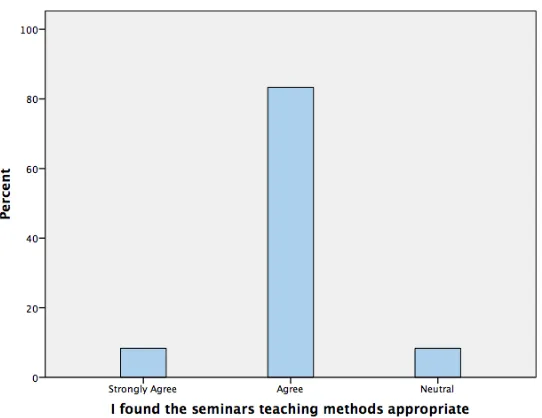
Q2. I found the seminars teaching methods appropriate
Figure 2. Shows Q2. I found the seminars teaching methods appropriate
Q3. The collaborative group learning exercise were beneficial to me
In this question, 25% of students (3 students) strongly agreed, 33.3% agreed and 33.3% remained neutral to the question as seen in figure 3. This reveals while some students preferred and enjoyed collaborative group learning exercises, others were not or might be new to this method of teaching and learning.
[image:8.612.174.445.445.648.2]Q4. I found the group monitoring by the tutor very useful
[image:9.612.171.447.154.357.2]This question reveals 25% (3 students) strongly agreed, 41.7% (about 5 students) agreed and 33.3% (about 4 students) were neutral (see figure 4). This revealed that greater percentage of students liked the tutor’s role of monitoring, contributing and supervising the group discussion and found it very informative.
Figure 4. Shows Q4. I found the group monitoring by the tutor very useful
Q5. I found giving the group presentation very useful
Figure 5. Shows Q5. I found giving the group presentation very useful
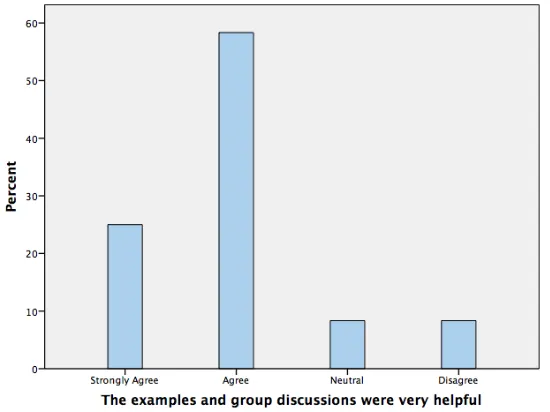
Q6. The examples and group discussions were very helpful
The feedback reveals that 58.3% (about 7 students) agreed to the comment and 25% (about 3 students) strongly agreed that all the examples used during the seminars and group discussions were very informative as seen in figure 6.
[image:10.612.172.447.415.621.2]Q7. I found the tutor engagement with the group discussion helpful to clarify doubts and issues
[image:11.612.169.449.201.387.2]Based on the feedback responses collected, greater number of students were in support of the comment. 66.7% (about 8 students) agreed to the question that they found the tutor frequent and constant engagement during the group discussion very useful. This reveals that my engagement did enlighten and clarified doubts and was very helpful. 16.7% about 2 students strongly agreed to the question and 16.7% (2 students) were neutral as seen in figure 7.
Figure 7. Shows Q7. I found the tutor engagement with the group discussion helpful to clarify doubts and issues
Q8. The seminars teaching were of high quality
Figure 8. Shows Q8. The seminars teaching were of high quality
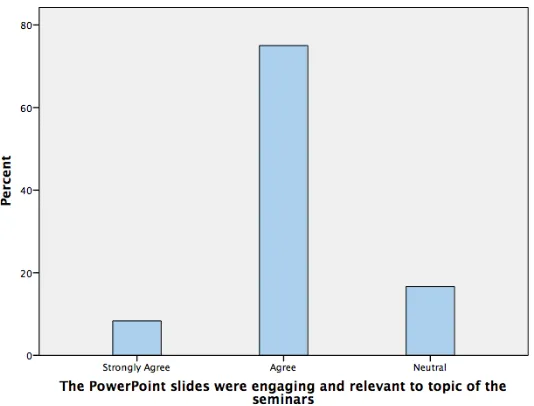
Q9. The PowerPoint slides were engaging and relevant to topic of the seminars
This feedback response reveals that greater percentage of students were satisfied with the PowerPoint slides designs and patterns of the seminar classes. It reveals 75% (about 9 students) agreed to the question. This revealed that the PowerPoint slides used encouraged more participation from the students during the classes and therefore students were highly engaged. An anonymous student commented thus; “they were relevant” and another said, “did just read from the PowerPoint” which sound to me like a critique that I will have to improve on.
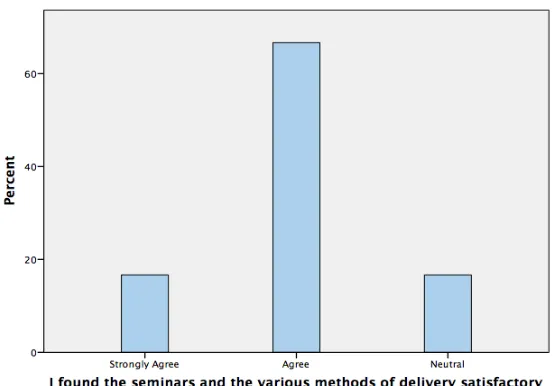
[image:12.612.176.443.444.647.2]Q10. I found the seminars and the various methods of delivery satisfactory
[image:13.612.170.450.219.412.2]In this question, it revealed that many students about 66.7% (8 students) were fully satisfied with the way the seminars were delivered. This brings to my understanding that all the various methods introduce in the class during the seminars as discussed in section 3 were very beneficial and rewarding to the students as shown in figure 10.
Figure 10. Shows Q10. I found the seminars and the various methods of delivery satisfactory
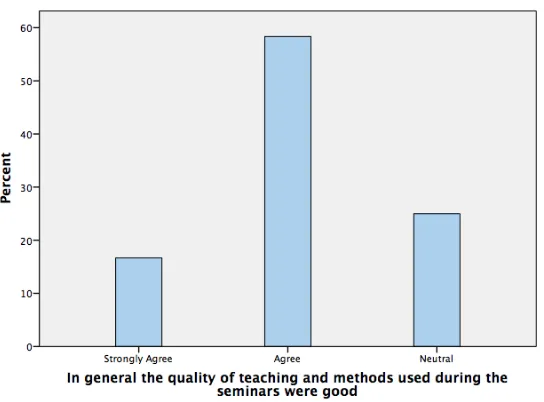
Q11: In general the quality of teaching and methods used during the seminar were good
Figure 11. Shows Q11. In general the quality of teaching and methods used during the seminars were good
Average positive responses
Combining the average sum of the two positive responses of strongly agreed and agreed shown in the tables and figures analyses, these reveals that about 75.02% of students (in these positive categories) found the overall teaching concepts, quality of the teaching, and the methods applied in the entire seminar periods satisfactory.
Discussions and reflections
In summary, I have some reflection on the feedback received from my students. This revealed that majority of the students are in agreement that the delivery and presentation of the content was appropriate to their understanding and needs. The feedback showed the students were fully satisfied with the way the seminars were delivered. This brings to my understanding that all the various methods introduced in the class during the seminars as discussed in my teaching methods were very beneficial and rewarding to my students.
some students will strongly agree in a method, while others will disagree on the same teaching method and so on. My analyses show that greater majority of the students were in agreement with most of the teaching methods applied. My lesson plans for the future is to apply the criticism in a more useful way to address lots of students’ issues and learning habits. These methods I applied during my seminar classes were very interesting as it has lots of techniques applied in the past for teaching and some others were new to the students. Those that were new have some drawbacks in response from the students. The group discussions to some students did not come across well, therefore some students were not confortable with the idea of group discussion and presentation. I intended to re-adjust my technique to teach the class in the pace of every student in the class so that no one is left behind and uncomfortable. I was able towards the end of the seminar to understand some of my students’ needs and most preferred way of learning during my teaching.
The following explain my reflective understanding of the learning habit or desires of the students, and ways I can improve upon the methods I used in teaching during the seminars.
Personal reflection
Some authors reflect on the old and new paradigms of teaching and learning (Huba & Freed, 2000), I have applied some of the various methods as discussed earlier in the seminar classes. This report provides elaborate overview of the feedbacks from the students at the end of the semester. The feedback contains some constructive and helpful criticisms, which I will adhere to and incorporate in my next plans for teaching. Having said that, however, there were so many motivational comments in regards to the methods applied during the seminar classes. Overwhelmingly, the greater majority were in favour of the teaching methods, though there is room for further improvement on the critiques and the desires of which the students wish to be included.
Personal improvement & skills acquired
I have improved in my interactive skills, communication skills, presentation skills, observation skills and teaching skills. During this seminar, I learned so many ways of communicating with students be it in large or smaller groups. I developed the ability to interact with each individual student and support him or her in his or her doubts. I also arranged a one-on-one meeting in my office with some students (especially two male students) in my seminar class for support to clarify about their assignments and provided guidance towards improving their learning. During the class interactions, I built up more confidence as I observed the students needed more discussion from me and they were keen with the real life examples on security issues and challenges I demonstrated.
appointment with them to motivate learning (Race, 2014). This would allow them to ease their fears in group discussions and presentations. I should have given my students a few minutes to work in pairs of two students during the seminar time slots each week to engage in class discussion. In my future lessons, I plan to divide my students in smaller pairs of two and then groups of three or four. This strategy would give my students the opportunity to be familiar with everyone in the seminar class and that should increase or boost their confidence in a larger group because they must have had time to discuss with everyone in their respective pairs and groups. I should have included much more real life scenarios to support my teaching (Fry et al., 2009) such as several security threats and how to overcome them. I created after seminar hours for anyone who will want to chat about his or her studies. Although not many turn-up, others did ask me questions they found difficult in class via emails. I should have encouraged them more at each lesson to book an appointment to discuss any doubts after the seminar at their convenience.
Future teaching consideration plans
I have explained some steps above which include strategies I would adopt in my future lessons. These are changes, which I will try to include in my future teaching based on things I should have done better in the seminar classes. I will observe carefully and structurally plan my teaching conscientiously to support students in their learning and equip them with efficient learning skills to shape their learning habits. I will also communicate regularly with my students to see how they are coping in the class. This will enable me to know what is interesting to them and this information will help me to plan by selecting methods my students prefer most. This will also help me to focus on my students learning styles and their immediate needs in relation to the module which I am going to teach. Furthermore, it would enhance their learning to become competent learners.
Ethical consideration
With diligent consideration with the permission of the programme and module leader, I carefully considered and decided to tag anonymously all the feedback analysis with no subject to any one single individual student in my seminar class. I understand the ethical implications involved in reviewing confidential feedback for public information (Ghaye, 2007). I do have full responsibility for all information contained here.
Acknowledgment
References
Bligh, D (2000). What’s the Point in Discussion? Exeter: Intellect.
Breslow, L.B., Pritchard, D.E., DeBoer, J., Stump, G.S., Ho, A.D., & Seaton, D.T. (2013). Studying learning in the worldwide classroom: Research into edX's first MOOC. In Research & Practice in Assessment, 8, 13- 25.
Brookfield, S. (1995). The getting of wisdom: What critically reflective teaching is and why it's important. Becoming a critically reflective teacher, 1-28.
Cornford, I. R. (2002). Reflective teaching: Empirical research findings and some implications for teacher education. Journal of Vocational education and Training, 54(2), 219-236.
Cranton, P., & Carusetta, E. (2004). Perspectives on authenticity in teaching. Adult Education Quarterly, 55(1), 5-22.
Davidson, K. (2013). Clearing up some myths about MOOCs. Hastac.
http://www.hastac.org/blogs/cathy- davidson/2013/06/11/clearing-some-myths-about- moocs.
Dewey, J. (1997). How we think. Courier Dover Publications.
Falk-Ross, F. C. (2012). Media options: a comparison of preservice teachers’ use of video, audio, and print journaling for reflective reading response. Reflective Practice,
13(1), 27-37.
Fry, H., Ketteridge, S., and Marshall, S. (eds)(2009), A Handbook for Teaching and Learning in Higher Education: Enhancing Academic Practice, London: Routledge.
Gadsby, H., & Cronin, S. (2012). To what extent can reflective journaling help beginning teachers develop Masters level writing skills?. Reflective Practice, 13(1), 1-12.
Gibbs, G. and Habeshaw, T. (1992). Preparig To Teach: An Introduction to Effective Teaching in Higher Education. 2nd Edition. Bristol: Technical and Education Services.
Ghaye, T. (2007). Is reflective practice ethical? (The case of the reflective portfolio).
Horn, D. (2013) Failing fast, not spectacularly. Clayton Christiensen Institute for Disruptive Innovations. http://www.forbes.com/sites/michaelhorn/2013/08/15/f ail-fast-not-spectacularly/ .
Huba, M. E., & Freed, J. E. (2000). Learner centered assessment on college campuses: Shifting the focus from teaching to learning. Community College Journal of Research and Practice, 24(9), 759-766.
Jaques, D., & Salmon, G. (2007). Learning in groups: A handbook for face-to-face and
online environments. Routledge.
Johnston, B., Ford, P., Mitchell, R., & Myles, F. (2011). Developing student criticality in
higher education: Undergraduate learning in the arts and social sciences. Bloomsbury
Publishing.
Kinsella, E. A. (2010). Professional knowledge and the epistemology of reflective practice. Nursing Philosophy, 11(1), 3-14.
Kreber, C., Klampfleitner, M., McCune, V., Bayne, S., & Knottenbelt, M. (2007). What do you mean by “authentic”? A comparative review of the literature on conceptions of authenticity in teaching. Adult Education Quarterly, 58(1), 22-43.
Loughran, J. J. (2002). Effective reflective practice in search of meaning in learning about teaching. Journal of teacher education, 53(1), 33-43.
Marton, F and Booth , S (1997). Lerning and Awareness, Mahwah, NJ: Lawrence Erlbaum Associates.
McAlpine, L., & Weston, C. (2002). Reflection: Issues related to improving professors’ teaching and students’ learning. In Teacher thinking, beliefs and knowledge in higher education (pp. 59-78). Springer Netherlands.
McIntosh, P., & Warren, D. (Eds.). (2013). Creativity in the Classroom: Case Studies in
Using the Arts in Teaching and Learning in Higher Education. Intellect Books.
Ottesen, E. (2007). Reflection in teacher education. Reflective practice, 8(1), 31-46.
Parsons, M., & Stephenson, M. (2005). Developing reflective practice in student teachers: Collaboration and critical partnerships. Teachers and teaching, 11(1), 95-116.
Race, P. (2014). The lecturer's toolkit: a practical guide to assessment, learning and teaching. Routledge.
Schon, D. (1983). Reflective practitioner: How Professionals think in action. New York. Basic Books.
Shoffner, M. (2009). Personal attitudes and technology: Implications for preservice teacher reflective practice. Teacher Education Quarterly, 143-161.
Wang, D. (2012). The use of self and reflective practice in relational teaching and adult learning: a social work perspective. Reflective Practice, 13(1), 55-63.
Wolcott, L.L. (1995). The distance teacher as reflective practioner. Educational Technology. Issue, 39 – 43.