warwick.ac.uk/lib-publications
Original citation:
Sookhak, Mehdi, Yu, Richard, He, Ying, Talebian, Hamid, Safa, Nader Sohrabi, Zhao, Nan,
Khan, Muhammad Khurram and Kumar, Neeraj. (2017) Fog vehicular computing :
augmentation of fog computing using vehicular cloud computing. IEEE Vehicular Technology
Magazine
Permanent WRAP URL:
http://wrap.warwick.ac.uk/91430
Copyright and reuse:
The Warwick Research Archive Portal (WRAP) makes this work by researchers of the
University of Warwick available open access under the following conditions. Copyright ©
and all moral rights to the version of the paper presented here belong to the individual
author(s) and/or other copyright owners. To the extent reasonable and practicable the
material made available in WRAP has been checked for eligibility before being made
available.
Copies of full items can be used for personal research or study, educational, or not-for profit
purposes without prior permission or charge. Provided that the authors, title and full
bibliographic details are credited, a hyperlink and/or URL is given for the original metadata
page and the content is not changed in any way.
Publisher’s statement:
“© 2017 IEEE. Personal use of this material is permitted. Permission from IEEE must be
obtained for all other uses, in any current or future media, including reprinting
/republishing this material for advertising or promotional purposes, creating new collective
works, for resale or redistribution to servers or lists, or reuse of any copyrighted component
of this work in other works.”
A note on versions:
The version presented here may differ from the published version or, version of record, if
you wish to cite this item you are advised to consult the publisher’s version. Please see the
‘permanent WRAP URL’ above for details on accessing the published version and note that
access may require a subscription.
Fog Vehicular Computing: Augmentation of
Fog Computing Using Vehicular Cloud
Computing
Mehdi Sookhak
∗, F. Richard Yu
∗, Ying He
∗†, Hamid Talebian
‡, Nader Sohrabi Safa
§, Nan Zhao
†,
Muhammad Khurram Khan
¶, Neeraj Kumar
k∗
Depart. of Systems and Computer Eng., Carleton University, Ottawa, Canada
†
Department of Information and Communication Eng., Dalian University of Technology, Dalian,
China
‡
Faculty of Computer Science and Information Technology, University of Malaya, Kuala Lumpur,
Malaysia
§
Cyber Security Centre at WMG, University of Warwick, Coventry, United Kingdom
¶
Center of Excellence in Information Assurance (CoEIA), King Saud University, Saudi Arabia
k
Thapar University, Patiala, India
F
Abstract—Fog computing has been emerged as a promising solution for accommodating the surge of mobile traffic and re-ducing latency, which are known as the inherent problem of cloud computing. The fog services including computation, storage, and networking are hosted in vicinity of end users (edge of network) and as a result a reliable access is provisioned to delay-sensitive mobile applications. However, in some cases, the fog computing capacity is overwhelmed by the growing number of demands from patrons particularly in peak hours and this can subsequently results in acute performance degradation. In this paper, we ad-dress this problem by proposing a new concept as Fog Vehicle Computing (FVC) to augment the computation and storage power of fog computing. We also design a comprehensive architecture for the FVC and present a number of salient applications. The result of implementation clearly shows the effectiveness of the proposed architecture. Eventually, some open issues and future direction are pointed out for the sake of future research in the context of FVC.
Index Terms—Fog Computing, Cloud Computing, Vehicular Cloud Computing, Fog Vehicle Computing.
1
INTRODUCTION
The emergence of Internet of Things (IoT) phe-nomenon is revolutionizing the era of computing. IOT refers to a large network of interconnected mobile intelligent objects (called things), distributed over a geographic region and tend to carry out various tasks such as monitoring, actuating, sensing, and measur-ing. The term things are everyday physical devices such as refrigerator, vehicles, biochip transponders, industrial machine, medical instruments and traffic lights. Each object has a unique identifier, connected to the Internet, gathers data and interacts with other devices in the network. The appealing concept of IoT offers a multitude of remarkable advantageous and opportunities, which has not been made possible be-fore. A wide range of innovative applications such as healthcare, transportation, aviation, social networking, and traffic control can be established based on the IoT concepts. The IoT can be useful in real time process tracking, better remote control over systems, real time analytics and decision making [1], [2].
amounts of data and this result in significant growth in network traffic. The velocity by which data is gen-erated often far more than the communication speed of these objects. Since the mobile objects are typically constrained with limited network connectivity, one of the primary challenges in IOT is to deliver a reliable service for latency-sensitive applications [3], [4].
Even though the conventional cloud computing paradigm is known as robust solution for delivering the diverse range of service to the mobile applications, in practice, the long network distance between mobile devices and remote data centers hinder provision of real time service to the application with high delay sensitivity. Examples of these applications are video streaming, online gaming and augmented reality [5], [6].
To address the aforementioned problem, Cisco coined the fog computing model as a complementary paradigm to the conventional cloud computing model. The services on the fog are hosted on the set-top-box and access points in vicinity of end users. This is to eliminate the dispensable network hops and therefore, minimizing the response time for mobile applications. In addition, the fog computing can alleviate the traffic congestion in the Internet back bone since the huge amount of traffic originated from end devices are locally handled by fog servers in vicinity of these devices. As analogues to the cloud computing, the services on fog are compute, network and storage [3]. In a certain scenarios, the fog resource capacity is severely swamped by immense number of demands from smart objects. For instance, in a multi-story mega shopping center, particularly during peak hours, thou-sands of patrons can use the provided fog services such as video streaming and video gaming. The excess number of connected clients incurs high computation overhead and acute bandwidth congestion, affects the fog service reliability. This circumstance also deters the mobile applications performance, which is contra-dictory to the aim of fog paradigm [7], [8]. On the other hand, a huge pool of smart vehicles is often left unexploited in the parking lot of shopping centers for extended period of time. These vehicles can be envisioned as auxiliary computing resource and can serve myriad of users [9].
In this paper, we propose an innovative approach termed Fog Vehicle Computing (FVC) to enhance the scalability of a fog computing infrastructure. FVC takes advantage of a dynamic group of vehicles to boost the computational power and decrease the la-tency of fog computing. The idea of FVC offers strik-ing advantages for both fog service provider and the vehicle owners. Fog service provider is relieved from the substantial upfront expenditure to scale up the fog infrastructure. On the other hand, vehicle owners are entitled to receive variety of attractive incentives such
as free parking, free Wi-Fi or free shopping voucher in exchange for providing their vehicle computing resource to fog provider.
The main contributions of this paper are as follows: (1) We present a new concept as a FVC to overcome the existing issues of the fog computing; (2) We present the first architecture for the FVC and explain its com-ponents in details; (3) We implement the proposed architecture and compare it with fog computing to prove its effectiveness
2
FOG
VEHICLE
COMPUTING
(FVC)
Fog is a cutting-edge paradigm of computing, which extends the conventional cloud computing to the edge of network. In the fog model, the data processing and analytics take place in proximity of end devices where huge quantity of data is generated. Residing the ser-vices as close as possible to end deser-vices eliminates the unnecessary network hops and expedites mass data transmission originated from IOT gadgets. From the security perspective, the fog strategy mitigates the risk of data exposure to adversaries through undue large distance between end devices and cloud data centers and thus helps protecting the secrecy of sensitive data. Deploying fog architecture provides a more reliable service to the end users. In particular, the fog model is imperative for assorted type of services, which are characterized by latency sensitivity. In general, the fog computing model is characterized by low latency, ge-ographical distribution of devices, mobility, and large number of nodes [10].
Although the fog computing environment has been designed to provide reliable service to the real time applications, in certain scenarios, the fog experiences the excessive number of demands, which are often far beyond its capacity and these consequently arise sporadic performance issues. For example, in a large multi-story shopping mall where a large number of patrons is hosted in a daily basis, a fog service is estab-lished to provide a variety of services to customers and visitors while they are spending time there. Instances of these services are online gaming, video streaming, and shopping information. During weekends, public holidays and specifically in peak hours, thousands of customers are roaming within the shopping mall and using the provided service. However, the limited computation resource in fog inhibits.
On the other hand, present and future vehicles are well equipped with powerful on-board computers for the sake of safer, convenient, and pleasant driving expe-rience. The on-board computers come with notable capabilities such as GPS, Camera, bandwidth, data recorder, sensors and actuators. Aside from managing the vehicle functionality, these computers also help in better navigation.
A pool of smart vehicles parked in shopping mall parking area for a long period of time form a tremen-dous computing power, which remains unexploited in normal condition. This large array of intelligent vehicles can be envisaged as supplementary comput-ing, storage and networking resources, It can also be leveraged to serve the enormous number of demands, which is impossible to regularly handled by fog re-sources [11]. The vehicles are presumed to be plugged into the electricity and network outlet, whilst they are parked. Furthermore, the owners of vehicles are offered a variety of attractive incentives such as free parking, shopping voucher, or free WI-FI in return for lending the computing resources of vehicles to the fog service provider. To avoid any congestion in whole parking area, merely a certain zone is dedicated to the vehicular cloud. The maximum capacity of FVC zone is determined according to the predicted need of the computational resources. A further analysis and modeling is required to predict the actual number of vehicles, which are parked in the parking zone at any specific time. It is worth mentioning that due to dynamic nature of vehicular cloud, resorting to computing resource of vehicles does not entail to over provisioning issue in contrast to regular fog case. This is because the number of patrons and consequently demands are intuitively commensurate to the number of parked vehicles. When the more demands are re-ceived from users, the more vehicles are also available to serve. Moreover, we pretend a a transparent and seamless picture of fog services to typical users of a fog in shopping centers. In other words, the users are not aware whether their computational tasks are processed by fog own infrastructure or delegated to the supplementary vehicular cloud. Figure 1 depicts an infrastructure of FVC to support Iot applications.
[image:4.612.313.544.49.258.2]Table 1 shows the importance of the proposed ar-chitecture by comparing the Fog, FVC, and VCC based on the following attributes: (1) Computing Power: indicates two systems have the identical computing power if they can run the execute the same program and produce the same results at the same time; (2) Life Time: refers to the duration that all components of the system are working properly;(3) Decision Making: is the main part of the system that decides about the sys-tem reaction against different situations, for example, how to address the received tasks by assigning the available resources;(4) Implementation Cost: indicates
Fig. 1. The infrastructure of FVC for IoT.
the total cost for implementing the whole system; (5) Storage Capacity: indicates the existing resources for storing data temporary or for a long time; and (6) Latency: is a time delay between assigning tasks and receiving the result.
3
USE
CASE: A
SMART MODERN SHOPPINGCENTER
(SMSC)
This use case refers to a fog computing service de-ployed in a large shopping center. The service is es-tablished on the basis of underlying network switches and set-top-box along with an array of parked vehicles as a supplementary computing resource to serve the myriad of customers inside the shopping mall.
SMSC deals with the group of smart vehicles, each of which is endowed with a processing unit, memory, storage, and network connection. The objectives for SMSC are as follows:
• To provide a reliable service for fog users
particularly with regards to latency sensitive applications such as video streaming.
• Online gaming: As an entertainment service
by which customers can enjoy playing mullti-player online games.
• For safety purposes such as emergency
TABLE 1
Comparison among FVC, Fog, and VCC.
Features FVC Fog VCC
Computing Power High Moderate High
Life Time High Moderate High
Decision Making Distributed and local Local Distributed
Implementation Cost Moderate Low Moderate
Storage Capacity High Low High
Latency low Moderate (depends on task) Moderate
the shortest and safest escape route by using their mobile devices.
• Locating the exact position of the vehicle in
a vast parking area. The drivers are given a hassle-free option to pinpoint the position of their car. Furthermore, a clear passage to reach the vehicle is visually shown to the driver.
• Shopping information. A diverse range of
shopping information is delivered to the pa-trons in a timely fashion. This information can be very simple such as locating a store, which sells a specific type of product such as apparel, dining, or entertainment. Aside from this, the customers are able to access many other ap-plications: the latest promotional of different stores, comparison the price of goods to pre-pare the shopping-list, and direct contact to the customer services.
• Camera Surveillance systems: Installed
cam-eras within a shopping center as public domain play a crucial role in preserving the security and safety. In this case, fog computing can pro-vide a copious amount of resource to archive and process the collected footage. Specifically, when it is necessary to carry out an automated real-time video stream analysis including face detection, object counting, object tracking, and vehicle recognition, the FVC capabilities can be leveraged to cope with the performance issues.
4
FVC ARCHITECTURE
Scarborough Research and Arbitron conducted a sur-vey about teen mall shoppers, which reveals 68% of teens spend more than two hours at the malls while 95% of shoppers spend 1 hour at such malls [12]. Therefore, a plenty number of customers visit the malls every day while their cars are parked in the parking. This section presents a novel architecture for
FVC based on the parked vehicle resources in shop-ping centers and describes its components in details.
Figure 2 shows the layered design of the FVC soft-ware framework and architectural components. The FVC architecture consists of three main layers: applica-tion and services, policy management, and abstracapplica-tion layer.
4.1 Application & Services Layer
The first layer of FVC architecture, namely application and services layer, provides a variety of real-time applications for the end users based on the collected data by the deployed sensors in the inertial navigation system (INS), parking environment, shopping cen-ter building, and inside vehicles (i.e. environmental, health, activity, and vehicle recognition). This layer also offers several new services to the end users, as follows:
a. Information as a Service (INaaS) and Enter-tainment as a Service (EnaaS):These services are able to provide the useful information about events and emergency circumstances for customers of the shopping center who are connected to the FVC. The center can also offers various entertainments such as online games and commercial movies with the aim of increasing the welfare and safety of the customers.
Real-time Applications Environmental Recognition Health Recognition Activity Recognition Vehicle Recognition
NaaS INaaS STaaS ENaaS
CaaS
FVC Primary Application Services
Application & Services Layer
Policy
Repository
Policy Sublayer
Load
Balancing Configuration QoS
Security/Priva cy Decision Manager FVC-Task manager FVC-Service finder Service Database
Distributed Edge Computation
DB DB DB
Distributed Edge Storage
Vehicle Cloud Infrustructure Fog Sublayer
Fog Resource
Manager Fog Task scheduler
Fog Capability SMP Servers Vehicle Cloud Computation Driver Behavior Information Traffic Information Road Information Storage Services GPS Information Vehicle Cloud Storage Vehicle Cloud Infrustructure Vehicular Cloud Sublayer
Vehicular Resource Manager Vehicular Task scheduler Vehicular Capability
Policy Management Layer
Computation Storage Network
[image:6.612.72.304.47.415.2]Abstraction Layer
Fig. 2. The general architecture of FVC.
who are interested in, as long as they have net access. These resources advertise on the center when the owner agreed to do so.
c. Storage as a Service (STaaS):The concept of storage as a service (STaaS) refers a situation in which the FVC has plenty of free on-board storage capability and in the meanwhile some clients need additional storage for different purposes, for example running the applica-tions that require high storage resources, tak-ing a temporary backup, or ustak-ing for p2p applications over an extended period of time. Thus, the vehicles with additional storage ca-pability will provide storage as a service. d. Computation as a Service (CaaS): U.S.
De-partment of Transportation (US DOT) recently released that most of the registered vehicles (around 256 million) in US are parked for several hours per day in parking lots, garages,
and centers [13]. These vehicles have enor-mous computational resources that are un-used and have the opportunity to be exploited in the VFC structure as a new service for the clients who want to augment the computation resources of their mobile devices to perform huge computational tasks.
4.2 Policy Management Layer
The policy management layer is known as a heart of the FVC system, which is responsible for managing the life-cycle of tasks by allocating the appropriate computation and storage resources to them. The policy management layer is also responsible to deal with the different basic issues such as monitoring system state dynamically. This layer consists of three sub-layers: policy, fog, and vehicular cloud, as follows:
4.2.1 Ploicy Sub-layer
is a centralized layer of the FVC architecture that is interconnected with both fog and vehicular cloud sub-layers to assign the tasks and resources dynamically. In other words, all the clients’ services have to be checked by this sub-layer and delivered to the fog or vehicular sub-layers based on particular policies and their situations. The main components of the policy sub-layer are:
a. Policy of Load Balancing:refers to the thresh-old for a maximum number of vehicles, clients, CPU load, and connections. It can be seen that the number of required vehicles can be set on the basis of the number of users and submitted tasks to the FVC.
b. Policy of Quality of Services (QoS):is used to set the criteria related to computing, network, and storage such as rate of delay, computation cost, and communication cost.
c. Policy of Configuration: refers to the neces-sary configuration for different devices and services, which are supported or presented by the FVC.
d. Policy Repository:is a database for storing the set of policies and rules that are used by the decision manager entity for handling security, performance, and network requirements dur-ing decision makdur-ing step.
f. Service Database: presents the list of active services which are provided by fog or vehicu-lar nodes.
g. Decision Manager: as a main component of the policy manager layer is in charge of mak-ing decision with regardmak-ing to collected data form other components. The decision manager component consists of two parties:
• FVC-Service finder:this module analyses the set of active services in the service database to identify the proper one that can satisfy the clients’ request.
• FVC-Task manager: when a task is re-ceived by this module, the FVC-Task manager decides to assign the task to fog or vehicular section based on pre-dicted time to perform the task in each of sections. In the next section, we ex-plain more about the decision making process in this component.
4.2.2 Fog sub-layer
is the second sub-layer of policy management and located within the vicinity of the clients. This sub-layer is able to serve a limited number of user needs based on its resources. The main components of Fog sub layer are as follows:
• Fog-Capability Database:a repository consists
of unassigned fog nodes and their capabilities to perform the different services.
• Fog-Task Scheduler: checks the list of unas-signed fog nods to find the appropriate nodes, which can satisfy the requested service from the available nodes in the fog clusters.
• Fog-Service Manager:is in charge of updating
the list of available fog nodes or clusters upon when a task is assigned to them. The fog task scheduler also needs to check the policy repos-itory to identify network configuration and service policies before assigning the requested services to the unallocated fog nodes.
4.2.3 Vehicular Cloud Sub-layer
is the last sub-layer of the policy management layer architecture, which contains a plenty of resources to augment the fog sub-layer by supporting the services that requires huge computation. This sub-layer con-sists of the following components:
• Vehicular-Capability Database:this repository
stores a list of existing vehicular clusters and their capabilities.
• Vehicular-Task Scheduler: is responsible for
assigning the computational task to the avail-able clusters or vehicles in a cluster.
• Vehicular-Resource Manager: is responsible
for identifying and managing any modifica-tion of vehicular resources dynamically. The vehicular-resource manager also requires find-ing the network configuration from policy repository and updating the service database.
4.3 Abstraction Layer
The abstraction layer is responsible for concealing the heterogeneous platform of FVC and revealing a mono-tonic interface for monitoring, provisioning, and man-aging the physical resources, such as memory, CPU, and network. This layer can also be used to control different operating systems, hypervisors, and services on physical machines. Moreover, the abstraction layer has adequate capabilities to carry out the visualiza-tion technique for supporting multi-tenancy, and to execute multiple operating systems and services on physical machines for cultivating resource utilization. Protecting the security and privacy is a crucial role of the abstraction layer. There are different method-ologies that can be used in this layer to ensure the data integrity, confidentiality, and resource isolation for diverse clients. Homomorphic secret sharing, zero knowledge proof, and attribute-based cryptography are some methods that can safeguard the confidential-ity, integrconfidential-ity, and access control in the FVC architecture [14], [15].
5
DECISION-
MAKING PROCESS INFVC
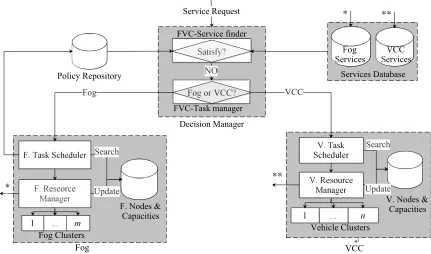
Decision-making process plays an important role in the FVC architecture. It determines how to fulfill the requested services efficiently based on the available re-sources, information about the demanded service, and its parameters. Figure 3 illustrates a general decision-making process in FVC. This process is carried out in the three different sections, as follows:
Policy Repository
Service Request
Decision Manager FVC-Service finder
Fog Services
VCC Services
Services Database
NO
Fog
F. Nodes & Capacities
Update Search
FVC-Task manager
Fog
VCC
V. Nodes & Capacities
Vehicle Clusters
Search
Update VCC
Fog Clusters *
**
[image:8.612.91.522.54.308.2]* **
Fig. 3. Decision-making process in FVC.
calculate the completion time of the task in each sub-layers. To achieve this goal, the decision manager asks the VCC and Fog sub-layers to provide the computational complexity of the task execution. This complexity is presented by
aNb, whereaandbare two constant integers,
and N indicates the problem size. Moreover,
the fog resource manager and VCC resource manager have to frequently update the service database about their workloads, available ser-vices, and computation speeds by using mega floating-point operations per second (MFlop) from a simple benchmark. As a result, the decision manager determines the completion time of a service with a particular problem size in each of the sub-layers by estimating: (1) the computation cost of the task by employing the received information (last status of resources and the service complexity), and (2) the com-munication cost of sending and receiving data. In the following, we describe the task schedul-ing process in each of these sub-layers.
• Fog sub-layer: Fog computing has been intro-duced as a new paradigm to extend the tra-ditional cloud computing to the edge of the network. Due to the decentralized architecture of fog computing, it is usually used for dis-tributed applications with the aim of decreas-ing the latency. To achieve this goal in the
pro-posed architecture, the decision manager dele-gates the task to fog sub-layer when its com-pletion time is less than VCC sub-layer. This type of tasks often requires less computation cost and is not very complex. Upon offloading the task by the fog sub-layer, the task scheduler component of fog, which is responsible for allocating tasks to the fog clusters, searches the nodes and capabilities database to identify a list of unassigned nodes, which can satisfy the task. The task scheduler transfers the list of nodes to the resource manager component to provision the task on the fog. In addition to updating the list of fog nodes and capabilities, the resource manager has to assign the task to the nearest nodes to fulfill the low latency object. How-ever, selecting the closest nodes is not always optimal from the point of view of the FVC provider, because of the unbalanced resource utilization issue due to overloading of some nodes. Moreover, the fog layer may include the variety of nodes with heterogeneous hard-ware specifications and energy prices, which incurs different computation cost. As a result, it requires to investigate the task scheduling optimization for fog computing to obtain the most efficient result, which is out of the scope of this paper.
parked vehicles are geo-distributed in different indoor or outdoor parking areas, such as streets parking, shopping malls parking, offices park-ing, and shopping mall parking. The collabora-tion of these parked vehicles provides plenty of idle computational resources that can be used by the FVC architecture to deal with com-plex tasks that necessitates large computational competence. The first component of VCC sub-layer is the task scheduler that is responsible for allocating the tasks to individual clusters or even to individual vehicles. After assigning the task to VCC sub-layer due to better completion time, the vehicular task scheduler can seek the vehicular nodes and capabilities database to identify a list of available resources and allocate the task. However, this database always needs to be updated by the resource manager because the VCC has a dynamic nature in terms of computational resources. In other words, the preparation of the list of available resources de-pends on predicting the availability of vehicles as computational resources in the parking lots. One of the main components of VCC sub-layer is resource manager, which is responsible for allocating the physical resources. Moreover, the resource manager has to control the clusters by: (1) following the available resources, (2) identifying the new resources by arriving new vehicles, (3) migrating tasks from a vehicle before leaving the parking, and (4) performing load balance between the existing clusters. The resource manager should also update the fog services database upon allocating or releasing the resources.
6
RESULT AND
DISCUSSION
To investigate the effectiveness of the proposed method, we carried out a simple experiment using Openstack to Implement a fog and vehicular cloud computing. Our experiment was implemented by us-ing Java on desktop computers with an Intel Core i5-2450 M CPU at 2.5 GHz, and 6 GB RAM.
We assumed that, the number of vehicles in the parking is 15 at the beginning of simulation. When drivers decide to get into the parking (e.g, shopping center parking), there is an opportunity for them to use the free accommodation by parking their vehicles in the VCC zone for at least two hours and give us permission to use the unused resources of the vehicles. As a result, we assumed the constant arrival rate and departure rates for the vehicles. Table 2 shows the required parameters to configure the system.
TABLE 2 System configuration.
Parameter Value
Topology LAN, fully connected
Number of tasks [1-5]
Number of VCC nodes 15
Number of fog nodes 15
Bandwidth 1024 Mbps
We also defined a task to compare the performance of fog and FVC in which each user is able to select a file with size of 10 mb, and ask the server to compute the algebraic signature of this file, which consist of the following steps: (1) dividing the file into 12500 blocks, (2) computing the algebraic signature of each block with length 256 b, and (3) integrating the signatures to generate the signature of the file. It is important to mention that The Algebraic signature is computed along with the groundwork of defining multiplication
by using the Galois theoremGF(2g)as a polynomial
multiplication modulo, where g can be 16 bit
(half-word) or 32 bit word [15].
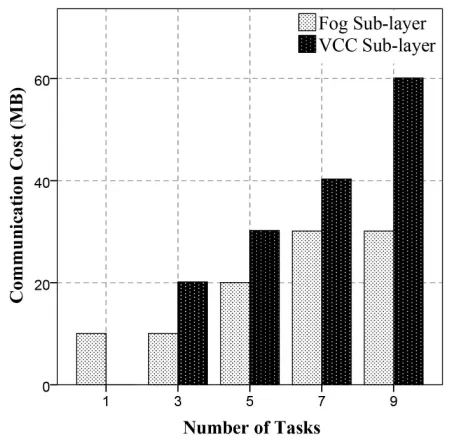
We evaluated the performance of the fog and FVC on the basis of the following metrics: (1) computa-tion cost: indicts the required time to compute the algebraic signature of a file, including file division, signature generation, and signature integration steps; (2) Communication cost of fog sub-layer: indicates the amount of data that transferred between decision manager and fog sub-layer; and (3) Communication cost of VCC sub-layer: indicates the amount of data that transferred between decision manager and VCC sub-layer.
In the first scenario, we checked the effectiveness of the proposed architecture by considering a scenario in which a number of visitors of a shopping center are using the existing fog or FVC of the center for perform-ing their tasks (e.g., generatperform-ing the algebraic signature of a file). Figure 4 clearly shows that by increasing the number of tasks, the required time to perform the computation in the FVC is less than the required time in the fog computing. This is because the FVC is able to delegate the task two unused computational resources of parked vehicles in the shopping center as a VCC sub-layer to decrease the latency and perform more tasks in comparison with the fog computing.
Fig. 4. The comparison of computation cost of different number of tasks Fog and FVC.
increasing the number of tasks, the communication cost of VCC sub-layer is rising more than the com-munication cost of fog sub-layer. This is because the decision manager assigned most of the tasks to the VCC sub-layer due to better completion time.
7
CONCLUSION AND
FUTURE
WORK
[image:10.612.317.542.50.271.2]Fog computing has been emerged as a new computa-tion paradigm in which the computacomputa-tional resources have been deployed along the edge of the network with the aim of reducing the latency. In accordance with the resource restriction of fog computing, a lim-ited number of clients are able to use the fog com-puting simultaneously. To alleviate this problem, we present a fog vehicular computing (FVC) as a new concept in which plenty of unused resources of ve-hicles can be leveraged to augment the fog computing resources. We also depict a cross layer architecture for FVC and elucidate its constitutive components along with their role in the construction of FVC. We explain a decision-making process as a most important proce-dure of this architecture and show how the different types of services are distributed among vehicle of fog nodes. As a future direction, we plan to implement this architecture in the real environment and compare with the sate-of-the-art methods to show its efficiency. Task scheduling is one of the most important re-quirements to improve the efficiency of FVC. The
Fig. 5. The comparison of communication cost of Fog and VCC sub-layers.
main issue to provide an applicable task Schelling is considering the role of decision manager and its interconnection with Fog sub-layer and VCC-sublayer, which make it a complex problem as a future work.
Another direction of this work is to focus on secu-rity and privacy as a main concern of users, especially when a huge number of computation task will be delegated to the FVC, and several users share the same set of resources in fog and vehicle nodes. Presenting a secure data access control for FVC by using attribute-based data encryption and proxy re-encryption has to be considered as a future work.
ACKNOWLEDGMENT
This work was supported in part by the Natural Sciences and Engineering Research Council (NSERC) of Canada.
REFERENCES
[1] F. Bonomi, R. Milito, P. Natarajan, and J. Zhu,Big Data
and Internet of Things: A Roadmap for Smart Environments,
ch. Fog Computing: A Platform for Internet of Things
and Analytics, pp. 169–186. Cham: Springer International
[2] M. Sookhak, H. Talebian, E. Ahmed, A. Gani, and M. K.
Khan, “A review on remote data auditing in single cloud
server: Taxonomy and open issues,”Journal of Network and
Computer Applications, vol. 43, pp. 121 – 141, 2014.
[3] L. M. Vaquero and L. Rodero-Merino, “Finding your Way in
the Fog: Towards a Comprehensive Definition of Fog
Com-puting,”ACM SIGCOMM Computer Communication Review,
vol. 44, pp. 27–32, oct 2014.
[4] M. Aazam and E. N. Huh, “Fog computing: The
cloud-iot/ioe middleware paradigm,” IEEE Potentials, vol. 35,
pp. 40–44, May 2016.
[5] S. Yi, C. Li, and Q. Li, “A Survey of Fog Computing:
Concepts, Applications and Issues,” in Proceedings of the
2015 Workshop on Mobile Big Data - Mobidata ’15, (New York,
New York, USA), pp. 37–42, ACM Press, 2015.
[6] I. Stojmenovic, “Fog computing: A cloud to the ground
sup-port for smart things and machine-to-machine networks,”
inAustralasian Telecommunication Networks and Applications
Conference (ATNAC), pp. 117–122, Nov 2014.
[7] D. Zeng, L. Gu, S. Guo, Z. Cheng, and S. Yu, “Joint
optimization of task scheduling and image placement in
fog computing supported software-defined embedded
sys-tem,”IEEE Transactions on Computers, vol. 65, pp. 3702–3712,
Dec 2016.
[8] X.-Q. Pham and E.-N. Huh, “Towards task scheduling in a
cloud-fog computing system,” in18th Asia-Pacific Network
Operations and Management Symposium (APNOMS), pp. 1–4,
Oct 2016.
[9] M. Whaiduzzaman, M. Sookhak, A. Gani, and R. Buyya, “A
survey on vehicular cloud computing,”Journal of Network
and Computer Applications, vol. 40, pp. 325–344, 2014.
[10] F. Bonomi, R. Milito, J. Zhu, and S. Addepalli, “Fog
comput-ing and its role in the internet of thcomput-ings,” inProceedings of the
First Edition of the MCC Workshop on Mobile Cloud Computing,
MCC ’12, (New York, NY, USA), pp. 13–16, ACM, 2012.
[11] S. Arif, S. Olariu, J. Wang, G. Yan, W. Yang, and
I. Khalil, “Datacenter at the Airport: Reasoning about
Time-Dependent Parking Lot Occupancy,”IEEE Transactions on
Parallel and Distributed Systems, vol. 23, pp. 2067–2080, nov
2012.
[12] “Teen Mall Shopping Attitudes and Usage Survey,” tech.
rep., Scarborough Research and Arbitron Inc., New York,
2009.
[13] “Intelligent Transportation Systems for Planned Special
Events: A Cross-Cutting Stud,” tech. rep., U.S. Department
of Transportation, Washington, 2008.
[14] M. Sookhak, A. Gani, H. Talebian, A. Akhunzada, S. U.
Khan, R. Buyya, and A. Y. Zomaya, “Remote Data
Audit-ing in Cloud ComputAudit-ing Environments,”ACM Computing
Surveys, vol. 47, pp. 1–34, may 2015.
[15] M. Sookhak, A. Gani, M. K. Khan, and R. Buyya, “Dynamic
remote data auditing for securing big data storage in cloud
computing,”Information Sciences, 2015.
PLACE PHOTO HERE
MEHDI SOOKHAK
PLACE PHOTO HERE
F. RICHARD YU(S’00-M’04-SM’08) re-ceived the PhD degree in electrical en-gineering from the University of British Columbia (UBC) in 2003. From 2002 to 2006, he was with Ericsson (in Lund, Sweden) and a start-up in California, USA. He joined Carleton University in 2007, where he is currently a Professor. He received the IEEE Outstanding Service Award in 2016, IEEE Outstanding Leadership Award in 2013, Carleton Research Achievement Award in 2012, the Ontario Early Re-searcher Award (formerly Premiers Research Excellence Award) in 2011, the Excellent Contribution Award at IEEE/IFIP TrustCom 2010, the Leadership Opportunity Fund Award from Canada Foundation of Innovation in 2009 and the Best Paper Awards at IEEE ICC 2014, Globecom 2012, IEEE/IFIP TrustCom 2009 and Int’l Conference on Networking 2005. His research interests include cross-layer/cross-system design, connected vehicles, se-curity, and green ICT.
PLACE PHOTO HERE
YING HEreceived the B.S. degree from Dalian Ocean University, Dalian, China, and the M.S. Degree from Dalian Univer-sity of Technology, Dalian, in 2007 and 2012, respectively, both in communication and information systems. She is currently pursuing the Ph.D. degree with the School of Information and Communication Engineering, Dalian University of Technology. She is a visiting student at Carleton University. Her current re-search interests include big data, connected vehicles, and ma-chine learning.
PLACE PHOTO HERE
HAMID TALEBIANreceived the B.S. de-gree and the M.S. Dede-gree from Islamic Azad University, Iran, in 2003 and 2007, respectively, both in Software Engineer-ing, and the PhD degree from University of Malaya in 2013. Then, he joined to Mo-bile Cloud Computing Research Group in University of Malaya. His research interest includes cloud computing security, digital forensics, steganography and watermarking, evolutionary com-putation, multi-objective optimization, computational intelligence, and bio-inspired metaheuristics.
PLACE PHOTO HERE
PLACE PHOTO HERE
NAN ZHAO (S’08-M’11) is currently an Associate Professor in the School of Infor-mation and Communication Engineering at Dalian University of Technology, China. He received the B.S. degree in electronics and information engineering in 2005, the M.E. degree in signal and information processing in 2007, and the Ph.D. degree in information and communication engineering in 2011, from Harbin Institute of Technology, Harbin, China. From Jun. 2011 to Jun. 2013, Nan Zhao did postdoctoral research in Dalian University of Technology, Dalian, China. His recent re-search interests include Interference Alignment, Cognitive Radio, Wireless Power Transfer, and Optical Communications. He has published nearly 70 papers in refereed journals and international conferences.
PLACE PHOTO HERE
MUHAMMAD KHURRAM KHANis cur-rently working as an associate professor and R&D Manager at the Center of Excel-lence in Information Assurance (CoEIA), King Saud University, Kingdom of Saudi Arabia. Dr. Khurram has published hun-dreds of research papers, received many awards. His areas of research interest are biometrics, multimedia security, digital data hiding, and authentication protocols.
PLACE PHOTO HERE