Undermining our Future by destroying the Past: Extractivism,
Resource-driven Wars and the Loss of Traditional Ecological Knowledge in the lower
Cauca region
By
Samuel Steinhorst
S1741195
University of Twente, Enschede July 2019
Supervisors: Dr. Ringo Ossewaarde, Associate Professor in Sociology of Governance, Faculty of Behavioural and Management and Social Sciences
Extract
This study investigates a threat to sustainable public administration in the future. It describes a contemporary epistemicide, i.e. the de-legitimation and destruction of ecological and indigenous knowledges, as a material-semiotic process, rather than a clash of cultures where one culture is ‘murdered’. This research asks for the implications of different types of resource extraction and a ‘small war’ for the re-production of traditional ecological knowledge in a non-sovereign territory. Applying the Actor-Network-Theory, the study follows the ordering of human and non-human actors in networks of ecological knowledge re-production, conceptualized as ‘ecological commons’, as well as those in extractive and violent networks. These descriptions reveal deep-rooted controversies over the anthropogenic appropriation of nature and natural processes, which surface in violent confrontations that are detrimental to ecological knowledge re-production. Ecological ways of knowing and sustainable resource use by indigenous and subsistence communities are critical to designing solutions to the ecological crisis which confronts administrations world-wide. The loss of these knowledges and practices may contribute to the future escalation of the ecological crisis through the de-legitimation of non-exploitative indigenous resource uses and the simultaneous proliferation of high-risk large-scale extractive practices in ecologically sensitive areas. The analytical approach is coupled with an ethnographic approach to data gathering in the lower Cauca region, a sub-region of the Antioquia department in Colombia. This region is the scene of an armed conflict that is maintained by and for extractive activities such as hydropower, gold mining, land grabbing and cocaine production.
Acknowledgements
I would like to express my sincere gratitude to both of my supervisors, Ringo and Ernesto. Ringo supported this undertaking with his intellectual guidance from the start, accompanying it along a long and winding path to its very end. I would like to thank Ernesto for his support and guidance in the field, which prepared us for investigating in a very difficult and new environment. Without this support, which came in the form of tactical advice, contacts and security preparation among others, this research would not have been possible, least of all because it took place in the framework of Ernesto’s own research project, an extensive investigation into the possibilities of transformative change in extractive economies.
I would furthermore like to thank the University of Twente in Enschede, the Universidad Externado in Bogotá and the Universidad de Antioquia in Medellin and Caucasia. The University of Twente, by supporting this collaborative international project, ultimately enabled this research to take place. The Universidad Externado, through its Centro de Investigaciones y Proyectos Especiales (CIPE) and the Universidad de Antioquia (UDEA) supported our research by providing facilities and administrative support in Bogotá and Caucasia. I especially thank the staff of the local NGO RioAbajo and the UDEA campus in Caucasia, from the director to the gatekeepers, who provided a peaceful working environment among the hundreds of Iguanas living on campus, in addition to advice and material support, even accompanying me on excursions to far-flung indigenous communities in addition to teaching me how to fish Cachama from the campus pond.
Table of Contents
1. Introduction ..………. p. 5 1.2 Background and Knowledge Gap ………....………. p. 5 1.3 Aim and Research Questions ………...……….……… p. 8 1.4 Research Approach ……….. p. 10
2. Theory Chapter: Three types of Actor-Networks in the lower Cauca region ………. p. 12 2.2 Ecological commons, TEK and Western Modernity ……….. p. 12 2.3 The Appropriation of Nature in Extractive Actor-Networks ………..……… p. 15 2.4 Resource-driven ‘Small Wars’ ………..……… p. 18 2.5 Epistemicide and the Enclosure of the Commons …….…………..……….……… p. 19 2.6 Concluding Remarks and Theoretical Expectations ………..………. p. 21
3. Methods Chapter: On retracing an Actor-Network ………..……… p. 23 3.2 Research Design ………..………..………..……….………..…………. p. 23 3.3 Case Selection ………..………….………..………..……….………..………… p. 25 3.4 Methods of Data Collection ………..………..………..………. p. 26 3.5 Methods of Data Analysis ..…………..………..………..……… p. 28
4. Chapter 4.: Analysis ………..………..………... p. 32 4.2 Ecological Commons and TEK in the lower Cauca region ……….. p.32 4.3 Moving Mountains: Extractive Actor Networks in the lower Cauca region ……….. p. 43 4.4 Floating Fortresses, Armed Extraction: ‘Small War’ Networks in the lower Cauca region ………. p. 53 4.5 Epistemicide: The De-legitimation of Ecological Ways of Knowing ……….. P. 60
5. Conclusion ………..………..……… p. 67
6. Literature Index ………..………..……… p. 74
List of Images
Title Page: Abandoned canoes on the shore of a lake destroyed by practices of illegal mining in a riverine community on the banks of the Cauca river
Image 1. Indigenous Protest march or ‘Minga’ near Puerto Bélgica, Lower Cauca Region ………. p. 34
Image 2. Construction of a house in Emberá community ‘Zoíbadó’, EL Bagre Municipality ………….. p. 40
Image 3. Alluvial gold mining operation conducted by Mineros S.A. in el Bagre municipality ………. P. 44
Image 4. Aerial View of damage to the Nechí river in the lower Cauca region ....……… p. 51
Image 5. Government Soldiers and Gun Turrets on Mineros’ gold Mining Barge ...………. P. 55
1. Introduction
1.1 Background & Knowledge Gap
Weston & Bollier (2013) distinguish six types of contemporary (ecological) commons, among them indigenous and subsistence commons. Ecological commons then is a term to denote a system of organization which regulates the anthropogenic utilization of ‘common-pool resources’ and ‘eschews individual property rights and state control’ (Weston & Bollier, 2013: 125). Communities establish the commons through ‘vernacular law’, i.e. ‘unofficial norms, institutions, and procedures that a peer community devises to manage its resources on its own, and typically democratically’ (Weston & Bollier, 2013: 20). Departing from such an economy-centred definition of the commons as a management system for resources, this study emphasizes that the commons ‘is not an alternative economy but an alternative to economy’ (Esteva, 2014). It is not a system but rather an ‘activity’, the enactment of heterogeneous social ties or ‘relationships’ among people, natural materials and processes for the sake of sustenance (Latour, 2005; Linebaugh, 2008; Esteva, 2014). More importantly, ecological commons are not centred around ‘resources’, these are an invention of modern western societies, which commodify nature as input for industrial production (Shiva, 2010; Conde & Walter, 2015). Defining ecological commons as ‘assemblages’ of actors – human and non-human, enables the actions and relationships that constitute them to be retraced as ‘actor-networks’ (Watson-Verran & Turnbull, 1995; Latour, 2005). Accordingly, an epistemicide can be described as the product of material and semiotic disruptions of associations in an actor-network where ecological knowledge circulates. In this study, the focus is on two closely linked phenomena that contribute to epistemicides of TEK: Extractivism and ‘small wars’ that are fuelled by resource rents (Korf, 2011; Gudynas, 2015).
alone, the Cerro Rico of Potosí, Bolivia (Galeano, 2015). By far the most notorious, Potosí was only one of thousands of sites of extraction (Ibid., 2015). Genocides typically coincide with epistemicides (de Sousa Santos, 2016). Galeano (2015) quotes the historian Sergio Bagú regarding the destruction of indigenous knowledge in this deadly extractivist economy: ‘It is almost certain, that hundreds of indigenous sculptors, architects, engineers and astronomers were thrown into the Hispanic mines, mixed up with the multitude of slaves, to realize a grueling and exhausting work of extraction.’ (Sergio Bagú in Galeano, 2015: 65). These indigenous academics and many more artists, craftsmen, doctors and agriculturalists did not survive the mines to write down their memoirs, their knowledge is lost forever. The process of indigenous knowledge destruction in extractivist territories is far from over, it continues, albeit under different circumstances as we shall see.
future extractivism, at the same time that it destroys vital tools for organizing responses to the ecological crisis which characterizes the Anthropocene (Wright, Nyberg, Rickards, & Freund, 2018).
1.2 Aim & Research Questions
dealing with the militarism and imperialism that enables the diversion of resources [for a minority’s consumption]’ (Saed, 2012: 28). This study zooms in on precisely this diversion and its’ consequences for ecological ways of knowing. Even though the enclosure of commons may be reversible from a legal-economic perspective (Brownhill, Turner, & Kaara, 2012), the revival of commoning as such is much more complex, as it depends on the survival of ecological knowledges that have adapted to and with specific conditions in commons for millennia (Weston & Bollier, 2013; Klein, 2014; Tauli-Corpuz, Alcorn, & Molnar, 2018; UNDESA, 2019).
1.3 Research Approach
The specific academic value of this paper rests on its unusual data set for exploring these contentious issues: An in-depth case-study of the lower Cauca region in north-central Colombia that is characterized by resource extraction and ongoing armed conflict, which continues also after the so-called Colombian peace process. The lower Cauca region is home to indigenous peoples such as the Zenú or Emberá as well as other subsistence communities. The extractive activities that fuel the ongoing ‘small war’ include cocaine production, legal and illegal gold mining, hydropower exploitation and extensive cattle-ranching (El Espectador, 2019; Fundación Paz y Reconciliación, 2018; Zuleta, 2018). Data was collected during a five-month stay in the case region, drawing from diverse sources: Semi-structured interviews, participant observation, official documents and news coverage. The interviewees are representatives from local and indigenous communities, academics, government officials, and social leaders. The analytical approach draws from the ‘Actor-Network Theory’ or ANT (Latour, 2005). ANT is not a social theory per se, it is an approach to social analysis that is descriptive rather than explanatory. Scholars of ANT seek to overcome the narrow definition of the term ‘social’ in social sciences (Latour, 2005). Its proponents assume instead that what constitutes the social are ‘materially and discursively heterogeneous relations that produce and reshuffle all kinds of actors including objects, subjects, human beings, machines, animals, ‘nature’, ideas, organisations, inequalities, scale and sizes, and geographical arrangements.’ (Law, 2007: 2).
2. Theory Chapter: Three types of actor-networks in the lower Cauca region
The objective of this chapter is to discuss the research questions and the concepts they entail in order to generate theoretical expectations that will be addressed in the analysis. The theoretical concepts that are addressed in this chapter are: 1) ecological commons and TEK, 2) extractivism, 3) resource driven ‘small wars’ and 4) epistemicide (Korf, 2011; Weston & Bollier, 2013, Gudynas, 2015; Santos, 2016). First, the reader is introduced to the complex interplay between modernist epistemes on the one hand and TEK and ecological commons on the other. In ecological commons, both the conceptualization of development as well as knowledge deployed for this conception differ strongly from contemporary sustainable development models (Shiva, 2010). Secondly, the concept of extractivism shall be introduced, placing an emphasis on its historical link to colonialism and the adverse negative effects of extractive economies on conventional human development as well as alternatives to development (Mignolo, 2011; Gudynas, 2015). A third section addresses the concept of ‘small wars’ and violence that corresponds to resource extraction (Korf, 2011; Malamud, 2018), while a fourth section discusses the loss of TEK through the enclosure of ecological commons (Weston & Bollier, 2013). In a concluding section, the theoretical expectations are summed up.
2.2 Ecological commons, TEK and Western Modernity
the conservation of ecosystems (Maclean, 2015; Wilder, O'Meara, Monti, & Nabhan, 2016; Tauli-Corpuz, Alcorn, & Molnar, 2018). Included in this knowledge is information about local biodiversity, sustainable use of resources or herbal medicines that provide remedies in regions where western medicine is not available (Wilder, O'Meara, Monti, & Nabhan, 2016). The continued uses and applications of TEK guaranty indigenous community’s autonomy and also an alternative to western development models (Huaman, 2015).
Indigenous metaphysics legitimize the small-scale appropriation of nature for local sustenance, but not for large-scale international export and profit-making: Communities in ecological commons favor adapting to natural environments and cycles over completely transforming and dominating them (Shiva, 2010; Céspedes Melo & Niño Muñoz, 2014). Thus, indigenous lifestyles frequently clash with extractive activities on or near their territories, which in turn are legitimized and enabled by techno-science (Gudynas, 2015). Differences between western techno-science and indigenous knowledge systems manifest themselves in their relation towards nature as well as the aims of knowledge application (Mignolo, 2011): While indigenous knowledge puts strong limits on how nature can be appropriated and what it can be appropriated for, techno-science for extractive activities does not. On the contrary, from a techno-scientific perspective, the concept of ‘resources’ (Shiva, 2010) encompasses a drive to overcome nature’s limits to material transformation, thereby propagating the large-scale transformations of ecosystems as well as human communities for the sake of economic growth (Gellert & Lynch, 2003; Gudynas, 2015). While techno-science endorses the extensive use of synthetic materials and complex, expensive technology in long supply chains, the bits and pieces involved in the re-production of indigenous knowledge are for a large part of natural, local origin (Wilder, O'Meara, Monti, & Nabhan, 2016, Weber, 2018). The substitution of plentiful natural materials with synthetic ones reproduces scarcity, while TEK deals at best with ‘shortages’ in ecological commons (Shiva, 2010; Esteva, 2014).
as ‘buen vivir’ in the Andes (Gudynas, 2016). The contemporary weak sustainability approach rests on the assumption that natural capital is substitutable with man-made capital, what is being sustained are the high levels of production and consumption which characterize industrial societies (Daly, 2007; Shiva, 2010). Extractive networks that deliver the materials necessary for sustainable development are grounded in western perceptions of reality and the appropriation or ‘mastery of nature’ (Mignolo, 2012: 11). Ecological commons and TEK, however, are established on vastly different assumptions (Escobar, 2016). Law (2011) demonstrates this in an Australian example: ‘in a European or a Northern way of thinking the world carries on by itself. People don’t perform it. It’s outside us and we’re contained by it. But that’s not true for Aboriginal people. The idea of a reified reality out there, detached from the work and the rituals that constantly re-enact it, makes no sense. Land doesn’t belong to people. Perhaps it would be better to say that people belong to the land.’ (Law, 2011: 1). Law is concerned with ‘one-world metaphysics’ here. The logic of the ‘one world’ places reality, including nature and materials, outside of the self, as if it were independent, continuous and taken for granted (Sachs, 2010; Law, 2011). Northern meta-physics are contested in the south: ‘the proliferation of struggles in defense of territory and cultural difference [by indigenous and other minority communities] suggests that what emerges from such struggles are entire worlds, which we will call relational worlds or ontologies.’ (Escobar, 2016). Many indigenous meta-physics or ‘relational ontologies’ (Ibid., 2016) follow a different vision of reality and nature, one that is not informed by a static containment of the self in reality, but rather of a ‘performance’ of reality involving humans and non-humans (Law, 2011; Escobar, 2016). Humans are part of the world, its environments, materials and resources, and the world is part of humans and their communities. This logic places strict limits on how much nature an individual may appropriate to satisfy basic needs. It recognizes that there is a balance in the earths systems that must be maintained at all costs. By following this logic and employing TEK, indigenous and subsistence commons have persisted in harsh environments for millennia (Shiva, 2010; Huaman, 2015). TEK is thus essential to the long-term survival of ecological commons (Weston & Bollier, 2013).
2011). As ecological commons are threatened by enclosure in many parts of the world due to growth-based extractivist activities (Sachs, 2010; Weston & Bollier, 2013; Klein, 2014), epistemological alternatives to modernist ways of knowing tend to disappear forever (UNDESA, 2019), even if so-called ‘common-pool resources’ can eventually be handed back over to communities (Weston & Bollier, 2013). This constitutes an avoidable loss of ‘tools’ for humanity to confront its home-made ecological crisis at the dawn of the Anthropocene. These ‘tools’, such as indigenous and subsistence communities’ knowledge and practices regarding agriculture, local biodiversity and adaption to local natural processes, are crucial in a necessary transition from growth-based to sustainable human communities (Klein, 2014).
2.3 The Appropriation of Nature in Extractive Actor-Networks
exploitation of their resources comes at higher environmental and social costs (Gudynas, 2017): The amount of energy needed to extract resources in remote places as well as the ‘overburden’ (the material removed to access resources) increases with time as easily accessible deposits are plundered first (Bridge, 2009; Klein, 2014). Terms such as ‘overburden’ which are employed in extractive industries pinpoint to a discourse that denies the value of the biosphere which sits on top of the resource to be commercialized, rendering its existence obsolete and undesirable in comparison to the profits generated through extraction (Klein, 2014).
Extractivism, as it is defined by the scholars that study this phenomenon, is thus ‘the appropriation of large volumes of natural resources through intensive methods for globalized mass exportation [with little additional further processing].’ (Gudynas, 2016: 13). Extractivism also encompasses the extensive use of renewable resources, such as forests and cropland, since these are often used in a manner which is no longer sustainable, for example in monocultures on rainforest soil (Acosta, 2012). In this sense, cocaine production can also be seen as an extractivist economy of enclave. The contemporary cultivation of high-yield breeds of coca plants in illicit mono-cultures in South America resembles that of other cash crops destined for export. Other renewable resources that can be mobilized in an extractive manner include large-scale hydropower and water in general, as well as other renewable sources of energy (Shiva, 2010; Gudynas, 2015). Especially hydropower projects have similar impacts as large-scale mining operations, transforming thousands of hectares of land and riverine landscapes (Gellert & Lynch, 2003). The displacement of peoples and materials is thus an inherent feature of mega projects for sustainable development such as large dams (Gellert & Lynch, 2003).
fracking. Resource extraction that violates human rights is denominated ‘extrahection’, which means literally to extract, to tear out something violently (Gudynas, 2014: 20). Extrahection is inherent to the third and fourth generations of extractivism, which would not make sense, economically, environmentally and socially, if they were properly audited in regard to violations of the rights of individuals, communities and nature (Ibid. 2014: 20). Rights infractions in these generations of extractive ativities are not accidental, rather they are a prerequisite to extraction and particularly affect indigenous and peasant communities in the immediate vicinity of extractive operations (Gudynas, 2014: 21). In terms of politics, Gudynas (2017) identifies a ‘symbiosis’ between corruption and extractive activities in Latin America, which typically amplifies the negative environmental effects of extractive activities. Actors that participate in extractive activities mobilize a variety of diverse (techno-scientific) arguments that support their activities, arguments which usually tend to minimize negative effects and exaggerate the alleged economic benefits of extractive activities (Shiva, 2010; Brownhill, Turner, & Kaara, 2012; Gudynas, 2014). These benefits, however, tend to accrue to a small elite while the negative effects are outsourced to local communities (Acosta, 2012; Klein, 2014; Gudynas, 2015). Instead of focusing on basic human rights of their constituents, governments tend to protect extractive corporations which they see as important contributors to revenue for funding their development (Esteva, 2014). Extractivism thus reinforces neo-colonial ways of reasoning, those opposed to extractive activities and resource-driven development often face oppression and exclusion (Acosta, 2012: 86). Latin American presidents have referred to protestors of extractivism as ‘nation-backwardizers’ (Valladares & Boelens, 2017: 1018), a term which alludes to the special relation between resource development and ‘progress’ in modernist societies (Sachs, 2010). Criticizing extractive operations openly in Latin America can be deadly, as critics of extractive activities are frequently assassinated (Gudynas, 2014: 20).
‘resources’, which are extracted and exported from a given site to international markets. This process is categorized by a rapid disruption and reassembly of previously existing social ties in communities and between humans and natural entities in and around the sites of extraction, processing and transportation of extracted resources. Actors in extractive networks may be mineral deposits, geo-physical cycles, corporations, individuals, machines, concepts such as prices, rules and regulations.
2.4 Resource-driven ‘Small Wars’
resource-rich states, citizens may hold more grievances because the government does not depend on tax revenue and is not accountable to them (Collier, 2009).
In order to adequately describe the resource-driven conflict which is being fought among rebel groups, paramilitaries, and state security forces in the case-region, this research borrows the term ‘small wars’, a term coined by the war-historian Clausewitz (Clausewitz, 1966, in: Korf, 2011). The term describes a war that is not fought exclusively between sovereign nations, but rather between unequal belligerents and non-state-factions (Ibid., 2011). These conflicts tend to be politically and economically highly complex: ‘In small wars, the boundaries between combatants and non-combatants, between war and peace, between fighting, looting and plundering, between politics and economics, are often obscured, transgressed, redefined.’ (Korf, 2011: 735). The conflict combines political grievances with economic incentives for gaining access to resources and populations (Ibid., 2011). These types of war are not new, but perhaps more present nowadays. The invocation of fuzzy boundaries between political grievances and economic motivation of combatants is directly applicable to the kind of conflict experienced in Colombia since the latter half of the 20th century began. Access to resources and protection of certain conflict-supporting economic sectors play a central role in the Colombian civil war, where rebels and paramilitaries alike obtain funding from oil theft, gold and emerald mining as well as cocaine production, among others (Ortiz-Riomalo & Rettberg, 2017; UNDP, 2012). The third theoretical concept in this study is thus defined as a ‘small war’ over the control, access and exploitation of natural resources and populations with numerous and unequal participants that have overlapping but also conflicting goals and employ a variety of (violent) tactics to achieve these goals. The analysis of these networks focusses on the methods employed by different armed groups (including the state) to enclose ecological commons and control territories. Forced displacement of indigenous and subsistence communities is one of the major causes of a disconnection with ancestral territories and the ensuing loss of TEK (UNDESA, 2019).
2.5. Epistemicide and the Enclosure of the Commons
ecological knowledges, then but also now, is a pre-condition of large-scale extraction (Galeano, 2015; Burgis, 2016). The dichotomies placing subaltern colonized subjects on the other sides of the ‘abyssal lines’ which divided European and colonial societies were never overcome, they simply transformed (Santos, 2016; Mignolo, 2012): Religious dichotomies of non-Christian / Christian (Reconquista period) transformed into secular racial dichotomies of European / non-European (early colonial period) and later into dichotomies of a civilizational discourse of primitive / civilized. In the 20th century and the rise of the development discourse this gave way to developed / undeveloped.
Epistemicides of indigenous or rural subsistence knowledge cannot be separated from the enclosure or privatization of commonly accessible nature: ‘The destruction of knowledge […] involves the destruction of the social practices and the disqualification of the social agents that operate according to such knowledges.’ (Santos, 2016: 243). In conquests of territories by Europeans, epistemicides went hand in hand with the appropriation of common nature (Mignolo, 2011): In Latin America, ‘the implantation of a mining economy would have worse consequences [for indigenous civilizations] than the fire and bloodshed of war.’ (Galeano, 2015: 64). Grosfoguel (2013) identifies four major epistemicides / cultural genocides that occurred between 1492 and 1700, starting with the expulsion of Muslims and Jews from the Iberian Peninsula. The Spanish burned down the Andalusian libraries, at that time the most extensive in the world holding hundreds of thousands of works (Ibid., 2013). These same practices were directly transferred to and applied in the conquest of American civilizations such as the Mayas or the Incas, where the conquistadores burned ‘códices’ and executed knowledge holders (Grosfoguel, 2013; Galeano, 2015). Once the Americas were firmly under European control and the trans-Atlantic slave trade was established, the silencing of African and indigenous knowledges continued: ‘Africans in the Americas were forbidden from thinking, praying or practicing their cosmologies, knowledges and world views. They were submitted to a regime of epistemic racism that forbade their autonomous knowledge production.’ (Grosfoguel, 2013: 84). Grosfoguel also argues that witch hunts in Europe in this period constitute an epistemicide (Grosfoguel, 2013: 86). A key component in the enclosure of commons and the destruction of TEK is thus physical and psychological violence towards knowledge-holders, violence that ultimately seeks to put an end to the intergenerational transmission of knowledge that is created in commons.
suddenly reduced to a population in poverty in comparison to their ‘modern’ compatriots, since the San have little monetary income and sustain themselves as hunter-gatherers. The modern state, seeking to alleviate this poverty, thus ‘develops’ both the people and the land they lived off (Shiva, 2010). In nearly every post-colonial state there are similar examples of communities that are forced to sever ancient relations to land and natural processes and become more integrated into the global economy. While it makes TEK redundant, this process reinforces both the need and the possibilities for more material extraction in sensitive ecosystems, at a time where both extraction and waste production need to be scaled down exponentially (Klein, 2014; Díaz, Settele, & Brondízio, 2019).
Defining epistemicide by the severing of social ties that support knowledge is applicable to many examples: The destruction of specific sites of spiritual significance destroys religious bonds. The privatization of land deprives indigenous peoples and subsistence communities of its uses (Shiva, 2010; Brownhill, Turner, & Kaara, 2012). When books are burned, their authors can no longer establish social ties to future readers. When Indo-Germanic women were burned alive they could not pass on their knowledge to future generations either (Grosfoguel R. , 2013). In sum, a ‘successful’ epistemicide implies that possible social ties that support knowledge reproduction are broken forever, leading to the eventual loss of this knowledge when the last person holding it has passed away or can no longer apply it. Contributing to and expanding the definition of epistemicide offered by the decolonial school, we can say that an epistemicide occurs, when the social ties supporting a type of knowledge reproduction cease to be sustained. The heterogeneous social ties that knowledge holders established and performed continuously over generations and which held and conveyed knowledge radically shift their shape or are severed in processes that rapidly reassemble previously existing ties and introduce completely new ones or none at all. Epistemicide is therefore an effect, similar to power (Law, 1992), that is performed through the enclosure of ecological commons for resource extraction and through resource conflicts, rupturing knowledge-bearing associations between communities, individuals and nature.
2.6 Concluding Remarks and Theoretical Expectations
3
.
Research Approach and Methods of Inquiry: On retracing an actor-network
The objective of this chapter is to guide the reader through the processes of the research approach and design, the gathering of data and its analysis. The chapter describes and explains the methodological tools and how they serve to find answers to the research questions posed. The chapter is divided into four further sections. The first concerns itself with the research design. The second refers to the case selection, while the third section is concerned with the methods of data collection in the case region. It also introduces the interviewees and highlights the complications that arose here and were often far beyond what was anticipated by the researchers. The fourth section refers to the methods of data analysis and explains the coding scheme. Finally, a conclusion summarizes the methods and explains which steps shall be taken to answer the initial questions.
3.1 Research Design
as it was being gathered (Ibid., 2012), following a reflexive process of introspection by the researcher in regard to the relevance of the research topic for public administration. As is typical of qualitative research and especially case-studies, this study does not attempt to test a hypothesis nor to generalize its findings, treating the case as an extreme example of the contemporary enclosure of ecological commons (Weston & Bollier, 2013). Nonetheless, assumptions concerning relevant findings for public administration and future research shall be presented in the conclusion.
The researchers’ job in offering an actor-network account is to allow the actors to speak for themselves, heeding to three principles: Agnosticism or impartiality, generalized symmetry and free association (Philipps, 2007; Law, 2004: 102). Impartiality refers to an indifference of the researcher towards truth and falsehood (Law, 2004) as well as ready-made explanatory frameworks or theories (Latour, 2005). In this sense, ANT does not offer a ‘framework’ for social analysis: ‘[…] Its main tenet is that actors themselves make everything, including their own frames […]’ (Latour, 2005: 147). It is the researchers’ job to remain impartial to the actor’s framework and not force them into one that renders them voiceless. An ANT account also abstains from investigating the truth or falsehood of statements
(Law, 2004: 102). Symmetry in ANT then refers to the coproduction of ‘nature’ (reality, the material world) and ‘culture’ (society, the human world) and the methodological distinction that is arbitrarily laid between these spheres and influences their analysis in social sciences: ‘When a hammer hits a nail, it is not social. But when the image of a hammer is crossed with that of a sickle, then it graduates to the social realm because it enters the ‘symbolic order’. Every object was thus divided in two, scientists and engineers taking the largest part— efficacy, causality, material connections—and leaving the crumbs to the specialists of ‘the social’ or ‘the human’ dimension.’ (Latour, 2005: 83). The arbitrary line that is drawn here limits severely what we can investigate as sociologists ‘the incommensurability between the two [material and social] will render invisible the drawing of what we mean by social connections. How they are associated will be lost for good.’ (Latour, 2005: 110). This study thus treats natural actors and processes occurring in the case region in the same way as human concepts such as corporations, laws and synthetic materials. How knowledge is mobilized in indigenous and subsistence lifestyles cannot be described without paying attention to how materials are mobilized. The same goes for extractive activities of course, which exist for the sole reason of moving materials. In order to reassemble an epistemicide, actors such as laws, rivers, minerals and knowledges must be described as nodes in a network, which together enact a specific reality. Retracing the assembly of heterogeneous actors’ accounts for the different realities enacted in ecological commons or extractive networks, which operate on fundamentally different assumptions (Weston & Bollier, 2013; Klein, 2014; Gudynas, 2015).
the actors and the associations they continuously rebuild as unbiased as possible (Callon, 1986: 4). This principle enshrines an a priori aversion to the application of grand social theories to explain away how heterogeneous actors are ordered to convey affects such as power or domination. ANT proponents maintain that standard sociology takes power to be some sort of static ‘stuff’, waiting to be unleashed by an organization or an individual, who is embedded in a material context (Latour, 2005). From an ANT perspective however, ‘[…] power, like society, is the final result of a process and not a reservoir, a stock, or a capital that will automatically provide an explanation. Power and domination have to be produced, made up, composed.’ (Latour, 2005: 64). An actor, such as a large mining corporation, does not simply have power, it must be produced in an network as an effect (Law, 1992). An actor-network, then, is not a theory explaining why the mining corporation has power. The corporation’s exertion of power must be made visible as a continuous performance involving distinct actors, material and conceptual. Armed with this methodological insight, the process of power projection through actor-networks is emphasized over a presumably static distribution of power in society.
3.2 Case Selection
conflict, in which around ten different armed groups participate (Defensoría del Pueblo, 2018). At least two indigenous peoples inhabit the sub-region, the Zenú and the Emberá, while Nutabe indigenous communities are present southwest of the lower Cauca region (ONIC, 2019). According to data from 2005, there were approximately 4000 Indigenous and 42 400 Afro-Colombians living in the sub-region (Gobernación de Antioquia, 2016). The latter are descendants of the slaves that Europeans brought to Latin America between the 16th and 19th century. In addition to ethnic groups, the case-region is also home to communities of subsistence farmers (campesinos) and miners (barequeros). It is important to keep in mind that the attributes afro-Colombian, indigenous or campesino are not rigid distinctions, one individual could auto-identify easily as all three simultaneously.
3.3 Methods of Data Collection
The data collection took place during six months of fieldwork between February and August 2018. It was conducted in the framework of a doctoral thesis by E. Andrade-Sastoque, who investigates transformative changes in extractive economies. His research is conducted and supported by the University of Twente in the Netherlands and the Universidad Externado in Bogotá. The doctoral student assisted his researchers with advice on the conducting of interviews and on moving around in complex territories. Our research was particularly supported by the Centro de Investigaciones y Proyectos Especiales (CIPE) of the Universidad Externado in Bogotá. In the case region, much support was provided by the Universidad de Antioquia (UDEA), the state university which has a branch in Caucasia. This university provided the researcher with institutional and material support during the course of the investigation and in conducting a workshop, with much appreciated help from its staff and administration.
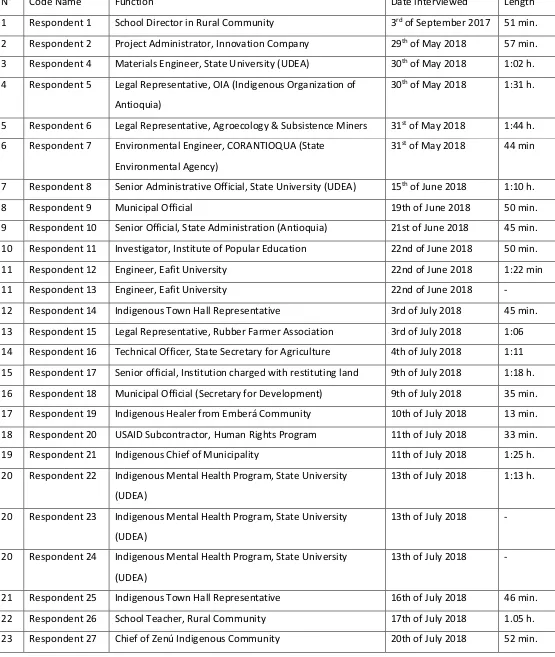
servants or political leaders. Only 7 respondents were females. The total interview material amounts to over 23 hours, with the average interview lasting between 45 and 75 minutes. The interviews were conducted openly, not imposing a fixed set of questions. A framework existed, but was not applied consistently, as the diverse respondents had differing areas of expertise. The security situation also affected the context of the interviews, as some of the respondents had received threats and had difficulty finding a safe and suitable spot for an interview. These interviews took place in public spaces or institutions. Other interviews took place in respondents’ government offices in the state capitol Medellin, one was conducted in a rainforest while sitting on a tree stump and one participant observation took place in a wooden canoe on a branch of the Cauca river, together with a fisherman and his 8-year old son. The locations where data was gathered thus tended to reflect the loci where our respondents ‘act’.
In addition to the recorded interviews, the research data consists of personal observations and notes taken during various excursions and daily life in the case region. The researcher visited sites of resource extraction, medium-sized and large-scale industrial operations, as well as sites of TEK reproduction and indigenous resistance, in local villages and even an indigenous protest march. Considerable time was spent together with members of indigenous and rural communities, especially school classes, in sessions that were mediated by teachers. These meetings yielded valuable insights into the daily lives of these communities and the re-production of knowledge there. The long distances and precarious security situation made travelling to these sites often difficult. During the period of field work, a hydropower project under construction spun out of control, forcing the closure of a major highway and the evacuation of thousands of residents. This also affected the ongoing research.
The method of data gathering for ANT-accounts is very similar to standard ethnography, this is no coincidence. From the outset, this study relied on the theoretical foundations of STS. The focus sharpened with the adoption of ANT, which shares many elements with Garfinkels’ ethnomethodology (Latour, 2005; Philipp, 2007), especially its reliance on case studies, focus on seemingly irrelevant activities and details, and its use of the concept ‘actor’ rather than ‘informant’, who is to be treated not as a mere placeholder but rather as an active and knowledgeable entity that shapes its own context. In Latours words: ‘ANT is simply an attempt to allow the members of contemporary society to have as much leeway in defining themselves as that offered by ethnographers’ (Latour, 2005: 41). Proponents of ANT are very skeptical about the arrogant positioning of observers by social scientists: ‘since ordinary agents are always ‘inside’ a social world that encompasses them, they can at best be ‘informants’ about this world and, at worst, be blinded to its existence, whose full effect is only visible to the social scientist’s more disciplined eyes; […]’ (Latour, 2005: 4). This approach is also reflected in the way the interviews were conducted. Although a fixed set of topics existed, and the questions were phrased according to the identity of the respondent, most of the time the respondents talked freely, with little guidance or interruption by the interviewer. They would relate to their personal experiences of living and working in the case region, and whenever topics came up that were relevant to the research, such as resource extraction or the conflict, the interviewer would inquire deeper into the respondents’ experience.
3.4 Methods of Data Analysis
identity emerges--and changes--in the course of interaction.’ (Law & Callon, 1997). In this sense, the data analysis is not a process that strictly precedes the writing of the text, it is the very process of writing the text.
The coding scheme emerged from a preliminary analysis of actor-networks in the case-region and their interrelation. The analytical tools employed in the analysis can be attributed to what Law (2007) terms ‘new material semiotics’. This set of methods and assumptions distinguishes itself from the ANT studies of the 1980s and 90’s in several dimensions: They place more emphasis on the performance instead of the social construction of networks, on the multiplicity of networks in a case, on their fluidity and the realities enacted in them (Law, 2007). From the perspective of the new material semiotics, instead of constructing an object or a fact, actors ‘assemble and enact a set of practices that make a more or less precarious reality’ (Law, 2007: 13). The static metaphor of construction can no longer serve to describe the continuity of certain effects such as power, which are not assembled once and then established, but rather continuously performed through a number of associations. The metaphor of enacting realities alludes to the multiplicities of realities and is also a rupture with most western metaphysical currents which are founded ontologically on a single static reality (Law, 2004; 2007; Escobar, 2016). Realities, the reasoning goes, are continuously crafted ‘[…] in a combination of people, techniques, texts, architectural arrangements and natural phenomena […].’ (Law, 2004: 57). Each actor-network depicted in the analysis (ecological, extractive or violent) thus enacts a different reality. An actor-network is a description which retraces these associations, thus ‘reassembling’ how a specific reality is enacted (Latour, 2005).
region is a place where technology, weapons, policy texts and knowledge come together with natural actors and processes. Each of these actors contributes to the performance of the other actors in the site, none of these actors can exist in this network without being associated to the others: The mineral, far from being a static material far underground, exerts agency on humans, who attribute economic utility to its possession and thus proceed to mobilize machines and chemicals for its extraction, even if this is against the law and the presence of illegally introduced machines in specific areas (mining titles pertaining to multinationals) draws yet another actor on the scene: The military is mobilized to destroy the machines, while paramilitaries are mobilized to protect them. Describing this process as an actor-network bridges the arbitrary divide between what is deemed to be ‘social’ and what is ‘material’, enabling the retracing of heterogeneous associations established between grains of gold in the subsoil to a bullet fired in a confrontation over a mine.
establish themselves and what the consequences of their interaction are.
Due to the large amounts of data collected, the data analysis was highly selective. Not all interview content was transcribed for lack of relevance. Of 24 interviews conducted, 23 were transcribed to a certain degree. The more information the interviews contained about the investigation topic, the more content was transcribed. Transcription was limited to Spanish summaries, whereby the most salient phrases, the ones that capture the central concepts, were transcribed literally, enabling their possible citation in the analysis. Of the 23 Interviews that were transcribed, 14 are directly cited in the analysis chapter. However, all of the 23 interviews provided relevant information which was included in the description of the actor-networks operating in the case-region. Some respondents are quoted multiple times, while others are not quoted once. Those that are quoted frequently often said similar things to respondents who are not quoted, however, their quotations were more apt for citation.
Chapter 4: Analysis
In the following sections, the study retraces the heterogeneous associations between actors in ecological commons, extractive and violent actor-networks in the lower Cauca region. The first section concerns itself with ecological commons, TEK and the importance of nature in indigenous and subsistence communities, contrasting these findings with the role of nature in contemporary western development models. In the second section, this exercise will be repeated for five different types of extractive actor networks, which revolve around the ‘extrahection’ of natural actors. The third section refers to the associations between extractive actors and those engaged in violent conflict, which cooperate to ensure possibilities for extraction. In the fourth section, these insights will be summarized and interpreted in regard to the primary research question. This section displays how the overlapping of these networks encloses ecological commons, thereby de-legitimizing TEK and contributing to its epistemicide.
4.1 Ecological Commons and TEK in the Lower Cauca Region
At least three pre-Hispanic indigenous societies have survived until present day in the case region and neighboring municipalities, in addition to communities of Afro-Colombians, typically descendants of runaway slaves (Galeano, 2015). In pre-Hispanic times one of the three indigenous peoples of the region, the Zenú, had established a sophisticated agricultural society on the coastal plains. Zenú society was divided into three kingdoms, Finzenú, Panzenú and Zenufana, each specialized in certain ‘products’ (food, jewelry, arts & religion) and connected to the others by an intricate trade system based on canals and roads (ONIC, 2019). The Emberá also survived the arrival of the Europeans, they still inhabit northern and western Colombia as well as parts of Panama (ONIC, 2019). The Emberá maintained semi-nomadic lifestyles along rivers and in deep rainforests. Two related groups of Emberá are recognized in the case-region, the Emberá Eyábida or Emberá Katio ‘people of the rainforest’, and the Emberá Dóbida, ‘people of the river’ (ONIC, 2018). The center of what is now Antioquia was then populated by the Nutabe, who now inhabit the Cauca canyon to the southwest of the lower Cauca region (David Higuita, 2018; ONIC, 2019). Although they have adopted many modern technologies and certain modern cultural features, the Zenú, Emberá, Nutabe and Afro-Colombian communities in the lower Cauca region still make extensive use of traditional ecological knowledge and are highly dependent on access to nature, which they share and organize in systems that can be pictured as ‘ecological commons’ (Weston & Bollier, 2013).
‘The indigenous peoples that are here today are not really alive but merely surviving, [survivors] of a wave of attacks, religious, educational, from the government in every sense. […] They taught us to depreciate ourselves, to hate ourselves to the point where many ancestors negated their identity towards their children and grandchildren.’ (Respondent 5)
Despite the survival of indigenous genes, indigenous culture was swiftly exterminated through the negation of indigenous identities. The waves of attacks’ described by the respondent began during early colonization, when the Spanish captured indigenous populations that survived the initial wave of lethal infectious diseases and began importing enslaved Africans to work in gold mines and plantations, thus establishing the ‘Atlantic Economy’ (Mignolo, 2011). After indigenous populations had been decimated by as much as 90%, the Spanish crown officially called upon the colonies to end slavery. Unofficially, the crown continued its support of slavery and the ‘encomienda system’ was born in 1536 (Galeano, 2015). In 1773, the Spanish crown established a reserve for the Zenú in San Andres de Sotavento (ONIC, 2019). The Nutabe for their part were confined to a large reserve in San Pedro de Sabanalarga in the Cauca canyon, which was dissolved with a pen-stroke by the newly founded Colombian republic in the 19th century (ONIC, 2019). In mid-20th century Colombia, during the aptly-named period known as ‘La Violencia’, many rural and indigenous communities were uprooted by large landowners and migrated to previously unpopulated areas (Galeano, 2015). According to our respondents, most of the indigenous settlements in the lower Cauca region were (re)founded around this time by communities that sought to flee the violent enclosure of their commons elsewhere.
Historically, interactions between Colombian indigenous communities and state institutions such as municipal or departmental governments or security forces were often detrimental to the former. The tide has shifted slightly in recent decades, evident in the Colombian constitution of 1991, which in principle recognizes the ethnic diversity of the nation and holds the state responsible for upholding the rights of ethnic communities. Indigenous respondents acknowledged however, that the recognition of diversity existed on paper only. Relations between their communities and state institutions were still fraught and characterized by neglect, a municipal Zenú chief confided:
‘There are no guarantees for our proper [indigenous] education. […] The children receive classes under a tree, from there on they have to graduate from high school, in a place where there is no internet, nothing. […] The problems concerning health are even worse.’ (Respondent 21)
Most indigenous communities in the case-region rely on the services of traditional healers, but would like to have access to systematic and intercultural health care provision, as a respondent working in an indigenous mental health program explained:
‘Indigenous communities have been insisting for many years now that they have to have a proper system of intercultural health provision. […] The approaches that the [national] government then brought forward, however, did not comply with the requirements of SISPI [Indigenous System of Proper Intercultural Health].’ (Respondent 22)
Intercultural health care, as our respondents explained, would combine methods of Zenú or Emberá medicine with modern western medicine, in ways that contribute to the preservation of indigenous knowledges, for example in regard to herbal medicine or local indigenous foods. At the same time, indigenous respondents maintained that while western medicine was theoretically capable of delivering much better results than traditional medicine, it was not accessible to many people and not applied in a holistic sense, emphasizing the treatment of symptoms with pills over addressing the root causes of illness.
At the same time, traditional medical knowledge is disappearing. A Zenú healer explained to me, that it used to be common to order plants not available in the specific climatic zone from healers located in different climate zones, i.e. higher up in the mountains. This system is not being applied as consistently as before and healers are therefore losing contact to one another, forgetting about specific practices and herbal medicines.
While indigenous communities near urban centers can receive ‘standard’ modern medical care in clinics there, in communities far off the grid, the absence of any kind of modern health care provision, paired with the loss of species with medical application or traditional medical knowledge, can be deadly: In a visit to an Emberá community deep in the forest in paramilitary-controlled territory, I noticed that the community had no access to any kind of reliable health care (neither modern nor intercultural), one child was experiencing a severe but apparently untreated infection. A day after our visit, an infant in this community died of malnutrition, which is still among the three main causes of death in 1-year old children in Colombia, with higher prevalence rates among rural and ethnic communities (Cotes-Cantillo, et al., 2016). The respondents working in the indigenous health program emphasized the relationship between changes in land use and malnutrition in indigenous communities which they had witnessed in their work in the Guajira department in northern Colombia:
‘One of the causes, if we are to speak of economic reasons [for infant malnutrition], is simply this neoliberal and extractivist model. Why? For example, because land in the Guajira is not used for agriculture or pastures anymore […] Instead, it is [perceived to be] rich in ‘natural resources’ […]’ (Respondent 22)
Extraction in the ‘resource-rich’ Guajira department but also in the lower Cauca region gains prevalence over the permanence of indigenous populations, and, as the respondents continued, indigenous communities in Colombia have committed communal suicides as responses to extractive projects on their territories, pinpointing the helplessness and the despair experienced by these communities in the face of the complete disruption of their systems of sustenance and meaning-making. Suicide rates for the Colombian Emberá population are estimated at 500 per 100 0001 (Gómez-Restrepo, Rincóna, & Urrego-Mendoza, 2016: 124). Not speaking Spanish, Emberá rarely leave their forest villages to seek treatment. These numbers indicate high levels of psychological distress caused by extractive activities in ecological commons, in addition to negative effects on physical health such as malnutrition or cancer-causing pollution (Klein, 2014; Cotes-Cantillo, et al., 2016). Ethnic communities’ rights to their own educational and health care systems are not being respected by the
1 For comparison, the suicide rate for the Netherlands is estimated to be at 11.1 per 100 000 residents, according to Netherlands Statistiks,
state, which largely leaves communities in the lower Cauca region to fend for themselves. These in turn rely heavily on the support of indigenous NGO’s such as the Indigenous Organization of Antioquia or outside agencies such as USAID, which lack substantial funding or only support specific projects, however. The national governments neglect of intercultural education or health approaches thus constitutes structural violence which reinforces indigenous identity loss and fosters human suffering from preventable health problems (Farmer, 2009).
The conceptions of ‘development’ in ecological commons in the case region differ strongly from the Colombian ‘sustainable development’ policy which is characterized by the hypocrisy of demanding material growth at the same time that it demands that future generations possibilities’ for sustainable resource use be maintained. ‘Development’, is seen by indigenous peoples in the case region as a repository of empty promises, adding the prefix ‘sustainable’ did not alleviate this. When referring to the Hidroituango hydropower project under construction to the south-west of the lower Cauca region, the Zenú representative from an indigenous organization explained that:
‘They have been giving us development for a long time but what they have promised has not materialized. Development is like a grand idea, in the future, ahead of us, that they conjure up to make us pass through all the hardships.’ (Respondent 5)
While western models of development are heavily dependent on long supply chains such as those established through hydropower projects (Gellert & Lynch, 2003; Shiva, 2010), indigenous conceptualizations of development emphasize the use of TEK and short supply chains for personal sustenance:
‘What is development? That you have a place to cultivate [your crops]. If you have a piece of land you may be ignorant, but at least you don’t go hungry.’ (Respondent 14).
For many indigenous people, the ecological commons that satisfy their basic vital needs is denoted by the term ‘territory’. An indigenous town hall representative (who was forcibly displaced twice from her land), emphasized that territory cannot serve the purpose of capital allocation:
‘We don’t have territory and without territory an indigenous person does not live. Our life is related to our territory, because with it you have the most important thing, mother nature to provide for you, with her you have everything to live well. We do not think in money, an indigenous person doesn’t want to have big mansions, she needs her territory.’ (Respondent 25).
Territory thus understood can be conceptualized as an actor-network of natural actors and processes that enables a community to survive. Territory denotes the assemblage of natural capital from which indigenous and subsistence communities gain an income. This income, in the form of food, water shelter, medicine etc… must be derived sustainably, i.e. without decreasing future yields, otherwise it would not be income but capital drawdown (Daly, 2007). In terms of ANT: no component or actor in the actor-network denoted ‘territory’ should shift its shape in a way that endangers the establishment of future associations between this actor and others. If a river becomes progressively more polluted, as is the case with the Cauca river, a fisherman’s son will not be able to establish the same type of associations with the river than his father who fished in unpolluted waters, catching more fish with less toxins inside of them. Ecological commons are understood by indigenous interviewees as one of many parts of a complicated system that must be balanced, not only in respect to material flows, but also in terms of reciprocity with ‘mother earth’. As an indigenous representative reminds us:
‘[in the Zenú culture] The fact of preparing the hills [for sowing crops] does not only imply the preparation itself, but to enter into a dialogue with the mountain, to shout at the mountain. We have this thing that we term ‘the call to the mountain’, when we go to collect the harvest, and depending on that call, you either harvest productively or not. Who is going to certify that scientifically? No, that is an intrinsic relation between our culture and territory.’ (Respondent 5)
Cooperation among community members without the incentive of private profit is central to the functioning of ecological commons. Certain subsistence commons are organized through the collective maintenance of common infrastructure and public spaces. A workers’ representative explains that:
‘The first Monday of every month we gathered for the colectivo. What is the colectivo? All the men in the village went to repair the road, or the bridge […] while the women stayed in the village and cleaned the houses and streets.’ (Respondent 6)
In indigenous commons, cooperation goes even further than simple maintenance, encompassing practices that contribute to sustenance, for example in agriculture, as a Zenú chief explained:
‘There is a time when we collectively prepare the hills or an extension of land, 10 or 8 hectares, and then we plant it collectively. […] Afterwards, we repartition the harvest equally among ourselves.’ (Respondent 21)
Collective actions establish functions and services in ecological commons which are typically provided by states’ or markets in growth societies, such as infrastructure maintenance or food provision. Thereby, these communities establish not an alternative economy but a downright alternative to economy (Esteva, 2014): They resist the individualization and alleged self-interest that characterize utilitarian social relations in growth societies (Romano, 2015). A Zenú community’s ‘economy’ does not rely on competition but on cooperation (Berthoud, 2010).
In the ordering of ecological commons, indigenous and subsistence communities in the lower Cauca region enact rules or ‘vernacular law’ to organize their territories (Weston & Bollier, 2013). These rules regulate activities such as traditional mining or agriculture, balancing them with other needs of human and non-human actors. As a municipal Zenú chief explained:
‘This part [of our territory], we’ll use it for cattle grazing, this part for agriculture, and this part we’ll conserve for fauna. […] If you need wood for a house, you can cut it there, but you have to plant a new tree.’ (Respondent 21)
‘Deeper in the forest, there are large haciendas, illegal logging, you can find everything there. […] San Lucas has been exploited by a lot of mining […] But precisely the territory where we are living has not been touched by these types of mining activities.’ (Respondent 27)
It is no surprise that indigenous communities are more effective in conserving crucial ecosystems than governments in weak states (Tauli-Corpuz, Alcorn, & Molnar, 2018): While the Colombian government can only fly over the forest reserve with helicopter gunships for fear of armed groups, indigenous communities are on the ground permanently for generations, noticing the slightest changes in the environment while resisting the intrusion of unsustainable land uses such as large-scale illegal logging in their territories. The intricate relations between humans and natural actors established in ecological commons are exemplified in a study regarding indigenous mental health in Colombia: Closer proximity of indigenous peoples to forests measurably improves their mental health state (Cotes-Cantillo, et al., 2016).
Ecological commons rely extensively on undisturbed endemic natural actors and processes for their functioning, local species of fish for instance or seasonal monsoon rains (Weston & Bollier, 2013; Klein, 2014). Their survival is at risk with both the privatization of commonly accessible nature, its degradation or transformation as well as the replacement of natural through non-natural materials such as plastics or chemicals. Independently of one another, several respondents told us that the Zenú used to know of a plant extract for gold separation, which was replaced by mercury amalgamation during Hispanic colonialization. Mercury is the most toxic non-radioactive element known to exist. Mercury pollution was already rampant in the 16th century in mines in Latin America, its toxic effects were known as far back as the Classical Period (Galeano, 2015). After more than 500 years of mercury pollution, in 2018, the state of Antioquia determined the use of this heavy metal in gold mining to be illegal. Traditional miners who have learned to use mercury are still complicit in mercury pollution and hence the destruction of their own commons in the lower Cauca region, which depend on unpolluted water sources (Oseas García a, Cordy, Suescún, Molina, & Roeser, 2015: 245).
‘In winter [the wet season] there is fish. When the waters rise, the fish enter the rivers from the lakes and swim upriver to spawn. When the rivers subside [in the dry season], they leave sediments and gold, so the people pan for gold. […] the biggest company we have in the lower Cauca region is the Cauca river.’ (Respondent 5)
The rivers are fundamental natural actors for indigenous peoples and subsistence communities of traditional miners and fishermen. Note the analogy between a river and a company presented by the respondent. The lower Cauca region has never experienced economic development beyond the extraction of primary materials, a typical destiny for rural regions in Latin America (Galeano, 2015). Here, life in indigenous and subsistence communities still depends overwhelmingly on renewable natural resources which are appropriated individually or collectively with pre-industrial methods. Rivers and forests are to these communities what companies are to the citizens of a ‘developed’ country, producing goods to satisfy the needs of consumers.
Rivers are actors at risk of being mastered, while other natural actors and ecological practices are being replaced by the introduction of synthetic materials in the lower Cauca region. Concerning the substitution of natural by synthetic materials, an indigenous representative said:
‘We are accustomed to packing our food in a large leaf of the hoja de bijao plant. You ate the food and left the leaf, and nature reabsorbed it. No pasaba nada. Now, they pack food in a plastic bag and those who are accustomed to throwing away a leaf, throw away a plastic bag.’ (Respondent 5)
The loss of TEK is fuelled through the substitution of plentiful natural materials through scarce and synthetic ones (Shiva, 2010). This empowers corporations that control and produce these materials while it fosters the increasing dependence of indigenous and subsistence communities on means of production outside of their control (Galeano, 2015). By employing TEK and naturally occurring materials, for example in the construction of an Emberá house as pictured in the image below, indigenous and subsistence communities maintain short supply chains in practically closed economies. TEK is thus central to the resistance of indigenous and subsistence communities to an involuntary integration into the global economy (Klein, 2014), an integration that would rob them of the control over their means of production.
TEK is also central for resistance to violent and extractive power structures that seek to establish themselves in the case region: At one point, paramilitaries enforced an economic blockade of a specific area in the lower Cauca region in the foothills of the Serranía San Lucas. It was only possible to enter goods with the permission of the paramilitaries and state security forces. The representative of a small miners and peasants organization shared his experiences with us:
‘They [paramilitaries] had a checkpoint, two hours from the town. If you had the three signatures [from police, military and paramilitaries], they let you pass the checkpoint, if not, they killed you. Many comrades died trying to enter goods […] What did we do? Well, we said, lets implement a closed economy here in the region.’ (Respondent 6)
‘These products were brought to the upper part of the region, where only mining was practiced, initiating a kind of trade […] Milk, cheese, all of that went to the upper parts, and there the peasants did not have money but paid with gold. […] (Respondent 6)
The aim of this ‘closed economy’ based on TEK and cooperation was for traditional miners and subsistence farmers to remain in their territories despite the pressure of paramilitaries to relocate. In the end, they persisted until the paramilitaries lifted the blockade under international pressure.
This analysis of the ordering of ecological commons around the appropriation of nature with TEK reveals various findings. Ecological commons in the case-region constitute alternatives to conventional western development, placing a special emphasis on reciprocal relations with natural actors (Shiva, 2010; Esteva, 2014). This conceptualization is captured in indigenous understandings of ‘territory’ (Escobar, 2016), also in Zenú and Emberá communities in the case region. Communities that establish ecological commons rely on collective action and cooperation to perform crucial functions that the market and the state can or should not provide in these communities in the lower Cauca region (Weston & Bollier, 2013; Romano, 2015). Indigenous and subsistence communities utilize ‘vernacular law’ (Weston & Bollier, 2013), which typically rests on combinations of traditional authority, communal practices, common sense and direct democracy in these communities. Furthermore, TEK is important to the resistance of indigenous and subsistence communities to extractive projects and oppression. TEK increases the resilience of communities off the grid (Wilder, O'Meara, Monti, & Nabhan, 2016) and fosters sustenance via shorter and more sustainable supply chains (Shiva, 2010), for example through permaculture gardening, hunting and gathering or seasonal economies. Adapting to local natural processes and actors such as the constantly changing rivers is crucial to the functioning of ecological commons. These findings are not necessarily new, as Escobar (2016) demonstrates in the Colombian Pacific. However, they have as such never been established for the indigenous communities in the case region, which have thus far been neglected in academic research. Not even Alexander von Humboldt mentions the Zenú or their pre-Hispanic hydraulic works in the description of his visit to the Colombian coast and Sínu river.