warwick.ac.uk/lib-publications
Original citation:Crawford, Claire, Macmillan, Lindsey and Vignoles, Anna. (2016) When and why do initially high attaining poor children fall behind? Oxford Review of Education, 43 (1). pp. 88-108.
Permanent WRAP URL:
http://wrap.warwick.ac.uk/83166
Copyright and reuse:
The Warwick Research Archive Portal (WRAP) makes this work by researchers of the University of Warwick available open access under the following conditions. Copyright © and all moral rights to the version of the paper presented here belong to the individual author(s) and/or other copyright owners. To the extent reasonable and practicable the material made available in WRAP has been checked for eligibility before being made available.
Copies of full items can be used for personal research or study, educational, or not-for profit purposes without prior permission or charge. Provided that the authors, title and full bibliographic details are credited, a hyperlink and/or URL is given for the original metadata page and the content is not changed in any way.
Publisher’s statement:
“This is an Accepted Manuscript of an article published by Taylor & Francis Oxford Review of Education on 28/11/2016 available online:
http://dx.doi.org/10.1080/03054985.2016.1240672
A note on versions:
The version presented here may differ from the published version or, version of record, if you wish to cite this item you are advised to consult the publisher’s version. Please see the ‘permanent WRAP URL’ above for details on accessing the published version and note that access may require a subscription.
When and why do initially high achieving poor children fall behind?1
Claire Crawford*, Lindsey Macmillan** and Anna Vignoles***
* Department of Economics, University of Warwick and Institute for Fiscal Studies
** Department of Social Science, UCL Institute of Education
*** Faculty of Education, University of Cambridge
June 2016
Abstract
In this paper, we examine the trajectories of initially higher- and lower-achieving children from lower and higher socio-economic status families from primary school through to university in England for the first time. We also explore what explains these trajectories. This enables us to provide new insights into when and why the performance of children with similar initial achievement diverges on the basis of their socio-economic background. Our results indicate that pupils from poor backgrounds who are higher achievers in primary school fall behind their better-off but lower achieving peers during secondary school. This suggests that secondary school may be a critical period to intervene to prevent poor children from falling behind their richer peers. Our analysis suggests that there is less divergence in performance between pupils from different socio-economic backgrounds who attend the same schools. This result is particularly strong for children with low initial achievement. While we remain cautious about the implications of these findings, they provide suggestive evidence that schools (or the sorting of pupils into schools) play an important role in explaining why the test scores of richer and poorer children diverge over time.
Keywords: social mobility, education achievement, regression to the mean
Acknowledgements:
This project is part of the Social Policy in a Cold Climate programme of work which is funded by Joseph Rowntree Foundation, the Nuffield Foundation and Trust for London. It builds on earlier work funded by the Social Mobility and Child Poverty Commission. The authors would like to thank Ruth Lupton and John Hills for useful comments on an earlier draft. All errors remain the responsibility of the authors.
1 Corresponding author: Dr Lindsey Macmillan, UCL Institute of Education, 20 Bedford Way, London, WC1H
1. Introduction
The role of education as a potential driver of social mobility has been well established in both
the theoretical (Blau and Duncan, 1967; Becker and Tomes, 1986) and empirical literature
(Atkinson, 1980; Atkinson and Jenkins, 1984; Breen and Goldthorpe, 2001; Breen and
Jonsson, 2007; Blanden et. al, 2007) across disciplines over the past fifty years. Many view
reducing educational inequality as a key policy lever for improving levels of social mobility.2
This is certainly true in the UK, where the Government now actively tracks levels of
educational inequality across the life course as a proxy for longer term trends in social
mobility (Cabinet Office, 2011).
Of particular importance from a policy perspective is whether educational inequalities
increase as children get older, as the existence of substantial inequalities at the end of
compulsory schooling may be detrimental to future social mobility. However, much of the
existing evidence focuses on cross-sectional trends in achievement gaps across cohorts
(Blanden and Gregg 2004; Strand, 2014a), which conflate changes in achievement as children
grow older with changes in achievement over time (amongst different cohorts). While there
has been a growing literature on the trajectories of different groups of children and the
value-added of different schools for different types of student (Strand et al. 2006; Strand, 2014b;
Thomas et al. 1997a, 1997b; Strand, 1997, 2010) there is limited evidence to date on the
trajectories of educational achievement for the same individuals over time from different
family backgrounds.
Within this literature, an important issue is the extent to which initially higher
achieving poor children fall behind their better-off peers, and what, if anything, can be done
to mitigate these patterns. This issue has received less attention to date, and the existing
evidence provides little consensus. For example, a seminal paper by Feinstein (2003) for the
UK found that high-achieving children from low income families fell behind low-achieving
children from high income families at a very early age.3 However, Jerrim and Vignoles (2013)
demonstrated that these findings could be at least partially driven by measurement error in the
initial achievement level, which was also used to plot the trajectories over time. This can lead
to a statistical phenomenon known as “regression to the mean”, which can arise when some
particularly high (or particularly low) initial scores are driven by ’luck’ rather than reflecting
the individual’s underlying potential. When replicating the Feinstein (2003) analysis to
account for this issue, Jerrim and Vignoles (2013) found little evidence of a convergence in
performance between poor children with high initial development and richer children with
lower initial development.
Both studies are limited by only focusing up to age 7, however; and neither explore
what factors might drive the differential trajectories that they observe between children from
different socio-economic backgrounds. This paper seeks to add to the literature in these two
respects. We start by examining the trajectories of initially high- and low-achieving children
from lower and higher socio-economic status families from primary school to university, for a
cohort of pupils born in England between September 1990 and August 1991.We use tests in
different subjects taken at the same age to minimise the impact of regression to the mean on
our results. We also try to account for what might be driving the differential trajectories by
initial achievement and family background using basic demographic characteristics and
information on the schools children attend.
In line with previous literature, we find large differences in educational achievement
by socio-economic background at age 7 that increase as pupils get older - by around two
thirds by the end of compulsory schooling (age 16). When looking at trajectories by
socio-economic background and initial achievement, we find that the performance of initially high
3 Other studies using comparable approaches have found similar results (e.g. Schoon 2006; Feinstein 2003,
achieving children from the most deprived families and that of average-achieving affluent
children converge, but this occurs somewhat later than previous literature has suggested,
namely between ages 11 and 14, when most young people in England are at the start of
secondary school. We find a similar pattern of convergence between initially low-achieving
children from the least deprived families and average-achieving poorer children. These
findings are robust to alternative definitions of initial achievement, suggesting that this
convergence is not driven by regression to the mean.
When exploring the role of other factors in explaining these trends, we find that the
schools attended by pupils from different backgrounds may be important. In particular, we
find less divergence in performance between pupils of similar initial achievement but from
different socio-economic backgrounds when we compare pupils attending the same schools.
(There is also less convergence between richer initially lower-achieving pupils and poorer
initially higher-achieving pupils.) However, we are cautious about ascribing a causal
interpretation to these findings, as the direction of causality is not obvious and the sorting of
pupils into schools, rather than school quality, may partly explain these patterns.
This paper now proceeds as follows: the next section reviews the related literature;
Section 3 outlines the data that we use and Section 4 our empirical approach. The main results
are discussed in Section 5 and we end in Section 6 with some brief conclusions.
2. Related literature
Large socio-economic gaps in children’s cognitive skills at an early age are well documented
in the literature (Cunha et al 2006, Goodman et al 2009). These findings are consistent with
both theoretical and empirical work which has indicated that the early years are particularly
question is whether these differences are narrowed by the school system or if instead
socio-economic gaps widen further as children progress through school.
Theoretically there is reason to believe that socio-economic differences in cognitive
achievement might widen through time if the greater levels of investment made by parents of
higher socio-economic status (SES) in their children in turn enable high SES children to
benefit more from later investments, such as schooling. In other words, if inputs into
children’s development are complementary, then the cognitive skills gap between richer and
poorer children is likely to widen through time – in the words of Heckman and co-authors,
skill begets skill (see Cunha et al., 2006). The empirical evidence on this point is somewhat
mixed. Some studies have found a widening of the socio-economic gap in cognitive
achievement as children get older (Caro, 2009; Feinstein, 2003; Goodman et al, 2009). Other
studies (Blanden and Machin, 2010, Reardon, 2011, Duncan and Magnuson 2011, Cunha et
al 2006) have found little change in the magnitude of the SES gap across childhood.
This literature has largely focused on average differences in cognitive skill by social
background between different cohorts at different ages. But such analysis may conflate
changes that occur as children get older with changes that occur over time/across cohort. To
better understand how education performance changes for particular children, one must rely
on longitudinal or panel data, following the same individuals as they get older, collecting
information on achievement at multiple time points. Goodman and Gregg (2010) piece
together within-child changes from three different cohorts, representing an initial step in this
direction using UK data.4 They find that the differences in achievement by socio-economic
background start large (around 23 percentiles at age 3) and widen up to age 14 (36
percentiles). Similarly, Washbrook and Lee (2015) using the US Early Childhood
Longitudinal Survey – Kindergarten cohort and Caro (2009) using data from the Canadian
4
National Longitudinal Study of Children and Youth find evidence of widening
socio-economic gaps in achievement as children get older. Cunha et al (2006), by contrast, using
the US Children of the National Longitudinal Survey of Youth (CNLSY), find large
achievement gaps at age 6 that remain broadly stable up to age 12 (see also Goodman et al.,
2011).
Another way to consider whether socio-economic gaps have widened during a
particular period of schooling is to use a value-added model, in which one would model
achievement at time period 2, controlling for achievement at time period 1. There is a large
body of work that has taken this approach, though such studies often constrain prior
attainment to have the same effect throughout the distribution, and very rarely interact the
effect of attainment with socio-economic background. (The set of studies referred to in
Goodman and Gregg (2010) are notable exceptions, however; see also Strand (2014b) who
focuses on ethnic differences in achievement.) Of particular interest is whether the academic
performance of children from poorer backgrounds who start out with higher levels of
cognitive skill declines relative to their richer (but lower achieving) counterparts. The few
UK papers that have examined this issue largely concur that high achieving children from
poorer backgrounds do fall behind relative to their richer lower-achieving peers (Schoon
2006; Feinstein 2003, 2004; Blanden and Machin 2007, 2010; Parsons et al 2011; amongst
others).
But, as outlined above, there is a concern that at least part of the story highlighted by
these papers might be driven by the problem of regression to the mean. This issue was first
identified by Galton (1886), and an increasing number of papers are paying attention to the
associated methodological challenges (e.g. Jerrim and Vignoles (2013), Washbrook and Lee
(2015)). Using simulations, Jerrim and Vignoles (2013) attempt to estimate the extent of the
socio-economic backgrounds and achievement groups that may arise if one does not account for the
possibility of regression to the mean, and showed that apparently substantial declines in test
scores for poor high achieving children can occur, even when no real change in achievement
is taking place. They attribute this to regression to the mean.
To overcome this issue, Jerrim and Vignoles adopt a standard approach in this
literature – namely to define initial achievement using a different test to the one that is used
as the baseline from which to measure a child’s education trajectory. In doing so, they find
little evidence that the cognitive skills of initially high achieving children from lower
socio-economic backgrounds suffer a significant decline between the ages of 3 and 7. They are not,
however, able to follow children to the end of primary school and beyond. Washbrook and
Lee (2015) adopt an analogous approach within a value-added context, using a test score
from an earlier time period (age 5 in their case) as an instrument for prior achievement. They
find evidence of a significant widening of educational inequality between ages 6 and 14
between those measured to have the same initial achievement, but they do not differentiate
between the patterns found for individuals at particular parts of the distribution of prior
achievement.
This study builds on the literature in this area, using a census of children attending
state schools in England and the methods adopted by Jerrim and Vignoles (2013) to
demonstrate how educational trajectories differ by socio-economic background and initial
achievement between primary school and university. It also explores the drivers of these
trajectories. This has not been done before for the same individuals over time and split by
3. Data
Given that our analysis is based on the educational careers of students in England, we start by
providing a brief overview of the English education system. Pupils in England generally start
school in the academic year (September to August) in which they turn five. For most pupils,
this means that they start school in the September after their fourth birthday. The first three
years are spent in Key Stage 1, with a further four years spent working through Key Stage 2.
This takes pupils to the end of primary school. In the academic year in which pupils’ turn 11
they make the transition from primary to secondary school, where attendance is compulsory
up until the end of Key Stage 4 (taken at the end of the academic year in which they turn 16).
Key Stage 3 usually runs for the first three years of secondary school and Key Stage 4 for the
final two years. The vast majority of students start school at the expected time and progress
through the system as expected, with very few held back or advanced a year. The compulsory
school leaving age was 16 for our cohort. Students who choose to stay on beyond compulsory
this point generally study for a further two years (known as Key Stage 5). Thereafter, students
can enter university if they choose to do so.
National achievement tests are taken at the end of each Key Stage by all pupils in state
schools. At the end of Key Stage 1 (the academic year in which pupils turn 7), they are tested
in reading, writing and maths. These tests were introduced in 1997-98. For the cohort that we
analyse, they were externally marked (although performance at the end of Key Stage 1 is now
teacher assessed). At the end of Key Stage 2 (the academic year in which pupils turn 11),
pupils are tested in English, maths and science. These tests were introduced in 1994-95 and
have always been externally marked. Up until 2009 there were compulsory national
achievement tests at the end of Key Stage 3 in English, Maths and Science which were
externally marked. At the end of Key Stage 4, almost all pupils (including those attending
equivalent qualifications, which largely determine their participation in post-compulsory
schooling. Around two thirds of students reach the benchmark of 5 A*-C grades in GCSEs or
equivalents. The majority of pupils stay in education beyond age 16, with approximately 60%
achieving two or more Advanced level (A level) qualifications by age 19 in 2013 and
approximately 35% entering a higher education institution at age 18 or 19 (Crawford, 2014).
To measure trajectories across individuals’ educational careers we require longitudinal
data on the educational achievement of children. We use linked individual-level
administrative data (the NPD-ILR-HESA data) which enables us to follow students from the
start of primary schooling through to the end of university.5 This data includes a limited set of
demographic information – including gender, ethnicity, month of birth, eligibility for free
school meals (a proxy for low family income) and home postcode, from which information on
the child’s local neighbourhood can be merged in – and detailed results from the national
achievement tests described above. We use a cohort born between September 1990 and
August 1991, enabling us to examine educational trajectories from age 7 through to university
entry at age 18 or 19.
Given our focus on educational trajectories throughout primary and secondary school,
we restrict attention to individuals for whom we observe English and Maths test scores at
each stage from Key Stage 1 to Key Stage 4. Because Key Stage tests are not compulsory in
private schools, this means that we focus on pupils attending state schools only. We
additionally exclude individuals who attended a special secondary school since many do not
access the full curriculum and will not take standardised tests.6 Our final sample therefore
comprises 460,653 pupils from the cohort born in 1990-91.
5 The NPD-ILR-HESA data links together the National Pupil Database (NPD), the school administrative data
set, which is a census of pupils, with data on their characteristics and achievement, the Individual Learner Records (ILR), the Further Education administrative data set, which is a census of students’ learning episodes and achievement, and Higher Education Statistics Agency (HESA) data, the higher education administrative data set, with data on students’ characteristics and higher education attainment.
The premise of our approach – described in more detail below – is to track the
education trajectories of children with different initial achievement and from different family
backgrounds. To do so, we split pupils into groups on the basis of early measures of
achievement and family background. Our analysis measures initial achievement at Key Stage
1, with pupils split into groups on the basis of their performance in maths. Specifically, pupils
are classified as “high achieving” if they reach Level 3 (above the government’s expected
level), “average achieving” if they achieve the government’s expected level (Level 2) and
“low achieving” if they score Level 1 or below. The distributions of initial achievement are
summarised in Table 1.
Family circumstance is measured by placing each pupil into a quintile group on the
basis of an index of socio-economic status (SES). This index is created using individuals’
eligibility for free school meals and a set of local area characteristics linked in on the basis of
their home postcode at age 16. These include the Index of Multiple Deprivation score, their
ACORN (A Classification of Residential Neighbourhoods) score, and three measures from
the 2001 census: the proportion of individuals who work in professional or managerial jobs,
the proportion of highly educated individuals and the proportion of individuals who own their
own home.7 This index is of course going to measure the socio-economic circumstances in
which pupils were raised with some error, particularly given that it uses information on
pupils’ circumstances when they were age 16. Crawford et al. (2015) confirms that our results
are robust to using richer data that contain better quality individual level information on the
socio-economic status of each pupil from the Longitudinal Study of Young People in
England. Our analysis focuses on pupils in the top 20% and bottom 20% of this index of
socio-economic status (the most and least deprived children). Table 1 documents the
percentage of our final sample who fall into these two quintile groups.
7 See Chowdry et al. (2013) for further information on this measure including how it compares with various
We combine information on initial achievement and family circumstance to create six
groups whose educational trajectories we track: most deprived (bottom quintile) with low,
average and high initial achievement (containing 2.2%, 12.1% and 2.2% respectively of our
final sample; and least deprived (top quintile) with low, average and high initial achievement
(containing 6.7%, 14.1% and 0.9% respectively of our final sample).
4. Empirical approach
As described above, when tracking the educational performance of pupils over time,
regression to the mean (RTM) may be an issue. Any child defined as having ‘high’ or ‘low’
achievement on any given day may have over- or under-performed relative to their ‘true’
underlying potential, meaning that the next time they are tested they will look more like the
average individual. When viewed over time as an educational trajectory, this statistical
artefact would drive those from high and low initial achievement groups towards the mean
value, creating an artificial convergence in educational trajectories over time. Jerrim and
Vignoles (2013) emphasise that any measurement error in the test that is used to define initial
achievement will be more prominent in the tails of the distribution, where sample sizes are
smaller, and hence this is more likely to be the case for the low and high initial achievement
groupings, particularly when split by socio-economic status. Finding that high achieving poor
children fall behind their lower achieving but better-off peers may therefore arise, at least in
part, as a result of RTM. If we do not account for this, then our conclusions regarding the
trajectories of children from different socio-economic backgrounds – and, in particular at
what point high achieving poor children appear to fall behind their lower achieving more
advantaged peers – may be misleading.
The problem of RTM is exacerbated by defining initial achievement groupings based
this, we use a method initially proposed by Ederer (1972) (see also Davis (1976) and Marsh
and Hau (2002)) and implemented by Jerrim and Vignoles (2013). This involves having two
test scores taken at the same time point (t1) and using one test to determine which pupils are
classified as “high achieving” and which “low achieving”, and the other test as the baseline
observation from which changes in achievement are measured. Defining initial achievement
using a different test, measured at the same time, be it on the same day or within the same
short time period, will go some way to reducing any effect of RTM by reducing the
correlation (and hence measurement error) between the initial grouping and the first observed
achievement measure. We use performance in Key Stage 1 maths to define whether a child
has high, average or low achievement at baseline, and Key Stage 1 reading scores as the basis
from which changes in achievement are measured.8
A second approach would be to use a test score measured at an earlier time point (t0)
to determine whether a child is high, average or low achieving, and then start measuring
trajectories of achievement from t1. Any measurement error in the initial test should not be
correlated with error in a test taken at a different time (based on the classical measurement
error assumption of no serial correlation). This method should therefore, in principle, be even
more robust to the presence of RTM than the first.
Test scores are not available before Key Stage 1, but when describing what happens
to the performance of children defined as high, average or low achieving at baseline, we
focus on what happens to their performance from the next period (Key Stage 2) onwards.
This approach enables us to be as confident as possible that any convergence in test scores
between pupils from different socio-economic backgrounds represents a true change in
underlying performance rather than a spurious result arising from RTM, though of course
subsequent tests are themselves not necessarily immune from measurement error. Although
8
there is remarkably little evidence on the validity and reliability of Key Stage 2 and 3 tests
during this period, there are concerns that “teaching to the test” for the high stakes (for
schools) exams at the end of primary school may lead to higher than expected test scores at
Key Stage 2, with some fall away thereafter. More generally Key Stage 2 results appear not
to be as predictive of Key Stage 4 results as one might expect (Strand, 2006; Black and
Wiliam, 2006).
From our perspective, these concerns regarding test validity should not matter as long
as the biases are random; but if they are systematically different across different types of
student, then it is possible that we may not completely purge the effect of RTM. For this to
cause problems for our analysis, initially high achieving children from poor backgrounds
would have had to be more effectively “taught to the test” than initially average or high
achieving children from rich backgrounds, for example, which seems relatively unlikely.
Information from the NPD is used to rank individuals within the distribution of overall
achievement from Key Stage 1 through to Key Stage 5. Key Stage 1 achievement is based on
pupils’ reading level9
; Key Stage 2 and 3 achievement is based on their fine grade score in
English, and Key Stage 4 achievement is based on their GCSE English point score. For those
who participate at Key Stage 5, achievement is measured based on their A level point score.10
At university level, information for those who participate is available on the institution that
they attend at age 18/19 from HESA data.11 We rank individuals on the basis of their
institution’s average score from the 2001 Research Assessment Exercise. Clearly there are a
number of alternative rankings of universities that we could have used here, including
rankings by course rather than institution. For our purposes, however, we argue that overall
9
Given that fine grade scores are not available at Key Stage 1, the ranking is based on a measure of six levels meaning that a lot of data is clustered around the three standard levels.
10 Or their individual Learner Record (ILR) score for those missing A level points in the NPD-ILR-HESA data.
Unfortunately this data is not available in the LSYPE.
11 163,104 individuals who went to university could be assigned an RAE ranking on the basis of the institution
RAE ranking is a reasonable proxy measure for pupils’ achievement on entry to university
since entry into more selective institutions is closely aligned with pupils’ A level scores and
these in turn vary systematically by RAE ranking. This ranking does not necessarily fully
capture institution quality, however.
When ranking individuals at Key Stage 5 and university, we encounter issues in
assigning a ranking for those who do not participate. We take the following approach: for
those who do not participate at Key Stage 5, we assign them a ranking based on their
predicted probability of participation from a probit model of participation and prior
achievement at Key Stage 4. For those who do not participate at university we similarly
assign a ranking based on their predicted probability of participation from a probit model
based on their prior achievement at Key Stage 4 and 5. The underlying models are presented
in Appendix Table A1 and the predicted percentile rankings by participation are reported for
each of our six groups in Appendix Table A2. In both cases, individuals who do not
participate are allocated a ranking below those who do participate. By predicting the
probability of participation based on prior attainment, this assignment process allows us to
distinguish between those who may have had the grades to stay on in education but chose not
to do so, who will be allocated a higher probability of participation, and those who were not
able to make the choice to stay on as their prior achievement was too low, who will be
allocated a lower probability of participation.
We standardise each measure of educational achievement (from Key Stage 1 to
university) within our sample and assign each pupil a percentile rank, with an average of
around 50.5.
We are of course interested in the factors that may be driving any changes in education
trajectories that we observe. To do this we control for characteristics that are likely to drive
that is, the distribution after accounting for various other factors. We begin by controlling for
individual-level characteristics that are fixed over time including gender, ethnicity and month
of birth, measured when children are age 16. We do not anticipate that these are major drivers
of the story.
One factor which we think is more likely to be a key driver of differences in pupils’
achievement trajectories by socio-economic background is the school that they attend. It is
well known that sorting into schools on the basis of socio-economic background is extensive
(Allen and Vignoles, 2007; Allen, 2007) and that sorting is moderately high in England
compared to other countries (Jenkins et al. 2008). If children from different socio-economic
backgrounds attend different quality schools, this may help to explain the trajectories that we
see. This is likely since part of the mechanism through which such social segregation occurs
is via the property market, with wealthier parents able to purchase houses nearer to certain
sought after state-funded schools (Gibbons and Machin, 2003; Allen et al. 2010).12 In
addition, in some areas, sorting into schools occurs on the basis of test scores rather than
socio-economic background (although the two are, of course, highly correlated).13
To explore the extent to which sorting into schools can help to explain different
academic trajectories we add school-level fixed effects to our model, based on the school in
which pupils take their Key Stage 4 exams. This enables us to control for any differences that
arise because pupils from different backgrounds with differing initial achievement attend
different schools and does not require us to make some of the more stringent assumptions
required with random effects or multi-level models (Clarke et al. 2010). Whilst the fixed
effects model comes at the cost of a loss in efficiency compared to the random effects model,
in this instance since we know there is substantial sorting into schools that we are unlikely to
12 A small percentage of pupils in England (around 7%) also attend private schools at age 16, with sorting occurring more explicitly on parents’ ability to pay in this case. But these pupils are not part of our sample. 13 While the percentage of pupils in England attending academically selective schools is small (less than 5%), it
be able to fully account for using the data at our disposal, the fixed effects model is the more
conservative choice.14
The method we use to account for differences in demographic characteristics and
school effects is to regress the achievement measure at age 16 on our range of pupil
characteristics and school fixed effects, and then to consider the average positions of those
from our six prior achievement/SES groups after controlling for these differences (in the
residual distribution of achievement).
5. Results
We begin by looking at how SES gradients change as pupils move through the education
system, from age 7 to university entry at age 18/19. Figure 1 plots the average percentile
ranking by SES quintile (lines) and the gap between the most and least deprived quintile
(bars) from Key Stage 1 through to university participation. (Underlying figures in top panel
of Appendix Table A3.) Consistent with previous work in the UK, there are stark SES
gradients at each stage of education, which increase as children move through their
educational careers and then flatten out during post-16 education. Large socio-economic
differences are observed in the earliest achievement tests at age 7 with a 16.1 percentile
achievement gap between the most and least deprived pupils at Key Stage 1. At Key Stage 2,
Key Stage 3 and Key Stage 4 these gaps widen to 22.1, 27.4 and 28.9 percentiles respectively.
This is driven both by the lower SES groups’ average percentile ranking falling (from 42 at
Key Stage 1 to 35.3 at Key Stage 4) and the higher SES groups’ average percentile ranking
increasing (from 58.1 to 64.2). The gap remains at almost 30 percentiles at Key Stage 5 and
into university: this is perhaps unsurprising given the close link between achievement at the
end of secondary school and A level grades, as well as the type of university a student can
14 Note that we are unable to measure school processes, e.g. streaming, which may be an important part of the
access. This means that the achievement gap between the most and least deprived quintile
groups increases by around two thirds between age 7 and age 18/19.
To explore how these patterns differ depending on pupils’ initial achievement and
socio-economic background, Figure 2 plots the average percentiles of those from the most and
least deprived families who were high, average and low achievers in their age 7 maths tests.
(Underlying figures in second panel of Appendix Table A3.) The groups who experience the
largest changes in performance over time are the initially high achieving poor children and the
initially low achieving rich children. While some of this convergence occurs between Key
Stage 1 and Key Stage 2, the majority happens between Key Stage 2 and Key Stage 4. More
specifically, initially lower-achieving affluent children move closer to higher-achieving
deprived children between Key Stage 2 and Key Stage 3 and, to a lesser extent, between Key
Stage 3 and Key Stage 4. Conversely, initially high-achieving children from the most
deprived families move closer to lower-achieving students from the least deprived families by
Key Stage 3. Note that while there is some slight further convergence between these groups at
Key Stage 5, most of the movement occurs between Key Stage 2 and Key Stage 4. This
suggests that the period of compulsory secondary schooling is a crucial time when children
from deprived families are at risk of falling behind their similarly achieving more affluent
peers. We look into what might be driving these differences later in this section.
While we are using different tests taken at age 7 to define initial achievement and from
which to measure educational performance in order to reduce the impact of measurement
error, there may still be some correlation in the error between the two tests that drives our
findings, if for example the pupil took both tests on a particularly ‘bad day’ and therefore
performed unusually badly on both measures. We argue, however, that our main findings
between Key Stage 2 and Key Stage 4 are unlikely to be driven by measurement error as
Crawford et al. (2015) show that the patterns of educational trajectories observed are
practically identical whether Key Stage 2 or Key Stage 1 tests are used to define initial
achievement. These findings strongly support the idea that the convergence between Key
Stage 2 and Key Stage 4 is not being driven by regression to the mean.
Drivers of educational trajectories
Given our finding that compulsory secondary schooling is a potentially critical period during
which initially higher achieving poorer children are at risk of falling behind their initially
lower achieving more affluent peers, we move on to consider why this might be: what might
help to explain the patterns that we see?
To assess the extent to which demographic characteristics and school attended affect
educational trajectories, we regress achievement from Key Stage 2 onwards on these
measures and consider the remaining achievement distribution once differences in these
factors are taken into account. We build our model in stages, focusing first on taking account
of individual-level characteristics before moving to a school fixed effects model assessing
how much of the pattern is driven by differences between schools that children from different
backgrounds attend (see Appendix Table A4 for full estimates from these models). We plot
raw achievement at Key Stage 1, followed by the conditional achievement rankings from Key
Stage 2 to 4: that is, we show how educational trajectories from Key Stage 1 to Key Stage 4
change, after differences between ethnicity, gender, month of birth and then the school
attended are removed (i.e. how achievement changes for children with the same gender,
ethnicity and month of birth, and who attend the same school).
Panel A of Figure 3 replicates the unconditional trajectory from Figure 2 (on a
different scale) while panel B plots the trajectory conditional on the individual characteristics
observed differences in these fixed individual-level characteristics does little to change the
picture of educational trajectories over this crucial period, and this is exactly what we might
have expected given the relatively limited evidence of substantial differences in these
characteristics between children in our different background and initial achievement
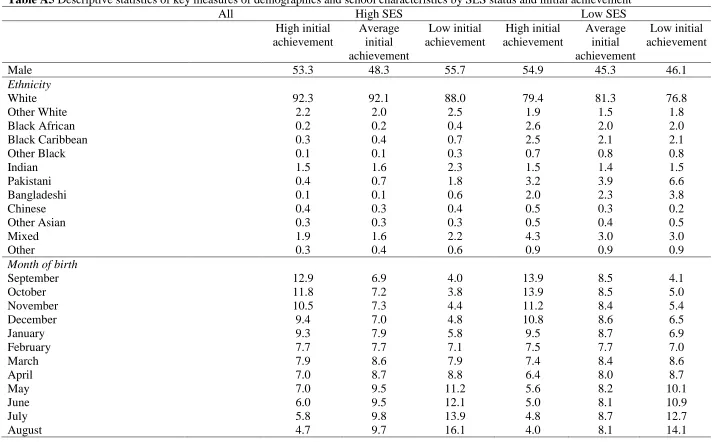
groupings (see Appendix Table A5).
Panel C of Figure 3 illustrates the educational trajectories between Key Stage 1 and
Key Stage 4 after controlling for differences in these individual-level characteristics and
differences between schools (using school fixed effects). This specification removes any
differences that are driven by children sorting into different schools, and essentially compares
the achievement levels of children from each of our six groups who attend the same schools.
We might expect this to make more of a difference to our results, as there are clear differences
across both SES and initial achievement groups in terms of the types of schools they attend.
For example, Appendix Table A5 shows that high achieving affluent children attend the best
performing secondary schools with the lowest proportion of children eligible for free school
meals, while low achieving deprived children attend the worst performing schools with the
highest proportion of children eligible for free school meals.
Panel C of Figure 3 shows that, within initial achievement group, the extent of the
divergence in performance between children from higher and lower socio-economic
backgrounds seen in Panels A and B is somewhat less once we allow for the school attended.
This indicates that some of the reason for the observed divergence is driven by the sorting of
pupils of similar initial achievement but different socio-economic backgrounds into different
schools. This pattern is particularly strong amongst the low initial achievement group, in
entirely coincide once we compare pupils who attend the same school.15 Moreover, this
appears to be driven by improved test score performance amongst low achieving children
from poor backgrounds.
While there is a narrowing of the gap within initial achievement groups by SES, there
is little change between initial achievement groups when school differences are accounted for.
In other words, attending different schools explains why poor children fall further behind their
richer counterparts but does not really explain differences between high and low achieving
pupils generally.
Although we are cautious about the interpretation of these results given that they do
not identify the causal effect of school variation on pupil achievement, they are nevertheless
indicative of a potentially important role for schools, teachers or peers influencing the
attainment of low achieving children from poor backgrounds to ensure that they do not fall
behind relative to their richer low achieving peers within the same school.
6. Conclusions
This paper has described the education trajectories of pupils from different
socio-economic backgrounds, focusing on how they differ between pupils of initially high, average
and low achievement, after accounting as far as possible for the possibility of regression to the
mean. We find clear evidence of a convergence of achievement during secondary school,
particularly from ages 11 to 14, between affluent children of lower initial achievement and
poorer children of higher initial achievement. This finding is robust to our attempts to
minimise the problem of regression to the mean.
15 Around 40% of schools in our data have at least one rich and one poor high-achieving pupil; 65% have at
A lot of policy attention has been focused on trying to improve the achievement of
poor children in England in recent years. Amongst pupils who attend the same secondary
school, initially low-achieving poor children seem to be keeping up with their richer initially
low-achieving peers, which may suggest that policies aimed at reducing the achievement gap
between rich and poor children – such as the provision of additional financial resources in the
form of the pupil premium – have been focused on those poor children with low initial
achievement (although more research is needed to understand how pupil premium resources
have been targeted within schools).
However, there is still evidence of some divergence in the performance of initially
average and high achieving children by socio-economic background even within schools,
which needs to be better understood. Work by the Education Endowment Foundation and
others has identified some policies which may help to reduce socio-economic gaps in
attainment across the distribution in secondary school – such as more one-to-one tuition and
summer schools – and outreach efforts by universities may also be successful at targeting
higher achieving children from poorer backgrounds.
The bigger issue highlighted by our research, however, is the fact that at least part of
the reason why poorer children fall behind their richer peers seems to be because they go to
different secondary schools. While our findings are not causal, they do seem to suggest that
policymakers interested in improving the educational progress of children from lower
socio-economic backgrounds need to adopt policies that ensure all pupils have access to good
schools and perhaps to consider the role of school choice and admissions policies in this.
We have identified early secondary as a key transition period. Given that Key Stage 3
tests have not been set or marked externally since 2009, there is currently no nationally
consistent way to identify those falling behind at this crucial time before entering into Key
secondary school may help both families and schools support students in making the
References
Allen, R. (2007). ‘Allocating pupils to their nearest secondary school: The consequences for
social and ability stratification’. Urban Studies Vol. 44 (4), pp. 751-770.
Allen, R., Burgess, S., and Key, T. (2010). ‘Choosing Secondary School by Moving House: School Quality and the Formation of Neighbourhoods.’ CMPO Working Paper No. 10/238.
Allen, R., and Vignoles, A (2007). ‘What should an index of school segregation measure?’ Oxford Review of Education Vol. 33 (5), pp. 643-668.
Atkinson A.B. (1980). ‘Inheritance and the redistribution of wealth’, in Public Policy and the
Tax System, (G.A. Hughes and G.M. Heal, eds.), Allen and Unwin: London.
Atkinson A.B., Jenkins, S.P. (1984). ‘The steady state assumption and the estimation of
distributional and related models’, Journal of Human Resources, Vol. 19,
pp.358-376.
Becker, G. and Tomes, N. (1986). ‘Human Capital and the Rise and Fall of Families’ The
Journal of Labor Economics Vol. 4(3).
Black, P. and Wiliam, D., (2006), ‘The reliability of assessments’. Assessment and Learning,
pp.119-131.
Blanden, J., Gregg, P. and Macmillan, L. (2007). ‘Accounting for Intergenerational Income
Persistence: Noncognitive Skills, Ability and Education’. Economic Journal, Vol.
117, pp. C43-C60.
Blanden, J., and Gregg, P. (2004). ‘Family income and educational attainment: a review of approaches and evidence for Britain’. Oxford Review of Economic Policy, Vol. 20(2), pp. 245-263.
Blanden, J. and Machin, S. (2007). ‘Recent Changes in Intergenerational Mobility in Britain’. Sutton Trust, London.
Blanden, J. and Machin, S. (2010). ‘Intergenerational Inequality in Early Years Assessments’. In Children of the 21st century: The first five years (eds K. Hansen, H. Joshi, and
S.Dex), pp. 153-168. Bristol: The Policy Press.
Blau, P.M. and Duncan, O.D. (1967). The American Occupational Structure. New York:
Wiley.
Breen, R. and Goldthorpe, J.. (2001). ‘Class, mobility and merit: The experience of two
British birth cohorts.’ European Sociological Review Vol.17(2), pp. 81-101.
Breen, R. and Jonsson, J.O. (2007). ‘Explaining change in social fluidity: educational
equalization and educational expansion in twentieth-century Sweden.’ American
Journal of Sociology Vol. 112(6), pp. 1775-1810.
Cabinet Office (2011). ‘Opening Doors, Breaking Barriers: A Strategy for Social Mobility’, HM Government, London.
Caro, D. (2009). ‘Socio-economic status and academic achievement trajectories from
childhood to adolescence’, Canadian Journal of Education, Vol. 32, pp. 558-590.
Chowdry, H., Crawford, C., Dearden, L., Goodman, A., and Vignoles, A. (2013). ‘Widening
of the Royal Statistical Society: Series A (Statistics in Society), Vol. 176, pp. 431– 457.
Clarke, P., Crawford, C., Steele, F., and Vignoles, A., (2010). ‘The choice between fixed and random effects models: some considerations for educational research’. CMPO working paper: University of Bristol.
Crawford, C. (2014). ‘The Link between Secondary School Characteristics and University Participation and Outcomes’. Report to the Department for Education.
Crawford, C., Macmillan, L. and Vignoles, A. (2015). ‘When and Why do Initially High
Attaining Poor Children Fall Behind?’ SPSS WP 20, CASE, London School of Economics
Cunha, F. Heckman, J. Lochner, L and Masterov, D. (2006). ‘Interpreting the Evidence on
Life Cycle Skill Formation’. In Handbook of the Economics of Education (eds E.
Hanushek and F. Welch), pp. 697-812. Amsterdam: Holland North.
Davis, C. (1976). ‘The Effect of Regression to the Mean in Epidemiologic and Clinical
Studies’, American Journal of Epidemiology, Vol. 104, pp. 493-498.
Duncan, G. and Magnuson, K. (2011). ‘The Nature and Impact of Early Achievement Skills,
Attention Skills and Behavior Problems’. In Whither Opportunity? Rising Inequality,
Schools, and Children’s Life Chances (eds G. Duncan and R. Murnane), pp. 47-69. New York: Russell Sage Foundation.
Ederer, F. (1972). ‘Serum Cholesterol: Effects of Diet and Regression Toward the Mean’, Journal of Chronic Disorders, Vol. 25, pp. 277-289.
Feinstein, L. (2003). ‘Inequality in the Early Cognitive Development of British Children in
the 1970 Cohort’, Economica, Vol. 70, pp. 73-97.
Feinstein, L. (2004). ‘Mobility in Pupils’ Cognitive Attainment During School Life’, Oxford
Review of Economic Policy, Vol. 20, pp. 213-229.
Galton, F. (1986). ‘Regression Towards Mediocrity in Hereditary Stature’, The Journal of the
Anthropological Institute of Great Britain and Ireland, Vol. 15, pp. 246–263.
Gibbons, S, and Machin, S. (2003). ‘Valuing English primary schools’. Journal of Urban
Economics, Vol. 53(2), pp. 197-219.
Goodman, A., & Gregg, P. (2010). ‘Poorer Children’s Educational Attainment: How
Important Are Attitudes and Behaviour?’ Report to the Joseph Rowntree Foundation.
Goodman, A., Gregg, P., & Washbrook, E. (2011). ‘Children’s educational attainment and the aspirations, attitudes and behaviours of parents and children through childhood.’
Longitudinal and Life Course Studies, Vol. 2(1), pp. 1-18.
Goodman A. Sibieta L. and Washbook E. (2009). ‘Inequalities in Educational Outcomes Among Children Aged 3 to 16’, Final report for the National Equality Panel, Institute for Fiscal Studies, London.
Jenkins, S P., Micklewright, J. and Schnepf. S.V. (2008). ‘Social segregation in secondary
schools: how does England compare with other countries?’ Oxford Review of
Education Vol. 34(1), pp. 21-37.
Jerrim, J., & Vignoles, A. (2013). ‘Social mobility, regression to the mean and the cognitive
development of high ability children from disadvantaged homes’. Journal of the
Marsh, H. and Hau, K. (2002). ‘Multilevel Modelling of Longitudinal Growth and Change:
Substantive Effects or Regression Toward the Mean Artefacts?’, Multivariate
Behavioral Research, Vol. 37, pp. 245-282.
Parsons, S. Schoon, I. Rush, R. and Law, J. (2011). ‘Long-term Outcomes for Children with
Early Language Problems: Beating the Odds’, Children and Society, Vol. 25, pp.
202 – 214.
Reardon, S. (2011). ‘The Widening Academic Achievement Gap Between the Rich and the
Poor: New Evidence and Possible Explanations’. In Whither Opportunity? Rising
Inequality, Schools, and Children’s Life Chances, (eds G. Duncan and R. Murnane), pp.91-116. New York: Russell Sage Foundation.
Schoon, I. (2006). Risk and Resilience: Adaptations in Changing Times, Cambridge:
Cambridge University Press.
Strand, S., (2006). ‘Comparing the predictive validity of reasoning tests and national end of
Key Stage 2 tests: which tests are the ‘best’?’. British Educational Research Journal,
Vol. 32(2), pp.209-225.
Strand, S., (1997). ‘Pupil progress during Key Stage 1: a value added analysis of school
effects’. British Educational Research Journal, Vol. 23(4), pp.471-487.
Strand, S., (2010). ‘Do some schools narrow the gap? Differential school effectiveness by
ethnicity, gender, poverty, and prior achievement’. School Effectiveness and School
Improvement, Vol. 21(3), pp.289-314.
Strand, S. (2014a). ‘Ethnicity, gender, social class and achievement gaps at age 16:
Intersectionality and ‘Getting it’ for the white working class’. Research Papers in Education, Vol. 29(2), pp.131-171.
Strand, S. (2014b). ‘School effects and ethnic, gender and socio-economic gaps in
educational achievement at age 11’. Oxford Review of Education, Vol. 40(2), pp. 223-245.
Strand, S., Deary, I.J. and Smith, P., (2006). ‘Sex differences in cognitive abilities test scores:
A UK national picture’. British Journal of Educational Psychology, Vol. 76(3), pp.
463-480.
Thomas, S., Sammons, P., Mortimore, P. and Smees, R., (1997a). ‘Stability and Consistency in Secondary Schools’ Effects on Students’ GCSE Outcomes over Three Years’. School effectiveness and school improvement, Vol. 8(2), pp.169-197.
Thomas, S., Sammons, P., Mortimore, P. and Smees, R., (1997b). ‘Differential secondary
school effectiveness: comparing the performance of different pupil groups’. British
Educational Research Journal, Vol. 23(4), pp.451-469.
Table 1 Descriptive statistics of final sample
Most deprived 16.5%
Least deprived 21.7%
Low initial achievement 21.4%
Average initial achievement 70.3%
High initial achievement 8.3%
Most deprived high initial achievement 2.2% (10,146)
Most deprived average initial achievement 12.1% (55,841)
Most deprived low initial achievement 2.2% (10,173)
Least deprived high initial achievement 6.7% (30,744)
Least deprived average initial achievement 14.1% (64,766)
Least deprived low initial achievement 0.9% (4,325)
Total N 460,653
Figure 1 Average percentile rankings at each stage of the educational trajectory by SES and the achievement gap between the most deprived and least deprived quintiles of SES
Notes: Assessments occur at each point in time with lines used to connect the points. Achievement is measured using standardised percentile rankings based on average reading and maths scores at Key Stage 1, average English and maths scores from Key Stage 2 to Key Stage 4, average scores across all subjects combined with predicted probabilities of attendance at Key Stage 5, and university rankings combined with predicted probabilities of attendance at university.
0 5 10 15 20 25 30 35 30 35 40 45 50 55 60 65 70
KS1 KS2 KS3 KS4 KS5 University
Gap in aver ag e p e rc e n til e b e tw e e n le ast an d m o st d e p ri ve d q u in til e s A ve rag e p e rc e n til e r an ki n g
Figure 2 Trajectories from Key Stage 1 to university by initial achievement (defined using Key Stage 1 maths) for the most deprived and least deprived quintiles of SES
Notes: Assessments occur at each point in time with lines used to connect the points. Achievement is measured using standardised percentile rankings based on reading scores at Key Stage 1, English scores at Key Stages 2 to 4, average scores across all subjects combined with predicted probabilities of attendance at Key Stage 5, and university rankings combined with predicted probabilities of attendance at university.
0 20 40 60 80 100
KS1 KS2 KS3 KS4 KS5 University
Most deprived high initial achievement Most deprived average initial achievement
Most deprived low initial achievement Least deprived high initial achievement
Figure 3 Trajectories from Key Stage 1 to Key Stage 4 by initial achievement (defined using Key Stage 1 maths) for the most deprived and least deprived SES quintiles, conditional on demographics and school fixed effects
Panel A: Unconditional
Panel B: Conditional on demographics 0
20 40 60 80 100
KS1 KS2 KS3 KS4
Most deprived high initial achievement Most deprived average initial achievement
Most deprived low initial achievement Least deprived high initial achievement
Least deprived average initial achievement Least deprived low initial achievement
0 20 40 60 80 100
KS1 KS2 KS3 KS4
Most deprived high initial achievement Most deprived average initial achievement
Most deprived low initial achievement Least deprived high initial achievement
Panel C: Conditional on demographics and school fixed effects
Notes: Assessments occur at each point in time with lines used to connect the points. Achievement is measured using standardised percentile rankings based on reading scores at Key Stage 1 and English scores at Key Stages 2 to 4. Demographic controls are gender, ethnicity and month of birth. School fixed effects are based on the secondary school in which students sit their Key Stage 4 tests.
0 20 40 60 80 100
KS1 KS2 KS3 KS4
Most deprived high initial achievement Most deprived average initial achievement
Most deprived low initial achievement Least deprived high initial achievement
Appendix
Table A1 Marginal effects from probit models predicting participation at Key Stage 5 and university based on prior achievement at Key Stage 4 Participation
at Key Stage 5
Participation at university
Key Stage 4 points score 0.012*** (0.0001) 0.003*** (0.0001)
Key Stage 4 English A*-C 0.245*** (0.002) 0.072*** (0.003)
Key Stage 4 maths A*-C 0.124*** (0.002) 0.054*** (0.003)
Number of A*s in EBacc subjects 0.130*** (0.004) 0.016*** (0.002)
Number of As in EBacc subjects 0.136*** (0.002) 0.023*** (0.001)
Number of Bs in EBacc subjects 0.099*** (0.001) 0.022*** (0.001)
Number of Cs in EBacc subjects 0.063*** (0.001) 0.011*** (0.001)
Participation at Key Stage 5 0.231*** (0.003)
Key Stage 5 point score 0.0003*** (0.000005)
Number of As at A-level 0.117*** (0.002)
Number of Bs at A-level 0.105*** (0.002)
Number of Cs at A-level 0.078*** (0.002)
Number of Ds at A-level 0.036*** (0.002)
Number of Es at A-level -0.012*** (0.002)
Pseudo R2 0.432 0.463
Table A2 Predicted percentile rankings at Key Stage 5 and University by participation status, initial achievement and socio-economic status
High SES Low SES
High initial achievement
Average initial achievement
Low initial achievement
High initial achievement
Average initial achievement
Low initial achievement
Participated at Key Stage 5 82.2 74.0 66.0 69.8 65.5 61.3
Did not participate at Key Stage 5 35.3 26.9 17.7 28.0 19.9 12.9
Participated at University 84.7 80.9 78.0 80.3 78.6 77.7
Table A3 Numbers underlying Figures 1 to 3
KS1 KS2 Cumulative
change KS1 to KS2
KS3 KS4 Cumulative
change KS2 to KS4
KS5 University
Figure 1
Most deprived (Q1) 42 39.3 36.2 35.3 35.5 36.7
Q2 45.5 44.2 42.9 42.1 42 42.6
Q3 49.7 49.5 49.6 49.4 49.3 49.3
Q4 53.1 54.6 55.7 55.9 55.7 55.2
Least deprived (Q5) 58.1 61.4 63.6 64.2 64.3 63.4
Gap (Q5-Q1) 16.1 22.1 27.4 28.9 28.8 26.7
Figure 2
Low SES, high initial achievement 69.2 63.0 -6.2 56.5 54.5 -8.5 51.1 51.9
Low SES, average initial achievement 42.3 37.8 -4.5 35.7 35.9 -1.9 35.3 36.5
Low SES, low initial achievement 15.8 16.1 0.3 18.1 20.4 4.3 21.1 22.8
High SES, high initial achievement 76.4 78.1 1.7 77.2 77.5 -0.6 77.3 75.2
High SES, average initial achievement 50.1 54.1 4.0 56.4 58.5 4.4 60.0 59.6
High SES, low initial achievement 20.1 22.6 2.5 28.7 32.9 10.3 35.3 37.1
Figure 3
Panel A: unconditional (see Figure 2) Panel B: conditional on demographics
Low SES, high initial achievement 69.2 63.8 57.5 54.3
Low SES, average initial achievement 42.3 38.8 36.3 35
Low SES, low initial achievement 15.8 18.7 19.6 20.3
High SES, high initial achievement 76.4 78.4 77.9 77.8
High SES, average initial achievement 50.1 55.1 57.5 58.8
High SES, low initial achievement 20.1 24.9 30.6 33.9
Panel C: demographics and school FE
Low SES, high initial achievement 69.2 68.1 63.6 61
Low SES, average initial achievement 42.3 43.9 42.6 41.9
Low SES, low initial achievement 15.8 23.4 24.7 25.8
High SES, high initial achievement 76.4 71.4 70.6 70.6
High SES, average initial achievement 50.1 51.1 52.8 53.9
Table A4 Regressions coefficients predicting outcomes at Key Stage 4 based on demographics and school fixed effects
Controlling for demographic characteristics
Controlling for demographic characteristics and school fixed effects
Male -9.521*** (0.082) -9.550*** (0.079)
White (omitted category) (omitted category)
Other White 6.365*** (0.310) 2.047*** (0.296)
Black African 2.894*** (0.427) 2.668*** (0.425)
Black Caribbean -5.903*** (0.373) -3.452*** (0.367)
Other Black -6.577*** (0.672) -3.573*** (0.629)
Indian 8.101*** (0.279) 6.954*** (0.293)
Pakistani -4.318*** (0.282) -0.530*** (0.310)
Bangladeshi -1.274*** (0.452) 3.706*** (0.489)
Chinese 14.681*** (0.772) 9.905*** (0.566)
Other Asian 9.437*** (0.603) 4.029*** (0.566)
Mixed 1.395*** (0.277) 1.138*** (0.259)
Other 4.102*** (0.549) 1.786*** (0.516)
Month of birth
September (omitted category) (omitted category)
October -0.599*** (0.196) -0.571*** (0.179)
November -0.949*** (0.199) -0.949*** (0.181)
December -2.170*** (0.200) -1.857*** (0.182)
January -2.337*** (0.198) -2.258*** (0.180)
February -2.780*** (0.202) -2.664*** (0.184)
March -2.967*** (0.198) -2.868*** (0.181)
April -3.240*** (0.200) -3.140*** (0.182)
May -3.555*** (0.197) -3.458*** (0.179)
June -4.262*** (0.198) -4.120*** (0.181)
July -4.708*** (0.196) -4.465*** (0.179)
August -5.330*** (0.198) -4.963*** (0.180)
School FEs Yes
Group N 3,767
Table A5 Descriptive statistics of key measures of demographics and school characteristics by SES status and initial achievement
All High SES Low SES
High initial achievement Average initial achievement Low initial achievement High initial achievement Average initial achievement Low initial achievement
Male 53.3 48.3 55.7 54.9 45.3 46.1
Ethnicity
White 92.3 92.1 88.0 79.4 81.3 76.8
Other White 2.2 2.0 2.5 1.9 1.5 1.8
Black African 0.2 0.2 0.4 2.6 2.0 2.0
Black Caribbean 0.3 0.4 0.7 2.5 2.1 2.1
Other Black 0.1 0.1 0.3 0.7 0.8 0.8
Indian 1.5 1.6 2.3 1.5 1.4 1.5
Pakistani 0.4 0.7 1.8 3.2 3.9 6.6
Bangladeshi 0.1 0.1 0.6 2.0 2.3 3.8
Chinese 0.4 0.3 0.4 0.5 0.3 0.2
Other Asian 0.3 0.3 0.3 0.5 0.4 0.5
Mixed 1.9 1.6 2.2 4.3 3.0 3.0
Other 0.3 0.4 0.6 0.9 0.9 0.9
Month of birth
September 12.9 6.9 4.0 13.9 8.5 4.1
October 11.8 7.2 3.8 13.9 8.5 5.0
November 10.5 7.3 4.4 11.2 8.4 5.4
December 9.4 7.0 4.8 10.8 8.6 6.5
January 9.3 7.9 5.8 9.5 8.7 6.9
February 7.7 7.7 7.1 7.5 7.7 7.0
March 7.9 8.6 7.9 7.4 8.4 8.6
April 7.0 8.7 8.8 6.4 8.0 8.7
May 7.0 9.5 11.2 5.6 8.2 10.1
June 6.0 9.5 12.1 5.0 8.1 10.9
July 5.8 9.8 13.9 4.8 8.7 12.7
School characteristics
School 5 A*-C at KS4 73.6 68.7 64.7 57.1 53.9 52.3
Figure A1 Trajectories from Key Stage 1 to university by initial achievement (defined using Key Stage 1 reading) for the most deprived and least deprived quintiles of SES
Notes: achievement is measured using standardised percentile rankings based on maths scores at Key Stages 1 to 4, average scores across all subjects combined with predicted probabilities of attendance at Key Stage 5, and university rankings combined with predicted probabilities of attendance at university.
0 20 40 60 80 100
KS1 KS2 KS3 KS4 KS5 University
Most deprived high initial achievement Most deprived average initial achievement
Most deprived low initial achievement Least deprived high initial achievement