Original citation:
Proto, Eugenio and Rustichinib, Aldo (2014) Cooperation and personality. Working Paper. Coventry, UK: Department of Economics, University of Warwick. Warwick economics research papers series (TWERPS), Volume 2014 (Number 1045). (Unpublished)
Permanent WRAP url:
http://wrap.warwick.ac.uk/60666
Copyright and reuse:
The Warwick Research Archive Portal (WRAP) makes this work of researchers of the University of Warwick available open access under the following conditions. Copyright © and all moral rights to the version of the paper presented here belong to the individual author(s) and/or other copyright owners. To the extent reasonable and practicable the material made available in WRAP has been checked for eligibility before being made available.
Copies of full items can be used for personal research or study, educational, or not-for-profit purposes without prior permission or charge. Provided that the authors, title and full bibliographic details are credited, a hyperlink and/or URL is given for the original metadata page and the content is not changed in any way.
A note on versions:
The version presented here is a working paper or pre-print that may be later published elsewhere. If a published version is known of, the above WRAP url will contain details on finding it.
Cooperation and Personality
Eugenio Proto and Aldo Rustichini
No 1045
WARWICK ECONOMIC RESEARCH PAPERS
Cooperation and Personality
Eugenio Proto
aAldo Rustichini
ba
Department of Economics, University of Warwick and CAGE
b
Department of Economics, University of Minnesota
April 22, 2014
Abstract: Cooperating behavior may be fostered by personality traits
reflecting either favorable inclination to others or willingness to comply with norms and rules. We test the relative importance of these two factors in an experiment where subjects provide real mental effort in two treatments with identical task, differing only by whether others’ payment is affected. If the first hypothesis is true, subjects reporting high Agreeableness score should put more effort; if the second is true, reporting higher Conscientiousness should predict more effort. We find experimental support for the second hypothesis but not for the first, as subjects reporting high Altruism do not behave consistently with this statement.
JEL classification: C90, D03, D82
Keywords: Personality Traits, Cooperation, Effort Provision
1
Introduction
Personality traits of individuals working together in economic organizations may significantly affect their performance, beyond what one can predict relying on measures of risk attitude, time preferences and effort cost. This insight has already made its way in the business practice. Personality tests are now a frequent practice in the process of applicant selection in many large firms: recently the BBC News Magazine reported1 that that 89 of the Fortune 100 companies use some test to assess the personality of the job applicants. In general, analysis of personality may provide us with a reliable characterization of systematic elements in the behavior of an individual. Several studies suggest what the genetic and neural basis of the traits are likely to be.2
Economic analysis has only recently started to address the question on how measure of personality affect individuals performances, especially in organized groups. Here we test experimentally whether cooperating and trusting behav-ior can be successfully explained by personality reflecting generally empathic attitude, helpful and unselfish orientations to others, or rather by personality traits revealing willingness to comply with norms and rules. We find strong support for the second hypothesis.
In our data, personality trait revealing a more favorable inclination to oth-ers is Agreeableness, defined as: “The degree to which a person needs pleasant and harmonious relations with others” (Costa and McCrae, 1992); and it is measured by explicitly asking to report cooperation (question 42), trust (22), helpful and kind attitude to others (7, 12, 27, 32, 37).3
The other trait likely to explain cooperative behavior is Conscientiousness, defined as: “The degree to which a person is willing to comply with conventional
1http://www.bbc.co.uk/news/magazine-18723950
2See deYoung and Gray 2010 for a comprehensive description of this literature.
3We report the statements that enter into the Agreeableness score. Subjects had to
rules, norms, and standards (Costa and McCrae, 1992). The trait can be measured by survey questions asking subjects to report reliability and care in work (3, 8, 13, 18, 23, 33) and consistency in carrying out plans (38, 43).4 Here
we use the big five personality traits to test the effect of altruistic preferences,5
and respect of norms on the cooperative behavior.
Since our interest is in understanding the working of real life social institu-tion, we insist that decisions on cooperation and trust should involve an effort cost (mental effort in our design), rather than monetary transfer. There are two reasons for this emphasis on effort provision as opposed to monetary trans-fer. The first is ecological validity. In all organizations, the cost of productive work is most commonly effort rather than monetary transfers. The second is degree of monitoring and the incentives to “fake” a trait (see e.g. Borghans et al., 2008 for an helpful discussion); monetary transfers are usually perfectly observable, but effort provision is not because its effect on observable outcome is confounded by skill and chance. This different degree of monitoring affects incentives. If a person claims to be unselfish, she is bound, in order to be credible to others as well as to herself, to make monetary transfers consistent with this claim. If instead the test of her claim is effort provision, which is not well monitored, checking the consistency with such claims is hard, thus she is not bound by the claims. As a corollary of this reasoning, it seems natural to conjecture that whereas monetary transfers might be strongly correlated with claims of being unselfish and caring, effort provision will not. This is what we find in our data.
Our method relies on the comparison between the performance in a control treatment where effort of an individual affects his own payment and only his own, and the performance in a treatment (called cooperative) where effort of an individual affects the payment of a different, randomly chosen, anonymous
4Here are the statements entering into the Conscientiousness score: 3. Does a thorough
job. 8. Can be somewhat careless (R). 13. Is a reliable worker. 18. Tends to be disorganized (R). 23. Tends to be lazy (R). 33. Does things efficiently. 38. Makes plans and follows through with them. 43. Is easily distracted (R).
subject. The tasks in the two treatments are identical, so the two treatments differ in the way in which final payoffs are computed, not the way in which effort is provided or effort translates into performance. In the control treatment each subject performs two series of ten additions and a third series where she adds the two previously obtained series of numbers. The subject is paid proportionally to the number of correct answers to the last series, so the three series of additions are perfectly complementary to obtain the right numbers. In this treatment the final payment depends only on the effort of the subject. In the cooperative treatment each subject is part of a team of two randomly and anonymously matched individuals, and exchanges the second series of addition with the partner. Hence in the cooperative treatment, the final outcome of each teammate is dependent on the effort of both. The interaction is one-shot and simultaneous.
As they complete the first addition, subjects have to anticipate the quality of the input that others will provide them; so their effort will be higher if they trust others to provide adequate effort, or to be of appropriate skill. Instead, when they do the second addition, they might consider that their output will influence the payment to others; so their effort will be higher if they care about the outcome of others (according to the hypothesis that a personality revealing other-regarding preferences drives their behavior) or if they feel that works need to be carried out properly independently from the personal reward, because intrinsically motivated by the fact that a “correct” behavior should be followed.
The measure of Agreeableness is not a good predictor of the performance in the cooperative treatment, as compared with the individual treatment. Thus the first hypothesis that cooperation is driven by self-reported social prefer-ences finds little support. To further investigate the reason for the absence of an effect of Agreeableness we analyzed the impact of two aspects (or facets) of this trait that should in theory be relevant for our experiment. The facet
partners perform correctly the second. While trust is a correct predictor of the first addition in the cooperative treatment,6 altruism has no effect. In
other words, subjects declaring a stronger willingness to help others do not behave consistently when they need to help other subjects is achieving their goals in our experiment.
On the contrary, subjects who report higher Conscientiousness are better in both trusting and helping the partner to achieve better results in the coopera-tive treatment; this also holds when we compare the outcome with that in the individual treatment, where Conscientiousness is not a performances’ predic-tor. This finding provides support for our second hypothesis that cooperation is explained by intrinsic motivation and reliability.
Neuroticism is associated with higher sensitivity to negative rewards, thus higher responsiveness to the negative side of incentives.7 Important
consider-ations may be fear of failing or not achieving a result, and a negative response of others to the failure to produce good output in a cooperative effort. These factors may induce individuals with higher Neuroticism score to higher effort in the cooperative treatment. Accordingly, in our experiment subjects with higher Neuroticism score are more effective in helping the partner to achieve better results. The direction of the effect is particulary interesting. It is nega-tive when individuals have a full incennega-tive to provide optimal effort, but seems to turn positive when this effort is devoted to help the other.
To the best of our knowledge, in this paper we perform the first laboratory experiment on the economic effect of personality in strategic situations where the final outcome is based on real effort rather than monetary cost. Hirsh and Peterson (2009) and Pothos et al. (2010) link personality traits to strategic behavior in experiments but use the classic prisoner dilemma game. Anderson et al (2011) analyze the effect of traits on the trust game using a large sample
6This result lends further support to the literature using the self-reported level of general
trust to build an index of the level of social capital (e.g. La Porta et al., 1997; Knack and Keefer, 1997; Algan and Cahuc, 2010)
7For convenience we report the statements entering into the Neuroticism score: 4. Is
of truck driver trainees. Becker et al. (2012) analyze the effect of the per-sonality traits on the trust game, in the dictator game, and in the punishing behavior in a modified prisoner dilemma game. Filiz-Ozbay et al. (2013) focus on the gift exchange game. We will discuss how their findings are related to ours in the discussion session. As in our paper, the design of Fr´echette’s et al. (2013) is not based on a classic laboratory game. They frame their labo-ratory experiment as a relationship between an investor and an intermediary and show how the big five personality traits influence decision under risk when information is not readily available to the investors. In their paper personality affects the way individuals collect and transmit information not ready avail-able, so, personality affects outcome when the tasks are performed jointly by two individuals, an investor and the intermediary.
Testing whether common measures of Agreeableness or Conscientiousness, or both, influence behavior in tasks where actions affect outcomes of others may throw light on the broader debate on cooperation. Several strands in the literature explore the effects of monetary and non monetary incentives on behavior, in decision and strategic environments. The first strand focuses on intrinsic motivation to work, defined as the motivation to exercise effort driven by the enjoyment of the activity, rather than material rewards (e.g. Gneezy and Rustichini 2000; Benabou and Tirole, 2003). A second strand focuses on social norms, where behavior is explained by consistency of beliefs of members of society (e.g. Konow, 2000; Bicchieri, 2006; Lindbeck and Nyberg, 2006).
self-interest and, more related to the current paper, Stoop et al. (2013) argue that in an experiment with real effort, subjects prefer to maximize private outcomes instead of cooperating for a social optimal outcome.
Empirical studies of the links between personality and economic perfor-mances show significant predictive power of some traits, which offer indirect support for our findings. Barrick and Mount (1991) present a meta-analysis showing how Conscientiousness is a good predictor in all job performances. Almlund et al., (2011) study the correlations of the Big Five and IQ with job performance, and show that of the Big Five, Conscientiousness is the most as-sociated with job performance (is about half as predictive as IQ). This finding, generally confirmed by a number of other studies, is consistent with our result that conscientiousness is an important trait for cooperation, if we consider the pervasiveness of cooperation in almost all kinds of jobs.
The literature in experimental psychology dealing with team work and personality has focused on the qualitative nature of the roles within the team; analyzing how traits influence the allocation of task roles and social roles and emphasizing how Conscientiousness is important for the first and Agree-ableness for the second, hence in promoting social cohesion (Blumberg 2001, Stewart et al. 2005). Other studies have analysed the impact of personality on team settings (e.g. LePine et al., 1997; Barrick et al., 1998; Mount et al., 1998; Barry and Stewart, 1999; Neuman and Wright, 1999). These studies are not in contrast with ours and, although interesting and relevant for the economist, do not usually focus on the variables usually considered in economic models. In addition, studies in psychology usually do not provide appropriate incentives to participants. Nevertheless, our result that personality has a such differ-ent impact on cooperative rather than individual effort for otherwise iddiffer-entical tasks and the inconsistent behaviour of subject declaring high altruism are, to the best of knowledge, new and possibly relevant with respect to psychology literature as well.
them-selves and others. More recently several studies have demonstrated a biological underpinning of the personality traits. For example, using analysis based on the difference between DZ and MZ twins, Rieman et al. (1997) show that, for all five factors, genetic effects were the strongest source of the phenotypic vari-ance on the personality traits measured via self-report, accounting of about 50 percent of the variance. Other studies (see Loehlin’s, 1992, meta analy-sis) based on the difference between twins reared apart and reared together show that shared sibling environment effects contributed little to phenotypic variance. The link of personality with neural structures is analyzed in a large literature on the neuroscience of personality. Empathy is linked to brain sys-tems that are involved in social information processing (see Seitz, Nickel and Azari, 2006 for a meta-analysis based on 80 studies). Serotonin and Glucose production is associated with Conscientiousness and self-discipline in particu-lar (e.g. Gailliot and Baumeister, 2007), prefrontal cortex seems likely to be involved as well (e.g. Brown et al., 2006). Neuroticism is linked to higher sensitivity to negative emotions like anger, hostility or depression (e.g. Clark and Watson, 2008), is associated with structural features of the brain systems associated with sensitivity to threat and punishment (DeYoung and Gray, 2010) and with low levels of serotonin in turns associated with aggression, poor impulse control, depression, and anxiety (Spoont 1992).
2
Experimental Design
The design has two treatments, called control and cooperative. Subjects per-formed exactly the same tasks in both treatments, but the final outcome in the control treatment only depended on the individual effort of each subject, while the final outcome in the cooperative treatment was determined by a combina-tion of the effort of two subjects, randomly and anonymously matched.
Treatments and Tasks
In the control treatment subjects solved a simple arithmetic problem of adding three series of ten two-digit numbers in the following way (a more formal timeline of the experiment is presented in appendix 4):
1. Perform 10 additions, indexed by i= 1, . . . ,10, of 5 two-digits numbers randomly chosen by the computer, in 4 minutes. Let Si1 be the answers provided.
2. Perform 10 more additions, also indexed by i= 1, . . . ,10, of 5 two-digits numbers randomly chosen by the computer, in 4 minutes. LetS2
i be the
answers provided.
3. Add the 10 numbers obtained in step 1 above and the 10 numbers ob-tained in step 2 above, producing for each i an answer S3
i in 2 minutes.
In the cooperative treatment subjects performed the same sequence of ad-ditions, but jointly with an anonymous subject, as follows:
1. Perform 10 additions, indexed by i= 1, . . . ,10, of 5 two-digits numbers randomly chosen by the computer, in 4 minutes. Let S1
i be the answers
provided.
2. Perform 10 more additions, also indexed by i= 1, . . . ,10, of 5 two-digits numbers randomly chosen by the computer, in 4 minutes. LetS2
i be the
3. The output of these 10 additions, S2
i, i = 1, . . . ,10 is transferred to a
randomly matched and anonymous partner, and the 10 numbers output produced by this partner is transferred in turn to the subject. We denote byS∗2
i the values of the sum that the partner makes.
4. Add the 10 numbers obtained in step 1 above, S1
i, and the 10 numbers
obtained from the randomly matched partner, S∗2
i , and producing an
outputSi3 in 2 minutes.
Let Cik denotes the correct final amount from each of the three series of ad-ditions specified above, with k = 1,2,3, for each addition i. In both cases, the payment rule was 15 British Pounds Sterling (GBP), approximately 26 US Dollars (USD), minus 1 in the event of an incorrect final sum: to be precise, the subject lost one pound (and only one pound) for eachisuch thatS3
i 6=Ci3.
In all steps a clock on the screen was displaying the time elapsed. In the cooperative treatment we reminded subjects at the beginning of the second step that the 10 additions they were about to make would then be used by another subject. We chose this exercise of summing in a fairly generous amount of time because we believe it is a rather elementary tasks for our pool of subjects, where it is less likely that the skill per se matters and it is mostly how much attention each subjects pay to the task (we will further discuss in section 3 the implication of this feature of the experiment).
A set of instructions in hard copy (available in the supplementary material) was distributed at the beginning and subjects were quizzed with 3 questions of progressive difficulty to check their comprehension. All subjects’ answers were checked and the task individually re-explained if subjects made any mistake. Instructions were also reported on a white board.
The Raven test is a nonverbal test commonly used to measure reasoning ability and general intelligence. In each test item, the tables show patterns presented in the form of a 3×3 matrix, the subject is asked to identify the missing element that completes a pattern. The Raven APM is appropriate for adults and adolescents of higher average intelligence. The 15 tables presented in order of progressive difficulty were selected from set II. Finally, a standard Big Five personality questionnaire and other questions were presented to the subjects who could answer with no time constraint. In particular we use the Big Five Inventory (BFI) based on 44 question with answer coded on a Likert scale. This version was developed by John, Donahue and Kentle (1991) and recently investigated by John, Naumann and Soto (2008).8 The BFI is
particularly suitable for our purpose because specifically designed for a sample of college and university students.
Implementation
We conducted 8 sessions for each treatment. In total 270 subjects (140 in the control, 130 in the cooperative treatment) participated, all recruited from the subject pool of the Warwick experimental laboratory. We used the DRAW (“Decision Research at Warwick”) system, based on the ORSEE recruitment software (the recruitment letter circulated is in the supplementary material).
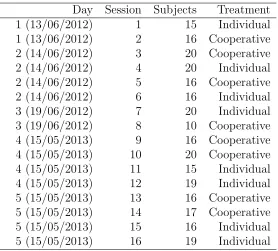
Each session lasted 45 minutes. Subjects earned an average of about 11 GBP (approximately 18 USD), the participation payment was 4 GBP. The breakdown and the dates of the different sessions are presented in table 8.9
The software used for the entire experiment is z-tree (Fishbacher, 2007). In the appendix we present a more detailed description of the time-line of the experiment. In the supplementary material we present the instructions and the quiz on the instructions administered to subjects. The Ethical Approval
8The questions can be downloaded from Oliver P John’s website called the Berkeley
Personality Labhttp://www.ocf.berkeley.edu/~johnlab/bfi.htm.
9In session 14 there was an odd number of subjects. This session was part of the
of this design has been granted from Humanities and Social Sciences Research Ethics Sub-Co at University of Warwick under DRAW Umbrella Approval (Ref: 03/12-13).
3
Results
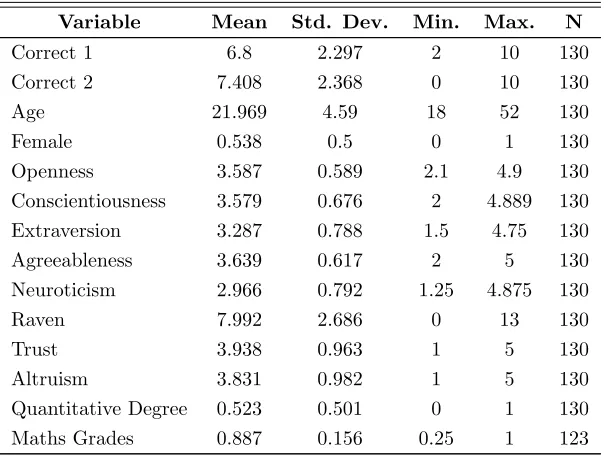
The descriptive statistics of the main variables are presented in tables 1 and 2. Correct 1 is the number of correct answers in the first sumS1, and Correct 2 is the number of correct answers in the second sum S2.10
It is important to note that Correct 2 is not significantly different in the two treatments (with p−value = 0.53), while Correct 1 is slightly smaller by about 0.4 in the cooperative treatment (with p−value = 0.06). This result, perhaps of independent interest in experimental tests of mechanisms, shows that one treatment is not particularly more efficient than the other in produc-ing higher Correct 1 and Correct 2 and it is arguably a good characteristic of our design because it increases the symmetry of the two treatments. We are not considering the final answers S3, since this is heavily dependent on the performances on S1 and S2. The reason we introduced the last task of
summing S1 and S2 was to stress the idea that the final task was a joint
con-tribution of the two subjects teamed together in the cooperative treatment. Personality traits are measured on a scale between 1 and 5; Ravenis the score in the Raven APM.
Samples in the two treatments were homogeneous: there is no statisti-cally significant (at the 5 percent level or even above this threshold) difference between variables in the control and in the cooperative treatment if we con-sider gender, age, personality traits, mathematics grades (the final high school grade, in mathematics normalized between 0 and 1) quantitative (the nature of the university degree subjects are undertaking coded as Yes= 1 and Not= 0 )
10In the control treatment there is one moreCorrect 1observation thanCorrect 2. This
and non european (coded as 1 if the citizenship of the subjects is non european, 0 otherwise).
Table 3 presents the correlations between the individual characteristics: personality traits, Raven and gender. Both the sign and the size of the cor-relations are the ones expected, with Neuroticism negatively correlated to the other traits.
Model
In order to assess the effect of the traits on the individual performances in the two treatments, we estimate the model:
Correctj =βOO+βCC+βEE+βAA+βNN +βRR+ (1)
β0+βFF + ΓDay+e, j = 1,2.
where O, C, E, A, N, R are the measures of Openness, Conscientiousness, Ex-traversion, Agreeableness, Neuroticism, Raven, respectively. F is equal to 1 if the subject is female, Day is the days’ dummies vector, representing the day the subject i participated to the experiment. Note thatCorrect 1, in the cooperative treatment is a clear measure of the subject to trust the anonymous partner, because the output of this task is fully complementary for the final result to the output produced by the partner.11 Given that the task requires
little skill but mostly attentional effort, we argue that the trust is respect to attention and effort of the partner, not respect to his or her mathematical skills. Whereas Correct 2 in the cooperative treatment is a clear measure of the willingness of the subject to assist the anonymous partner, because the output of this task is only used by the partner.
To help with the interpretation of the results, variables measuring person-ality traits and Raven score have been rescaled to assume a value between 0
11In the discussion session, and in table 7 in particular, we will present some specific
to 1, using for each variable the transformation:
xi =
ˆ
xi−xˆmin
ˆ
xmax−xˆmin
(2)
where ˆx represent the original value and ˆxmax and ˆxmin are the maximum and
minimum value of the variables.
From the estimation of model 1, we will be able to assess the effect of the traits, the fluid intelligence (as measured by the Raven test) and the gender on individual performances in the cooperative and individual settings. In order to provide a formal test of the differences of the effect of the above characteristics in the two treatments we estimate another model, where we add to the equation estimated in 1, the interacted term:
Coop∗(βO0 O+βC0 C+βE0 E+βA0 A+βN0 N +βF0 F +βR0 R) +Coop∗β00
Where, Coopis 1 if the treatment is cooperative,β00 represents the general treatment effect, βx0 represents the differential effect of the characteristics x
between the cooperative and individual treatments. A significant βx0 implies that there is a statistically significant difference between the two treatments in the effect of characteristic x. Note that a positive (negative) coefficient of the interacted terms, βx0 that we will define as differential effect between individual and cooperative treatment, will imply that x increases (decreases) the performance more in the cooperative treatment than in the individual, or baseline, treatment.
Model estimation
Conscientiousness
From table 4 we note that both Correct 1 and Correct 2 are increasing in Conscientiousness in the cooperative treatment, while Conscientiousness has a negative, but not significant effect in the baseline treatment. The overall ef-fect of Conscientiousness is 2.5 additions, a quarter of the entire task for both
Correct 1andCorrect 2. From column 2 of table 5 we note that Conscientious-ness has statistically significant positive differential effect in the cooperative treatment for Correct 1. A positive differential effect seems to exist also for
Correct 2, as we note from column 4, although this last is non significant. In figure 1, we plot the regression lines of Conscientiousness in both treat-ments over Correct 1, we can observe this relation as well. We then make the following:12
Observation 3.1. More conscientious subjects have a stronger performance in
a cooperative treatment, especially in trusting the partner; and they seem not to have significantly larger performance in the control treatment (with individual
payment).
Agreeableness
From table 4, we note that the effect of agreeableness is non significant in both treatments, nor it is significantly different in the two treatments as table 5 shows. Then, we can argue that:
Observation 3.2. More Agreeable subjects do not have higher performance in
the cooperative treatment, nor agreeableness is a predictor of performances in
the control treatment.
Neuroticism
Neuroticism has a negative impact in the control treatment as we note from the coefficient of Neuroticism in columns 1 and 3 of table 4; its effect on the
12In Figure 3 and 4 in the appendix we report for completeness the comparison between
cooperative treatment seems positive, although it is not statisically significant as we observe from columns 2 and 4.
Consistently with results from table 4, Neuroticism has a positive differ-ential effect in the cooperative treatment as we note from columns 2 and 4 of table 5. Furthermore, considering the fourth column, from the magnitude of the coefficients we conclude that an individual with high Neuroticism score performs about 1.7 additions more in the cooperative than in the control treat-ment (i.e. −3.5 + 5.1) in the second series of additions; which seems to suggest that neurotic subjects seem to perform better in the cooperative treatment than in the individual treatment.
Figure 2 illustrates the relation of performance in the second addition in the two treatments and Neuroticism. The two regression lines show that less neurotic individuals perform significantly better in the control treatment, while more neurotic individuals perform better in the cooperative treatment. Fur-thermore, the relation is clearly negative in the control and it seems positive in the cooperative treatment. Therefore we make the following:
Observation 3.3. Subjects with higher Neuroticism score have a weaker
per-formance in the control treatment (with individual payment), but not in the
cooperative treatment, where they seem to have, if anything, a stronger
perfor-mance, especially in the task of helping the partner.
Gender Effects
From table 4 we note that female perform worse than male in the individual treatments, but there is virtually no difference in the cooperative treatment. Consistently with this result, from table 5 we note that there is a positive, al-though weakly significant, differential effect between the treatments inCorrect 1. We then make the following
Observation 3.4. Female subjects perform like male subjects in the
coopera-tive treatment but worse than male subjects in the individual treatment.
and Vesterlund, 2007 and Kuhn and Villeval, 2013, for a more recent contri-bution).
Opennes, IQ and Extraversion
Openness is weakly negatively associated with performances in cooperation at the same time it does not have an effect in the baseline treatment, as we note from table 4. Furthermore, from table 5, we observe that Openness seems to have a negative differential effect in Correct 1 in cooperation. The Raven score is a positive predictor of performances in both Correct 1 and Correct 2
(table 4). It seems stronger for the control treatment, although table 5 reject the hypothesis of a significant differential effect. We will briefly discuss these results in the next section.
Extraversion seems to be a negative predictor of performances in the in-dividual treatment, but not in the cooperative treatment (table 4). However, table 5 rejects the hypothesis of a statistically significant difference.
Finally note that in Figure 3 and 4 in the appendix we report for complete-ness the comparison between control and cooperative treatment for all the Big Five factors and for the Raven score.
Cooperative treatment
Finally as we have already argued at the beginning of this section, from columns 1 and 3 of table 5 we observe that when we do not consider the traits interacted by the dummy treatment, the dummy indicating the coop-erative treatment are small or non significant. However, when we introduce the interacted terms– measuring the differential effect of the traits in the two treatments– performance in the first and in the second addition is substantially lower in the cooperative treatment than in the control by 3.5 correct answers, as economic analysis of the task suggests.13 Hence, comparing columns 1 and
2 and columns 3 and 4 respectively, we can argue that
13This is natural: when computing the first addition subjects anticipate that the quality
Observation 3.5. There is little differences in average performances when
individuals act singularly or in cooperation. But, once the effect of personality,
gender and intelligence are taken into account, these differences become very
large.
The model estimated above implicitly assumes substitutability between skills – like diligence or ability to avoid distraction or notice errors– and effort. A possible objection to this argument is that effort is complementary rather than substitute of those skills; this would explain why subjects reporting more agreeableness do not perform better in the cooperative treatment and espe-cially in correct 2: their higher motivation deriving from the willingness of helping the partner may result in higher effort, but this is not enough in itself to guarantee better performances.
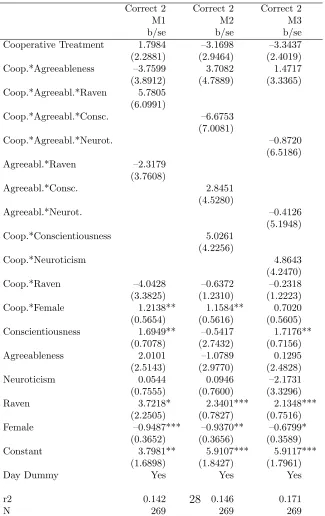
To test the validity of this explanation, we introduce in the model an in-teractions between Agreeableness and Conscientiousness, Agreeableness and Raven, and Agreeableness and Neuroticism. If Agreeableness is complemen-tary to the other traits to improve performances then when interacted with these traits this should improve performances, and the interaction should re-sult significant if subjects reporting high agreeableness were really willing to help the partners. In table 6, we report the estimation of the model with the three new interactions: Agreeableness and Raven in column 1, Agreeableness and Conscientiousness in column 2, Agreeableness and Neuroticism in column 3. None of the interactions are in fact significant, hence more Agreeable sub-jects even when they are also more skilled in performing for the task in our experiment do not seem to be more helpful for the partners.14
4
Discussion
In our experimental design two identical tasks were performed under different payment conditions. In one treatment the payment depended only on the effort
14For expositional simplicity we excluded the traits which are not directly involved and
and skill provided by the individual who would then receive the payment. In the other, the final payment was dependent on effort and skill of the individual and of another, randomly matched participant: in this case subjects knew that during the execution of a part of the task, they would not directly benefit of the outcome of their effort, benefit which would instead go to another participant in the session. It may be useful to regard our design as a new, modified version of the classical Trust Game: Both players have to decide how much they trust the other, simultaneously and symmetrically, when they make the first sum, because that effort will provide a return only if the other player cooperates when her time comes to do the second sum. In the second move, when they have to do the sum that the other will use, they do it before they know how much effort the other contributed. In summary, our game can be considered as simultaneous moves trust game, where the reciprocating move is done before the player knows how much the other contributed, and effort cost is real, non monetary. Thus our design gives a condition (the control) that can be used in the comparison of performance when the effort directly benefits (in terms of the payment) the individual who provides it as compared to the environment where someone else enjoys those monetary benefits. In our experiment, willingness and inclination to cooperate is tested by voluntary provision of mentally costly effort that is improving the outcome of others.
The role of Agreeableness, Trust and Altruism
Possibly the most surprising and instructive conclusion of our study is that the personality trait of a specifically social nature, Agreeableness, is not associated with a significant difference in effort provision in the two treatments. Given the questions in the survey, it is natural and plausible to identify a high score in our measure of Agreeableness with a more generous and benevolent
stated attitude to others. The evidence of actions shows convincingly that these statements are not necessarily followed by facts, particularly when the cost associated with altruistic behavior is real effort rather than a monetary transfer.
this table we introduced the variables Trust corresponding to the answer (on a scale from 1 to 5) to the question: I am someone who is generally trusting
and Altruism corresponding to the answer (also on a scale from 1 to 5) to the question: I am someone who is helpful and unselfish with others. Both questions contribute to the agreeableness score in our measurements. In par-ticular, we introduced the two variables, together with their interaction with the cooperative treatment dummy. We note that (see column 1) the sign of the interaction with trust is positive and significant for the first series of addi-tions,Correct 1. This is true also when we add our set of controls in column 3 (the coefficient is almost unchanged, although it becomes borderline significant with a p−value = 0.055). It is also important to note that interaction with trust is insignificant when regressed against Correct 2. These results confirm our interpretation of Correct 1 as an index of trust on other people and also suggest how this specific aspect of agreeableness is important for cooperation. Instead, interaction with Altruism is negative and non significant, and this is remarkable especially in the regression with Correct 2 that, we argued, is a measure of how much people are willing to help others. This suggest that that the statement of altruism is not necessarily followed by facts, when the cost associated with altruistic behavior is real effort.
men-tioned games and in our real effort experiment can be explained by the nature of the choice. Real effort is subject to a lower level of monitoring than the transfer of the symbolic wealth during the experiment, hence individuals who define themselves altruistic or socially oriented would feel less comfortable in passing a smaller amount of money than putting a lower level of effort for helping the partners. This interpretation finds support in Stoop et al. (2012), who show that subjects contribute less to social outcomes when they perform a real task than when they transfer experiment money.
The Effect of Conscientiousness and Neuroticism
If, instead of the verbal statements on personal inclination to help oth-ers, one relies on the provision of costly effort in the control and cooperative treatment as reliable evidence, then cooperative and trustful behavior is better predicted by two other traits: Conscientiousness and Neuroticism. The effect of Conscientiousness is particularly interesting. The effect on Correct 2 can be explained by intrinsic motivation, conscientious individuals like to do “a thorough job” independently from the monetary reward.
such individuals are unfit in subordinating individual creativity in the context of a collaborative work process, especially like the one subjects perform in our experiment (Stewart et al.,2005).
Table 1: Control Treatment, Main Variables
Variable Mean Std. Dev. Min. Max. N
Correct 1 7.243 2.26 1 10 140
Correct 2 7.583 2.242 1 10 139
Age 21.3 3.003 18 34 140
Female 0.514 0.502 0 1 140
Openness 3.573 0.589 1.9 5 140
Conscientiousness 3.452 0.626 1.667 4.889 140
Extraversion 3.333 0.704 1.625 4.875 140
Agreableness 3.71 0.559 2.111 5 140
Neuroticism 2.967 0.673 1.375 4.75 140
Raven 8.443 2.696 0 13 140
Trust 4.093 0.758 2 5 140
Altruism 3.957 0.847 1 5 140
Quantitative Degree 0.536 0.501 0 1 140
Maths Grades 0.881 0.146 0.5 1 132
Non European 0.307 0.463 0 1 140
Table 2: Cooperative Treatment, Main Variables
Variable Mean Std. Dev. Min. Max. N
Correct 1 6.8 2.297 2 10 130
Correct 2 7.408 2.368 0 10 130
Age 21.969 4.59 18 52 130
Female 0.538 0.5 0 1 130
Openness 3.587 0.589 2.1 4.9 130
Conscientiousness 3.579 0.676 2 4.889 130
Extraversion 3.287 0.788 1.5 4.75 130
Agreeableness 3.639 0.617 2 5 130
Neuroticism 2.966 0.792 1.25 4.875 130
Raven 7.992 2.686 0 13 130
Trust 3.938 0.963 1 5 130
Altruism 3.831 0.982 1 5 130
Quantitative Degree 0.523 0.501 0 1 130
[image:25.612.156.460.454.682.2]... table 2 continued
Variable Mean Std. Dev. Min. Max. N
Table 4: Analysis of the performances in the cooperative and indi-vidual treatments Correct 1 are the correct additions used by the subject performing them in both the individual and the cooperative treatment. Correct 2are the correct additions passed to the respective partners in the cooperative treatment. The variables representing personality traits and Raven have been rescaled to take a value between 0 and 1. OLS estimator. Robust Standard Errors in Brackets. ∗ p−value <0.1,∗∗ p−value <0.05, ∗∗∗ p−value <0.01
Correct 1 Correct 1 Correct 2 Correct 2
Individual Cooperative Individual Cooperative
Conscientiousness –0.6685 2.4018** 0.7552 2.5022**
(0.9396) (0.9483) (0.8567) (1.0157)
Agreeableness –0.3259 0.2419 0.1901 0.6456
(0.9604) (0.9812) (1.0431) (0.8859)
Neuroticism –2.2111** 0.7598 –3.0790*** 1.7509
(1.0466) (1.0949) (0.9841) (1.1308)
Extraversion –1.8612** 0.1382 –1.2449 –0.1008
(0.8360) (0.9002) (0.8460) (0.9927)
Openness 0.6460 –1.9571* –0.2136 –1.9179
(1.0451) (1.1492) (1.0067) (1.3872)
Raven 2.0717*** 1.2085 1.8569** 1.6243
(0.7611) (0.9531) (0.7621) (0.9801)
Female –1.0257*** 0.0294 –0.6615* 0.0304
(0.3487) (0.4096) (0.3536) (0.4161)
Constant 8.1001*** 4.5837*** 7.7627*** 3.9067**
(1.4526) (1.5441) (1.4007) (1.7848)
Day Dummy Yes Yes Yes Yes
r2 0.250 0.179 0.227 0.191
Table 5: Differences in the performances between the two treatments
Correct 1 are the correct additions used by the subject performing them in both the individual and the cooperative treatment. Correct 2 are the correct additions passed to the respective partners in the cooperative treatment. The variables representing personality traits and Raven have been rescaled to take a value between 0 and 1. OLS estimator. Robust Standard Errors in Brackets.
∗ p−value <0.1, ∗∗ p−value <0.05, ∗∗∗ p−value <0.01
Correct 1 Correct 1 Correct 2 Correct 2
Cooperative Treatment –0.4857* –3.1315 –0.2324 –3.3711
(0.2699) (1.9583) (0.2777) (2.0947)
Coop.*Conscientiousness 3.0395** 1.7250
(1.3344) (1.2870)
Coop.*Agreeableness 0.5516 0.4498
(1.3696) (1.3447)
Coop.*Neuroticism 2.6264* 4.6111***
(1.5236) (1.5056)
Coop.*Extraversion 1.9708 1.2693
(1.2186) (1.3221)
Coop.*Openness –2.8547* –1.8558
(1.5758) (1.7291)
Coop.*Raven –1.1087 –0.4292
(1.2099) (1.2800)
Coop.*Female 1.0265* 0.5926
(0.5448) (0.5552)
Conscientiousness 1.0593 –0.7079 1.8109*** 0.7850
(0.6658) (0.9456) (0.6879) (0.8785)
Agreeableness 0.2724 –0.3594 0.5811 0.1176
(0.7144) (0.9572) (0.6776) (1.0076)
Neuroticism –0.1384 –1.9025* –0.0806 –2.8677***
(0.7745) (1.0619) (0.7631) (0.9718)
Extraversion –0.5850 –1.7780** –0.5496 –1.3116
(0.6302) (0.8481) (0.6467) (0.8614)
Openness –0.8371 0.8082 –1.2965 –0.0573
(0.7857) (1.0722) (0.8550) (1.0189)
Raven 1.8931*** 2.3042*** 1.9006*** 2.0144***
(0.6018) (0.7513) (0.5946) (0.7661)
Female –0.5440* –1.0137*** –0.3548 –0.6169*
(0.2763) (0.3515) (0.2655) (0.3549)
Constant 5.9512*** 7.7868*** 5.6253*** 7.4285***
(1.0771) (1.3824) (1.1395) (1.3164)
Day Dummy Yes Yes Yes Yes
r2 0.133 0.199 0.138 0.193
Table 6: Differences in the performances between the two treatments,
assuming that Agreeableness is complementary to other traits The
variables representing personality traits and Raven have been rescaled to take a value between 0 and 1 have been rescaled to take a value between 0 and 1. OLS estimator. Robust Standard Errors in Brackets. ∗ p−value < 0.1, ∗∗
p−value <0.05, ∗∗∗ p−value <0.01
Correct 2 Correct 2 Correct 2
M1 M2 M3
b/se b/se b/se
Cooperative Treatment 1.7984 –3.1698 –3.3437
(2.2881) (2.9464) (2.4019)
Coop.*Agreeableness –3.7599 3.7082 1.4717
(3.8912) (4.7889) (3.3365)
Coop.*Agreeabl.*Raven 5.7805 (6.0991) Coop.*Agreeabl.*Consc. –6.6753 (7.0081) Coop.*Agreeabl.*Neurot. –0.8720 (6.5186) Agreeabl.*Raven –2.3179 (3.7608) Agreeabl.*Consc. 2.8451 (4.5280) Agreeabl.*Neurot. –0.4126 (5.1948) Coop.*Conscientiousness 5.0261 (4.2256) Coop.*Neuroticism 4.8643 (4.2470)
Coop.*Raven –4.0428 –0.6372 –0.2318
(3.3825) (1.2310) (1.2223)
Coop.*Female 1.2138** 1.1584** 0.7020
(0.5654) (0.5616) (0.5605)
Conscientiousness 1.6949** –0.5417 1.7176**
(0.7078) (2.7432) (0.7156)
Agreeableness 2.0101 –1.0789 0.1295
(2.5143) (2.9770) (2.4828)
Neuroticism 0.0544 0.0946 –2.1731
(0.7555) (0.7600) (3.3296)
Raven 3.7218* 2.3401*** 2.1348***
(2.2505) (0.7827) (0.7516)
Female –0.9487*** –0.9370** –0.6799*
(0.3652) (0.3656) (0.3589)
Constant 3.7981** 5.9107*** 5.9117***
(1.6898) (1.8427) (1.7961)
Table 7: Differences in the performances between the two treatments
and the facets of Agreeableness Correct 1 are the correct additions used
by the subject performing them in both the individual and the cooperative treatment. Correct 2are the correct additions passed to the respective partners in the cooperative treatment. The variables representing Altruism, Trust, and Raven have been rescaled to take a value between 0 and 1. OLS estimator. Robust Standard Errors in Brackets. ∗ p−value < 0.1, ∗∗ p−value < 0.05,
∗∗∗ p−value <0.01
Correct 1 Correct 2 Correct 1 Correct 2
Cooperative Treatment –2.0831* –0.0526 –2.3914* –0.5246
(1.1187) (1.2520) (1.2296) (1.4127)
Coop.*Altruism –0.6924 –1.3151 –0.2053 –0.8499
(1.2713) (1.3643) (1.2195) (1.2829)
Coop.*Trust 2.8739** 1.1416 2.7081* 0.9016
(1.4152) (1.4015) (1.4035) (1.4028)
Coop.*Raven –1.0172 –0.5398
(1.2006) (1.2460)
Coop.*Female 1.3915** 1.2969**
(0.5373) (0.5671)
Altrusim –0.0703 0.1256 –0.0554 0.1796
(0.9851) (1.0997) (0.9113) (0.9811)
Trust –0.4365 0.6829 –0.6410 0.5017
(1.0541) (1.1256) (1.0564) (1.1274)
Raven 2.4993*** 2.1422***
(0.7307) (0.7964)
Female –1.2043*** –0.9357**
(0.3603) (0.3675)
Constant 7.6324*** 6.9617*** 6.4213*** 5.6572***
(0.8605) (1.0430) (0.9348) (1.0963)
Day Dummy No No Yes Yes
r2 0.036 0.018 0.165 0.123
Figure 1: Correct sums in the 1st series of additions and
Figure 2: Correct sums in the 2nd series of additions and
References
[1] Algan, Y., P. Cahuc. 2010. “Inherited Trust and Growth”,American Eco-nomic Review, 100: 20602092
[2] Almlund, M., Duckworth, A., Heckman, J.J. and Kautz, T. 2011. “Per-sonality Psychology and Economics”. IZA Discussion Paper No. 5500
[3] Anderson, J., Burks, S., DeYoung, C. and Rustichini, A. 2012. “Toward the Integration of Personality Theory and Decision Theory in the Expla-nation of Economic Behavior”. IZA Discussion Paper No. 6750
[4] Andreoni, J., and J. Miller. 2002. “Giving According to GARP: An Exper-imental Test of the Consistency of Preferences for Altruism.Econometrica
70 (March): 73753
[5] Barry B, Stewart GL. (1997). “Composition, process, and performance in self-managed groups: The role of personality”. Journal of Applied Psy-chology, 82, 62–78.
[6] Barrick, M. R.; Mount, M.K. 1991. “The Big Five Personality Dimensions and Job Performance: A Meta-Analysis”, Personnel Psychology; Spring 1991; 44, 1
[7] Barrick MR, Stewart GL, Neubert M, Mount MK. 1998. “Relating mem-ber ability and personality to work team processes and team effective-ness”. Journal of Applied Psychology, 83, 377–391.
[8] Benabou, R., Tirole, J. 2003. “Intrinsic and extrinsic motivation”.Review of Economic Studies 70, 489-520.
[10] Bicchieri, C. 2006. The Grammar of Society: The Nature and Dynamics of Social Norms. Cambridge: Cambridge University Press.
[11] Blumberg H.H. 2001. “The common ground of natural language and social interaction in personality description”. Journal of Research in Personal-ity, 35, 289–312.
[12] Bolton, Gary E., and Axel Ockenfels. 2000. “ERC: a Theory of Eq-uity, Reciprocity, and Competition.”American Economic Review, 90 (1): 16693.
[13] Borghans, L., A. L. Duckworth, J. J. Heckman and B. ter Weel, 2008.“The Economics and Psychology of Personality Traits”.Journal of Human Re-sources, University of Wisconsin Press, vol. 43(4).
[14] Brown, S. M., Manuck, S. B., Flory, J. D. and Hariri, A. R. 2006. “Neural basis of individual differences in impulsivity: Contributions of corticolim-bic circuits for behavioral arousal and control”. Emotion, 6, 239245.
[15] Camerer, C. F., and K. Weigelt. 1988. “Experimental Tests of a Sequential Equilibrium Reputation Model.” Econometrica 56 (January): 136.
[16] Charness, G., and M. Rabin. 2002. “Understanding Social Preferences with Simple Tests. Quarterly Journal of Economics. 117 (3): 81769.
[17] Clark, L.A., and Watson, D. 2008. “Temperament: An organizing paradigm for trait psychology”. In O.P. John, R.W. Robins, and L.A. Pervin (Eds.), Handbook of personality: Theory and research (pp. 265– 286). New York: Guilford Press.
[18] Costa, P.T. and McCrae, R.R. 1992. “Revised NEO Personality Inven-tory (NEO-PI-R) and NEO Five-Factor InvenInven-tory (NEO-FFI) manual”. Odessa, FL: Psychological Assessment Resources.
Corr and G. Matthews (Eds.), The Cambridge Handbook of Personality Psychology, New York: Cambridge University Press.
[20] Fehr Ernst, and Klaus M. Schmidt. 1999. “A Theory of Fairness, Competi-tion, and Cooperation.”Quarterly Journal of Economics, 114(3): 817-68.
[21] Filiz-Ozbay, E., J. C. Ham, J. H. Kagel, Ozbay, E. 2013. “The Role of Cognitive Ability, Personality Traits and Gender in Gift Exchange Out-comes.” http://econweb.umd.edu/~ozbay/FHKO.pdf
[22] Fischbacher, U. 2007. “z-Tree: Zurich Toolbox for Ready-made Economic Experiments”. Experimental Economics, 10(2): 171–178.
[23] Fr´echette, G. R., Schotter, A. and Trevino, I. 2013 “Personality, Informa-tion AcquisiInforma-tion and Choice under Uncertainty: An Experimental Study”.
https://files.nyu.edu/gf35/public/print/Frechette_2013b.pdf
[24] Gailliot, M. T., Baumeister, R. F. 2007. “The physiology of willpower: Linking blood glucose to self-control”. Personality and Social Psychology Review, 11, 303-327.
[25] Gneezy, U., M. Niederle, A. Rustichini (2003) “Performance in Competi-tive Environments: Gender Differences”,Quarterly Journal of Economics, 143, August 2003, 1049 1074.
[26] Gneezy, U., Rustichini, A. 2000. “Pay enough or don’t pay at all”, Quar-terly Journal of Economics 115, 791-810.
[27] Greiner B. 2004. “An online recruitment system for economic experi-ments”. Forschung und wissenschaftliches Rechnen 63: 79-93.
[29] John, O.P., Naumann, L.P., and Soto, C.J. 2008. “Paradigm shift to the integrative Big Five trait taxonomy: History: measurement, and concep-tual issue”. In O.P. John, R.W. Robins, and L.A. Pervin (Eds),Handbook of personality: Theory and research, 114–158, New York, Guilford Press.
[30] John, O. P., Donahue, E. M., and Kentle, R. L. 1991. “The Big Five Inventory–Versions 4a and 54”. Berkeley, CA: University of California, Berkeley, Institute of Personality and Social Research.
[31] Knack, S. and P. Keefer. 1997. “?Does Social Capital Have an Economic Payoff, A Cross-Country Comparison”,?Quarterly Journal of Economics, 112: 1251-1288.
[32] Konow, J. 2000. “Fair shares: Accountability and cognitive dissonance in allocation decisions”. American Economic Review, 90(4): 1072-91.
[33] Kuhn, P. and Villeval, M.C. 2013. “Are Women More Attracted to Co-operation Than Men?”, NBER Working Paper No. 19277.
[34] La Porta, R., F. Lopez-de-Silanes, A. Shleifer and R. Vishny. 1997. “?Trust in Large Organizations” ?American Economic Review, 87(1997), 333-38.
[35] LePine JA, Hollenbeck JR, Ilgen DR, Hedlund J. 1997. “Effects of in-dividual differences on the performance of hierarchical decision-making teams: Much more than g”. Journal of Applied Psychology, 82, 803–811.
[36] Lindbeck, A. and N. Sten. 2006. “Raising Children to Work Hard: Al-truism, Work Norms, and Social Insurance”. The Quarterly Journal of Economics, 121 (4).
[37] List, J. A. 2006. The Behavioralist Meets the Market: Measuring Social Preferences and Reputation Effects in Actual Transactions. Journal of Political Economy 114 (1): 137.
[39] Mount M.K., Barrick M.R., Stewart G.L. (1998). “Personality predictors of performance in jobs involving interaction with others”.Human Perfor-mance, 11, 145–166.
[40] Neuman G.A., Wright J. 1999. “Team effectiveness: Beyond skill and cognitive ability”. Journal of Applied Psychology, 84, 376–389.
[41] Niederle, M., and Vesterlund, L. 2007. “Do Women Shy away from Com-petition? Do Men Compete too Much?,”Quarterly Journal of Economics, August 2007, Vol. 122, No. 3: 1067-1101.
[42] Pothos Emmanuel M., Gavin Perry, Philip J. Corr, Mervin R. Matthew, Jerome R. Busemeyer. 2011. “Understanding cooperation in the Prisoners Dilemma game”,Personality and Individual Differences, 51, (3), 210–215
[43] Ross, L., Greene, D., and House, P. 1977. “The ’false consensus effect’: an egocentric bias in social Perception and Attribution Processes.” Journal of Experimental Social Psychology 13, 279-301.
[44] Reimann, R., Angleitner, A., and Strelau, J. 1997. “Genetic and environ-mental influences on personality: A study of twins reared together using the self- and peer report NEO-FFI scales”. Journal of Personality, 65, 449–476.
[45] Rustichini, A. 2009. “Neuroeconomics: what have we found, and what should we search for”. Current Opinion in Neurobiology. 19, 672–677.
[46] Seitz, R. J., Nickel, J., and Azari, N. P. 2006. “Functional modularity of the medial prefrontal cortex: Involvement in human empathy” Neuropsy-chology, 20, 743751.
[47] Spoont, M. R. 1992. “Modulatory role of serotonin in neural informa-tion processing: Implicainforma-tions for human psychopathology”. Psychological Bulletin, 112, 330–350.
[49] Stewart, G.L., Fulmer, I.S. and Barrick, M.R. 2005. “An exploration of member roles as a multilevel linking mechanism for individual traits and team outcomes”. Personnel Psychology, 58(2), 343–365.
Appendix
Timeline of the Experiment
1. At the beginning participants were assigned a Project ID card, with a number corresponding to a computer station and a paper in hard copy with the illustration of the task they were going to perform. They were asked questions at the end to check for comprehension.
2. An illustration of the task was presented on a white board.
3. Participants are seated in the laboratory at individual, private computer terminals, corresponding to their Project ID cards.
4. Participants read and answer the questions in the instruction paper dis-tributed to them to check their comprehension of the exercise.
5. In sessions 1, 4, 6, 7 participants face the control exercise. In sessions 2 of day 1 and 1 and 3 of day 2 they face the treatment exercise.
6. In the control treatment participants had to add three series of 10 two-digit numbers in the following way:
(a) Perform 10 additions, indexed by i = 1, . . . ,10, of 5 two-digits numbers in 4 minutes, let S1
i be the answers provided.
(b) Perform 10 more additions, also indexed by i= 1, . . . ,10, of 5 two-digits numbers in 4 minutes, let S2
i be the answers provided.
(c) Add the 10 numbers obtained in step 1 above and the 10 numbers obtained in step 2 above, producing for each i an answer Si3 in 2 minutes.
In the cooperative treatment subjects performed the same sequence of additions, but jointly with an anonymous subject, as follows:
(a) Perform 10 additions, indexed by i = 1, . . . ,10, of 5 two-digits numbers in 4 minutes, let S1
(b) Perform 10 more additions, also indexed by i= 1, . . . ,10, of 5 two-digits numbers in 4 minutes, let S2
i be the answers provided.
(c) The output of these 10 additions, Si2, i = 1, . . . ,10 is transferred to a randomly marched and anonymous partner, and the 10 num-bers output produced by this partner is transferred in turn to the subject. We denote byS∗2
i the values of the sum that the partner
makes.
(d) Add the 10 numbers obtained in step 1 above,Si1, and the 10 num-bers obtained from the randomly matched partner, Si∗2, and pro-ducing an outputS3
i in 2 minutes.
Let the Ck
i denotes the correct final amount from the three additions
k = 1,2,3 for each i. In both cases, the payment rule was 15 British Pounds Sterling (GBP), approximately 26 US Dollars (USD), minus 1 in the event of an incorrect final sum: to be precise, the subject lost one pound (and only one pound) for each i such that Si3 6=Ci3.
7. Raven test, 15 tables for 30 seconds each table. Each correct answer was paid 0.20 GBP.
8. The questionnaire is presented and filled.
9. Subjects were paid.
We report in the Supplementary Information the entire test for:
1. Instructions and Quiz questions for the control/individual treatment
2. Instructions Quiz questions for the cooperative treatment
3. General questions in the final Questionnaire
4. Personality Traits Questions and Scoring Instructions
Dates of Sessions
Table 8: Dates.
Figures
Figure 3: Correct sums in the1st series of additions, Personality traits
Figure 4: Correct sums in the 2nd series of additions, Personality