Available on arXiv and internet at https://arxiv.org/abs/1707.02566 ht tp s: // ar xi v. or g/ ab s/ 17 07 .0 25 66
CONTINUUM GATING CURRENT MODELS COMPUTED WITH CONSISTENT INTERACTIONS Tzyy-Leng Horng1 , Robert S. Eisenberg2, Chun Liu3, Francisco Bezanilla4
1Department of Applied Mathematics, Feng Chia University, Taichung, Taiwan 40724
2Department of Molecular Biophysics and Physiology, Rush University, Chicago, Illinois 60612, United
States
3Department of Mathematics, Pennsylvania State University, University Park, Pennsylvania 16802,
United States
4Department of Biochemistry and Molecular Biology, University of Chicago, Chicago, Illinois 60637,
United States
Abstract
arginines, and appears as a spike in the beginning of gating currentthat have been already observed as the early transient gating current in experiments. Our results agree qualitatively well with experiments, and can obviously be improved by adding more details of the structure and its correlated movements. The proposed
continuum model is a promising tool to explore the dynamics and mechanism of the voltage sensor that
avoids the sampling constraints that so limit the representation of biological concentrations (10-7- 5×10⁻¹ M) and currents (time scale > 10-4 sec) in molecular dynamics simulations that compute atomic motion on the 10 -15 sec time scale.
Keywords: ion channel; voltage sensor; gating current; arginine; S4; PNP-steric model
1. Introduction
Much of biology depends on the voltage across cell membranes. The voltage across the membrane
must be sensed before it can be used by proteins. Permanent charges1 move in the strong electric fields
within membranes, so carriers of gating and sensing charge were proposed as voltage sensors even before membrane proteins were known to span lipid membranes [18-19, 21-23]. Movement of
permanent charges of the voltage sensor is gating current and movement is the voltage sensing
mechanism. Measurements of gating current were made much easier by biological preparations with artificially increased densities of voltage sensors and blocked conduction pores.
Knowledge of membrane protein structure has allowed us to identify and look at the atoms that make up the voltage sensor. Protein structures do not include the membrane potentials and macroscopic concentrations that power gating currents, and therefore simulations are needed. Atomic level
simulations like molecular dynamics do not provide an easy extension from the atomic time scale 2×10
-16 sec to the biological time scale of gating currents that starts at 50×10-6 sec and reaches 50×10-3 sec. Calculations of gating currents from simulations must average the trajectories (lasting 50×10-3 sec sampled every 2×10-16 sec) of ~106 atoms all of which interact through the electric field to conserve charge and current, while conserving mass. It is difficult to enforce continuity of current flow in simulations of atomic dynamics because simulations compute only local behavior while continuity of current is global, involving current flow far from the atoms that control the local behavior. It is impossible to enforce continuity of current flow in calculations that assume equilibrium (zero flow) under all conditions. Periodic boundary conditions are widely used in simulations. Such conditions take a box of material and replicate it identically, so the potential at the corresponding edges of the box are identical. If the potentials are identical, current will not flow. Periodic boundary conditions of this sort are incompatible with current flow from one boundary to the other. Voltage clamp experiments, and natural biological function involve current flow from one boundary to another.
A hybrid approach is needed, starting with the essential knowledge of structure, but computing
1 Permanent charge is our name for a charge or charge density independent of the local electric field, for example, the charge and charge distribution of Na+ but
not the charge in a highly polarizable anion like Br or the nonuniform charge distribution of H2O in the liquid state with its complex time dependent (and
only those parts of the structure used by biology to sense voltage. In close packed (‘condensed’) systems like the voltage sensor, or ionic solutions, ‘everything interacts with everything else’ because electric fields are long ranged as well as exceedingly strong [14]. In ionic solutions, ion channels, even in enzyme active sites, steric interactions that prevent the overfilling of space in well-defined protein structures are also of great importance as they produce long range correlations [17]. Closely packed charged systems are best handled mathematically by energy variational methods. Energy variational methods guarantee that all variables satisfy all equations (and boundary conditions) at all times and under all conditions and are thus always consistent. We have used the energy variational approach developed in [12, 20] to derive a consistent model of gating charge movement, based on the basic features of the structure of crystallized channels and voltage sensors. The schematic of the model is shown below. The continuum model we use simulates the mechanical dynamics in a single voltage sensor, while the experimental data from [7] is from many independent voltage sensors. Ensemble averages of independent voltage sensors recording is roughly equivalent to macroscopic continuum modeling in a single voltage sensor. It is unlikely one can do better until experiments determine the structural source of the variance in the voltage sensor and its time, voltage, and chemical dependence on ion type and concentration.
3. Mathematical model
The reduced mechanical model for a voltage sensor is shown in Fig. 1 with four arginines Ri, i=1, 2, 3, 4, each attached to S4 helix by identical spring with spring constant K. The electric field will drag these four arginines since each arginine carries +1 charge. In addition, the charged arginines move the group
itself. S4 connect to S3 and S5 at its two ends by identical springs with spring constant KS4/2. Once the
membrane is depolarized from say 90mV inside negative, to +10mV inside positive, arginines together
with S4 will be driven towards extracellular side. When the membrane is repolarized from say +10mV
volts to 90mV, the arginines move to the intracellular side. This movement is the basic voltage sensing
mechanism of ion channel. The movement of S4 triggers the opening or closing of the lower gate mainly consisting of S6 of the permeant ion channel by a mechanism widely assumed to be mechanical, although we hasten to say that electrical aspects of the linker motion are likely to be involved, as well, perhaps acting as a deterministic trigger and control for the otherwise stochastic sudden discontinuous change of current seen in single channel measurements of ion flow through the permeation channel.
When arginines are driven by electric field, they are forced to move through a hydrophobic plug, composed by several nonpolar amino acids from S1, S2 and S3 [25]. Arginines moving from vestibule, a hydrated lumen, on one side, though the hydrophobic plug, and entering into the vestibule on another side would involve dehydration when passing through the hydrophobic plug. Therefore, arginines will encounter a barrier in the potential of mean force, an energy barrier, mainly dominated by the solvation energy [42]. Note that Na+ and Cl (used here as the only solution ions, for simplicity) can only exist in
vestibules and are not allowed into the hydrophobic plug. The bottoms of the two vestibules on each side of the system act as impermeable walls for Na+ and Cl. When the voltage is turned on and off, these two
motion on the average, as temperature or diffusion. Such methods often include the correlations of the average electric field, e.g., Poisson-Nernst-Planck (PNP), but not those that differ from atom to atom, as a glance at the structure of any protein shows is important. Here we include a steric effect in the PNP model [20], and so deal with many of the atomic scale correlations ignored in classical PNP. We hasten to add that it is not at all clear how well molecular dynamics deals with correlations produced by the average electric field, particularly when they include nonequilibrium components that drive current flow. Classical molecular dynamics assumes equilibrium and uses periodic boundary conditions that have certain difficulties dealing with the current flow and nonperiodic electric fields found in real devices and channels, as we have previously mentioned. Continuum models can adequately describe the time behavior of a voltage sensor in action, in which the time span is on the order of several hundreds of milliseconds.
The four arginines Ri, i=1, 2, 3, 4, are described by their individual density distributions (concentrations) ci, i=1, 2, 3, 4, allowing the arginines to interact with Na+ and Cl in vestibules. The
density (concentration) distributions represent probability density functions as shown explicitly in the theory of stochastic processes, used to derive such equations in [29] using the general methods of [28]. This practice is used widely in quantum mechanics [3, 34]. The important issue here is how well the correlations are captured in the continuum model. Some are more likely to be faithfully captured in molecular dynamics simulations (e.g., more or less local hard sphere interactions), others in continuum models (e.g., correlations induced by far field boundary conditions).
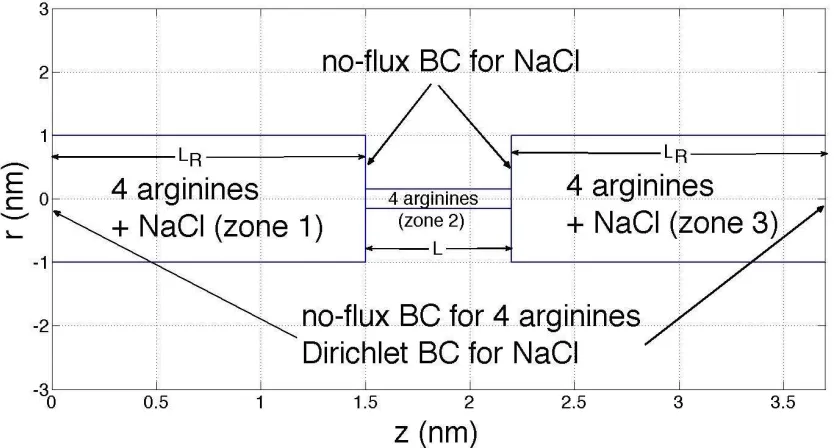
Here we treat the S4 itself as a rigid body so we can capture the basic mechanism of a voltage sensor without considering the full details of structure, which might lead to a three dimensional model hard to compute in the time available. We construct an axisymmetric 1D model with a three-zone geometric configuration illustrated in Fig. 2 following Fig. 1. Zone 1 with 𝑧 ∈ [0, 𝐿 ] is the intracellular vestibule;
zone 2 with 𝑧 ∈ [𝐿 , 𝐿 + 𝐿] is the hydrophobic plug; zone 3 with 𝑧 ∈ [𝐿 + 𝐿, 2𝐿 + 𝐿] is the
extracellular vestibule. Arginines, Na+, and Cl can all reside in zone 1 and 3. Zone 2 only allows the
residence of arginines, albeit with a severe hydrophobic penalty because of their permanent charge, in a region of low dielectric coefficient hence called hydrophobic. Spatial variation of dielectric coefficient allows construction of many useful devices [15, 41]. Types of boundary conditions and relevant sizes of this geometric configuration are also specified in Fig. 2. Note the no-flux boundary conditions specified in Fig. 2. One prevents Na+ and Cl from entering the hydrophobic plug (zone 2) with low dielectric
coefficient. The other boundary condition constrains S4 motion and so prevents the arginines from leaving the vestibules into intracellular/extracellular domains.
We first non-dimensionalize all physical quantities as follows,
𝑐̃ = , 𝜙 =
/ , 𝑈 = , 𝑠̃ = , 𝑡̃ = / , 𝐷 = , 𝑔 = / , 𝐽 = / , 𝐼 = ,
where 𝑐 is concentration of species i, with i=Na+, Cl, 1, 2, 3, and 4. Each is scaled by 𝑐 which is the
bulk concentration of NaCl at the intracellular/extracellular domains. Here 𝑐 is set to be 184mM, equal
on both sides, so that the Debye length 𝜆 = is 1nm when the relative permittivity 𝜀 = 80.
to uniqueness of each arginine. 𝜙 is the electric potential scaled by 𝑘 𝑇/𝑒 with 𝑘 being the
Boltzmann constant; 𝑇 the temperature; e the elementary charge. All relevant external potentials U are
scaled by 𝑘 𝑇. All sizes s are scaled by R, which is the radius of vestibule as shown in Fig. 2. R=1nm here.
The time t is scaled by 𝑅 /𝐷 , with 𝐷 being a diffusion coefficient that can be adjusted later to be
consistent with the time spans of on/off currents measured in experiments (caused by the movement of arginines). The diffusion coefficient of species i is scaled by 𝐷 . The coupling constant 𝑔 of PNP-steric
model based on combining rules of Lennard Jones, representing the strength of steric interaction between species i and j, is scaled by 𝑘 𝑇/𝑐 [20]. Note that here we only consider steric interaction among
arginines, which is the most significant since arginines are generally crowded in hydrophobic plug and
vestibules.For simplicity, we assume 𝑔 = 𝑔, ∀𝑖 ≠ 𝑗
0, ∀𝑖 = 𝑗 , 𝑖, 𝑗 = 1,2,3,4. The flux density of species i, 𝐽, is
scaled by 𝑐 𝐷 /𝑅, and therefore the electric current I is scaled by 𝑒𝑐 𝐷 𝑅. For simplicity of notation, we
will drop ~ for all dimensionless quantities from here on.
Based on Fig. 2, the governing 1D dimensionless PNP-steric equations are expressed below. The first one is Poisson equation:
− Γ𝐴 = ∑ 𝑧 𝑐 , 𝑖 = Na, Cl, 1, 2, 3, 4, (1)
with 𝑧 = 1, 𝑧 = −1, 𝑧 = 𝑧 = 1, 𝑖 = 1, 2, 3, 4, Γ = and A(z) being the cross-sectional area. For zones 1 and 3, Γ = 1 since here the arginines are fully hydrated with 𝜀 = 80. For zone 2, we assume a hydrophobic environment 𝑤𝑖𝑡ℎ 𝜀 = 8, and therefore Γ = 0.1. The second equation is the species transport equation based on conservation law: + (𝐴𝐽 ) = 0, 𝑖 = Na, Cl, 1 ,2 , 3, 4. (2)
with the content of Ji expressed below based on Nernst-Planck equation for Na+ and Cl-: 𝐽 = −𝐷 + 𝑐 𝑧 , 𝑖 = Na, Cl, 𝑧 ∈ zones 1 and 3, (3)
and based on Nernst-Planck equation with steric effect and some imposed potentials for 4 arginines ci, i=1, 2, 3 and 4, based on Fig. 2, 𝐽 = −𝐷 + 𝑧 𝐶 + 𝐶 + + 𝑔𝐶 + + , 𝑧 ∈ all zones, (4)
𝐽 = −𝐷 + 𝑧 𝐶 + 𝐶 + + 𝑔𝐶 + + , 𝑧 ∈ all zones, (5)
𝐽 = −𝐷 + 𝑧 𝐶 + 𝐶 + + 𝑔𝐶 + + , 𝑧 ∈ all zones, (6)
𝐽 = −𝐷 + 𝑧 𝐶 + 𝐶 + + 𝑔𝐶 + + , 𝑧 ∈ all zones. (7)
𝑉 (𝑧, 𝑡) = 𝐾(𝑧 − (𝑧 + 𝑍 (𝑡))) , (8)
where K is the spring constant, zi is the fixed anchoring position of the spring for each arginine cion S4,
𝑍 (𝑡) is the center-of-mass z position of S4 by treating S4 as a rigid body. Here we set z1=0.6, z2=0.2, z
3=-0.2, z4=-0.6 given from the structure that gives the arginine anchoring interval on S4 as 0.4nm. 𝑍 (𝑡)
follows the motion of equation based on spring-mass system:
𝑚 + 𝑏 + 𝐾 (𝑍 − 𝑍 , ) = ∑ 𝐾 𝑧, − (𝑧 + 𝑍 ) , (9)
where 𝑚 , 𝑏 and 𝐾 are mass, damping coefficient and restraining spring constant for S4. 𝑍 , is
the natural position of 𝑍 (𝑡) when the net force on the right hand side of Eq. (9) vanishes. Here, 𝑧,
is the center of mass forthe set of arginines ci , which can be calculated by
𝑧, =
∫ ( )
∫ ( ) , i=1, 2, 3, 4. (10)
We assume that the spring mass system for S4 is over-damped, which means the inertia term in Eq. (9) can be neglected.
Another external potential in the third term of Eqs. (4-7) is the energy barrier 𝑉, which is nonzero
only in zone 2 representing mainly the solvation energy barrier from hydrophobicity. Generally, the accurate shape of 𝑉 in zone 2 requires a calculation of potential mean force (PMF) using molecular dynamics simulations by the structure of protein and the possible change in the PMF with membrane potential, ionic conditions, consistent with the distribution of charge and boundary conditions, and so on. However, here we simply assume a hump shape for the PMF, while we await proper calibrated calculations
of the PMF and its dependence on membrane potential, etc.
𝑉, tanh 5(𝑧 − 𝐿 ) − 𝑡𝑎𝑛ℎ 5(𝑧 − 𝐿 − 𝐿 ) − 1 , 𝑧 ∈ zone 2,
0, 𝑧 ∈ zones 1 and 3. (11)
with 𝑉, set to be 5 in the current situation [42]. If we set 𝑉, too large, the gating current would
be very small since it would be very difficult for arginines to move across this barrier. Note that the tanh function is designated to smooth the otherwise top-hat-shape barrier profile, with its awkward infinite slopes not good for (numerical) differentiation. It is also generally believed that energy barrier in a protein structure does not have a jump. The last term in Eqs. (4-7) is the steric term that accounts for steric interaction among arginines [20]. Here we set g=0.5. Larger g implies larger steric effect, but g
cannot be arbitrarily large due to the limitation of stability.
Governing equations Eqs. (1-7) were derived by energy variational method based on the following energy (in dimensional form):
𝐸 = 𝑘 𝑇 𝑐 𝑙𝑜𝑔𝑐 −𝜀 𝜀
2 |∇𝜙| + 𝑧 𝑒𝑐 𝜙 + (𝑉 + 𝑉 ) 𝑐
+ 𝑔
2 𝑐 𝑐 ,
𝑑𝑉,
where the first term is entropy; second and third terms are electrostatic energy; fourth term is constraint and barrier potential for arginines; last term is the steric energy term based on Lennard-Jones potential [12, 20]. The Poisson equation Eq. (1) is derived by
and species flux densities in Eqs. (3-7) are derived by
𝜇 =𝛿𝐸
𝛿𝑐 , 𝐽 = − 𝐷
𝑘 𝑇𝑐 ∇𝜇 ,
where 𝜇 is the chemical potential of species i.
Also, here we assume quasi-steady state for Na+ and Cl-, which means = 0, 𝑖 = Na, Cl. This is
justified by the fact that the diffusion coefficients of Na+ and Cl in vestibules are much larger than the
diffusion coefficient of arginine based on the very narrow time span of the leading spike of gating current measured in experiments. The spike comes from the linear capacitive current of vestibule when the
command potential suddenly rises or drops. This quasi-steady state assumption is essential. Otherwise
using realistic diffusion coefficients for Na+ and Cl- would render Eqs. (1-7) too stiff to integrate in time. The spike contaminating the gating current can be removed by a simple technique called P/n leak subtraction in experiments (see Section 5.4). How to do this computationally will be discussed in section 5.3. Boundary and interface conditions for electric potential 𝜙 are
𝜙(0) = 𝑉, 𝜙(𝐿 ) = 𝜙(𝐿 ), Γ(𝐿 )𝐴(𝐿 )𝑑𝜙
𝑑𝑧(𝐿 ) = Γ(𝐿 )𝐴(𝐿 ) 𝑑𝜙
𝑑𝑧(𝐿 ),
𝜙(𝐿 + 𝐿 ) = 𝜙(𝐿 + 𝐿 ), Γ(𝐿 + 𝐿 )𝐴(𝐿 + 𝐿 ) (𝐿 + 𝐿 ) = Γ(𝐿 + 𝐿 )𝐴(𝐿 + 𝐿 ) (𝐿 +
𝐿 ), 𝜙(2𝐿 + 𝐿) = 0. (12)
These are Dirichlet boundary conditions at both ends and continuity of electric potential and displacement at the interfaces between zones. Boundary and interface conditions for arginine are
𝐽 (0, 𝑡) = 𝐽 (2𝐿 + 𝐿, 𝑡) = 0, 𝑐 (𝐿 , 𝑡) = 𝑐 (𝐿 , 𝑡), 𝐴(𝐿 )𝐽 (𝐿 , 𝑡) = 𝐴(𝐿 )𝐽 (𝐿 , 𝑡),
𝑐 (𝐿 + 𝐿 , 𝑡) = 𝑐 (𝐿 + 𝐿 , 𝑡), 𝐴(𝐿 + 𝐿 )𝐽 (𝐿 + 𝐿 , 𝑡) = 𝐴(𝐿 + 𝐿 )𝐽 (𝐿 + 𝐿 , 𝑡), 𝑖 = 1,2,3,4. (13)
No-flux boundary conditions are placed at both ends of the gating pore to prevent arginines and S4 from entering intracellular/extracellular domains. The others are continuity of concentration and flux at interfaces between zones. Boundary conditions for Na+ and Cl are
𝑐 (0, 𝑡) = 𝑐 (0, 𝑡) = 𝑐 (2𝐿 + 𝐿, 𝑡) = 𝑐 (2𝐿 + 𝐿, 𝑡) = 1,
𝐽 (𝐿 , 𝑡) = 𝐽 (𝐿 , 𝑡) = 𝐽 (𝐿 + 𝐿, 𝑡) = 𝐽 (𝐿 + 𝐿, 𝑡) = 0. (14)
Dirichlet boundary conditions are placed at both ends of the gating pore to describe the concentrations for Na+ and Cl are bulk concentration over there and no-flux boundary conditions at both ends of
hydrophobic plug to describe the impermeability of Na+ and Clinto hydrophobic plug.
Besides the main input parameter 𝑉, which is the voltage bias (command potential) applied, other
parameters like Di, i=1, 2, 3, 4, K, KS4, bS4 are also required. Results are especially sensitive to the values of
K, KS4, bS4. We have tried and found Di=50, i=1,2,3,4, K=3, KS4=3, bS4=1.5 fit best with experiment [7]. We compare computational outputs with important experiments: (1) gating current versus voltage curve (IV) and (2) gating charge versus voltage curve (QV) as well as (3) gating current vs. time curves.
Usually the electric current in the ion channel is treated simply as the flux of charge and is uniform
in z when steady. This is not so in the present non-steady dynamic situation, since storing and releasing
of charge in vestibules and the channel are involved. Here the flux of charge at the middle of hydrophobic
plug, z= LR+L/2, was computed to estimate the experimentally observed gating current. However, it is
a probe in the middle of the hydrophobic plug and optical methods to record these variables are so far unavailable. In experiments, the voltage clamp technique is used, and on/off gating current through the
membrane is measured in experiments, which should be equal to the flux of charge at z=0 in the present
frame work as shown in Fig. 2. The flux of charges at any z position 𝐼(𝑧, 𝑡) can be related to the flux of
charges at z=0, 𝐼(0, 𝑡), simply by charge conservation:
𝑄 (𝑧, 𝑡) = 𝐼(0, 𝑡) − 𝐼(𝑧, 𝑡), (15)
where
𝑄 (𝑧, 𝑡) = ∫ 𝐴(𝜉) ∑all 𝑧 𝑐 𝑑𝜉, (16)
and flux of charges at any z position 𝐼(𝑧, 𝑡) is defined by
𝐼(𝑧, 𝑡) = 𝐴(𝑧) ∑all 𝑧 𝐽 (𝑧, 𝑡). (17)
We may as well identify 𝑄 (𝑧, 𝑡) as the displacement current, and denote it as 𝐼 (𝑧, 𝑡), since it will
be shown later that Eq. (15) is equivalent to Ampere’s law in Maxwell’s equations, and 𝑄 (𝑧, 𝑡) is
exactly the displacement current in Ampere’s law. A general discussion can be found in [10].Hence, Eq.
(15) can be simply re-written as
𝐼 (𝑧, 𝑡) = 𝐼(𝑧, 𝑡) + 𝐼 (𝑧, 𝑡) = 𝐼(0, 𝑡), (18)
where we define the sum of displacement current and flux of charges as the total current 𝐼 (𝑧, 𝑡). The
z-distribution of the total current should be uniform by Kirchhoff’s law, which will be computationally
verified in section 5.3. We are also interested in observing the net charge at vestibules. Taking net charge at intracellular vestibule, 𝑄 (𝐿 , 𝑡), as an example, the net charge consists of arginine charges and their
counter charges formed by the EDL of ionic solution over there. Generally, electro-neutrality is approximate but will not be exact there. Note that the existence of EDL’s at vestibules, acting as a pair of capacitors, is an unavoidable consequence of discontinuities in constitutive properties like permanent charge density and dielectric coefficients. Realistic atomic scale simulations will have EDL and capacitive currents. More about flux of charge, displacement current and net charge at vestibules will be discussed in section 5.3.
Eq. (15) is consistent with Ampere’s law in Maxwell’s equations:
∇× ⃗ = 𝜀 𝜀 ⃗+ 𝐽⃗, (19)
or equivalently,
∇ ∙ 𝜀 𝜀 ⃗+ 𝐽⃗ = 0, (20)
where 𝐸⃗ is the electric field and 𝐽⃗ is flux density of charge (current density). Eq. (20) tells us that the
current is conserved everywhere and it consists of flux of charges 𝐽⃗ and displacement current 𝜀 𝜀 ⃗.
Eq. (20) can be derived by Poisson equation and species transport equation like Eq. (1) and Eq. (2). Starting from Poisson equation in dimensional form:
or equivalently
∇ ∙ 𝜀 𝜀 𝐸⃗ = 𝜌 + ∑ 𝑧 𝑒𝑐. (22)
Taking time derivative of Eq. (22),
∇ ∙ 𝜀 𝜀 ⃗ = ∑ 𝑧 𝑒 , (23)
and using species transport equation based on mass conservation,
+ ∇ ∙ 𝐽⃗ = 0, (24)
then
∇ ∙ 𝜀 𝜀 ⃗ = ∑ 𝑧 𝑒 = − ∇ ∙ ∑ 𝑧 𝑒𝐽⃗ = −∇ ∙ 𝐽⃗, (25)
which is exactly Eq. (20) by defining
𝐽⃗=∑ 𝑧 𝑒𝐽⃗. (26)
Casting Eq. (20) into the present 1D framework and integrate in space from 0 to z, we have
𝜀 𝜀 𝐴(𝑧) ( , )+ 𝐼(𝑧, 𝑡) = 𝜀 𝜀 𝐴(0) ( , )+ 𝐼(0, 𝑡). (27)
Comparing with Eq. (18),
𝜀 𝜀 𝐴(𝑧) ( , )− 𝜀 𝜀 𝐴(0) ( , )= 𝐼 (𝑧, 𝑡), (28)
which justifies the naming of displacement current in Eq. (18).
To construct the QV curve, we calculate 𝑄 = ∫ 𝐴(𝑧) ∑ 𝑐 𝑑𝑧, 𝑄 = ∫ 𝐴(𝑧) ∑ 𝑐 𝑑𝑧, 𝑄 =
∫ 𝐴(𝑧) ∑ 𝑐 𝑑𝑧, which are the amounts of arginine found in zone 1, 2 and 3, respectively. Usually
𝑄 ≈ 0 due to the energy barrier 𝑉 in zone 2. Arginines tend to jump across zone 2 when driven from
zone 1 to zone 3 when the voltage V is turned on. The number of arginines that move and settles at zone
3 depends on the magnitude of 𝑉. Besides IV and QV curves, the time course of the movement of the
arginines and of gating charge (and 𝑧, (𝑡) and 𝑍 (𝑡)), are important to report here. The movement
of arginines can (almost) be recorded in experiments nowadays by optical methods. Many qualitative models accounting for the movement of S4 and conformation change of the voltage sensor have been proposed. Readers are referred to the review paper [37] for more details.
4. Numerical method
High-order multi-block Chebyshev pseudospectral methods are used here to discretize Eqs. (1-2)
in space [38]. The resultant semi-discrete system is then a set of coupled ordinary differential equations in time and algebraic equations (an ODAE system) [2]. The ordinary differential equations are chiefly
from Eq. (2), and algebraic equations are chiefly from Eq. (1) and boundary/interface conditions Eq. (12
pseudospectral methods generally provide excellent spatial accuracy with economically practicable resolutions. A combination of these two techniques makes the whole computation very efficient. This is particularly important, since numerous computations have to be tried during the tuning of parameters.
5. Results and discussions
Here we explored several parameter values to obtain charge movement with kinetics and steady state properties similar to the experimentally recorded gating currents. Numerical results based on the mathematical model described above were calculated and compared with experimental measurements [7]. Our one dimensional continuum model has advantages and disadvantages. The lack of three-dimensional structural detail means of course that some details of the gating current and charge cannot be reproduced. It should be noted however that to reproduce those, one needs more than just static structural detail. One must also know how the structures (particularly their permanent and polarization charge) change after a command potential is applied, in the ionic conditions of importance. Structural detail that does not depend on time can be expected to give an incomplete, probably misleading image of mechanism (imagining studying an internal combustion engine without seeing the pistons or valves moving). The 1D model has the important advantages that it computes the actual experimental results on the actual experimental time scale, in realistic ionic solutions and with far field boundary conditions actually used in voltage clamp experiments. It also conserves current as we will discuss later
5.1 QV curve
When the membrane and voltage sensor is held at a large inside negative potential (e.g., hyperpolarized to inside negative say -90mV), S4 is in a down position and all arginines stay in the intracellular vestibule. When the potential is made more positive (e.g., depolarized to +10mV, inside positive), S4 is in the up position and all arginines are at the extracellular vestibule.
The voltage dependence of the charge (arginines) transferred from intracellular vestibule to extracellular vestibule is characterized as a QV curve in experimental papers and it is sigmoidal in shape [7]. Fig. 3(a) shows that our computed QV curve— the dependence of 𝑄 on V—is in very good
agreement with the experiment [7]. Fig. 3(b) shows the steady-state distributions of Na+, Cl and arginines
in the inside negative, hyperpolarized situation (V=-90mV). As we can see, all arginines stay at intracellular vestibule, and none of arginines transferred to extracellular vestibule (𝑄 ≈ 0).
Fig. 3(c) shows the situation at V=-48mV, which is the midpoint of QV curve. As we can see, each
vestibule has half of the arginines staying in it (𝑄 = 2): R1 and R2 are expected in extracellular vestibule,
and R3 and R4 in intracellular vestibule. The concentration distributions of arginines shown in Fig. 3(c), interpreted as individual probability density functions, show R1 and R2 residing more in extracellular vestibule, and R3 and R4 on the contrary more in intracellular vestibule. Note that there are almost no arginines in zone 2 (hydrophobic plug) due to the energy barrier in it. If the command potential at the midpoint (𝑄 = 2) is V=0mV, the unforced natural position of S4 is at the middle of gating pore, i.e.,
𝑍 , = 𝐿 + 0.5𝐿. In experimental measurement [7], V is actually -48mV instead of 0mV for the midpoint.
This requires 𝑍 , to be biased from 𝐿 + 0.5𝐿 to 𝑍 , = 𝐿 + 0.5𝐿 + 1.591nm. Fig. 3(d) shows the
(𝑄 ≈ 4).
5.2 Gating current
Fig. 4 shows the time course of gating currents, observed as flux of charge at the middle of gating
pore 𝐼(𝐿 + 𝐿/2, 𝑡), due to the movement of arginines when the membrane is largely depolarized, and
partially depolarized. In the case of large depolarization, V rises from -90mV to -8mV at t=10, holds on till t=150, and drops back to -90mV as shown in Fig. 4(a). Time course of gating current and contributions of individual arginines are shown in Fig. 4(b). We observe that the rising order of each current component follows the moving order of R1, R2, R3 and R4 when depolarized, and that order is reversed when repolarized later. The area under the gating current is the amount of charge moved. Since arginines move forward and backward in this depolarization/repolarization scenario, the areas under the ON current (arginines moving forward) and the OFF current (arginines moving backward) are same. The areas are equal for each component of current as well. The equality of area is an important signature of gating current that contrasts markedly with the properties of ionic current. Equality of area has in fact been used as a signature that identifies gating current and separates it from ionic current [26, 5]. Since almost all arginines move from intracellular to extracellular vestibule when the command potential is suddenly made more positive in a large depolarization, the area under each current component is then very close to 1. In the case of partial depolarization, V rises from -90mV to -50mV at t=10, holds on till t=150, and drops back to -90mV as shown in Fig. 4(c). The time course of gating current and its four components contributed by each arginine for this situation is shown in Fig. 4(d). Under this partial polarization, not all arginines move past the middle of hydrophobic plug due to weaker driving force in partial polarizations compared with large depolarization case. This can be seen in Fig. 4(d), where areas under each component current are different, and based on these various areas R1 moves more towards extracellular vestibule than R2; R2 more so than R3; and etc.
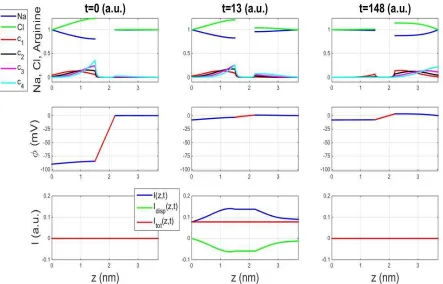
The gating currents shown above can be better understood by looking at a sequence of snapshots showing the spatial distribution of electric potential, species concentration and electric current. The distributions at several times are shown in Fig. 5 for the case of sudden change in command voltage to a more positive value, a large depolarization, and Fig. 6 for the case of small positive going change in potential, a partial depolarization. Fig. 5 shows that almost all arginines are driven from intracellular to extracellular vestibules in case of large depolarization, but only part of the arginines move in case of partial depolarization (Fig. 6). The electric potential profiles at t=13 and t=148 show that the profile of electric potential as arginines move from left to right even though the voltage is maintained constant across the sensor. This is not a constant field system at all! Note that slight bulges in electric potential profile exist wherever arginines are dense. This can be easily understood by understanding the effect of Eq. (1) on a concave spatial distribution of electric potential.
In Figs. 5 and 6, total current defined in Eq. (18), though changing with time, is always constant in
5.3 Flux of charges at different locations
Flux of charges 𝐼(𝑧, 𝑡) , together with displacement of current 𝐼 (𝑧, 𝑡) and total current
𝐼 (𝑧, 𝑡), depicted in Figs. 5 and 6 deserves more discussions here. Flux of charges at the middle of gating pore, 𝐼(𝐿 + 𝐿/2, 𝑡), and both ends of gating pore, 𝐼(0, 𝑡) and 𝐼(2𝐿 + 𝐿, 𝑡), should be computed by
𝐼 𝐿 + , 𝑡 = 𝐴 𝐿 + ∑ 𝑧 𝐽 𝐿 + , 𝑡 , (29)
𝐼(0, 𝑡) = 𝐴(0) ∑ , 𝑧 𝐽 (0, 𝑡), (30) 𝐼(2𝐿 + 𝐿, 𝑡) = 𝐴(2𝐿 + 𝐿) ∑ , 𝑧 𝐽 (2𝐿 + 𝐿, 𝑡). (31)
Except 𝐼 𝐿 + , 𝑡 , 𝐼(0, 𝑡) and 𝐼(2𝐿 + 𝐿, 𝑡) are trivially zero due to the implement of
quasi-steadiness = 0, 𝑖 = Na, Cl, in vestibules, which causes 𝐽 and 𝐽 to be uniform in vestibules by Eq.
(2), and further become zero by the no-flux boundary conditions for 𝑁𝑎 and 𝐶𝑙 at the bottom of
vestibules as described in Eq. (14). We have to alternatively reconstruct 𝐼(0, 𝑡) and 𝐼(2𝐿 + 𝐿, 𝑡) by
charge conservation of 𝑁𝑎 and 𝐶𝑙 ,
𝐼(0, 𝑡) = ∫ 𝐴(𝑧) ∑Na,Cl𝑧 𝑐 𝑑𝑧, (32)
𝐼(2𝐿 + 𝐿, 𝑡) = − ∫ 𝐴(𝑧) ∑Na,Cl𝑧 𝑐 𝑑𝑧. (33)
After obtaining 𝐼(0, 𝑡) and 𝐼(2𝐿 + 𝐿, 𝑡) , we can further reconstruct flux of charges 𝐼(𝑧, 𝑡) at zone 1
(intracellular vestibule) and zone 3 (extracellular vestibule) by charge conservation of 𝑁𝑎 and 𝐶𝑙
again,
𝐼(𝑧, 𝑡) = 𝐼(0, 𝑡) − ∫ 𝐴(𝑧) ∑Na,Cl𝑧 𝑐 𝑑𝑧, 𝑧 ∈ [0, 𝐿 ], (34)
𝐼(𝑧, 𝑡) = 𝐼(2𝐿 + 𝐿, 𝑡) + ∫ 𝐴(𝑧) ∑Na,Cl𝑧 𝑐 𝑑𝑧, 𝑧 ∈ [𝐿 + 𝐿, 2𝐿 + 𝐿]. (35)
Once flux of charges is analyzed, we can then compute the displacement current based on finding the time
derivative of Eq. (16). Finally we sum up flux of charges 𝐼(𝑧, 𝑡) and displacement of current 𝐼 (𝑧, 𝑡)
to obtain total current 𝐼 (𝑧, 𝑡) and verify that it satisfies Eq. (18) and is uniform in z. This verification is shown in Figs. 5 and 6 at several various times, and is fact true at any time as well.
In the bottom rows of Figs. 5 and 6 at t=13, we observe that 𝐼(𝑧, 𝑡) is generally non-uniform in z
and is accompanied by congestion/decongestion of arginines in between. However 𝐼(𝑧, 𝑡) is almost
uniform at zone 2 (hydrophobic plug), which means almost no congestion/decongestion of arginines
occurs there, and therefore no contribution to the displacement current 𝑄 (𝑧, 𝑡) from zone 2. This
is no surprise since arginines can hardly reside at zone 2 due to energy barrier in it. Because of the energy barriers, once arginines leave zone 1 (intracellular vestibule), they immediately jump across zone 2 and enter into zone 3 (extracellular vestibule).
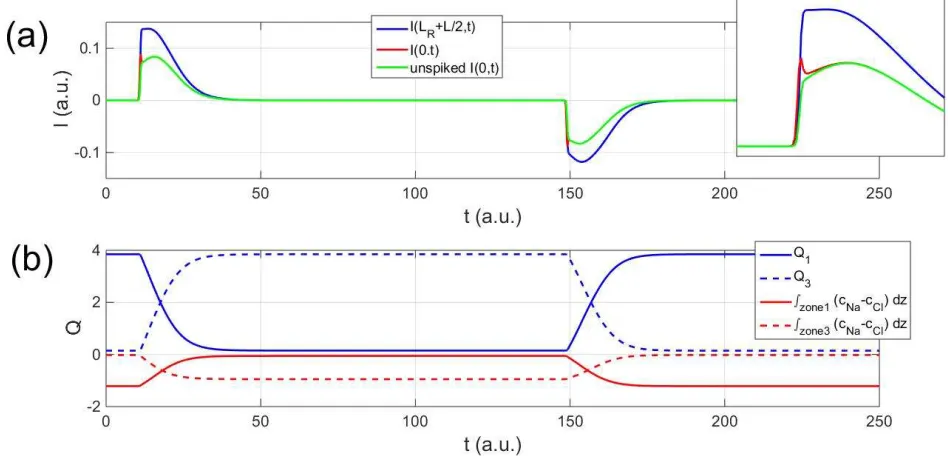
7(a) under the case of large depolarization. First, 𝐼 𝐿 + , 𝑡 is noticeably larger than 𝐼(0, 𝑡) in ON
period. This is because their difference, exactly the displacement current 𝐼 , is always negative at zone
2 when depolarized, since arginines are leaving zone 1 and make 𝑄 < 0 for zone 2. It is expected
the area under the time course of 𝐼 𝐿 + , 𝑡 would be very close to 4e, as verified by the time courses
of Q3 in Fig. 7(b), while the counterpart area of experimentally measurable 𝐼(0, 𝑡) would be less than 4e
due to its smaller magnitude compared with 𝐼 𝐿 + , 𝑡 . This may account for some experimental
observations that at most 13e [4, 27, 30], instead of 16e, are moved during full depolarization in 4 voltage sensors (for a single ion channel) based on calculating the area under voltage-clamp gating current. Therefore, flux of charge at any location of zone 2, though impossible to measure in experiments so far,
will give us amount of arginines moved during depolarization more reliably than the measurable 𝐼(0, 𝑡).
Second, we see in Fig. 7(a) with magnification in its inset plot that, as in experiments, 𝐼(0, 𝑡), but
not 𝐼 𝐿 + , 𝑡 , has contaminating leading spikes in ON and OFF parts of the current. These spikes are
linear capacitive currents from solution EDL of vestibules caused by sudden rising and dropping of command potential, and are called the early transient gating current in experiments [33, 35-36]. In voltage-clamp experiments, subtracting this linear capacitive component and removing the spike from gating current is done by ‘leak subtraction’, in various forms, e.g., P/4 (see Section 5.4) In reality, this linear capacitive current that is subtracted in this procedure comes from both the lipid bilayer membrane in parallel with the channel and vestibule solution in series with the channel. Here, we only considered capacitive current from solution EDL of vestibule and ignored the capacitive current of the membrane in parallel with the channel (which is actually much larger than vestibule capacitive current) because we
use Dirichlet boundary conditions for 𝜙 at both ends of gating pore in Eq. (12). Following the idea of
experiment [7], we calculated 𝐼(0, 𝑡) with V rising from -150mV to -140mV at t=10, holding on till t=150,
and dropping back to -150mV. The reason to choose the rising range of V from -150mV to -140mV is that
essentially none of the arginines move in this hyperpolarized situation. The voltage step only quickly
charges and discharges solution EDL in vestibules, and the computational time course of 𝐼(0, 𝑡) is just
two spikes when the command potential rises suddenly and drops suddenly later. Subtracting this
hyperpolarized 𝐼(0, 𝑡), multiplied by a proportion factor, from its original counterpart will then remove
the spikes, and the unspiked 𝐼(0, 𝑡) is shown in Fig. 7(a).
Third, in Fig. 7(b), the time courses of Q1 and Q3 show that arginines move from the intracellular vestibule to the extracellular one when depolarized and move back to intracellular vestibule again when repolarized later. As arginines move from one vestibule to another, the concentrations of Na+ and Cl also
As mentioned above, here we used flux of charges at the middle of hydrophobic plug, 𝐼 𝐿 + , 𝑡 ,
instead of experimentally measurable 𝐼(0, 𝑡) to represent ‘the gating current’ in discussions. This ‘gating
current’ just leaves out the displacement current 𝐼 𝐿 + , 𝑡 . We use this definition of ‘gating
current’ for several reasons: (1) the area under time course of 𝐼 𝐿 + , 𝑡 gives us the amount of
arginines moved during depolarization more faithfully than 𝐼(0, 𝑡) as explained above. The fluxes of
charge for each arginine shown in Fig. 4 (b) and (d) carry important information about how each arginine is moved by the electric field, that will be illustrated in Fig. 8. All these will not be easy to display and comprehend if we use 𝐼(0, 𝑡) instead. (2) Using 𝐼(0, 𝑡) as a definition of gating current would require a
decontamination by removing the leading spikes in it, which is computationally costly by the procedure described above. Especially, it would pose a heavy numerical burden when doing parameter fitting, where
numerous repeated computations need to be conducted; (3) The shape of 𝐼 𝐿 + , 𝑡 is actually close
to the unspiked 𝐼(0, 𝑡). Hence here we used the computationally handy 𝐼 𝐿 + , 𝑡 to replace 𝐼(0, 𝑡)
as the gating current.
5.4 Comparison with experimental records.
Our computations have limited fidelity at short times because of time step limitation in integrating stiff systems. The spike artifacts are one example, described previously. Experimental measurements [16, 33] of the fast transient gating current are fascinating but our calculations must be extended to deal with them.
A more general consideration is the subtraction procedure used in experiments to isolate gating current from currents arising from other sources. Channels and their voltage sensors are always accompanied by large amounts of lipid membranes. Currents through channels and in voltage sensors are ‘in parallel’ with large capacitive currents through lipid membranes. The lipid membrane of cells
introduces a large capacitance ( 𝐶 ≅ 6×10 farads/cm ) that has nothing to do with the capacitive
(i.e., displacement) currents produced by charge movement in the voltage sensor. Fortunately, this
capacitance 𝐶 is a nearly ideal circuit element. Current through the membrane capacitance is entirely
a displacement current accurately described by 𝑖 = 𝐶 with a single constant 𝐶 . V is the
voltage across the lipid capacitor. Note that 𝑖 does not include any current carried by the translocation
of ions across the lipid.
In experimental measurements, this displacement current 𝑖 is always present, in large amounts,
A procedure to remove the lipid membrane current is needed if the gating current of the voltage sensor is to be measured. The procedure introduced by Schneider and Chandler [26] has been used ever since in the improved P/4 version developed by Armstrong and Bezanilla [1] reviewed and discussed in [8].Also, see another approach in [6, 13].Schneider and Chandler’s procedure [26] estimates the
so-called linear current 𝑖 = 𝐶 in conditions in which the voltage sensor and 𝐶 behaves as an ideal
circuit element. An ideal capacitor has a capacitance 𝐶 independent of voltage, time, current, or ionic
composition. The Schneider procedure then subtracts that linear current 𝑖 from the total current
measured in conditions in which the voltage sensor does not behave as an ideal capacitor. The leftover estimates the nonlinear properties of the charge movement in the voltage sensor. That is to say it estimates the charge movement of the voltage sensor that is not proportional to the size of the voltage step used in the measurement. The leftover is called gating current here and in experimental papers.
The gating current reported in experiments however is missing a component of the displacement
current of the voltage sensor, because of the Schneider and Chandler’s procedure that estimates 𝑖 . The
Schneider and Chandler’s procedure does not measure 𝑖 by itself. The linear current 𝑖 estimated
by the Schneider and Chandler’s procedure has more in it than the current through the lipid membrane
capacitor 𝑖 . Rather, it contains the lipid membrane current 𝑖 plus current through any structures
in the membrane (‘in parallel’) in which current follows the law 𝑖 = 𝐶 .
Clearly, some of the current produced by movements of the arginines in the voltage sensor will be a linear displacement current, a linear component of gating current. But that component is likely to be included in 𝑖 and so would not be present in the reported gating current. The linear component of
gating current is removed by the experimental procedure that is needed to remove the lipid membrane
displacement current 𝑖 . Other systems may contribute to the linear displacement current as well, for
example, (1) all sorts of experimental and instrumentation artifacts and (2) displacement current in the conduction channel itself. The conduction channel of field effect transistors produces a large capacitance described by drift diffusion equations quite similar to the PNP equations of the open conduction channel. Our procedure in the computations reported here subtracts a hyperpolarized current with arginines not moving in this situation, thereby removing all the currents carried by arginine movement, linear and nonlinear in voltage. Most systems have substantial motions that are linear in voltage (even if the system is labelled ‘nonlinear’). The response of most systems to a voltage step can be written as a sum of terms,
each with a different dependence on the size of the applied step of voltage V. The first term in that sum
changes linearly if the voltage step is changed. Higher order terms exhibit a nonlinear dependence on V.
The linear term is present in most systems, just as it is present in most Taylor expansions of nonlinear functions.
voltage sensor to the gating process of the conduction channel.
Direct measurements of the movement of arginines (e.g., with optical methods) are likely to include the linear component and so should not agree with experimental measurements of gating current or with the currents reported here.
5.5 Time course of arginine and S4 translocation
Time course of Q (amount of arginines moved to extracellular vestibule, equal to Q3 here) and center-of-mass trajectories of individual arginines (𝑧, , i=1, 2, 3, 4) and S4 segment (𝑍 ) are shown in
Fig. 8 with (a) and (b) for the case of large depolarization and (c) and (d) for the case of partial depolarization. In the case of large depolarization, from Fig. 8(b), we can see arginines and S4 are driven towards extracellular vestibule once the electric field is turned on. Their z-positions quickly reach individual steady states with almost all arginines transferred to extracellular vestibule as previously shown in Fig. 5 and therefore Q is close to 4 as shown in Fig. 8(a). Arginines and S4 move back to intracellular vestibule once the voltage drops back to -90mV. From Fig. 8(b), the forward moving order of arginines is R1, R2, R3 and R4, and the backward moving order is on the opposite R4, R3, R2 and R1. This obviously coincides with the structure. Note that S4 is initially farthest to the right but lags behind R1 and R2 during movement in depolarization as shown in Fig. 8(b). This is certainly because S4 is relaxed to an
almost unforced situation close to its natural position 𝑍 , . We can further calculate the displacements
of each arginine and S4 during this full depolarization, and find Δ𝑧 , ≈ Δ𝑧 , ≈ Δ𝑧 , ≈ 1.93 nm,
Δ𝑧 , =1.76nm, Δ𝑍 =1.51nm. Besides almost the same displacements for R1, R2 and R3, their average
moving velocities are also very close to each other. This seems to suggest a synchronized movement among R1, R2 and R3. Also, we can see the movements of arginines contribute significantly to the
movement of S4 segment. This can be seen by steady state z-position of S4 derived from Eq. (9),
𝑍 = ∑ 𝑧, − 𝑧 + 𝑍 , = 𝑍 , + ∑ 𝑧, .
Experimental estimates of S4 displacement during full depolarization ranged from 2-20 A [24, 37]. This large deviation accommodates several models for voltage sensing: transporter model, helical screw
model and paddle model [37]. Our Δ𝑍 =1.51nm here is large enough that seems to agree better with
experimental estimates requiring large displacements, such as the paddle model. However, our model is more based on helical screw model, which is known to have shorter displacements. A plausible
explanation for our over-estimated Δ𝑍 is that our 1D model has made the known helical path into a
linear path. It would be shorter for displacement perpendicular to the plane of the membrane. The diameter of an alpha helix between alpha carbons is approximately 1 nm, therefore if the rotation were 90o, the displacement in 1D would be extended by 0.5×0.5×π=0.78 nm, making the linear translation perpendicular to the membrane only 0.73 nm. This number is very close to the displacement perpendicular to the membrane that is estimated when comparing the open-relaxed state crystal structure of Kv1.2 [9] and the consensus closed structure that has been derived from experimental measurements [40].
seen from Fig. 8(c), that Q reaches 1.57 at most which should be 2 instead if equilibrium, which can be reached if time is long enough, as shown in QV curve of Fig. 3(a). Fig. 8(d) shows that S4 initially farthest to the right lags behind R1 during movement and is almost caught up by R2. The maximum displacements
of arginines and S4 calculated from Fig. 8(d) are Δ𝑧 , = 1.36nm, Δ𝑧 , = 0.966nm,
Δ𝑧 , =0.459nm, Δ𝑧 , =0.316nm, and Δ𝑍 , =0.616nm.
5.6 Family of gating currents for a range of voltages
Fig. 9(a) shows the time courses of gating current for a range of voltages V, ranging from -62mV to
-8mV. We can see the area under gating current, for both on and off parts, increases with V since more
arginines are transferred to extracellular vestibule as V increases. However, this area will saturate with further increasing V since all arginines would then be transferred to the extracellular vestibule. The shapes of this family of gating currents agree well with experiment [7] in both magnitude and time span. We can characterize the time span by fitting the time course (only the decay part) of a gating current by
𝑎𝑒 ⁄ + 𝑏𝑒 ⁄ , 𝜏 < 𝜏 , as generally conducted in experiment [7], where 𝜏 is the fast time constant
and 𝜏 is the slow time constant. Usually the movement of arginines is dominated by 𝜏 . Here 𝜏 was
calculated from simulation and compared with experiment [7] as shown in Fig. 9(b). Since in our
computation the time is in arbitrary unit, we have scaled the time to have the maximum 𝜏 to fit with its
counterpart in experiment [7]. The trend of 𝜏 versus V in our result agrees well with experiment [7].
For the left branches to the maximum point in Fig. 9(b), simulation result fits very well with experiment.
For the right branches to the maximum point, simulation result overestimates 𝜏 compared with
experiment. This is consistent with the observation that the amount of transferred charges Q saturates
faster in experiment data than in present simulation as V increases as shown in the QV curve of Fig. 3(a). This phenomenon is related to cooperativity of movement among arginines, that will be further discussed below.
5.7 Effect of voltage pulse duration
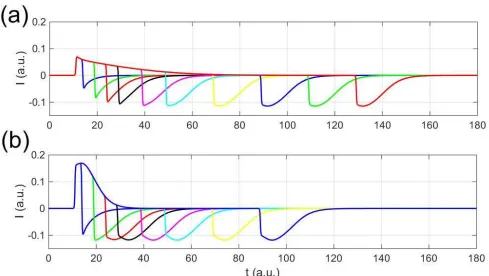
Fig. 10 shows the effect of voltage pulse duration with Fig. 10(a) for the case of partial depolarization and Fig. 10(b) for the case of full depolarization. Magnitude and time span of gating current are influenced by pulse duration in both cases, but the shape will asymptotically approach the same as pulse duration increases. This behavior occurs because driving arginines towards extracellular
vestibule by the command potential takes time. If the pulse duration is long enough, the time course of Q
will approach its steady state like in Fig. 8(a) for large depolarization. Partial depolarization takes longer time to reach its steady state as demonstrated in Fig. 8(c). Again these shapes of gating currents in Fig. 10 compare favorably with experiment [7].
6. Conclusions
well represented by the simulations. The continuum approach seems to be a good model of voltage sensors, provided that it takes into account all interactions, and satisfies conservation of current. The continuum approach used here describes the mechanical behavior of a single voltage sensor, but experimental measurements are ensemble averages of multiple ion channels (and hence multiple voltage sensors). There is no conflict, however. Experiments average of measurements of large numbers of voltage sensors as does our macroscopic model.
Here we simplify the profile of energy barrier in hydrophobic plug since the potential of mean force (PMF) in that region, and its variation with potential and conditions, is unknown. Therefore the next step is to model the details of interactions or the moving arginines with the wall of the hydrophobic plug. There is plenty of detailed information on the amino acid side chains in the plug and how each one of them has important effects in the kinetics and steady-state properties of gating charge movement [25]. The studied side chains reveal steric as well as dielectric interactions with the arginines that the present model does not have. On the other hand, the power of the present mathematical modeling is precisely the implementation of interactions, therefore we believe that when we add the dielectric details of the
channel a better prediction of the currents should be attained. Also, here the plug energy barrier Vb is
assumed to be independent of time. However, once the first arginine enters the hydrophobic plug by carrying some water with it, this partial wetting of pore will lower Vb, chiefly consisting of solvation energy, and enable the next arginine to enter the plug with less difficulty. This might explain the cooperativity of movement among arginines when they jump through the plug. This remains to be included in the future modeling. Besides, it has been reported that a very strong electric field might affect the hydration equilibrium of the hydrophobic plug and would lower its hydration energy barrier as well [39]. This cooperativity of movement may help explain the quick saturation in the upper right branch of QV curve (and smaller τ2). This also remains to be considered in the future modeling.
Also, further work must address the mechanism of coupling between the voltage sensor movements and the conduction pore. It seems likely that the classical mechanical models will need to be
extended to include coupling through the electrical field. It is possible that the voltage sensor modifies
the stability of conduction current by triggering sudden transitions from closed to open state, in a controlled process reminiscent of Coulomb blockade.
ACKNOWLEDGMENTS
This research was sponsored in part by the Ministry of Science and Technology of Taiwan under grant no. MOST-102-2115-M-002-015-MY4 (T.L.H.) and MOST-104-2115-M-035 -002 -MY2 (T.L.H.). Dr. Horng also thanks the support of National Center for Theoretical Sciences Mathematical Division of Taiwan (NCTS/MATH), and Dr. Ren-Shiang Chen for the long-term benefiting discussions.
REFERENCES
[1] Armstrong, C.M., and F. Bezanilla. 1974. Charge movement associated with the opening and closing of the activation gates of the sodium channels. J. Gen. Physiol. 63:533-552.
[2] Ascher, U. M., and L. R. Petzold. 1998. Computer methods for ordinary differential
equations and differential-algebraic equations. SIAM, Philadelphia.
European Physical Journal D. 68(10):286.
[4]Bezanilla, F. 2008. How membrane proteins sense voltage. Nat. Rev. Mol. Cell Biol. 9:323–332.
[5] Bezanilla, F., and C. M. Armstrong. 1975. Properties of the sodium channel gating current. Cold Spring
Harb. Symp. Quant. Biol. 40: 297-304.
[6] Bezanilla, F., and C. M. Armstrong. 1977. Inactivation of the sodium channel. I. Sodium current experiments. J. Gen. Physiol. 70(5):549-566.
[7] Bezanilla, F., E. Perozo, and E. Stefani. 1994. Gating of K+ channels : II. The components of gating currents and a model of channel. Biophy. J. 66:1011-1021.
[8] Bezanilla, F., and J. Vergara. 1980. Properties of Excitable membranes. In: Membrane structure and
Function. E.E. Bittar, Ed. Vol. II, Ch. 2. J. Wiley & Sons, New York, pp. 53-113.
[9] Chen, X., Q. Wang, F. Ni, and J. Ma. 2010. Structure of the full-length Shaker potassium channel Kv1.2 by normal-mode-based X-ray crystallographic refinement. Proc. Natl. Acad. Sci. USA. 107(25):11352-11357.
[10] Eisenberg, B. 2016. Conservation of Current and Conservation of Charge. arXiv.
https://arxiv.org/abs/1609.09175.
[11] Eisenberg, B. 2016. Maxwell Matters. arXiv. https://arxiv.org/pdf/1607.06691.
[12] Eisenberg, B., Y. K. Hyon, and C. Liu. 2010. Energy variational analysis EnVarA of ions in water and channels: field theory for primitive models of complex ionic fluids. Journal of Chemical Physics.
133:104104.
[13] Fernández, J. M., F. Bezanilla, and R. E. Taylor. 1982. Distribution and kinetics of membrane dielectric polarization. II. Frequency domain studies of gating currents. J. Gen. Physiol. 79(1):41-67.
[14] Feynman, R. P., R. B. Leighton, and M. Sands. 1963. The Feynman lectures on physics, Vol. 2: mainly
electromagnetism and matter. Addison-Wesley, New York.
[15] Fiedziuszko, S. J., I. C. Hunter, T. Itoh, Y. Kobayashi, T. Nishikawa, S. N. Stitzer, and K. Wakino. 2002. Dielectric materials, devices, and circuits. IEEE Transactions on Microwave Theory and Techniques.
50(3):706-720.
[16] Forster, I. C., and N. G. Greeff. 1992. The early phase of sodium channel gating current in the squid
giant axon. Characteristics of a fast component of displacement charge movement. Eur. Biophys. J. 21(2):
99-116.
[17] Jimenez-Morales, D., J. Liang, and B. Eisenberg. 2012. Ionizable side chains at catalytic active sites of
enzymes. European Biophysics Journal. 41(5):449-460.
[18] Hodgkin, A. L. 1992. Chance and Design. Cambridge University Press, New York.
[19] Hodgkin, A. L., and A. F. Huxley. 1952. A quantitative description of membrane current and its application to conduction and excitation in nerve. J. Physiol. 117:500-544.
[20] Horng, T. L., T. C. Lin, C. Liu, and B. Eisenberg. 2012. PNP equations with steric effects: a model of ion
flow through channels. The Journal of Physical Chemistry B. 116(37):11422-11441.
[21] Huxley, A. 2000. Sir Alan Lloyd Hodgkin, O. M., K. B. E. 5 February 1914-20 December 1998. Biograph.
Mem. Roy. Soc. 46: 221-241.
[22] Huxley, A. F. 1992. Kenneth Stewart Cole. Biograph. Mem. Roy. Soc. 38:99–110.
[23] Huxley, A. F. 2002. From overshoot to voltage clamp. Trends in neurosciences. 25(11):553-558.
selectivity and gating. Cold Spring Harb. Perspect. Biol. 8:a029231.
[25] Lacroix, J. J., H. C. Hyde, F. V. Campos, and F. Bezanilla. 2014. Moving gating charges through the gating pore in a Kv channel voltage sensor. Proc. Natl. Acad. Sci. USA. 111:1950-1959.
[26] Schneider, M. F., and W. K. Chandler. 1973. Voltage dependent charge movement in skeletal muscle:
a possible step in excitation contraction coupling. Nature. 242:244-246.
[27]Schoppa, N. E., K. McCormack, M. A. Tanouye, and F. J. Sigworth. 1992. The size of gating charge in
wild-type and mutant shaker potassium channels. Science.255:1712–1715.
[28] Schuss, Z. 2009. Theory And Applications Of Stochastic Processes: An Analytical Approach. Springer,
New York.
[29] Schuss, Z., B. Nadler, and R. S. Eisenberg. 2001. Derivation of Poisson and Nernst-Planck equations in
a bath and channel from a molecular model. Phys. Rev. E. 64:036116.
[30]Seoh, S.-A., D. Sigg, D. M. Papazian, and F. Bezanilla. 1996. Voltage-sensing residues in the S2 and S4
segments of the Shaker K+ channel. Neuron.16:1159–1167.
[31] Shampine, L. F., and M. W. Reichelt. 1997. The MATLAB ODE Suite. SIAM Journal on Scientific Computing. 18:1–22.
[32] Shampine, L. F., M. W. Reichelt, and J. A. Kierzenka. 1999. Solving Index-1 DAEs in MATLAB and
Simulink. SIAM Review. 41:538–552.
[33] Sigg, D., F. Bezanilla, and E. Stefani. 2003. Fast gating in the Shaker K+ channel and the energy landscape of activation. Proc. Natl. Acad. Sci. USA. 100:7611-7615.
[34] Solé, A., X. Oriols, D. Marian, and N. Zanghı̀. 2016. How does quantum uncertainty emerge from
deterministic Bohmian mechanics? Fluct. and Noise Lett. 15(03):1640010.
[35] Stefani, E., and F. Bezanilla. 1997. Voltage dependence of the early events in voltage gating. Biophys. J. 72:131.
[36] Stefani, E., D. Sigg, and F. Bezanilla. 2000. Correlation between the early component of gating current and total gating current in Shaker K channels. Biophys. J. 78:7.
[37] Tombola, F., M. M. Pathak, and E. Y. Isacoff. 2006. How does voltage open an ion channel? Annu. Rev.
Cell Dev. Biol. 22:23-52.
[38] Trefethen, L. N. 2000. Spectral Methods in MATLAB. SIAM, Philadelphia.
[39] Vaitheeswaran, S., J. C. Rasaiah, and G. Hummer. 2004. Electric field and temperature effects on water
in the narrow nonpolar pores of carbon nanotubes. J. Chem. Phys. 121(16):7955-7965.
[40] Vargas, E., F. Bezanilla, and B. Roux. 2011. In search of a consensus model of the resting state of a
voltage-sensing domain. Neuron. 72(5):713-20.
[41] Varsos, K., J. Luntz, M. Welsh, and K. Sarabandi. 2011. Electric Field-Shaping Microdevices for Manipulation of Collections of Microscale Objects. Proceedings of the IEEE. 99(12): 2112-2124.
Figure 1. Geometric configuration of the model including the attachments of arginines to the S4 segment.
Figure 2. Following Figure 1, an axisymmetric 3-zone domain shape is designated in r-z coordinate for
the current 1D model. Here the diameter of hydrophobic plug is 0.3nm (arginine’s diameter); L=0.7nm;
[image:21.612.99.516.345.569.2]Figure 3. (a) QV curve and comparison with [7]. Steady-state distributions for Na, Cl and arginines at (b)
V=-90mV, (c) V=-48mV, (d) V=-8mV.
Figure 4. (a) Time course of V rising from -90mV to -8mV at t=10, holds on till t=150, and drops back to
-90mV, (b) time course of gating current and its components corresponding to (a), (c) time course of V
rising from -90mV to -50mV at t=10, holds on till t=150, and drops back to -90mV, (d) time course of
[image:22.612.70.524.58.294.2] [image:22.612.64.551.340.558.2]
Figure 6. The four panels on the top row are species concentration distributions at t=0, 13, 148, for the
case of large depolarization with V rising from -90mV to -50mV at t=10, holding on till t=150, and dropping back to -90mV. The four panels on the middle row are concurrent electric potential profiles. The four panels on the bottom row are concurrent electric current profiles with components of flux of charge, displacement current and total current.
[image:24.612.72.546.470.698.2]depolarization with V rising from -90mV to -8mV at t=10, holding on till t=150, and dropping back to -90mV. The inset plot is a blow-up of ON-current to visualize the difference of 𝐼(0, 𝑡) and unspiked 𝐼(0, 𝑡)
more clearly. (b) Time courses of 𝑄 , 𝑄 , ∫ (𝑐 − 𝑐 ) 𝑑𝑧, and ∫ (𝑐 − 𝑐 ) 𝑑𝑧 under the same
depolarization scenario as (a).
Figure 8. (a) and (c) are time courses of amount of arginines moved to extracellular vestibule. (b) and (d) are center-of-mass trajectories of individual arginines and S4. (a) and (b) are the case of large depolarization with V rising from -90mV to -8mV at t=10, holding on till t=150, and dropping back to -90mV. (c) and (d) are the case of partial depolarization with V rising from -90mV to -50mV at t=10, holding on till t=150, and dropping back to -90mV.
Figure 9. (a) Time courses of gating current with voltage rising from -90mV to V mV at t=10, holds on till
[image:25.612.70.555.135.360.2] [image:25.612.73.555.464.695.2][7].
Figure 10. Effect of voltage pulse duration: (a) V increases from -90mV to -35mV at t=10 and drops back
to -90mV at various times, (b) V increases from -90mV to 0mV at t=10 and drops back to -90mV at
![Figure 3. (a) QV curve and comparison with [7]. Steady-state distributions for Na, Cl and arginines at (b) V=-90mV, (c) V=-48mV, (d) V=-8mV](https://thumb-us.123doks.com/thumbv2/123dok_us/891208.601614/22.612.64.551.340.558/figure-curve-comparison-steady-state-distributions-na-arginines.webp)