EFFECTS OF PHYTASE SUPPLEMENTATION ON THE PERFORMANCE AND EGG
QUALITY OF FREE
*
Hasan Akyurek and Zeynep Colak
Department of Animal Science, Faculty of Agriculture, Namik Kemal University, Tekirdag, Turkey 59030
ARTICLE INFO ABSTRACT
This study was carried out to the effects of supplementation of phytase enzyme to free
diets on performance and egg quality traits. In the trial, at 48 wk old 152 Lohman Brown layers were divided into 3 dietary treatments with 2 replicates. Die
75% crude protein and 2795 kcal/kg metabolisable energy were used. Three dietary treatments were formed as followed; (1) control group diet had 0 FTU/kg with phytase (T1), (2) T2 group diet had 250 FTU/kg phyt
libitum
intake and egg weight were significantly (P<0,01) increased by phytase ad
not affect egg shape index, haugh unit and specific gravity. On the other hands, phytase supplementation was increased egg weight, albumen and yolk weight, egg shell weight and shell thickness. An according to result of the exper
diets had significant positive effects on performance and egg quality traits.
Copyright©2016, Hasan Akyurek and Zeynep Colak Orhan
permits unrestricted use, distribution, and reproduction in any medium, provided the original work is properly cited.
INTRODUCTION
The poultry industry has experienced significant change in the last two decades. For many years, a relatively large number of consumers have been interested in buying free
organic eggs. This has led to an increase in the production of both free-range and organic poultry in many countries. systems can be environmentally friendly, sustaining animals in good health with high welfare standards and lead to better quality products (Sundrum, 2001) and more flavoursome products (Sauveur, 1997). By eating various grasses and herbs, free-range layers enrich their food and assimilate valuable natural nutrients that influence some egg quality traits (Nys,
2000; Van den Brand et al., 2004). The consequences of
alternative housing systems (especially outdoo
egg quality are not yet clear. Free-range layer diets are based largely on grasses, cereal grains and oilseed meals. Unfortunately, approximately 2/3 of the phosphorus in these plant materials are present in the form of phytic acid (Akyurek
et al., 2005). The ability of poultry to use phytate phosphorus
is poor (Wu et al., 2004) due to insufficient quantities or lack
of intestinal phytase secretion (Ravindran
Sebastian et al., 1998). This inadequacy of poulty to use
phytate phosphorus results in the excretion of large amounts of phosphorus in manure, posing an environmental concern especially, in areas of intensive animal production (Wu 2004).
*Corresponding author: Hasan Akyurek,
Department of Animal Science, Faculty of Agriculture, Namik Kemal University, Tekirdag, Turkey 59030.
ISSN: 0975-833X
Vol.
Article History:
Received 10th September, 2016
Received in revised form
12th October, 2016
Accepted 25th November, 2016
Published online 30th December,2016
Key words:
Free-Range Layer, Phytase, Performance, Egg Quality.
Citation: Hasan Akyurek and Zeynep Colak Orhan
International Journal of Current Research, 8, (12), 44142
RESEARCH ARTICLE
EFFECTS OF PHYTASE SUPPLEMENTATION ON THE PERFORMANCE AND EGG
QUALITY OF FREE-RANGE LAYERS
Hasan Akyurek and Zeynep Colak Orhan
Department of Animal Science, Faculty of Agriculture, Namik Kemal University, Tekirdag, Turkey 59030
ABSTRACT
This study was carried out to the effects of supplementation of phytase enzyme to free
diets on performance and egg quality traits. In the trial, at 48 wk old 152 Lohman Brown layers were divided into 3 dietary treatments with 2 replicates. Diets were fed 8 wk periods. Basal diets with 16, 75% crude protein and 2795 kcal/kg metabolisable energy were used. Three dietary treatments were formed as followed; (1) control group diet had 0 FTU/kg with phytase (T1), (2) T2 group diet had 250 FTU/kg phytase and (3) T3 group diet had 500 FTU/kg phytase. Feed and water were supplied for libitum. Light was provided 16 hours daily. The results were indicated that egg production, feed intake and egg weight were significantly (P<0,01) increased by phytase ad
not affect egg shape index, haugh unit and specific gravity. On the other hands, phytase supplementation was increased egg weight, albumen and yolk weight, egg shell weight and shell thickness. An according to result of the experiment that phytase supplementation of free
diets had significant positive effects on performance and egg quality traits.
Hasan Akyurek and Zeynep Colak Orhan. This is an open access article distributed under the Creative use, distribution, and reproduction in any medium, provided the original work is properly cited.
The poultry industry has experienced significant change in the last two decades. For many years, a relatively large number of consumers have been interested in buying free-range or This has led to an increase in the production of nge and organic poultry in many countries. These systems can be environmentally friendly, sustaining animals in good health with high welfare standards and lead to better quality products (Sundrum, 2001) and more flavoursome ting various grasses and herbs, range layers enrich their food and assimilate valuable natural nutrients that influence some egg quality traits (Nys, ., 2004). The consequences of alternative housing systems (especially outdoor systems) for range layer diets are based largely on grasses, cereal grains and oilseed meals. Unfortunately, approximately 2/3 of the phosphorus in these plant materials are present in the form of phytic acid (Akyurek ., 2005). The ability of poultry to use phytate phosphorus ., 2004) due to insufficient quantities or lack
of intestinal phytase secretion (Ravindran et al., 1998;
., 1998). This inadequacy of poulty to use sphorus results in the excretion of large amounts of phosphorus in manure, posing an environmental concern
especially, in areas of intensive animal production (Wu et al.,
Department of Animal Science, Faculty of Agriculture, Namik Kemal
On the other hands, phosphorus is an essential nutrient in several metabolic processes and it is one of the major mineral elements required poultry. Pho
major role in the development and maintenance of skeletal system and for eggshell formation (Kannan
Phytase supplementation of the feed has been shown to improve the use of phytate phosphorus in laying hens (Gordon and Roland, 1997; Van der Klis
Edwards, 1998; Um and Paik, 1999; Jalal and Scheideler,
2001; Scott et al., 2001). However the influence of phytase
supplementation on performance and egg quality have not been fully studied in free-range laying hens. Therefore, the aim of the present experiment was to examine the effect of microbial phytase on performance and egg quality in free
hens fed corn-soybean meal based diets.
MATERIALS AND METHODS
Hens, housing and feed
A total of 150 Lohmann Brown hens at the age of 48 weeks were distributed into three groups with two replicate flocks of 25 hens each. Each replicate flock was housed in a wooden
house of 8 m2, equipped with perches, 5 nests, 1 suspended
drinker and 1 suspended feeder. The hens had 24h access to an
outdoor yard of 8 m2/bird. The each outdoor yard was also
equipped with a suspender drinker. Throughout the experimental period, the birds were fed
diet (NRC, 1994) which was given
International Journal of Current Research
Vol. 8, Issue, 12, pp.44142-44147, December, 2016
INTERNATIONAL
Hasan Akyurek and Zeynep Colak Orhan,2016. “Effects of phytase supplementation on the performance and egg quality of free
44142-44147.
EFFECTS OF PHYTASE SUPPLEMENTATION ON THE PERFORMANCE AND EGG
Department of Animal Science, Faculty of Agriculture, Namik Kemal University, Tekirdag, Turkey 59030
This study was carried out to the effects of supplementation of phytase enzyme to free-range layer diets on performance and egg quality traits. In the trial, at 48 wk old 152 Lohman Brown layers were ts were fed 8 wk periods. Basal diets with 16, 75% crude protein and 2795 kcal/kg metabolisable energy were used. Three dietary treatments were formed as followed; (1) control group diet had 0 FTU/kg with phytase (T1), (2) T2 group diet had 250 ase and (3) T3 group diet had 500 FTU/kg phytase. Feed and water were supplied for ad-. Light was provided 16 hours dailyad-. The results were indicated that egg production, feed intake and egg weight were significantly (P<0,01) increased by phytase addition. The treatments did not affect egg shape index, haugh unit and specific gravity. On the other hands, phytase supplementation was increased egg weight, albumen and yolk weight, egg shell weight and shell iment that phytase supplementation of free-range layer diets had significant positive effects on performance and egg quality traits.
is an open access article distributed under the Creative Commons Attribution License, which
On the other hands, phosphorus is an essential nutrient in several metabolic processes and it is one of the major mineral elements required poultry. Phosphorus and calcium play a major role in the development and maintenance of skeletal
system and for eggshell formation (Kannan et al., 2011).
Phytase supplementation of the feed has been shown to improve the use of phytate phosphorus in laying hens (Gordon
and Roland, 1997; Van der Klis et al., 1997; Carlos and
Edwards, 1998; Um and Paik, 1999; Jalal and Scheideler, ., 2001). However the influence of phytase supplementation on performance and egg quality have not been range laying hens. Therefore, the aim of the present experiment was to examine the effect of microbial phytase on performance and egg quality in free-range laying
soybean meal based diets.
AND METHODS
al of 150 Lohmann Brown hens at the age of 48 weeks were distributed into three groups with two replicate flocks of 25 hens each. Each replicate flock was housed in a wooden , equipped with perches, 5 nests, 1 suspended drinker and 1 suspended feeder. The hens had 24h access to an /bird. The each outdoor yard was also equipped with a suspender drinker. Throughout the experimental period, the birds were fed on commercial layer
diet (NRC, 1994) which was given ad-libitum.
INTERNATIONAL JOURNAL OF CURRENT RESEARCH
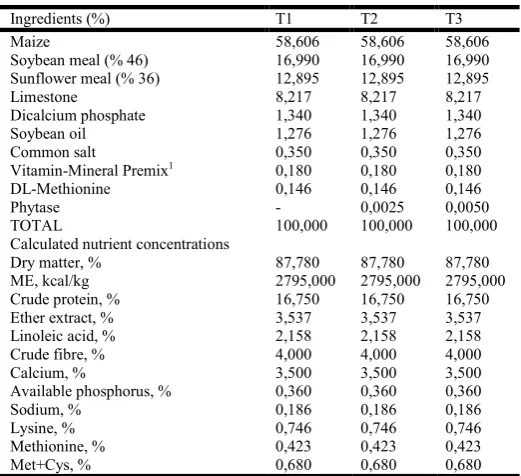
Light was provided 16 hours daily. The calculated contents of crude protein and metabolisable energy in the basal diet were 16.75% and 2795 kcal/kg. The composition of basal diet is shown in Table 1.
Experimental design and measurements
The experimental periods lasted 8 weeks and started at a hen age of 48 weeks and consisted of the following 3 experimental treatments as: (1) control group diet had 0 FTU/kg with phytase (T1), (2) T2 group diet had 250 FTU/kg phytase and (3) T3 group diet had 500 FTU/kg phytase. In the present
experiment, Natuphos® 10,000G, (a phytase preparation
obtained from Aspergillus niger and supplied by BASF,
Turkey) was used as supplemental phytase. Egg production and egg weights were recorded daily. Feed consumption was measured weekly. Random samples of 6 eggs from each replicates were collected biweekly to measure some eggshell quality and internal egg quality such as specific gravity, eggshell strength, eggshell thickness, eggshell weight, eggshell percentage, Haugh unit, shape index, albumen and yolk weight, albumen and yolk pH.
Specific gravity of eggs was determined biweekly by using salt solutions with 0.005 incremental concentrations in the range
from 1.065 to 1.120 (Hempe et al., 1988). Eggshell strength
breaking force from blunt to sharp end in kg/cm2, was
measured by using the compression test cell. Shell thickness was the mean value of measurements made at three locations (aircell, medium, and sharp end) with the micrometer [Type D/06 20717 (0,01-0,25 µm) micrometer, Fabrikat Mauser, Germany] after determination of eggshell strength. Egg weight was measured using a balance and was recorded to the nearest 0,01 g. The height of the thick albumen and egg yolk were measured within a tripod micrometer. The Haugh units were calculated from albumen height and egg weight using Haugh
unit=100log (H+7.57-1.7W0.37), where H is the albumen height
(mm) and W is the weight of the egg (g). After the eggs were broken, the albumen was separated from yolk. The pH of the albumen and yolk was measured using a pH meter (pH meter, Inolab level 1, WTWGmbH, Weilheim, Germany). Cracked eggs were determined each week on the same day by examining all the eggs collected from the flocks and they were subjected to a bulb control in the dark to identify the cracked eggs. The rate of cracked eggs was calculated as percentage of the total collected eggs on the same day.
Statistical analysis
Collected data were recorded on a weekly basis and statistically subjected to ANOVA using the PASW Statistics18 packed program for windows (PASW Statistics18, 2010). The differences between group means were evaluated by Duncan’s multiple range test.
RESULTS AND DISCUSSION
Performance: The results presented in Table 2 indicate that
layer production performance was significantly affected by dietary treatments. Phytase supplementation to the control diet, 250 FTU/kg and 500 FTU/kg increased (P<0,05) egg production from 94,96% to 95,56% and 96,29% respectively. Egg production of hens consuming diets with phytase was also higher than that of the control diet.
This result is in agreement with observations by Van der Klis
et al. (1997) and Keshavarz (2000). In other study, Um and
Paik (1999) who observed that phytase supplementation to the diet containing between 3,0 and 3,5 g aP/kg increased hen-day
egg production significantly. Similarly, Lim et al. (2003)
found that supplementation of microbial phytase (300U/kg) in the diet of laying hens can improve egg production. Significant differences in feed intake and egg weights (P<0.01) showed the same trends as egg production. In the absence of phytase, feed intake was significantly decreased. Similar results were reported by Punna and Roland (1999). The higher feed intake in phytase supplemented groups may be the results of higher egg production. The intake of the birds fed the diets containing the 500 FTU/kg enzyme group (125 g/d) was the highest and those following the 250 FTU/kg enzyme group (120 g/d) and control group (116,55 g/d) respectively (P<0,01). These differences among the groups may be due to from the use of microbial phytase enzyme amount in diets. Because, the increase of the amount of phytase enzyme in diets, the feed intake was increased too. The improved to the feed intake with phytase released P, is potential for other nutrients to show a higher availability or in the case of minerals retention. In particular, positively-changed (cationic) minerals such as calcium, zink, copper, cobalt, iron, magnesium, nickel and manganese are all known to from complexes with phytate and show higher digestibility values in the presence of phytase (Remus, 2005). In agreement with these result, in studies phytase use reported that, the addition phytase in poultry diets were increased feed intake (Punna and Roland, 1999; Um and Paik, 1999; Jalal and Scheideler, 2001).
The highest feed efficiency was determined in control group (1,77) and those following the 250 FTU/kg enzyme group (1,84) and 500 FTU/kg enzyme group (1,85) (P<0,01). This
results does not agree with the previous reports. Liebert et al.
(2005) found that microbial phytase significantly improved
feed conversion ratio whereas Boling et al. (2000) reported
that FCR was not affected by phytase supplementation. Similarly, in studies phytase use reported that, the addition phytase in poultry diets were increased feed efficiency (Van der Klis, 1997; Jalal and Scheideler, 2001).The highest egg weight was determined in 500 FTU/kg enzyme group (67,69g) and those following the 250 FTU/kg enzyme group (65,36g) and control group (65,77g) respectively (P<0,01). This results just as results of Peter (1992) indicated that laying hens fed a diet with phytase had significantly higher egg weight than hens fed on the same diet without supplemental phytase (control).
Also, Ciftci et al. (2005) who reported that the highest egg
weight was determined in 600 U of microbial phytase kg-1
enzyme group (70,29g) and these following the 300 U of
microbial phytase kg-1 enzyme group (67,37 g) and control
group (64,31 g) respectively (P<0,01). While presented results
are disagreement with findings of Scott et al. (1999) reported
that, phytase supplementation had no significant effect on egg weight. Increasing egg production as a result of phytase supplementation may be due to that phytate presented in the most ingredients of poultry diet is capable of forming complexes with essential nutrients such as proteins and some in organic cations. The use of phytase led to release these essential nutrients and improving nutritional value of poultry diet which can be positively effect on productive performance
of laying hens (Panda et al., 2005). In addition, several studies
have examined the influence of microbial phytase on protein digestion and utilization in poultry (Kornegay, 1996; Klis and
They reported that phytase supplementation poultry diet improved protein digestion and utilization. Moreover,
Ravindran et al. (1999) and Kies et al. (2001) reported that
phytase supplementation in poultry diet increased nitrogen
retention in broiler chickens. Similar results obtained by Klis et
al. (1996) in layer hens. Moreover, exogenous phytase is
effective in improving utilization of phytase to bound mineral
in the diet (Biehl et al., 1995).
There is evidence to indicate that hydrolysis of phytate by microbial supplementation has improved absorption or retention of calcium, manganese, iron and magnesium in
poultry (Qian et al., 1997; Sebastian et al., 1998; Ravindran et
al., 2000).
Egg Quality
[image:3.595.171.432.79.317.2]Data related to egg internal quality traits including egg weight, yolk and albumen weight, yolk and albumen percentage, yolk:albumen ratio, Haugh unit, albumen and yolk pH are presented in Table 3. The addition of phytase enzyme levels 250 and 500 FTU/kg of feed during the experimental period illustrated in data of Table 3 shows that main effect of phytase supplementation on egg weight was significant (P<0,01). Results showed that phytase supplementation improved egg weight, yolk and albumen weight.This results just as results of Peter (1992) indicated that laying hens fed a diet with phytase had significantly higher egg weight than hens fed on the same diet without supplemental phytase (control).
Table 1. Composition and nutrient concentrations of experimental diets
Ingredients (%) T1 T2 T3
Maize 58,606 58,606 58,606
Soybean meal (% 46) 16,990 16,990 16,990
Sunflower meal (% 36) 12,895 12,895 12,895
Limestone 8,217 8,217 8,217
Dicalcium phosphate 1,340 1,340 1,340
Soybean oil 1,276 1,276 1,276
Common salt 0,350 0,350 0,350
Vitamin-Mineral Premix1 0,180 0,180 0,180
DL-Methionine 0,146 0,146 0,146
Phytase - 0,0025 0,0050
TOTAL 100,000 100,000 100,000
Calculated nutrient concentrations
Dry matter, % 87,780 87,780 87,780
ME, kcal/kg 2795,000 2795,000 2795,000
Crude protein, % 16,750 16,750 16,750
Ether extract, % 3,537 3,537 3,537
Linoleic acid, % 2,158 2,158 2,158
Crude fibre, % 4,000 4,000 4,000
Calcium, % 3,500 3,500 3,500
Available phosphorus, % 0,360 0,360 0,360
Sodium, % 0,186 0,186 0,186
Lysine, % 0,746 0,746 0,746
Methionine, % 0,423 0,423 0,423
Met+Cys, % 0,680 0,680 0,680
1 Supplied per kg of diet: vit A: 12 500 000 IU, vit D
3: 2 500 000 IU, vit E: 40 000 mg, vit
K3: 4 500 mg, vit B1: 2 000 mg, vit B2: 7 000 mg, nichotin amide: 40 000 mg, cal-D-panth.:8 000 mg, vit B12: 20 mg,
[image:3.595.125.477.381.443.2]folic acid: 750 mg, Mn: 100 000 mg, Fe: 35 000, Zn: 60 000, Cu: 5 000,Se: 300 mg, I: 500 mg, Co: 100 mg.
Table 2. Effects of phytase supplementation on layer production performance (48 to 56 wk of age)
Treatment Hen-day production (%) Feed intake (g/d) Egg weight (g) Feed conversion
T1 94,36a 116,55a 65,77a 1,77a
T2 95,56ab 120,00a 65,36a 1,84b
T3 96,29b 125,00b 67,69b 1,85b
SEM 0,279 0,818 0,102 0,125
P-level 0,017 0,001 0,001 0,023
Table 3. Effects of phytase supplementation on egg internal quality (48 to 56 wk of age)
Treatment Egg weight (g) Albumen (%) Yolk (%) Yolk:Albumen Yolk weight (g) Albumen weight (g) HU Albumen pH Yolk pH
T1 65,68a 58,40a 25,24b 0,43b 16,57a 38,38a 90,40 8,19a 6,28
T2 67,70b 59,49b 24,35a 0,41a 16,45a 40,33b 89,33 8,25a 6,26
T3 68,30b 58,86ab 25,22b 0,43b 17,21b 40,23b 87,34 8,42b 6,29
SEM 0,367 0,214 0,143 0,037 0,112 0,301 0,696 0,025 0,014
P-level 0,009 0,113 0,014 0,033 0,010 0,011 0,190 0,001 0,654
Table 4. Effects of phytase supplementation on egg shell quality (48 to 56 wk of age)
Treatment Specific
gravity Shell weight (g)
Shell breaking
strength (kg/cm2)
Shell thicknes (µ)
Shape index
Shell percentage (%)
Broken and soft shell (%)
T1 1,089 38,38a 1,69 32,10a 75,70 10,51 0,33
T2 1,088 40,33b 1,55 33,55b 76,64 10,48 0,11
T3 1,088 40,23b 1,70 33,51b 77,58 10,55 0,07
SEM 0,0005 0,047 0,063 0,245 0,593 0,582 0,062
[image:3.595.44.563.474.532.2] [image:3.595.84.516.563.633.2]Also, Ciftci et al. (2005) who reported that the highest egg
weight was determined in 600 U of microbial phytase kg-1
enzyme group (70,29g) and these following the 300 U of
microbial phytase kg-1 enzyme group (67,37 g) and control
group (64,31 g) respectively (P<0,01). While presented results
are disagreement with findings of Scott et al. (1999) reported
that, phytase supplementation had no significant effect on egg
weight. The same was found by Yossef et al. (2001) who
reported that phytase supplementation was not significant effect on egg weight at the average of 5- all nonphytate phosphorus levels. Egg weight, albumen and yolk weight were significantly increase by phytase supplementation (P<0,01). Keshevarz (2000) also reported that phytase supplementation significantly increased egg size laying hens. Phytase supplementation to the control diet 250 FTU/kg and 500 FTU/kg increased (P<0,01) albumen percentage from 58.40%
to 59.49% and 58,86% respectively. But phytase
supplementation was not increased yolk percentage and yolk: albumen ratio.
The highest yolk weight was determined in containing 500 FTU/kg enzyme group (17,21g) and those following control group (16,57g) and 250 FTU/kg enzyme group (16,45g) respectively (P<0,01). Haugh unit and yolk pH were not differed by dietary treatments (P>0,05). But albumen pH was significantly higher in 500 FTU/kg phytase supplemented group. In accordance with the present study, Gordon and Roland (1998) found that supplemental phytase significantly increased egg weights during weeks 4 and 6 (starting at 58 weeks of age) when diets contained 0,1% NPP. Peter (1992) noticed that layers fed diet with phytase had significantly higher egg weight than hens fed same diet except phytase. Several authors came up with the opinion that supplementation of phytase enzyme in poultry diet leads to improve in protein
digestion and utilization (Kornegay, 1996; Sebastian et al.,
1997) which might be the reason of deposition of augmented amount of egg content leading to bigger sized eggs.
Mohammed et al. (2010) however, reported that phytase
supplementation caused a significant increase in hen-day egg production but egg weight at the same time decreased significantly. Significantly (P<0,05) higher egg weight was obtained in hens of phytase supplemented groups compared to the control group likely because of an improvement in the digestion and utilization of protein by the hens resulting from phytase supplementation in the diet (Kornegay, 1996;
Sebastian et al., 1997).
Phytase supplementation generally improved egg weight, yolk and albumen weight.
Shell Quality
The effect of treatments on some egg shell quality parameters
are presented in Table 4.Egg shell strength, specific gravity of
eggs, egg shape index and eggshell percentage were not significantly different among the treatments. However, egg shell weight and shell thickness were showed a significant (P<0,01) difference, that of phytase supplemented groups
being the highest. As it was in this experiment, Panda et al.
(2005) and Francesch and Brufau (2005) reported that specific gravity didn’t influenced by phytase supplementation. Several researchers have demonstrated that phytase supplementation of 100 to 2 000 phytase units (FTU/kg) to diets containing approximately 0,10% dietary NPP has positive effects on egg production, egg mass, egg specific gravity, bone ash and egg shell quality by improving utilization of P (Van der Klis and
Versteegh, 1996; Boling et al., 2000a; Boling et al., 2000b;
Francesch et al., 2005). No effects on egg weight or egg
specific gravity were observed by Carlos and Edwards (1998) when 600 FTU/kg was added to a 0,1% nonphytate phosphorus layer diet.
Um et al. (1999) observed no effect on eggshell strength, egg
specific gravity, or eggshell thickness when 250 FTU/kg was added to diets with 0,26, 0,21 and 0,16% nonphytate phosphorus but did find these parameters to be lower when diets with 0,11% nonphytate phosphorus were used. Keshavarz (2000) also observed that the main effect of phytase on specific gravity was significant, as it was lower in the presence of phytase in the diet during the 30 to 42 and 54 to 66 week periods, respectively. In contrast, Gordon and Roland (1998) reported that phytase supplementation in diets with low NPP
(0,1%) improved specific gravity. Lim et al (2003) found that
supplementation of phytase in hens at 21 to 41 weeks of age
did not affect specific gravity. Also, no phytase
supplementation effect on specific gravity was observed by
Boling et al. (2000) during the 20 to 70 weeks period, when
maximum concentrations of NPP in diets were 0,2%. Broken and soft shell egg was not significantly affect by phytase supplementation. But there was a numerically decrease in the percentage of soft-shelled, broken, and cracked eggs with the
addition of phytase to the diet in the current study. Lim et al.
(2003) documented that phytase supplementation decreased the percentage of broken and soft shelled eggs. Studies have demonstrates that addition of phytase improves performance, and Ca and P digestibility, in layers fed on a maize and
soybean-based diet (Lim et al., 2003; Panda et al., 2005; Wu et
al., 2006). Similarly, Lim et al. (2003) found that
supplementation of microbial phytase (300 U/kg) in the diet of laying hens can improve egg production and decrease the number of broken and soft eggs. The beneficial effects of phytase on egg shell quality were well documented by Lettner
et al (1995), Kaminska et al (1996), Gordon and Roland
(1998) and Rao et al. (1999). However, Panda et al. (2005),
also obtained that addition of phytase to the 1,2 g/kg low phosphorus diet improved both shell weight and shell thickness.
Results showed that phytase supplementation significantly improved egg weight, albumen and yolk percentage, yolk and albumen weight, egg shell weight, egg shell strength and egg shell thickness. The present results are agreement with Punna and Roland (1999), Narahari and Jayaprasad (2001) and Metwally (2006) they found a beneficial effect of phytase supplementation on shell quality. Increasing shell thickness as a result of phytase supplementation due to. First the numerically improving shell breaking strength and second to beneficial effect of phytase supplementation on the utilization
of phosphorus by poultry (Liebert et al., 2005; Pulmstead,
2007). Also, the present result are agreements with Jalal and Scheideler (2001) they indicated that there were not significant effects of phytase supplementation in normal, corn-soybean meal diets on dry and wet shell percentage. While the present
results are disagreements with Casartelli et al. (2005) who
studied that the effect of phytase supplementation (0, 1000
FTU kg-1) on egg quality parameters from 32-48 weeks of age
free-range laying hens. Phytase was added to layer diets, has positive effects on egg weight. On the other hand, There was no significant differences (P>0,05) on Haugh unit, egg specific gravity and shell breaking strength when laying hen fed with corn-soybean meal base diet supplemented with 250 or 500 U of phytase/kg diet.
REFERENCES
Akyurek H, Senkoylu N and Ozduven ML. 2005. Effect of microbial phytase on growth performance and nutrients
digestibility in broilers. Pak. J. Nutr. 4(1): 22-26.
Biehl RR, Baker DH and De Luca HF. 1995. 1 α-Hydroxylated cholecalciferol compounds act additively with microbial phytase to improve phosphorus, zinc and manganese
utilization in chicks fed soy-based diets. J. Nutr. 125(9):
2407-2416.
Boling SD, Douglas MW, Johnson ML, Wang X, Parsons CM, Koelkebeck KW and Zimmerman RA. 2000a. The effects of dietary available phosphorus levels and phytase on
performance of young and older laying hens. Poult. Sci.
79(2):224-230.
Boling SD, Douglas MW, Shirley RB, Parsons CM and Koelkebeck KW. 2000b. The effects of various dietary levels of phytase and available phosphorus on performance
of laying hens. Poult. Sci. 79(4):535-538.
Carlos AB and Edwards HM Jr. 1998. The effects of 1,25-dihydroxycholecalciferol and phytase on the natural
phytate phosphorus utilization by laying hens. Poult. Sci.
77(6):850-858.
Casartelli EM, Junqueira OM, Laurentiz AC, Junior JL and Araujo LF. 2005. Effect of phytase in laying hen diet with
different phosphorus sources. Braz. J. Poult. Sci. 7(2):
93-98.
Ciftci M, Dalkilic B, and Ali-Azman M. 2005. Effects of microbial phytase supplementation on feed consumption
and egg production of laying hens. Int. J. Poult. Sci. 4(10):
758-760.
Francesch M, Broz J and Brufau J. 2005. Effects of an experimental phytase on performance, egg quality, tibia ash content and phosphorus bioavailability in laying hens fed
on maize- or barley-based diets. Br. Poult. Sci. 46(3):
340-348.
Gordon RW and Roland DA Sr. 1997. Performance of commercial laying hens fed various phosphorus levels,
with and without supplemental phytase. Poult. Sci. 76(8):
1172-1177.
Gordon RW and Roland SR. 1998. Influence of supplemental on calcium and phosphorus utilization in laying hens.
Poult. Sci. 77(2): 290-294.
Hempe JM, Lauxen RC and Savage JE. 1988. Rapid Determination of Egg Weight and Specific Gravity Using a
Computerized Data Collection System. Poult. Sci. 67(6):
902-907.
Jalal MA and Scheideler SE. 2001. Effect of supplementation of two different sources of phytase on egg production
parameters in laying hens and nutrient digestibility. Poult.
Sci. 80(10): 1463-1471.
Kaminska BZ, Skraba B and Koreleski J. 1996. Effect of dietary phosphorous level and supplemental phytase on performance of Hisex brown laying hens and egg shell
quantity. J. Anim. Feed Sci. 5(30): 249-529.
Kannan D, Edwin SC, Amutha R, Shamsudeen P and Rajendran K. 2011. Egg Quality and Eggshell Quality Characters of Commercial Chicken Layers by The Dietry
Inclusion of Enzyme Phytase. Tamilnadu J. Veterinary and
Anim. Sci. 7(3) 117-122.
Keshavarz K. 2000. Nonphytate phosphorus requirement of laying hens with and without phytase on a phase feeding
program. Poult. Sci. 79(5): 748-763.
Kies AK, van Hemert KHF and Sauer WC. 2001. Effect of phytase on protein and amino acid digestibility and energy
utilisation. World's Poult. Sci. J. 57(2): 109-126.
Klis JDV and Vesteegh HAJ. 1996. Phosphours Nutrition of Poultry. In: Recent Advances in Animal Nutrition, Germany, P.C., J. Wiseman and W. Haresign (Eds.). Nottingham University Press, Nottingham, UK., 71-83 p. Klis JDV, Versteegh HAJ and Simons PCM. 1996. Natuphos
in laying hen nutrition. Proceedings of Technical Symposium on Phosphorus and Calcium Management in Layers, (TSPCML'96), BASF, Atlanta, GA., 71-82 p. Kornegay ET. 1996. Nutritional, Environmental and Economic
Considerations for Using Phytase in Pigs and Poultry Diets. In: Nutrient Management of Food Animals to Enhance and Protect the Environment, Kornegay ET, (Ed.). CRC Press, Boca Raton, FL.
Lettner F, Zollitsch W and Preining F. 1995. Enzyme preparation in complete layer diets. Use of Natuphos and
phosphorous reduction. Forderungsdieust. 43(11):
350-352.
Liebert F, Htoo JK and Sünder A. 2005. Performance and nutrient utilization of laying hens fed low-phosphorus corn-soybean and wheat-corn-soybean diets supplemented with
microbial phytase. Poult. Sci. 84(10): 1576-1583.
Lim HS, Namkung H and Paik IK. 2003. Effects of phytase supplementation on the performance, egg quality and phosphorus excretion of laying hens fed different levels of
dietary calcium and nonphytate phosphorus. Poult. Sci.
82(1): 92-99.
Metwally MA. 2006. The effect of dietary phosphorus level with and without supplemental phytase or dried yeast on
the performance of dandarawi laying hens. Egypt. Poult.
Sci., 26: 159-178.
Mohammed KA, Toson MA, Hassanien HHM, Soliman MAH and Sanaa El-Nagar HM. 2010. Effects of phytase supplementation on performance and egg quality of laying
hens fed diets containing rice bran. Egypt. Poult. Sci.
30(III): 649-659.
Narahari D and Jayaprasad IA. 2001. Effect of replacement of non-phytate phosphorus and phytase supplementation on
layers performance. Indian J. Anim. Sci. 71: 491-492.
NRC. 1994. Nutrient Requirements of Poultry. 9th rev. ed. National Academy Press, Washington, DC. 1-145 p. Nys Y. 2000. Dietary carotenoids and egg yolk coloration-a
review. Arch. Geflügelk. 64: 45-54.
Panda AK, Rama Rao SV, Raju MVLN and Bhanja SK. 2005. Effect of microbial phytase on production performance of White Leghorn layers fed on a diet low in non-phytate
phosphorus. Br. Poult. Sci. 46(4): 464-469.
PASW Statistics 18. 2010. SPSS Inc., IBM Company Headquarters, 233 S. Wacker Drive. 11th flor Chicago, Illınois 60606.
Perney KM, Cantor AH, Straw ML and Herkelman KL. 1993. The effect of dietary phytase on growth performance and
phosphorus utilization of broiler chicks. Poultry Sci.
72(11):2106-2114.
Peter W. 1992. Investigations on the use of phytase in the feeding of laying hens. Proceedings of 19th Worlds Poultry Congress, (WPC'92), Amsterdam, 672-672 p.
Plumstead PW. 2007. Strategies to reduce fecal phosphorus excretion in the broiler industry without affecting
performance. Ph.D. Thesis, North Carolina State
University.
Punna S and Roland SR. 1999. Influence of supplemental microbial phytase on first cycle laying hens fed
phosphorus-deficient diets from day one of age. Poult. Sci.
78(10): 1407-1411.
Qian H, Kornegay ET and Denbow DM 1997. Utilization of phytase phosphours and calcium as influenced by microbial phytase, colecalaferol and calcium total phosphours ration
in broiler diet. Poult. Sci. 76(1): 37-46.
Rao SVR, Reddy VR and Ramasubbra Reddy V. 1999. Enhancement ofphytase phosphorus availability in the diets
of Commercial broilers and layers. Anim. Feed Sci.
Tech.79(3): 211-222.
Ravindran V, Cabahug S, Ravindran G and Bryden WL. 1999. Influence of microbial phytase on apparent ileal amino acid
digestibility of feedstuffs for broilers. Poult. Sci. 78(5):
699-706.
Ravindran V. Bryden WL, Cabahug S and Selle PH. 1998. Impact of microbial phytase on the digestibility of protein,
amino acids and energy in broilers. Pages 156–165 in:
Proceedings of the Maryland Nutrition Conference for Feed Manufacturing, Baltimore, MD.
RavindranV, Cabahug S, Ravindran G, Selle PH and Bryden WL. 2000. Response of broiler chickens phytase supplementation as affected by dietary phytic acid and non-phytate phosphours levels. II. Effect of apparent metabolizable energy nutrient digestibility and nutrients
retention. Br. Poult. Sci. 41(2): 193-200.
Remus J. 2005. Poultry and environment reap the benefits of
new-generation phytase. Feedtech (International feed
production and applied nutrition). 9: 22-25.
Sauveur B. 1997. Criteria and factors of the quality of French
Label Rouge chickens. Productions Animales. 10: 219-226.
Scott TA, Kampen R and Silversides FG. 1999. The effects of phosphorus, phytase enzyme and calcium on the
performance of layers fed corn-based diets. Poult. Sci.
78(12): 1742 1749.
Scott TA, Kampen R and Silversides FG. 2001. The effect of adding exogenous phytase to nutrient-reduced corn- and wheat-based diets on performance and egg quality of two
strains of laying hens. Can. J. Anim. Sci. 81(3):393-401.
Sebastian S, Touchburn SP and Chavez ER. 1998. Implications of phytic acid and supplemental microbial phytase in
poultry nutrition: A review. World’s Poult. Sci. J. 54(1): 27
47.
Sebastian S, Touchburn SP, Chavez ER and Lague PC. 1997. Apparent digestibity of protein and amino acids in broiler chickens fed a corn soybean diet supplemented with
microbial phytase. Poult. Sci. 76(12): 1760-1769.
Sundrum A. 2001. Organic livestock farming: A critical
review. Livestock Production Sci. 67: 207-215.
Type D/06 20717 (0.01 to 0.25 mm) Micrometer. Fabrikat Mauser, Germany.
Um JS, Paik IK, Chang MB and Lee BH. 1999. Effects of microbial phytase supplementation to diets with low non-phytate phosphorus levels on the performance and
bioavailability of nutrients in laying hens. Asian Australas.
J. Anim. Sci. 12(2):203-208.
Um SJ and Paik IK. 1999. Effect of microbial phytase supplementation on egg production, eggshell quality and mineral retention of laying hens fed different levels of
phosphorus. Poult. Sci. 78(1): 75-79.
Van den Brand H, Parmentier HK and Kemp B. 2004. Effect of housing system (outdoor vs cages) and age of laying
hens on egg characteristics. Brit. Poultry Sci. 45(6):
745-752.
Van der Klis JD and Versteegh HAJ. 1996. Phosphorus nutrition of poultry. Pages 71-83 in Proc. Nottingham Feed Manufact. Conf., Univ. Nottingham, Loughborough, UK. Van der Klis JD, Versteegh HAJ, Simons PCM and Kies AK.
1997. The efficacy of phytase in corn-soybean meal-based
diets for laying hens. Poult. Sci. 76(11): 1535-1542.
Wu G, Liu Z, Bryant MM and Roland Sr. DA. 2006. Comparison of Natuphos and Phyzyme as phytase sources
for commercial layers fed corn-soy diet. Poult. Sci.
85(1):64-69.
Wu YB, Ravindran V, Morel PCH, Hendriks WH and Pierce J. 2004. Evaluation of a Microbial Phytase, Produced by Solid-State Fermentation, in Broiler Diets. 1. Influence on Performance, Toe Ash Contents, and Phosphorus
Equivalency Estimates. J. Appl. Poult. Res. 13(3): 373-383.
Yi Z, Kornegay ET and Denbow DM. 1996. Supplemental microbial phytase improves zink utilization in broilers.
Poult. Sci. 75(4): 540-546.
Yossef MSE, Abaza MA, Yakout HM, Abdalla AA and
El-Sebai A. 2001. Influnce of microbial phytase
supplementation on performance parameters and blood constituence of Gimaaizah hens fed different dietary
phosphorus levels. Egypt. Poult. Sci. 21: 997-1020.