Environmental Assessment of Infrastructure Projects of
Water Sector in Baghdad, Iraq
Allaa M. Aenab, S. K. Singh
Civil and Environmental Engineering Department, Delhi Technological University (DTU), Delhi, India. Email: [email protected]
Received October 23rd, 2011; revised November 24th, 2011; accepted December 18th, 2011
ABSTRACT
In 1970s the city of Baghdad had a good infrastructure. Education and healthcare systems were widely regarded as the best in the Middle East. Income per capita rose to over US$3600 in the early 1980s. Since that time, successive wars and a repressive, state-dominated economic system have stifled economic growth and development and debilitated basic infrastructure and social services. At the end of the 2003 war, Baghdad’s infrastructure was seriously degraded. The majority of the population had limited or inadequate access to essential basic services. Currently, there is an ongoing effort by donor countries, such as the United States (US) (through the US Agency for International Development (USAID)), Japan, the European Union (EU), etc., as well as efforts by multilateral agencies such as the United Nations Children’s Fund (UNICEF), the United Nations Development Programme (UNDP), the International Committee of the Red Cross (ICRC), and Non Governmental Organizations (NGOs), to restore the sector to standards that existed prior to the latest conflict. The present study deals with the evaluation of four projects proposed to improve the deteriorating status of water and wastewater treatment plants. Three methods viz. checklist, strategic environment assessment and cost and benefit analysis are used to evaluate the efficiency of the projects.
Keywords: Water Supply; Water and Sanitation; Wastewater; Infrastructure Projects; Drinking Water; WTPs; WWTPs; EIA; Cost and Benefit
1. Introduction
Infrastructural projects are very crucial in the overall de- velopment of society. They cater to the basic needs of the population and promote the growth of economy. The lack of basic infrastructure services, particularly electricity, has contributed to the general lack of security in various parts of the country. Today most Iraqis have limited ac- cess to essential basic services, including electricity, wa- ter supply, sanitation, and refuse collection. Serious en-vironmental and health risks associated with contami-nated water supplies, inappropriate handling of solid waste, and disposal of sewage threaten to further burden the already stressed health system [1].
After war against America in 2003, the young Iraqi government is trying to rebuild the basic infrastructures to cater to the needs of the people. Due to rapid industri- alization and population growth in some of these regions, and increasing recognition of the regional and global environmental impacts of certain development projects, the need to apply EIA in these countries effectively is apparent. Environmental assessment of the infrastructural projects is a mandatory requirement of the international sponsoring loaning agencies (UNEP, UNESCO, WHO,
JICA, World Bank etc.). The International Organization for Standardisation (ISO) Standard 14011, which covers EIA, includes principal steps such as general require- ments, environmental policy, planning, implementation and operation, checking and corrective action, and man- agement review. Many of the current assessment appro- aches embody the steps of prediction, scaling and sig-nificant interpretation. The scientific validity of the tech- nology available for the prediction of impacts varies de- pending upon the particular environmental descriptor.
2. Objectives and Approach
and evaluate those impacts expected for the particular al- ternative under consideration. There are four basic cate- gories of checklists viz. simple checklist, descriptive checklist, scaling checklist and scaling weighting check- list. Strategic environment assessment examines whether an intervention has achieved its intended outputs and outcomes. The challenge is to define clearly how to measure these achievements in an objective and robust manner. Finally the most contentious analysis in an EIA is the cost benefit analysis. It is a tool that decision- makers use to choose between alternative courses of ac- tion and in deciding whether a proposed project should go ahead or not.
3. Study Area
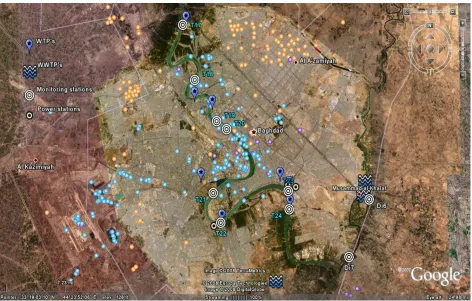
The capital city of Iraq, Baghdad has been selected as the study area (Figure 1). Baghdad is located at about 33.29˚N, 44.40˚E. The city lies on a vast plain bisected by the Tigris River. The Tigris splits Baghdad in half, with the Eastern half being called “Rusafa” and the Western half known as “Karkh”. The study area, covering the whole Baghdad Mayoralty (BM) area, is divided into eleven administrative districts (municipalities) viz. Ad- hamiya, Sader 1, Sader 2, Rusafa, Nissan, Karadah, Khadamiyah, Mansour, Karkh, Rasheed and Doura [5]. Baghdad has a hot arid climate and is, in terms of maxi-
mum temperatures, one of the hottest cities in the world. The city has about 7.4 million inhabitants (2005 esti- mate), situated in the interior of the country on the Tigris River at the point where land transportation meets river transportation, and where the distance between Tigris and the other main river of Iraq, Euphrates, is the shortest. The soil consists of about 10 m deep silt-clay soil strata on the surface, and thick sand/gravel strata beneath it [6]. The study region has been classified to 25 land use/land cover classes from 1973 to 2007 using ArcGIS v.9.1 software [7]. There are a wide variety of industries, pro- ducing leather goods, furniture, wood products, chemi- cals, electrical equipment, textiles, clothing, bricks, ce- ment, tobacco, processed food and beverages [8].
[image:2.595.63.535.418.719.2]Since 1991, the water supply and sanitation sector has experienced a steady but devastating decline. At the end of the 2003 war, Iraq’s infrastructure was seriously de- graded. The deficiency of basic infrastructure services has added to the general lack of security in various parts of the city. The majority of the population had limited or inadequate access to essential basic services. Those who could afford it relied on costly alternatives for electricity and water services. Contaminated water supplies, im- proper handling of solid waste and disposal of sewage led to environmental degradation and increased health hazards. What had escaped destruction and looting oper- ates at minimal capacity due to years of neglect and lack
of maintenance. This situation weakened urban econo- mies and the income of the population. Without the im- provement project, the current severely deteriorated pub- lic health and water environment in Baghdad will further get worse, and reducing essential services to its people. Public health conditions will continue to deteriorate in the absence of adequate sewerage services in Baghdad. Pollution of local groundwater and of the Tigris River, already serious, could rise to more dangerous levels. The disposal and waste system, and animal retention areas and pens are primitive, ineffective, and a major health risk. Furthermore, environmental standards for odour con- trol, waste disposal, and effluent control and treatment do not exist [1].
Furthermore, the unpaved and dilapidated conditions of roads in the cities and residential quarters, the lack of proper storm water drainage, and the formation of stag- nant water pools and the muddy/sandy roads’ conditions are impeding the flow of human and vehicular traffic and increasing health risks. The majorities of governorates suffer from insufficient and damaged urban roads and storm water drainage, street lighting and social facilities. Improving the roads’ conditions and increasing their ca- pacity in major urban areas becomes necessary for im- proved access of the populations to markets and social services and for the economic well-being of the city [9].
4. Proposed Projects
Various infrastructural projects that are considered for
the present study are described briefly below. These pro- jects are the initiatives taken up by the government of Iraq with the support of the international funding organi- zations like World Bank, JICA etc. to improve the dete- riorating status of water and wastewater treatment plants. They are briefly described in the following paragraphs.
4.1. Improvement of Integrated Sewerage System in Baghdad
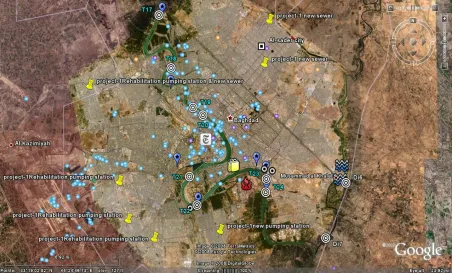
[image:3.595.72.526.446.719.2]In order to improve such acute deterioration of public health and environmental conditions in Baghdad, BM and the Japan International Cooperation Agency (JICA) started this project to establish an immediate improve- ment program for the Baghdad Sewerage System. Figure 2 represents the activity locations of project 1 The study area, covering the whole BM area, was divided into eleven administrative districts (municipalities) viz. Adhamiya, Sader 1, Sader 2, Rusafa, Nissan, Karadah, Khadamiyah, Mansour, Karkh, Rasheed and Doura. The sewer service area was divided into two sewer districts, 1) Rusafa and 2) Karkh. The study report [10] presented the results of identification and field survey on the present situation of Baghdad’s sewerage system, and provided planning bases for the forthcoming Master Plan (M/P) and Feasibility Study (F/S) on the improvement of Baghdad integrated sewerage system. Also the need for the sewerage system improvement strategy plan was examined, and priority sewerage components that are to be immediately reha- bilitated and/or extended were selected [11].
4.2. Emergency Baghdad Water Supply and Sanitation Project
This project represented the first phase of the Emergency Infrastructure Reconstruction Program, described in the Project Information Document (PID) of April 21, 2004 [1], which intended to cover five sectors: water supply and sanitation, electricity, urban rehabilitation, transport, and telecommunications. The project addresses the ur- gent reconstruction needs of Baghdad including water mains, distribution pipes, sewer collectors, pumping sta- tions, small treatment plants, and auxiliary facilities. It provides support to the MOB to better manage projects at the design, supervision, operation and maintenance stages by building the capacity of the staff working in the water supply and sanitation sector. It also includes the devel- opment of a Comprehensive City Development Plan (CCDP) to ensure that future expansion of the water sup- ply and sanitation networks are in line with the overall urban development plan for the city. The principal objec- tive of the project is to assist in restoring basic water supply and sanitation services for the capital city of Baghdad through 1) the reconstruction and rehabilitation of existing priority networks and treatment facilities and 2) providing capacity building support through training and technical assistance.
4.3. Emergency Water Supply, Sanitation and Urban Reconstruction Project
The project represents the part of the Emergency Infra- structure Reconstruction Program, described in the Project Information Document (PID) of April 21, 2004, which intended to cover five sectors: water supply and sanita- tion, electricity, urban rehabilitation, transport, and tele- communications [9]. The project addresses the urgent sectoral needs of urban communities outside Baghdad in- cluding rehabilitation of water and sewer networks, pump- ing stations, small treatment plants, community roads and other urban facilities. It provides support to the MMWP to better manage projects at the design, supervision, op- eration and maintenance stages by building the capacity of its staff.
The principal objective of the project is to restore some basic water supply, sanitation and urban services for urban areas outside Baghdad City through 1) the recon- struction and rehabilitation of existing facilities, and 2) providing capacity building support through training and technical assistance. This project also aims to improve the existing environmental and health conditions by re- newing the old water networks and sanitation services. It will also contribute to the reduction of waterborne dis- eases through the reduction of water supply by tankers and the provision of potable water and sanitation net- works. This would also help improve the economic con-
ditions of the population by reducing the amounts of wa- ter obtained from tankers, which is generally more ex- pensive.
4.4. Baghdad Infrastructure Reconstruction
The principal objective of the project is to restore essen- tial infrastructure and services by addressing the urgent reconstruction needs highlighted in the Needs Assess- ment. The project will also create badly needed employ- ment; and it will help build Iraq’s capacity to manage large-scale reconstruction. The component of this project includes rehabilitation of chlorine and chemical process in all water treatment plants, rehabilitation of pumping stations in all water treatment plants, constructing of new networks for newly planned cities and sub-cities, techni- cal assistance and capacity building [12].
5. Results of Environmental Assessment
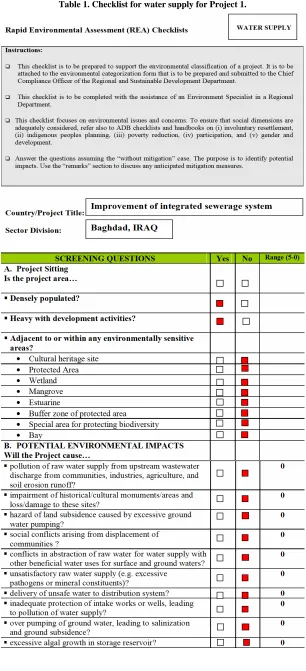
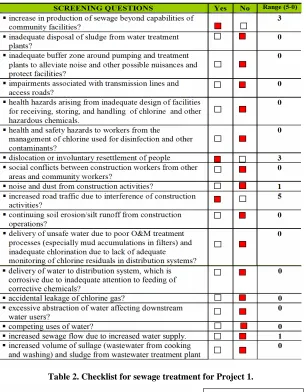
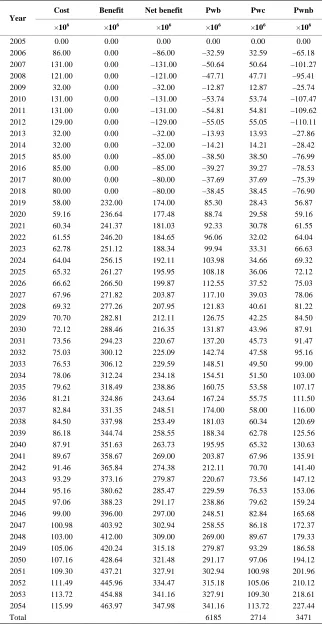
The details of evaluation for the first project are given below. The results of checklist are presented in Table 1 (water supply checklist) and Table 2 (sewage treatment checklist). The results for cost and benefit analysis are shown in Table 3. The same procedure of analysis has been adopted for the other three projects and overview is presented in the end. In the checklist for water supply and sewerage certain numerical values have been as- signed which measure the impact of a particular condi- tion in the checklist. These numerical values range from 0 to 5 where 0 means no impact and 5 means maximum impact. These values were assigned on the basis of visual interpretation of the project site and information provided by the Ministry of Environment.
The first project (Improvement of integrated sewerage system in Baghdad) satisfied all the conditions included in the checklist and the Strategic Environmental Assess- ment (SEA) method. From the cost and benefit method, the cost involved in the project was evaluated to be 2714 × 106 US$ the benefit 6185 × 106 US$. This gives a B.C Ratio of 2.28, which is greater than 1, indicating that the benefit obtained is more than the cost involved.
A brief discussion on the results obtained for the other projects is presented below:
Table 3. Cost and benefit analysis for Project 1.
Cost Benefit Net benefit Pwb Pwc Pwnb
Year
×106 ×106 ×106 ×106 ×106 ×106
2005 0.00 0.00 0.00 0.00 0.00 0.00
2006 86.00 0.00 –86.00 –32.59 32.59 –65.18
2007 131.00 0.00 –131.00 –50.64 50.64 –101.27
2008 121.00 0.00 –121.00 –47.71 47.71 –95.41
2009 32.00 0.00 –32.00 –12.87 12.87 –25.74
2010 131.00 0.00 –131.00 –53.74 53.74 –107.47
2011 131.00 0.00 –131.00 –54.81 54.81 –109.62
2012 129.00 0.00 –129.00 –55.05 55.05 –110.11
2013 32.00 0.00 –32.00 –13.93 13.93 –27.86
2014 32.00 0.00 –32.00 –14.21 14.21 –28.42
2015 85.00 0.00 –85.00 –38.50 38.50 –76.99
2016 85.00 0.00 –85.00 –39.27 39.27 –78.53
2017 80.00 0.00 –80.00 –37.69 37.69 –75.39
2018 80.00 0.00 –80.00 –38.45 38.45 –76.90
2019 58.00 232.00 174.00 85.30 28.43 56.87 2020 59.16 236.64 177.48 88.74 29.58 59.16 2021 60.34 241.37 181.03 92.33 30.78 61.55 2022 61.55 246.20 184.65 96.06 32.02 64.04 2023 62.78 251.12 188.34 99.94 33.31 66.63 2024 64.04 256.15 192.11 103.98 34.66 69.32 2025 65.32 261.27 195.95 108.18 36.06 72.12 2026 66.62 266.50 199.87 112.55 37.52 75.03 2027 67.96 271.82 203.87 117.10 39.03 78.06 2028 69.32 277.26 207.95 121.83 40.61 81.22 2029 70.70 282.81 212.11 126.75 42.25 84.50 2030 72.12 288.46 216.35 131.87 43.96 87.91 2031 73.56 294.23 220.67 137.20 45.73 91.47 2032 75.03 300.12 225.09 142.74 47.58 95.16 2033 76.53 306.12 229.59 148.51 49.50 99.00 2034 78.06 312.24 234.18 154.51 51.50 103.00 2035 79.62 318.49 238.86 160.75 53.58 107.17 2036 81.21 324.86 243.64 167.24 55.75 111.50 2037 82.84 331.35 248.51 174.00 58.00 116.00 2038 84.50 337.98 253.49 181.03 60.34 120.69 2039 86.18 344.74 258.55 188.34 62.78 125.56 2040 87.91 351.63 263.73 195.95 65.32 130.63 2041 89.67 358.67 269.00 203.87 67.96 135.91 2042 91.46 365.84 274.38 212.11 70.70 141.40 2043 93.29 373.16 279.87 220.67 73.56 147.12 2044 95.16 380.62 285.47 229.59 76.53 153.06 2045 97.06 388.23 291.17 238.86 79.62 159.24 2046 99.00 396.00 297.00 248.51 82.84 165.68 2047 100.98 403.92 302.94 258.55 86.18 172.37 2048 103.00 412.00 309.00 269.00 89.67 179.33 2049 105.06 420.24 315.18 279.87 93.29 186.58 2050 107.16 428.64 321.48 291.17 97.06 194.12 2051 109.30 437.21 327.91 302.94 100.98 201.96 2052 111.49 445.96 334.47 315.18 105.06 210.12 2053 113.72 454.88 341.16 327.91 109.30 218.61 2054 115.99 463.97 347.98 341.16 113.72 227.44
Total 6185 2714 3471
to buildings, nuisance to neighboring areas due to rodents, insects and noise. There was dislocation or involuntary resettlement of people, inadequate buffer zone around the pumping stations and social conflicts between construc- tion workers from other areas. Apart from this there was a lot of noise and dust from construction activities, traffic disturbances due to construction material temporary silt runoff due to construction. The SEA method showed that the project is unable to avoid conflicts between the water users. There was inadequate protection of intake wells and no buffer facilities have been provided to alleviate noise. The pumping stations for waste were not given enough buffer facilities and due to improper waste disposal tech- niques the downstream water quality was found to be bad.
Finally the total cost involved in the project is 267 × 106 US$ and the benefit attained was 367 × 106 US$. The B.C Ratio thus came out to be 1.33. Since the B.C Ratio is greater than 1, it indicates that the benefit attained is greater than the cost involved.
For the third project the water supply checklist indicated that there was inadequate buffer zone around pumping and treatment plants to alleviate noise and other possible nuisances and protect facilities. The project caused dis- location or involuntary resettlement of people. There was a lot of noise and dust from construction activities. There was increased volume of sullage and sludge from the wastewater treatment plant. The sewage treatment plants were flooded with overflowing sewage, blocking access to building and some were breeding grounds for mosque- toes and rodents. In some places there was discharge of hazardous materials into sewers resulting in blockage. Due to lack of funds and frequent wars, proper care was not taken towards groundwater pollution due to untreated sewage. The SEA method showed that in case of water supply the project satisfies all the conditions except for one condition, which said that no buffer facility was pro- vided around the project to alleviate noise and other nui- sances. This resulted in a lot of noise pollution in the sur- rounding areas. In case of sewage and sanitation checklist, the sewage pumping stations were located within the city and not well kept. They were not well buffered and in unhygienic conditions. In some cases the intake of the sewage treatment plants was more than its capacity, which lead to unhygienic conditions in the surrounding areas. Further, considering the cost and benefit method it was found that the cost involved in this project was 37 × 106 US$ and the benefit obtained was 62 × 106 US$. Thus the B.C Ratio came out to be 1.67. Since the B.C Ratio is greater than 1, it showed that the benefit is greater than the cost, which further indicated that the project is good. The total cost involved was found to be 267 × 106 US$ and the benefit attained, 367 × 106 US$. The B.C. Ratio came out to be 1.33. In this case also the B.C Ratio is
greater than 1, which indicated that the benefit is greater than the cost.
In case of the 4th project, the checklist for water supply showed that there is an inadequate protection of intake wells or works, leading to the pollution of water supply, increase in production of sewage beyond capabilities of community facilities, inadequate buffer zone around pump- ing stations and treatment plants to lower down noise, insufficient health and safety hazards to workers from the management of chlorine used for disinfection and other contaminants. In the checklist for sewage treatment most of the conditions were not satisfied. The conditions that were satisfied were adequate protection of historical places, adequate buffer zone protection to the pumping stations, settling social conflicts among the water users, protection from noise and dust and avoiding traffic disturbances. From the SEA method it was seen that in case of water supply, sometimes the treatment plant capacity was less than the intake due to which large qualities of wastewater and sewage was thrown untreated. The pumping stations were located within the cities and were not well main- tained giving rise to noise pollution and unhygienic con- ditions. Further, from the cost and benefit method, it was found that the total cost involved is 351 × 106 US$ and benefit, 395 × 106 US$. Thus the B.C Ratio was 1.12. This Ratio is again greater than 1, which shows the bene- fit is greater than the cost.
6. Conclusions
After evaluation one can say that the first project is the best project, the next best project is the third project fol- lowed by the second project and finally the least good project is the fourth project.
REFERENCES
[1] World Bank, “Emergency Baghdad Water Supply and Sanitation Project,” World Bank Iraq Trust Fund, Wash- ington DC, 2004, pp. 5-38.
[2] R. J. Kopp, A. J. Krupnick and M. Toman, “Cost-Benefit Analysis and Regulatory Reform: An Assessment of the Science and the Art,” Discussion Paper, Resources for the Future, Washington DC, 1997, pp. 79-86.
[3] ADB, “Environmental Assessment Guidelines,” Asian Development Bank, Mandaluyong City, 2003, pp 96-145.
[4] DAC, “Applying Strategic Environmental Assessment,” Development Assistance Committee DAC Guidelines and Reference Series,” OECD Organization for Economic Co- Operation and Development, Washington, 2006, pp. 17- 64.
[5] S. A. H. Saleh, A. F. Al-Bayati Sataa and A. W. Izzat Maha, “Evaluation and Forecasting of Baghdad City Pub-lic Services by GIS Techniques,” University of Technol-ogy Baghdad, Baghdad, 2007, pp. 5-12.
“As-sessment of Population Exposure Risk and Risk Zones due to Surface Water Quality by GIS—A Case Study on Sylhet,” ARPN Journal of Engineering and Applied
Sci-ences, 2006, pp. 1-3.
[7] S. A. H. Saleh, “Remote Sensing Technique for Land Use and Surface Temperature Analysis for Baghdad, Iraq,” University of Al-Nahrain, Baghdad, 2003, pp. 9-10.
[8] Central Intelligence Agency (CIA), “The Online Fact- book Is Updated Periodically throughout the Year,” McLean, 2008, pp. 1-13.
[9] World Bank, “Emergency water Supply, Sanitation and
Urban Reconstruction Project,” World Bank Iraq Trust Fund, Washington DC, 2004, pp. 8-94.
[10] UNEP Report, “Experience Funds for Project Provided to UN Trust Fund by Japanese Government, to Be Imple-mented by UNEP,” United Nations Environment Pro-gramme,Media, 2004, pp. 22-36.
[11] JICA, Japan International Cooperation Agency Guide-lines for Environmental and Social Considerations, To-kyo, 2004, pp. 11-20.