SEISMIC CONTROL OF STRUCTURES USING SHAPE MEMORY ALLOYS
*Gopika Shaji
Department of Civil Engineer
ARTICLE INFO ABSTRACT
There has been an increase in the use of concentrically braced frames, damage during past sesmic effects suggests that braced systems may perform poor due to limited ductility and energy dissipation, failure in the connection between the braces and the frame and asymmetric in tension and compression. One way of improving the performance of CBF system
drifts is the use of smart materials in the bracing system. Shape Memory Alloys (SMAs) are a novel functional material which can exhibit little residual strains under cycles of loading and unloading even after passing the
severe deformations which enable them to be widely used in numerous applications in the area of smart materials or intelligent materials. In this study, the behaviour of stee
braced frames are compared by performing time history analysis. The effect on displacement and stress distribution was analyzed and discussed.
materials earlier utilized in engineeri
designing and proposing innovative commercial products based on their unique characteristics.
Copyright © 2015 Gopika Shaji and Manju. This is an open access article distributed under the Creati unrestricted use, distribution, and reproduction in any medium, provided the original work is properly cited.
INTRODUCTION
Earthquake events cause destructions including permanent damage and failure of many buildings. Steel structures are mostly designed for safety conditions, where the earthquake energy is mainly dissipated through yielding of their nonlinear deformation. Structures are allowed to undergo severe damage – this means saving lives at the expense of structures incurring excessive economic losses. Recently, the seismic design of structures has evolved towards a performance approach in which there is need for new structural members and systems that possess enhanced deformation capacity and ductility, higher damage tolerance, and recovered or reduced permanent deformations. In the 1960s, Buehler and Wiley developed a series of nickel-titanium alloys,
composition of 53 to 57% nickel by weight,
unusual effect: severely deformed specimens of the alloys, with residual strain of 8-15%, regained their original shape after a thermal cycle. This effect known as shape-memory effect and the alloys exhibiting it were named shape
(SMAs). It was later found that at sufficiently high temperatures such materials also possess the property of super elasticity, that is, the ability of recovering large deformations during mechanical loading-unloading cycles performed at constant temperature.
*Corresponding author: Gopika Shaji, S.
Department of Civil Engineering, SNGCE, Kadayiruppu, Kerala, India
ISSN: 0975-833X
Vol.
Article History:
Received 25th September, 2015
Received in revised form
27th October, 2015
Accepted 09th November, 2015
Published online 21st December,2015
Key words:
Shape Memory Alloys, Pseudoelasticity, Shape Memory Effect, Seismic response.
Citation: Gopika Shaji, S. and Manju, P.M. 2015. “
Current Research, 7, (11), 23613-23617.
RESEARCH ARTICLE
SEISMIC CONTROL OF STRUCTURES USING SHAPE MEMORY ALLOYS
Gopika Shaji, S. and Manju, P.M.
Department of Civil Engineering, SNGCE, Kadayiruppu, Kerala, India
ABSTRACT
There has been an increase in the use of concentrically braced frames, damage during past sesmic effects suggests that braced systems may perform poor due to limited ductility and energy dissipation, failure in the connection between the braces and the frame and asymmetric in tension and compression. One way of improving the performance of CBF system
drifts is the use of smart materials in the bracing system. Shape Memory Alloys (SMAs) are a novel functional material which can exhibit little residual strains under cycles of loading and unloading even after passing the yield zone. They have the ability to remember a predetermined shape even after severe deformations which enable them to be widely used in numerous applications in the area of smart materials or intelligent materials. In this study, the behaviour of stee
braced frames are compared by performing time history analysis. The effect on displacement and stress distribution was analyzed and discussed. SMAs possess properties which are not present in materials earlier utilized in engineering practice. Accordingly, their use opens the possibility of designing and proposing innovative commercial products based on their unique characteristics.
is an open access article distributed under the Creative Commons Att use, distribution, and reproduction in any medium, provided the original work is properly cited.
Earthquake events cause destructions including permanent damage and failure of many buildings. Steel structures are mostly designed for safety conditions, where the earthquake energy is mainly dissipated through yielding of their nonlinear
uctures are allowed to undergo severe this means saving lives at the expense of structures incurring excessive economic losses. Recently, the seismic design of structures has evolved towards a performance-based s need for new structural members and systems that possess enhanced deformation capacity and ductility, higher damage tolerance, and recovered or reduced In the 1960s, Buehler and Wiley titanium alloys, with a composition of 53 to 57% nickel by weight, that exhibited an unusual effect: severely deformed specimens of the alloys, with 15%, regained their original shape after a memory effect and the alloys exhibiting it were named shape-memory alloys (SMAs). It was later found that at sufficiently high temperatures such materials also possess the property of super elasticity, that is, the ability of recovering large deformations unloading cycles performed at
Department of Civil Engineering, SNGCE, Kadayiruppu, Kerala,
Due to their unique properties, not present in most traditional materials, nowadays SMAs have attracted important attention from the scientific community. Shape Memory Alloys have been widely used in many different fields, in particular for aerospace, automotive and biomedical applications. In this paper the seismic analysis of different types of braced frames using both steel and SMA in ANSYS 14.5 is done.
SHAPE MEMORY ALLOYS
One of the important properties that make SMA an innovative is its superelasticity. A superelastic SMA can regain
shape very fast, even from its inelastic range,on unloading. Among various allos, Ni-Ti has been found to be the most efficient SMA for structural applications because of its large recoverable strain, peudo elasticity and good resistance to corrosion.
When an SMA specimen is undergoing cyclic axial deformation within its superelastic strain range, it dissipates a certain amount of energy without permanent deformation. This results from the phase transformation from austenite to martensite during loading and the reverse transformation during unloading release of net energy occurs. SMA with superelasticity has a merit over other common metals alloys is that besides releasing a considerable amount
contionous load cycles, it has a no residual strain. The factors used to define the material model are σ
International Journal of Current Research
Vol. 7, Issue, 12, pp.23613-23617, December, 2015
INTERNATIONAL
2015. “Seismic control of structures using shape memory alloys
SEISMIC CONTROL OF STRUCTURES USING SHAPE MEMORY ALLOYS
, India
There has been an increase in the use of concentrically braced frames, damage during past sesmic effects suggests that braced systems may perform poor due to limited ductility and energy dissipation, failure in the connection between the braces and the frame and asymmetric in tension and compression. One way of improving the performance of CBF systems in terms of limiting inter story drifts is the use of smart materials in the bracing system. Shape Memory Alloys (SMAs) are a novel functional material which can exhibit little residual strains under cycles of loading and unloading even yield zone. They have the ability to remember a predetermined shape even after severe deformations which enable them to be widely used in numerous applications in the area of smart materials or intelligent materials. In this study, the behaviour of steel braced frames and SMA braced frames are compared by performing time history analysis. The effect on displacement and SMAs possess properties which are not present in ng practice. Accordingly, their use opens the possibility of designing and proposing innovative commercial products based on their unique characteristics.
ve Commons Attribution License, which permits
Due to their unique properties, not present in most traditional materials, nowadays SMAs have attracted important attention from the scientific community. Shape Memory Alloys have been widely used in many different fields, in particular for omotive and biomedical applications. In this paper the seismic analysis of different types of braced frames using both steel and SMA in ANSYS 14.5 is done.
SHAPE MEMORY ALLOYS
One of the important properties that make SMA an innovative superelasticity. A superelastic SMA can regain its initial , even from its inelastic range,on unloading. Ti has been found to be the most efficient SMA for structural applications because of its large in, peudo elasticity and good resistance to
When an SMA specimen is undergoing cyclic axial deformation within its superelastic strain range, it dissipates a certain amount of energy without permanent deformation. This transformation from austenite to martensite during loading and the reverse transformation during unloading release of net energy occurs. SMA with superelasticity has a merit over other common metals alloys is that besides releasing a considerable amount of energy under contionous load cycles, it has a no residual strain. The factors used to define the material model are σsAS(austenite to
INTERNATIONAL JOURNAL OF CURRENT RESEARCH
martensite starting stress), σfAS (austenite to martensite
finishing stress), σsSA(martensite to austenite starting stress),
σfSA (martensite to austenite finishing stress) ,εL maximum
residual strain; and modulus of elasticity, ESMA
SCOPE
Failure of structures designed by conventional methods during recent earthquakes lead to the more effective methods. Passive control techniques are effective and novel alternative to conventional design methods. Shape Memory Alloys (SMA) are smart materials which can be utilized in structures aimed at eliminating the limitations of conventional methods. In the present study, analysis of buildings with steel braces and SMA braces under non-linear time history analysis is going to be study.
Finite element analysis
[image:2.595.338.527.144.255.2]The frame considered is of 3 storied having span of 9144 mm and storey height of 3962.4 mm. For braces ISMC 175 ,for Beams ISMB 150 and for columns ISMB 200 are considered.
Table 1. Details of Material Properties of SMA
Parameter Value
σSAM 520 MPa
σfAM 600 MPa
σSMA 240 MPa
σfMA 200 MPa
EA 60 GPa
Density 6450 kg/m3
Yield Strength 550 MPa
Poissons ratio .33
Recoverable elongation 8%
23614 Gopika Shaji and Manju, Seismic control of structures using shape memory alloys
Comparison of steel braced frame and sma braced frame
[image:2.595.141.456.308.493.2]Single- diagonal braced frame
Fig. 1. Maximum combined stress value of Single-diagonal Steel braced frame
[image:2.595.140.458.523.748.2]Chart 1. Graph of Maximum combined stress graph of single-diagonal braced frame
The output results from FE analysis show reduction in maximum combined stress when SMA braced frame is used. The maximum combined stres of building frame were decreased about 23 %by the use of SMA braces
Chart 2. Graph of Maximum combined stress graph of X- braced frame
0.00E+00 1.00E+07 2.00E+07 3.00E+07 4.00E+07 5.00E+07 6.00E+07 7.00E+07
1 5 9 13 17 21 25 29
ST
R
ES
S
(P
a)
TIME (s)
Stress Vs Time
steel
SMA
0.00E+00 2.00E+07 4.00E+07 6.00E+07 8.00E+07 1.00E+08
1 5 9 13 17 21 25 29
ST
R
ES
S(
P
a)
TIME (s)
Stress Vs Time
steel
SMA
[image:3.595.48.280.51.264.2]X-braced frames
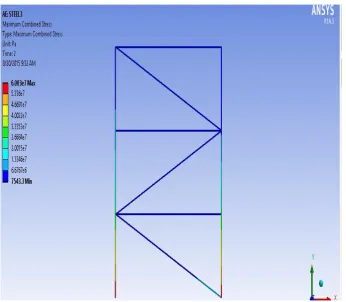
Fig. 3. Maximum combined stress value of X- braced frame with Steel
[image:3.595.317.547.106.293.2]The output results from FE analysis show reduction in maximum combined stress when SMA braced frame is used. The maximum combined stress of building frame were decreased about 30% by the use of SMA braces
The output results from FE analysis show reduction in maximum combined stress when SMA braced frame is used. The maximum combined stress of building frame were decreased about 23% by the use of SMA braces
23616 Gopika Shaji and Manju, Seismic control of structures using shape memory alloys
[image:4.595.128.475.131.433.2] [image:4.595.139.466.463.769.2]Single – diagonal alternate braced frames
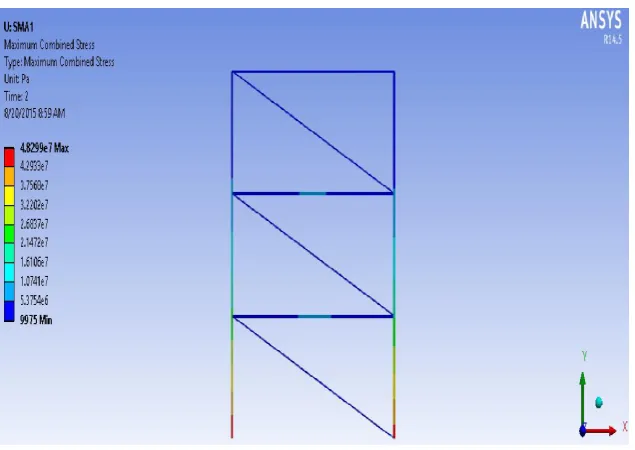
Fig. 5. Maximum combined stress value of Single – diagonal alternate braced frames with Steel
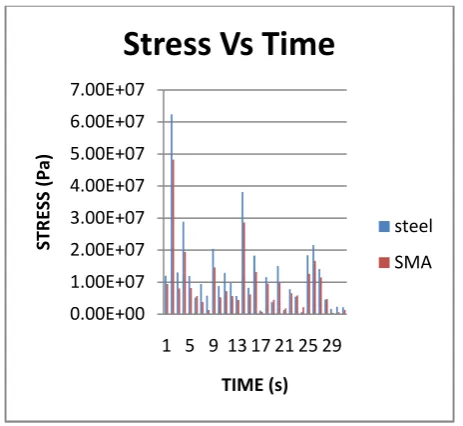
Chart 3. Graph of Maximum combined stress graph of Single-diagonal alternate braced frames with steel and SMA
Conclusion
During this study, finite element analysis was carried out on braced frames. A study was achieved by considering different types of commonly used bracings with both Steel and SMA. The maximum combined stress of single- diagonal braced frame were decreased about 23% by the use of SMA braces. The maximum combined stress of X- braced frame were decreased about 30% by the use of SMA braces. The maximum combined stress of single-alternate diagonal braced frame were decreased about 23% by the use of SMA braces.
The inter storey drift of SMA braces is less than that of steel braces for different type of conventional braced frames. Shape Memory Alloys (SMA) are smart materials which can be utilized in structures aimed at eliminating the limitations of conventional methods. SMA can be used for further research in the field like analysis of reinforced-concrete structures endowed with superelastic SMA braces, analysis of structures isolated by SMA-based devices, analysis of multistoried buildings with SMA as braces.
Acknowledgment
We would like to extend thanks to to Prof. Usha S., Professor, Civil Department, SNGCE and toDr. V. S. Pradeepan, Head, Department of Civil Engineering, SNGCE, for giving me necessary facilities and valuable suggestions for the successful completion of our work
REFERENCES
Alam MS, Nehdi M, Youssef MA. Seismic performance of concrete framestructures reinforced with superelastic shape memory alloys. Smart StructSyst, 2009;5(5):565–85. Ghobarah A. Performance-based design in earthquake
engineering: state of development. EngStruct., 2001; 23(8):878–84.
Saiidi MS, Zadeh M, Ayoub C, Itani A. A pilot study of behavior of concretebeams reinforced with shape memory alloys. J Mater Civil Eng ASCE, 2007;19:454–61.
Shahria Alam M., M. Moni, S. Tesfamariam, Seismic
overstrength and ductility of concrete buildings
reinforcedwith superelastic shape memory alloy rebar.
EngStruct., 2012;(34):8–20.
0.00E+00 1.00E+07 2.00E+07 3.00E+07 4.00E+07 5.00E+07 6.00E+07 7.00E+07
1 5 9 13 17 21 25 29
ST
R
ES
S
(P
a)
TIME (s)
Stress Vs Time
steel
SMA