• No results found

Impact of transformational and transactional leadership on organizational performance

N/A
N/A
Protected

Academic year: 2020

Share "Impact of transformational and transactional leadership on organizational performance"

Copied!
6
0
0

Loading.... (view fulltext now)

Full text

(1)

IMPACT OF TRANSFORMATIONAL AND TRANSACTIONAL LEADERSHIP ON ORGANIZATIONAL

1

Ben, Etim Udoh

Management, University of Nigeria, Enugu

ARTICLE INFO ABSTRACT

The study investigated the impact of transformational and transactional leadership styles on performance of manufacturing organizations in Cross River State of Nigeri

study are;

performance; to determine the relationship between transactional leadership style and organizational performance.

of senior and junior workers of the three selected organizations in Cross River State. Systematic sampling technique was employed in selecting the organizations from the list of registered companies in the state. A sample size of 286 was drawn from the population of 1005 through application of Taro Yamane formular. Questionnaire was the main instrument for data collection and was designed in a 5

were analysed with descriptive statistics, while the corresponding hypotheses were tested with Pearson Product Movement Correlation Coefficien at 0.05 alpha level. The findings indicate that there is significant positive relationship between transformational leadership style and organizational performance; there is a significant relationship between transactional leadership style and organizational performance. Thus, it was recommended that

style that will enable him or her to successfully integrate and maximize available resource within the internal and external environment for attainment of organizational and societal goals.

INTRODUCTION

Leadership is one of the critical elements in enhancing organizational performance. Being responsible for the development and execution of strategic organizational decisions, leaders have to acquire, develop, and deploy organizational resources optimally in order to bring out the best products and services in the best interest of stakehol (Bassey,2008:123). Contemporary school of thought mainly focuses on the two main dimensions of leadership; transformational and transactional leadership. Transformational leadership is a process in which the leaders take actions to try to increase their associates’ awareness of what is right and important, to raise their associates’ motivational maturity and to move their associates to go beyond the associates’ own self-interests for the good of the group, the organization, or society. Such leaders p

associates with a sense of purpose that goes beyond a simple exchange of rewards for effort provided. They attempt to optimize development, not just performance (Usoro. 2008:96). Transformational leadership is that which:

…. facilitates a redefinition of a people’s mission and vision, a renewal of their commitment and the restructuring of their systems for goal accomplishment. It is a relationship of mutual

*Corresponding author: [email protected],

[email protected]

ISSN: 0975-833X

Article History:

Received 18th August, 2012 Received in revised form 17thSeptember, 2012 Accepted 25th October, 2012 Published online 18th November, 2012 xxxxxxxxxxxxxxx

Key words:

Transformational leadership, Transactional leadership , Performance.

RESEARCH ARTICLE

IMPACT OF TRANSFORMATIONAL AND TRANSACTIONAL LEADERSHIP ON ORGANIZATIONAL

PERFORMANCE

Ben, Etim Udoh and

2

Agu . O. Agu

Management, University of Nigeria, Enugu Campus

ABSTRACT

The study investigated the impact of transformational and transactional leadership styles on performance of manufacturing organizations in Cross River State of Nigeri

study are; to determine the relationship between transformational leadership style and organizational performance; to determine the relationship between transactional leadership style and organizational performance. Cross sectional survey design was adopted. The population of the study was made up of senior and junior workers of the three selected organizations in Cross River State. Systematic sampling technique was employed in selecting the organizations from the list of registered companies in the state. A sample size of 286 was drawn from the population of 1005 through application of Taro Yamane formular. Questionnaire was the main instrument for data collection and was designed in a 5- point Likert scale format supported with per

were analysed with descriptive statistics, while the corresponding hypotheses were tested with Pearson Product Movement Correlation Coefficien at 0.05 alpha level. The findings indicate that there is significant positive relationship between transformational leadership style and organizational performance; there is a significant relationship between transactional leadership style and organizational performance. Thus, it was recommended that m

style that will enable him or her to successfully integrate and maximize available resource within the internal and external environment for attainment of organizational and societal goals.

Copy Right, IJCR, 2012,

Leadership is one of the critical elements in enhancing Being responsible for the development and execution of strategic organizational decisions, leaders have to acquire, develop, and deploy organizational resources optimally in order to bring out the best products and services in the best interest of stakeholders Contemporary school of thought mainly focuses on the two main dimensions of leadership; transformational and transactional leadership. Transformational leadership is a process in which the leaders heir associates’ awareness of what is right and important, to raise their associates’ motivational maturity and to move their associates to go interests for the good of the group, the organization, or society. Such leaders provide their associates with a sense of purpose that goes beyond a simple exchange of rewards for effort provided. They attempt to optimize development, not just performance (Usoro. 2008:96).

definition of a people’s mission and vision, a renewal of their commitment and the restructuring of their systems for goal accomplishment. It is a relationship of mutual

stimulation and elevation that converts followers into leaders and may convert leaders into moral agents. (Henry, 2007:67). The major premise of the transformational leader

leader’s ability to motivate the follower to accomplish more than what the follower planned to accomplish.

In contrast transactional leadership centred on leader

exchanges. Followers perform according to the will and direction of leaders and leaders positively reward the efforts. The primary goal of transactional leadership is to promote stability in the organization by creating a give

of exchange between managers and employers. Specific performance objectives are dete

employees. Constructive feedback is offered in terms of progress toward or away from rewards. Rewards are based upon meeting certain criteria. Mistakes are either actively or passively observed by managers and dealt with accordin (Martins 2004:45). Its fundamental assumption is that subordinates work in order to receive compensation.

(2008) believes that all managers could be classified by leadership style according to their propensity for transactions with, versus transformation of subordinates. Transformational leaders engaged with followers and sought new ways of working so as to achieve more for both themselves and followers than they would ordinarily. Transactional leaders engaged with followers as part of an excha

involved tangible rewards for superior performance

Available online at http://www.journalcra.com

International Journal of Current Research Vol. 4, Issue, 11, pp.142-147, November,2012

INTERNATIONAL

IMPACT OF TRANSFORMATIONAL AND TRANSACTIONAL LEADERSHIP ON ORGANIZATIONAL

The study investigated the impact of transformational and transactional leadership styles on performance of manufacturing organizations in Cross River State of Nigeria. The objectives of the to determine the relationship between transformational leadership style and organizational performance; to determine the relationship between transactional leadership style and organizational The population of the study was made up of senior and junior workers of the three selected organizations in Cross River State. Systematic sampling technique was employed in selecting the organizations from the list of registered companies in the state. A sample size of 286 was drawn from the population of 1005 through application of Taro Yamane formular. Questionnaire was the main instrument for data collection and point Likert scale format supported with personal interview. The data collected were analysed with descriptive statistics, while the corresponding hypotheses were tested with Pearson Product Movement Correlation Coefficien at 0.05 alpha level. The findings indicate that there is significant positive relationship between transformational leadership style and organizational performance; there is a significant relationship between transactional leadership style and managers should adopt a leadership style that will enable him or her to successfully integrate and maximize available resource within the internal and external environment for attainment of organizational and societal goals.

, Academic Journals. All rights reserved.

stimulation and elevation that converts followers into leaders and may convert leaders into moral agents. (Henry, 2007:67). The major premise of the transformational leadership is the leader’s ability to motivate the follower to accomplish more than what the follower planned to accomplish.

In contrast transactional leadership centred on leader-follower exchanges. Followers perform according to the will and ers and leaders positively reward the efforts. The primary goal of transactional leadership is to promote stability in the organization by creating a give- and – take type of exchange between managers and employers. Specific performance objectives are determined and communicated to employees. Constructive feedback is offered in terms of progress toward or away from rewards. Rewards are based upon meeting certain criteria. Mistakes are either actively or passively observed by managers and dealt with accordingly (Martins 2004:45). Its fundamental assumption is that subordinates work in order to receive compensation. Boseman (2008) believes that all managers could be classified by leadership style according to their propensity for transactions nsformation of subordinates. Transformational leaders engaged with followers and sought new ways of working so as to achieve more for both themselves and followers than they would ordinarily. Transactional leaders engaged with followers as part of an exchange process that involved tangible rewards for superior performance

(2)

Statement of the Problem

Leadership in today’s organization is a tough business. Organization leaders face a number of challenges as their jobs and world around them become increasingly complex. Trends, such as organizational re-structuring, globalization, rapid technological advances, cultural complexity and increasing demand for employee empowerment require that managers adopt techniques and style of leadership to meet these new challenges; thus efficiency in resources mobilization, allocation, utilization and enhancement of organizational performance depends to a large extent, on leadership style; but such is yet to be realized in real life situation of most organizations because of leadership style they adopt. The implication of this is that such organizations do not quickly respond to change and fold up few years after taking off. Thus, the study focuses on impact of transformational and transactional leadership on organizational performance.

Objectives of the study

The specific objectives of the study are:

1. To determine the relationship between transformational leadership style and organizational performance.

2. To determine the relationship between transactional leadership style and organizational performance.

Research Questions [

This study will focus on answering the following research questions;

1. What is the relationship between transformational leadership style and organizational performance? 2. What is the relationship between transactional

leadership style and organizational performance?

Hypotheses

The following null hypotheses will be tested for the purpose of the study;

1. Ho:There is no significant relationship between transformational leadership style and organizational performance.

H1:There is significant relationship

betweentransformational leadership style and organizational performance.

2. Ho:There is no significant relationship between

transactional leadership style and organizational performance.

H1:There is significant relationship between

transactional leadership style and organizational performance.

Theoretical Framework

Transformational Leadership Style

Transformational leadership theory has captured the interest of many researchers in the field of organizational leadership over the past three decades. This theory was developed in the late 20th century by Burns (1978) in his analysis of political leaders. Prior to this time much attention had been given to the examination of the approaches of leaders who successfully

transformed organizations. Burns characterized transformational leadership as that which “occurs when one or more persons engage with others in such a way that leaders and followers raise one another to higher levels of motivation and morality”. The goal of transformational leadership is to ‘transform’ people and organizations in a literal sense to change them in mind and heart: enlarge vision, insight, and understanding; clarify purposes; make behavior congruent with beliefs, principles, or values; and bring about changes that are permanent, self- perpetuating, and momentum building (Masi, 2008 :23). Johnson(2009;30) opined that transformational leaders seek new ways of working, seek opportunities in the face of risk, prefer effective to efficient answers and are less likely to support the status quo. Transformational leaders do not merely react to environmental circumstances; they attempt to shape and create them. According to Johnson (2009:32), transformational leaders exhibit the following:

Intellectual stimulation: Transformational leaders encourage

their followers to be innovative and creativity. They encourage new ideas from their followers and never criticize them publicly for the mistakes committed by them. The leaders focus on the “what” in problems and do not focus on blaming part of it. They have no hesitation in discarding an old practice set by them if it is found ineffective (Johnson, 2009:32).

Inspirational motivation: They articulate an appealing vision

of the future, challenge followers with high standards, talks optimistically and enthusiasm and provide encouragement and meaning for what needs to be done (Johnson, 2009:32).

Idealized influence: They display conviction, emphasize

trust, take stands on difficult issues, present their most important values and the importance of purpose, commitment, and the ethical consequences of decision (Johnson, 2009:33).

Individualized consideration: Leaders act as mentors to their

follower and reward them for creativity and innovation. The followers are treated differently according to their talents and knowledge. They are empowered to make decisions and are always provided with the needed support to implement their decisions (Johnson, 2009:33). Richard and Clifford (2008:65) found out that leaders who display the four behaviours of transformational leadership are able to realign their followers’ values and norms, promote both personal and organizational changes, and exceed their initial performance expectations.

According to Richard and Clifford (2008:67), transformational leaders go beyond exchanging contractual agreements for desired performance by:

 Actively engaging followers’ personal value systems and providing ideological explanations that link followers’ identities to the collective identity of their organisation, thereby increasing followers’ intrinsic motivation (rather than extrinsic motivation) to perform their job.

(3)

 Raising the performance expectations of followers so increasing their willingness to transcend their self-interests for the sake of the collective entity.

Scott and Peter (2009:87) asserted that by providing intellectual stimulation, transformational leaders encourage followers to adopt generative and explorative thinking process. They stimulate their followers to think about old problems in new ways and encourage them to challenge their own values, traditions, and beliefs. By showing high expectations and confidence in their followers’ capabilities, they help to develop their followers’ commitment to long term goals, missions, and vision thereby shifting their focus from short term and immediate solutions and objectives to long-term and fundamental solutions and objectives.

Transactional Leadership Style

Transactional leadership has been of great interest to many researchers in the current era. According to Bassey (2005:234), transactional leadership centred on leader-follower exchange. Followers perform according to the will and the direction of the leaders and leaders positively reward the efforts. The baseline is reward which can be negative like punitive action, if followers fail to comply with or it can be positive like praise and recognitions, if subordinates comply with the intent and direction settled by a leader and achieve the given objective. Transactional leadership seeks to maintain stability rather than promoting change within an organization through regular economic and social exchange that achieve specific goals for both the leaders and their followers. Its fundamental assumption is that subordinates work in order to receive compensation (Micheal, 2005:38). Four core facets of transactional leadership as described by Philip (2000:45) are contingent rewards, active management by exception, passive management by exception and laissez-faire.

Contingent Rewards: Transactional leaders link the goal to

rewards, clarify expectations, provide necessary resources, set mutually agreed upon goals, and provide various kinds of rewards for successful performance. They set SMART (specific, measurable, attainable, realistic, and timely) goals for their subordinates (Philip, 2000:45).

Active Management by Exception: Transactional leaders

actively monitor the work of their subordinates, watch for deviations from rules and standards and taking corrective action to prevent mistakes (Philip, 2000:45)

Passive Management by Exception: Transactional leaders

intervene only when standards are not met or when the performance is not as per the expectations. They may even use punishment as a response to unacceptable performance (Philip, 2000:46)

Laissez- faire: The leader provides an environment where the

subordinates get many opportunities to make decisions. The leader himself abdicates responsibilities and avoids making decisions and therefore the group often lacks direction (Philip, 2000:46)

Transformational Leadership And Performance

Transformational leadership styles have been validated against numerous outcome variables such as the impact on followers’ extra effort, organizational commitment, satisfaction, and perceived performance. There are numerous articles in the

literature as well as studies that have reported a relationship between transformational leadership and higher levels of follower effort, satisfaction with the job and leader, and perceived performance compared to other leadership styles (Kinsman, 2006; Bennis, 2008; Limerick and Simon, 2007; Howell & Morris, 2009). By articulating a compelling and positive vision of the future, communicating high performance expectations, role modelling, and displaying confidence in followers’ ability to meet high expectations, transformational leaders have been found to positively influence followers

The transformational leader strives to achieve results beyond what is normal and sets higher corporate goals by inspiring a sense of importance about the team’s mission, by stimulating employees to think innovatively about a problem or task in new ways, and by placing group goals over personal self-interest (James, 2005:90). Kelloway and Barling (2000) report that transformational leadership behaviours trickle down through the organization, raising the level of performance at all levels. Transformational leaders also influence followers by raising their level of consciousness about the importance and value of designated goals and how the followers can help reach these outcomes (making the organization’s goals, the leaders’ followers’ goals). According to Leli (2008:81), transformational leaders can do this by “… altering followers’ needs levels on Maslow’s need hierarchy or by expanding their portfolio of needs and wants ” One of the core tenets of transformational leadership is that it transforms the individual as well the relationship between leader and follower. There are other things that transformational leaders do to improve individual performance and positively impact organizational performance. According to Bennis (2008:57) these leaders place much value and emphasis on developing a vision and inspiring followers to pursue the vision; they concentrate their efforts on longer term versus short term goals; they change or align systems to accommodate their vision rather than work within existing systems; and they coach to take on more responsibility for their own development as well as the greater development of others. It is in realization of this fact that Brown (2009) contends that:

……this is a time which calls for a critical mass of transformational leaders who will commit to creating a synergy of energy within their circle of influence so that new level of social, economic, organizational and spiritual success can be reached. We have not, however, developed the leaders we need for this noble task. To reach such heights, we will need to un tap the leadership potentials of skilful leaders who are successfully directing various organizations and systems. Some of these men and women, knowledgeable and committed to their profession, will be the transformational leaders we need to create the needed synergy for energy.

Transactional Leadership And Organizational

Performance

(4)

an economic exchange transaction Premack (2009) argue that finding ways of enhancing goal commitment is a key leadership task, suggesting that this may be achieved by strengthening individuals’ outcome expectancies and self- efficacy. Transactional leadership represent a viable way of strengthening subordinates’ goal commitment by providing the required clarifications for subordinates on how to attain work goals and on which intrinsic and extrinsic rewards subordinates will receive upon goal attainment thereby motivating them to contributes immensely towards improving organizational productivity.

Criticism of Transformational Leadership

The morality of transformational leadership has been questioned, especially by libertarian and organizational development consultants. Slack (2008:123) notes, transformational leadership lack the checks and balances of countervailing interests, influences and power that might help to avoid dictatorship and oppression of a minority by a majority. In the absence of moral rectitude it is self-evident then that transformational leadership might be applied for less- than- desirable social ends.

Criticism of Transactional Leadership

The main limitation of transactional leadership is that it assumes that people are largely motivated by simple rewards. Employees cannot do much to improve job satisfaction under transactional leadership. This style of leadership is less interested in changing working environment and as such has been ineffective in providing skilled workers to organization. Experts do not recommend this approach because it focuses more on management of punishment and rewards (Jackson, 2008:26).

METHODOLOGY

The study adopted survey method. The population of the study is made up of senior and junior workers of the three selected organizations in Cross River State. Systematic sampling technique was employed in selecting the organizations from the list of registered companies in the state. A sample size of 286 was drawn from the population of 1005 through application of Taro Yamane formular at 5% error tolerance. The sources of data were both primary and secondary. The primary data were collected through questionnaire administration supported with personal interview while secondary data were obtained from journals, textbooks and internet. The questionnaire was designed in a 5- point Likert scale format. Two hundred and eighty six copies of the questionnaire were administered. All the copies were duly completed and returned. The data collected from the field were presented and analyzed with descriptive statistic while the corresponding hypotheses were tested with Pearson’s Correlation at 0.05 alpha level with the aid of computer through the application of Statistical Package for Social Science (SPSS 15.0 version).

DATA ANALYSIS AND DISCUSSION

The data obtained from the field were presented and analyzed with descriptive statistics to provide answers for the research

questions while the corresponding hypotheses were tested with Pearson’s Correlation at 0.05 alpha level.

What is the relationship between transformational leadership style and organizational performance?

Table 1: Coded Responses on Transformational Leadership style and Organizational Performance.

s/no Questionnaire items S.Agree

/Agree

Disagree /S.Disagree

Undecided

Freq % Freq % Freq % Total

(Freg)

1 Transformational

leadership fosters

innovative thinking

among followers in

order to enhance

individual and group performance?

256 89 16 6 14 5 286

2 Transformational

leadership empowered

followers, boast

employees’ trust and self-

efficacy to sustain

performance?

271 95 7 2 8 3 286

3 Transformational

leadership promotes

organizational citizenship behaviour, culture and vision to induce commitment to organizational goal?

263 91 17 6 6 2 286

TOTAL 790 40 28 858

Source: fieldwork 2011

According to table (1) based on aggregate response 790(92%) indicated strongly agree, 40(5) indicated disagree while 22 (2%) indicated undecided. This implies that there is a relationship between transformational leadership style and organizational performance.

Ho1: There is no significant relationship between

[image:4.595.315.558.145.344.2]

transformational leadership and organizational performance.

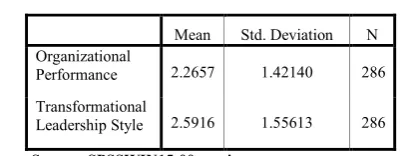
Table 2: Descriptive Statistics of the Relationship between Transformational Leadership Style and organizational

Performance

Mean Std. Deviation N

Organizational

Performance 2.2657 1.42140 286

Transformational

Leadership Style 2.5916 1.55613 286

Source: SPSSWIN15:00 version

Table 3: Correlation Matrix on the Relationship between Transformational and Organizational Performance

Organization al Performance

Transformati onal Leadership

Style Organizational

Performance

Pearson

Correlation 1 .754*

Sig. (2-tailed) .000

N 286 286

Transformational Leadership Style

Pearson

Correlation .754* 1

Sig. (2-tailed) .000

N 286 286

** Correlation is significant at the 0.05 level (2-tailed).

[image:4.595.331.536.497.575.2]
(5)

Table 2 shows the descriptive statistics of the relationship between transformational leadership style and organizational performance, with a mean response of 2.59 and std. deviation of 1.55 for transformational leadership style and a mean response of 2.26 and std. deviation of 1.42 for organizational performance. By careful observation of standard deviation values, it can be said that there is about the same variability of data points amongst the dependent and independent variables. This implies that transformational leadership style constitutes a greater percentage of variables that affect organizational performance positively. Table 3 is the Pearson correlation coefficient matrix of the relationship between transformational leadership style and organizational performance, showing the correlation coefficient, significant values and the number of cases. The correlation coefficient shows 0.75 this value indicates that correlation is significant at 0.05 level (2tailed) and implies that there is a relationship between transformational leadership style and organizational performance (r = .75). However, the computed correlations coefficient is greater than the table value of r = .195 with 284 degrees of freedom (df. = n-2) at alpha level for a two-tailed test ((r = .75, p< .05). This result indicates that there is a significant relationship between transformational leadership style and organizational performance. Therefore, the null hypothesis should be rejected.

[image:5.595.317.554.79.195.2]

What is the relationship between transactional leadership style and organizational performance?

Table 4: Coded Responses on Transactional Leadership Style and Organizational Performance

s/no Questionnaire items S.Agree

/Agree

Disagree

/S.Disagree Undecided

Freq % Freq % Freq % Total

(Freq

4 Transactional leadership

boasts employees’ morale by rewarding individuals with praise or recognition when they performed at or

above expectation to

improve performance

263 92 17 6 6 2 286

5 Transactional leadership

induces employees’

commitment through

criticism, correction, and

censure to keep

performance aligned with what is expected.

257 90 19 7 10 3 286

6 Transactional leadership

motivate followers with rewards and punishment to induce commitment

260 91 20 7 6 2 286

780 56 22 858

Source: fieldwork 2011

According to table (4) based on aggregate response 780(91%) indicated strongly agree, 56(6) indicated disagree while 22 (3%) indicated undecided. This implies that there is a relationship between transactional leadership style and organizational performance.

Ho2: There is no significant relationship between

transactional leadership style and organizational

performance.

Table 5: Descriptive Statistics of the Relationship between Transactional Leadership Style and organizational Performance

Mean Std. Deviation N Organizational Performance 1.3182 .67029 286 Transactional Leadership 2.0168 1.16119 286

Source: SPSSWIN15:00 version

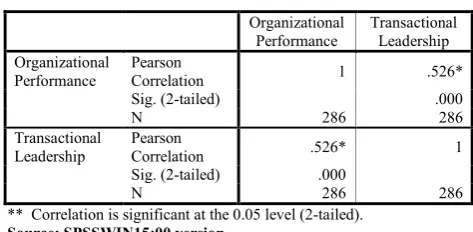
Table 6: Correlation Matrix on the Relationship between Transactional and Organizational performance

Organizational Performance

Transactional Leadership Organizational

Performance

Pearson

Correlation 1 .526*

Sig. (2-tailed) .000

N 286 286

Transactional Leadership

Pearson

Correlation .526* 1

Sig. (2-tailed) .000

N 286 286

** Correlation is significant at the 0.05 level (2-tailed).

Source: SPSSWIN15:00 version

Table 5 shows the descriptive statistics of the relationship between transactional leadership style and organizational performance, with a mean response of 2.01 and std. deviation of 1.16 for transactional leadership style and a mean response of 1.31 and std. deviation of .67 for organizational performance. By careful observation of standard deviation values, it can be said that there is about the same variability of data points amongst the dependent and independent variables.

Table 6 is the Pearson correlation coefficient matrix of the relationship between transactional leadership style and organizational performance, showing the correlation coefficient, significant values and the number of cases. The correlation coefficient shows 0.52 this value indicates that correlation is significant at 0.05 level (2tailed) and implies that there is a relationship between transactional leadership style and organizational performance (r = .52). However, the computed correlations coefficient is greater than the table value of r = .195 with 284 degrees of freedom (df. = n-2) at alpha level for a two-tailed test ((r = .52, p< .05). This result indicates that there is a significant relationship between transactional leadership style and organizational performance. Therefore, the null hypothesis should be rejected.

Summary of Findings

The study found that:

1. There is a significant relationship between transformational leadership style and organizational performance. The test of hypothesis one confirmed this (r =.75: tc = 0.75 > tt = 0.195).

2. There is a significan relationship between transactional leadership style and organizational performance. The test of hypothesis two confirmed this (r =.52: tc = 0 .52 > tt = 0.195).

Conclusion

[image:5.595.38.289.412.587.2]
(6)

subordinates will receive upon goal attainment thereby motivating them to contribute immensely towards improving organizational productivity.

Recommendations

Managers should adopt a leadership style that will enable him or her to successfully integrate and maximize available resource within the internal and external environment for attainment of organizational and societal goals. Training of management/senior staff on leadership style should be regular in order to equip them on the need to be proactive and responsive to today’s dynamic work environment for better performance.

REFERENCES

Bassey, L .P and Iniekon, D. G.(2008). The Executive Leadership and Performance Management. Calabar: University of Calabar Press.

Bassey, J. F.(2005). Management: Theory, Process and Practice. Calabar: University of Calabar Press.

Benis, P.S.(2008). The join Effects of Conscientiousness and Self‐Leadership Training on Employee Self‐Directed Behavior in a Service Setting. http://www.hpsy.org/articles/clm3.html, Accessed 18 June 2012.

Bisong, S. J. and Inyang. B.(2008). Improving Leadership Effectiveness. Calabar: Clear Lines Publishers.

Boseman, D.(2008). From Transactional to Transformational leadership: Learning to Share the Vision. http://www.manconsult.org/articles/clm2.htm Accessed 12 June 2012

Brown, Y. P. (2009). Transformational leadership and Multiple Levels of Leadership.

http://www.consult.org/articles/clm3.html Accessed 23 May 2012

Henry, F. J (2007). The Effects of Transformational and Transactional Leadership on Quality Improvement. Management Journal. 2, 7-24.

Hickman, E. C.(2006). An Examination of the Relationship between Leadership Behavior and Organizational Commitment at Steel Companies. Journal of Applied Management and Entrepreneurship, 7, 12-26.

Howell, T.and Morris (2009). Superiors’ Evaluations and Subordinates’ Perceptions of Transformational and Transactional Leadership.

http://www.ijrcm.org/articles/cm3.ht.

Jackson, R. W.(2008). Leadership: Good, Better, Best. Organizational Dynamic. ,Journal of Management, 2, 25-26.

James, k. M.(2005). A Meta‐Analysis of Transformational and Transactional Leadership Correlates of Effectiveness and Satisfaction. http://www.ijrcm.org/articles/cm3.ht. Johnson, R. M.(2009). Transformational and Transactional

Leadership and Performance. Journal of the Academy of Marketing Science, 29, 23-30

Kelloway, P. And Barling, H.N.(2005). Leader‐Member Exchange as a Mediator of the Relationship between Transformational Leadership and Followers’ Performance and Organizational Citizenship Behavior, http://www.manconsult.org/articles/clm2.htm Accessed 12 June 2012

Kinsman, R. Z.(2006). Transformational Leadership and Job Behaviors: The Mediating Role of Core Job Characteristics.

http://www.consult.org/articles/clm3.html, Accessed 15 April 2012.

Leli, R. K. (2008). Impact of Transformational and Transactional Leadership on Follower Development and Performance. Accessed 12 June 2012.

Limerick, G and Simon, C. D.(2007). Predicting Unit Performance by Assessing Transformational and TransactionalLeadership.

http://www.ijrcm.org/articles/cm3.ht.

Martins, M. (2004). Transformational Leadership and Organizational Culture. International Journal of Public Administration, 3, 45-48.

Masi, R. I.(2008). Further assessment of Bass’s (1985) Conceptualization of transactional and transformational leadership. Journal of Applied Psychology, 7, 23-28. Micheal, B. K.(2005). Transformational Leadership,

Transactional Leadership, Locus of Control, and Support for Innovation: Key Predictors of

Consolidated‐Business‐Unit Performance. Journal of Applied Psychology, 37-39,

Philip, L. J.(2000). Transformational and Transactional Leadership: A Meta‐Analytic test of their Relative Validity. http://www.manconsult.org/articles/clm2.html, Accessed 15 April 2012.

Premack, F. K.(2009). Management and Organizational Behaviour. New Delhi: Wheel and Company.

Richard,E, and Clifford, S. L.(2008). The role Transformational Leadership in Enhancing Organizational Innovation. Journal of Management, 2, 65-68.

Robbinson, L. P. (2008). The Implications of Transactional and Transformational Leadership for Individual, team, and Organizational Development.

http://www.ijrcm.org/articles/cm3.ht. Accessed 26 June 2012.

Scott, M. H and Peter, W.(2009). Empirical Investigation of the Effects of Transformational and Transactional Leadership on Organizational Climate. Journal of Applied Psychology, 4, 16-18.

Slack, E. G.(2008). Follower Behavior and Organizational Performance: The Impact ofTransformational Leaders. Journal of Leadership and Organizational Studies. 3, 123– 127.

Figure

Table 2: Descriptive Statistics of the Relationship between Transformational Leadership Style and organizational Performance
Table 6: Correlation Matrix on the Relationship between Transactional and Organizational performance

References

Related documents

“Collaborative Leadership: An Essential Component of Public Health.” International Leadership Association Annual Meeting, Guadalajara, Mexico, November 2003 “Public Health

Patient ’ s value in terms of healthcare outcomes and patient experience, by leveraging digital technologies and next-gen solutions to address both healthcare outcomes and.

For example, IEEE Standard 610.12 defines software engineering as “the application of sys- tematic, disciplined, quantifiable approaches to the development, operation, and

Plant: Indicators that spider mites are present include pale colored, minute spots (“fleck- ing”) on both deciduous and evergreen leaves, leaf or needle discoloration ranging

Free Market.—At the free market yesterday 576 persons, members of soldiers families, were supplied with the following provisions: 1400 pounds flour, 30 bushels corn meal, 600

All of the drugs below are commonly given by subcutaneous bolus or infusion in palliative care patients regardless of their licensed routes of administration?. Note: If

Akamai is growing the customer base for its WAF offering mainly from existing clients of other cloud services in the U.S., but Gartner does not see the vendor winning deals on