arXiv:1703.05296v2 [math.QA] 4 Oct 2017
ON THE PERTURBATION ALGEBRA
J. CHUANG AND A. LAZAREV
Abstract. We introduce a certain differential graded bialgebra, neither commutative nor co-commutative, that governs perturbations of a differential on complexes supplied with an ab-stract Hodge decomposition. This leads to a conceptual treatment of the Homological Pertur-bation Lemma and its multiplicative version. As an application we give an explicit form of the decomposition theorem forA∞algebras andA∞ modules and, more generally, for twisted objects in differential graded categories.
Contents
1. Introduction 1
1.1. Notation and conventions 2
2. Category of abstract Hodge decompositions 2
3. The perturbation algebra 4
3.1. Definition and first properties 4
3.2. Abstract Perturbation Lemma and its consequences 5
3.3. Minimal models forA∞ algebras 8
3.4. Gauge equivalence and the decomposition theorem 9
3.5. Decomposition theorem in categories of twisted objects 12
References 13
1. Introduction
The Homological Perturbation Lemma (HPL) is a kind of a homotopy transfer theorem: it allows one to transfer a perturbed differential of a (co)chain complex onto another one, that is a strong deformation retract of it, see [5] and references therein. One interesting feature of HPL is that it gives explicit universal formulae, as formal power series in the original strong deformation retract data. The standard proof of HPL is based on algebraic manipulations with certain linear operators and we introduce a certain algebraAthat captures the properties of these operators, leading to an abstract version of HPL, of which the ordinary HPL is a consequence. It should be noted that in [1] the term ‘Perturbation Algebra’ is reserved for a different, though closely related, algebra, that is not differential graded (the differential is viewed as its element rather than an operator). It is possible that our results could be recovered in the framework of [1], but we found that working with the smaller differential graded object is more natural.
The category of modules over A is, essentially, the category of strong homotopy retractions (in fact, we find it more convenient to work with an equivalent notion of an abstract Hodge decomposition) with a perturbed differential. This category is non-symmetric monoidal, which corresponds to a certain comultiplication on A turning it into a noncommutative and nonco-commutative bialgebra. We introduce a certain localization ˆA of Awhich turns out also to be a bialgebra. This bialgebra, despite having a simple presentation by very few generators and relations, exhibits a surprisingly rich structure; it is a central object of study in this paper. We discover a certain remarkable endomorphism of ˆA that leads to a strengthened version of the
2010 Mathematics Subject Classification. 18D50, 17B55, 17B66, 16E45.
Key words and phrases. Abstract Hodge decomposition, differential graded algebra, Maurer-Cartan element. This work was partially supported by EPSRC grants EP/N015452/1 and EP/N016505/1.
HPL, as well as its multiplicative version [8]. As a corollary, we obtain a decomposition theorem forA∞ algebras: every such algebra is isomorphic to the direct sum of a minimalA∞ algebra (having zero cohomology) and a linear contractible one. A similar result is also obtained for A∞ modules over an A∞ algebra. The structure maps for the minimal module as well as for theA∞isomorphism are explicitly described in terms of summation over certain trees.
1.1. Notation and conventions. We work in the category ofZ-graded (dg) vector spaces over a fixed ground field k; an object in this category is a pair (V, dV) where V is a graded vector
space and dV is a differential on it; it will always be assumed to be of cohomological type (so
it raises the degree of a homogeneous element). Unmarked tensor products will be understood to be taken over k; we will abbreviate ‘differential graded’ to ‘dg’. Thesuspension of a graded vector space V is the graded vector space ΣV so that (ΣV)i =Vi+1.
The gradedk-linear dual to a graded vector spaceV is denoted byV∗; it is apseudo-compact
vector space, i.e. an inverse limit of finite-dimensional (graded) vector spaces. Pseudo-compact vector spaces are endowed with the topology of the inverse limit and form a category where maps are required to be continuous. The category of pseudo-compact vector spaces is anti-equivalent to that of (discrete) vector spaces via linear duality; we refer to [16] for a short account on pseudo-compact spaces. All results and constructions of this paper are valid when we work in the underlying category of pseudo-compact graded vector spaces.
A dg algebra is an associative monoid in the dg category of dg vector spaces with respect to the standard monoidal structure given by the tensor product. A dg vector space V is a (left) dg module over a dg algebra A if it is supplied with a dg mapA⊗V →V satisfying the usual conditions of associativity and unitality.
A Maurer-Cartan (MC) element in a dg algebra A is an element x of cohomological degree 1 satisfying the MC equation d(x) +x2 = 0. It determines a twisted differential in A by the formuladx(a) :=d(a)+[x, a] fora∈A; the MC equation ensures that (dx)2 = 0. We will denote the dg algebra Asupplied with the differential dx by Ax. The MC element xalso determines a twisting of any dg A-module (M, dM); namely the differential d+x (where x is viewed as an
operator onM) makes M into a left dg Ax-module as could easily be checked; we will denote
this dg A-mod by M[x]. The group A×0 of invertible elements γ of A0 acts on the set of MC elements inA by via the gauge action: γ·x:=γxγ−1−d(γ)γ−1.
The paper is organized as follows. In Section 2 we recall the definition of an abstract Hodge decomposition and introduce a dg bialgebra governing this structure. In Section 3 the Per-turbation Algebra, our main object of study, is introduced and studied in some detail; this is, in fact a dg bialgebra, neither commutative nor cocommutative. We formulate and prove an abstract version of the HPL, of which the ordinary HPL is a corollary. We further strengthen HPL by proving that the perturbed differential is actually conjugate to a transferred one in a suitable sense. A decomposition theorem for twisted objects in a differential graded category is a consequence of the strengthened HPL. Specializing further, we obtain an explicit form of the decomposition theorem for A∞ modules.
2. Category of abstract Hodge decompositions
In this section we will recall the definition of an abstract Hodge decomposition on a dg vector space; this terminology was introduced in [4].
Definition 2.1. An abstract Hodge decomposition on a dg vector space (V, d) is a pair of operators t, son V
t:V →V and s:V →V, of degrees 0 and −1 respectively, such that
(1) s2 = 0,
(2) sd+ds= 1−t, (3) dt=td,
(5) st=ts= 0,
We will also refer to the quadruple (V, d, s, t) (or the triple (V, s, t) ifdis clear from the context) as an abstract Hodge decomposition and use the shorthand HD for it.
Remark 2.2. The notion of an HD could be reformulated as follows. Let U := Im(t) be the image of the operatort. It follows from the identity (3) above that the differential onV restricts to a differential onU and that the projectiont:V →U and the inclusioni:U ֒→V determine chain maps between the dg spaces U and V. The conditions (2) and (4) above imply that t◦i= idU and that i◦t is chain homotopic to the identity on V. Thus, the pair of dg vector
spaces V and U constitute a strong deformation retraction data. The condition s2 = 0, the so-calledside condition, can always be imposed at no cost. It is more convenient for us to view the above as the structure on a single space V.
Let (V, tV, sV) and (W, tW, sW) be dg vector spaces with the choice of an HD. Then the
operatorst⊗tand s⊗1 +t⊗sdetermine an HD on the vector space V⊗W. A straightforward inspection shows that this turns the category of HDs into a (non-symmetric) monoidal category. We will denote this category byH.
The content of an HD is captured by a certain dg bialgebra. The following result is obvious.
Proposition 2.3. Let H be an associative algebra spanned by three vectorss, t and1, with the
relations st= ts =s2 = 0 and t2 =t and the differential d(s) = 1−t, d(t) = 0. There is a
coassociative coproduct ∆ :H → H⊗H so that ∆(t) =t⊗t and ∆(s) = s⊗1 +t⊗s and a
counit ǫ:H→k:ǫ(t) = 1, ǫ(s) = 0; these turnH into a bialgebra. Furthermore, the monoidal
categories of dg H-modules and of HDs are isomorphic.
Remark 2.4.
(1) The bialgebraH lacks an antipode since the grouplike elementtis a zero divisor, hence non-invertible.
(2) The dg abelian group H is isomorphic to the normalized simplicial chain complex of the unit interval [0,1] with two 0-simplices and one 1-simplex; morever, the coalgebra structure corresponds to Alexander-Whitney map; this was observed in [15], pp 503-504. The commutative product onH corresponds to the ordinary multiplication on [0,1].
Definition 2.5. We will call a monoid inHa multiplicative HD.
Recall that given two endomorphismsf, g ∈End(A) of an associative algebra A, a linear map s : A → A is called an (f, g)-derivation, if for any a, b ∈ A we have the ‘(f, g)-Leibniz rule’: s(ab) = s(a)g(b)±f(a)s(b) where the sign is determined by the standard Koszul rule. Note thatf−gis always both an (f, g)-derivation and a (g, f)-derivation. We can give the following characterization of multiplicative HDs:
Proposition 2.6. A dg algebra A is a multiplicative HD if its underlying dg vector space is
supplied with operators sand tsatisfying the conditions of Definition 2.1, and such that tis an
algebra endomorphism of A ands is a (t,id)-derivation.
Proof. The condition that A is a multiplicative HD is equivalent to the multiplication map
A⊗A → A being an H-module map. Taking into account the comultiplication in H we see that the latter is equivalent tot being an algebra map andsbeing a (t,id)-derivation.
Example 2.7. Let (V, s, t) be an HD. Then the tensor algebra T(V) :=L∞n=0V⊗n is a
multi-plicative HD where t is extended to an algebra endomorphismtT(V) of T(V) component-wise, sT(V) is extended from s by the (tT(V),id)-Leibniz rule and dT(V) is extended from d by the ordinary Leibniz rule. Indeed, the identities
s2T(V)=tT(V)sT(V) =sT(V)tT(V)= 0 and tT2(V)=tT(V)
are immediate. To see that dT(V)(sT(V)) = id−tT(V),note that both sides of the last identity are (tT(V),id)-derivations and so it is sufficient to check onV where it is clear.
Remark 2.8. We considered the notion of an abstract Hodge decomposition in the category of dg vector spaces; one can define it, completely analogously, in the category of pseudo-compact dg vector spaces. The category of pseudo-compact dg vector spaces is symmetric monoidal, and a monoid in this category is, essentially, the same as a dg coalgebra by linear duality. There is, then, the notion of a pseudo-compact multiplicative HD analogous to Definition 2.5. We will skip the (rather obvious) details.
3. The perturbation algebra
3.1. Definition and first properties. We will now introduce our main object of study: the perturbation dg algebraA as well as its localization ˆA.
Definition 3.1. The perturbation algebraA is the associative dg bialgebra generated by the elements s, tand x of degrees −1,0 and 1 respectively, subject to the relations
s2 =st=ts= 0
t2 =t.
The differential onA is specified by
d(s) = 1−t; d(t) = 0
d(x) =−x2.
The comultiplication on A is specified by
∆(s) =s⊗1 +t⊗s; ∆(t) =t⊗t;
∆(x) =x⊗1 + 1⊗x.
Additionally, the bialgebra A possesses a counit: ǫ(s) =ǫ(x) = 0; ǫ(t) = 1.
Thus, A is obtained fromH by freely adjoining the primitive element x satisfying the MC equation dx = −x2. Just as H, A does not possess an antipode. Nevertheless, there exists a (unique, involutory) dg algebra anti-automorphism ρ : A → A fixing s and t, and sending x to −x; using ρ one can define an A-module structure on a k-linear dual to an A-module. Rather than being a coalgebra anti-automorphism like a Hopf algebra antipode,ρis a coalgebra automorphism; consequently, givenA-modulesV andW, the standard isomorphism of dg vector spaces (V ⊗W)∗∼=V∗⊗W∗ is an isomorphism of A-modules.
The algebra Agoverns ‘perturbations’ of the differential on a given dg vector space supplied with the choice of an HD. More precisely, we have the following result.
Proposition 3.2. Let (V, dV, s, t) be an HD and x be an endomorphism ofV of degree 1 and
such that (dV +x)2 = 0. ThenV is a dg module over A; conversely any dg A-module is of the
kind just described.
Proof. We just need to note that the equation (dV +x)2 = 0 is equivalent to [dV, x] +x2 = 0.
Thus, viewing the operators x, sand tas elements in End(V) determines a map of dg algebras A→ End(V) where End(V) is supplied with the differential [?, dV]. This map is equivalent to
giving V the structure of an A-module.
We also have a multiplicative version of this result; the proof is obvious.
Proposition 3.3. Let (V, dVs, t) be a multiplicative HD and x be a derivation of V of degree
1 and such that (dV +x)2 = 0. Then V is a dg algebra over A (i.e. the multiplication map
V ⊗V →V is a dg A-module map); conversely any dgA-algebra is of the kind just described.
We will also be interested in the dg algebra ˆAobtained fromAby formally inverting the elements 1 +sxand 1 +xs. In fact, invertibility of one of these elements implies that the other one is also invertible, e.g. (1 +xs)−1=x(1 +sx)−1s+ 1 as was observed in [2, Remark 2.4]. Then ˆA turns out to be a dg bialgebra (despite 1 +sx and 1 +xs not being grouplike). The dg bialgebra ˆA could be realized as a dg subbialgebra of the completion of A at the two-sided ideal generated by x. The inverses of 1 +sx and a+xs are represented by power series P∞n=0(−1)n(sx)n
and P∞n=0(−1)n(xs)n respectively. We will denote these inverses by α := (1 +sx)−1 and β := (1 +xs)−1.
3.2. Abstract Perturbation Lemma and its consequences. We will now delve a little deeper in the structure of the algebra ˆA, and, in particular, prove an abstract version of the Homological Perturbation Lemma.
Note the following useful identities, to be used repeatedly in calculations:
αs=sβ, xα=βx, sα=s, βs=s,
tα=t, βt=t,
βα=α+β−1. (3.1)
These are all obvious except, perhaps, the last one. To deduce it, note that α−1 =−sxαand β−1 =−βxs from which it follows that (β−1)(α−1) = 0 or βα=α+β−1. Furthermore, the following identities hold:
d(α) = (αt−1)xα, d(β) =βx(1−tβ). (3.2)
The first formula above is given by the calculation
d(α) =−αd(α−1)α =−α((1−t)x−s(−x2))α =α(t−α−1)xα,
and the second formula by a similar calculation, or by using the anti-involution ρ.
Proposition 3.4. There exists a unique algebra automorphism
φ: ˆA→Aˆ
such that
φ(s) =αs=sβ,
φ(t) =αtβ, φ(x) =−x,
φ(α) =α−1, φ(β) =β−1
It is an involution commuting withρ. Moreover, there is a dg bialgebra structure onAˆextending
that on A; with this structure φis a bialgebra automorphism.
Proof. If such an endomorphism taking the stated values exists, it is clearly an involutory
we compute, using (3.1)
(αs)(αs) = (αs)(sβ) = 0,
(αtβ)2 =αt(α+β−1)tβ =αtβ+αtβ−αtβ =αtβ,
(αs)(αtβ) =αstβ = 0, (αtβ)(sβ) =αtsβ = 0,
α−1φ(α−1) =α−1[1 + (αs)(−x)]
=α−1−sx= 1,
φ(β−1)β−1 = [1 + (−x)(sβ)]β−1
=β−1−xs= 1.
To deal with the comultiplication, let us embed ˆAinto ˜A, the completion ofA by the two-sided ideal generated by x. Note that ˜A is a (topological) dg bialgebra; it is topologically generated by s, t and x and the diagonal ∆ : ˜A → A˜⊗ˆA˜ is continuous. Let us check compatibility of φ and ∆ in ˜A; it suffices to check it ons, t and x.
Sincexandφ(x) =−xare both primitive, we just need to show thatφ(t) =αtβis group-like and φ(s) =αsis skew-primitive with respect to the idempotent αtβ, i.e.
(3.3) ∆(αs) =αs⊗1 +αtβ⊗αs.
We have:
∆(α−1)(αt⊗αt) = ∆(1 +sx)(αt⊗αt)
= [(1 +sx)⊗1 +s⊗x−tx⊗s+t⊗sx](αt⊗αt) =t⊗αt+t⊗sxαt
=t⊗(1 +sx)αt =t⊗t.
This shows that αt is grouplike. Similarly tβ is grouplike and then αtβ = (αt)(tβ) is likewise grouplike. Next,
∆(α−1)(αs⊗1 +αtβ⊗αs) = [(1 +sx)⊗1 +s⊗x−tx⊗s+t⊗sx](αs⊗1 +αtβ⊗αs) =s⊗1 +tβ⊗αs+txαs⊗s+tβ⊗sxαs
=s⊗1 +tβ⊗s+txαs⊗s =s⊗1 +t⊗s.
This implies (3.3) and shows thatφis a coalgebra endomorphism of ˜A. Thus,φ⊗ˆφ◦∆ = ∆◦φ and ∆ =φ⊗ˆφ◦∆◦φ−1 on ˜A. This allows one to restrict ∆ on ˆA by ∆(α) := (φ⊗φ)∆(α−1)
and ∆(β) := (φ⊗φ)∆(β−1).
The endomorphismφis, however, not a dg endomorphism of ˆA. Consider ˆAx, the algebra ˆA supplied with the twisted differentialdx=d+ [x,?]. The following result is an abstract version
of the HPL.
Theorem 3.5.
(1) We have the following equation of endomorphisms of Aˆ:
(3.4) φd=dxφ.
Thus φdefines isomorphisms of dg bialgebras:
φ: ˆA→Aˆx,
(2) The map tat7→α(tat)β determines an isomorphism of dg bialgebras
(tAt, dˆ +txαt)−∼=→((αtβ) ˆA(αtβ), dx)
Proof. Bothφdφ anddx are derivations of ˆA, so it suffices to check (3.4) on the generatorss,t
and x. We have
φ(d(x)) =φ(−x2)
=−(φ(x))2
=−x2,
and similarly,
dx(φ(x)) =−(−(−x)2) + [x,−x]
=−x2
Using (3.1) and (3.2) we obtain:
dx(φ(s)) =dx(αs)
= (αt−1)xαs+α(1−t) +xαs+αsx =αtβxs+α(1 +sx−t)
= 1−αt(1−βxs) = 1−αtβ
=φ(d(s)).
Finally,
dx(φ(t)) =dx(1−φ(d(s))) =dx(1−dx(φ(s))) = 0 =φ(d(t)).
This finishes the proof of the first claim. To prove the second, we note first that, since t and αtβ are grouplike idempotents, the spaces tAtˆ and αtβAαtβˆ are (graded) bialgebras. To see that they are multiplicatively isomorphic, let a, b∈A, then we have:ˆ
(αtatβ)(αtatβ) =αta(tβαt)atβ =(αta)(tbβ)
as required. Next, since dx(αtβ) = 0, the vector space and αtβAαtβˆ is closed with respect
to dx respectively and thus, is a dg algebra. Similarly, tAtˆ is closed with respect to d+txαt. The following calculation shows that the actions of dx and d+txαtare compatible (and thus, d+txαt squares to zero intAt). Letˆ a∈A. We have:ˆ
dx(αtatβ) =d(αtatβ) + [x, αtatβ]
= (αt−1)xαtatβ+ (−1)|a|αtatβx(1−tβ) +αtd(a)tβ+xαtatβ−(−1)|a|αtatβx
=αt(da+xαta−(−1)|a|atβx)tβ =αt(da+ [a, txαt])tβ
as claimed.
Corollary 3.6.
(1) The elementξ :=txαt(=tβxt)∈Aˆ is an MC element in Aˆ.
(2) It is t-primitive, i.e. ∆(ξ) =ξ⊗t+t⊗ξ.
Proof. We saw that the twisted differentialdξ :a7→dA(a) + [ξa] squares to zero in tAtˆ and it
follows thatξ is an MC element in the dg algebra tAt. Sinceˆ tAtˆ is a retract of ˆA, the element ξ is also MC in ˆA. Furthermore,
∆(ξ) = ∆(txαt)
= (t⊗t)(x⊗1 + 1⊗x)(αt⊗αt) =txαt⊗t+txαt⊗t
=ξ⊗t+t⊗ξ.
The ordinary HPL is a consequence of the abstract one:
Corollary 3.7.
(1) Let (V, dV, s, t) be an HD and x ∈ End(V) is such that [d, x] +x2 = 0. Additionally,
we assume that the operators 1 +sx and 1 +xs act invertibly on V. Then (V, dV +
x, αs, αtβ) is also an HD. If (V, dV, s, t) is a multiplicative HD and x was a derivation,
then (V, dV +x, αs, αtβ) is also a multiplicative HD.
(2) The operator αt ∈ End(V) restricts to an isomorphism of dg tAtˆ -modules, which is
multiplicative if the HD (V, dV, s, t) is multiplicative:
αt: (tV, dV +txαt)→(αtβV, dV +x),
wheretAtˆ acts on(αtβV, dV+x)via the dg algebra maptAtˆ →(αtβ) ˆA(αtβ)constructed
in Theorem 3.5. The inverse isomorphism is given bytβ ∈End(V):
tβ: (αtβV, dV +x)→(tV, dV +txαt).
Proof. The vector space V supplied with the perturbed differential d+x is a dg module over
the twisted perturbation algebra (A, dx). Therefore the composite map
H //( ˆA, d) φ
//( ˆA, dx)
makes V into an H-module (an H-algebra in the multiplicative case) with elements t, s ∈ H acting on V as operators αtβ and sα respectively. This proves statement (1). For statement (2) note first that sinced(t) = 0 in ˆA, the differentialdV restricts totV ֒→V, the image of the
projector t, making it a dg vector space. Similarly, αtβV is a dg vector space with respect to the perturbed differentialdV +x. In the multiplicative case bothtV and αtβV are dg algebras.
Statement (2) above now follows form the corresponding statement of Theorem 3.5. The claim about the inverse isomorphism also follows, taking into account the identity tαβt=t.
Remark 3.8. The HPL is particularly useful when (V, s, t) is a harmonious HD, i.e. when tV carries the homology of V. In that case the differential dV vanishes in tV and we have an
isomorphism of dg vector spaces
(tV, txαt) ∼= (αtβdV, V +x).
3.3. Minimal models for A∞ algebras. We will now outline a standard application of the HPL, cf. for example [7], [14].
Recall that an A∞ algebra structure on a dg vector space (V, dV) is a continuous derivation
m=m2+m3+. . .of the completed tensor algebra ˆTΣV∗, the free local pseudo-compact algebra on the pseudo-compact vector space V∗; heremi is the component of m that raises the tensor
degree by i−1. The derivation m is determined by its restriction on ΣV∗ that we will also denote by m. Thus,m: ΣV∗→ TΣVˆ ∗ and m
n: ΣV∗ →(ΣV∗)⊗ˆn. Note that this definition is
equivalent by dualization to the, perhaps, more familiar one given in terms of multilinear maps V⊗n→V.
Furthermore, anA∞ map between twoA∞algebras (V, dV, mV) and (U, dU, mU) is a
herefn is the component off raising the tensor degree byn−1. The mapf it is called a weak
equivalence if f1: ΣU∗ →ΣV∗ is a quasi-isomorphism; there is also an appropriate notion of a
homotopy between twoA∞ maps. We refer to [11, 6] for details on A∞ algebras.
If V is supplied with an HD then so is V∗ and therefore ˆT V∗, cf. Example 2.7; there the definition was given for an ordinary (non-completed) tensor algebra, but the completed case is similar, cf. Remark 2.8. Additionally, the action of A on ˆT V∗ extends to an action of ˆA (for this the completeness of the tensor algebra is necessary).
If the underlying space of an A∞ algebra, has vanishing differential, the corresponding A∞ algebra is called minimal. The well-known result of Kadeishvili [9] states that there for any A∞ algebra (V, dV, mV) is anA∞ structure onH∗(V) that is weakly equivalent to (V, dV, mV).
More recently, many proofs of this important results appeared, particularly those giving explicit formulas for minimal models. Perhaps the most straightforward and compact way to obtain these formulas is through the HPL. The following result was essentially formulated in [7]. Its proof is just the unwrapping of the (pseudo-compact analogue of) Corollary 3.7.
Theorem 3.9. Let (V, d, m) be an A∞ algebra and suppose that V is supplied with operators
s, t constituting an HD onV, we will denote by ˜t,˜sthe corresponding operators giving a
multi-plicative HD on TˆΣV∗ (cf. Example 2.7 for the construction in the discrete case). Then:
(1) The dg spacetV supports the structure of an A∞ algebra given by
mt(V):= ˜tm(1 + ˜sm)−1t;˜
(2) There areA∞ maps between (V, m) and tV, mt(V) represented by
(1 + ˜sm)−1t˜: ˆTΣ(tV)∗ →TˆΣV∗;
˜
t(1 +m˜s)−1 : ˆTΣV∗→TˆΣ(tV)∗,
such that
˜
t(1 +m˜s)−1)◦(1 + ˜sm)−1˜t= idtV and
˜
t(1 + ˜sm)−1)◦(1 +m˜s)−1˜t= id−˜s(1 + ˜sm)−1.
This is a compact version of the minimal model theorem for A∞ algebras; writing the corre-sponding formulas in components leads to summations over certain decorated planar trees as explained in the papers of Markl and Huebschmann cited above.
3.4. Gauge equivalence and the decomposition theorem. Let V be a dg ˆA module, in other words a dg vector space with an HD and an MC operatorx∈End(V) : [d, x] =−x2, such that 1+sxand 1+xsact invertibly onV. We saw in Corollary 3.7 that dg spaces (tV, dV+tαxt)
and (αtβV, dV +x) are isomorphic. Note that sincetαxtis an MC element (either in End(V) or
ˆ
A, see Corollary 3.6), the operatordV +tαxtsquares to zero on the whole of V. It makes sense
to ask, therefore, whether the operators dV +tαxt and dV +x are conjugate or, equivalently,
that the MC elements x and tαxt are gauge equivalent in End(V). This turns our to be true (see Corollary 3.13 below), in fact we will show that these elements are gauge equivalent in ˆA (Theorem 3.11 below). First we will introduce a certain invertible element in ˆAclosely related to the idempotentαtβ.
Proposition 3.10. Let g:= (1 +t−αt)β. Theng is invertible and
g−1 =φ(g) =β−1(1−t+αt).
Moreover, the following identities holds
(αtβ)g(αtβ) =αtβ tg=tβ
Proof. Using Proposition 3.4 we compute:
φ(g) =φ(1 +t−αt)φ(β)
= (1 +αtβ−tβ)β−1
=β−1(1−t+αt).
Furthermore, taking into account the identitytα=t we have
(1−t+αt)(1 +t−αt) = 1 +t−αt−t−t−tαt+αt+αt−αtαt = 1
Then also φ(g)g=φ(gφ(g)) =φ(1) = 1. To prove the stated identities we compute :
αtβgαtβ =αtβ(1 +t−αt)βαtβ
= (αtβ+αt−αt(α+β−1)t)βαtβ =αtαtβαtβ
=αtβαtβ =αtβ.
Next,
tg=t(1 +t−αt)βt =(2t−tαt)β=tβ.
Finally,
g−1t=β−1(1−t+αt)t
=β−1αt=αt.
We will now prove the promised gauge equivalence.
Theorem 3.11. Let g ∈ Aˆ be defined as above. Then the MC elements x and ξ are gauge
equivalent via g, i.e. gxg−1−d(g)g−1 =ξ.
Proof. Letk:= 1 +t−αt; we have seen that g=kβ. We have, taking into account (3.2):
β·x=βxβ−1−d(β)β−1
=βxβ−1−βx(1−tβ)β−1 =βxt.
Thus
g·x=k·(βxt)
= [kβxt−d(k)]k−1
= [(1 +t−αt)βxt+ (αt−1)xαt](1−t+αt) =tβxt=ξ.
Remark 3.12. Using the anti-automorphismρ, we can construct another invertible element of ˆ
A effecting gauge equivalence of xand ξ. Indeed, since ρ(x) =−x andρ(ξ) =−ξ, it is easy to deduce from g·x =ξ that ρ(g)−1·x =ξ. As a consequence the MC element x is fixed under the gauge action of theρ-invariant element ρ(g)g.
Corollary 3.13. Let (V, dV, s, t, x) be a dg Aˆ-module. Then the following equality of operators
on V holds:
(1 +t−αt)β(dV +x)((1 +t−αt)β)−1 =dV +tαxt.
Proof. The claimed equation is equivalent to
(1 +t−αt)βx((1 +t−αt)β)−1−dV(1 +t−αt)(1 +t−αt)−1 =dV +tαxt
which holds in End(V) because it holds in ˆA.
We will now explain how this leads to an explicit form of the decomposition theorem for A∞ algebras, [10, 12, 4, 13]. The latter result is a strengthened version of the minimal model theorem; for an A∞ algebra (V, dV, m) with a choice of an HD, it gives an A∞ isomorphism (as opposed to merely a weak equivalence) between (V, dV, m) and an A∞ algebra that is a direct sum of one supported ontV and a linear contractible one supported on (1−t)V (a linear contractible A∞ algebra has acyclic differential and vanishing higher products).
Let (V, d, m) be an A∞ algebra with an HD as above. Recall that we have also operators ˜s and ˜t giving a multiplicative HD on ˆTΣV∗. Consider the operator mt(V) = ˜tm(1 + ˜sm)−1t˜∈
End( ˆTΣV∗). It is equivalent to the original m via the gauge transformation g = (1 + ˜t−
(1 + ˜sm)−1˜t)(1 +m˜s)−1 ∈ End( ˆTΣV∗). This is not yet the statement we are looking for. Firstly, mt(V) not a derivation of ˆTΣV∗, but a ˜t-derivation, i.e. for a, b ∈ TˆΣV∗ we have mtV(ab) = mtVa˜t(b) + (−1)|a|˜t(a)mtV(b). Secondly, g is not a multiplicative automorphism
of ˆTΣV∗. Nevertheless it turns out, rather surprisingly, that a small modification to g does produce the desired multiplicative isomorphism as we will now explain.
For any (continuous, possibly non-multiplicative) endomorphismhof ˆTΣV∗, denote byhthe
multiplicative endomorphism of ˆTΣV∗ such that h|V∗ =h|V∗; this clearly determines h
unam-biguously. It is easy to see that for anyv∈V∗, we haveg−1(v) =v+ terms of tensor degree>1 from which it follows that g−1 is a multiplicative automorphism of ˆTΣV∗. As such, it acts by gauge transformations on derivations of ˆTΣV∗ having degree quadratic or higher, i.e. A
∞ structures onV.
Furthermore, for an endomorphism (not necessarily a derivation) f of ˆTΣV∗ denote by ˇf
the derivation of ˆTΣV∗ such that ˇf|
V∗ = f|V∗. Note that the derivation ˇm := ˇmtV of ˆTΣV∗
is an A∞ structure on V that is a direct sum of a minimal A∞ structure on V and a linear contractible one.
Then we have the following result, the promised decomposition theorem for A∞ algebras.
Theorem 3.14. The multiplicative automorphism g−1 determines a canonical (with respect to
the HD on V) A∞ isomorphism (V, m)→(V,m)ˇ . More precisely, we have:
(3.5) m=g−1mgˇ −1−1−dg−1 g−1−1.
Proof. The automorphismgdetermines a gauge equivalence between mtV and m:
mtV =gmg−1−dgg−1.
Evaluating this on an elementv∈V∗ and multiplying through, we obtain:
(3.6) g−1mtV(v) =mg−1(v) +d(g−1)(v)
Since mtV = ˜tmtV and g−1˜t=αt, which is a multiplicative automorphism of˜ TΣVˆ ∗, and since
mtV(v) = ˇm(v), we can rewrite (3.6) as
g−1m(v) =ˇ mg−1(v) +d(g−1)(v).
or, equivalently, as
ˇ
m(v) =g−1−1mg−1(v) +g−1−1d(g−1)(v) Since the last equality holds for any v∈V∗, it follows that
ˇ
which is clearly equivalent to (3.5).
3.5. Decomposition theorem in categories of twisted objects. Let C be a dg category, i.e. a category enriched in dg k-vector spaces.
Definition 3.15. The dg category tw(C) of twisted objects in C is defined as follows. Its objects are pairs (M, x), where M ∈ C and x is a MC element in the dga EndC(M), and the morphism spaces are given by Homtw(C)((M, x),(M′, x′)) = HomC(M, M′) as graded spaces, with differential dtw(C) defined bydtw(C)(f) =dC(f) +x′◦f−(−1)|f|f◦x.
Note that the full subcategory of tw(C) consisting of objects of the form (M,0) is a equivalent toC. Our definition differs to the standard one originally given in [3] in that the latter is obtained by first adding formally all direct sums to C and then forming the tw-construction.
Example 3.16. LetA be a dg algebra.
(1) Viewing A as a dg category with one object, we see that tw(A) has MC elements in A as objects. The dg space of morphisms between two MC elements x and y is A[x,y], whose underlying vector space is A and the differential is d[x,y] so that for a ∈ A we have d[x,y](a) = dA(a) +ya−(−1)aax. Note that A[x,y] is identified with the dg space
of rightA-module morphisms betweenA[x] and A[y].
(2) Take Cto be the category of freeA-modules. Then tw(C) is what is normally called the category of twisted complexes ofA-modules. Its objects are freeA-modules with twisted differentials, and morphisms are the usual dg Hom-spaces of A-module morphisms.
We have the following easy application of Theorem 3.11.
Corollary 3.17. Let (M, x) be an object of tw(C). Suppose that M is equipped with a Hodge
decomposition, i.e, elements t, s ∈ EndC(M) of degrees 0 and −1, respectively, satisfying the
relations in Definition 2.1, and assume that 1 +xs (equivalently 1 +sx) is invertible. Suppose
further that the image of t in C splits: there exists a direct sum decomposition M = H ⊕K
withEndC(H) =tEndC(M)t andEndC(K) = (1−t) EndC(M)(1−t). Then the automorphism
(1+t−(1−sx)−1t)(1−xs)−1 ofM induces an isomorphism(M, x)∼= (H, tx(1+sx)−1t)⊕(K,0)
in tw(C), and therefore an isomorphism (M, x)∼= (H, tx(1 +sx)−1t) in H0(tw(C)).
Proof. Because the element 1 +xs is invertible as an endomorphism of M, the action of the
dg algebraA on M extends to that of ˆA, i.e. there is a dg algebra map ˆA→EndC(M). Since ξ=txαt∈Aˆis an MC element, its imagetx(1 +sx)−1tis an MC element in End
C(M). Thus, (M, x) and (M, tx(1 +sx)−1t) are objects in tw(C).
Furthermore, by Theorem 3.11 we have ξ=gxg−1−dg·g−1 whereg= (1 +t−αt)β, which implies that dg +ξ·g−gx = 0. It follows that the element g, viewed as an endomorphism of M, determines a morphism (M, tx(1 +sx)−1t)→(M, x) in tw(C), which is an isomorphism since g is invertible. Finally, by assumption, there is an isomorphism (M, tx(1 +sx)−1t) ∼=
(H, tx(1 +sx)−1t)⊕(K,0) and we are done.
We finish by applying our results to constructing an explicit minimal model forA∞ modules. Let (V, m) be an A∞ algebra and (M, dM) be a dg vector space. The structure of an A∞ module overV onM is a ˆTΣV∗-linear differentialmM on ˆTΣV∗⊗M∗ having the formmM = mM2 +mM3 +. . .wheremMi :M∗→Tˆi−1ΣV∗⊗M∗. We will refer to a pair (M, mM) as anA∞ module over (V, m). A map betweenA∞ modules (M, mM) and (N, mN) is a morphism of the corresponding ˆTΣV∗modules. Such a map will necessarily have the formf =f1+f2+. . .where fi :N∗ → Tˆi−1ΣV∗⊗M∗; it is a weak equivalence if f1 :N∗ → M∗ is a quasi-isomorphism. We refer to [11] for a more detailed discussion of A∞ modules.
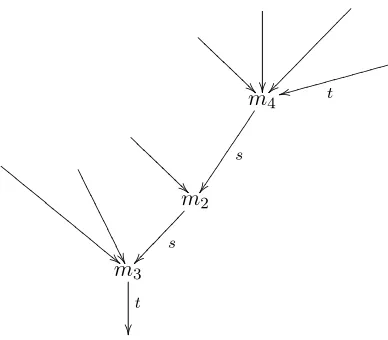
❅ ❅ ❅ ❅ ❅ ❅ ❅ ❅ ❅ t ss ❤❤❤❤❤❤❤❤ ❤❤❤❤ m4 s ✡✡✡✡ ✡✡✡✡ ✡✡ ❅ ❅ ❅ ❅ ❅ ❅ ❅ ❅ ❅ "" ❊ ❊ ❊ ❊ ❊ ❊ ❊ ❊ ❊ ❊ ❊ ❊ ❊ ❊ ❊ ❊ ✴ ✴ ✴ ✴ ✴ ✴ ✴ ✴ ✴ ✴ ✴ m2 s ✁✁✁✁ ✁✁✁✁ m3 t
Figure 1. Definition ofmΓ.
On the opposite end of the spectrum we have alinear contractible A∞ module: one having the form (M,0) and with a contractible differentialdM.
Then we have the following decomposition theorem forA∞modules as a direct consequence of Corollary 3.17.
Proposition 3.18. Let (M, m) be an A∞ module over an A∞ algebra V. Suppose that the dg
vector space (M, dM) is supplied with operators s, t turning it into an HD. Then the
automor-phism (1 +t−(1−sm)−1t)(1−ms)−1 of the dg space (M, dM) determines an isomorphism of
(M, m)to the direct sum of a minimalA∞module (tM, tm(1+sm)−1t)and a linear contractible
A∞ module ((1−t)M, dM).
The (dual) structure maps (mtM
i )∗:Ti−1Σ−1V ⊗tM →tM for the minimal model tM can
be described explicitly as follows. Let Γ be a planar rooted tree with i+ 1 extremities with the property that every branching has valence at least three and is below the rightmost leaf; such trees will be calledadmissible. Label the root and the rightmost leaf byt, all other leaves by id and all internal edges bys. The following picture illustrates one such labelled tree. Define the mapmΓ:Ti−1Σ−1V ⊗tM →tM by composing labels in an obvious manner, working from the leaves down to the root. For the tree pictured in Figure 1,
mΓ=tm3(id⊗2⊗sm2)(id⊗3⊗sm4)(id⊗6⊗t).
We then put (mtM i )∗ =
P
mΓ, with the sum taken over all admissible trees. Note that no signs appear in this formula, since the action of the perturbation algebra ˆA on ˆTΣV∗ ⊗M∗ dualises to an action of its opposite dg algebra ˆAop onTΣ−1V⊗M; the latter is then converted to an action of ˆA via ρ. Explicit formulae for the structure maps of the A∞-isomorphism g: (M, m)∼= (tM, tm(1 +sm)−1t)⊕((1−t)M, dM) and its inverse can be obtained in a similar
manner; we will refrain from giving details.
References
[1] D. W. Barnes, L. A. Lambe.A fixed point approach to homological perturbation theory, Proc. Amer. Math. Soc., 112(3), 881–892, 1991.
[2] A. Berglund, Homological perturbation theory for algebras over operads, Algebr. Geom. Topol. 14 (2014), no. 5, 2511-2548.
[3] A. Bondal, M. Kapranov,Enhanced triangulated categories, Mathematics of the USSR-Sbornik, 1991, 70:1, 93–107.
[4] J. Chuang, A. Lazarev, Feynman diagrams and minimal models for operadic algebras. J. London Math. Soc. (2) 81 (2010) no. 2, 317–337. arXiv:0802.3507.
[6] A. Hamilton, A. Lazarev, Cohomology theories for homotopy algebras and noncommutative geometry , Algebraic and Geometric Topology, 9, 2009, 1503–1583
[7] J. Huebschmann,On the construction ofA∞-structures, Georgian Math. J. 17 (2010), no. 1, 161-202 [8] J. Huebschmann, T. Kadeishvili,Small models for chain algebras, Math. Z. 207 (1991), no. 2, 245-280. [9] T. V. Kadeishvili,The algebraic structure in the homology of anA(∞)-algebra.(Russian) Soobshch. Akad.
Nauk Gruzin. SSR 108 (1982), no. 2, 249-252, 1983.
[10] H. Kajiura,Noncommutative homotopy algebras associated with open strings.Rev.Math.Phys. 19, 2007, 1-99.
arXiv:math.QA/0306332.
[11] B. Keller,Introduction to A-infinity algebras and modules, Homology Homotopy Appl. 3 (2001), no. 1, 1–35. [12] K. Lef`evre-Hasegawa, Sur les A-infini cat´egories,arXiv:math.CT/0310337.
[13] J.-L. Loday, B. Vallette, Bruno Algebraic Operads, Grundlehren der Mathematischen Wissenschaften, 346, Berlin, New York: Springer-Verlag, 2012.
[14] M. Markl, Transferring A∞ (strongly homotopy associative) structures, Proceedings of the 25th Winter School Geometry and Physics. Palermo: Universita degli Studi di Palermo, 2006. Supplemento ai Rendiconti del Circolo Matematico, 2006, 139-151.
[15] S. Schwede, B. Shipley,Algebras and Modules in Monoidal Model Categories, Proc. London Math Soc (2000) 80 (2): 491–511.
[16] M. Van den Bergh,Calabi-Yau algebras and superpotentials,Selecta Math. (N.S.) 21 (2015), no. 2, 555-603.
Centre for Mathematical Science, City University, London EC1V 0HB, UK E-mail address: [email protected]