© 2019, IRJET | Impact Factor value: 7.34 | ISO 9001:2008 Certified Journal | Page 1222
DISTANCE ALGORITHM FOR TRANSMISSION LINE WITH MID-POINT
CONNECTED STATCOM
Bhupendra Dewangan
1, Neelesh Kumar
21
Student, Electrical & Electronics Engineering,
2Asst. prof., Electrical & Electronics Engineering,
1,2
Disha Institute of Management & Technology, Raipur (C.G), India
---***---
Abstract -Flexible AC Transmission System (FACTS) devicesare playing an increasingly important role in electrical power systems to satisfy the function of achieving better power transferability and enhancing power system controllability. The presence of FACTS devices in power systems has carried up some challenges to the protection schemes in the grid. Distance protection, as a major transmission line protective scheme, is facing such a challenge to meet the basic requirements for the accuracy, selectivity, reliability and security. This dissertation reviews FACTS concepts, and studies the shunt connected STATCOM and its modeling. Based on the dynamic behavior of a shunt connected STATCOM in a two-machine system, where a distance protection scheme is applied to protect the transmission line connecting the two machines, performance of the two zone distance protection scheme has been evaluated in EMTDC/PSCAD simulation environment for different contingent conditions. This includes different load angles, various STATCOM mode of operation, various fault locations & types. To overcome the misoperation of the conventional distance relay and make the distance scheme operational and reliable when the transmission line is shunt compensated with STATCOM, an adaptive distance algorithm is presented in this work.
Key Words: STATCOM; FACTS; EMTDC/PSCAD; Distance
Relay, Adaptive Distance Algorithm.
1. INTRODUCTION
Transmission lines, as a most important component of an electrical power system, play the very important role in the transmission of power from generation to load and to interconnect regional power systems into a grid network. Hence, protection of transmission lines is critical in system contingencies to separate faults and to ensure the safety and integrity of a power grid. Despite the economic reasons, distance protection is widely employed because the basic requirements for a protection scheme, which are selectivity, reliability and sensitivity with satisfactory fault clearing time, can be easily met with proper scheme setup and coordination study. By measuring the ratio of voltage to current at relay position, distance protection can sense different types of faults and initiate related tripping schemes to separate the fault from the system with a desired time delay [1]. Distance protection is a reliable and selective form of protection for transmission lines particularly where line terminals are relatively distant apart. With the development
and application of power electronics technology and maturity of manufacturing, more and more power semi-conductor based devices, called FACTS [2], with ratings from tens to hundreds of giga watts, have been utilized in the power systems to satisfy the function of achieving better power transferability and enhancing power system controllability.
In the present work of STATCOM, a shunt connected FACTS device, and its modeling technology. Based on the dynamic behavior of a STATCOM in a two machine transmission system, performance of a distance relay protecting the transmission line in the system during several incident conditions has been estimated in EMTDC/PSCAD (commercial software) simulation environment.
2. DISTANCE RELAY
Distance relay, also called impedance relay [5], operates on the principle that measures the ratio of voltage to current phasors at a relay location to determine if a fault is within the relay’s protection boundary. Various characteristics in distance relay family are built up according to the positive and zero sequence impedance of the protected transmission line. Based on transmission line impedance, setting coordination with adjacent lines and other regulations, distance protection with particular characteristic can be selected to apply on the protected transmission line.
Fig-1: Mho Characteristic
It is common to use an R–X diagram to both analyze and visualize the response of a distance relay. Impedance characteristic is plotted as a circle with its center at the origin of the coordinates and radius equal to its setting in ohms [6]. Relay operation occurs for all impedance values less than the setting, that is, for all the points within the circle. In this work, the Mho characteristic is select to build up the simulation models and is used to conduct analysis for a distance relay’s behavior under various system conditions
© 2019, IRJET | Impact Factor value: 7.34 | ISO 9001:2008 Certified Journal
| Page 1223
with a STATCOM installed on the transmission line. Asshown in Figure 1, the characteristic of a Mho impedance relay, when plotted on R-X diagram, is a circle whose circumference passes through the origin. It will operate only on faults in forward direction (quadrant one) along the transmission line. The Mho Characteristic of a distance relay is inherently directional to protect the faults in single direction on the protected line [7]. The relay operates when the measured impedance falls within the circle Zone.
3. STEP DISTANCE SCHEME
As a non-pilot application, distance relaying is called step distance protection when numerous zones are employed to protect a transmission line [3]. A conventional step distance scheme installed at terminal 1 protecting transmission lines is shown in Figure 2 The first zone, designated as Z1, is set to trip without any intentional time delay and its protection boundary is set as approximately 80%-90% of transmission line impedance in order to avoid overreach operation for faults. The second zone, Z2, is set to protect the remaining 10%-20% of the transmission line plus an adequate margin, and it has to be time delayed (TA2) to coordinate with the relays installed at remote terminal 2. The third zone with time delay (TA3), Z3, is applied as backup for zone 2 and can be applied as backup for relay failure or breaker failure at remote terminal 2. With proper coordination, Z1 & Z2 at terminal 1, Z1 &Z2 at distant terminal 2, and Z3 at terminal 1 relay will detect all faults on the transmission lines A and B plus some part of the lines fed from the distant terminal 3 (Line C).
Fig-2: Normal Selectivity Adjustment of Step Distance Scheme
4. MODELING OF DISTANCE PROTECTION IMPEDANCE
The best location for the installation of a STATCOM to improve system stability and power flow in a two-power source transmission system is the mid-point of the transmission line. The chapter begins with the discussion of STATCOM operating principle with its associate control structures. The detail modeling of STATCOM control scheme is presented.
4.1 STATCOM INSTALLED AT MID-POINT OF THE TRANSMISSION LINE
Fig-3: Single line diagram of the studied power system.
The system shown in Figure 3 is utilized to perform an analysis of the distance relay protecting a transmission line with a STATCOM installed at the mid-point. In the circuit, two generators, S1 and S2, are connected with a transmission line. The distance relay is installed next to Bus M to protect the transmission line on which a STATCOM is installed at the mid-point (Figure 3). In this case, only the distance relay close to Bus M is analyzed. Another distance relay installed at the Bus N end to protect the transmission line should behave in a similar manner when the same types of faults occur on the transmission line.
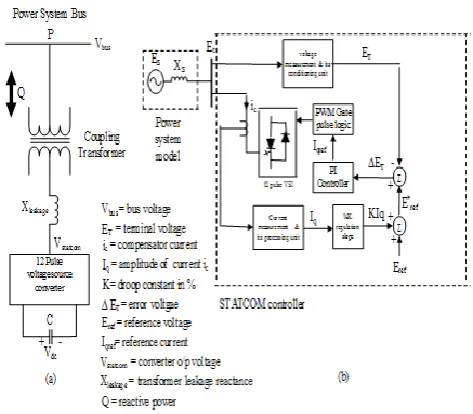
4.2 STATCOM OPERATING PRINCIPLE AND CONTROL STRUCTURE
© 2019, IRJET | Impact Factor value: 7.34 | ISO 9001:2008 Certified Journal
| Page 1224
Fig-4: (a) Single line diagram of STATCOM connected to apower system,
(b) STATCOM control structure used in the simulation.
The shunt FACTS compensator is connected at a bus in a power system. The blocks shown in the figure is described as following:
Measurement and Processing Circuit: The function of this circuit is to step-down the three phase voltages and currents to a lower levels using potential and current transformers and then produce a corresponding a dc equivalent signals proportional to the root mean square (rms) value of the reduced balance three-phase voltages and currents at the fundamental frequency. In addition, the circuit filters the unwanted frequencies and harmonics.
The voltage regulator: A proportional-integral (PI) controller is commonly used as voltage regulator. It is used to produce the reference current signal (Iqref)
would reduce the error voltage signal (∆ET) to zero,
which mean the terminal voltage will be maintained at the desired reference voltage.
Slop or Current-Droop Constant (K): A drop of in the range of 3 to 5% is normally used in practice [2]. In many applications, the terminal voltage (ET) is allowed to vary
from the reference voltage (Eref) with small percentage in
proportional with the compensation current for the sake of getting additional benefits from the static compensator. The advantages attained from using the regulation droop are as follows:
4.3 CONVENTIONAL DISTANCE ALGORITHM WITH MID-POINT CONNECTED STATCOM
In order to analyze the operation of the distance relay when a STATCOM is installed at the midpoint of the line, a
sequence network for a single phase fault is utilized. The apparent impedance seen by the distance relay can be calculated with the symmetrical components of the voltage and the current measured at the relay location. The basic equation to calculate the apparent impedance seen by a distance relay for a single phase to ground is [4]:
MA
SA S 0
pp A a V I kI Z =
+ (1)
where, k is the zero sequence compensation factor and given as, L0 L1
L1 Z -Z k=
Z
. where: VMA, ISA are the phase voltage and
current at relay point ISA0 is zero sequence phase current ZL0,
ZL1 are zero and positive sequence impedance, respectively,
of the transmission line.
For a distance relay on this transmission line, there are two possible fault locations to consider relative to the STATCOM in the circuit: before and after the STATCOM point of installation.
4.4 SINGLE PHASE FAULT AFTER STATCOM
A transmission line with a STATCOM installed at the mid-point and a single phase to ground fault in the second half of the transmission line, i.e. after the STATCOM, is shown in Figure 4. In the circuit, the distance relay is installed next to the sending Bus M and protects the transmission line. The parameter ‘m’ is defined as the per unit distance from the fault location to the relay location. IM is the current in the
transmission line after the STATCOM installation point, VSA
and ISA are the voltage and current at bus M, respectively, IF
is the ground fault current, Ishis the shunt current injected
from the STATCOM, ZL is the combined impedance of the
whole transmission line.
This variation in fault current adversely affects the impedance seen by the distance relay. Fig. 3 represents the equivalent network of system represented in EMTDC/PSCAD domain. The corresponding CT and PT modelling in EMTDC/PSCAD.
Fig-5: Equivalent network of the studied power system.
The positive, negative and zero sequence networks of the equivalent power system with mid-point connected
ZS B1 V S A V S B V M V N
~
I S B I F I M I s h R F X sh V F 0.5 ZL (m-0.5)ZL (1-m)ZL ZS A1 STAT COM Source A(SA)
Source B
(SB)
~
[image:3.595.326.555.601.704.2]© 2019, IRJET | Impact Factor value: 7.34 | ISO 9001:2008 Certified Journal
| Page 1225
STATCOM shown in Fig.3. Distance relay is located at Bus Mto protect the transmission line. The following symbolizations with reference to Fig. 5. are used for the analysis:
VSA, VSB = equivalent voltages of the two sources.
Z , Z , ZL1 L2 L0 = positive, negative and zero sequence impedance of the line respectively.
VM1, VM2, VM0= positive, negative and zero sequence phase voltages at relay location at Bus ‘M’.
IM1, IM2, IM0= positive, negative and zero sequence currents through transmission line at relay location.
Ish1, Ish2, Ish0= positive, negative and zero sequence shunt injected phase current by STATCOM.
m = per unit distance from the fault location to the relay location.
RF = fault resistance in ohm.
I , IF1 F2, IF0= positive, negative and zero sequence of fault current.
Fig-6: Sequence network of the studied power system. (a) Positive. (b) Negative (c) Zero
shA L1 L1rela app
y
m-0.5 I Z
I
Z =mZ +
(2) where, Irelay is the relay current and is given by
0
relay sa s1
I =I +kI .
new L1
SA S
sh A0 A
0. 0.35
Z = Z
1 5+
+ I
I +kI
(3)
where, sh relay I γ =
I
= compensation factor (4)
5. FLOW DIAGRAM OF PROPOSED METHOD
The flow diagram of the proposed adaptive zone selection algorithm is shown in Fig.7. In this study, the current injected by STATCOM at point of connection (Ish) and the
relay operating quantities (Irelay and Vrealy) are collected
based on the assumption that there exists a synchronization link between bus M and midpoint [8]. It is also assumed that the shunt current (Ish) is transmitted with the help of fast
fiber-optic cable.
Fig-7: Flow diagram of the proposed method N
o
No
Ye s
No Trip START
V, I and Ish signals form CT and CCVT
Compute apparent impedance
Zapp<Zset
Calculate γ using (51)
Calculate ZNew using (50)
ZNew>Zset
Tri pP PP PII PP p
No
Zapp>Zset
Ye s Ye
s
Fault at boundary of zone-1 (Capacitive mode)
© 2019, IRJET | Impact Factor value: 7.34 | ISO 9001:2008 Certified Journal
| Page 1226
The algorithm begins with the accumulation of currentand voltage signals at the point of relay connection. Full cycle discrete Fourier transform (DFT) is applied to extract fundamental frequency component. However, with midpoint connected STATCOM, phasor estimation is not accurate. Therefore, depending upon the mode of operation of STATCOM, faults at boundary and end zone create problems in distance relaying. To mitigate this problem, proposed method adaptively sets its new boundary based on the calculation of degree of compensation. Finally, the relay takes decision depending upon the new set impedance.
6. RESULTS
SINGLE LINE TO GROUND (SLG) FAULT
To verify the efficiency of the proposed algorithm during SLG fault considering different worst power system parameters are discussed and presented in this section. The performance of the proposed method is tested for fault, fault resistance, location, and load angles.
6.1 DURING UNDERREACH
Underreach occurs due to capacitive mode operation of STATCOM as a result of which the net impedance seen by the relay increases. Therefore, the conventional relay doesn’t trip for a fault close to boundary of zone 1. Fig. 8 shows impedance trajectory for system with and without STATCOM. Conventional relays for the transmission line without STATCOM operates correctly and with STATCOM it maloperates. However, with new adaptive zone setting this malfunction can be prevented. Single line to ground fault is created at remote end (255 km) of the transmission line with STATCOM connected at the midpoint.
Fig-8: Adaptive Mho relay for load angle 20◦ and Rf =1 Ω.
6.1.1 PERFORMANCE FOR DIFFERENT FAULT
LOCATIONS, FAULT RESISTANCE, LOAD ANGLE
Faults occurring at the boundary of zone 1 hinder the performance of the relay. However, for an in-zone fault the relay should operate properly with adaptive zone setting. Single line to ground fault is created at 255 km from relay location with fault resistance of 10Ω and load angle of 100.
The corresponding results with and without STATCOM is shown in Fig. 9(a).
LG fault is created near the zone 1 reach. Fig. 9(b). shows the impedance trajectory with and without STATCOM. The fault resistance and load angle is set to 30Ω and 300
correspondingly.
In this section load angle of 500 and a low fault resistance
of Rf =50Ω is considered. From this exploration it has been
found that increasing the load angle of the system the relay calculated impedance is increased. The corresponding result is shown in Fig.9(c).
Fig-9: (a) load angle 10◦ and Rf =10 Ω (b) load angle
30◦and R
f =30 Ω. (c) load angle 50◦and Rf =50 Ω
6.2 DURING OVERREACH
Overreach occurs when the STATCOM is operated in inductive mode. The primary sources are when STATCOM compensates a poor system and the reference voltage is less than 1 p. u. To detect the relay overreach condition reference voltage of 0.85 p. u. is considered. LG fault is created a remote end (260 km) of the transmission line with midpoint connected STATCOM and proposed adaptive method is applied with various power system situations to mitigate the condition of the overreach . Relay measured impedance without STATCOM is exact while with STATCOM for an out of section fault the impedance trajectory enters into the Zone-1. However, proposed technique evaluates the new zone for which the relay operation is precise. The corresponding result is shown in Fig. 10.
X (Ω
)
R (Ω)
-10 -5 0 5 10 15
0 5 10 15 20
Adaptive Zone Zone 1
© 2019, IRJET | Impact Factor value: 7.34 | ISO 9001:2008 Certified Journal
| Page 1227
Fig-10: Adaptive Mho relay for load angle 20◦ and Rf =1Ω.
6.2.1 PERFORMANCE FOR DIFFERENT FAULT LOCATIONS, FAULT RESISTANCE, LOAD ANGLE
To examine the performance of the proposed adaptive method a single line to ground fault is created at 200 km since the relay location. The case is simulated with fault resistance Rf = 10Ω and load angle of 100. The proposed
algorithm not only operates properly for out of section faults but also operate properly for an in-zone fault. The corresponding result is shown in Fig. 11(a).
Fig-10(a) load angle 10◦and R
f =10 Ω. (b) load angle
30◦and R
f =30 Ω. (c) load angle 50◦and Rf =50 Ω.
Single line to ground fault is created at remote end of the transmission line (beyond Zone-1) with a high fault resistance of Rf = 30Ω and load angle of 300. Fig.11(b). shows
the impedance seen by relay with conventional zone-1 setting, which leads to malfunction. However, operation of the relay is accurate with proposed adaptive zone Region.
In this section load angle of 500 and a low fault resistance of
Rf =50Ω is considered. Henceforth, it has been found that by
increasing the load angle of system the relay calculated impedance also increases. The corresponding result is shown in Fig.11(c).
7. CONCLUSION
The impact of a shunt connected FACTS device, the STATCOM, in a power transmission system is investigated in terms of impedance protection. In particular, the impedance measured by the distance relay protecting a transmission line compensated by a STATCOM is studied. A model for a transmission line including a STATCOM and a distance protection scheme is built in the PSCAD environment, in which various system fault conditions together with three STATCOM installation locations are simulated. The Mho tripping characteristic of the distance relay is analyzed in various contingent conditions. Both analysis and simulation results show that the STATCOM installation location has a significant influence on the performance of the distance relay. If the STATCOM is connected at the mid-point of the line, presence of the STATCOM in the transmission line can cause malfunction of the distance relay. If the STATCOM is installed at the sending end of the transmission line, the measured impedance of the distance relay is not affected. In the cases when the STATCOM is installed at the receiving end, the distance relay functions well with minimum errors. Voltage settings of the STATCOM also are considered in the studies. However, no effect on the measured impedance of the distance relay is detected when the voltage settings of the STATCOM are changed. In order to overcome the mis-operation of the distance relay in the transmission line system, and make the distance scheme operational and reliable when the transmission line is shunt compensated using STATCOM, some communication-aided protection schemes are discussed.
APPENDIX A
Parameters of the study system
The parameters of the study system modeled using the EMTDC/PSCAD are given in this appendix.
A.1. Equivalent Sources Data:
Rated voltage (kV) = 230, System frequency (Hz) = 50, Positive sequence, impedance (Ω) = 4.497+j25.506, Zero sequence, impedance (Ω) = 4.497+j25.506.
A.2. Transmission Line Data:
Length of line: 300 km, Positive sequence impedance = 0.0362 + j0.5087 Ω/km, Positive sequence capacitance = 0.01054 μF/km, Zero sequence impedance = 0.3659+ j1.3357Ω /km, Zero sequence capacitance = 0.00760 μF/km.
X (Ω
)
R (Ω)
-10 0 10 20
0 5 10 15
20 Adaptive
Zone Zone 1
© 2019, IRJET | Impact Factor value: 7.34 | ISO 9001:2008 Certified Journal
| Page 1228
REFERENCES[1] Paul M. Anderson, Power System Protection. Volume 4 of IEEE Press Power Engineering Series, 1998, pp. 379 [2] N G Hingorani and L Gyugyi. Understanding FACTS: Concepts and Technology of Flexible AC Transmission Systems, IEEE Press, 2000, Chapter 5
[3] IEEE Guide for Protective Relay Applications to Transmission Lines," IEEE StdC37.113-1999, 2000 [4] Stanley H. Horowitz &Arun G. Phadke, Power System
Relaying, Third Edition, John Wiley& Sons Ltd, 2008 [5] J. Lewis Blackburn Thomas J. Domin, Protective Relaying
Principles and Applications, Third Edition, CRC Press. 2006.
[6] Network Protection & Automation Guide, published by Alstom Grid, 2011, page 176, chapter 11.
[7] ElmorWaltera, Protective Relaying Theory and Application, Second Edition, 2004Marcel Dekker, Inc. [8] K. El-Arroudi, G. Joos, D. T. McGillis, "Operation of
Impedance ProtectionRelays with the STATCOM", IEEE Transactions on Power Delivery, Volume: 17, Issue: 2, April 2002, Pages: pp. 381 - 387.