ISSN Online: 2152-7199 ISSN Print: 2152-7180
The Effectiveness of a Pilot Self-Compassion
Program on Well Being Components
Eirini Karakasidou, Anastasios Stalikas
Department of Psychology, Panteion University of Social and Political Sciences, Athens, Greece
Abstract
Self-compassion is a newly developed construct in the field of positive psy-chology while a plethora of studies highlighted its beneficial outcomes on people’s psychological prosperity. This study aimed to explore the effective-ness of a self-compassion training program on self-compassion, positive and negative affect, depression, anxiety, stress, life satisfaction and subjective hap-piness as well as to contribute to knowledge by investigating whether changes in self-compassion can significantly predict changes in aspects of well being. A sample of 74 students of Social Sciences is randomly assigned to either the in-tervention (N = 33) or a control group (N = 41). The inin-tervention group par-ticipated in a psycho-educational training program aiming to teach them how to be more self-compassionate in challenging situations whilst the control group received no training. The results showed that the intervention group experienced increases in self-compassion, positive affect, life satisfaction as well as subjective happiness and decreases in negative affect, depression, anxiety and stress scores, compared to the control group which reported no changes. These findings suggest the vital role self-compassion plays on psychological well-being and the effectiveness of focused intervention programs. Other possible implications and recommendations for future research are also con-sidered.
Keywords
Self-Compassion, Training Program, Well-Being, Positive Psychology, Positive Interventions
1. Introduction
The construct of compassion to oneself (or self-compassion), is derived from Buddhist philosophy, was introduced in Psychology in the last decade and has been recently gathering growing research interest. Eastern traditions consider
How to cite this paper: Karakasidou, E., & Stalikas, A. (2017). The Effectiveness of a Pilot Self-Compassion Program on Well Being Components. Psychology, 8, 538-549.
https://doi.org/10.4236/psych.2017.84034
Received: February 6, 2017 Accepted: March 11, 2017 Published: March 14, 2017
Copyright © 2017 by authors and Scientific Research Publishing Inc. This work is licensed under the Creative Commons Attribution International License (CC BY 4.0).
compassion—not only towards others but also towards oneself—as a central element for the liberation of the mind from the power of destructive emotions such as fear and jealousy (Germer, 2009). Self-compassion, as a concept of Posi-tive Psychology, comes to broaden our horizons in improving mental health and wellness and leads to new methods of investigation and treatment of psycholog-ical disorders.
Self-compassion involves being kind, warm and standing with understanding toward oneself when one suffers, fails or feels inadequate, rather than criticizing and blaming oneself or ignoring the pain and negative feelings (Neff, 2003a, b). According to Neff (2003a), self-compassion consists of three basic interacting components: self-kindness versus self-judgment, common humanity versus iso-lation and mindfulness versus over-identification. It is difficult to separate these three components since their combination is what essentially defines the con-struct. Self-kindness is the ability to be warm and sympathetic to oneself when suffering, trying to soothe one’s pain instead of holding an angry and furious at-titude; it is the ability to understand the defect, failure and difficult experiences in life as something inevitable and therefore to be polite to oneself when con-fronting painful experiences. Common humanity refers to the realization that the individual is not alone within the universe. All people make mistakes and thus it is easier to forgive oneself for one’s own transgressions. The situation ex-perienced by a person, no matter how painful it is, is still part of human nature. To show compassion to oneself implies forgiving and respecting oneself.
Mind-fulness is about the uncritical attitude towards the thoughts, feelings and actions
of a person. As Armstrong (as cited in Germer, 2009) emphasized, mindfulness refers to “knowing what you are experiencing while you are experiencing it”. In other words, it is the open state of mind in which the person observes negative emotions the way they are without denying or repressing them.
There is a proliferation of research over the past decade highlighting the as-sociation of self-compassion with psychological well being (Barnard & Curry, 2011; Neff, 2009) and functioning (Birnie, Speca, & Carlson, 2010; Neff, Kirkpa-trick, & Rude, 2007). There is strong evidence that self-compassion constitutes a predicting factor of psychological well being and promoting mental health (Neff, 2004; Smeets et al., 2014). Diener (2002) defined well-being as low stress, low negative affect and high life satisfaction. More specifically, psychological well-
being, based onZessin’s, Dickhauser’s, & Garbade’s (2015) insightful meta-analysis,
seems to be a key factor for eudaimonia, leading to a meaningful life and is strongly related to self-compassion.
states, such as anxiety and depression (Barnard & Curry, 2011; Yang, 2016), stress, rumination, thought suppression, perfectionism and shame (Macbeth & Gumley, 2012; Neff & Lamb, 2009). These results strongly indicate the relation-ship between psychopathology and low levels of self compassion.
Recently findings strongly indicate that self-compassion has beneficial out-comes and plays a positive role in fostering mental health and healthy psycho-logical functioning. Thus, there is a need for developing interventions that will raise self-compassion and teach people to be more self-compassionate. It seems that self-compassion can be taught (Neff & Costigan, 2014), but the ways to teach it eludes us.
Recently, Neff & Germer (2013) developed an 8-week Mindful Self-Compassion training program in order to teach participants to be more self-compassionate. The program includes techniques such as loving-kindness, affectionate breathing and self-compassionate letter writing. The results indicated increases in self- compassion, compassion for others, mindfulness and life satisfaction, as well as significant decreases in depression, anxiety, stress, and emotional avoidance, up to one year after the intervention. On the same line, Bluth, Roberson, & Gaylord (2015) explored the effects of a mindfulness intervention on the emotional well- being of a sample of adolescents. The results indicated improvements in mind-fulness, self-compassion, stress and life satisfaction.
The existing literature strongly supports the significance of self-compassion in promoting aspects of psychological well-being. It is also recognized that there is a need for implementation of positive intervention programs aiming at training people to become more self-compassionate when facing difficult situations. Nevertheless, what seems to need further investigation is whether changes in self-compassion can predict changes in other aspects of well being. Although a large body of studies indicated a strong relation between self-compassion and emotional well-being, this relation still needs to be examined through a self- compassion intervention program. Furthermore, although mindfulness-based programs can promote self-compassion, they mainly focus on enhancing mind-fulness rather than self-compassion and thus there is a need for the development of interventions that specifically aim at increasing self-compassion (Neff & Ger-mer, 2013).
The present study aims to examine the effectiveness of a self-compassion pro-gram and the relationship between self compassion levels and aspects of psy-chological well being as well as indices of psypsy-chological difficulties.
Specifically, the research questions of this study are the followings: 1) Is this program effective in raising levels of self compassion? 2) Does self compassion relate to indices of well being?
3) Does self compassion relate to lower levels of depression, anxiety and stress?
2. Methods
2.1. Participants
Sciences at Panteion University of Greece, of which 5 were males and 69 females. They ranged in age from 18 to 25 years old with mean age 19.86 (SD = 1.11), the ethnic composition was 100% Greek and the method of recruitment was by op-portunity sampling through brochures that announced a study examining the impact of emotions on psychological well-being. Participation was voluntary and participants signed an informed consent. All participants were randomly divided into two groups, either the self-compassion intervention group (N = 33) or the control group (N = 41). In the control group the students filled out the same questionnaires with the first group but without receiving any training. In return for their participation, participants received course credits. The present study was conducted according to the Greek Psychological Society ethical guidelines for research.
2.2. Materials
Participants were asked to answer a number of demographic questions related to their age, gender and educational status. All participants also filled out a number of self-report measures one week before and one week after the six-week inter-vention.
2.2.1. Self-Compassion Scale (SCS) (Mantzios, Wilson, & Giannou, 2015; Neff, 2003a)
Participants were given the Greek version of the 26-item Self-Compassion Scale (SCS, Neff, 2003a) which was translated by Mantzios, Wilson, & Giannou (2015). The SCS includes the 5 item Self-Kindness subscale (e.g., “I try to be under-standing and patient toward aspects of my personality I don’t like”), the 5-item Self-Judgment subscale (e.g., “I’m disapproving and judgmental about my own flaws and inadequacies”), the 4-item Common Humanity subscale (e.g., “I try to see my failings as part of the human condition”), the 4-item Isolation subscale (e.g., “When I think about my inadequacies it tends to make me feel more sepa-rate and cut off from the rest of the world”), the 4-item Mindfulness subscale (e.g., “When something painful happens I try to take a balanced view of the situ-ation”), and the 4-item Over-Identification subscale (e.g., “When I’m feeling down I tend to obsess and fixate on everything that’s wrong.”). Responses are given on a 5-point scale from “1-Almost Never” to “5-Almost Always.” Mean scores on the six subscales are then averaged (after reverse-coding negative items) to create an overall self-compassion score ranging from 26 to 130. Higher scores correspond to higher levels of self-compassion. In the current research, internal consistency reliability was found to be α = 0.91.
2.2.2. Positive and Negative Affect Schedule
demonstrate greater positive or negative affect. Internal consistency reliability in the present study was α = 0.72 for positive affect and α = 0.73 for negative affect.
2.2.3. Depression, Anxiety, Stress Scale
The concise version DASS 21 (Lovibond & Lovibond, 1995) was used to measure symptoms of depression, anxiety and stress. The respondents are requested to self-report on a Likert scale (0 “did not apply to me at all” to 3 “applied to me very much or most of the time”). We used the Greek standardized version of DASS 21 (Lyrakos et al., 2011). Internal consistency reliability in the present study was α = 0.82 for depression, α = 0.71 for anxiety and α = 0.89 for stress.
2.2.4. Subjective Happiness Scale
The Greek version of Subjective Happiness Scale (SHS; Lyubomirsky & Lepper, 1999; Avgoustaki, Dimitriadou, & Stalikas, 2012) was used to examine the sub-jectivity of the participants’ global happiness. The scale uses four items rated on a 7-point Likert scale (1 “Not a very happy person” to 7 “A very happy person”) with higher scores reflecting greater happiness (e.g., “Some people are generally very happy. They enjoy life regardless of what is going on, getting the most out of everything. To what extent does this characterization describe you?”). In our sample the scale demonstrated adequate internal consistency (a = 0.77).
2.2.5. Satisfaction with Life Scale
The Satisfaction With Life Scale (Diener, Emmons, Larsen, & Griffin, 1985) is a five-item measure of global life satisfaction, using a Likert-type scale, ranging from 1 (strongly disagree) to 7 (strongly agree). (e.g., “In most ways, my life is close to my ideal”) that has been found to have good internal reliability, test-re- liability, and validity. We used the Greek version of the scale (Stalikas & Lakioti, 2012), which demonstrated good internal consistency in our sample (α= 0.85).
2.3. Procedure
For the purpose of this study, a consent form as well as a briefing and a debrief-ing statement were provided to the participants. In order for participants’ ano-nymity and privacy to be secured, there were codes match for each participant. Greek versions were used for all measures and the questionnaires were distri-buted to the participants in a counterbalanced order.
re-quired once a week, lasting approximately 120 minutes each, if they still want to participate. The control group was also informed that they need to participate in one more meeting after six weeks, lasting approximately half an hour. All 33 participants of the intervention group completed a 6-month follow-up assess-ment.
The structure of this program was based on previous research findings (Neff & Germer, 2013). Each session of the program focused on a specific topic. The first session provided an introduction to the concept of self-compassion. Week 2 focused on training to self kindness meditation. In week 3 we facilitated partici-pants to develop a “compassionate inner voice” through writing a self-compas- sion letter. In week 4 we taught skills to effectively cope with challenging situa-tions. Week 5 was centered on using self-compassion in dealing with difficult emotions. During the final session we discussed how to relate with positive as-pects of oneself and the participants created a self compassion motto.
2.4. Statistical Analysis
The data collected was analyzed using the Statistical Package for the Social Sciences vol. 21. First of all, we checked whether there were significant differ-ences between the intervention and control group on any demographics or measures at pretest. Then, we have conducted a series of two-tailed paired sam-ples t-tests in order to examine pre and post changes in study outcomes for each group separately. Additionally, a series of 2 (Group: Self-compassion Interven-tion VS Control) × 2 (Time: Pretest VS Posttest) repeated measure ANOVAs, with Group being a between-subjects factor and Time being a within-subjects factor were conducted. Finally, a series of paired samples t tests were conducted in order to examine the gains associated with participation in the intervention program would be maintained 6 months after completion of the program. The alpha level adopted for all main effects and contrasts was 0.05.
3. Results
Statistical analysis of the raw data collected was conducted. First of all, we ex-amined whether there were significant differences between the intervention and control group on any demographics or measures at pretest, and none were found. Additionally, a series of two-tailed paired samples t-tests was employed to ex-amine pre and post changes in study outcomes for each group separately. The intervention group demonstrated statistically significant improvements in all out-comes: increased self-compassion (t = −6.760, p = 0.000), positive affect (t = −3.508, p = 0.001), life satisfaction (t = −2.872, p = 0.008), and subjective happi-ness (t = −2.913, p = 0.007), as well as decreased depression (t = 2.483, p = 0.019), anxiety (t = 2.516, p = 0.018), stress (t = 4.299, p = 0.000), and negative affect (t = 3.509, p = 0.002). As expected, the control group demonstrated statis-tically non-significant results.
were analyzed using a series of 2 (Group: Self-compassion Intervention VS Con-trol) x 2 (Time: Pretest VS Posttest) repeated measure ANOVAs, with Group being a between-subjects factor and Time being a within-subjects factor.
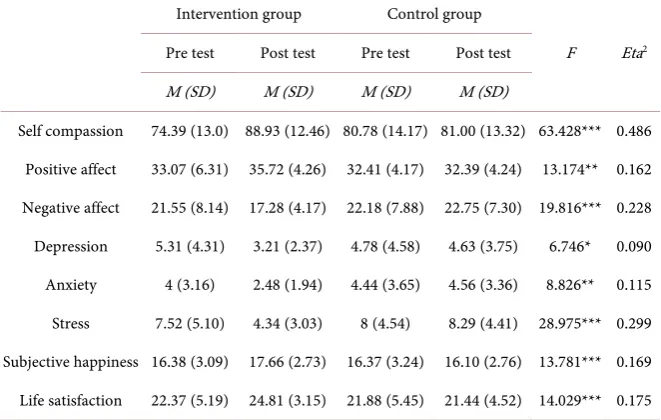
More specifically, the results indicated that there was a significant interaction between the time of all variables (pretest-posttest) and the group (intervention- control) (Table 1). All these effects indicate that the time of each variable (pret-est-posttest) had a different effect on the group (intervention-control). Also, a series of two-tailed independent samples t-tests showed a significant change be-tween the two groups, self-compassion intervention and control group with the intervention group demonstrating greater scores in self-compassion [t(67) = 2.492, p = 0.015], positive affect [t(68) = 3.237, p = 0.002], subjective happiness [t(68) = 2.335, p = 0.023] and life satisfaction [t(66) = 3.373, p = 0.001] rather than the control group. Also, the results demonstrated lower scores in negative affect [t(68) = −3.768, p = 0.000], depression [t(68) = −2.150, p = 0.049], anxiety [t(68) = −2.992, p = 0.004] and stress [t(68) = −4.174, p = 0.000] rather than the control group.
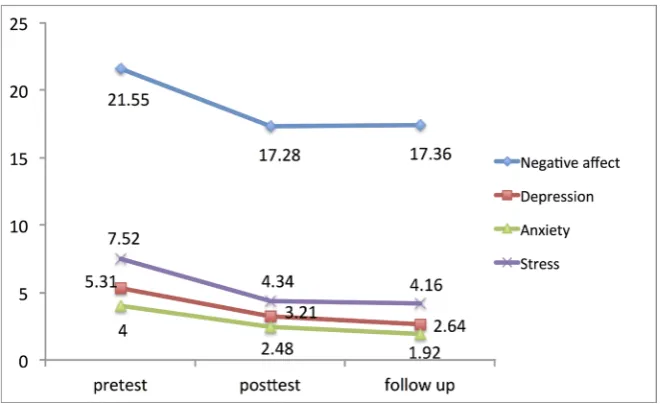
We also examined whether the gains associated with participation in the in-tervention program would be maintained 6 months after completion of the pro-gram using a series of paired samples t tests. There were no significant changes (all p’s > 0.05) for self compassion, positive affect, negative affect, depression, anxiety, stress, subjective happiness and life satisfaction (see Figure 1 and Fig-ure 2).
4. Discussion
[image:7.595.208.539.512.722.2]The primary goal of this study entailed the exploration of the effectiveness of a newly developed training program in increasing self compassion. A second goal
Table 1. Pretest and posttest mean scores by group and MSC intervention effects
ana-lyzed with 2 (Group) × 2 (Time) repeated measures analyses of variance.
Intervention group Control group
F Eta2 Pre test Post test Pre test Post test
M (SD) M (SD) M (SD) M (SD)
Self compassion 74.39 (13.0) 88.93 (12.46) 80.78 (14.17) 81.00 (13.32) 63.428*** 0.486
Positive affect 33.07 (6.31) 35.72 (4.26) 32.41 (4.17) 32.39 (4.24) 13.174** 0.162 Negative affect 21.55 (8.14) 17.28 (4.17) 22.18 (7.88) 22.75 (7.30) 19.816*** 0.228
Depression 5.31 (4.31) 3.21 (2.37) 4.78 (4.58) 4.63 (3.75) 6.746* 0.090
Anxiety 4 (3.16) 2.48 (1.94) 4.44 (3.65) 4.56 (3.36) 8.826** 0.115
Stress 7.52 (5.10) 4.34 (3.03) 8 (4.54) 8.29 (4.41) 28.975*** 0.299
Subjective happiness 16.38 (3.09) 17.66 (2.73) 16.37 (3.24) 16.10 (2.76) 13.781*** 0.169
Life satisfaction 22.37 (5.19) 24.81 (3.15) 21.88 (5.45) 21.44 (4.52) 14.029*** 0.175
Figure 1. Self compassion, positive affect, subjective happiness and life satisfaction levels before, during and after the 6-week self-compassion program.
Figure 2. Negative affect, depression, anxiety and stress levels before, during and after the
6-week self-compassion program.
of this study was to examine the relationship between self compassion and spe-cific constructs of well being such as positive emotions, subjective happiness and life satisfaction. Finally, we also tested the possible beneficial effects of self com-passion in lowering levels of negative emotions, depression, anxiety and stress.
This study indicated that training people to treat themselves in a more self- compassionate way when suffering, through the 6-week intervention, resulted in significant gains in self-compassion. This confirms previous assertions (Albert- son, Neff, & Dill-Shackleford, 2015; Gilbert & Irons, 2004; Neff & Costigan, 2014; Shapira & Mongrain, 2010; Smeets et al., 2014) arguing that self-compassion can be cultivated and learned through intervention programs.
[image:8.595.208.539.320.522.2]en-hanced participants’ life satisfaction levels as well as subjective happiness levels. In other words, that means that people, who have increased levels of self-com- passion on the way one evaluates his life satisfaction and his levels of subjective happiness. In other words, as previous results haw inducted (Neely, et al., 2009; Seligowski, Miron, & Orcutt, 2015; Van Dam, Sheppard, Forsyth, & Earleywine, 2011; Wei, et al., 2011; Yang, 2016) raising levels of self compassion seem to po-sitiveley alter the way one evaluates both his subjective happiness and life satis-faction.
Furthermore, in line with our expectations, the results of this study strongly indicated that the self-compassion program lead to an important increase in positive affect levels (Heffernan, Griffin, McNulty & Fitzpatrick, 2010; Hollis- Walker & Colosimo, 2011; Neff, Rude, & Kirkpatrick, 2007; Neff, 2009), as well as to a decrease in negative affect levels and symptoms of depression, anxiety and stress (Choi, Lee, & Lee, 2014; Leary et al., 2007). We hypothesized that in-creased levels of positive emotions may act as a mediator in increasing levels of subjective happiness and life satisfaction. It seems that higher level of self com-passion leads to higher level of positive emotions and this relationship facilitates the psychological health.
The results of this study suggest that self compassion is teachable and that higher levels of self compassion are related to higher levels of positive emotions, life satisfaction and subjective happiness. These high levels may be related to how people perceive and evaluate their life. Positive emotions help people rec-ognize the positive elements in their daily life, change their focus from negative to positive and broaden their perspectives (Fredrickson, 2001; Fredrickson & Branigan, 2005).
Moreover, the benefits of self compassion program appear to be enduring, lasting at least 6 months after completion of the program. Given that research is increasingly underlying self-compassion be an important aspect of mental and physical health, the creation of a program that successfully teaches people how to be more self-compassionate is be of interest to many. Self compassion can be used as a different road to positivity by reducing negative emotions and lowering levels of depression, anxiety and stress and enhancing well being.
5. Implications
6. Limitations and Future Research Directions
The limitations of this study offer important directions for future research. First of all, the number of females participating in the study was greater than that of males, which highlights the need for future investigation on gender differences regarding the changes of self-compassion. The research was also based on stu-dents of Social Sciences, whose ethnic composition was 100% Greek. Thus, our results might not be generalizable to other groups and populations with different characteristics (e.g. different age, different ethnic and cultural backgrounds) and there is the need for further research.
Of special importance, it would be to implement this program to people that have experienced serious types of adversity (e.g. refugees, rape survivors, victims of domestic violence). We should always remember that adversity and suffering are unfortunate yet unavoidable parts of the human condition. Therefore it would be very helpful to teach those people specific skills for soothing and comforting themselves when they need it the most.
References
Albertson, E. R., Neff, K. D., & Dill-Shackleford, K. E. (2015). Self-Compassion and Body Dissatisfaction in Women: A Randomized Controlled Trial of a Brief Meditation In-tervention. Mindfulness, 6, 444-454. https://doi.org/10.1007/s12671-014-0277-3
Barnard, L. K., & Curry, J. F. (2011). Self-Compassion: Conceptualizations, Correlates, & Interventions. Review of General Psychology, 15, 289-303.
https://doi.org/10.1037/a0025754
Birnie, K., Speca, M., & Carlson, L. E. (2010). Exploring Self Compassion and Empathy in the Context of Mindfulness-Based Stress Reduction (MBSR). Stress and Health, 26,
359-371. https://doi.org/10.1002/smi.1305
Bluth, K., Roberson, P. N., & Gaylord, S. A. (2015). A Pilot Study of a Mindfulness Inter-vention for Adolescents and the Potential Role of Self-Compassion in Reducing Stress.
Explore: The Journal of Science and Healing, 11, 292-295.
https://doi.org/10.1016/j.explore.2015.04.005
Choi, Y. M., Lee, D. G., & Lee, H. K. (2014). The Effect of Self-Compassion on Emotions When Experiencing a Sense of Inferiority across Comparison Situations. Procedia— Social and Behavioral Sciences, 114, 949-953.
https://doi.org/10.1016/j.sbspro.2013.12.813
Diener, E. D., Emmons, R. A., Larsen, R. J., & Griffin, S. (1985). The Satisfaction with Life Scale. Journal of Personality Assessment, 49, 71-75.
https://doi.org/10.1207/s15327752jpa4901_13
Diener, E., & Seligman, M. E. (2002). Very Happy People. Psychological Science, 13, 81- 84. https://doi.org/10.1111/1467-9280.00415
Fredrickson, B. L. (2001). The Role of Positive Emotions in Positive Psychology: The Broaden-And-Build Theory of Positive Emotions. American Psychologist, 56, 218-226.
https://doi.org/10.1037/0003-066X.56.3.218
Fredrickson, B. L., & Branigan, C. (2005). Positive Emotions Broaden the Scope of Atten-tion and Thought-AcAtten-tion Repertoires. Cognition & Emotion, 19, 313-332.
https://doi.org/10.1080/02699930441000238
Gilbert, P., & Irons, C. (2004). A Pilot Exploration of the Use of Compassionate Images in a Group of Self-Critical People. Memory, 12, 507-516.
https://doi.org/10.1080/09658210444000115
Heffernan, M., Quinn Griffin, M. T., McNulty, S. R., & Fitzpatrick, J. J. (2010). Self Com-passion and Emotional Intelligence in Nurses. International Journal of Nursing Prac-tice, 16, 366-373. https://doi.org/10.1111/j.1440-172X.2010.01853.x
Hollis-Walker, L., & Colosimo, K. (2011). Mindfulness, Self-Compassion, and Happiness in Non-Meditators: A Theoretical and Empirical Examination. Personality and Indi-vidual Differences, 50, 222-227. https://doi.org/10.1016/j.paid.2010.09.033
Leary, M. R., Tate, E. B., Adams, C. E., Batts Allen, A., & Hancock, J. (2007). Self-Com- passion and Reactions to Unpleasant Self-Relevant Events: The Implications of Treat-ing Oneself Kindly. Journal of Personality and Social Psychology, 92, 887-904.
https://doi.org/10.1037/0022-3514.92.5.887
Lovibond, P. F., & Lovibond, S. H. (1995). The Structure of Negative Emotional States: Comparison of the Depression Anxiety Stress Scales (DASS) with the Beck Depression and Anxiety Inventories. Behaviour Research and Therapy, 33, 335-343.
https://doi.org/10.1016/0005-7967(94)00075-U
Lyrakos, G. N., Arvaniti, C., Smyrnioti, M., & Kostopanagiotou, G. (2011). P03-561- Translation and Validation Study of the Depression Anxiety Stress Scale in the Greek General Population and in a Psychiatric Patient’s Sample. European Psychiatry, 26,
1731. https://doi.org/10.1016/s0924-9338(11)73435-6
MacBeth, A., & Gumley, A. (2012). Exploring Compassion: A Meta-Analysis of the Asso-ciation between Self-Compassion and Psychopathology. Clinical Psychology Review, 32, 545-552. https://doi.org/10.1016/j.cpr.2012.06.003
Mantzios, M., Wilson, J. C., & Giannou, K. (2015). Psychometric Properties of the Greek Versions of the Self-Compassion and Mindful Attention and Awareness Scales. Mind-fulness, 6, 123-132. https://doi.org/10.1007/s12671-013-0237-3
Neff, K. D. (2003a). The Development and Validation of a Scale to Measure Self Compas-sion. Self and Identity, 2, 223-250. https://doi.org/10.1080/15298860309027
Neff, K. D. (2003b). Self-Compassion: An alternative conceptualization of a healthy atti-tude toward oneself. Self and Identity, 2, 85-102.
https://doi.org/10.1080/15298860309032
Neff, K. D. (2004). Self-Compassion and Psychological Well-Being. Constructivism in the Human Sciences, 9, 27-37.
Neff, K. D. (2009). The Role of Self-Compassion in Development: A Healthier Way to Relate to Oneself. Human Development, 52, 211-214.
https://doi.org/10.1159/000215071
Neff, K. D., & Costigan, A. P. (2014). Self-Compassion, Well-Being, and Happiness. Psy-chologie in Österreich, 2, 114-119.
Neff, K. D., & Germer, C. K. (2013). A Pilot Study and Randomized Controlled Trial of the Mindful Self Compassion Program. Journal of Clinical Psychology, 69, 28-44.
https://doi.org/10.1002/jclp.21923
Neff, K. D., Kirkpatrick, K. L., & Rude, S. S. (2007). Self-Compassion and Adaptive Psy-chological Functioning. Journal of Research in Personality, 41, 139-154.
https://doi.org/10.1016/j.jrp.2006.03.004
Neff, K., & Lamb, L. (2009). Self Compassion. In S. Lopez (Ed.), The Encyclopedia of Pos-itive Psychology (pp. 864-867). Hoboken, NJ: Wiley Blackwell.
Self-Kindness When Facing Stress: The Role of Self-Compassion, Goal Regulation, and Support in College Students’ Well-Being. Motivation and Emotion, 33, 88-97.
https://doi.org/10.1007/s11031-008-9119-8
Seligowski, A. V., Miron, L. R., & Orcutt, H. K. (2015). Relations among Self-Compassion, PTSD Symptoms, and Psychological Health in a Trauma-Exposed Sample. Mindful-ness, 6, 1033-1041. https://doi.org/10.1007/s12671-014-0351-x
Shapira, L. B., & Mongrain, M. (2010). The Benefits of Self-Compassion and Optimism Exercises for Individuals Vulnerable to Depression. The Journal of Positive Psychology, 5, 377-389. https://doi.org/10.1080/17439760.2010.516763
Van Dam, N. T., Sheppard, S. C., Forsyth, J. P., & Earleywine, M. (2011). Self-Compassion Is a Better Predictor than Mindfulness of Symptom Severity and Quality of Life in Mixed Anxiety and Depression. Journal of Anxiety Disorders, 25, 123-130.
https://doi.org/10.1016/j.janxdis.2010.08.011
Watson, D., Clark, L. A., & Tellegen, A. (1988). Development and Validation of Brief Measures of Positive and Negative Affect: The PANAS Scales. Journal of Personality and Social Psychology, 54, 1063-1070. https://doi.org/10.1037/0022-3514.54.6.1063
Wei, M., Liao, K. Y. H., Ku, T. Y., & Shaffer, P. A. (2011). Attachment, Self Compassion, Empathy, and Subjective Well-Being among College Students and Community Adults.
Journal of Personality, 79, 191-221. https://doi.org/10.1111/j.1467-6494.2010.00677.x
Zessin, U., Dickhäuser, O., & Garbade, S. (2015). The Relationship between Self Compas-sion and Well Being: A Meta Analysis. Applied Psychology: Health and Well Being, 7,
340-364. https://doi.org/10.1111/aphw.12051
Submit or recommend next manuscript to SCIRP and we will provide best service for you:
Accepting pre-submission inquiries through Email, Facebook, LinkedIn, Twitter, etc. A wide selection of journals (inclusive of 9 subjects, more than 200 journals)
Providing 24-hour high-quality service User-friendly online submission system Fair and swift peer-review system
Efficient typesetting and proofreading procedure
Display of the result of downloads and visits, as well as the number of cited articles Maximum dissemination of your research work